wheel CADILLAC STS 2011 1.G Owners Manual
[x] Cancel search | Manufacturer: CADILLAC, Model Year: 2011, Model line: STS, Model: CADILLAC STS 2011 1.GPages: 528, PDF Size: 4.96 MB
Page 427 of 528
Black plate (77,1)Cadillac STS Owner Manual - 2011
{WARNING:
Idling a vehicle in an enclosed area with poor
ventilation is dangerous. Engine exhaust may
enter the vehicle. Engine exhaust contains
Carbon Monoxide (CO) which cannot be seen or
smelled. It can cause unconsciousness and even
death. Never run the engine in an enclosed area
that has no fresh air ventilation. For more
information, seeEngine Exhaust on page 3‑36.
{WARNING:
Over-inflating a tire could cause the tire to rupture
and you or others could be injured. Be sure to
read and follow the tire sealant and compressor
kit instructions and inflate the tire to its
recommended pressure. Do not exceed the
recommended pressure.
{WARNING:
Storing the tire sealant and compressor kit or
other equipment in the passenger compartment of
the vehicle could cause injury. In a sudden stop or
collision, loose equipment could strike someone.
Store the tire sealant and compressor kit in its
original location.
If this vehicle has a tire sealant and compressor kit,
there may not be a spare tire, tire changing equipment,
and on some vehicles there may not be a place to store
a tire.
The tire sealant and compressor can be used to
temporarily seal punctures up to ¼ inch (6 mm) in the
tread area of the tire. It can also be used to inflate an
under inflated tire.
If the tire has been separated from the wheel, has
damaged sidewalls, or has a large puncture, the tire
is too severely damaged for the tire sealant and
compressor kit to be effective. See Roadside Service
on page 8‑8.
6-77
Page 429 of 528
Black plate (79,1)Cadillac STS Owner Manual - 2011
Using the Tire Sealant and Compressor
Kit to Temporarily Seal and Inflate a
Punctured Tire
When using the tire sealant and compressor kit
during cold temperatures, warm the kit in a heated
environment for five minutes. This will help to inflate
the tire faster.If a tire goes flat, avoid further tire and wheel damage
by driving slowly to a level place. Turn on the hazard
warning flashers. See
Hazard Warning Flashers
on
page 4‑3.
See If a Tire Goes Flat
on page 6‑74for other
important safety warnings.
Do not remove any objects that have penetrated
the tire.
1. Remove the tire sealant and compressor kit from its storage location. See Tire Sealant and
Compressor Kit Storage on page 6‑94.
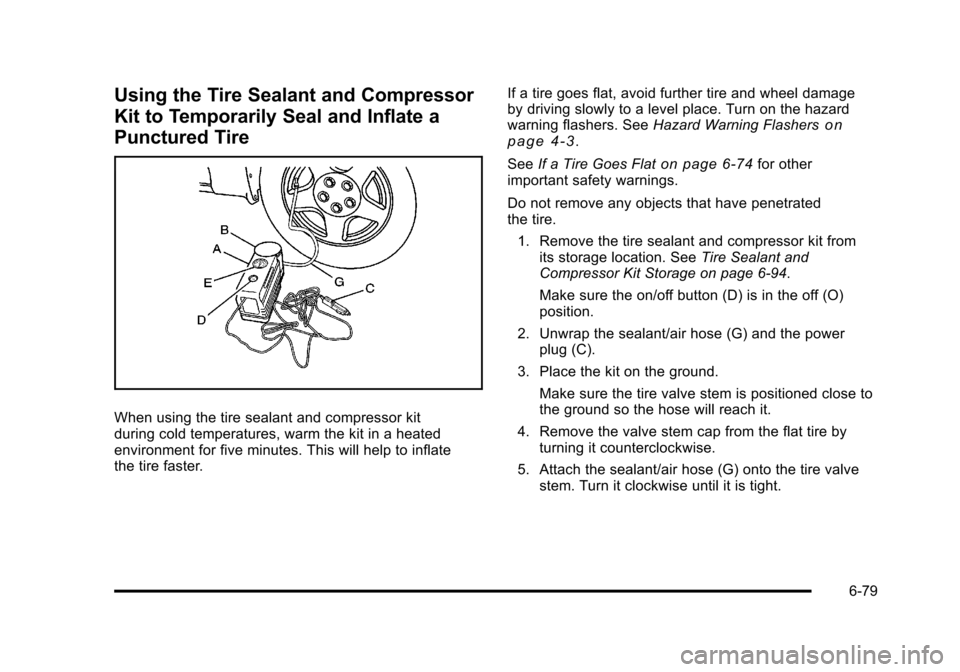
Make sure the on/off button (D) is in the off (O)
position.
2. Unwrap the sealant/air hose (G) and the power plug (C).
3. Place the kit on the ground. Make sure the tire valve stem is positioned close to
the ground so the hose will reach it.
4. Remove the valve stem cap from the flat tire by turning it counterclockwise.
5. Attach the sealant/air hose (G) onto the tire valve stem. Turn it clockwise until it is tight.
6-79
Page 431 of 528
Black plate (81,1)Cadillac STS Owner Manual - 2011
11. Unplug the power plug (C) from the accessorypower outlet in the vehicle.
12. Turn the sealant/air hose (G) counterclockwise to remove it from the tire valve stem.
13. Replace the tire valve stem cap.
14. Replace the sealant/air hose (G), and the power plug (C) back in their original location.
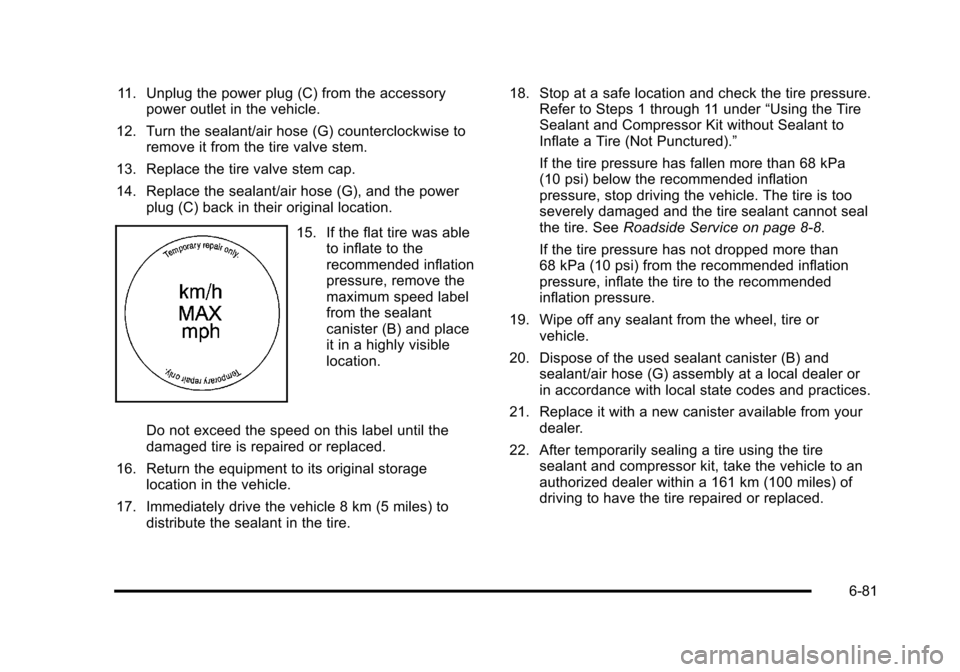
15. If the flat tire was ableto inflate to the
recommended inflation
pressure, remove the
maximum speed label
from the sealant
canister (B) and place
it in a highly visible
location.
Do not exceed the speed on this label until the
damaged tire is repaired or replaced.
16. Return the equipment to its original storage location in the vehicle.
17. Immediately drive the vehicle 8 km (5 miles) to distribute the sealant in the tire. 18. Stop at a safe location and check the tire pressure.
Refer to Steps 1 through 11 under “Using the Tire
Sealant and Compressor Kit without Sealant to
Inflate a Tire (Not Punctured).”
If the tire pressure has fallen more than 68 kPa
(10 psi) below the recommended inflation
pressure, stop driving the vehicle. The tire is too
severely damaged and the tire sealant cannot seal
the tire. See Roadside Service on page 8‑8.
If the tire pressure has not dropped more than
68 kPa (10 psi) from the recommended inflation
pressure, inflate the tire to the recommended
inflation pressure.
19. Wipe off any sealant from the wheel, tire or vehicle.
20. Dispose of the used sealant canister (B) and sealant/air hose (G) assembly at a local dealer or
in accordance with local state codes and practices.
21. Replace it with a new canister available from your dealer.
22. After temporarily sealing a tire using the tire sealant and compressor kit, take the vehicle to an
authorized dealer within a 161 km (100 miles) of
driving to have the tire repaired or replaced.
6-81
Page 432 of 528
Black plate (82,1)Cadillac STS Owner Manual - 2011
Using the Tire Sealant and Compressor
Kit without Sealant to Inflate a Tire
(Not Punctured)
To use the air compressor to inflate a tire with air only
and not sealant:
If a tire goes flat, avoid further tire and wheel damage
by driving slowly to a level place. Turn on the hazard
warning flashers. SeeHazard Warning Flashers
on
page 4‑3. See
If a Tire Goes Flat
on page 6‑74for other
important safety warnings.
1. Remove the tire sealant and compressor kit from its storage location. See Tire Sealant and
Compressor Kit Storage on page 6‑94.
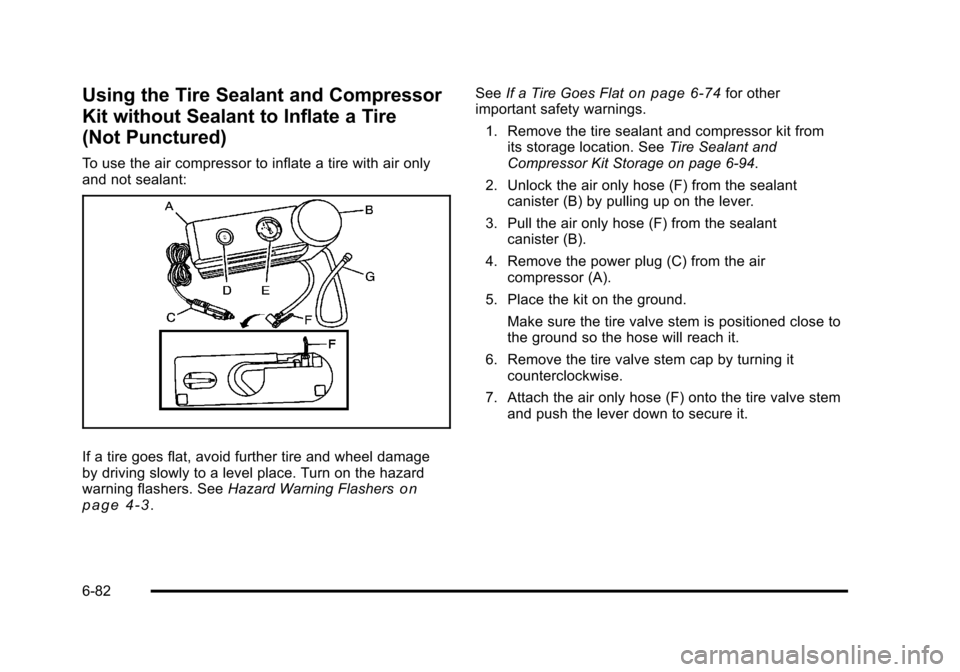
2. Unlock the air only hose (F) from the sealant canister (B) by pulling up on the lever.
3. Pull the air only hose (F) from the sealant canister (B).
4. Remove the power plug (C) from the air compressor (A).
5. Place the kit on the ground. Make sure the tire valve stem is positioned close to
the ground so the hose will reach it.
6. Remove the tire valve stem cap by turning it counterclockwise.
7. Attach the air only hose (F) onto the tire valve stem and push the lever down to secure it.
6-82
Page 437 of 528
Black plate (87,1)Cadillac STS Owner Manual - 2011
{WARNING:
Storing the tire sealant and compressor kit or
other equipment in the passenger compartment of
the vehicle could cause injury. In a sudden stop or
collision, loose equipment could strike someone.
Store the tire sealant and compressor kit in its
original location.
If this vehicle has a tire sealant and compressor kit,
there may not be a spare tire, tire changing equipment,
and on some vehicles there may not be a place to store
a tire.
The tire sealant and compressor can be used to
temporarily seal punctures up to ¼ inch (6 mm) in the
tread area of the tire. It can also be used to inflate an
under inflated tire.
If the tire has been separated from the wheel, has
damaged sidewalls, or has a large puncture, the tire is
too severely damaged for the tire sealant and
compressor kit to be effective. See Roadside Service
on page 8‑8. Read and follow all of the tire sealant and compressor
kit instructions.
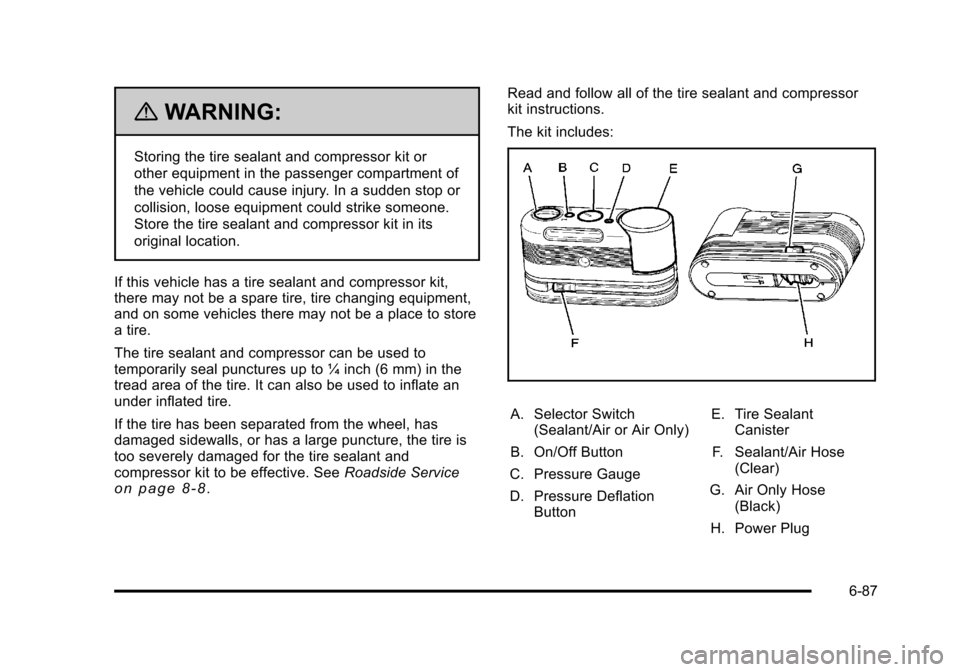
The kit includes:
A. Selector Switch
(Sealant/Air or Air Only)
B. On/Off Button
C. Pressure Gauge
D. Pressure Deflation Button E. Tire Sealant
Canister
F. Sealant/Air Hose (Clear)
G. Air Only Hose (Black)
H. Power Plug
6-87
Page 439 of 528
Black plate (89,1)Cadillac STS Owner Manual - 2011
If a tire goes flat, avoid further tire and wheel damage
by driving slowly to a level place. Turn on the hazard
warning flashers. SeeHazard Warning Flashers
on
page 4‑3.
See If a Tire Goes Flat
on page 6‑74for other
important safety warnings.
Do not remove any objects that have penetrated
the tire.
1. Remove the tire sealant and compressor kit from its storage location. See Tire Sealant and
Compressor Kit Storage on page 6‑94.
2. Unwrap the sealant/air hose (F) and the power plug (H).
3. Place the kit on the ground.
4. Remove the valve stem cap from the flat tire by turning it counterclockwise.
5. Attach the sealant/air hose (F) onto the tire valve stem. Turn it clockwise until it is tight. 6. Plug the power plug (H) into the accessory power
outlet in the vehicle. Unplug all items from other
accessory power outlets. See Accessory Power
Outlet(s) on page 4‑42.
If the vehicle has an accessory power outlet, do
not use the cigarette lighter.
If the vehicle only has a cigarette lighter, use the
cigarette lighter.
Do not pinch the power plug cord in the door or
window.
7. Start the vehicle. The vehicle must be running while using the air compressor.
8. Turn the selector switch (A) counterclockwise to the Sealant + Air position.
9. Press the on/off (B) button to turn the tire sealant and compressor kit on.
The compressor will inject sealant and air into
the tire.
The pressure gauge (C) will initially show a high
pressure while the compressor pushes the sealant
into the tire. Once the sealant is completely
dispersed into the tire, the pressure will quickly
drop and start to rise again as the tire inflates with
air only.
6-89
Page 441 of 528
Black plate (91,1)Cadillac STS Owner Manual - 2011
19. Stop at a safe location and check the tire pressure.Refer to Steps 1 through 11 under “Using the Tire
Sealant and Compressor Kit without Sealant to
Inflate a Tire (Not Punctured).”
If the tire pressure has fallen more than 68 kPa
(10 psi) below the recommended inflation
pressure, stop driving the vehicle. The tire is too
severely damaged and the tire sealant cannot seal
the tire. See Roadside Service on page 8‑8.
If the tire pressure has not dropped more than
68 kPa (10 psi) from the recommended inflation
pressure, inflate the tire to the recommended
inflation pressure.
20. Wipe off any sealant from the wheel, tire, and vehicle.
21. Dispose of the used sealant canister (E) and sealant/air hose (F) assembly at a local dealer or
in accordance with local state codes and practices.
22. Replace it with a new canister available from your dealer.
23. After temporarily sealing a tire using the tire sealant and compressor kit, take the vehicle to an
authorized dealer within a 161 km (100 miles) of
driving to have the tire repaired or replaced.Using the Tire Sealant and Compressor
Kit without Sealant to Inflate a Tire
(Not Punctured)
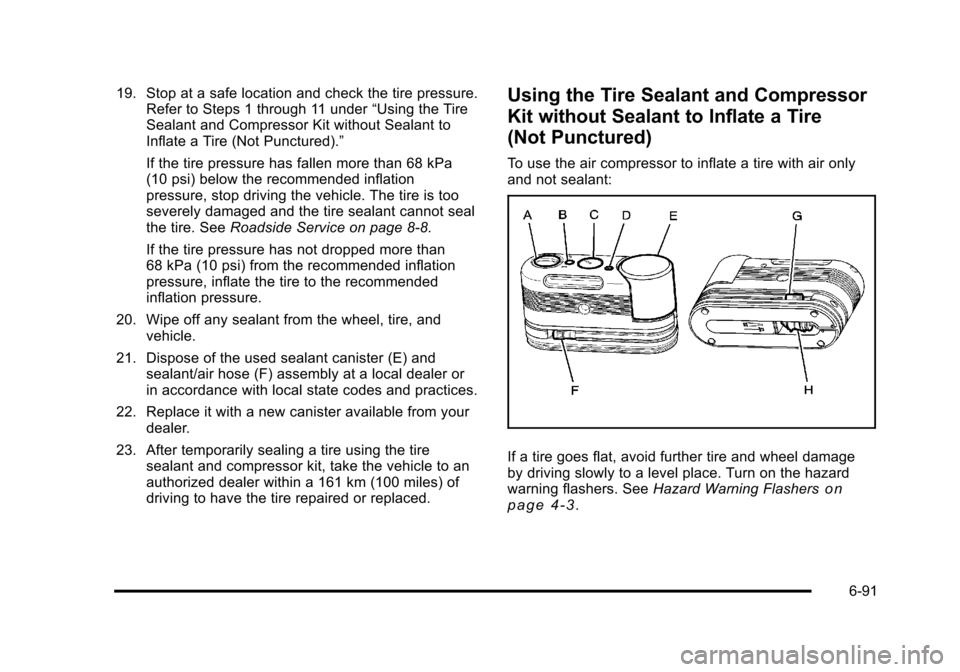
To use the air compressor to inflate a tire with air only
and not sealant:
If a tire goes flat, avoid further tire and wheel damage
by driving slowly to a level place. Turn on the hazard
warning flashers. See Hazard Warning Flashers
on
page 4‑3.
6-91
Page 444 of 528
Black plate (94,1)Cadillac STS Owner Manual - 2011
Tire Sealant and Compressor Kit
Storage
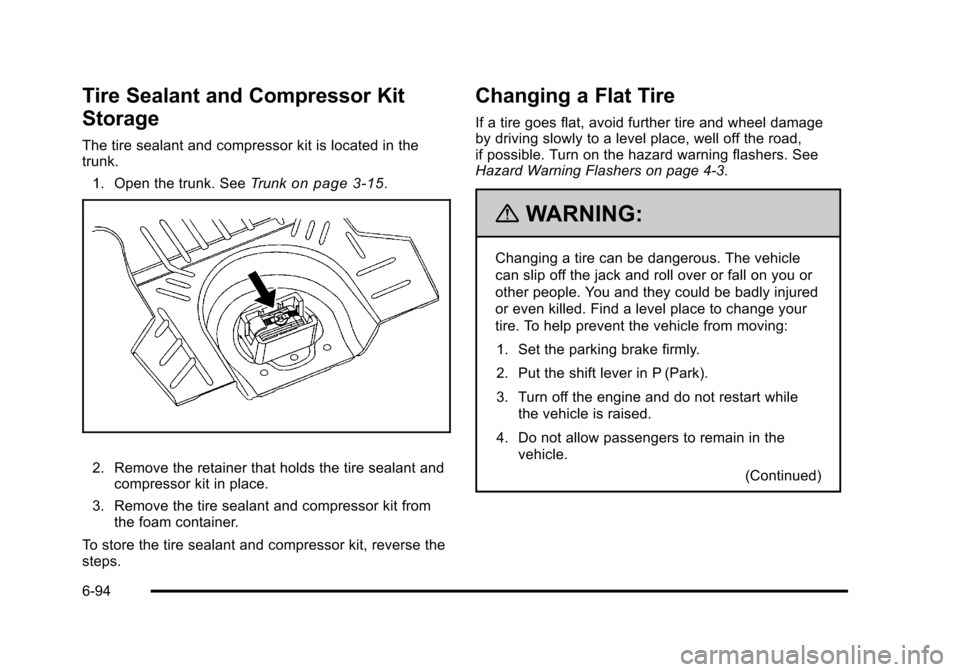
The tire sealant and compressor kit is located in the
trunk.1. Open the trunk. See Trunk
on page 3‑15.
2. Remove the retainer that holds the tire sealant and
compressor kit in place.
3. Remove the tire sealant and compressor kit from the foam container.
To store the tire sealant and compressor kit, reverse the
steps.
Changing a Flat Tire
If a tire goes flat, avoid further tire and wheel damage
by driving slowly to a level place, well off the road,
if possible. Turn on the hazard warning flashers. See
Hazard Warning Flashers on page 4‑3.
{WARNING:
Changing a tire can be dangerous. The vehicle
can slip off the jack and roll over or fall on you or
other people. You and they could be badly injured
or even killed. Find a level place to change your
tire. To help prevent the vehicle from moving:
1. Set the parking brake firmly.
2. Put the shift lever in P (Park).
3. Turn off the engine and do not restart while the vehicle is raised.
4. Do not allow passengers to remain in the vehicle.
(Continued)
6-94
Page 445 of 528
Black plate (95,1)Cadillac STS Owner Manual - 2011
WARNING: (Continued)
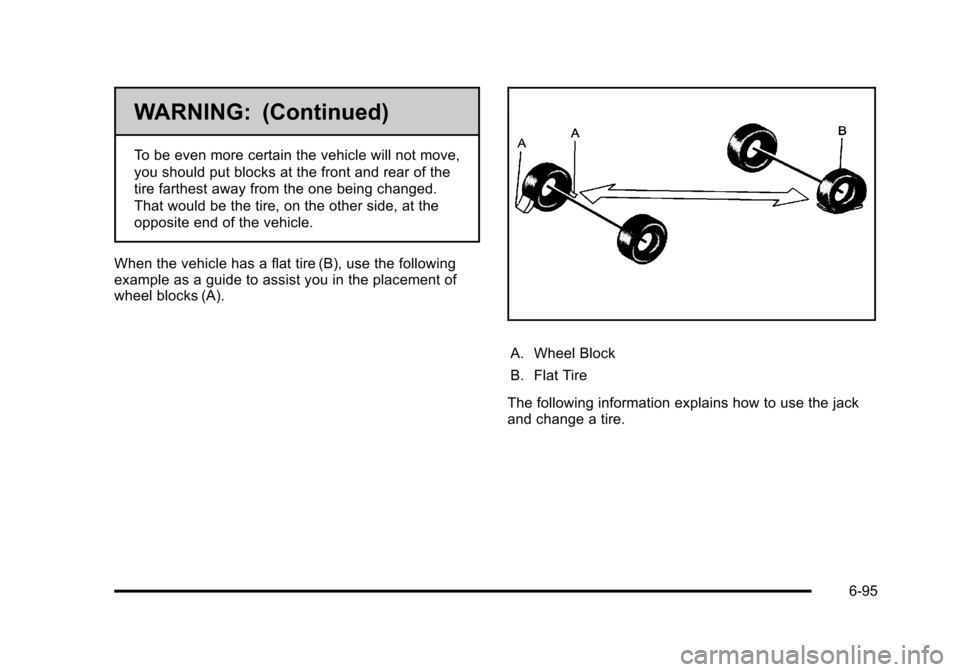
To be even more certain the vehicle will not move,
you should put blocks at the front and rear of the
tire farthest away from the one being changed.
That would be the tire, on the other side, at the
opposite end of the vehicle.
When the vehicle has a flat tire (B), use the following
example as a guide to assist you in the placement of
wheel blocks (A).
A. Wheel Block
B. Flat Tire
The following information explains how to use the jack
and change a tire.
6-95
Page 446 of 528
Black plate (96,1)Cadillac STS Owner Manual - 2011
Removing the Spare Tire and Tools
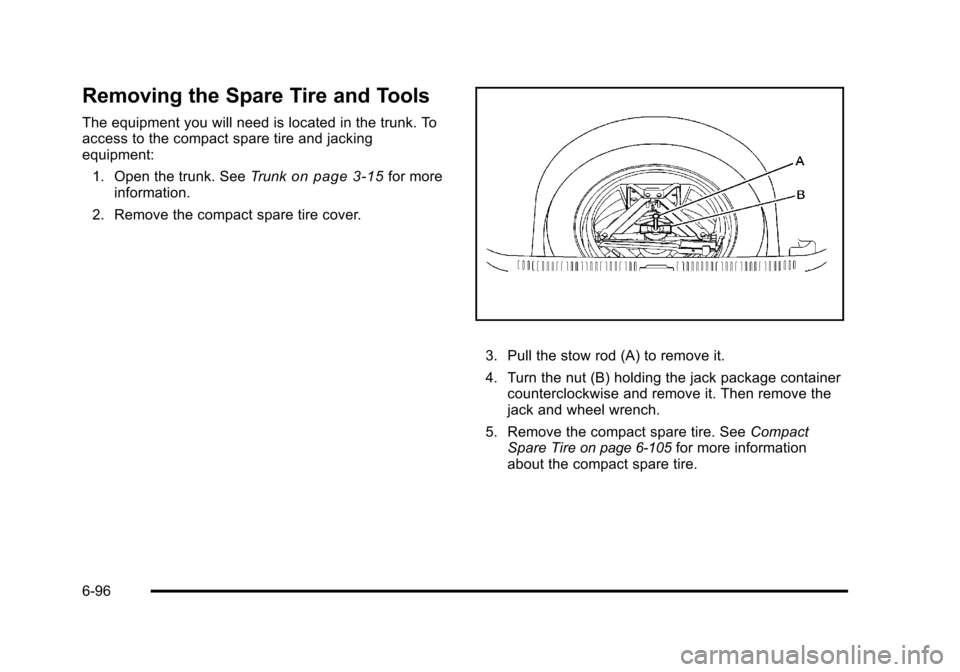
The equipment you will need is located in the trunk. To
access to the compact spare tire and jacking
equipment:1. Open the trunk. See Trunk
on page 3‑15for more
information.
2. Remove the compact spare tire cover.
3. Pull the stow rod (A) to remove it.
4. Turn the nut (B) holding the jack package container counterclockwise and remove it. Then remove the
jack and wheel wrench.
5. Remove the compact spare tire. See Compact
Spare Tire
on page 6‑105for more information
about the compact spare tire.
6-96