phone CADILLAC STS 2011 1.G User Guide
[x] Cancel search | Manufacturer: CADILLAC, Model Year: 2011, Model line: STS, Model: CADILLAC STS 2011 1.GPages: 528, PDF Size: 4.96 MB
Page 287 of 528
Black plate (101,1)Cadillac STS Owner Manual - 2011
MSG (Message):Displays if the current RDS station
has a message. The message can display the artist,
song title, call in phone numbers, etc. If the entire
message does not display, parts of the message appear
every three seconds until the message is completed.
MSG disappears from the display once the completed
message has displayed.
To display the last message:
1. Press
wto enter the main menu.
2. Turn
wuntil RECALL RDS MESSAGE displays.
3. Press
wand the message displays.
Once the message displays, MSG disappears from the
display until another new message is received.
TP (Traffic Program): Displays when the radio
detects a signal from an RDS station that has traffic
announcement broadcast capability. TA (Traffic Announcement):
Displays when
the feature is turned on and allows the radio to
automatically seek radio stations that broadcast
traffic announcements.
.If the current radio station broadcasts traffic
announcements the station will not change.
.If the current radio station does not broadcast
traffic announcements, the radio seeks to the first
station that does. If the radio cannot find a station
that broadcasts traffic announcements, No Traffic
displays.
.If a CD is playing and the previous radio station
broadcasts traffic announcements, the radio
interrupts the CD for the traffic announcement.
To turn TA on or off:
1. Press
wto enter the main menu.
2. Turn
wuntil TRAFFIC ANNOUNCE displays.
3. Press
wto select ON or OFF. An X appears in
the box when ON is selected.
4. Press F6 to exit the display. To return to the original display, repeatedly press F6 or wait for
the display to time out.
4-101
Page 299 of 528
Black plate (113,1)Cadillac STS Owner Manual - 2011
Check Antenna:If this message does not clear within
a short period of time, the receiver or antenna could
have a fault. Consult with your dealer.
Check XM Receivr: If this message does not clear
within a short period of time, the receiver could have
a fault. Consult with your dealer.
XM Not Available: If this message does not clear
within a short period of time, the receiver could have
a fault. Consult with your dealer.
Navigation/Radio System
For vehicles with a navigation radio system, see the
separate Navigation System manual.
Bluetooth®
For vehicles with a Navigation System and Bluetooth,
see the Navigation System Manual for information
about how to use the Bluetooth system.
For vehicles without a Navigation System, the Bluetooth
system can use a Bluetooth‐capable cell phone with
a Hands‐Free Profile to make and receive phone
calls. The system can be used while the ignition is in
ON/RUN or ACC/ACCESSORY. The range of the
Bluetooth system can be up to 9.1 m (30 ft). Not all
phones support all functions and not all phones work
with the Bluetooth system. See www.gm.com/bluetooth
for more information about compatible phones.
Voice Recognition
The Bluetooth system uses voice recognition to
interpret voice commands to control the system
and dial phone numbers.
For additional information say “Help”while you are
in a voice recognition menu.
Noise: The system may not recognize voice commands
if there is too much background noise.
When to Speak: A tone sounds to indicate that the
system is ready for a voice command. Wait for the tone
and then speak.
How to Speak: Speak clearly in a calm and natural
voice.
Audio System
When using the Bluetooth system, sound comes
through the vehicle's front audio system speakers and
overrides the audio system. Use the the audio system
volume knob during a call to change the volume level.
The adjusted volume level remains in memory for later
calls. The system maintains a minimum volume level.
4-113
Page 300 of 528
Black plate (114,1)Cadillac STS Owner Manual - 2011
Bluetooth Controls
Use the buttons located on the steering wheel to
operate the Bluetooth system. SeeAudio Steering
Wheel Controls
on page 4‑124for more information.
b g(Push to Talk) : Press to answer incoming calls,
to confirm system information, and to start voice
recognition.
Pairing
A Bluetooth cell phone must be paired to the Bluetooth
system and then connected to the vehicle before it can
be used. See your cell phone manufacturer's user guide
for Bluetooth functions before pairing the cell phone. If a Bluetooth phone is not connected, calls will be made
using OnStar
®Hands‐Free Calling, if available. Refer
to the OnStar Owner's Guide for more information.
Pairing Information
.Up to five cell phones can be paired to the
Bluetooth system.
.The pairing process is disabled when the vehicle is
moving.
.Pairing only needs to be completed once, unless
the pairing information on the cell phone changes
or the cell phone is deleted from the system.
.Only one paired cell phone can be connected to
the Bluetooth system at a time.
.If multiple paired cell phones are within range
of the system, the system connects to the first
available paired cell phone in the order that they
were first paired to the system. To connect to a
different paired phone, see “Connecting to a
Different Phone” later in this section.
Pairing a Phone
1. Press and holdbgfor two seconds.
2. Say “Bluetooth.”
3. Say “Pair.”The system responds with instructions
and a four‐digit Personal Identification Number
(PIN). The PIN is used in Step 5.
4. Start the pairing process on the cell phone that you want to pair. For help with this process, see your
cell phone manufacturer's user guide.
5. Locate the device named “Your Vehicle”in the list
on the cell phone. Follow the instructions on the
cell phone to enter the PIN number that was
provided in Step 3. After the PIN is successfully
entered, the system prompts you to provide a
name for the paired cell phone. This name will be
used to indicate which phones are paired and
connected to the vehicle. See “Listing All Paired
and Connected Phones” later in this section for
more information.
6. Repeat Steps 1 through 5 to pair additional phones.
4-114
Page 301 of 528
Black plate (115,1)Cadillac STS Owner Manual - 2011
Listing All Paired and Connected Phones
The system can list all cell phones paired to it. If a
paired cell phone is also connected to the vehicle, the
system responds with“is connected”after that
phone name.
1. Press and hold
b gfor two seconds.
2. Say “Bluetooth.”
3. Say “List.”
Deleting a Paired Phone
If the phone name you want to delete is unknown, see
“Listing All Paired and Connected Phones.”
1. Press and hold
b gfor two seconds.
2. Say “Bluetooth.”
3. Say “Delete.” The system asks which phone to
delete.
4. Say the name of the phone you want to delete.
Connecting to a Different Phone
To connect to a different cell phone, the Bluetooth
system looks for the next available cell phone in the
order in which all the available cell phones were paired.
Depending on which cell phone you want to connect to,
you may have to use this command several times.
1. Press and hold
b gfor two seconds.
2. Say “Bluetooth”.
3. Say “Change phone.”
.If another cell phone is found, the response will
be“
.If another cell phone is not found, the original
phone remains connected.
4-115
Page 302 of 528
Black plate (116,1)Cadillac STS Owner Manual - 2011
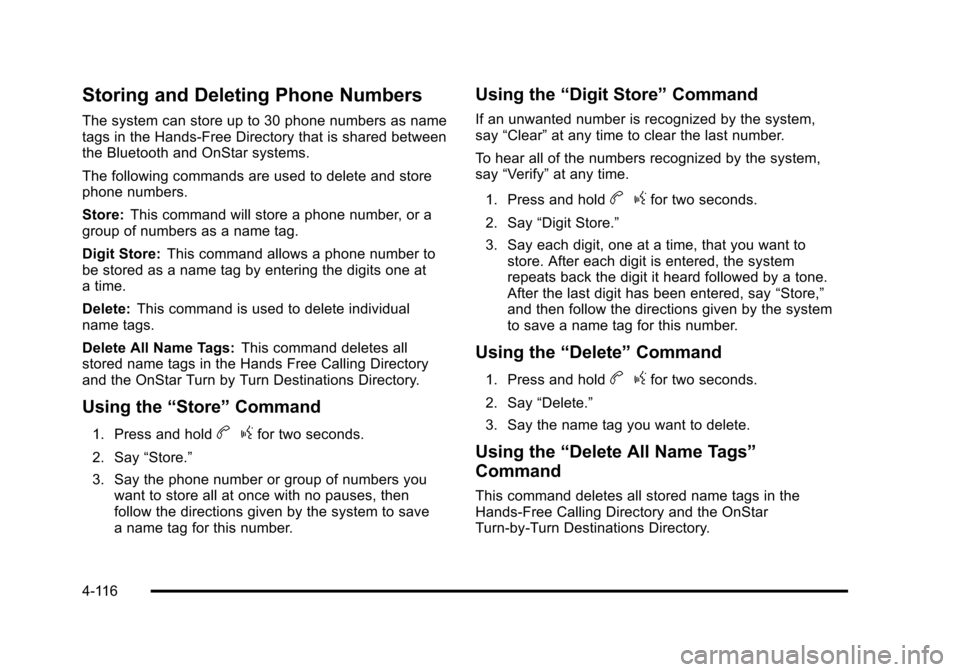
Storing and Deleting Phone Numbers
The system can store up to 30 phone numbers as name
tags in the Hands‐Free Directory that is shared between
the Bluetooth and OnStar systems.
The following commands are used to delete and store
phone numbers.
Store:This command will store a phone number, or a
group of numbers as a name tag.
Digit Store: This command allows a phone number to
be stored as a name tag by entering the digits one at
a time.
Delete: This command is used to delete individual
name tags.
Delete All Name Tags: This command deletes all
stored name tags in the Hands Free Calling Directory
and the OnStar Turn by Turn Destinations Directory.
Using the “Store”Command
1. Press and holdbgfor two seconds.
2. Say “Store.”
3. Say the phone number or group of numbers you want to store all at once with no pauses, then
follow the directions given by the system to save
a name tag for this number.
Using the “Digit Store” Command
If an unwanted number is recognized by the system,
say“Clear” at any time to clear the last number.
To hear all of the numbers recognized by the system,
say “Verify” at any time.
1. Press and hold
b gfor two seconds.
2. Say “Digit Store.”
3. Say each digit, one at a time, that you want to store. After each digit is entered, the system
repeats back the digit it heard followed by a tone.
After the last digit has been entered, say “Store,”
and then follow the directions given by the system
to save a name tag for this number.
Using the “Delete”Command
1. Press and holdbgfor two seconds.
2. Say “Delete.”
3. Say the name tag you want to delete.
Using the “Delete All Name Tags”
Command
This command deletes all stored name tags in the
Hands‐Free Calling Directory and the OnStar
Turn‐by‐Turn Destinations Directory.
4-116
Page 303 of 528
Black plate (117,1)Cadillac STS Owner Manual - 2011
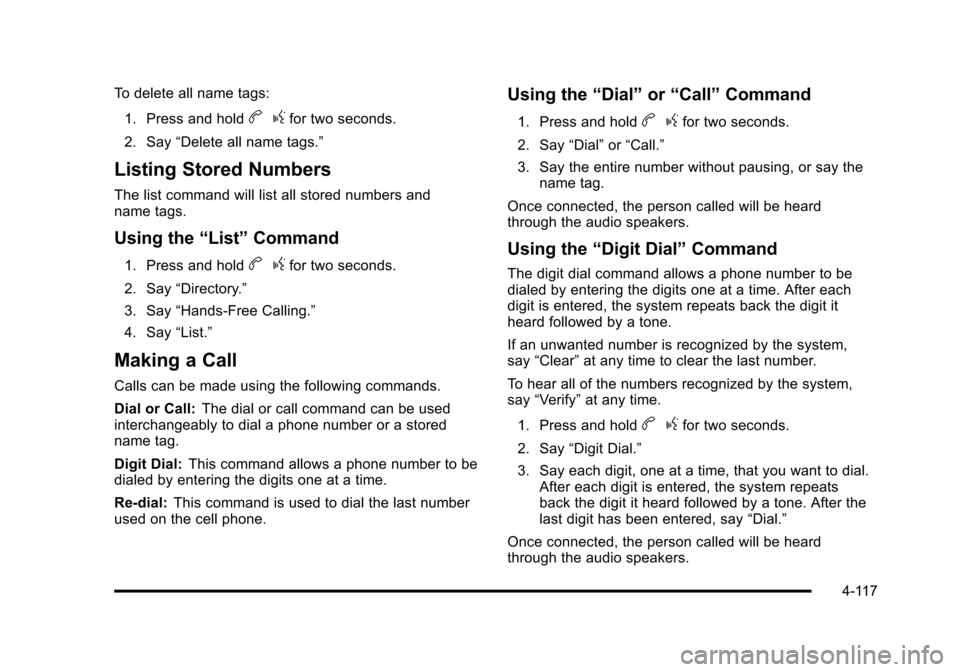
To delete all name tags:1. Press and hold
b gfor two seconds.
2. Say “Delete all name tags.”
Listing Stored Numbers
The list command will list all stored numbers and
name tags.
Using the “List”Command
1. Press and holdbgfor two seconds.
2. Say “Directory.”
3. Say “Hands‐Free Calling.”
4. Say “List.”
Making a Call
Calls can be made using the following commands.
Dial or Call: The dial or call command can be used
interchangeably to dial a phone number or a stored
name tag.
Digit Dial: This command allows a phone number to be
dialed by entering the digits one at a time.
Re‐dial: This command is used to dial the last number
used on the cell phone.
Using the “Dial”or“Call” Command
1. Press and holdbgfor two seconds.
2. Say “Dial”or“Call.”
3. Say the entire number without pausing, or say the name tag.
Once connected, the person called will be heard
through the audio speakers.
Using the “Digit Dial” Command
The digit dial command allows a phone number to be
dialed by entering the digits one at a time. After each
digit is entered, the system repeats back the digit it
heard followed by a tone.
If an unwanted number is recognized by the system,
say“Clear” at any time to clear the last number.
To hear all of the numbers recognized by the system,
say “Verify” at any time.
1. Press and hold
b gfor two seconds.
2. Say “Digit Dial.”
3. Say each digit, one at a time, that you want to dial. After each digit is entered, the system repeats
back the digit it heard followed by a tone. After the
last digit has been entered, say “Dial.”
Once connected, the person called will be heard
through the audio speakers.
4-117
Page 304 of 528
Black plate (118,1)Cadillac STS Owner Manual - 2011
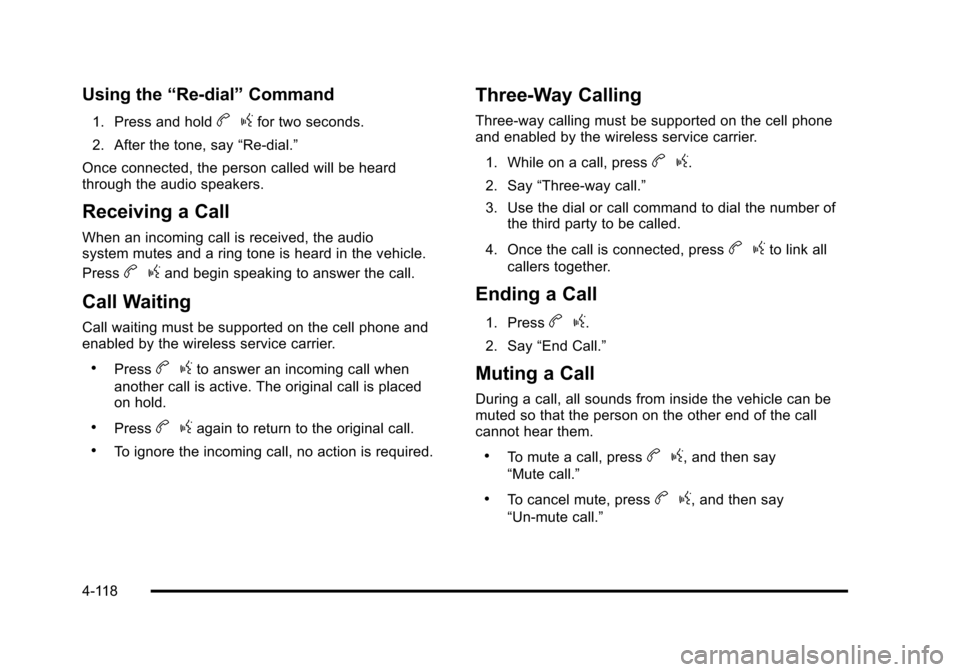
Using the“Re‐dial”Command
1. Press and holdbgfor two seconds.
2. After the tone, say “Re‐dial.”
Once connected, the person called will be heard
through the audio speakers.
Receiving a Call
When an incoming call is received, the audio
system mutes and a ring tone is heard in the vehicle.
Press
b gand begin speaking to answer the call.
Call Waiting
Call waiting must be supported on the cell phone and
enabled by the wireless service carrier.
.Pressbgto answer an incoming call when
another call is active. The original call is placed
on hold.
.Pressb gagain to return to the original call.
.To ignore the incoming call, no action is required.
Three‐Way Calling
Three‐way calling must be supported on the cell phone
and enabled by the wireless service carrier.
1. While on a call, press
b g.
2. Say “Three‐way call.”
3. Use the dial or call command to dial the number of the third party to be called.
4. Once the call is connected, press
b gto link all
callers together.
Ending a Call
1. Pressb g.
2. Say “End Call.”
Muting a Call
During a call, all sounds from inside the vehicle can be
muted so that the person on the other end of the call
cannot hear them.
.To mute a call, pressbg, and then say
“Mute call.”
.To cancel mute, pressb g, and then say
“Un‐mute call.”
4-118
Page 305 of 528
Black plate (119,1)Cadillac STS Owner Manual - 2011
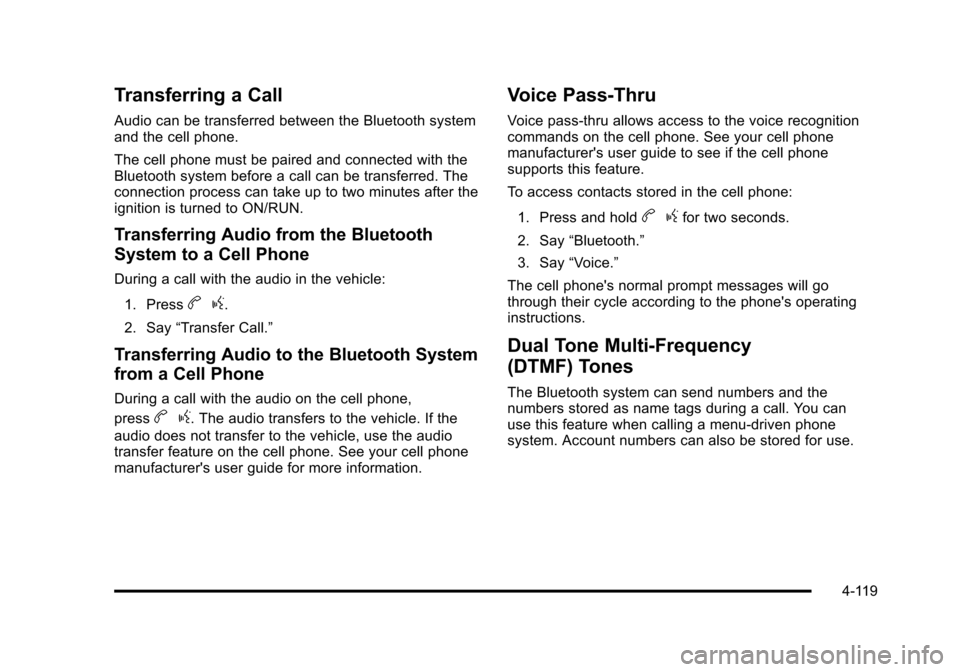
Transferring a Call
Audio can be transferred between the Bluetooth system
and the cell phone.
The cell phone must be paired and connected with the
Bluetooth system before a call can be transferred. The
connection process can take up to two minutes after the
ignition is turned to ON/RUN.
Transferring Audio from the Bluetooth
System to a Cell Phone
During a call with the audio in the vehicle:1. Press
b g.
2. Say “Transfer Call.”
Transferring Audio to the Bluetooth System
from a Cell Phone
During a call with the audio on the cell phone,
press
bg. The audio transfers to the vehicle. If the
audio does not transfer to the vehicle, use the audio
transfer feature on the cell phone. See your cell phone
manufacturer's user guide for more information.
Voice Pass-Thru
Voice pass‐thru allows access to the voice recognition
commands on the cell phone. See your cell phone
manufacturer's user guide to see if the cell phone
supports this feature.
To access contacts stored in the cell phone:
1. Press and hold
b gfor two seconds.
2. Say “Bluetooth.”
3. Say “Voice.”
The cell phone's normal prompt messages will go
through their cycle according to the phone's operating
instructions.
Dual Tone Multi-Frequency
(DTMF) Tones
The Bluetooth system can send numbers and the
numbers stored as name tags during a call. You can
use this feature when calling a menu‐driven phone
system. Account numbers can also be stored for use.
4-119
Page 306 of 528
Black plate (120,1)Cadillac STS Owner Manual - 2011
Sending a Number or Name Tag
During a Call
1. Pressbg.
2. Say “Dial.”
3. Say the number or name tag to send.
Clearing the System
Unless information is deleted out of the in‐vehicle
Bluetooth system, it will be retained indefinitely. This
includes all saved name tags in the phone book and
phone pairing information. For information on how to
delete this information, see the previou section
“Deleting a Paired Phone” and the previous sections
on deleting name tags.
Other Information
The Bluetooth®word mark and logos are owned by the
Bluetooth®SIG, Inc. and any use of such marks by
General Motors is under license. Other trademarks and
trade names are those of their respective owners.
See Radio Frequency Statement
on page 8‑20for
Federal Communications Commission and Industry
Canada information.
Radio Personalization
For vehicles with a Navigation System, see the
Navigation System manual supplied with the vehicle for
more information on accessing the main menu and for
descriptions of the menu items for the Navigation
system.
Accessing the Main Menu
To access the main menu:
1. Press CNFG or
wto enter the main menu.
2. Turn
wto scroll through the menu items.
The main menu consists of the following menu items:
.eBASS - MID - TREBLE
.xBALANCE - FADER
.eEQ EQUALIZER
.H/A (HOME/AWAY) PRESETS
.AUTOSTORE PRESETS
.CAT CATEGORY
.TA TRAFFIC ANNOUNCE
.RECALL RDS (Radio Data System) MESSAGE
4-120
Page 311 of 528
Black plate (125,1)Cadillac STS Owner Manual - 2011
bg(Mute/Voice Recognition): Press and release to
silence the vehicle speakers only. Press and release
again to turn the sound on.
.For vehicles with a navigation system, press and
hold
b gfor two seconds to initiate speech
recognition. See “Voice Recognition” in the
Navigation System manual for more information.
.For vehicles with a navigation system and
OnStar®, press and holdb gfor two seconds and
then say “OnStar” to interact with the OnStar
system. See the OnStar Owner's Guide for more
information.
.For vehicles with a navigation system and
Bluetooth®, see the Navigation System manual for
more information.
.For vehicles without a navigation system, and with
OnStar or Bluetooth, press and hold
b gfor
two seconds to interact with the Bluetooth or
system OnStar. See Bluetooth
®on page 4‑113,
or the OnStar Owner's Guide for more information
about these features.
Radio Reception
Frequency interference and static can occur during
normal radio reception if items such as cell phone
chargers, vehicle convenience accessories, and
external electronic devices are plugged into the
accessory power outlet. If there is interference or static,
unplug the item from the accessory power outlet.
AM
The range for most AM stations is greater than for FM,
especially at night. The longer range can cause station
frequencies to interfere with each other. For better radio
reception, most AM radio stations boost the power
levels during the day, and then reduce these levels
during the night. Static can also occur when things like
storms and power lines interfere with radio reception.
When this happens, try reducing the treble on the radio.
FM Stereo
FM signals only reach about 10 to 40 miles
(16 to 65 km). Although the radio has a built-in electronic
circuit that automatically works to reduce interference,
some static can occur, especially around tall buildings
or hills, causing the sound to fade in and out.
4-125