seats CADILLAC STS 2011 1.G User Guide
[x] Cancel search | Manufacturer: CADILLAC, Model Year: 2011, Model line: STS, Model: CADILLAC STS 2011 1.GPages: 528, PDF Size: 4.96 MB
Page 37 of 528
Black plate (5,1)Cadillac STS Owner Manual - 2011
Heated and Ventilated Seats
{WARNING:
If you cannot feel temperature change or pain to
the skin, the seat heater may cause burns even at
low temperatures. See the Warning underHeated
Seats on page 2‑4.
On vehicles with this feature, the buttons are on the
climate control panel.
z(Heated Seat and Seatback): Press to heat the seat
and seatback.
{(Ventilated Seat): Press to ventilate the seat.
Press the button once for the highest setting. With each
press of the button, the setting will change to the next
lower setting, and then to the off setting.
A light bar in the climate control display shows the
setting: high, medium, or low.
The heated or ventilated seats shut off when the vehicle
is turned off.
Memory Seat, Mirrors and Steering
Wheel
If the vehicle has the memory feature, you can program
and recall memory settings for the following features for
up to two drivers:
.The driver seat position
.The outside rearview mirrors position
.The power tilt wheel and telescopic steering
column position
The following settings and presets are set automatically:
.The language, radio and XM™ presets, tone,
volume, playback mode (AM/FM or CD), last
displayed stations, and compact disc position
.The last climate control setting
.The Head-Up Display (HUD) position, if your
vehicle has this feature
.Other personalization settings, for example, remote
start settings
See Vehicle Personalization on page 3‑59.
2-5
Page 42 of 528
Black plate (10,1)Cadillac STS Owner Manual - 2011
Power Reclining Seatbacks
{WARNING:
You can lose control of the vehicle if you try to
adjust the seat while the vehicle is moving. The
sudden movement could startle and confuse you,
or make you push a pedal when you do not want
to. Adjust the driver seat only when the vehicle is
not moving.
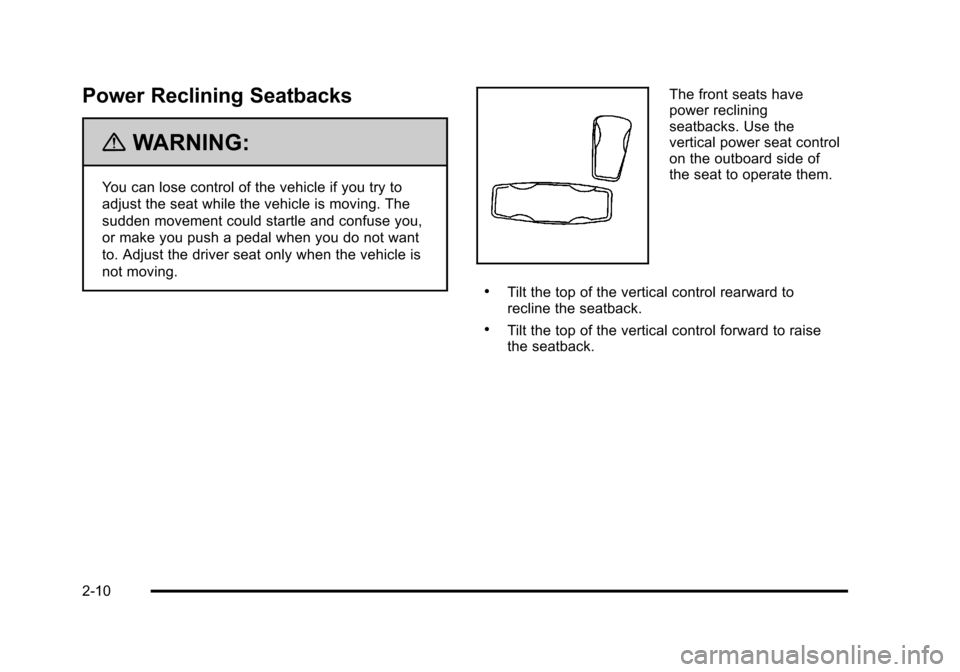
The front seats have
power reclining
seatbacks. Use the
vertical power seat control
on the outboard side of
the seat to operate them.
.Tilt the top of the vertical control rearward to
recline the seatback.
.Tilt the top of the vertical control forward to raise
the seatback.
2-10
Page 44 of 528
Black plate (12,1)Cadillac STS Owner Manual - 2011
Head Restraints
The vehicle's front seats have adjustable head
restraints in the outboard seating positions.
{WARNING:
With head restraints that are not installed and
adjusted properly, there is a greater chance that
occupants will suffer a neck/spinal injury in a
crash. Do not drive until the head restraints for all
occupants are installed and adjusted properly.
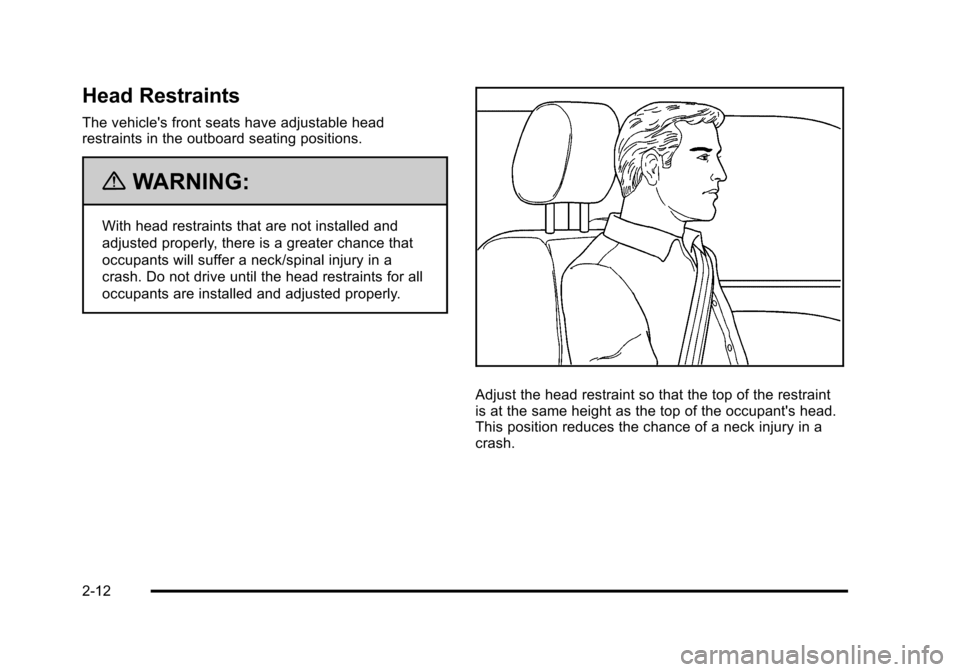
Adjust the head restraint so that the top of the restraint
is at the same height as the top of the occupant's head.
This position reduces the chance of a neck injury in a
crash.
2-12
Page 46 of 528
Black plate (14,1)Cadillac STS Owner Manual - 2011
Rear Seats
Heated Seats
{WARNING:
If you cannot feel temperature change or pain to
the skin, the seat heater may cause burns even at
low temperatures. See the Warning underHeated
Seats on page 2‑4.
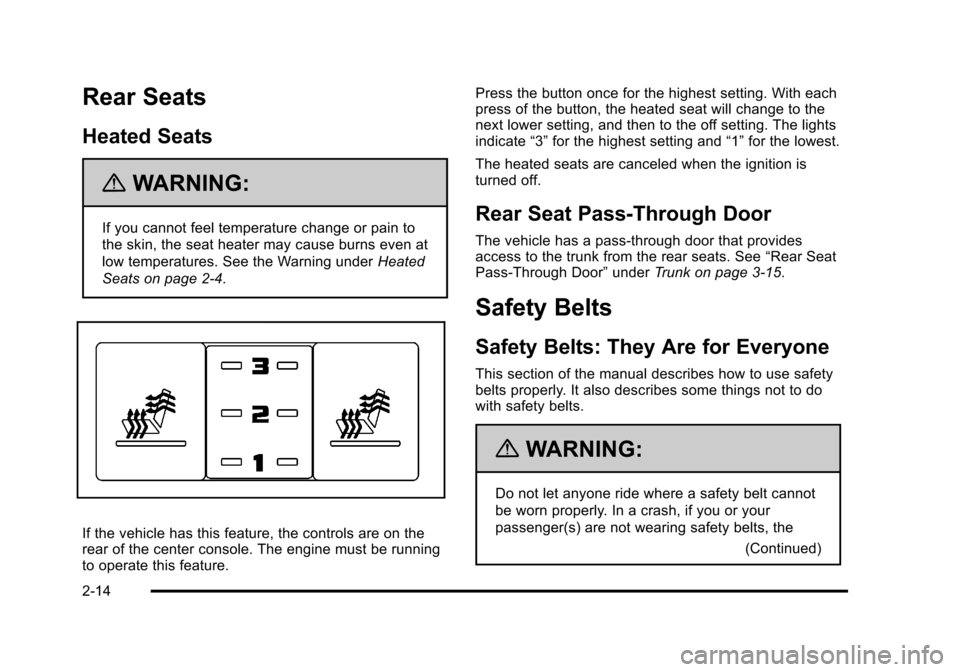
If the vehicle has this feature, the controls are on the
rear of the center console. The engine must be running
to operate this feature. Press the button once for the highest setting. With each
press of the button, the heated seat will change to the
next lower setting, and then to the off setting. The lights
indicate
“3”for the highest setting and “1”for the lowest.
The heated seats are canceled when the ignition is
turned off.
Rear Seat Pass-Through Door
The vehicle has a pass‐through door that provides
access to the trunk from the rear seats. See “Rear Seat
Pass‐Through Door” underTrunk on page 3‑15.
Safety Belts
Safety Belts: They Are for Everyone
This section of the manual describes how to use safety
belts properly. It also describes some things not to do
with safety belts.
{WARNING:
Do not let anyone ride where a safety belt cannot
be worn properly. In a crash, if you or your
passenger(s) are not wearing safety belts, the
(Continued)
2-14
Page 47 of 528
Black plate (15,1)Cadillac STS Owner Manual - 2011
WARNING: (Continued)
injuries can be much worse. You can hit things
inside the vehicle harder or be ejected from the
vehicle. You and your passenger(s) can be
seriously injured or killed. In the same crash, you
might not be, if you are buckled up. Always fasten
your safety belt, and check that your passenger(s)
are restrained properly too.
{WARNING:
It is extremely dangerous to ride in a cargo area,
inside or outside of a vehicle. In a collision,
people riding in these areas are more likely to be
seriously injured or killed. Do not allow people
to ride in any area of your vehicle that is not
equipped with seats and safety belts. Be sure
everyone in your vehicle is in a seat and using a
safety belt properly.This vehicle has indicators as a reminder to buckle the
safety belts. See
Safety Belt Reminders
on page 4‑53for additional information.
In most states and in all Canadian provinces, the law
requires wearing safety belts. Here is why:
You never know if you will be in a crash. If you do have
a crash, you do not know if it will be a serious one.
A few crashes are mild, and some crashes can be so
serious that even buckled up, a person would not
survive. But most crashes are in between. In many of
them, people who buckle up can survive and sometimes
walk away. Without safety belts, they could have been
badly hurt or killed.
After more than 40 years of safety belts in vehicles,
the facts are clear. In most crashes buckling up does
matter ... a lot!
2-15
Page 60 of 528
Black plate (28,1)Cadillac STS Owner Manual - 2011
Lap-Shoulder Belt
All seating positions in your vehicle have a
lap-shoulder belt.
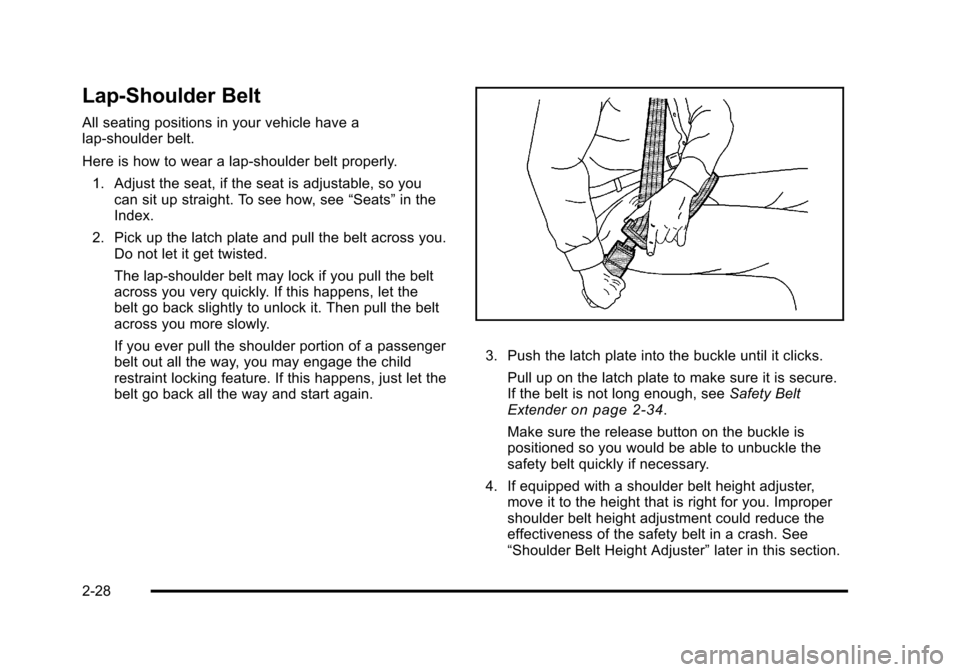
Here is how to wear a lap-shoulder belt properly.1. Adjust the seat, if the seat is adjustable, so you can sit up straight. To see how, see “Seats”in the
Index.
2. Pick up the latch plate and pull the belt across you. Do not let it get twisted.
The lap-shoulder belt may lock if you pull the belt
across you very quickly. If this happens, let the
belt go back slightly to unlock it. Then pull the belt
across you more slowly.
If you ever pull the shoulder portion of a passenger
belt out all the way, you may engage the child
restraint locking feature. If this happens, just let the
belt go back all the way and start again.
3. Push the latch plate into the buckle until it clicks.
Pull up on the latch plate to make sure it is secure.
If the belt is not long enough, see Safety Belt
Extender
on page 2‑34.
Make sure the release button on the buckle is
positioned so you would be able to unbuckle the
safety belt quickly if necessary.
4. If equipped with a shoulder belt height adjuster, move it to the height that is right for you. Improper
shoulder belt height adjustment could reduce the
effectiveness of the safety belt in a crash. See
“Shoulder Belt Height Adjuster” later in this section.
2-28
Page 63 of 528
Black plate (31,1)Cadillac STS Owner Manual - 2011
Rear Safety Belt Comfort Guides
This vehicle may have rear shoulder belt comfort
guides. If not, they are available through your dealer.
The guides may provide added safety belt comfort for
older children who have outgrown booster seats and for
some adults. When installed and properly adjusted, the
comfort guide positions the belt away from the neck
and head.
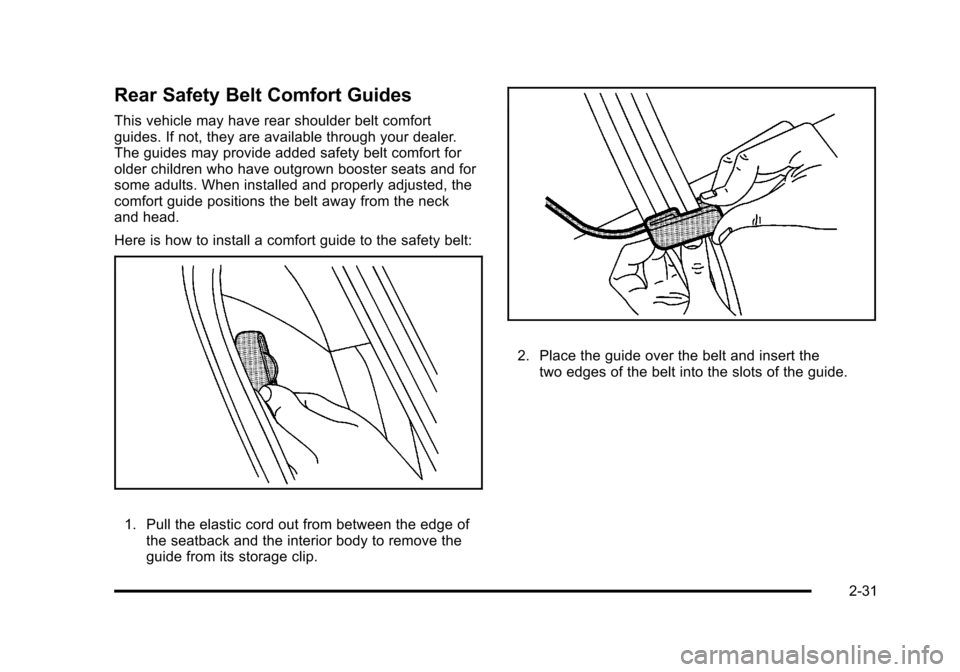
Here is how to install a comfort guide to the safety belt:
1. Pull the elastic cord out from between the edge ofthe seatback and the interior body to remove the
guide from its storage clip.
2. Place the guide over the belt and insert thetwo edges of the belt into the slots of the guide.
2-31
Page 66 of 528
Black plate (34,1)Cadillac STS Owner Manual - 2011
The best way to protect the fetus is to protect the
mother. When a safety belt is worn properly, it is more
likely that the fetus will not be hurt in a crash. For
pregnant women, as for anyone, the key to making
safety belts effective is wearing them properly.
Safety Belt Extender
If the vehicle's safety belt will fasten around you, you
should use it.
But if a safety belt is not long enough, your dealer will
order you an extender. When you go in to order it, take
the heaviest coat you will wear, so the extender will be
long enough for you. To help avoid personal injury, do
not let someone else use it, and use it only for the seat
it is made to fit. The extender has been designed for
adults. Never use it for securing child seats. To wear it,
attach it to the regular safety belt. For more information,
see the instruction sheet that comes with the extender.
Child Restraints
Older Children
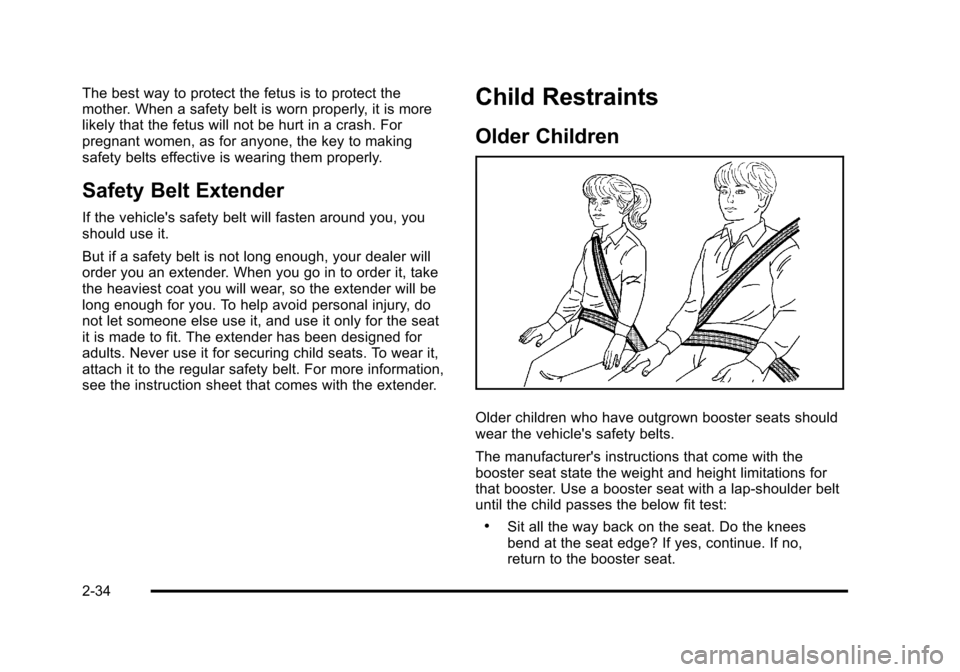
Older children who have outgrown booster seats should
wear the vehicle's safety belts.
The manufacturer's instructions that come with the
booster seat state the weight and height limitations for
that booster. Use a booster seat with a lap-shoulder belt
until the child passes the below fit test:
.Sit all the way back on the seat. Do the knees
bend at the seat edge? If yes, continue. If no,
return to the booster seat.
2-34
Page 74 of 528
Black plate (42,1)Cadillac STS Owner Manual - 2011
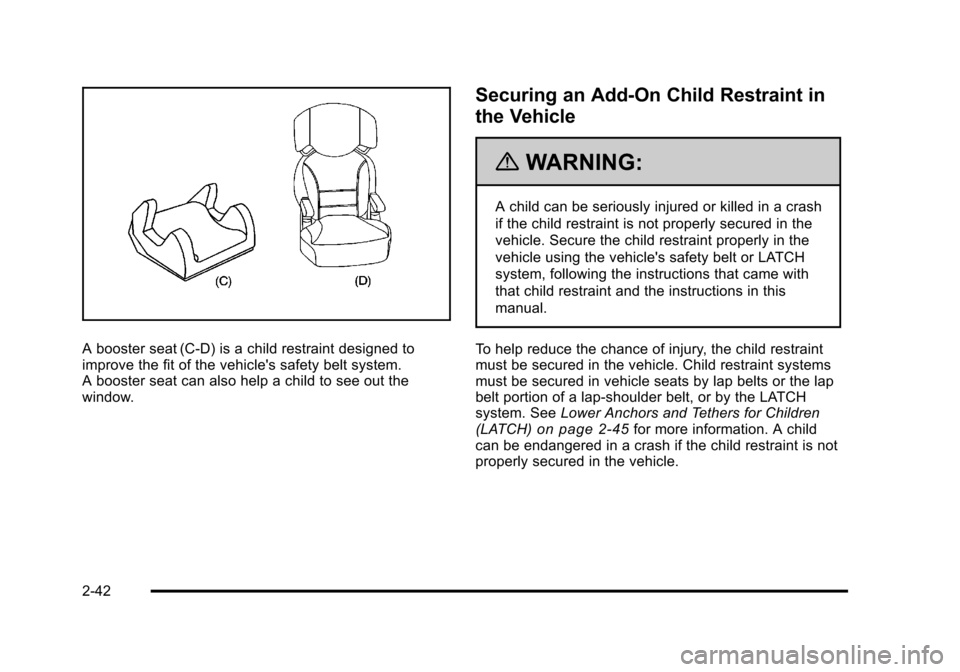
A booster seat (C-D) is a child restraint designed to
improve the fit of the vehicle's safety belt system.
A booster seat can also help a child to see out the
window.
Securing an Add-On Child Restraint in
the Vehicle
{WARNING:
A child can be seriously injured or killed in a crash
if the child restraint is not properly secured in the
vehicle. Secure the child restraint properly in the
vehicle using the vehicle's safety belt or LATCH
system, following the instructions that came with
that child restraint and the instructions in this
manual.
To help reduce the chance of injury, the child restraint
must be secured in the vehicle. Child restraint systems
must be secured in vehicle seats by lap belts or the lap
belt portion of a lap-shoulder belt, or by the LATCH
system. See Lower Anchors and Tethers for Children
(LATCH)
on page 2‑45for more information. A child
can be endangered in a crash if the child restraint is not
properly secured in the vehicle.
2-42
Page 76 of 528
Black plate (44,1)Cadillac STS Owner Manual - 2011
A label on the sun visor says,“Never put a rear-facing
child restraint in the front.” This is because the risk to
the rear-facing child is so great, if the airbag deploys.
{WARNING:
A child in a rear-facing child restraint can be
seriously injured or killed if the right front
passenger airbag inflates. This is because the
back of the rear-facing child restraint would be
very close to the inflating airbag. A child in a
forward-facing child restraint can be seriously
injured or killed if the right front passenger airbag
inflates and the passenger seat is in a forward
position.
Even if the passenger sensing system has turned
off the right front passenger frontal airbag, no
system is fail-safe. No one can guarantee that
an airbag will not deploy under some unusual
circumstance, even though it is turned off.
(Continued)
WARNING: (Continued)
Secure rear-facing child restraints in a rear
seat, even if the airbag is off. If you secure a
forward-facing child restraint in the right front seat,
always move the front passenger seat as far back
as it will go. It is better to secure the child restraint
in a rear seat.
SeePassenger Sensing System
on page 2‑66
for additional information.
When securing a child restraint in a rear seating
position, study the instructions that came with the child
restraint to make sure it is compatible with this vehicle.
Child restraints and booster seats vary considerably in
size, and some may fit in certain seating positions
better than others. Always make sure the child restraint
is properly secured.
2-44