brake CADILLAC STS 2011 1.G Manual PDF
[x] Cancel search | Manufacturer: CADILLAC, Model Year: 2011, Model line: STS, Model: CADILLAC STS 2011 1.GPages: 528, PDF Size: 4.96 MB
Page 423 of 528

Black plate (73,1)Cadillac STS Owner Manual - 2011
If you need to replace any of your wheels, wheel bolts,
wheel nuts, or Tire Pressure Monitor System (TPMS)
sensors, replace them only with new GM original
equipment parts. This way, you will be sure to have the
right wheel, wheel bolts, wheel nuts, and TPMS sensors
for your vehicle.
{WARNING:
Using the wrong replacement wheels, wheel bolts,
or wheel nuts on your vehicle can be dangerous.
It could affect the braking and handling of your
vehicle, make your tires lose air and make you
lose control. You could have a collision in which
you or others could be injured. Always use the
correct wheel, wheel bolts, and wheel nuts for
replacement.Notice:
The wrong wheel can also cause problems
with bearing life, brake cooling, speedometer or
odometer calibration, headlamp aim, bumper height,
vehicle ground clearance, and tire or tire chain
clearance to the body and chassis.
See Changing a Flat Tire
on page 6‑94for more
information.
Used Replacement Wheels
{WARNING:
Putting a used wheel on the vehicle is dangerous.
You cannot know how it has been used or how far
it has been driven. It could fail suddenly and
cause a crash. If you have to replace a wheel, use
a new GM original equipment wheel.
6-73
Page 424 of 528
Black plate (74,1)Cadillac STS Owner Manual - 2011
Tire Chains
{WARNING:
If your vehicle has P255/45R17, P255/45ZR18,
or 255/45ZR18 size tires, do not use tire chains,
as there is not enough clearance.
Tire chains used on a vehicle without the proper
amount of clearance can cause damage to the
brakes, suspension, or other vehicle parts. The
area damaged by the tire chains could cause you
to lose control of the vehicle and you or others
may be injured in a crash.
Use another type of traction device only if its
manufacturer recommends it for use on your
vehicle and tire size combination and road
conditions. Follow that manufacturer's
instructions. To help avoid damage to the vehicle,
drive slowly, readjust, or remove the device if it is
contacting the vehicle, and do not spin the
vehicle's wheels.
If you do find traction devices that will fit, install
them on the rear tires only.Notice:
If your vehicle has P235/50R17 size tires,
use tire chains only where legal and only when you
must. Use only SAE Class S‐type chains that are the
proper size for your tires. Install them on the rear
tires and tighten them as tightly as possible with the
ends securely fastened. Drive slowly and follow the
chain manufacturer's instructions. If you can hear
the chains contacting your vehicle, stop and
retighten them. If the contact continues, slow down
until it stops. Driving too fast or spinning the wheels
with chains on will damage your vehicle.
If a Tire Goes Flat
It is unusual for a tire to blowout while you are driving,
especially if you maintain your vehicle's tires properly.
If air goes out of a tire, it is much more likely to leak out
slowly. But if you should ever have a blowout, here are
a few tips about what to expect and what to do:
If a front tire fails, the flat tire creates a drag that pulls
the vehicle toward that side. Take your foot off the
accelerator pedal and grip the steering wheel firmly.
Steer to maintain lane position, and then gently brake to
a stop, well off the road, if possible.
6-74
Page 425 of 528
Black plate (75,1)Cadillac STS Owner Manual - 2011
A rear blowout, particularly on a curve, acts much like a
skid and may require the same correction you would
use in a skid. In any rear blowout remove your foot from
the accelerator pedal. Get the vehicle under control by
steering the way you want the vehicle to go. It may be
very bumpy and noisy, but you can still steer. Gently
brake to a stop, well off the road, if possible.
{WARNING:
Driving on a flat tire will cause permanent damage
to the tire. Re-inflating a tire after it has been
driven on while severely under-inflated or flat may
cause a blowout and a serious crash. Never
attempt to re-inflate a tire that has been driven on
while severely under-inflated or flat. Have your
dealer or an authorized tire service center repair
or replace the flat tire as soon as possible.
{WARNING:
Lifting a vehicle and getting under it to do
maintenance or repairs is dangerous without the
appropriate safety equipment and training. If a
jack is provided with the vehicle, it is designed
only for changing a flat tire. If it is used for
anything else, you or others could be badly
injured or killed if the vehicle slips off the jack. If a
jack is provided with the vehicle, only use it for
changing a flat tire.
This vehicle may come with a jack and spare tire or a
tire sealant and compressor kit. To use the jack and
spare tire, see Changing a Flat Tire
on page 6‑94. To
use the tire sealant and compressor kit, see Tire
Sealant and Compressor Kit (Without Selector Switch)
on page 6‑76or Tire Sealant and Compressor Kit (With
Selector Switch)on page 6‑85.
6-75
Page 444 of 528
Black plate (94,1)Cadillac STS Owner Manual - 2011
Tire Sealant and Compressor Kit
Storage
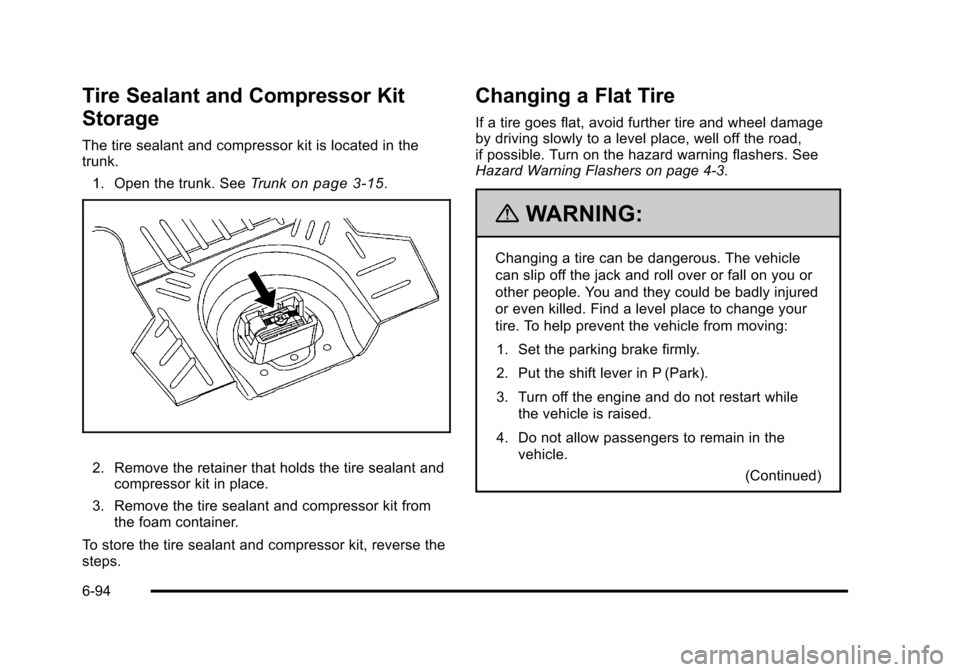
The tire sealant and compressor kit is located in the
trunk.1. Open the trunk. See Trunk
on page 3‑15.
2. Remove the retainer that holds the tire sealant and
compressor kit in place.
3. Remove the tire sealant and compressor kit from the foam container.
To store the tire sealant and compressor kit, reverse the
steps.
Changing a Flat Tire
If a tire goes flat, avoid further tire and wheel damage
by driving slowly to a level place, well off the road,
if possible. Turn on the hazard warning flashers. See
Hazard Warning Flashers on page 4‑3.
{WARNING:
Changing a tire can be dangerous. The vehicle
can slip off the jack and roll over or fall on you or
other people. You and they could be badly injured
or even killed. Find a level place to change your
tire. To help prevent the vehicle from moving:
1. Set the parking brake firmly.
2. Put the shift lever in P (Park).
3. Turn off the engine and do not restart while the vehicle is raised.
4. Do not allow passengers to remain in the vehicle.
(Continued)
6-94
Page 452 of 528
Black plate (102,1)Cadillac STS Owner Manual - 2011
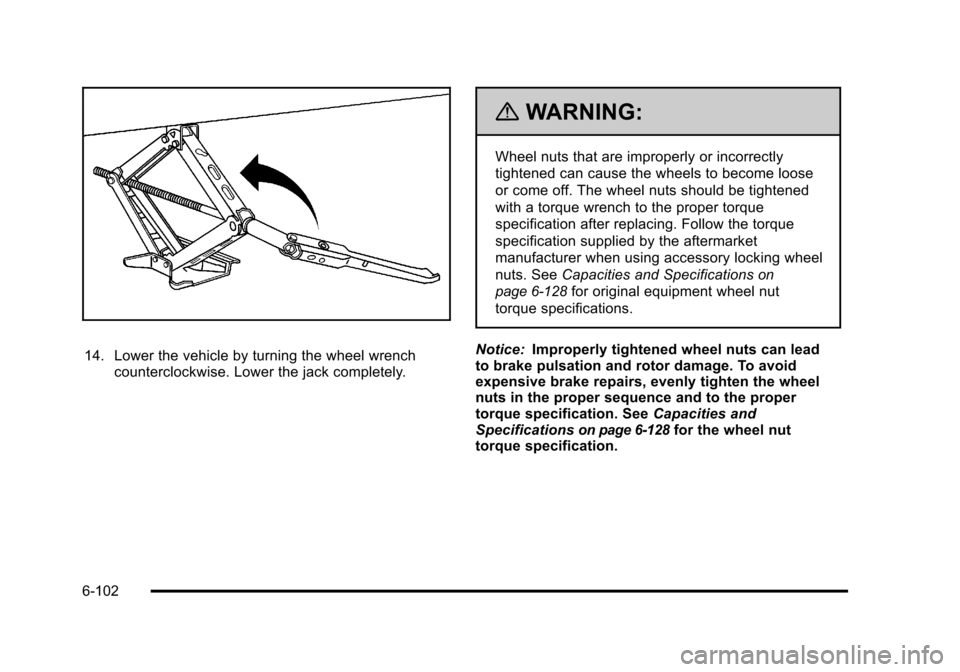
14. Lower the vehicle by turning the wheel wrenchcounterclockwise. Lower the jack completely.
{WARNING:
Wheel nuts that are improperly or incorrectly
tightened can cause the wheels to become loose
or come off. The wheel nuts should be tightened
with a torque wrench to the proper torque
specification after replacing. Follow the torque
specification supplied by the aftermarket
manufacturer when using accessory locking wheel
nuts. See Capacities and Specifications
on
page 6‑128
for original equipment wheel nut
torque specifications.
Notice: Improperly tightened wheel nuts can lead
to brake pulsation and rotor damage. To avoid
expensive brake repairs, evenly tighten the wheel
nuts in the proper sequence and to the proper
torque specification. See Capacities and
Specifications
on page 6‑128for the wheel nut
torque specification.
6-102
Page 467 of 528

Black plate (117,1)Cadillac STS Owner Manual - 2011
The underhood fuse block is located in the front of the
engine compartment on the passenger side of the
vehicle. SeeEngine Compartment Overview
on
page 6‑13for more information on location and
removal procedure for the front compartment underhood
sights shields.
To access the fuses, push in the tabs located on each
side of the fuse block cover, then lift the cover off.
Notice: Spilling liquid on any electrical component
on the vehicle may damage it. Always keep the
covers on any electrical component.
Fuses JCase Usage
ABS MTR ABS Module- ABS Module-Stabilitrak AFS Active Front Steering
BLWR Blower Motor
FAN 1 Cooling Fan-Low Speed
FAN 2 Cooling Fan-High Speed
LPDB 1 Driver Side Rear Fuse Block
LPDB 2 Driver Side Rear Fuse Block
RPDB 1 Passenger Side Rear Fuse Block
RPDB 2 Passenger Side Rear Fuse Block
Fuses JCase Usage
SPARE Spare
SPARE Spare
STRTR Starter
Fuses MiniUsage
A/C CLTCH Air Conditioning Compressor Clutch
ABS ABS Module-Stabilitrak
ABS IGN Antilock Brake Controller
AUX OUTLET Rear Accessory Power Outlet BRK
VAC PUMP Brake Vacuum Pump
CCP Climate Control Panel
CCP/RLY COILS Climate Control Panel, Headlamp
Level Control, Active Cruise Control,
Relay Coils, Starter, Front Blower
ECM 1 Engine Control Module (ECM)
ECM/TCM BATT ECM, Transmission Control
Module (TCM)
ECM/TCM IGN ECM, TCM, Instrument Panel Cluster
6-117
Page 469 of 528

Black plate (119,1)Cadillac STS Owner Manual - 2011
Fuses MiniUsage
V/CHKInstrument Panel Module-Voltage
Check
WPR Wipe/Wash Module Assembly
WPR SW/VICS Rain Sensor, Wiper Switch
Relays Usage
A/C CMPRSR
CLTCH Air Conditioning Compressor Clutch
ACCY Accessory, Rain Sensor, Headlamp
Washer Relay Coil, Windshield
Wiper/Washer Module
BRK
VAC PUMP Brake Vacuum Pump
FAN S/P Cooling Fan Series/Parallel
FOG LAMP Fog Lamps FRT BLWR Front Blower Motor
FUEL COOL Fuel Cooling Pump
HI BEAM High Beam Headlamp
HI FAN SPD Cooling Fan High Speed HORN Horn
Relays Usage
LO FAN SPD Cooling Fan Low Speed
LOW BEAM
W/O HID/HID Low Beam Headlamp, High Intensity
Discharge (HID)
PRK LAMP Parking Lamps, Instrument Panel
Dimming, Rear License Plate Lamps
PWR/TRN Engine Controls
RUN CRNK Heated Washer Nozzle, Air Quality,
Antilock Brake System, Climate
Control Panel, TCM, ECM, Instrument
Panel Cluster
SPARE Spare
SPARE Spare
SPARE Spare
STRTR Starter
WPR HI Windshield Wiper High Speed
Circuit
Breakers Usage
HDLP WASH
Headlamp Washer Motor
(Circuit Breaker)
6-119
Page 478 of 528
Black plate (128,1)Cadillac STS Owner Manual - 2011
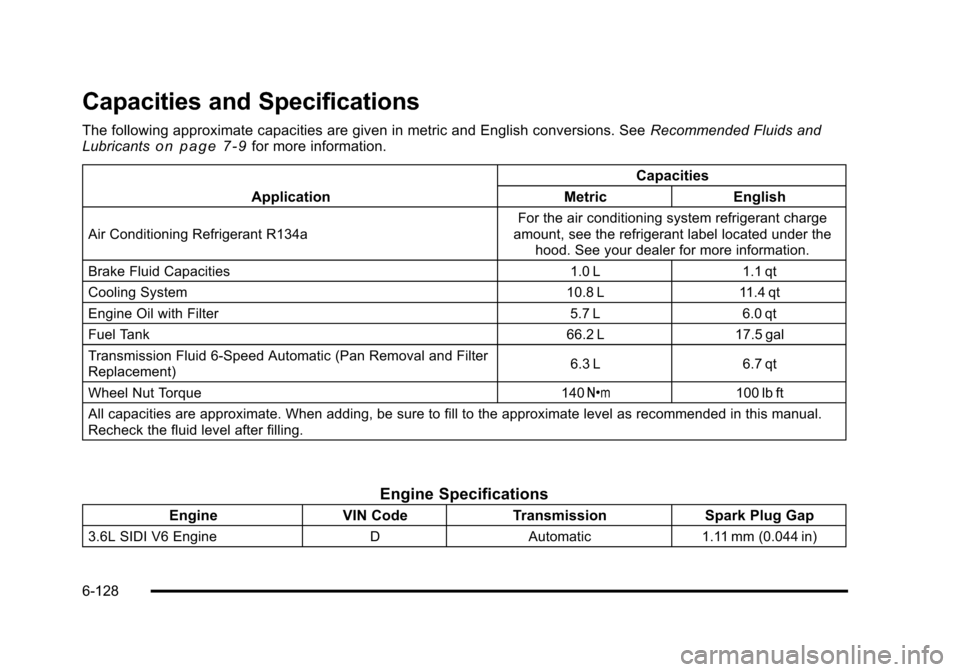
Capacities and Specifications
The following approximate capacities are given in metric and English conversions. SeeRecommended Fluids and
Lubricantson page 7‑9for more information.
Application Capacities
Metric English
Air Conditioning Refrigerant R134a For the air conditioning system refrigerant charge
amount, see the refrigerant label located under the hood. See your dealer for more information.
Brake Fluid Capacities 1.0 L1.1 qt
Cooling System 10.8 L11.4 qt
Engine Oil with Filter 5.7 L6.0 qt
Fuel Tank 66.2 L17.5 gal
Transmission Fluid 6-Speed Automatic (Pan Removal and Filter
Replacement) 6.3 L
6.7 qt
Wheel Nut Torque 140Y 100 lb ft
All capacities are approximate. When adding, be sure to fill to the approximate level as recommended in this manual.
Recheck the fluid level after filling.
Engine Specifications
Engine VIN CodeTransmission Spark Plug Gap
3.6L SIDI V6 Engine DAutomatic 1.11 mm (0.044 in)
6-128
Page 482 of 528
Black plate (4,1)Cadillac STS Owner Manual - 2011
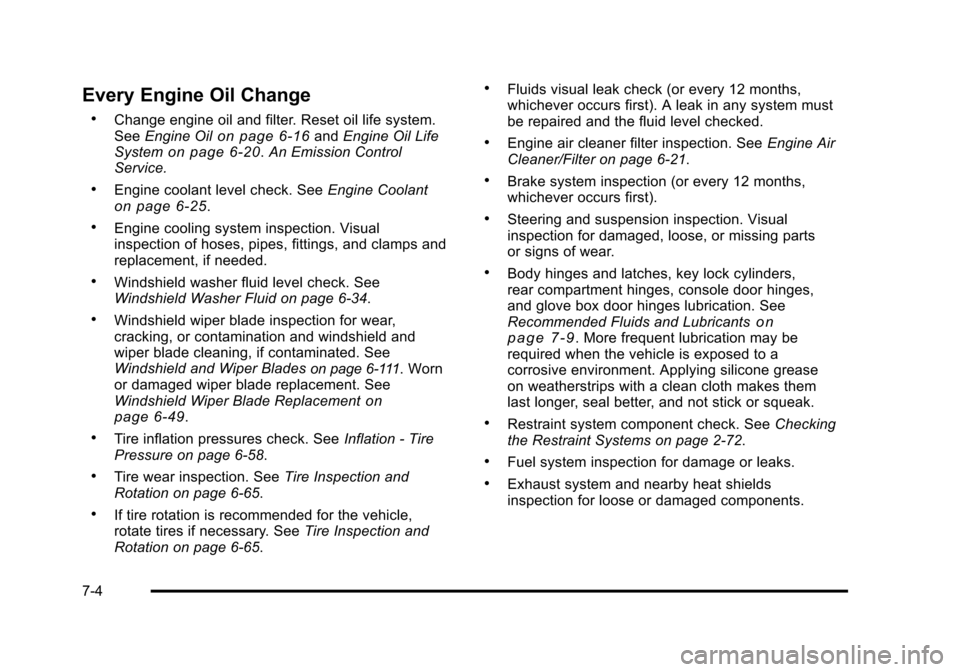
Every Engine Oil Change
.Change engine oil and filter. Reset oil life system.
SeeEngine Oilon page 6‑16andEngine Oil Life
Systemon page 6‑20. An Emission Control
Service.
.Engine coolant level check. See Engine Coolanton page 6‑25.
.Engine cooling system inspection. Visual
inspection of hoses, pipes, fittings, and clamps and
replacement, if needed.
.Windshield washer fluid level check. See
Windshield Washer Fluid on page 6‑34.
.Windshield wiper blade inspection for wear,
cracking, or contamination and windshield and
wiper blade cleaning, if contaminated. See
Windshield and Wiper Blades
on page 6‑111. Worn
or damaged wiper blade replacement. See
Windshield Wiper Blade Replacement
on
page 6‑49.
.Tire inflation pressures check. See Inflation - Tire
Pressure on page 6‑58.
.Tire wear inspection. See Tire Inspection and
Rotation on page 6‑65.
.If tire rotation is recommended for the vehicle,
rotate tires if necessary. See Tire Inspection and
Rotation on page 6‑65.
.Fluids visual leak check (or every 12 months,
whichever occurs first). A leak in any system must
be repaired and the fluid level checked.
.Engine air cleaner filter inspection. See Engine Air
Cleaner/Filter on page 6‑21.
.Brake system inspection (or every 12 months,
whichever occurs first).
.Steering and suspension inspection. Visual
inspection for damaged, loose, or missing parts
or signs of wear.
.Body hinges and latches, key lock cylinders,
rear compartment hinges, console door hinges,
and glove box door hinges lubrication. See
Recommended Fluids and Lubricants
on
page 7‑9. More frequent lubrication may be
required when the vehicle is exposed to a
corrosive environment. Applying silicone grease
on weatherstrips with a clean cloth makes them
last longer, seal better, and not stick or squeak.
.Restraint system component check. See Checking
the Restraint Systems on page 2‑72.
.Fuel system inspection for damage or leaks.
.Exhaust system and nearby heat shields
inspection for loose or damaged components.
7-4
Page 483 of 528
Black plate (5,1)Cadillac STS Owner Manual - 2011
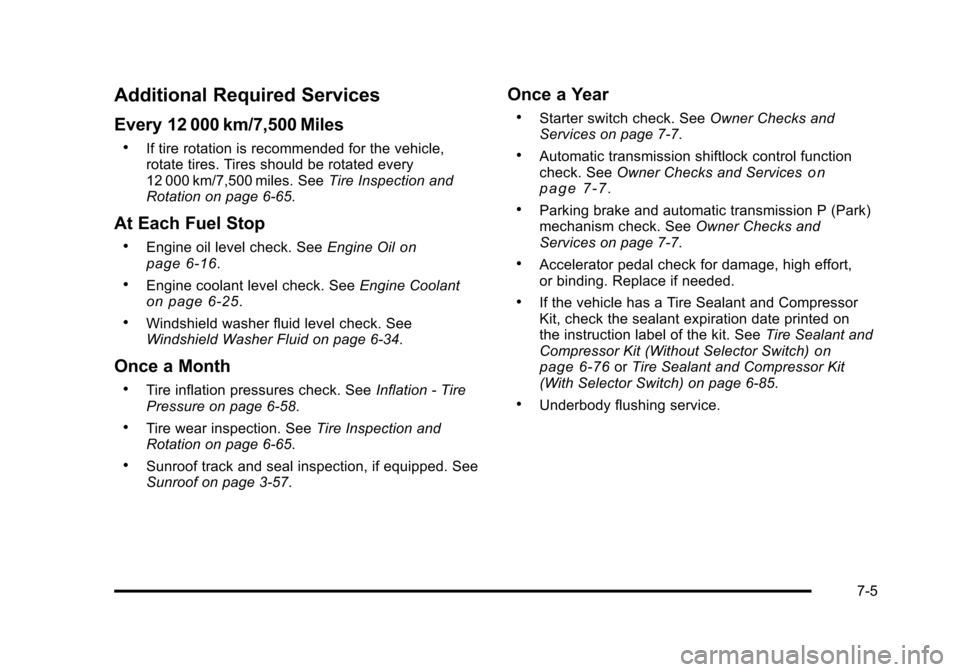
Additional Required Services
Every 12 000 km/7,500 Miles
.If tire rotation is recommended for the vehicle,
rotate tires. Tires should be rotated every
12 000 km/7,500 miles. SeeTire Inspection and
Rotation on page 6‑65.
At Each Fuel Stop
.Engine oil level check. See Engine Oilon
page 6‑16.
.Engine coolant level check. See Engine Coolanton page 6‑25.
.Windshield washer fluid level check. See
Windshield Washer Fluid on page 6‑34.
Once a Month
.Tire inflation pressures check. See Inflation - Tire
Pressure on page 6‑58.
.Tire wear inspection. See Tire Inspection and
Rotation on page 6‑65.
.Sunroof track and seal inspection, if equipped. See
Sunroof on page 3‑57.
Once a Year
.Starter switch check. See Owner Checks and
Services on page 7‑7.
.Automatic transmission shiftlock control function
check. See Owner Checks and Serviceson
page 7‑7.
.Parking brake and automatic transmission P (Park)
mechanism check. See Owner Checks and
Services on page 7‑7.
.Accelerator pedal check for damage, high effort,
or binding. Replace if needed.
.If the vehicle has a Tire Sealant and Compressor
Kit, check the sealant expiration date printed on
the instruction label of the kit. See Tire Sealant and
Compressor Kit (Without Selector Switch)
on
page 6‑76or Tire Sealant and Compressor Kit
(With Selector Switch) on page 6‑85.
.Underbody flushing service.
7-5