tow CADILLAC XLR 2008 1.G Owner's Manual
[x] Cancel search | Manufacturer: CADILLAC, Model Year: 2008, Model line: XLR, Model: CADILLAC XLR 2008 1.GPages: 470, PDF Size: 8.39 MB
Page 314 of 470
Rocking Your Vehicle to Get It Out
First, turn the steering wheel left and right to clear
the area around the front wheels. Turn off any traction
or stability system. SeeTraction Control System
(TCS) on page 5-6andStabiliTrak
®System on
page 5-8. Then shift back and forth between
REVERSE (R) and a forward gear, spinning the wheels
as little as possible. To prevent transmission wear,
wait until the wheels stop spinning before shifting gears.
Release the accelerator pedal while you shift, and
press lightly on the accelerator pedal when the
transmission is in gear. By slowly spinning the wheels in
the forward and reverse directions, you will cause a
rocking motion that could free your vehicle. If that does
not get your vehicle out after a few tries, it might
need to be towed out. If your vehicle does need to be
towed out, seeTowing Your Vehicle on page 5-27.
Loading Your Vehicle
It is very important to know how much weight your
vehicle can carry. This weight is called the
vehicle capacity weight and includes the weight of
all occupants, cargo, and all nonfactory-installed
options. Two labels on your vehicle show how
much weight it may properly carry, the Tire and
Loading Information label and the Certication
label.
{CAUTION:
Do not load your vehicle any heavier than
the Gross Vehicle Weight Rating (GVWR),
or either the maximum front or rear Gross
Axle Weight Rating (GAWR). If you do,
parts on your vehicle can break, and it
can change the way your vehicle handles.
These could cause you to lose control
and crash. Also, overloading can shorten
the life of your vehicle.
5-22
Page 316 of 470
Steps for Determining Correct Load Limit
1.Locate the statement “The combined weight of
occupants and cargo should never exceed
XXX kg or XXX lbs” on your vehicle’s placard.
2.Determine the combined weight of the driver
and passengers that will be riding in your
vehicle.
3.Subtract the combined weight of the driver
and passengers from XXX kg or XXX lbs.
4.The resulting gure equals the available
amount of cargo and luggage load capacity.
For example, if the “XXX” amount equals
1400 lbs and there will be ve 150 lb
passengers in your vehicle, the amount of
available cargo and luggage load capacity is
650 lbs (1400−750 (5 x 150) = 650 lbs).
5.Determine the combined weight of luggage
and cargo being loaded on the vehicle.
That weight may not safely exceed the
available cargo and luggage load capacity
calculated in Step 4.
6.If your vehicle will be towing a trailer, the load
from your trailer will be transferred to your
vehicle. Consult this manual to determine how
this reduces the available cargo and luggage
load capacity of your vehicle.
Your vehicle is neither designed nor intended
to tow a trailer.
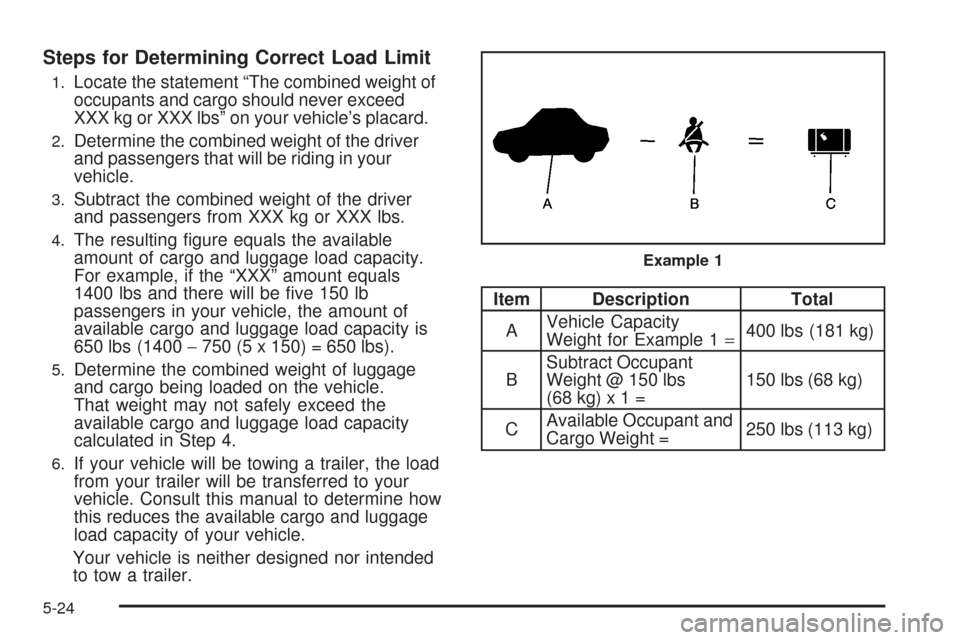
Item Description Total
AVehicle Capacity
Weight for Example 1=400 lbs (181 kg)
BSubtract Occupant
Weight @ 150 lbs
(68kg)x1=150 lbs (68 kg)
CAvailable Occupant and
Cargo Weight =250 lbs (113 kg)
Example 1
5-24
Page 319 of 470
If you put things inside your vehicle — like
suitcases, tools, packages, or anything
else — they will go as fast as the vehicle goes.
If you have to stop or turn quickly, or if there is a
crash, they will keep going.
{CAUTION:
Things you put inside your vehicle can
strike and injure people in a sudden stop
or turn, or in a crash.
Put things in the rear area of your
vehicle. Try to spread the weight
evenly.
Never stack heavier things, like
suitcases, inside the vehicle so that
some of them are above the tops of
the seats.
Do not leave an unsecured child
restraint in your vehicle.
When you carry something inside the
vehicle, secure it whenever you can.
Towing
Towing Your Vehicle
Consult your dealer/retailer or a professional towing
service if you need to have your disabled vehicle towed.
SeeRoadside Service on page 8-7.
Recreational Vehicle Towing
Notice:Dolly towing or dinghy towing your
vehicle may cause damage because of reduced
ground clearance. Always put your vehicle on
a atbed truck.
Your vehicle was neither designed nor intended to be
towed with any of its wheels on the ground. If your
vehicle must be towed, see “Towing Your Vehicle”
earlier in this section.
Towing a Trailer
Your XLR is neither designed nor intended to tow
a trailer.
5-27
Page 336 of 470
Engine Oil
If the LOW OIL LEVEL or LOW OIL PRESSURE
message on the Driver Information Center (DIC)
appears, check the engine oil level right away.
For more information, see LOW OIL LEVEL and
LOW OIL PRESSURE underDIC Warnings and
Messages on page 3-63. You should check the engine
oil level regularly; this is an added reminder.
Checking Engine Oil
It is a good idea to check the engine oil every time
you get fuel. In order to get an accurate reading,
the oil must be warm and the vehicle must be on
level ground.The engine oil dipstick handle is a yellow loop.
SeeEngine Compartment Overview on page 6-12for
the location of the engine oil dipstick.
1. Turn off the engine and give the oil several minutes
to drain back into the oil pan. If you do not
do this, the oil dipstick might not show the
actual level.
2. Pull out the dipstick and clean it with a paper
towel or cloth, then push it back in all the way.
Remove it again, keeping the tip down, and check
the level.
6-16
Page 342 of 470

Engine Air Cleaner/Filter
SeeEngine Compartment Overview on page 6-12for
the location of the engine air cleaner/lters.
When to Inspect the Engine Air
Cleaner/Filters
Inspect the air cleaner/lters at the MaintenanceII
intervals and replace them at the rst oil change after
each 50,000 mile (80 000 km) interval. SeeScheduled
Maintenance on page 7-4for more information.
If you are driving in dusty/dirty conditions, inspect the
lters at each engine oil change.
How to Inspect the Engine Air
Cleaner/Filters
To inspect the air cleaner/lters, remove the lters from
the vehicle and lightly shake the lters to release
loose dust and dirt. If the lters remain caked with dirt,
new lters are required.To inspect or replace the lters, do the following:
1. Some XLR-V vehicles, have a single piece black
cover that snaps over the entire air cleaner
assembly. For vehicles with this cover, simply pull it’s
left/right sides toward the outside of the vehicle and
lift up to remove cover. Reinstall the cover when you
are nished inspecting/replacing the lters.
2. Move the clasps on the top of the engine air
cleaner/lter cover forward to unlatch the cover.
6-22
Page 346 of 470
Checking Coolant
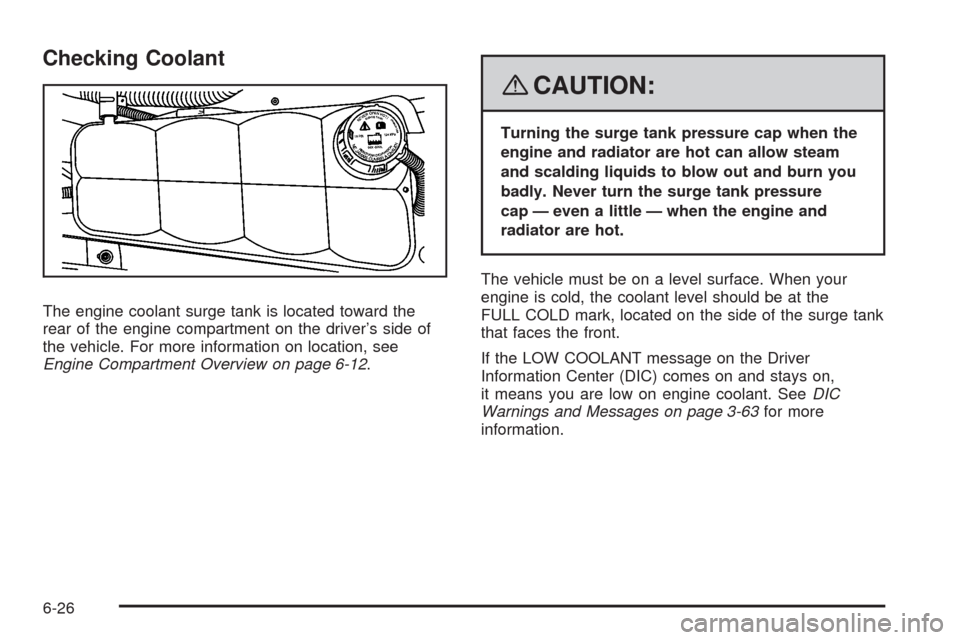
The engine coolant surge tank is located toward the
rear of the engine compartment on the driver’s side of
the vehicle. For more information on location, see
Engine Compartment Overview on page 6-12.
{CAUTION:
Turning the surge tank pressure cap when the
engine and radiator are hot can allow steam
and scalding liquids to blow out and burn you
badly. Never turn the surge tank pressure
cap — even a little — when the engine and
radiator are hot.
The vehicle must be on a level surface. When your
engine is cold, the coolant level should be at the
FULL COLD mark, located on the side of the surge tank
that faces the front.
If the LOW COOLANT message on the Driver
Information Center (DIC) comes on and stays on,
it means you are low on engine coolant. SeeDIC
Warnings and Messages on page 3-63for more
information.
6-26
Page 348 of 470
If Steam Is Coming From Your Engine
{CAUTION:
Steam from an overheated engine can burn
you badly, even if you just open the hood.
Stay away from the engine if you see or hear
steam coming from it. Turn it off and get
everyone away from the vehicle until it cools
down. Wait until there is no sign of steam or
coolant before you open the hood.
If you keep driving when the vehicles engine
is overheated, the liquids in it can catch re.
You or others could be badly burned. Stop
your engine if it overheats, and get out of the
vehicle until the engine is cool.
SeeOverheated Engine Protection Operating
Mode on page 6-29for information on driving
to a safe place in an emergency.Notice:If your engine catches re because you
keep driving with no coolant, your vehicle can
be badly damaged. The costly repairs would not be
covered by your warranty. SeeOverheated Engine
Protection Operating Mode on page 6-29for
information on driving to a safe place in an
emergency.
If No Steam Is Coming From Your
Engine
An overheat warning, along with a low coolant message,
can indicate a serious problem.
If you get an engine overheat warning with no low
coolant message, but see or hear no steam, the problem
may not be too serious. Sometimes the engine can
get a little too hot when you:
Climb a long hill on a hot day.
Stop after high-speed driving.
Idle for long periods in traffic.
Tow a trailer.
6-28
Page 385 of 470
Tire Inspection and Rotation
We recommend that you regularly inspect your
vehicle’s tires for signs of wear or damage.
SeeWhen It Is Time for New Tires on page 6-66
for additional information.
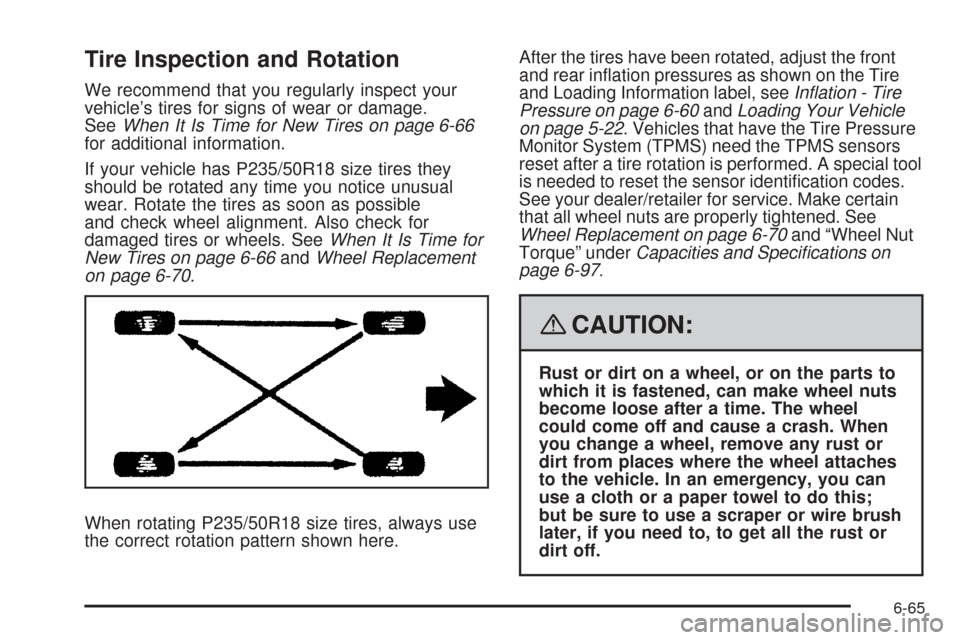
If your vehicle has P235/50R18 size tires they
should be rotated any time you notice unusual
wear. Rotate the tires as soon as possible
and check wheel alignment. Also check for
damaged tires or wheels. SeeWhen It Is Time for
New Tires on page 6-66andWheel Replacement
on page 6-70.
When rotating P235/50R18 size tires, always use
the correct rotation pattern shown here.After the tires have been rotated, adjust the front
and rear ination pressures as shown on the Tire
and Loading Information label, seeInflation - Tire
Pressure on page 6-60andLoading Your Vehicle
on page 5-22. Vehicles that have the Tire Pressure
Monitor System (TPMS) need the TPMS sensors
reset after a tire rotation is performed. A special tool
is needed to reset the sensor identication codes.
See your dealer/retailer for service. Make certain
that all wheel nuts are properly tightened. See
Wheel Replacement on page 6-70and “Wheel Nut
Torque” underCapacities and Specifications on
page 6-97
.
{CAUTION:
Rust or dirt on a wheel, or on the parts to
which it is fastened, can make wheel nuts
become loose after a time. The wheel
could come off and cause a crash. When
you change a wheel, remove any rust or
dirt from places where the wheel attaches
to the vehicle. In an emergency, you can
use a cloth or a paper towel to do this;
but be sure to use a scraper or wire brush
later, if you need to, to get all the rust or
dirt off.
6-65
Page 391 of 470

If you need to replace any of your wheels, wheel bolts or
wheel nuts, replace them only with new GM original
equipment parts. This way, you will be sure to have the
right wheel, wheel bolts, and wheel nuts for your vehicle.
{CAUTION:
Using the wrong replacement wheels, wheel
bolts, or wheel nuts on your vehicle can be
dangerous. It could affect the braking and
handling of your vehicle, make your tires lose
air and make you lose control. You could have
a collision in which you or others could be
injured. Always use the correct wheel, wheel
bolts, and wheel nuts for replacement.
Notice:The wrong wheel can also cause problems
with bearing life, brake cooling, speedometer or
odometer calibration, headlamp aim, bumper height,
vehicle ground clearance, and tire clearance to
the body and chassis.
{CAUTION:
Rust or dirt on a wheel, or on the parts to
which it is fastened, can make wheel nuts
become loose after a time. The wheel
could come off and cause a crash. When
you change a wheel, remove any rust or
dirt from places where the wheel attaches
to the vehicle. In an emergency, you can
use a cloth or a paper towel to do this;
but be sure to use a scraper or wire brush
later, if you need to, to get all the rust or
dirt off.
{CAUTION:
Never use oil or grease on studs or the threads
of the wheel nuts. If you do, the wheel nuts
might come loose and the wheel could fall off,
causing a crash.
6-71
Page 401 of 470
Use only mild, neutral-pH soaps. Avoid laundry
detergents or dishwashing soaps with degreasers.
Using too much soap will leave a residue that
leaves streaks and attracts dirt. For liquid cleaners,
about 20 drops per gallon (3.78 L) of water is a
good guide.
Do not heavily saturate your upholstery while
cleaning.
Damage to your vehicle’s interior may result from
the use of many organic solvents such as naptha,
alcohol, etc.
Fabric/Carpet
Use a vacuum cleaner with a soft brush attachment
frequently to remove dust and loose dirt. A canister
vacuum with a beater bar in the nozzle may only
be used on oor carpet and carpeted oor mats.
For soils, always try to remove them rst with plain
water or club soda. Before cleaning, gently remove as
much of the soil as possible using one of the following
techniques:
For liquids: gently blot the remaining soil with a
paper towel. Allow the soil to absorb into the
paper towel until no more can be removed.
For solid dry soils: remove as much as possible
and then vacuum.To clean, use the following instructions:
1. Saturate a lint-free, clean white cloth with water or
club soda.
2. Wring the cloth to remove excess moisture.
3. Start on the outside edge of the soil and gently rub
toward the center. Continue cleaning, using a clean
area of the cloth each time it becomes soiled.
4. Continue to gently rub the soiled area until the
cleaning cloth remains clean.
5. If the soil is not completely removed, use a mild
soap solution and repeat the cleaning process
that was used with plain water.
If any of the soil remains, a commercial fabric cleaner or
spot lifter may be necessary. When a commercial
upholstery cleaner or spot lifter is to be used, test a
small hidden area for colorfastness rst. If the locally
cleaned area gives any impression that a ring formation
may result, clean the entire surface.
After the cleaning process has been completed, a paper
towel can be used to blot excess moisture from the
fabric or carpet.
6-81