headlamp CADILLAC XLR 2009 1.G User Guide
[x] Cancel search | Manufacturer: CADILLAC, Model Year: 2009, Model line: XLR, Model: CADILLAC XLR 2009 1.GPages: 462, PDF Size: 3.72 MB
Page 151 of 462

Twilight Sentinel®
This feature can turn the lamps on and off for you.
A light sensor on top of the instrument panel makes the
Twilight Sentinel
®work, so be sure it is not covered.
With Twilight Sentinel
®you will see the following happen:
When it is dark enough outside, the front turn signal
lamps (DRL) will go off, and the headlamps and
parking lamps will come on. The other lamps that
come on with headlamps will also come on.
When it is bright enough outside, the headlamps will
go off, and the front turn signal lamps (DRL) will
come on, as long as the exterior lamp switch is in the
AUTO position.
If the vehicle is started in a dark garage, the automatic
headlamp system will come on immediately. Once the
vehicle leaves the garage, it takes about one minute for
the automatic headlamp system to change to DRL if
it is light outside. During that delay, the instrument panel
cluster may not be as bright as usual. Make sure the
instrument panel brightness control is in full bright
position. SeeInstrument Panel Brightness on page 3-30
for more information.You can idle the vehicle with the lamps off, even when
it is dark outside. After starting the vehicle, turn the
exterior lamp control band to off, then release it.
The lamps will remain off until you turn the control
band to off again.
Twilight Sentinel
®also provides exterior illumination as
you leave the vehicle. If Twilight Sentinel®has turned
on the lamps when you turn off the ignition, the
lamps will remain on until:
The exterior lamp switch is moved from OFF to the
parking lamp position, or
the delay time selected has elapsed.
SeeDriver Information Center (DIC) on page 3-57to
select the delay time. You can also select no delay time.
If the ignition is turned off with the exterior lamp switch
in the parking lamp or headlamp position, the Twilight
Sentinel
®delay will not occur. The lamps will turn off as
soon as the switch is turned off.
The regular headlamp system should be turned on
when needed.
3-29
Page 152 of 462

Exterior Lighting Battery Saver
If the manual parking lamps or headlamps have been
left on, the exterior lamps will turn off as soon as
the ignition is turned off or Retained Accessory Power
(RAP) is active. This protects against draining the
battery in case you have accidentally left the headlamps
or parking lamps on. The battery saver does not work
if the headlamps are turned on after the ignition switch is
turned to off.
If you need to leave the lamps on, use the exterior lamp
control to turn the lamps back on.
Instrument Panel Brightness
The button for this feature is located on the instrument
panel to the left of the steering column.
+
!- (Brightness):Press to change the brightness of
the instrument panel lights.
Press the DIMMER button until PANEL DIMMING
appears on the Driver Information Center (DIC). Then
use the brightness button to adjust the instrument panel
brightness. Press the top or bottom of the button to
brighten or dim the lights. SeeHead-Up Display (HUD)
on page 3-31for more information.Be sure not to have the brightness turned all the way
down with the lamps on during the day. The DIC
may not be visible.
Courtesy Lamps
When any door or the trunk lid is opened, the interior
lamps will go on unless it is bright outside.
Press the interior lamp button on the right side of the
instrument panel, to turn the courtesy lamps on or off.
Entry/Exit Lighting
With entry lighting, the interior lamps will come on when
entering the vehicle. The interior lamps will come on
for about 20 seconds when the engine is turned off.
You can turn exit and entry lighting off by quickly turning
the courtesy lamps on and off.
Reading Lamps
The inside rearview mirror includes two reading lamps.
The lamps will go on when a door is opened. When
the doors are closed, each lamp can be turned on
individually by pressing the button for that lamp.
3-30
Page 177 of 462

Security Light
For information regarding
this light and the vehicle’s
security system, see
Theft-Deterrent System
on page 2-20.
Fog Lamp Light
The fog lamp light comes
on when the fog lamps are
in use.
The light goes out when the fog lamps are turned off.
SeeFog Lamps on page 3-28for more information.
Lights On Reminder
This light comes on
whenever the headlamps
are on.
SeeHorn on page 3-6for more information.
Highbeam On Light
This light comes on when
the high-beam headlamps
are in use.
SeeHeadlamp High/Low-Beam Changer on page 3-8
for more information.
United States Only
3-55
Page 184 of 462
DRIVER NO. X (1 OR 2)
This message displays when the vehicle is started or
when there is a change of driver. The message
shows which driver is activating the personalization
feature. It will only stay on for ve seconds.
ENGINE HOT, STOP ENGINE
This message displays when the engine has overheated.
Stop and turn the engine off immediately to avoid
severe engine damage. SeeEngine Overheating on
page 6-27. A multiple chime also sounds when
this message displays.
ENGINE PROTECTION REDUCE
ENGINE RPM
If this message displays, the control system has
determined that continued operation at the existing
engine speed may lead to engine overheating. Lower
the engine speed by upshifting the transmission or drive
at a lower speed.
HEADLAMPS SUGGESTED
This message displays if it is dark enough outside and
the headlamps and Twilight Sentinel®controls are
off. This message informs the driver that turning on theexterior lamps is recommended. It has become dark
enough outside to require the headlamps and/or other
exterior lamps. This message also displays if the
optional Rainsense™ wiping feature is on and the
Twilight Sentinel is off.
HIGH TRANS (Transmission) TEMP
(Temperature)
This message displays when the transmission uid in
the vehicle is too hot. Stop and allow the vehicle to idle
until it cools down or until this message is removed.
HIGH VOLTAGE
This message displays when the electrical charging
system is overcharging. To avoid being stranded, have
the electrical system checked by your dealer/retailer.
You can reduce the charging overload by using
the accessories. Turn on the lamps and radio, set the
climate control on AUTO and the fan speed on HI,
and turn the rear window defogger on. You can monitor
battery voltage on the DIC by pressing the information
button. The normal range is 11.5 to 15.5 volts when the
engine is running.
3-62
Page 194 of 462
DIC Vehicle Personalization
The vehicle has personalization capabilities that allow
you to program certain features to a preferred setting for
up to two drivers. The back of the keyless access
transmitters are labelled 1 or 2.
The current driver preferences are recalled when one of
the following occurs:
The lock or unlock button on the keyless access
transmitter, programmed as 1 or 2, is pressed.
The appropriate memory button, 1 or 2, located on
the driver seat is pressed. SeeMemory Seat,
Mirrors and Steering Wheel on page 1-3for more
information.
A valid keyless access transmitter is detected upon
opening the driver door.
If more than one valid keyless access transmitter is
detected upon opening the driver door, the driver
preferences for the lowest driver number will be recalled.
If a keyless access transmitter is programmed as
#3 or #4, the personalization system will not recognize
the transmitter. The Driver Information Center (DIC)
will not display a current driver number and the features
that are normally programmed through the DIC will
be set to the default states. Also, if the OPTIONS button
is pressed, the DIC does not display the menus used
to set personalizations, but instead displays OPTIONS
UNAVAILABLE for a few seconds.
Feature Programming
To change feature preferences, make sure the vehicle
is running and in P (Park). To avoid excessive drain
on the battery, it is recommended that the headlamps
are turned off. Press the OPTIONS button and the Driver
Information Center (DIC) will display the current driver
for a few seconds, then display the rst personalization
menu item. You can now use the OPTIONS button
to change the setting of the displayed feature. Press the
top or bottom of the information button to scroll up or
down the list of features. When you get to a feature you
want to change, press the OPTIONS button again.
When you are nished, press the RESET button to exit
the personalization menu. If no button is pressed within
45 seconds, the DIC will exit the personalization menu.
The following are DIC options that will be available in the
personalization menu.
Auto Recall
This feature allows the steering column, outside mirrors
and the driver seat to automatically move to the
current driver’s set position when the engine starts.
The DIC will display AUTO RECALL OFF or AUTO
RECALL ON. Press the OPTIONS button to change
the setting.
3-72
Page 195 of 462

Auto Exit Recall
This feature allows the steering column and driver seat
to automatically move to the current driver’s exit
position when one of the following occurs:
The vehicle is turned off or in RAP or accessory
mode and the driver’s door is opened.
The vehicle is turned off or in RAP and the unlock
button on the keyless access transmitter is
pressed.
The DIC will display AUTO EXIT RECALL OFF or
AUTO EXIT RECALL ON. Press the OPTIONS button
to change the setting.
Approach Lights
This feature activates the parking lamps, front fog lamps
and back-up lamps during low light periods when the
unlock button on the keyless access transmitter is
pressed, both doors are closed and the vehicle is off or
in RAP. The lamps remain on for 20 seconds or until
a door is opened, the lock button on the keyless access
transmitter is pressed or the vehicle is no longer off
or in RAP.
The DIC will display APPROACH LIGHTS OFF or
APPROACH LIGHTS ON. Press the OPTIONS button
to change the setting.
Exit Lights
This feature activates the parking lamps and front fog
lamps for 15, 30 or 90 seconds. This will occur when the
vehicle is off or in RAP and the headlamps are on
due to the automatic headlamp system. The parking
lamps and front fog lamps will remain on until the driver
selected time period expires, the exterior lamp control
is activated or the vehicle is no longer off or in RAP.
The DIC will display EXIT LIGHTS OFF, EXIT
LIGHTS - 15 SEC, EXIT LIGHTS - 30 SEC, or EXIT
LIGHTS - 90 SEC. Press the OPTIONS button to
change the setting.
Flash at Unlock
This feature activates the front and rear turn signals for
two short ashes when the unlock or trunk button on
the keyless access transmitter is pressed. This will only
occur when the vehicle is off.
The DIC will display NO FLASH AT UNLOCK or
FLASH AT UNLOCK. Press the OPTIONS button to
change the setting.
3-73
Page 308 of 462
Racing or Other Competitive Driving
(XLR-V)
See your warranty book before using your vehicle for
racing or other competitive driving.
Notice:If you use your vehicle for racing or other
competitive driving, the engine may use more oil than
it would with normal use. Low oil levels can damage
the engine. Be sure to check the oil level often during
racing or other competitive driving and keep the level
at or near 2 quarts (2 L) above the upper mark that
shows the proper operating range on the engine oil
dipstick. For information on how to add oil, see
Engine Oil on page 6-15. After the competitive
driving, remove excess oil so that the level on the
dipstick is not above the upper mark that shows the
proper operating range.
Driving at Night
Night driving is more dangerous than day driving because
some drivers are likely to be impaired — by alcohol or
drugs, with night vision problems, or by fatigue.Night driving tips include:
Drive defensively.
Do not drink and drive.
Reduce headlamp glare by adjusting the inside
rearview mirror.
Slow down and keep more space between you and
other vehicles because headlamps can only light up
so much road ahead.
Watch for animals.
When tired, pull off the road.
Do not wear sunglasses.
Avoid staring directly into approaching headlamps.
Keep the windshield and all glass on your vehicle
clean — inside and out.
Keep your eyes moving, especially during turns or
curves.
No one can see as well at night as in the daytime.
But, as we get older, these differences increase.
A 50-year-old driver might need at least twice as much
light to see the same thing at night as a 20-year-old.
5-14
Page 313 of 462

{CAUTION:
Snow can trap engine exhaust under the vehicle.
This may cause exhaust gases to get inside.
Engine exhaust contains carbon monoxide (CO)
which cannot be seen or smelled. It can cause
unconsciousness and even death.
If the vehicle is stuck in the snow:
Clear away snow from around the base of
your vehicle, especially any that is blocking
the exhaust pipe.
Check again from time to time to be sure
snow does not collect there.
Open a window about two inches on the side
of the vehicle that is away from the wind to
bring in fresh air.
Fully open the air outlets on or under the
instrument panel.
Adjust the Climate Control system to a setting
that circulates the air inside the vehicle and
set the fan speed to the highest setting.
See Climate Control System in the Index.
For more information about carbon monoxide,
seeEngine Exhaust on page 2-36.
CAUTION: (Continued)
CAUTION: (Continued)
Snow can trap exhaust gases under your vehicle.
This can cause deadly CO (carbon monoxide) gas
to get inside. CO could overcome you and kill you.
You cannot see it or smell it, so you might not
know it is in your vehicle. Clear away snow from
around the base of your vehicle, especially any
that is blocking the exhaust.
Run the engine for short periods only as needed to
keep warm, but be careful.
To save fuel, run the engine for only short periods as
needed to warm the vehicle and then shut the engine off
and close the window most of the way to save heat.
Repeat this until help arrives but only when you
feel really uncomfortable from the cold. Moving about to
keep warm also helps.
If it takes some time for help to arrive, now and then
when you run the engine, push the accelerator
pedal slightly so the engine runs faster than the idle
speed. This keeps the battery charged to restart
the vehicle and to signal for help with the headlamps.
Do this as little as possible to save fuel.
5-19
Page 321 of 462
Service............................................................6-3
Accessories and Modications..........................6-3
California Proposition 65 Warning.....................6-4
California Perchlorate Materials Requirements.....6-4
Doing Your Own Service Work.........................6-4
Adding Equipment to the Outside of the
Vehicle......................................................6-5
Fuel................................................................6-5
Gasoline Octane............................................6-5
Gasoline Specications....................................6-6
California Fuel...............................................6-6
Additives.......................................................6-6
Fuels in Foreign Countries...............................6-7
Filling the Tank..............................................6-8
Filling a Portable Fuel Container.....................6-10
Checking Things Under the Hood....................6-10
Hood Release..............................................6-11
Engine Compartment Overview.......................6-12
Engine Oil...................................................6-15
Engine Oil Life System..................................6-18
Engine Air Cleaner/Filter................................6-20
Automatic Transmission Fluid.........................6-21
Cooling System............................................6-22
Engine Coolant.............................................6-23Engine Overheating.......................................6-27
Overheated Engine Protection
Operating Mode........................................6-29
Power Steering Fluid.....................................6-30
Windshield Washer Fluid................................6-31
Brakes........................................................6-32
Battery........................................................6-35
Jump Starting...............................................6-36
Rear Axle.......................................................6-41
Headlamp Aiming...........................................6-42
Headlamp Vertical Aiming..............................6-43
Bulb Replacement..........................................6-45
Windshield Replacement.................................6-45
Windshield Wiper Blade Replacement..............6-45
Tires..............................................................6-46
Winter Tires (XLR-V).....................................6-47
Tire Sidewall Labeling...................................6-48
Tire Terminology and Denitions.....................6-50
Run-Flat Tires..............................................6-52
Ination - Tire Pressure.................................6-54
Tire Pressure Monitor System.........................6-55
Tire Pressure Monitor Operation.....................6-57
Tire Inspection and Rotation...........................6-60
Section 6 Service and Appearance Care
6-1
Page 362 of 462
Headlamp Aiming
The high intensity discharge (HID) visual optical aiming
type headlamps have been preset at the factory and
should need no further adjustment. If the headlamps
need to be re-aimed, it is recommended to see your
dealer/retailer for service. However, it is possible to
re-aim the headlamps as described in the following
procedure.
Notice:To make sure the headlamps are aimed
properly, read all the instructions before beginning.
Failure to follow these instructions could cause
damage to headlamp parts.
The vehicle should be properly prepared as follows:
The vehicle should be placed so the headlamps are
25 ft (7.6 m) from a light colored wall.
The vehicle must have all four tires on a perfectly
level surface which is level all the way to the wall.
The vehicle should be placed so it is perpendicular
to the wall.
The vehicle should not have any snow, ice, or mud
attached to it.
The vehicle should be fully assembled all other
work stopped while headlamp aiming is being done.
The vehicle should be normally loaded with a
full tank of fuel and one person or 160 lbs (75 kg) on
the driver seat.
The tires should be properly inated.
Start the vehicle and rock it to level the suspension.
Headlamp aiming is done with the low-beam
headlamps. The high-beam headlamps are correctly
aimed if the low-beam headlamps are aimed properly.
The headlamp aiming
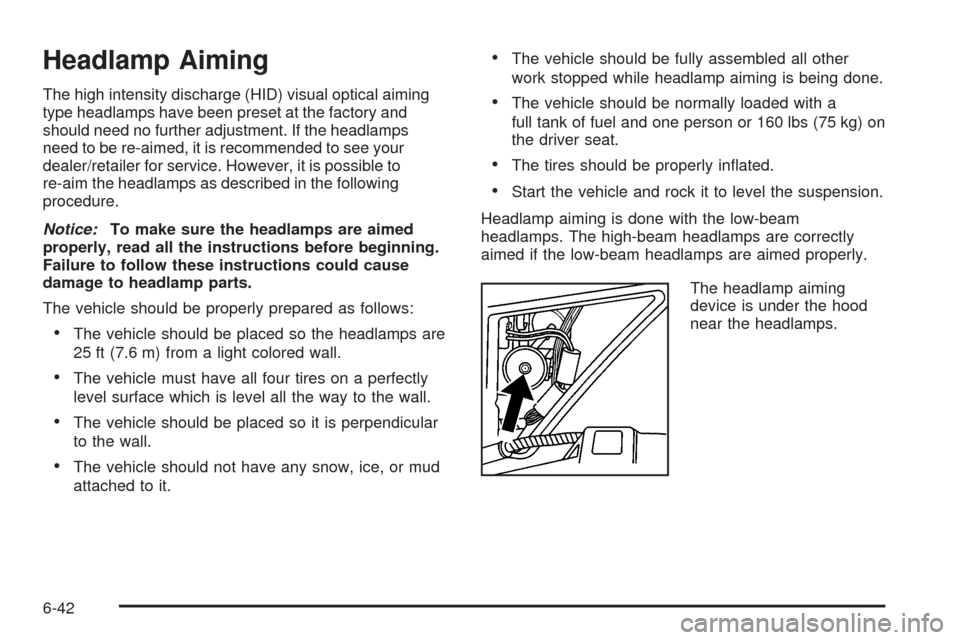
device is under the hood
near the headlamps.
6-42