coolant CADILLAC XTS 2018 User Guide
[x] Cancel search | Manufacturer: CADILLAC, Model Year: 2018, Model line: XTS, Model: CADILLAC XTS 2018Pages: 370, PDF Size: 6.45 MB
Page 248 of 370
Cadillac XTS Owner Manual (GMNA-Localizing-U.S./Canada-11354412) -
2018 - crc - 11/16/17
VEHICLE CARE 247
Caution
Do not use anything other than a
mix of DEX-COOL coolant that
meets GM Standard GMW3420 and
clean, drinkable water. Anything
else can cause damage to the
engine cooling system and the
vehicle, which would not be covered
by the vehicle warranty.
Never dispose of engine coolant by
putting it in the trash, pouring it on
the ground, or pouring into sewers,
streams, or bodies of water. Have the
coolant changed by an authorized
service center, familiar with legal
requirements regarding used coolant
disposal. This will help protect the
environment and your health.
Checking Coolant
The vehicle must be on a level surface
when checking the coolant level.
The engine coolant surge tank and
CAC bottle are in the engine
compartment on the driver side of the
vehicle. See Engine Compartment
Overview 0236.
Check to see if coolant is visible in the
surge tank and CAC bottle. If the
coolant inside the surge tank is
boiling, do not do anything else until
it cools down. If coolant is visible but
the coolant level is not at or above the
mark pointed to on the surge tank or
at the CAC bottle cold fill mark, add a
50/50 mixture of clean, drinkable
water and DEX-COOL coolant.
Be sure the cooling system is cool
before this is done. If no coolant is visible in the coolant
surge tank or CAC bottle, add coolant
as follows:
How to Add Coolant to the
Surge Tank
{Warning
Plain water, or other liquids such as
alcohol, can boil before the proper
coolant mixture will. With plain
water or the wrong mixture, the
engine could get too hot but there
would not be an overheat warning.
The engine could catch fire and you
or others could be burned.
{Warning
Spilling coolant on hot engine parts
can burn you. Coolant contains
ethylene glycol and it will burn if
the engine parts are hot enough.
Page 249 of 370
Cadillac XTS Owner Manual (GMNA-Localizing-U.S./Canada-11354412) -
2018 - crc - 11/16/17
248 VEHICLE CARE
Caution
Failure to follow the specific
coolant fill procedure could cause
the engine to overheat and could
cause system damage. If coolant is
not visible in the surge tank,
contact your dealer.
The coolant surge tank pressure cap
can be removed when the cooling
system, including the surge tank
pressure cap and upper radiator hose,
is no longer hot.
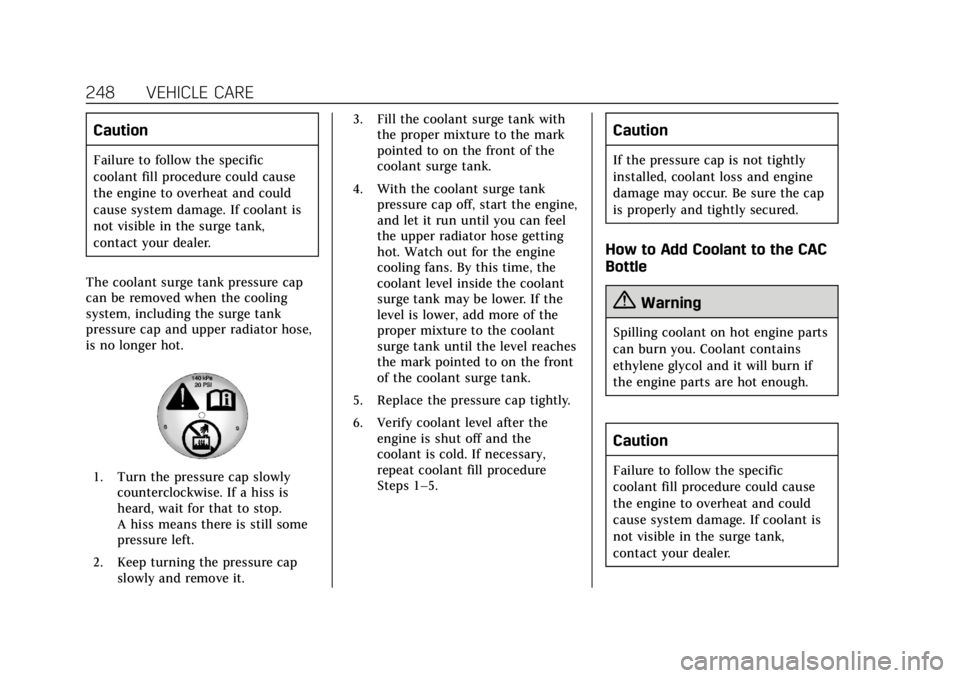
1. Turn the pressure cap slowly counterclockwise. If a hiss is
heard, wait for that to stop.
A hiss means there is still some
pressure left.
2. Keep turning the pressure cap slowly and remove it. 3. Fill the coolant surge tank with
the proper mixture to the mark
pointed to on the front of the
coolant surge tank.
4. With the coolant surge tank pressure cap off, start the engine,
and let it run until you can feel
the upper radiator hose getting
hot. Watch out for the engine
cooling fans. By this time, the
coolant level inside the coolant
surge tank may be lower. If the
level is lower, add more of the
proper mixture to the coolant
surge tank until the level reaches
the mark pointed to on the front
of the coolant surge tank.
5. Replace the pressure cap tightly.
6. Verify coolant level after the engine is shut off and the
coolant is cold. If necessary,
repeat coolant fill procedure
Steps 1–5.
Caution
If the pressure cap is not tightly
installed, coolant loss and engine
damage may occur. Be sure the cap
is properly and tightly secured.
How to Add Coolant to the CAC
Bottle
{Warning
Spilling coolant on hot engine parts
can burn you. Coolant contains
ethylene glycol and it will burn if
the engine parts are hot enough.
Caution
Failure to follow the specific
coolant fill procedure could cause
the engine to overheat and could
cause system damage. If coolant is
not visible in the surge tank,
contact your dealer.
Page 250 of 370
Cadillac XTS Owner Manual (GMNA-Localizing-U.S./Canada-11354412) -
2018 - crc - 11/16/17
VEHICLE CARE 249
The CAC bottle pressure cap can be
removed when the Charged Air
Coolant cooling system, including the
CAC bottle pressure cap, is no
longer hot.
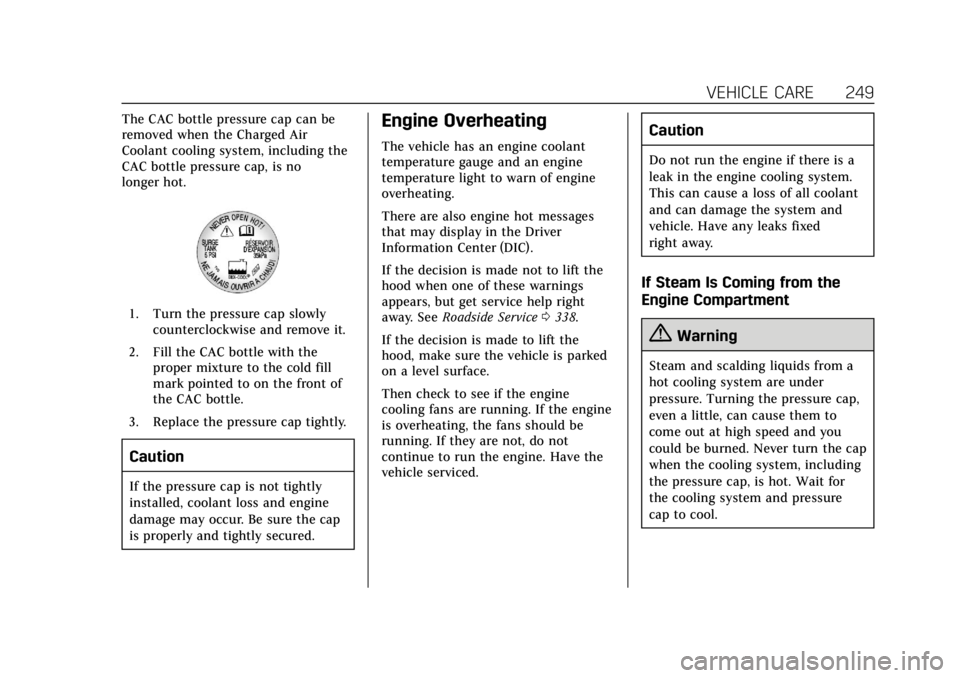
1. Turn the pressure cap slowlycounterclockwise and remove it.
2. Fill the CAC bottle with the proper mixture to the cold fill
mark pointed to on the front of
the CAC bottle.
3. Replace the pressure cap tightly.
Caution
If the pressure cap is not tightly
installed, coolant loss and engine
damage may occur. Be sure the cap
is properly and tightly secured.
Engine Overheating
The vehicle has an engine coolant
temperature gauge and an engine
temperature light to warn of engine
overheating.
There are also engine hot messages
that may display in the Driver
Information Center (DIC).
If the decision is made not to lift the
hood when one of these warnings
appears, but get service help right
away. See Roadside Service 0338.
If the decision is made to lift the
hood, make sure the vehicle is parked
on a level surface.
Then check to see if the engine
cooling fans are running. If the engine
is overheating, the fans should be
running. If they are not, do not
continue to run the engine. Have the
vehicle serviced.Caution
Do not run the engine if there is a
leak in the engine cooling system.
This can cause a loss of all coolant
and can damage the system and
vehicle. Have any leaks fixed
right away.
If Steam Is Coming from the
Engine Compartment
{Warning
Steam and scalding liquids from a
hot cooling system are under
pressure. Turning the pressure cap,
even a little, can cause them to
come out at high speed and you
could be burned. Never turn the cap
when the cooling system, including
the pressure cap, is hot. Wait for
the cooling system and pressure
cap to cool.
Page 251 of 370
Cadillac XTS Owner Manual (GMNA-Localizing-U.S./Canada-11354412) -
2018 - crc - 11/16/17
250 VEHICLE CARE
If No Steam Is Coming from the
Engine Compartment
If an engine overheat warning is
displayed but no steam can be seen or
heard, the problem may not be too
serious. Sometimes the engine can get
a little too hot when the vehicle:
.Climbs a long hill on a hot day.
. Stops after high-speed driving.
. Idles for long periods in traffic.
. Tows a trailer.
If the overheat warning is displayed
with no sign of steam: 1. Turn the air conditioning off.
2. Turn the heater on to the highest temperature and to the highest
fan speed. Open the windows as
necessary.
3. When it is safe to do so, pull off the road, shift to P (Park) or
N (Neutral), and let the
engine idle.
If the temperature overheat gauge is
no longer in the overheat zone or an
overheat warning no longer displays,
the vehicle can be driven. Continue to drive the vehicle slow for about
10 minutes. Keep a safe vehicle
distance from the car in front of you.
If the warning does not come back on,
continue to drive normally and have
the cooling system checked for proper
fill and function.
If the warning continues, pull over,
stop, and park the vehicle right away.
If there is no sign of steam, idle the
engine for three minutes while parked.
If the warning is still displayed, turn
off the engine until it cools down.
Also, see
“Overheated Engine
Protection Operating Mode ”next in
this section.
Overheated Engine
Protection Operating Mode
This emergency operating mode
allows the vehicle to be driven to a
safe place in an emergency situation.
If an overheated engine condition
exists, an overheat protection mode,
which alternates firing groups of
cylinders, helps prevent engine damage. In this mode, there is
significant loss in power and engine
performance.
The engine coolant temperature
warning light comes on in the
instrument cluster, to indicate the
vehicle has entered overheated engine
protection operating mode. The
temperature gauge also indicates an
overheat condition exists. Driving
extended distances and/or towing a
trailer in the overheat protection
mode should be avoided.
Power Steering Fluid (LFX
with FWD)
The vehicle has electric power steering
and does not use power steering fluid.
Power Steering Fluid
(LF3 and LFX with AWD)
Page 253 of 370
Cadillac XTS Owner Manual (GMNA-Localizing-U.S./Canada-11354412) -
2018 - crc - 11/16/17
252 VEHICLE CARE
Caution (Continued)
.Do not use engine coolant
(antifreeze) in the windshield
washer. It can damage the
windshield washer system
and paint.
. Do not mix water with
ready-to-use washer fluid.
Water can cause the solution
to freeze and damage the
washer fluid tank and other
parts of the washer system.
. When using concentrated
washer fluid, follow the
manufacturer instructions for
adding water.
. Fill the washer fluid tank only
three-quarters full when it is
very cold. This allows for
fluid expansion if freezing
occurs, which could damage
the tank if it is
completely full.
Brakes
Disc brake pads have built-in wear
indicators that make a high-pitched
warning sound when the brake pads
are worn and new pads are needed.
The sound can come and go or can be
heard all the time when the vehicle is
moving, except when applying the
brake pedal firmly.
{Warning
The brake wear warning sound
means that soon the brakes will not
work well. That could lead to a
crash. When the brake wear
warning sound is heard, have the
vehicle serviced.
Caution
Continuing to drive with worn-out
brake pads could result in costly
brake repair. Some driving conditions or climates
can cause a brake squeal when the
brakes are first applied or lightly
applied. This does not mean
something is wrong with the brakes.
Properly torqued wheel nuts are
necessary to help prevent brake
pulsation. When tires are rotated,
inspect brake pads for wear and
evenly tighten wheel nuts in the
proper sequence to torque
specifications. See
Capacities and
Specifications 0331.
Brake pads should be replaced as
complete sets.
Brake Pedal Travel
See your dealer if the brake pedal does
not return to normal height, or if
there is a rapid increase in pedal
travel. This could be a sign that brake
service may be required.
Replacing Brake System Parts
Always replace brake system parts
with new, approved replacement parts.
If this is not done, the brakes may not
work properly. The braking
performance expected can change in
Page 263 of 370
Cadillac XTS Owner Manual (GMNA-Localizing-U.S./Canada-11354412) -
2018 - crc - 11/16/17
262 VEHICLE CARE
FusesUsage
23 Variable effort steering module
24 Front power windows
25 Retained accessory power
26 ABS pump
27 Electric park brake
28 Rear window defogger
29 Passive entry/Passive start
30 Spare
31 Heated driver seat
32 Stop lamps —center
high mounted stop
lamp/Backup-reverse
lamps/Interior
33 Heated passenger seat
34 ABS valves
35 Amplifier
36 Tail park lamp —
driver side Fuses
Usage
37 Right high-beam headlamp
38 Left high-beam headlamp
39 Tail park lamp —
passenger side
40 Long range radar
41 Brake vacuum assist pump
42 Cooling fan high speed
43 –
44 –
45 Cooling fan low speed
46 Cooling fan control
47 Pre-catalytic converter O2 sensor
heater/Canister purge
solenoid
48 Low temperature radiator coolant pump
49 Right headlamp LED Fuses
Usage
50 Left headlamp LED
51 Horn
52 Display/Ignition
53 Air quality sensor/ Inside rearview
mirror/Rear vision
camera
54 HVAC/Reflective LED alert display
55 Driver and passenger door switches/Outside
rearview mirror
switch/Mirror
memory module
56 Windshield washer
57 –
58 –
59 –
60 Heated outside rearview mirror
61 –
62 Front seats massage module
Page 273 of 370
Cadillac XTS Owner Manual (GMNA-Localizing-U.S./Canada-11354412) -
2018 - crc - 11/16/17
272 VEHICLE CARE
diagonal or bias ply construction;
and the letter B means belted-bias
ply construction.
(5) Rim Diameter
:Diameter of
the wheel in inches.
(6) Service Description
:These
characters represent the load
index and speed rating of the tire.
The load index represents the load
carrying capacity a tire is certified
to carry. The speed rating is the
maximum speed a tire is certified
to carry a load.
Tire Terminology and
Definitions
Air Pressure:The amount of air
inside the tire pressing outward
on each square inch of the tire.
Air pressure is expressed in kPa
(kilopascal) or psi (pounds per
square inch).
Accessory Weight
:The combined
weight of optional accessories.
Some examples of optional accessories are automatic
transmission, power windows,
power seats, and air conditioning.
Aspect Ratio
:The relationship of
a tire's height to its width.
Belt
:A rubber coated layer of
cords between the plies and the
tread. Cords may be made from
steel or other reinforcing
materials.
Bead
:The tire bead contains steel
wires wrapped by steel cords that
hold the tire onto the rim.
Bias Ply Tire
:A pneumatic tire in
which the plies are laid at
alternate angles less than
90 degrees to the centerline of the
tread.
Cold Tire Pressure
:The amount
of air pressure in a tire, measured
in kPa (kilopascal) or psi (pounds
per square inch) before a tire has
built up heat from driving. See
Tire Pressure 0274. Curb Weight
:The weight of a
motor vehicle with standard and
optional equipment including the
maximum capacity of fuel, oil, and
coolant, but without passengers
and cargo.
DOT Markings
:A code molded
into the sidewall of a tire
signifying that the tire is in
compliance with the U.S.
Department of Transportation
(DOT) Motor Vehicle Safety
Standards. The DOT code includes
the Tire Identification Number
(TIN), an alphanumeric designator
which can also identify the tire
manufacturer, production plant,
brand, and date of production.
GVWR
:Gross Vehicle Weight
Rating. See Vehicle Load Limits
0 176.
GAWR FRT
:Gross Axle Weight
Rating for the front axle. See
Vehicle Load Limits 0176.
Page 318 of 370
Cadillac XTS Owner Manual (GMNA-Localizing-U.S./Canada-11354412) -
2018 - crc - 11/16/17
SERVICE AND MAINTENANCE 317
Cadillac Premium Care
Maintenance
This vehicle comes with Cadillac
Premium Care Maintenance. It is a
maintenance program that covers
select services, when scheduled in
accordance with the owner’s manual,
including:
.Oil changes based on the vehicle's
oil life monitor system.
. Tire rotation every 12 000 km
(7,500 mi).
. Passenger compartment air filter
replacement.
. Multi-point vehicle inspection
(MPVI) performed by a qualified
technician.
Cadillac requires that all Cadillac
Premium Care Maintenance services
be performed by a Cadillac authorized
service dealer.
Maintenance Schedule
Owner Checks and Services
At Each Fuel Stop
. Check the engine oil level. See
Engine Oil 0240.
Once a Month
. Check the tire inflation pressures.
See Tire Pressure 0274.
. Inspect the tires for wear. See Tire
Inspection 0280.
. Check the windshield washer fluid
level. See Washer Fluid 0251.
Engine Oil Change
When the CHANGE ENGINE OIL
SOON message displays, have the
engine oil and filter changed within
the next 1 000 km/600 mi. If driven
under the best conditions, the engine
oil life system may not indicate the
need for vehicle service for up to a
year. The engine oil and filter must be
changed at least once a year and the
oil life system must be reset. Your
trained dealer technician can perform
this work. If the engine oil life system is reset accidentally, service the
vehicle within 5 000 km/3,000 mi since
the last service. Reset the oil life
system when the oil is changed. See
Engine Oil Life System
0242.
Tire Rotation and Required
Services Every 12 000 km/
7,500 mi
Rotate the tires, if recommended for
the vehicle, and perform the following
services. See Tire Rotation0280.
. Check engine oil level and oil
life percentage. If needed, change
engine oil and filter, and reset oil
life system.
See Engine Oil 0240 and Engine Oil
Life System 0242.
. Check engine coolant level. See
Cooling System 0245.
. Check windshield washer fluid
level. See Washer Fluid 0251.
. Visually inspect windshield wiper
blades for wear, cracking,
or contamination. See Exterior
Care 0307. Replace worn or
damaged wiper blades. See Wiper
Blade Replacement 0255.
Page 327 of 370
Cadillac XTS Owner Manual (GMNA-Localizing-U.S./Canada-11354412) -
2018 - crc - 11/16/17
326 SERVICE AND MAINTENANCE
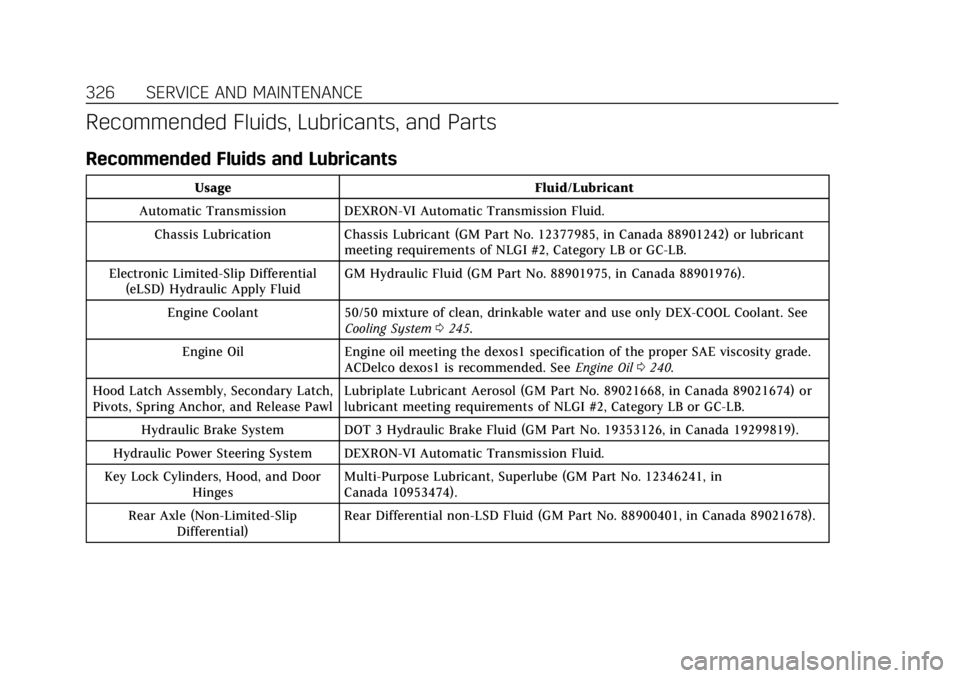
Recommended Fluids, Lubricants, and Parts
Recommended Fluids and Lubricants
UsageFluid/Lubricant
Automatic Transmission DEXRON-VI Automatic Transmission Fluid. Chassis Lubrication Chassis Lubricant (GM Part No. 12377985, in Canada 88901242) or lubricant
meeting requirements of NLGI #2, Category LB or GC-LB.
Electronic Limited-Slip Differential (eLSD) Hydraulic Apply Fluid GM Hydraulic Fluid (GM Part No. 88901975, in Canada 88901976).
Engine Coolant 50/50 mixture of clean, drinkable water and use only DEX-COOL Coolant. See
Cooling System 0245.
Engine Oil Engine oil meeting the dexos1 specification of the proper SAE viscosity grade.
ACDelco dexos1 is recommended. See Engine Oil0240.
Hood Latch Assembly, Secondary Latch,
Pivots, Spring Anchor, and Release Pawl Lubriplate Lubricant Aerosol (GM Part No. 89021668, in Canada 89021674) or
lubricant meeting requirements of NLGI #2, Category LB or GC-LB.
Hydraulic Brake System DOT 3 Hydraulic Brake Fluid (GM Part No. 19353126, in Canada 19299819).
Hydraulic Power Steering System DEXRON-VI Automatic Transmission Fluid.
Key Lock Cylinders, Hood, and Door Hinges Multi-Purpose Lubricant, Superlube (GM Part No. 12346241, in
Canada 10953474).
Rear Axle (Non-Limited-Slip Differential) Rear Differential non-LSD Fluid (GM Part No. 88900401, in Canada 89021678).
Page 361 of 370

Cadillac XTS Owner Manual (GMNA-Localizing-U.S./Canada-11354412) -
2018 - crc - 11/16/17
360 INDEX
Cluster, Instrument . . . . . . . . . . . . . . . . . 118
Collision Damage Repair . . . . . . . . . . . 341
Compact Spare Tire . . . . . . . . . . . . . . . . . 299
CompartmentsStorage . . . . . . . . . . . . . . . . . . . . . . . . . . . . 106
Compass . . . . . . . . . . . . . . . . . . . . . . . . . . . . . 113
Compressor Kit, Tire Sealant . . . . . . . 288
Connections OnStar . . . . . . . . . . . . . . . . . . . . . . . . . . . . . 350
Control Traction and Electronic
Stability . . . . . . . . . . . . . . . . . . . . . . . . . . 193
Control of a Vehicle . . . . . . . . . . . . . . . . 171
Convenience Net . . . . . . . . . . . . . . . . . . . . 109
Convex Mirrors . . . . . . . . . . . . . . . . . . . . . . 44
Coolant Engine Temperature Gauge . . . . . . 124
Engine Temperature WarningLight . . . . . . . . . . . . . . . . . . . . . . . . . . . . . 133
Cooling . . . . . . . . . . . . . . . . . . . . . . . . .160, 165
Cooling System . . . . . . . . . . . . . . . . . . . . . 245
Cornering Lamps . . . . . . . . . . . . . . . . . . . 156
Courtesy Lamps . . . . . . . . . . . . . . . . . . . . . 156
Courtesy Transportation Program . . . . . . . . . . . . . . . . . . . . . . . . . . . . 340
Cover Engine . . . . . . . . . . . . . . . . . . . . . . . . . . . . . 239
Cruise Control . . . . . . . . . . . . . . . . . . . . . . . 196 Cruise Control (cont'd)
Light . . . . . . . . . . . . . . . . . . . . . . . . . . . . . . . 135
Cruise Control, Adaptive . . . . . . . . . . . 198
Customer Assistance . . . . . . . . . . . . . . . 336 Offices . . . . . . . . . . . . . . . . . . . . . . . . . . . . . 336
Text Telephone (TTY) Users . . . . . 336
Customer Information Service Publications OrderingInformation . . . . . . . . . . . . . . . . . . . . . . 343
Customer Satisfaction Procedure . . . . . . . . . . . . . . . . . . . . . . . . . . 334
D
Damage Repair, Collision . . . . . . . . . . . 341
Danger, Warning, and Caution . . . . . . . . 3
Data CollectionInfotainment System . . . . . . . . . . . . . 346
OnStar . . . . . . . . . . . . . . . . . . . . . . . . . . . . . 346
Data Recorders, Event . . . . . . . . . . . . . . 345
Daytime Running Lamps (DRL) . . . 154
Defensive Driving . . . . . . . . . . . . . . . . . . . 171
Delayed Locking . . . . . . . . . . . . . . . . . . . . . 38
Diagnostics OnStar . . . . . . . . . . . . . . . . . . . . . . . . . . . . . 352
Distracted Driving . . . . . . . . . . . . . . . . . . 170
Dome Lamps . . . . . . . . . . . . . . . . . . . . . . . . 156
Door Ajar Light . . . . . . . . . . . . . . . . . . . . . . . . . 136 Door (cont'd)
Delayed Locking . . . . . . . . . . . . . . . . . . . . 38
Locks . . . . . . . . . . . . . . . . . . . . . . . . . . . . . . . . 36
Power Locks . . . . . . . . . . . . . . . . . . . . . . . . . 38
Rear Seat Pass-Through . . . . . . . . . . . . 68
Drive Belt Routing, Engine . . . . . . . . . 333
Drive Systems All-Wheel Drive . . . . . . . . . . . . . . 190, 254
Driver Assistance Systems . . . . . . . . . 206
Driver Information
Center (DIC) . . . . . . . . . . . . . . . . . . . . . . . 136
Driving Assistance Systems . . . . . . . . . . . . . . . 213
Characteristics andTowing Tips . . . . . . . . . . . . . . . . . . . . . 226
Defensive . . . . . . . . . . . . . . . . . . . . . . . . . . 171
Drunk . . . . . . . . . . . . . . . . . . . . . . . . . . . . . . 171
For Better Fuel Economy . . . . . . . . . . . 26
Hill and Mountain Roads . . . . . . . . 174
If the Vehicle is Stuck . . . . . . . . . . . . 176
Loss of Control . . . . . . . . . . . . . . . . . . . . 173
Off-Road Recovery . . . . . . . . . . . . . . . . 173
Vehicle Load Limits . . . . . . . . . . . . . . 176
Wet Roads . . . . . . . . . . . . . . . . . . . . . . . . . 173
Winter . . . . . . . . . . . . . . . . . . . . . . . . . . . . . 175
Dual Automatic Climate Control System . . . . . . . . . . . . . . . . . . . . 160