check engine CHERY TIGGO 2009 Service User Guide
[x] Cancel search | Manufacturer: CHERY, Model Year: 2009, Model line: TIGGO, Model: CHERY TIGGO 2009Pages: 1903, PDF Size: 33.38 MB
Page 45 of 1903
Downloaded from www.Manualslib.com manuals search engine Cylinder Compression Pressure Test
•The result of a cylinder compression pressure test can be utilized to diagnose several engine malfunctions.
• Ensure the battery is completely charged and the engine starter motor is in good operating condition. Otherwise
the indicated compression pressures may not be valid for diagnostic purposes.
Check engine oil level and add oil if necessary.
Disconnect the spark plug wires.
Remove all spark plugs from engine (as spark plugs are being removed, check electrodes for abnormal
firing indicators fouled, hot, oily, etc.).
Record cylinder number of each spark plug for future reference.
Disconnect fuel injector electrical connectors.
Be sure throttle blade is fully open during the compression check.
Insert compression pressure adaptor or the equivalent into each spark plug hole in cylinder head.
Crank engine until maximum pressure is reached on gauge. Record each cylinder pressure.
Compression should not be less than 1000 kPa and not vary more than 25 percent from cylinder to cylinder.
If one or more cylinders have abnormally low compression pressures, repeat the compression test.
If the same cylinder or cylinders repeat an abnormally low reading on the second compression test, it could indicate the existence of a problem with the cylinder in question.
NOTE :
The recommended compression pressures are to be used only as a guide to diagnosing engine problems. An engine
should not be disassembled to determine the cause of low compression unless some malfunction is present.
Cylinder Head Gasket Test
• A cylinder head gasket leak can be located between adjacent cylinders, between a cylinder and the adjacent
water jacket or from an oil passage to the exterior of the engine.
• Possible indications of the cylinder head gasket leaking between adjacent cylinders are:
Loss of engine power
Engine misfiring
Poor fuel economy
• Possible indications of the cylinder head gasket leaking between a cylinder and an adjacent water jacket are:
Engine overheating
Loss of coolant
Excessive steam (white smoke) emitting from exhaust
Coolant foaming
DIAGNOSIS & TESTING
02–16Chery Automobile Co., Ltd.
Page 79 of 1903
Downloaded from www.Manualslib.com manuals search engine ENGINE UNIT REPAIR
Engine Block
Specifications
Torque Specifications
DESCRIPTIONTORQUE (N·m)
Connecting Rod Cap Bolts 1st Step: Tighten the bolt to 25 N·m
2nd Step: Tighten the bolt an additional 90°
Main Bearing Cap Bolts 1st Step: Tighten the bolt to 45 N·m
2nd Step: Tighten the bolt an additional 180°
Lower Cylinder Block Bolts 23
Clearance Specifications
DESCRIPTIONSPECIFICATION (mm)
Surface Distortion Limit 0.15
Inner Diameter Standard 81
Out-Of-Round < 0.008
Taper < 0.01
Disassembly
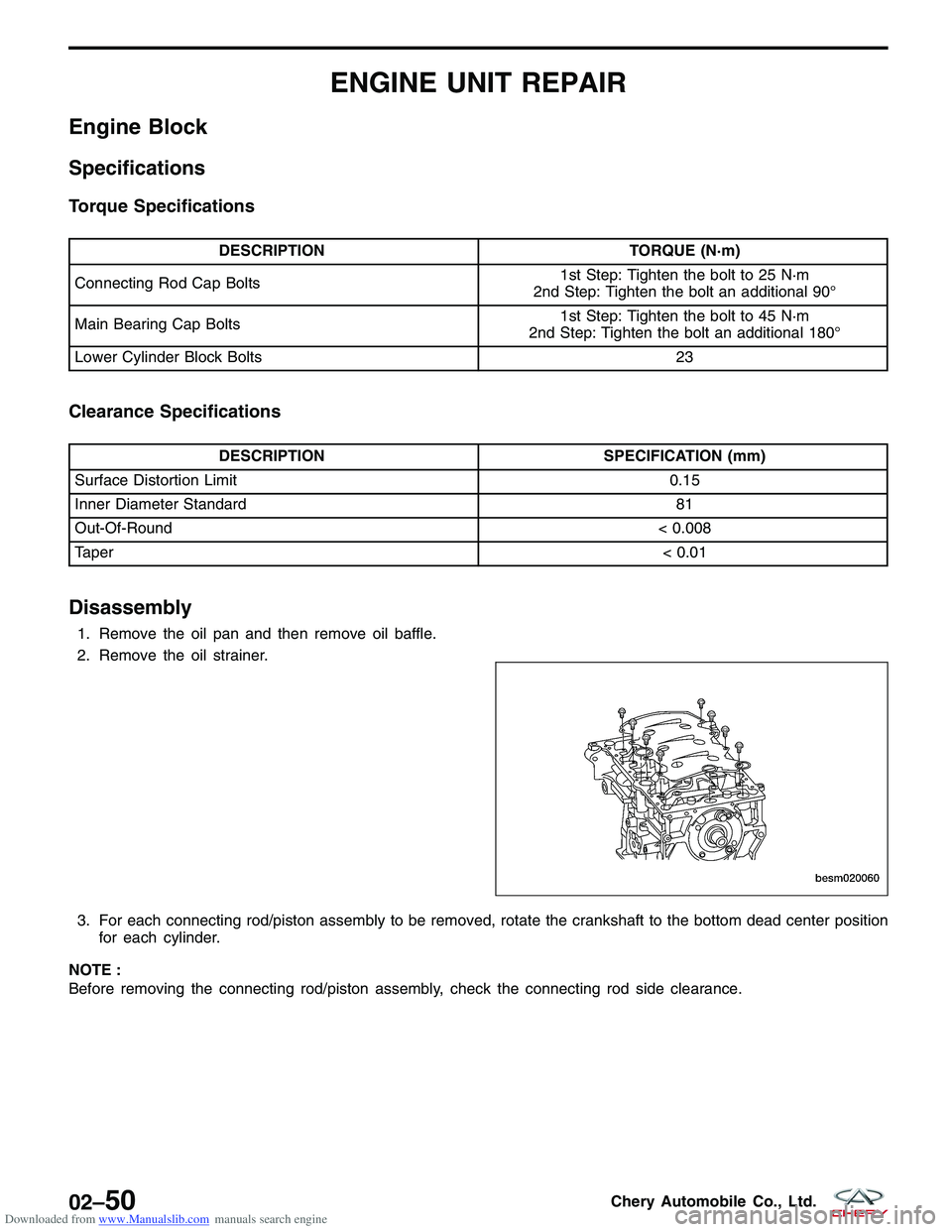
1. Remove the oil pan and then remove oil baffle.
2. Remove the oil strainer.
3. For each connecting rod/piston assembly to be removed, rotate the crankshaft to the bottom dead center position
for each cylinder.
NOTE :
Before removing the connecting rod/piston assembly, check the connecting rod side clearance.
BESM020060
02–50Chery Automobile Co., Ltd.
Page 81 of 1903
Downloaded from www.Manualslib.com manuals search engine 8. Installation is in the reverse order of removal.
Inspection
NOTE :
All measurements should be taken with the engine block at room temperature, 21°C.
Engine Block
•Clean cylinder block thoroughly and check all core hole plugs for evidence of leaking.
• Examine block and cylinder bores for cracks or fractures.
• Check block deck surfaces for flatness. Deck surface must be within service limit of 0.050 mm.
Cylinder Bore
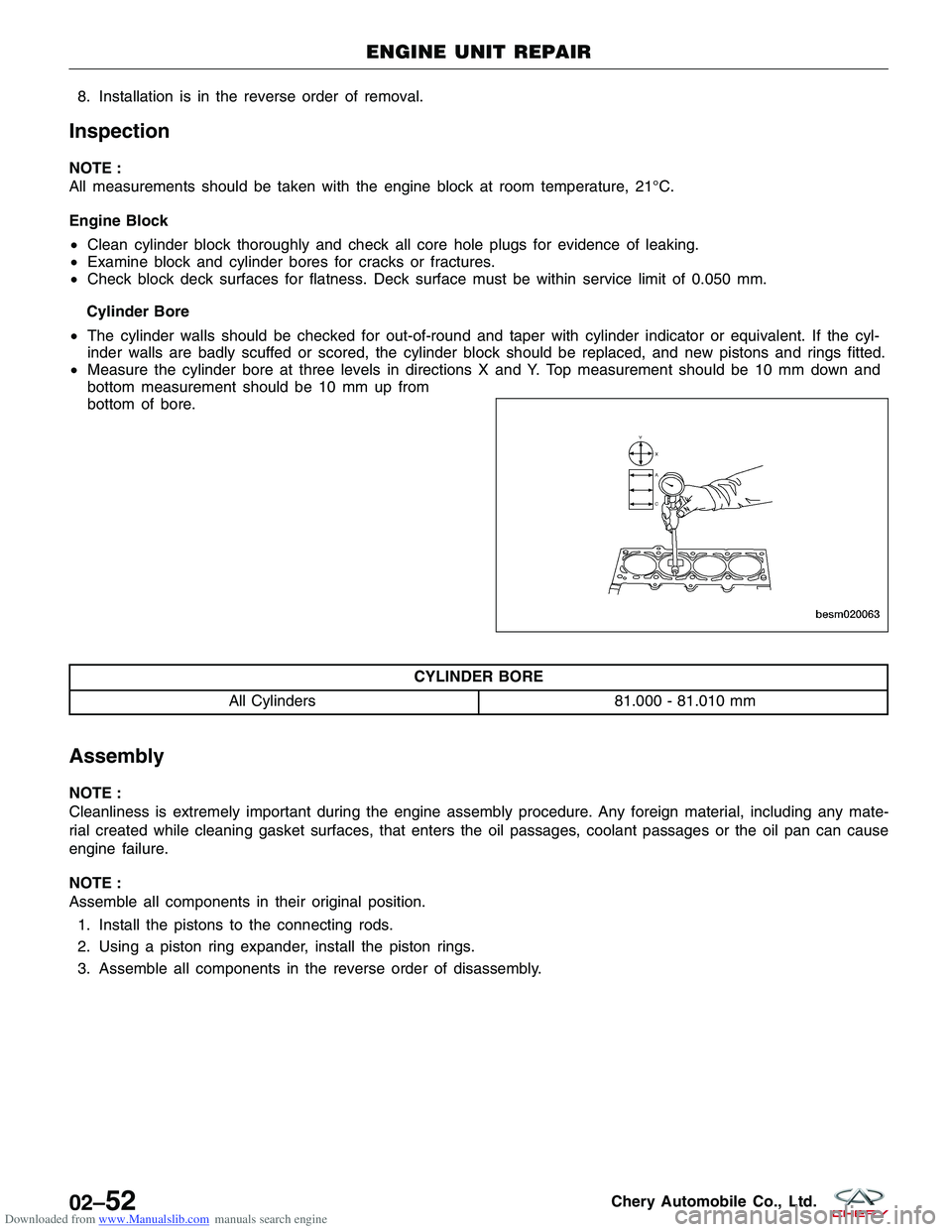
• The cylinder walls should be checked for out-of-round and taper with cylinder indicator or equivalent. If the cyl-
inder walls are badly scuffed or scored, the cylinder block should be replaced, and new pistons and rings fitted.
• Measure the cylinder bore at three levels in directions X and Y. Top measurement should be 10 mm down and
bottom measurement should be 10 mm up from
bottom of bore.
CYLINDER BORE
All Cylinders 81.000 - 81.010 mm
Assembly
NOTE :
Cleanliness is extremely important during the engine assembly procedure. Any foreign material, including any mate-
rial created while cleaning gasket surfaces, that enters the oil passages, coolant passages or the oil pan can cause
engine failure.
NOTE :
Assemble all components in their original position.
1. Install the pistons to the connecting rods.
2. Using a piston ring expander, install the piston rings.
3. Assemble all components in the reverse order of disassembly.
ENGINE UNIT REPAIR
BESM020063
02–52Chery Automobile Co., Ltd.
Page 83 of 1903
Downloaded from www.Manualslib.com manuals search engine Disassembly
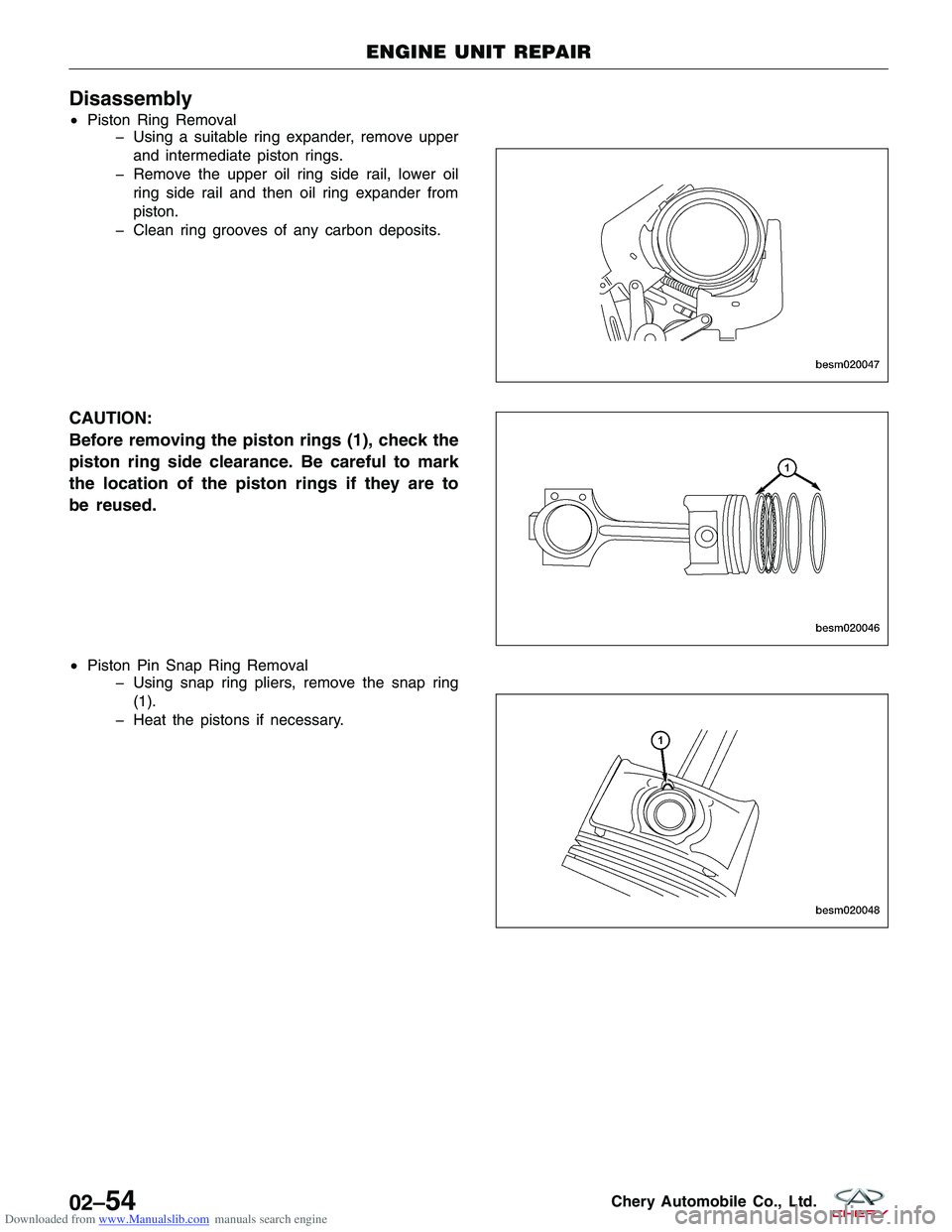
•Piston Ring Removal
Using a suitable ring expander, remove upper
and intermediate piston rings.
Remove the upper oil ring side rail, lower oil ring side rail and then oil ring expander from
piston.
Clean ring grooves of any carbon deposits.
CAUTION:
Before removing the piston rings (1), check the
piston ring side clearance. Be careful to mark
the location of the piston rings if they are to
be reused.
• Piston Pin Snap Ring Removal
Using snap ring pliers, remove the snap ring
(1).
Heat the pistons if necessary.
ENGINE UNIT REPAIR
BESM020047
BESM020046
BESM020048
02–54Chery Automobile Co., Ltd.
Page 84 of 1903
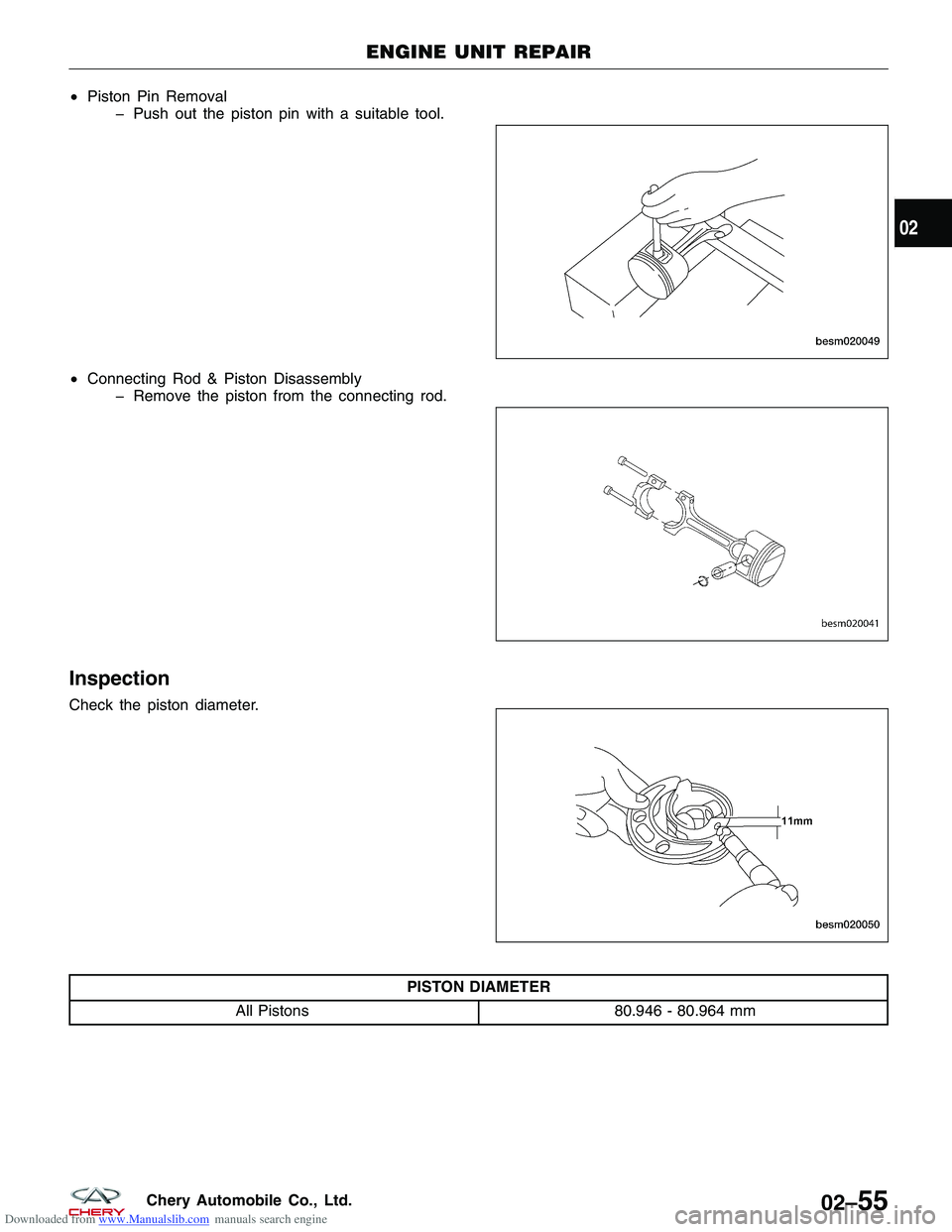
Downloaded from www.Manualslib.com manuals search engine •Piston Pin Removal
Push out the piston pin with a suitable tool.
• Connecting Rod & Piston Disassembly
Remove the piston from the connecting rod.
Inspection
Check the piston diameter.
PISTON DIAMETER
All Pistons 80.946 - 80.964 mm
ENGINE UNIT REPAIR
BESM020049
BESM020041
BESM020050
02
02–55Chery Automobile Co., Ltd.
Page 85 of 1903
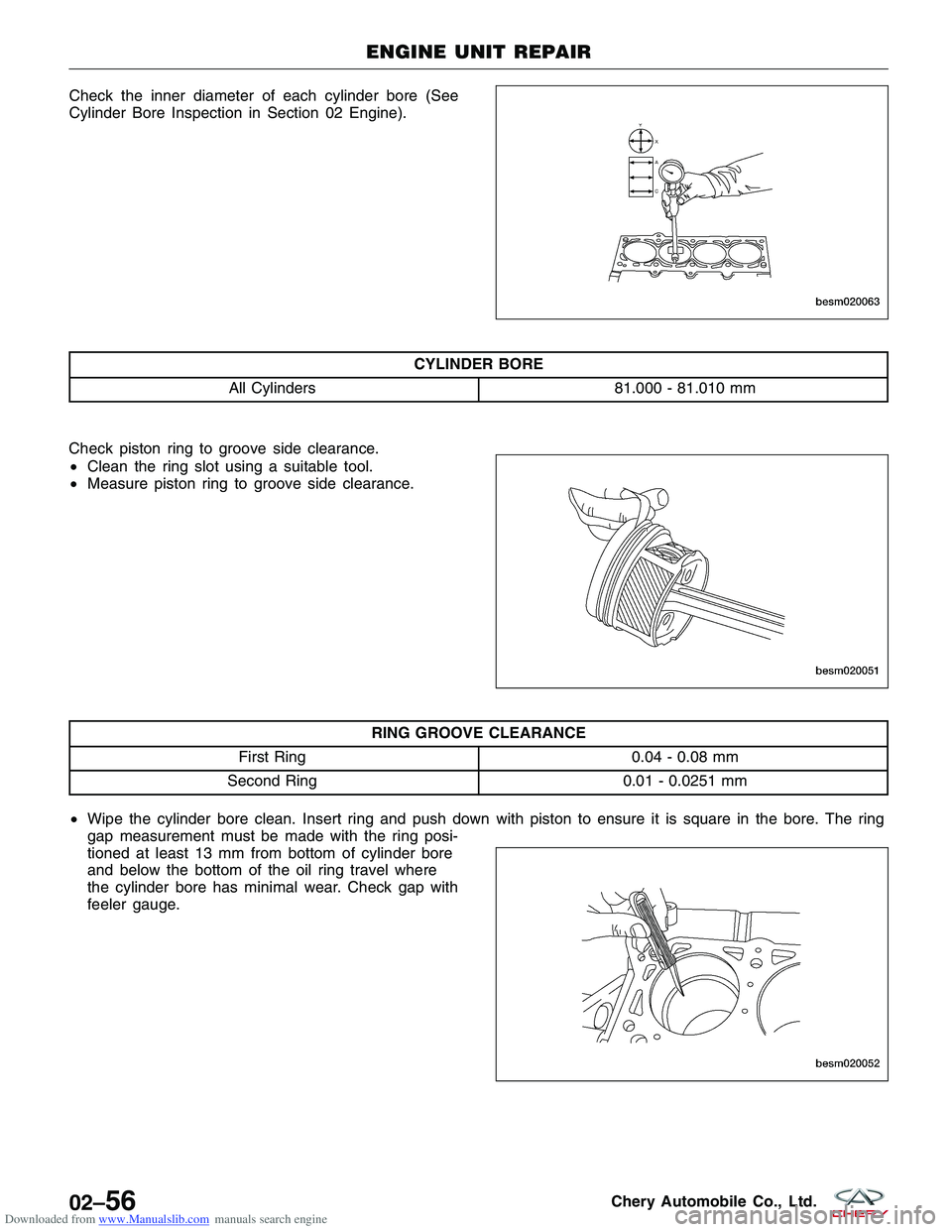
Downloaded from www.Manualslib.com manuals search engine Check the inner diameter of each cylinder bore (See
Cylinder Bore Inspection in Section 02 Engine).
CYLINDER BORE
All Cylinders 81.000 - 81.010 mm
Check piston ring to groove side clearance.
• Clean the ring slot using a suitable tool.
• Measure piston ring to groove side clearance.
RING GROOVE CLEARANCE
First Ring 0.04 - 0.08 mm
Second Ring 0.01 - 0.0251 mm
• Wipe the cylinder bore clean. Insert ring and push down with piston to ensure it is square in the bore. The ring
gap measurement must be made with the ring posi-
tioned at least 13 mm from bottom of cylinder bore
and below the bottom of the oil ring travel where
the cylinder bore has minimal wear. Check gap with
feeler gauge.
ENGINE UNIT REPAIR
BESM020063
BESM020051
BESM020052
02–56Chery Automobile Co., Ltd.
Page 86 of 1903
Downloaded from www.Manualslib.com manuals search engine RING END GAP CLEARANCE
First Ring 0.2 - 0.4 mm 0.8 mm
Second Ring 0.4 - 0.6 mm 1.0 mm
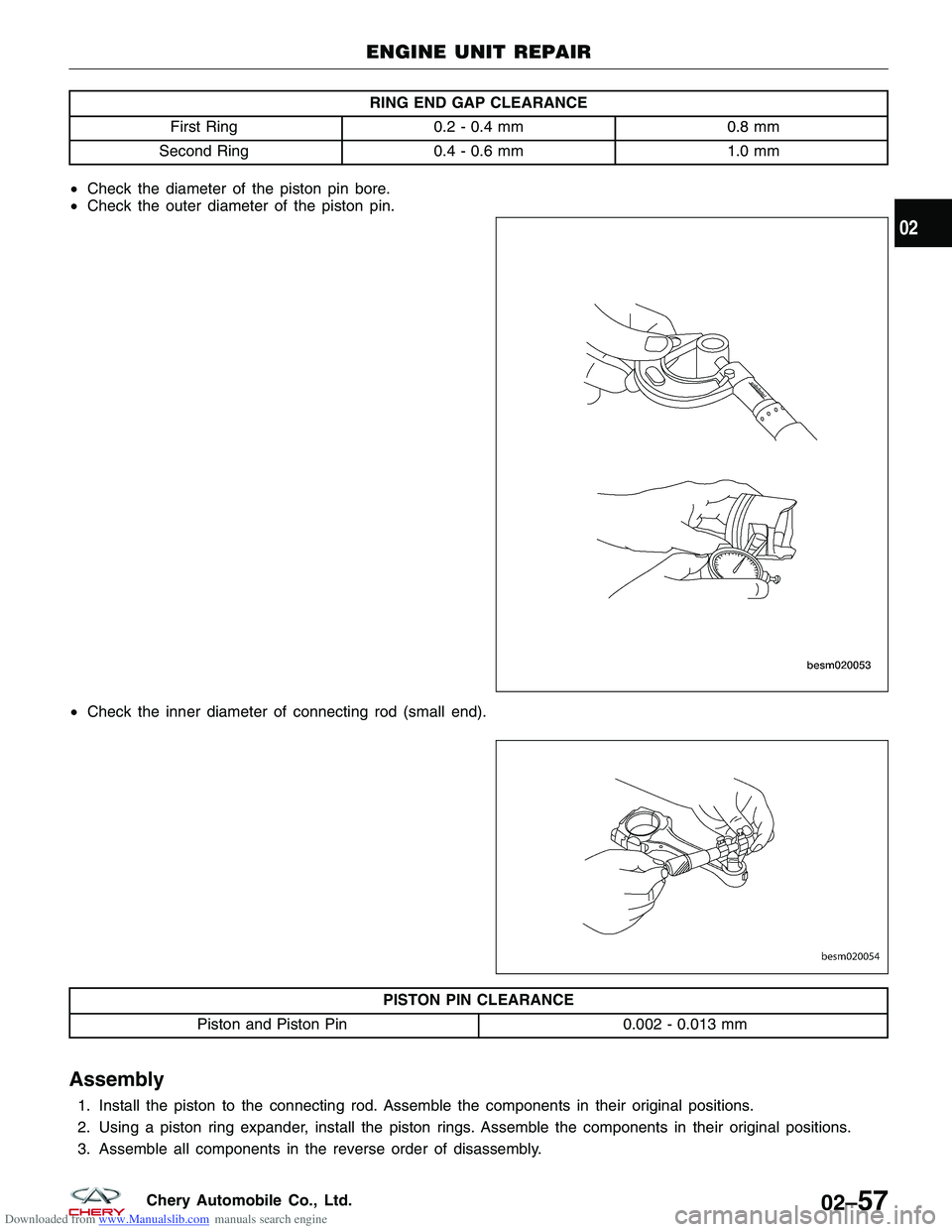
• Check the diameter of the piston pin bore.
• Check the outer diameter of the piston pin.
• Check the inner diameter of connecting rod (small end).
PISTON PIN CLEARANCE
Piston and Piston Pin 0.002 - 0.013 mm
Assembly
1. Install the piston to the connecting rod. Assemble the components in their original positions.
2. Using a piston ring expander, install the piston rings. Assemble the components in their original positions.
3. Assemble all components in the reverse order of disassembly.
ENGINE UNIT REPAIR
BESM020053
BESM020054
02
02–57Chery Automobile Co., Ltd.
Page 87 of 1903
Downloaded from www.Manualslib.com manuals search engine Connecting Rods
Specifications
Torque Specifications
DESCRIPTIONTORQUE (N·m)
Connecting Rod Bolts 1st Step: Tighten bolts to 25 N·m
2nd Step: Tighten the connecting rod bolts an additional 90°
Clearance Specifications
DESCRIPTION SPECIFICATION (mm)
Connecting Rod Radial Clearance 0.016 - 0.051
Connecting Rod Axial Clearance 0.002 - 0.013
Disassembly
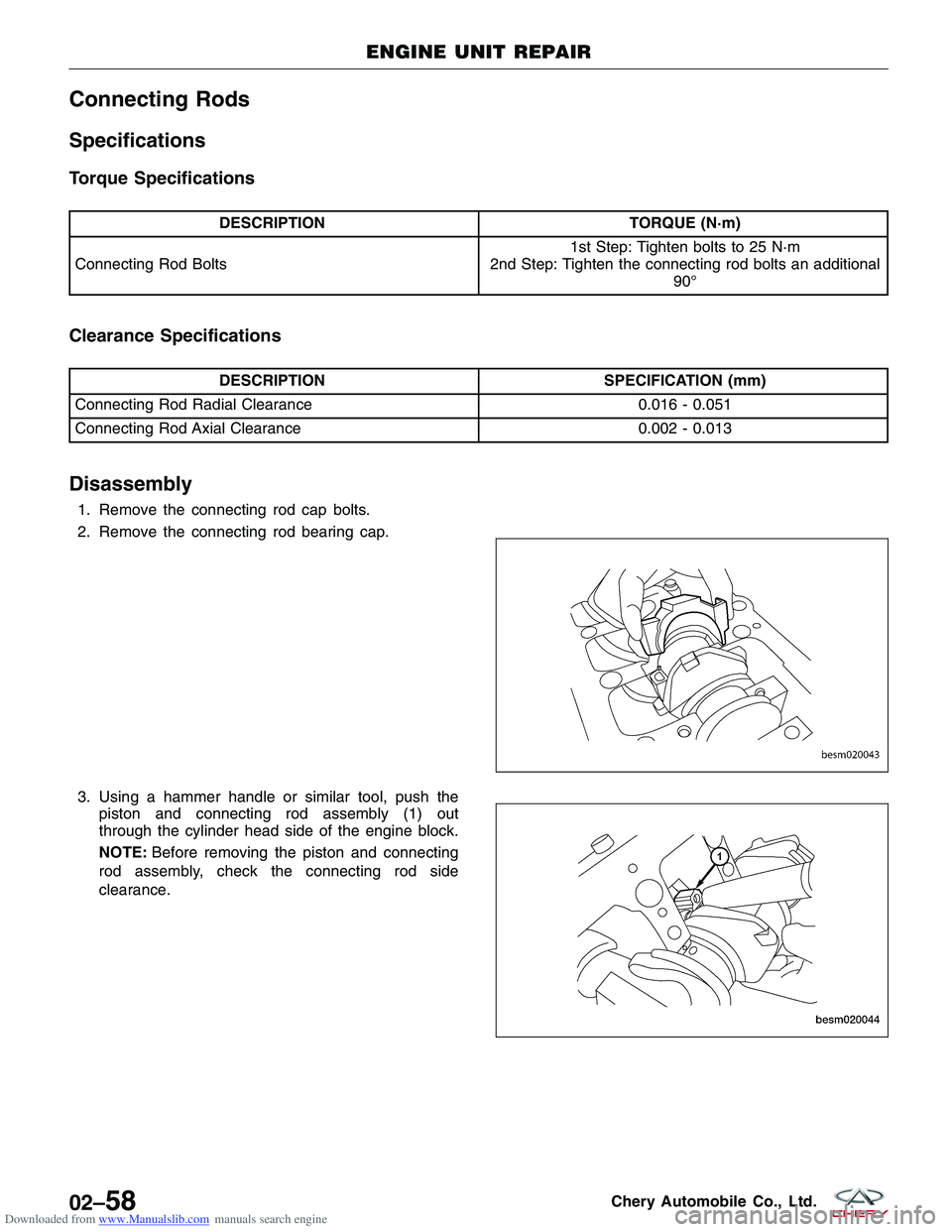
1. Remove the connecting rod cap bolts.
2. Remove the connecting rod bearing cap.
3. Using a hammer handle or similar tool, push the
piston and connecting rod assembly (1) out
through the cylinder head side of the engine block.
NOTE: Before removing the piston and connecting
rod assembly, check the connecting rod side
clearance.
ENGINE UNIT REPAIR
BESM020043
BESM020044
02–58Chery Automobile Co., Ltd.
Page 88 of 1903
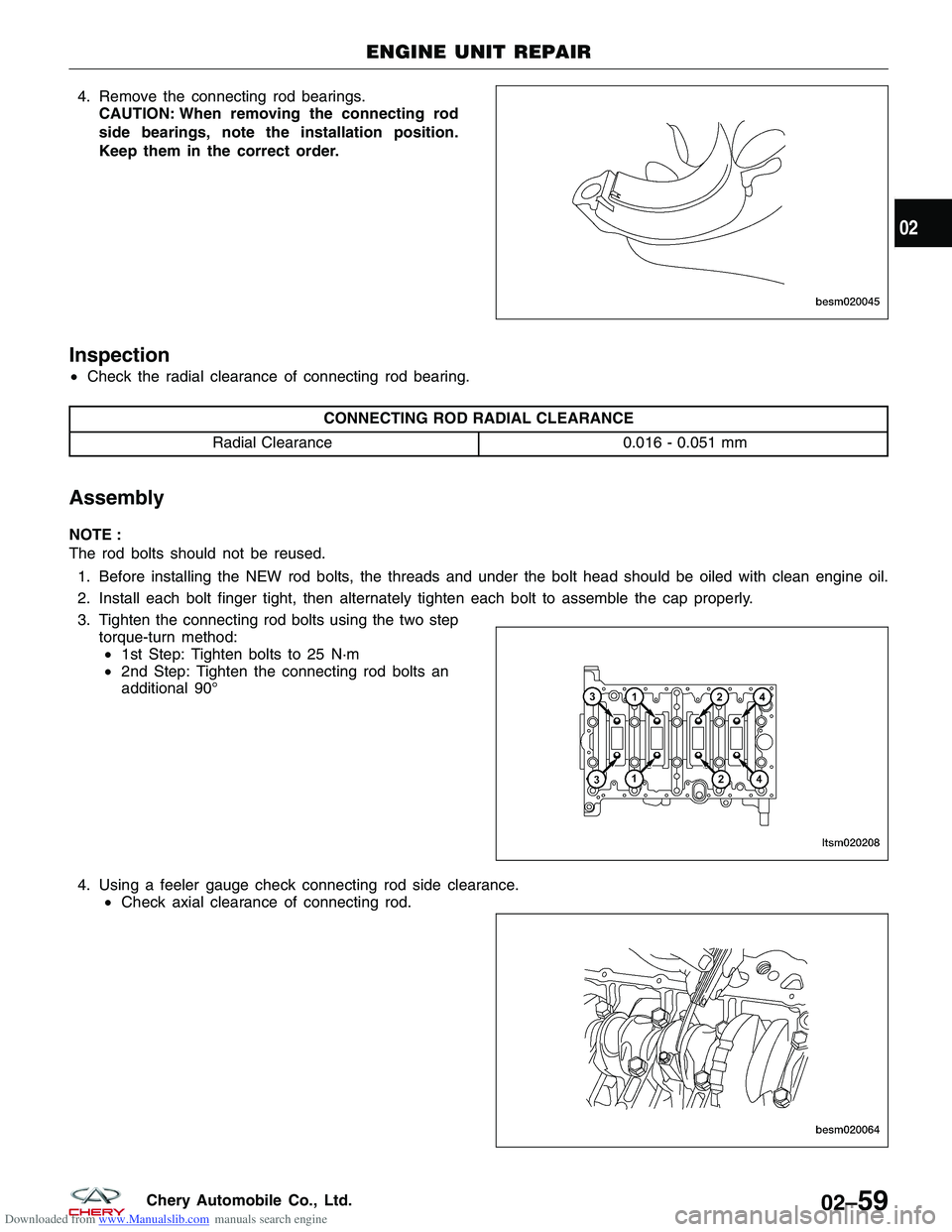
Downloaded from www.Manualslib.com manuals search engine 4. Remove the connecting rod bearings.CAUTION: When removing the connecting rod
side bearings, note the installation position.
Keep them in the correct order.
Inspection
•Check the radial clearance of connecting rod bearing.
CONNECTING ROD RADIAL CLEARANCE
Radial Clearance 0.016 - 0.051 mm
Assembly
NOTE :
The rod bolts should not be reused.
1. Before installing the NEW rod bolts, the threads and under the bolt head should be oiled with clean engine oil.
2. Install each bolt finger tight, then alternately tighten each bolt to assemble the cap properly.
3. Tighten the connecting rod bolts using the two step torque-turn method:• 1st Step: Tighten bolts to 25 N·m
• 2nd Step: Tighten the connecting rod bolts an
additional 90°
4. Using a feeler gauge check connecting rod side clearance. •Check axial clearance of connecting rod.
ENGINE UNIT REPAIR
BESM020045
LTSM020208
BESM020064
02
02–59Chery Automobile Co., Ltd.
Page 90 of 1903
Downloaded from www.Manualslib.com manuals search engine Inspection
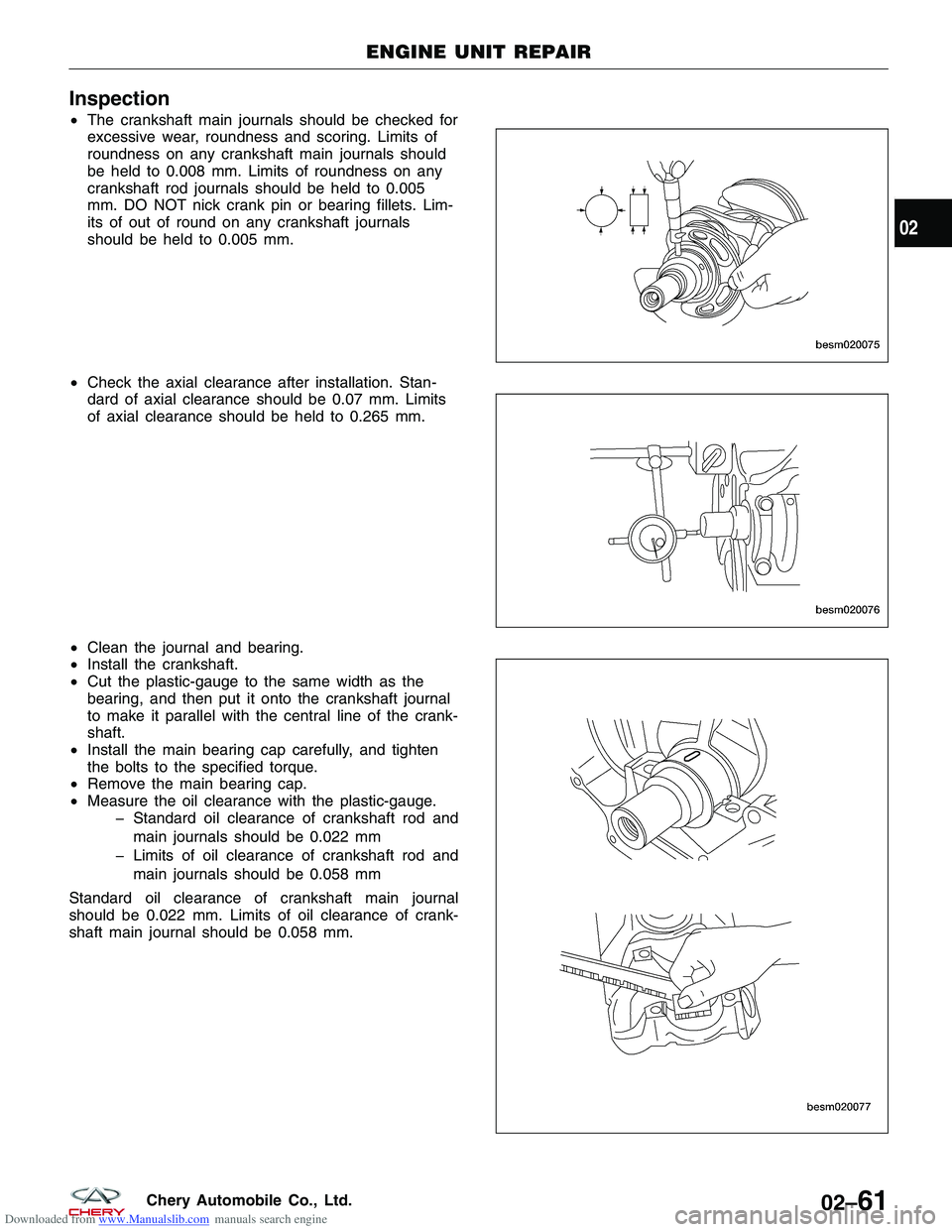
•The crankshaft main journals should be checked for
excessive wear, roundness and scoring. Limits of
roundness on any crankshaft main journals should
be held to 0.008 mm. Limits of roundness on any
crankshaft rod journals should be held to 0.005
mm. DO NOT nick crank pin or bearing fillets. Lim-
its of out of round on any crankshaft journals
should be held to 0.005 mm.
• Check the axial clearance after installation. Stan-
dard of axial clearance should be 0.07 mm. Limits
of axial clearance should be held to 0.265 mm.
• Clean the journal and bearing.
• Install the crankshaft.
• Cut the plastic-gauge to the same width as the
bearing, and then put it onto the crankshaft journal
to make it parallel with the central line of the crank-
shaft.
• Install the main bearing cap carefully, and tighten
the bolts to the specified torque.
• Remove the main bearing cap.
• Measure the oil clearance with the plastic-gauge.
Standard oil clearance of crankshaft rod and
main journals should be 0.022 mm
Limits of oil clearance of crankshaft rod and main journals should be 0.058 mm
Standard oil clearance of crankshaft main journal
should be 0.022 mm. Limits of oil clearance of crank-
shaft main journal should be 0.058 mm.
ENGINE UNIT REPAIR
BESM020075
BESM020076
BESM020077
02
02–61Chery Automobile Co., Ltd.