transmission CHERY TIGGO 2009 Service User Guide
[x] Cancel search | Manufacturer: CHERY, Model Year: 2009, Model line: TIGGO, Model: CHERY TIGGO 2009Pages: 1903, PDF Size: 33.38 MB
Page 919 of 1903
Downloaded from www.Manualslib.com manuals search engine •Hoses and clamps
• Coolant temperature sensor
• Coolant temperature sensor (for instrument cluster) (with 2.4L engine)
• Heater core
Operation
The primary purpose of a cooling system is to maintain engine temperature in a range that will provide satisfactory
engine performance and emission levels under all expected driving conditions. It also provides hot coolant for heater
performance and cooling for automatic transmission oil. This is done by transferring heat from engine metal to cool-
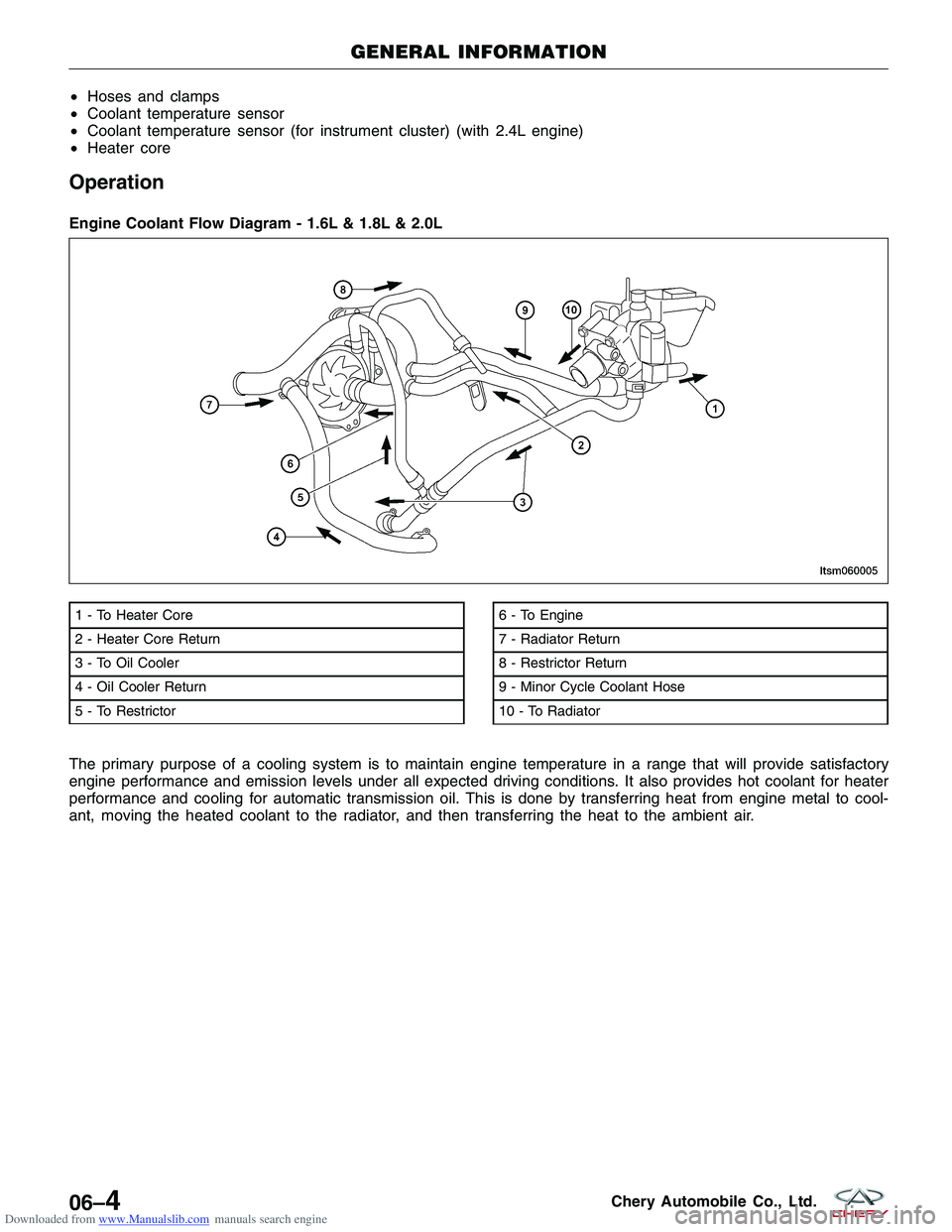
ant, moving the heated coolant to the radiator, and then transferring the heat to the ambient air. Engine Coolant Flow Diagram - 1.6L & 1.8L & 2.0L
1 - To Heater Core
2 - Heater Core Return
3 - To Oil Cooler
4 - Oil Cooler Return
5 - To Restrictor6 - To Engine
7 - Radiator Return
8 - Restrictor Return
9 - Minor Cycle Coolant Hose
10 - To Radiator
GENERAL INFORMATION
LTSM060005
06–4Chery Automobile Co., Ltd.
Page 926 of 1903
Downloaded from www.Manualslib.com manuals search engine DIAGNOSIS AND TESTING
Cooling System Pressure Test
WARNING!
Always allow the engine to cool before opening the cooling system. Do not remove the coolant pressure relief
cap when the engine is operating or the cooling system is hot. The cooling system is under pressure; steam and
hot liquid can come out forcefully when the cap is loosened slightly. Failure to follow these instructions may
result in serious personal injury.
CAUTION:
Do not pressurize the cooling system beyond the maximum pressure listed in the specifications
table in this section, or cooling system components can be damaged.
1. Turn the engine off.
2. Check the engine coolant level. Adjust the coolant level as necessary.
3. Attach the pressure tester to the coolant recovery reservoir. Install a pressure test pump to the quick-connectfitting of the test adapter.
4. Pressurize the engine cooling system to 111 kPa. Observe the gauge reading for approximately 2 minutes. Pres- sure should not drop during this time. If the pressure drops within this time, inspect for leaks and repair as nec-
essary.
5. If no leaks are found and the pressure drops, the pressure relief cap may be leaking. Install a new pressure relief cap and retest the system.
6. If no leaks are found after a new pressure relief cap is installed, and the pressure drops, the leak may be inter- nal to the radiator transmission cooler (if equipped). Inspect the coolant for transmission fluid and the transmis-
sion fluid for coolant. Repair as necessary.
7. If there is no contamination of the coolant or transmission fluid, the leak may be internal to the engine. Inspect the coolant for engine oil and the engine oil for coolant.
8. Release the system pressure by loosening the pressure relief cap. Check the coolant level and adjust as nec- essary.
Cooling System Concentration Test
CAUTION:
Do not mix types of coolant, corrosion protection will be severely reduced.
Coolant concentration should be checked when any additional coolant is added to the cooling system or after a cool-
ant drain, flush and refill. The coolant mixture offers optimum engine cooling and protection against corrosion when
mixed to a freeze point of -37°C to -46°C. The use of a hydrometer or a refractometer can be used to test coolant
concentration.
06
06–11Chery Automobile Co., Ltd.
Page 1186 of 1903
Downloaded from www.Manualslib.com manuals search engine Installation Notes:
•Check the transaxle fluid level.
Drive the vehicle until the ATF reaches oper-
ating temperature (70° - 80°C).
Park the vehicle on level ground.
Shift the gear selector lever to all gear posi- tions once, then shift to gear “N”.
Clean and check the outside of the dipstick and remove the dipstick to check the fluid
level.
Check if the transmission fluid level is within the HOT marking of the dipstick. If lower than
the HOT marking, refill the transaxle until the
fluid level is above the HOT marking.
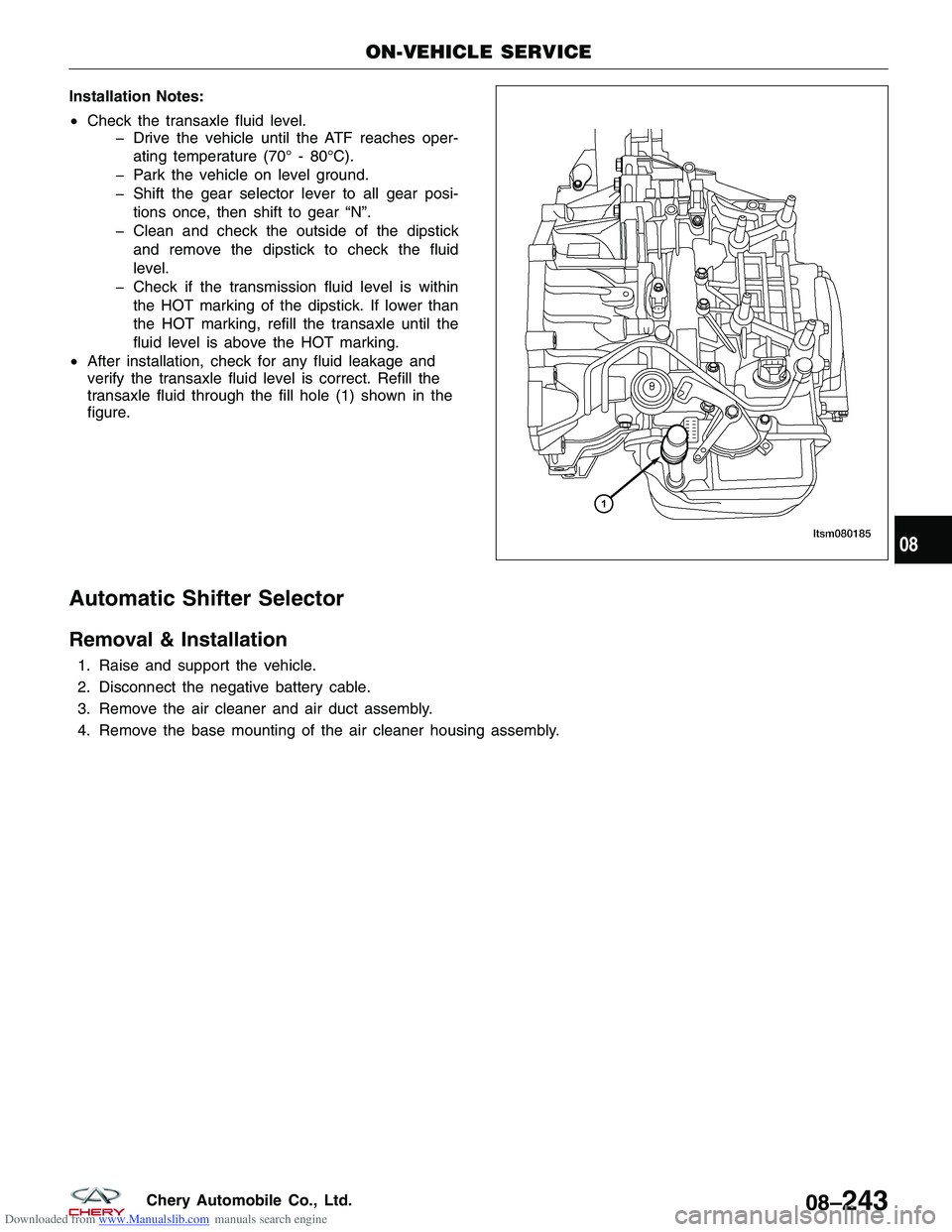
• After installation, check for any fluid leakage and
verify the transaxle fluid level is correct. Refill the
transaxle fluid through the fill hole (1) shown in the
figure.
Automatic Shifter Selector
Removal & Installation
1. Raise and support the vehicle.
2. Disconnect the negative battery cable.
3. Remove the air cleaner and air duct assembly.
4. Remove the base mounting of the air cleaner housing assembly.
ON-VEHICLE SERVICE
LTSM080185
08
08–243Chery Automobile Co., Ltd.
Page 1344 of 1903
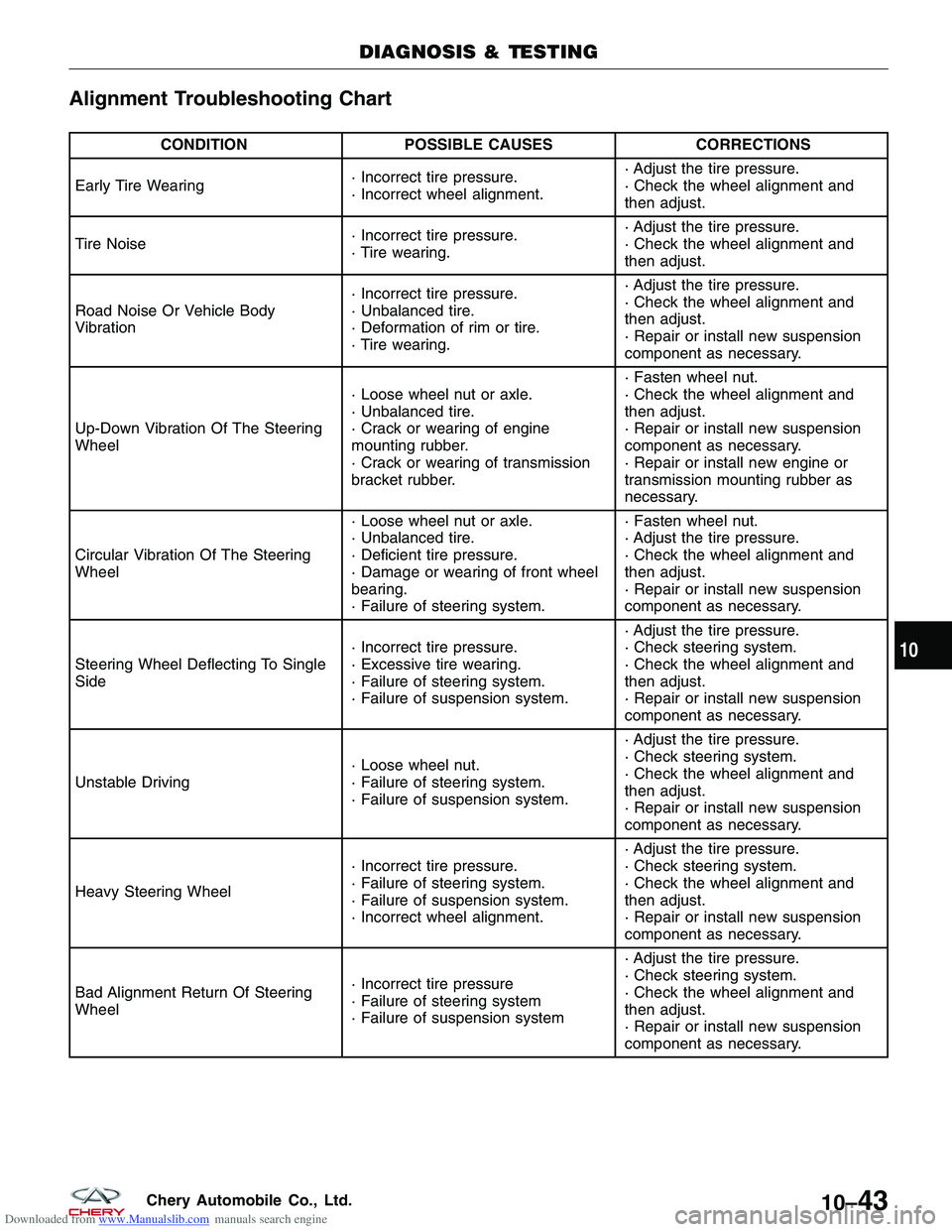
Downloaded from www.Manualslib.com manuals search engine Alignment Troubleshooting Chart
CONDITIONPOSSIBLE CAUSES CORRECTIONS
Early Tire Wearing · Incorrect tire pressure.
· Incorrect wheel alignment.· Adjust the tire pressure.
· Check the wheel alignment and
then adjust.
Tire Noise · Incorrect tire pressure.
· Tire wearing.· Adjust the tire pressure.
· Check the wheel alignment and
then adjust.
Road Noise Or Vehicle Body
Vibration · Incorrect tire pressure.
· Unbalanced tire.
· Deformation of rim or tire.
· Tire wearing.· Adjust the tire pressure.
· Check the wheel alignment and
then adjust.
· Repair or install new suspension
component as necessary.
Up-Down Vibration Of The Steering
Wheel · Loose wheel nut or axle.
· Unbalanced tire.
· Crack or wearing of engine
mounting rubber.
· Crack or wearing of transmission
bracket rubber.· Fasten wheel nut.
· Check the wheel alignment and
then adjust.
· Repair or install new suspension
component as necessary.
· Repair or install new engine or
transmission mounting rubber as
necessary.
Circular Vibration Of The Steering
Wheel · Loose wheel nut or axle.
· Unbalanced tire.
· Deficient tire pressure.
· Damage or wearing of front wheel
bearing.
· Failure of steering system.· Fasten wheel nut.
· Adjust the tire pressure.
· Check the wheel alignment and
then adjust.
· Repair or install new suspension
component as necessary.
Steering Wheel Deflecting To Single
Side · Incorrect tire pressure.
· Excessive tire wearing.
· Failure of steering system.
· Failure of suspension system.· Adjust the tire pressure.
· Check steering system.
· Check the wheel alignment and
then adjust.
· Repair or install new suspension
component as necessary.
Unstable Driving · Loose wheel nut.
· Failure of steering system.
· Failure of suspension system.· Adjust the tire pressure.
· Check steering system.
· Check the wheel alignment and
then adjust.
· Repair or install new suspension
component as necessary.
Heavy Steering Wheel · Incorrect tire pressure.
· Failure of steering system.
· Failure of suspension system.
· Incorrect wheel alignment.· Adjust the tire pressure.
· Check steering system.
· Check the wheel alignment and
then adjust.
· Repair or install new suspension
component as necessary.
Bad Alignment Return Of Steering
Wheel · Incorrect tire pressure
· Failure of steering system
· Failure of suspension system· Adjust the tire pressure.
· Check steering system.
· Check the wheel alignment and
then adjust.
· Repair or install new suspension
component as necessary.
DIAGNOSIS & TESTING
10
10–43Chery Automobile Co., Ltd.
Page 1398 of 1903
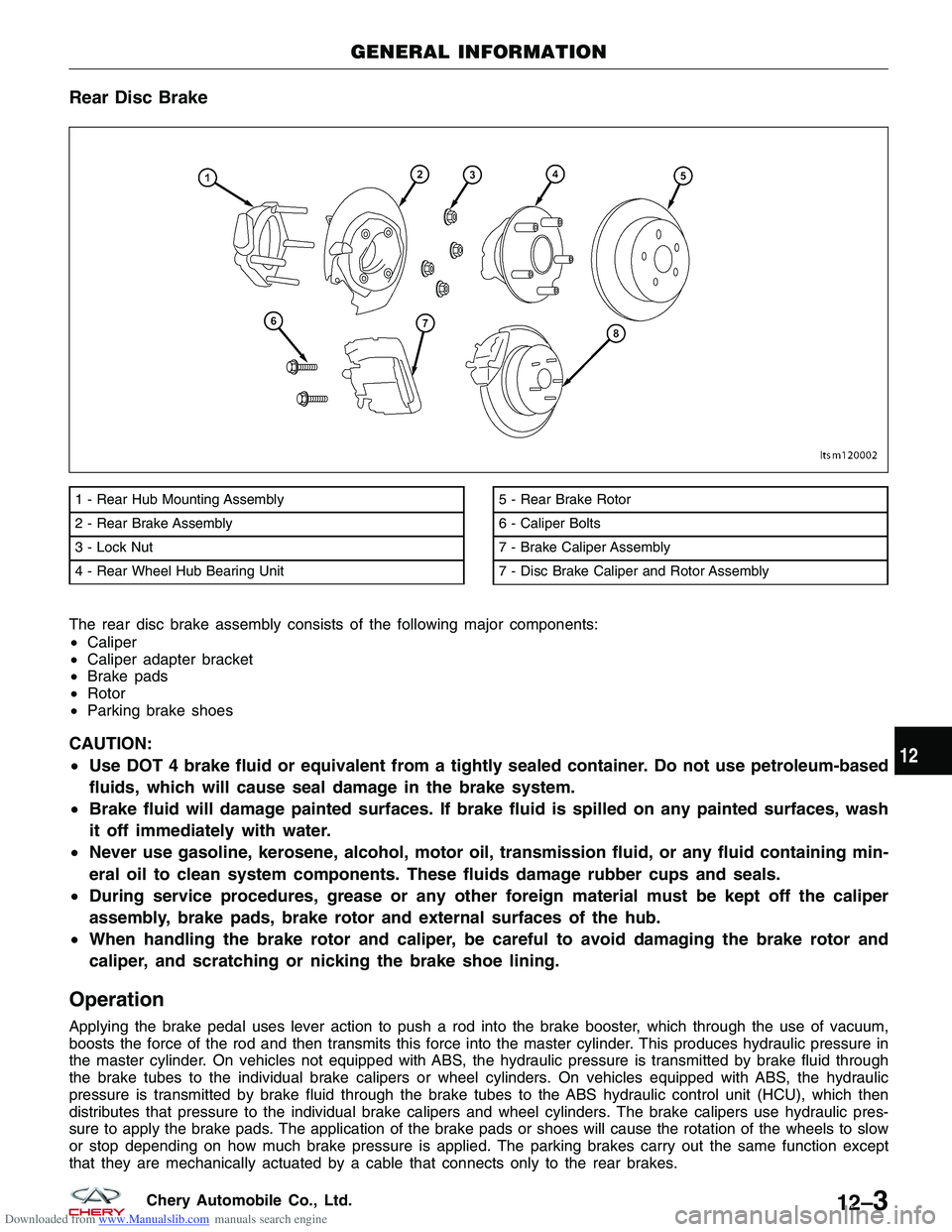
Downloaded from www.Manualslib.com manuals search engine Rear Disc Brake
The rear disc brake assembly consists of the following major components:
•Caliper
• Caliper adapter bracket
• Brake pads
• Rotor
• Parking brake shoes
CAUTION:
•Use DOT 4 brake fluid or equivalent from a tightly sealed container. Do not use petroleum-based
fluids, which will cause seal damage in the brake system.
• Brake fluid will damage painted surfaces. If brake fluid is spilled on any painted surfaces, wash
it off immediately with water.
• Never use gasoline, kerosene, alcohol, motor oil, transmission fluid, or any fluid containing min-
eral oil to clean system components. These fluids damage rubber cups and seals.
• During service procedures, grease or any other foreign material must be kept off the caliper
assembly, brake pads, brake rotor and external surfaces of the hub.
• When handling the brake rotor and caliper, be careful to avoid damaging the brake rotor and
caliper, and scratching or nicking the brake shoe lining.
Operation
Applying the brake pedal uses lever action to push a rod into the brake booster, which through the use of vacuum,
boosts the force of the rod and then transmits this force into the master cylinder. This produces hydraulic pressure in
the master cylinder. On vehicles not equipped with ABS, the hydraulic pressure is transmitted by brake fluid through
the brake tubes to the individual brake calipers or wheel cylinders. On vehicles equipped with ABS, the hydraulic
pressure is transmitted by brake fluid through the brake tubes to the ABS hydraulic control unit (HCU), which then
distributes that pressure to the individual brake calipers and wheel cylinders. The brake calipers use hydraulic pres-
sure to apply the brake pads. The application of the brake pads or shoes will cause the rotation of the wheels to slow
or stop depending on how much brake pressure is applied. The parking brakes carry out the same function except
that they are mechanically actuated by a cable that connects only to the rear brakes.
1 - Rear Hub Mounting Assembly
2 - Rear Brake Assembly
3 - Lock Nut
4 - Rear Wheel Hub Bearing Unit5 - Rear Brake Rotor
6 - Caliper Bolts
7 - Brake Caliper Assembly
7 - Disc Brake Caliper and Rotor Assembly
GENERAL INFORMATION
LTSM120002
12
12–3Chery Automobile Co., Ltd.
Page 1839 of 1903

Downloaded from www.Manualslib.com manuals search engine GENERAL INFORMATION
Description
The power distribution system is designed to provide safe, reliable, centralized and convenient access to the distri-
bution of the electrical power required to operate all vehicle electrical and electronic systems.
The following components are used for power distribution:
•Battery
• Power Fuse Box
• Body Fuse and Relay Box
• Front Fuse and Relay Box
• Ignition Switch
• Fuses
• Circuit Breakers
• Relays
Operation
The power distribution system operates all electrical and electronic engine, transmission, chassis, safety, comfort and
convenience systems.
16
16–13Chery Automobile Co., Ltd.
Page 1854 of 1903
Downloaded from www.Manualslib.com manuals search engine GENERAL INFORMATION
Description
The ground distribution system is designed to provide centralized and convenient ground locations for the entire vehi-
cle electrical system.
Operation
The ground distribution system provides a grounding path for all electrical and electronic engine, transmission, chas-
sis, safety, comfort and convenience systems.
16–28Chery Automobile Co., Ltd.
Page 1878 of 1903
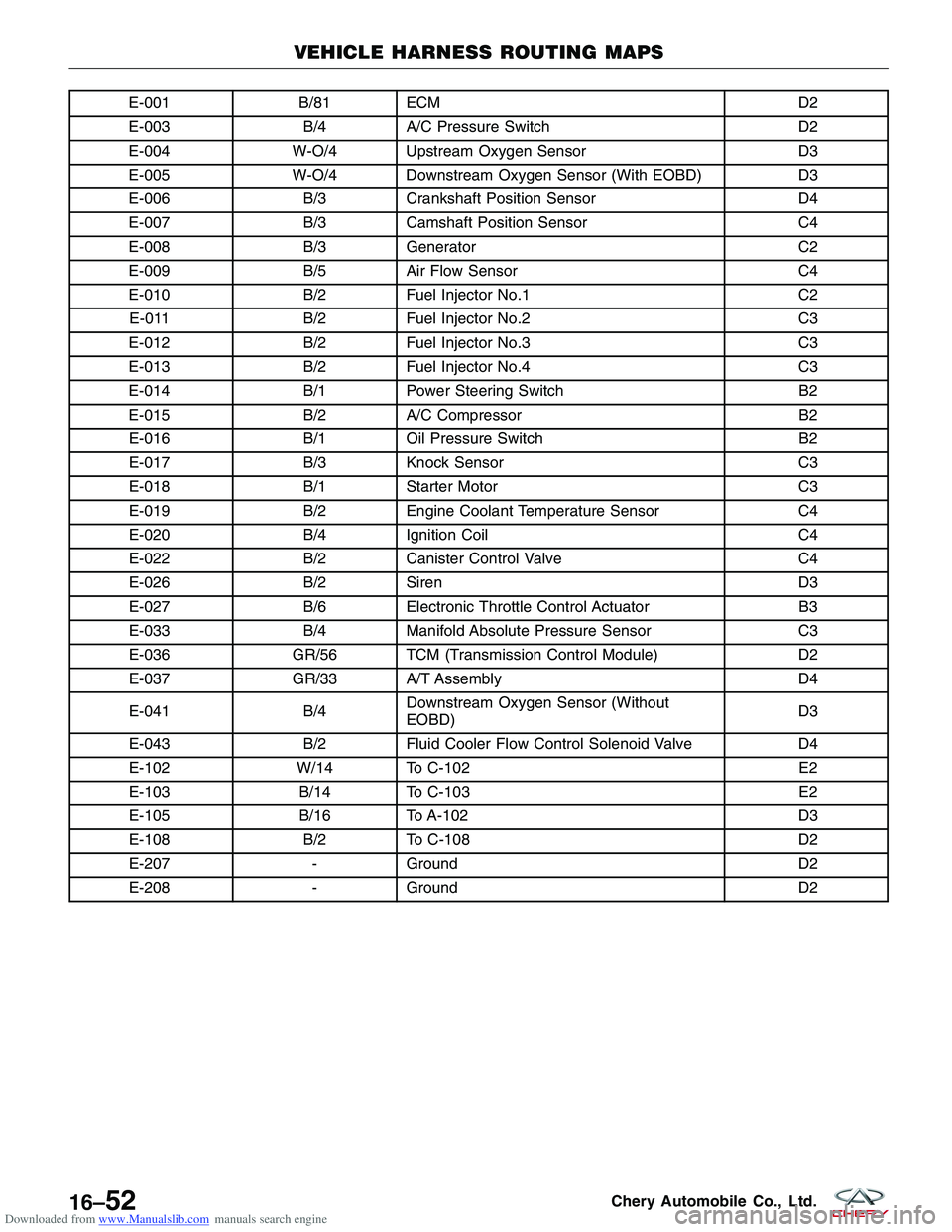
Downloaded from www.Manualslib.com manuals search engine E-001B/81 ECM D2
E-003 B/4A/C Pressure Switch D2
E-004 W-O/4 Upstream Oxygen Sensor D3
E-005 W-O/4 Downstream Oxygen Sensor (With EOBD) D3
E-006 B/3Crankshaft Position Sensor D4
E-007 B/3Camshaft Position Sensor C4
E-008 B/3Generator C2
E-009 B/5Air Flow Sensor C4
E-010 B/2Fuel Injector No.1 C2
E-011 B/2Fuel Injector No.2 C3
E-012 B/2Fuel Injector No.3 C3
E-013 B/2Fuel Injector No.4 C3
E-014 B/1Power Steering Switch B2
E-015 B/2A/C Compressor B2
E-016 B/1Oil Pressure Switch B2
E-017 B/3Knock Sensor C3
E-018 B/1Starter Motor C3
E-019 B/2Engine Coolant Temperature Sensor C4
E-020 B/4Ignition Coil C4
E-022 B/2Canister Control Valve C4
E-026 B/2Siren D3
E-027 B/6Electronic Throttle Control Actuator B3
E-033 B/4Manifold Absolute Pressure Sensor C3
E-036 GR/56 TCM (Transmission Control Module) D2
E-037 GR/33 A/T Assembly D4
E-041 B/4Downstream Oxygen Sensor (Without
EOBD) D3
E-043 B/2Fluid Cooler Flow Control Solenoid Valve D4
E-102 W/14 To C-102 E2
E-103 B/14 To C-103 E2
E-105 B/16 To A-102 D3
E-108 B/2To C-108 D2
E-207 -Ground D2
E-208 -Ground D2
VEHICLE HARNESS ROUTING MAPS
16–52Chery Automobile Co., Ltd.
Page 1880 of 1903
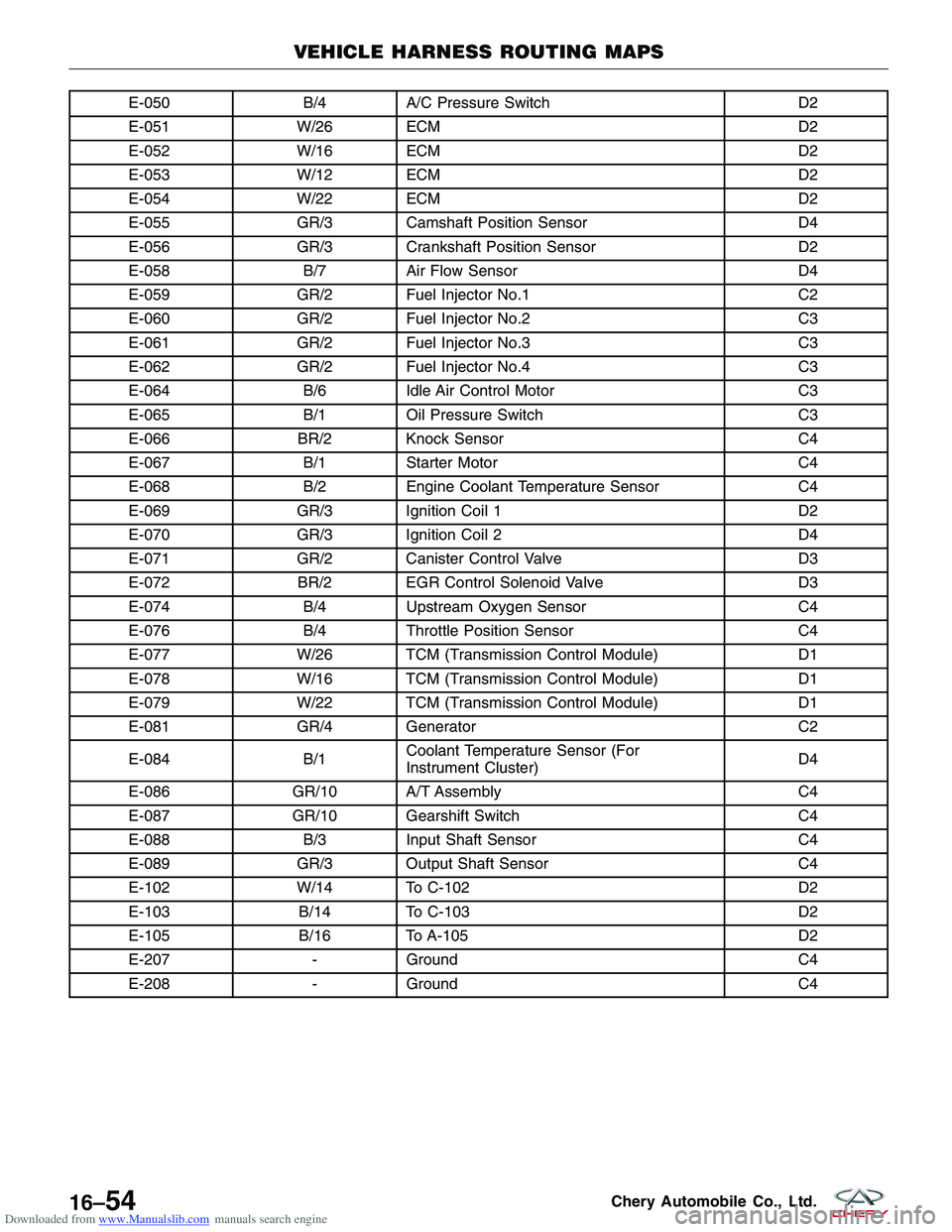
Downloaded from www.Manualslib.com manuals search engine E-050B/4A/C Pressure Switch D2
E-051 W/26 ECM D2
E-052 W/16 ECM D2
E-053 W/12 ECM D2
E-054 W/22 ECM D2
E-055 GR/3 Camshaft Position Sensor D4
E-056 GR/3 Crankshaft Position Sensor D2
E-058 B/7Air Flow Sensor D4
E-059 GR/2 Fuel Injector No.1 C2
E-060 GR/2 Fuel Injector No.2 C3
E-061 GR/2 Fuel Injector No.3 C3
E-062 GR/2 Fuel Injector No.4 C3
E-064 B/6Idle Air Control Motor C3
E-065 B/1Oil Pressure Switch C3
E-066 BR/2 Knock Sensor C4
E-067 B/1Starter Motor C4
E-068 B/2Engine Coolant Temperature Sensor C4
E-069 GR/3 Ignition Coil 1 D2
E-070 GR/3 Ignition Coil 2 D4
E-071 GR/2 Canister Control Valve D3
E-072 BR/2 EGR Control Solenoid Valve D3
E-074 B/4Upstream Oxygen Sensor C4
E-076 B/4Throttle Position Sensor C4
E-077 W/26 TCM (Transmission Control Module) D1
E-078 W/16 TCM (Transmission Control Module) D1
E-079 W/22 TCM (Transmission Control Module) D1
E-081 GR/4 Generator C2
E-084 B/1Coolant Temperature Sensor (For
Instrument Cluster) D4
E-086 GR/10 A/T Assembly C4
E-087 GR/10 Gearshift Switch C4
E-088 B/3Input Shaft Sensor C4
E-089 GR/3 Output Shaft Sensor C4
E-102 W/14 To C-102 D2
E-103 B/14 To C-103 D2
E-105 B/16 To A-105 D2
E-207 -Ground C4
E-208 -Ground C4
VEHICLE HARNESS ROUTING MAPS
16–54Chery Automobile Co., Ltd.