wheel CHERY TIGGO 2009 Service Owner's Manual
[x] Cancel search | Manufacturer: CHERY, Model Year: 2009, Model line: TIGGO, Model: CHERY TIGGO 2009Pages: 1903, PDF Size: 33.38 MB
Page 714 of 1903
Downloaded from www.Manualslib.com manuals search engine 4. Installation is in the reverse order of removal.
Installation Notes:
• Before installing the oxygen sensor, coat the threads with rust inhibiting lubricant.
Crankshaft Position (CKP) Sensor
Description
The Crankshaft Position (CKP) sensor is located on the flywheel shell facing the gear teeth of the signal plate. It
detects the fluctuation of the engine revolution. The sensor consists of a permanent magnet and Induction coil.
Operation
When the engine is running, the high and low parts of the teeth cause the gap with the sensor to change. The
changing gap causes the magnetic field near the sensor to change. Due to the changing magnetic field, the voltage
from the sensor changes. The Engine Control Module (ECM) receives the voltage signal and detects the fluctuation
of the engine revolution.
Removal & Installation
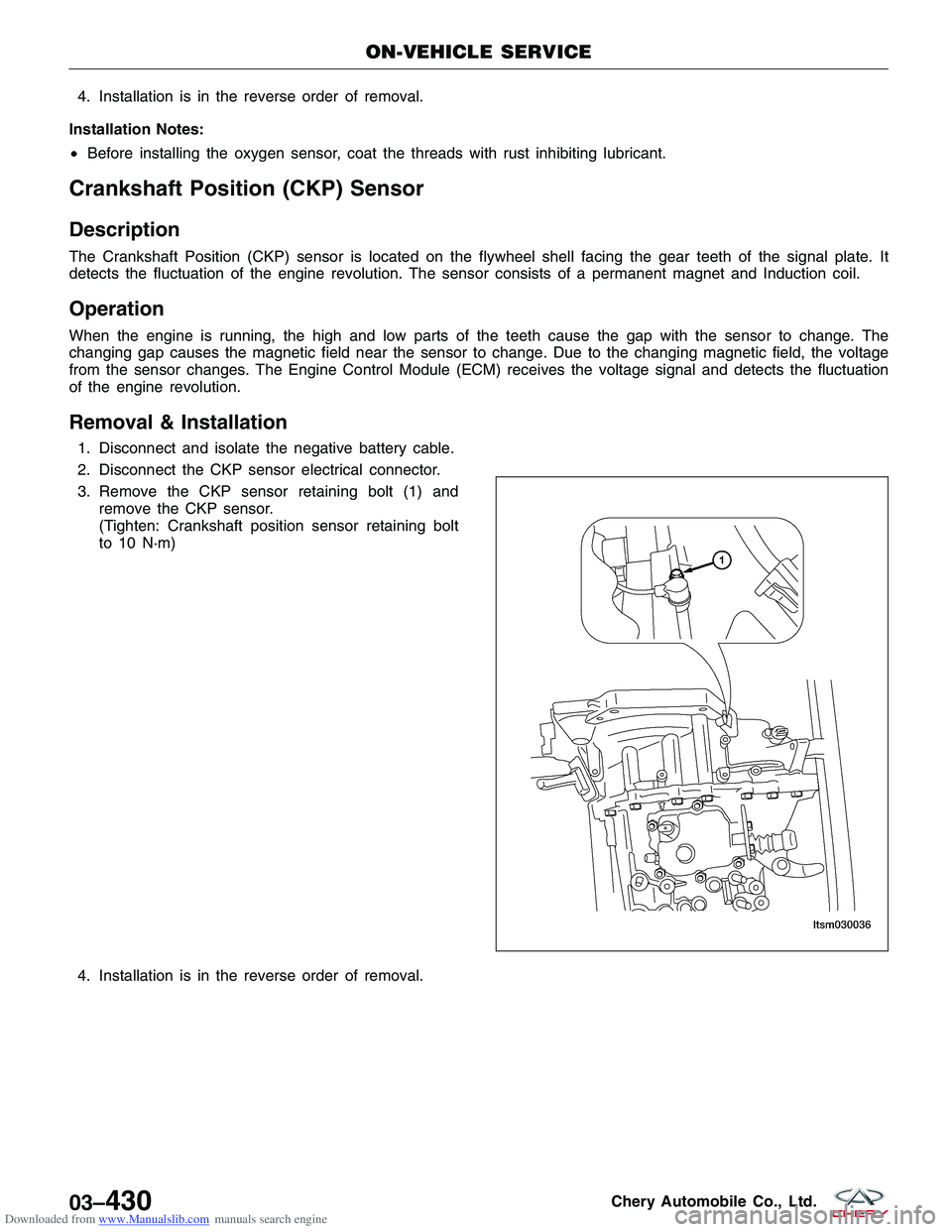
1. Disconnect and isolate the negative battery cable.
2. Disconnect the CKP sensor electrical connector.
3. Remove the CKP sensor retaining bolt (1) and
remove the CKP sensor.
(Tighten: Crankshaft position sensor retaining bolt
to 10 N·m)
4. Installation is in the reverse order of removal.
ON-VEHICLE SERVICE
LTSM030036
03–430Chery Automobile Co., Ltd.
Page 826 of 1903
Downloaded from www.Manualslib.com manuals search engine Crankshaft Position (CKP) Sensor
Description
The Crankshaft Position (CKP) sensor is located on the flywheel shell facing the gear teeth of the signal plate. It
detects the fluctuation of the engine revolution. The sensor consists of a permanent magnet and Induction coil.
Operation
When the engine is running, the high and low parts of the teeth cause the gap with the sensor to change. The
changing gap cause the magnetic field near the sensor to change. Due to the changing magnetic field, the voltage
from the sensor changes. The Engine Control Module (ECM) receives the voltage signal and detects the fluctuation
of the engine revolution.
Removal & Installation
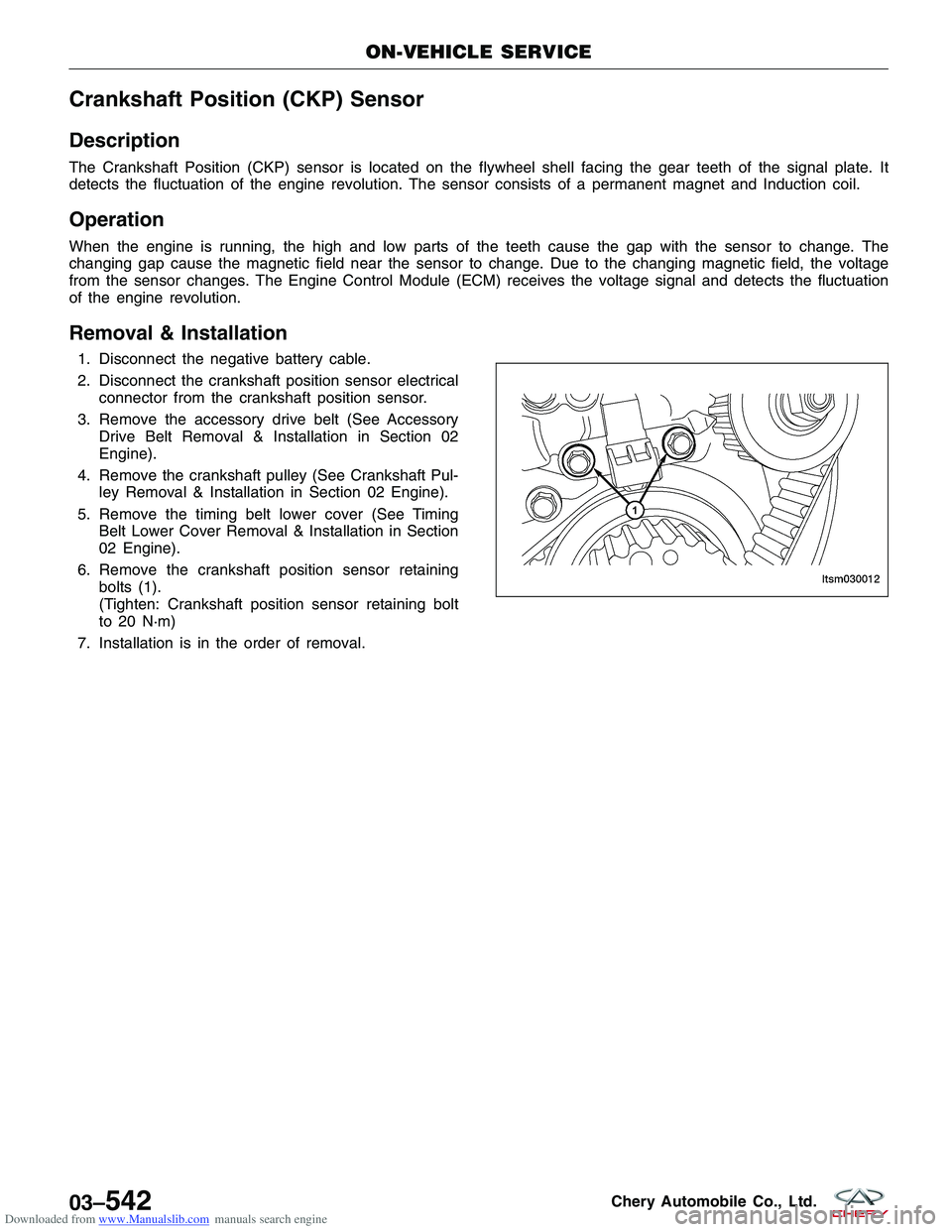
1. Disconnect the negative battery cable.
2. Disconnect the crankshaft position sensor electricalconnector from the crankshaft position sensor.
3. Remove the accessory drive belt (See Accessory Drive Belt Removal & Installation in Section 02
Engine).
4. Remove the crankshaft pulley (See Crankshaft Pul- ley Removal & Installation in Section 02 Engine).
5. Remove the timing belt lower cover (See Timing Belt Lower Cover Removal & Installation in Section
02 Engine).
6. Remove the crankshaft position sensor retaining bolts (1).
(Tighten: Crankshaft position sensor retaining bolt
to 20 N·m)
7. Installation is in the order of removal.
ON-VEHICLE SERVICE
LTSM030012
03–542Chery Automobile Co., Ltd.
Page 996 of 1903

Downloaded from www.Manualslib.com manuals search engine 2.HYDRAULIC TEST
• Preheat the transaxle fluid to 80° - 100°C.
• Lift the vehicle until the wheels can rotate freely.
• Connect the special fluid pressure gage onto the
fluid pressure measurement port as (3).
CONNECTOR AND TEST CAVITY
CONNECTOR AND CAVITY 12 3
Figure name Output speed sensor Fluid pressure sensor Fluid pressure test port
STANDARD FLUID PRESSURE TEST
MEASURE STATUS ENGINE SPEED (RPM)STANDARD FLUID PRESSURE
(BAR)
Gear lever position Not runningBelow 0.2
D/R 820 RPM 2.6
D/R 1400 RPM 8.7
• In accordance with the shown status of standard fluid pressure measurement table, measure the fluid pressure
of measurement port. The measurement of port should be within the standard range.
• If some measurement values is beyond the standard range, please refer to the fluid pressure measurement and
diagnosis table for causes.
Is the check result normal?
Ye s>>Go to step 5 for disc or plate abrasion.
No
>>Go to the next step.
3.CHECK VALVE BODY ASSEMBLY AND FLUID PUMP AND PIPELINE
• Turn the ignition switch off.
• Remove and disassemble the DP0 Automatic Transaxle Assembly (See Automatic Transaxle Removal & Instal-
lation in Section 08 Transaxle & Transfer Case).
• Check valve body and fluid pump and pipeline.
Is the check result normal?
Ye s>>Go to the next step.
No
>>Replace the damaged components as needed.
DIAGNOSIS & TESTING
LTSMD080021
08
08–53Chery Automobile Co., Ltd.
Page 1152 of 1903
Downloaded from www.Manualslib.com manuals search engine 2.HYDRAULIC TEST
• Preheat the fluid from engine to transaxle to 80-100°C.
• Lift the vehicle until the wheels can rotate freely.
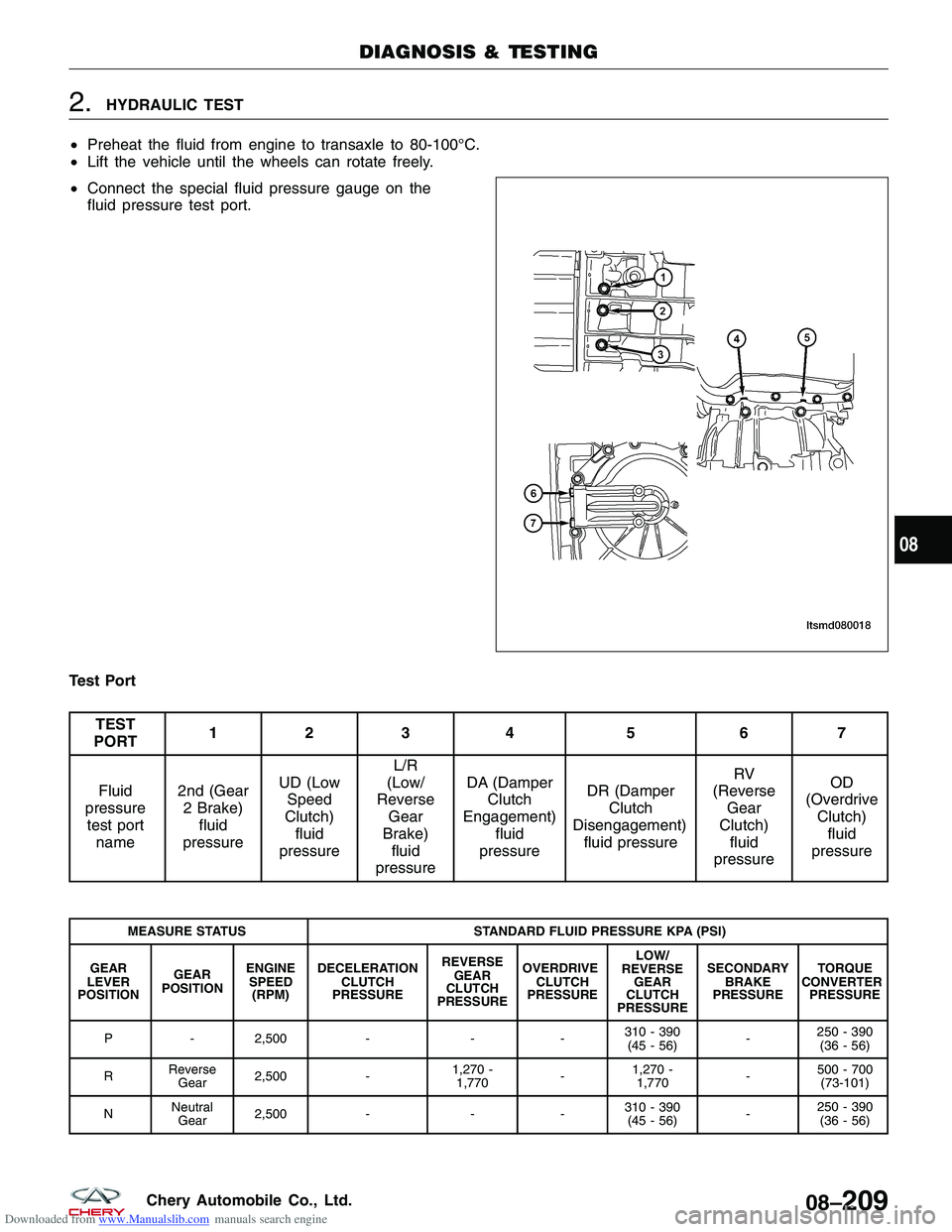
• Connect the special fluid pressure gauge on the
fluid pressure test port.
Test Port
TEST
PORT 123 4 5 6 7
Fluid
pressure test port name 2nd (Gear
2 Brake) fluid
pressure UD (Low
Speed
Clutch) fluid
pressure L/R
(Low/
Reverse Gear
Brake) fluid
pressure DA (Damper
Clutch
Engagement) fluid
pressure DR (Damper
Clutch
Disengagement) fluid pressure RV
(Reverse Gear
Clutch) fluid
pressure OD
(Overdrive Clutch)fluid
pressure
MEASURE STATUS STANDARD FLUID PRESSURE KPA (PSI)
GEAR
LEVER
POSITION GEAR
POSITION ENGINE
SPEED (RPM) DECELERATION
CLUTCH
PRESSURE REVERSE
GEAR
CLUTCH
PRESSURE OVERDRIVE
CLUTCH
PRESSURE LOW/
REVERSE GEAR
CLUTCH
PRESSURE SECONDARY
BRAKE
PRESSURE TORQUE
CONVERTER PRESSURE
P - 2,500 ---310 - 390
(45 - 56) -250 - 390
(36 - 56)
R Reverse
Gear 2,500
-1,270 -
1,770 -1,270 -
1,770 -500 - 700
(73-101)
N Neutral
Gear 2,500
---310 - 390
(45 - 56) -250 - 390
(36 - 56)
DIAGNOSIS & TESTING
LTSMD080018
08
08–209Chery Automobile Co., Ltd.
Page 1158 of 1903
Downloaded from www.Manualslib.com manuals search engine 2.HYDRAULIC TEST
• Preheat the fluid from engine to transaxle to 80° - 100°C.
• Lift the vehicle until the wheels can rotate freely.
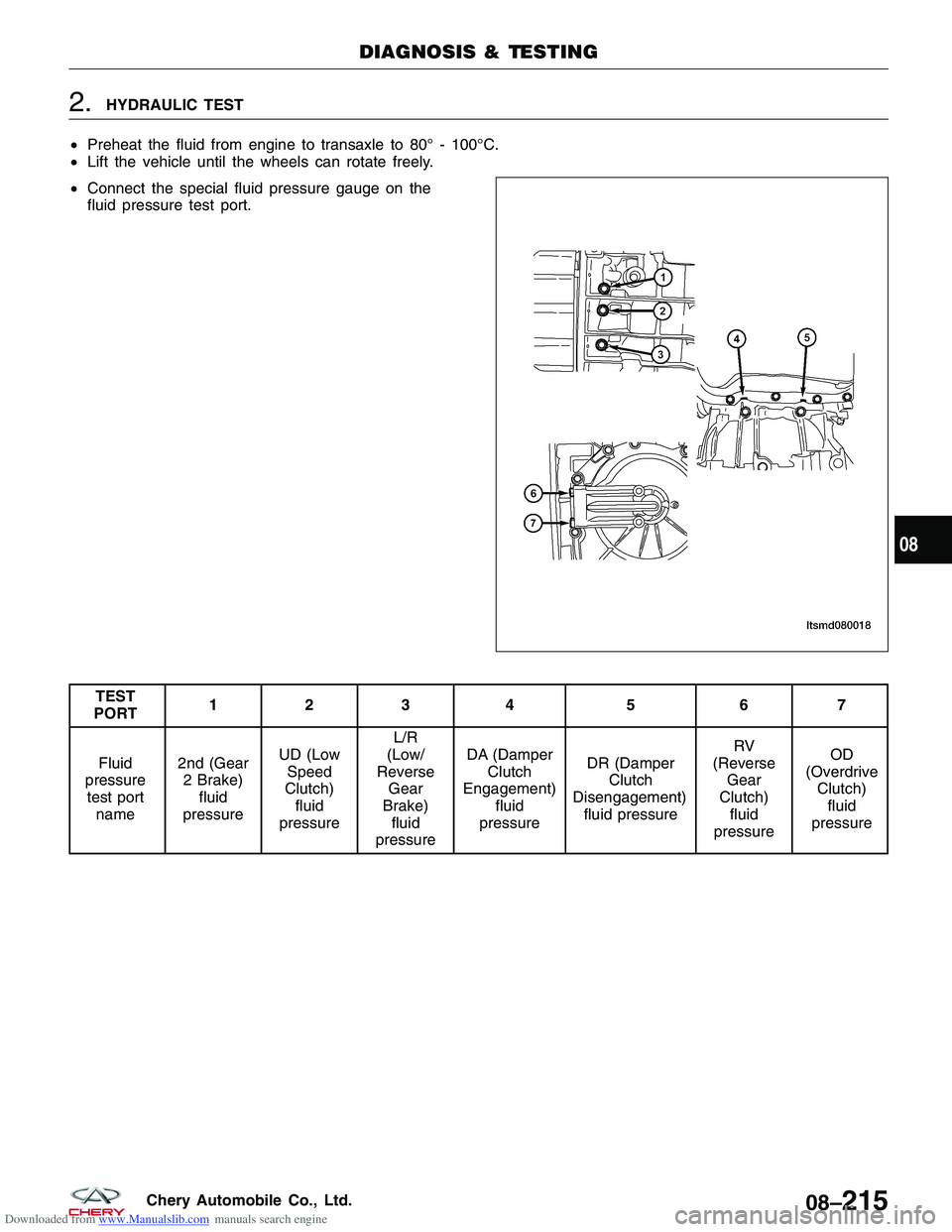
• Connect the special fluid pressure gauge on the
fluid pressure test port.
TEST
PORT 123 4 5 6 7
Fluid
pressure test port name 2nd (Gear
2 Brake) fluid
pressure UD (Low
Speed
Clutch) fluid
pressure L/R
(Low/
Reverse Gear
Brake) fluid
pressure DA (Damper
Clutch
Engagement) fluid
pressure DR (Damper
Clutch
Disengagement) fluid pressure RV
(Reverse Gear
Clutch) fluid
pressure OD
(Overdrive Clutch)fluid
pressure
DIAGNOSIS & TESTING
LTSMD080018
08
08–215Chery Automobile Co., Ltd.
Page 1164 of 1903
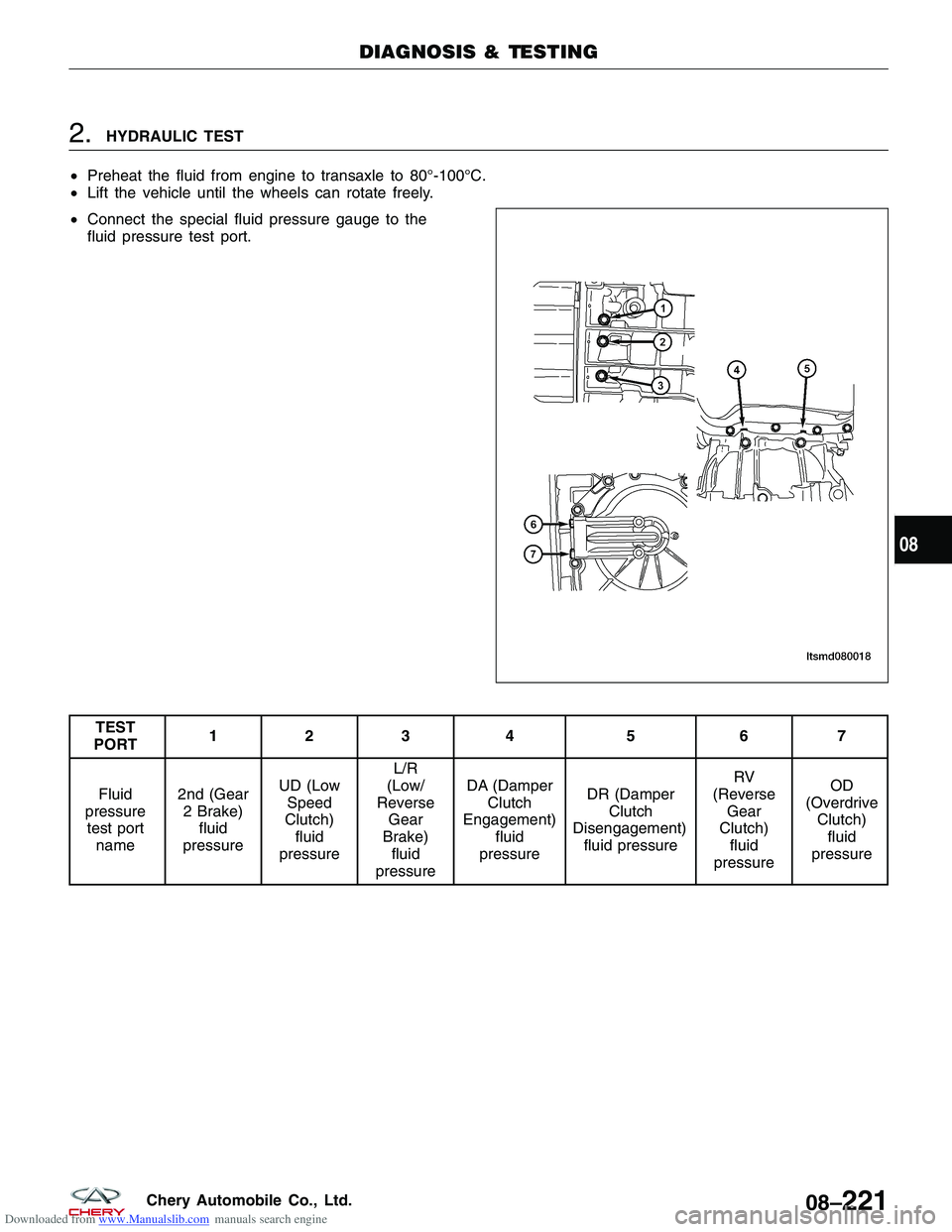
Downloaded from www.Manualslib.com manuals search engine 2.HYDRAULIC TEST
• Preheat the fluid from engine to transaxle to 80°-100°C.
• Lift the vehicle until the wheels can rotate freely.
• Connect the special fluid pressure gauge to the
fluid pressure test port.
TEST
PORT 123 4 5 6 7
Fluid
pressure test port name 2nd (Gear
2 Brake) fluid
pressure UD (Low
Speed
Clutch) fluid
pressure L/R
(Low/
Reverse Gear
Brake) fluid
pressure DA (Damper
Clutch
Engagement) fluid
pressure DR (Damper
Clutch
Disengagement) fluid pressure RV
(Reverse Gear
Clutch) fluid
pressure OD
(Overdrive Clutch)fluid
pressure
DIAGNOSIS & TESTING
LTSMD080018
08
08–221Chery Automobile Co., Ltd.
Page 1170 of 1903
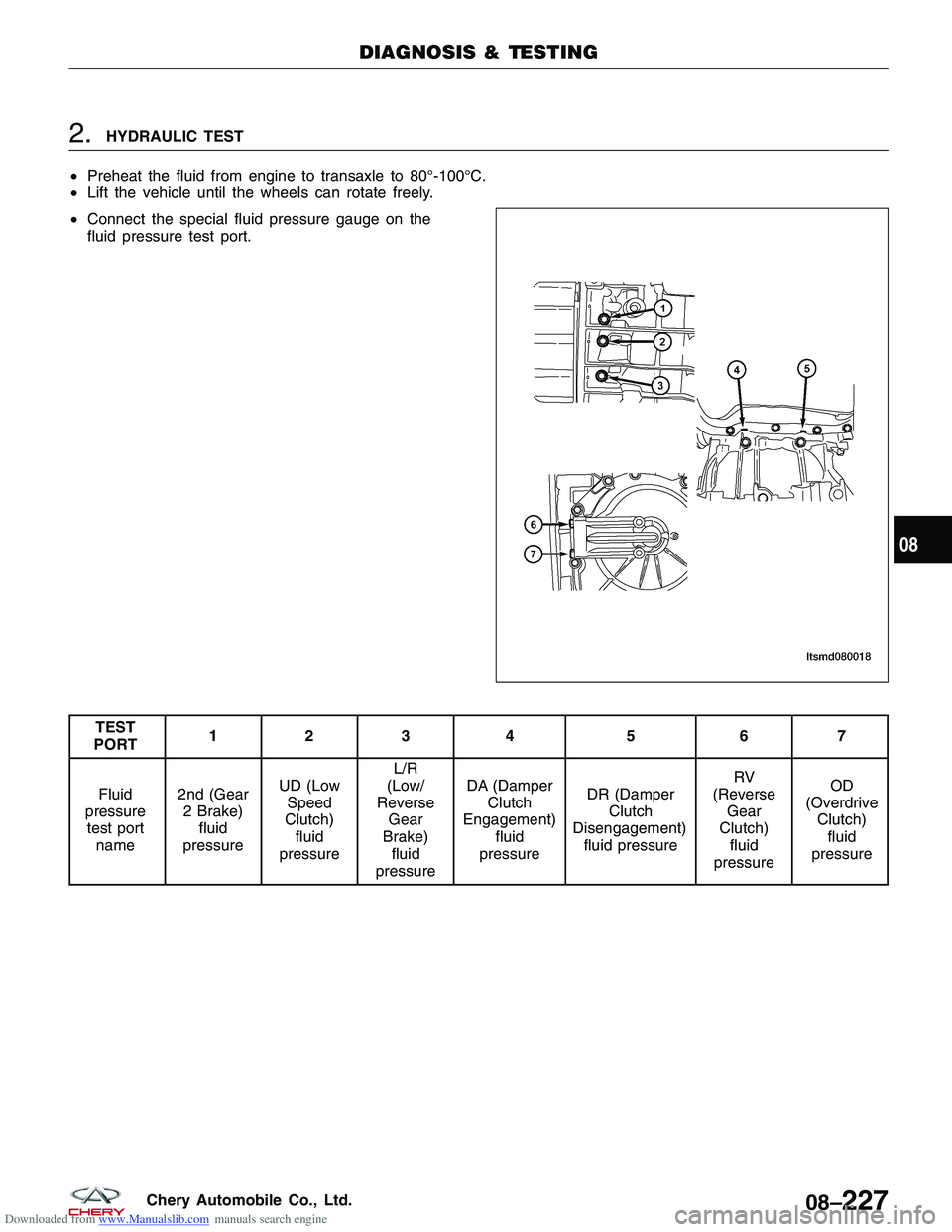
Downloaded from www.Manualslib.com manuals search engine 2.HYDRAULIC TEST
• Preheat the fluid from engine to transaxle to 80°-100°C.
• Lift the vehicle until the wheels can rotate freely.
• Connect the special fluid pressure gauge on the
fluid pressure test port.
TEST
PORT 123 4 5 6 7
Fluid
pressure test port name 2nd (Gear
2 Brake) fluid
pressure UD (Low
Speed
Clutch) fluid
pressure L/R
(Low/
Reverse Gear
Brake) fluid
pressure DA (Damper
Clutch
Engagement) fluid
pressure DR (Damper
Clutch
Disengagement) fluid pressure RV
(Reverse Gear
Clutch) fluid
pressure OD
(Overdrive Clutch)fluid
pressure
DIAGNOSIS & TESTING
LTSMD080018
08
08–227Chery Automobile Co., Ltd.
Page 1176 of 1903
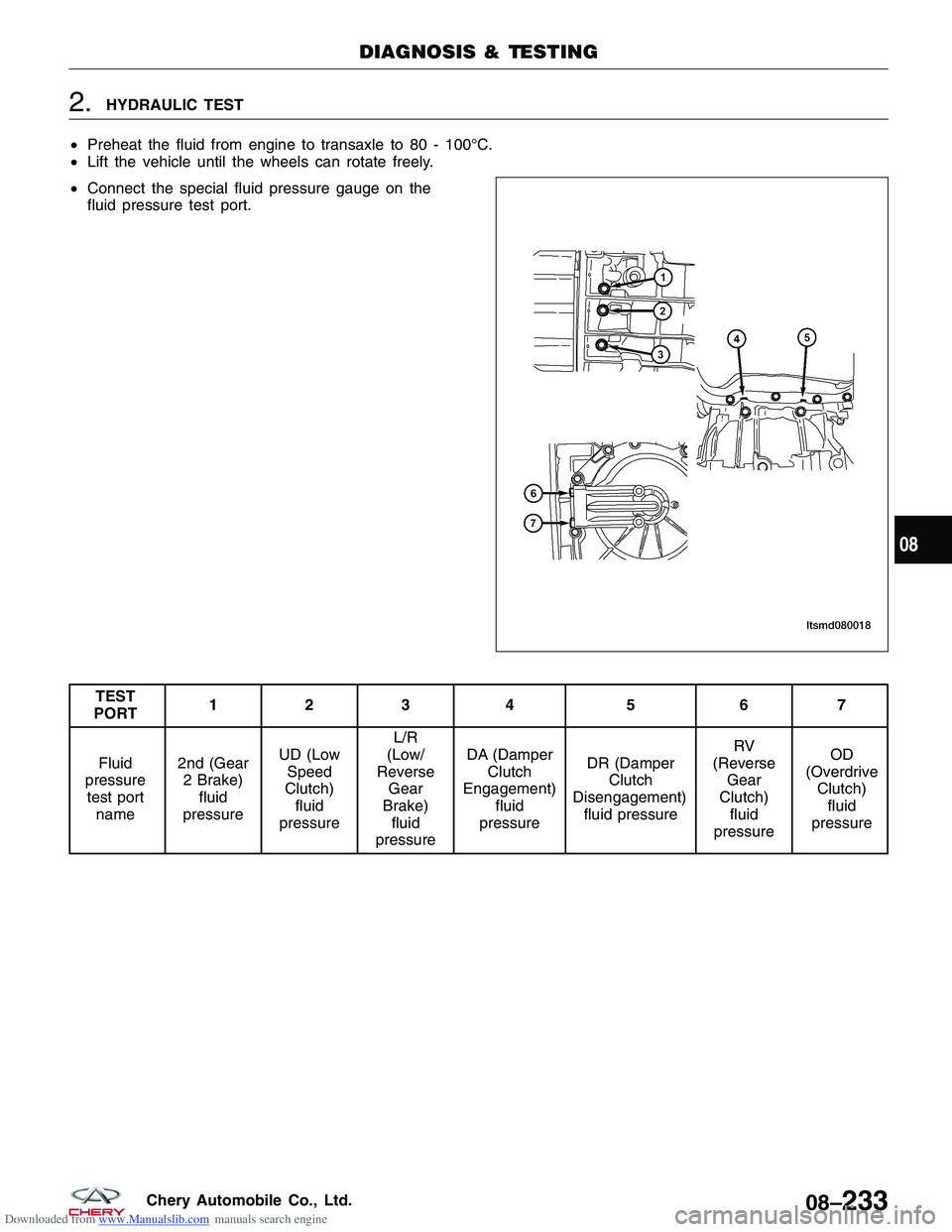
Downloaded from www.Manualslib.com manuals search engine 2.HYDRAULIC TEST
• Preheat the fluid from engine to transaxle to 80 - 100°C.
• Lift the vehicle until the wheels can rotate freely.
• Connect the special fluid pressure gauge on the
fluid pressure test port.
TEST
PORT 123 4 5 6 7
Fluid
pressure test port name 2nd (Gear
2 Brake) fluid
pressure UD (Low
Speed
Clutch) fluid
pressure L/R
(Low/
Reverse Gear
Brake) fluid
pressure DA (Damper
Clutch
Engagement) fluid
pressure DR (Damper
Clutch
Disengagement) fluid pressure RV
(Reverse Gear
Clutch) fluid
pressure OD
(Overdrive Clutch)fluid
pressure
DIAGNOSIS & TESTING
LTSMD080018
08
08–233Chery Automobile Co., Ltd.
Page 1193 of 1903
Downloaded from www.Manualslib.com manuals search engine Operation
The following are the details of the manual transaxle:
Neutral
Engine power is transmitted to the input shaft via the clutch assembly and the input shaft turns. Since no synchro-
nizers are engaged on either the input or output shafts, power is not transmitted to the output shafts, power is not
transmitted to the output shaft and the differential does not turn.
1st Gear
Engine power is transmitted to the input shaft via the clutch assembly and the input shaft turns. The input shaft first
gear is integral to the input shaft, and is in constant mesh with the intermediate shaft first speed gear. Because of
this constant mesh, the output shaft first speed gear freewheels until first gear is selected. As the gearshift lever is
moved to the first gear position, the 1-2 fork moves the 1-2 synchronizer sleeve towards first gear on the output
shaft. The synchronizer sleeve engages the first gear clutch teeth, engaging the gear to the output shaft, and allow-
ing power to transmit through the output shaft to the differential.
2nd Gear
Engine power is transmitted to the input shaft via the clutch assembly and the input shaft turns. The input shaft
second gear is integral to the input shaft, and is in constant mesh with the output shaft second speed gear. Because
of this constant mesh, the output shaft second speed gear freewheels until second gear is selected. As the gearshift
lever is moved to the second gear position, the 1-2 fork moves the 1-2 synchronizer sleeve towards second gear on
the output shaft. The synchronizer sleeve engages the second gear clutch teeth, engaging the gear to the output
shaft, and allowing power to transmit through the output shaft to the differential.
3rd Gear
Engine power is transmitted to the input shaft via the clutch assembly and the input shaft turns. The input shaft third
speed gear is in constant mesh with the output shaft 3-4 cluster gear which is fixed to the output shaft. Because of
this constant mesh, the input shaft third speed gear freewheels until third gear is selected. As the gearshift lever is
moved to the third gear position, the 3-4 fork moves the 3-4 synchronizer sleeve towards third gear on the input
shaft. The synchronizer sleeve engages the third gear clutch teeth, engaging the gear to the input shaft, and allowing
power to transmit through the output shaft to the differential.
4th Gear
Engine power is transmitted to the input shaft via the clutch assembly and the input shaft turns. The input shaft fourth
speed gear is in constant mesh with the output shaft 3-4 cluster gear which is fixed to the output shaft. Because of
this constant mesh, the input shaft fourth speed gear freewheels until fourth gear is selected. As the gearshift lever
is moved to the fourth gear position, the 3-4 fork moves the 3-4 synchronizer sleeve towards fourth gear on the input
shaft. The synchronizer sleeve engages the fourth gear clutch teeth, engaging the gear to the input shaft, and allow-
ing power to transmit through the output shaft to the differential.
5th Gear
Engine power is transmitted to the input shaft via the clutch assembly and the input shaft turns. The input shaft fifth
speed gear is pressed on to the input shaft, and is in constant mesh with the output shaft fifth speed gear. Because
of this constant mesh, the output shaft fifth speed gear freewheels until fifth gear is selected. As the gearshift lever
is moved to the fifth gear position, the 5-R fork moves the 5-R synchronizer sleeve towards the output shaft fifth
speed gear. The synchronizer sleeve engages the fifth gear clutch teeth, engaging the gear to the input shaft, and
allowing power to transmit through the output shaft to the differential.
Reverse Gear
Engine power is transmitted to the input shaft via the clutch assembly and the input shaft turns. The input shaft
reverse gear is integral to the input shaft, and is in constant mesh with the reverse idler gear. The reverse idler gear,
which reverses the rotation of the output shaft, is in constant mesh with the output shaft reverse gear. Because of
this constant mesh, the output shaft reverse gear freewheels until reverse gear is selected. As the gearshift lever is
moved to the reverse gear position, the 5-R fork moves the 5-R synchronizer sleeve towards the output shaft reverse
gear. The synchronizer sleeve engages the reverse gear clutch teeth, engaging the gear to the output shaft, and
allowing power to transmit through the output shaft to the differential.
GENERAL INFORMATION
08–250Chery Automobile Co., Ltd.
Page 1201 of 1903
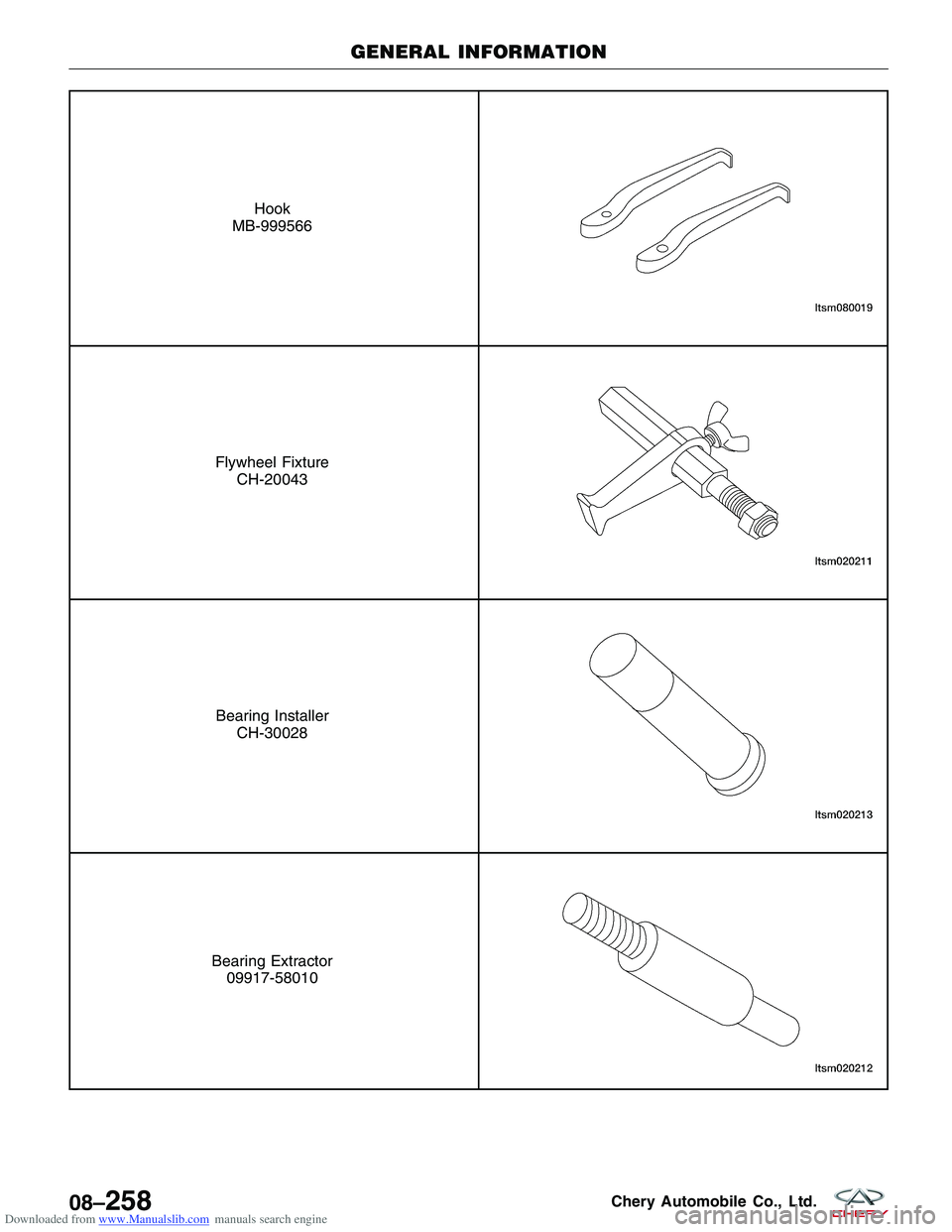
Downloaded from www.Manualslib.com manuals search engine Hook
MB-999566
Flywheel Fixture CH-20043
Bearing InstallerCH-30028
Bearing Extractor09917-58010
GENERAL INFORMATION
08–258Chery Automobile Co., Ltd.