check engine CHERY TIGGO 2009 Service Repair Manual
[x] Cancel search | Manufacturer: CHERY, Model Year: 2009, Model line: TIGGO, Model: CHERY TIGGO 2009Pages: 1903, PDF Size: 33.38 MB
Page 1241 of 1903
Downloaded from www.Manualslib.com manuals search engine Assemble
Assemble in the reverse order of disassembly.
NOTE :
•Check and ensure the shift fork is properly installed to the fork shaft, there should be NO axial or radial motion in
the fork shaft.
• Check and ensure the fork rack is properly installed to the fork shaft, there should be NO axial or radial motion in
the fork shaft.
• Check and ensure backup light driving block is properly installed to the fork shaft, there should be NO axial or
radial motion in the fork shaft.
• Check the fork shaft surface for any damage.
• Check the position of the three spring pins, ensure the pins are in proper alignment. The extension of both ends
of the three spring pins should not exceed 3 mm.
3rd-4th Gear Shift Fork
Disassemble
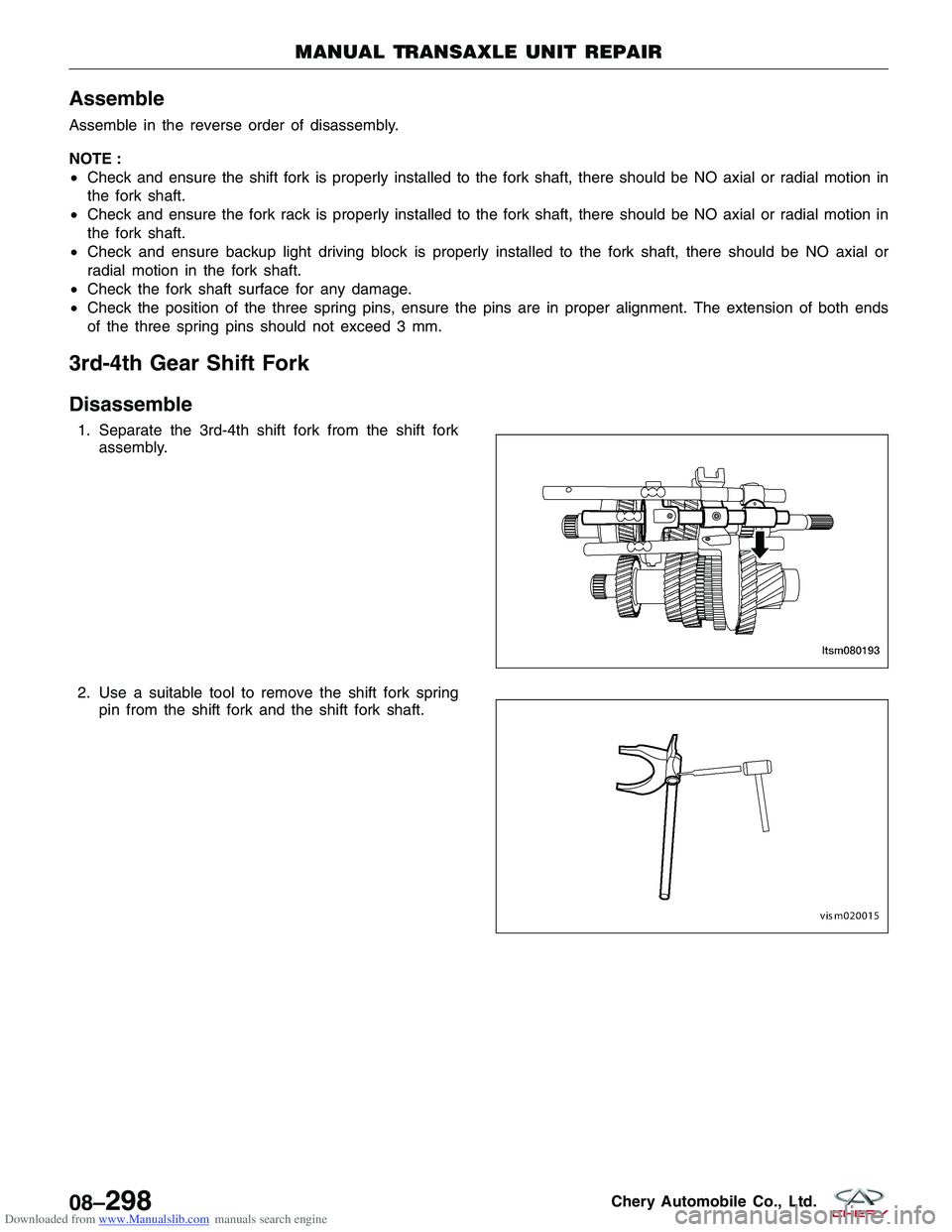
1. Separate the 3rd-4th shift fork from the shift fork
assembly.
2. Use a suitable tool to remove the shift fork spring pin from the shift fork and the shift fork shaft.
MANUAL TRANSAXLE UNIT REPAIR
LTSM080193
VISM020015
08–298Chery Automobile Co., Ltd.
Page 1242 of 1903
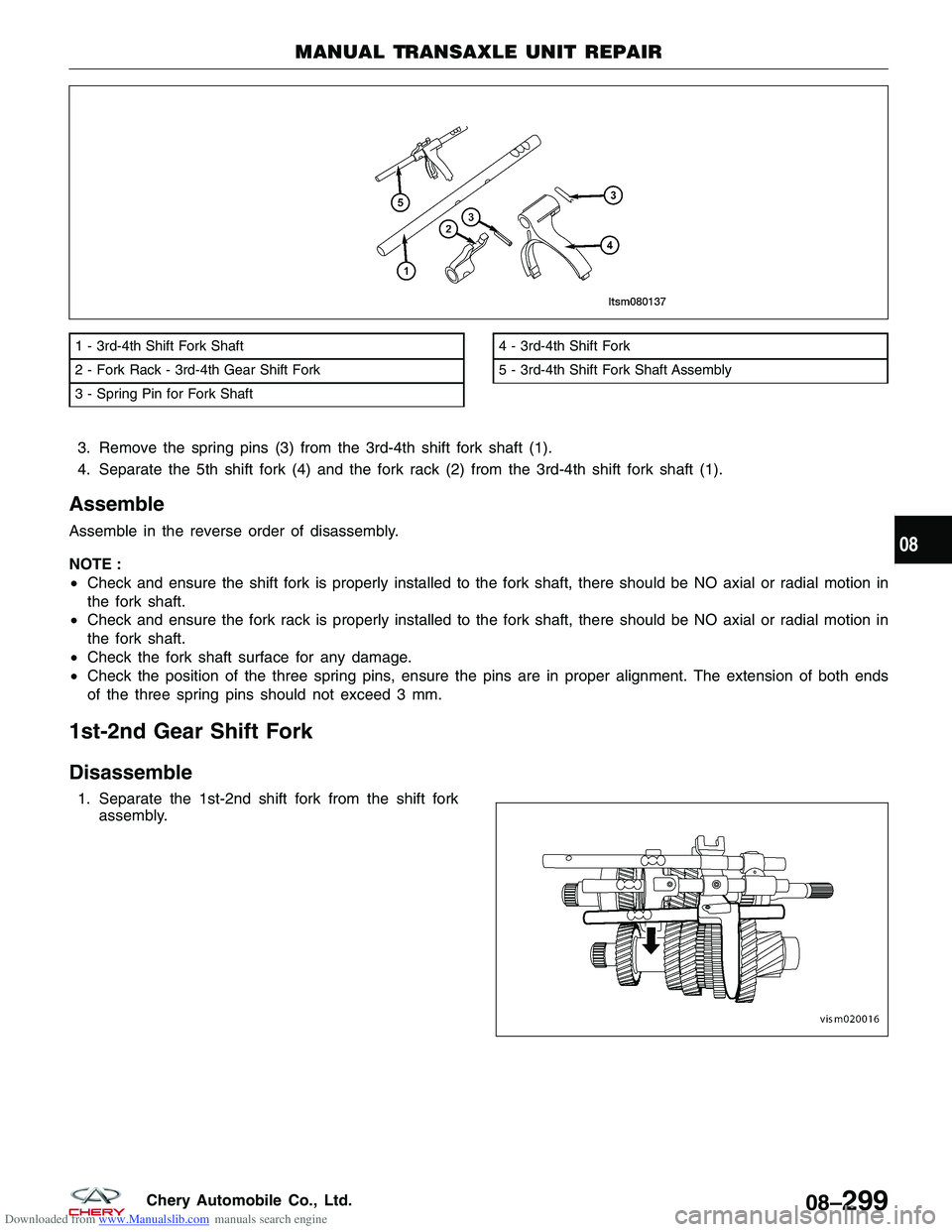
Downloaded from www.Manualslib.com manuals search engine 3. Remove the spring pins (3) from the 3rd-4th shift fork shaft (1).
4. Separate the 5th shift fork (4) and the fork rack (2) from the 3rd-4th shift fork shaft (1).
Assemble
Assemble in the reverse order of disassembly.
NOTE :
•Check and ensure the shift fork is properly installed to the fork shaft, there should be NO axial or radial motion in
the fork shaft.
• Check and ensure the fork rack is properly installed to the fork shaft, there should be NO axial or radial motion in
the fork shaft.
• Check the fork shaft surface for any damage.
• Check the position of the three spring pins, ensure the pins are in proper alignment. The extension of both ends
of the three spring pins should not exceed 3 mm.
1st-2nd Gear Shift Fork
Disassemble
1. Separate the 1st-2nd shift fork from the shift fork
assembly.
1 - 3rd-4th Shift Fork Shaft
2 - Fork Rack - 3rd-4th Gear Shift Fork
3 - Spring Pin for Fork Shaft4 - 3rd-4th Shift Fork
5 - 3rd-4th Shift Fork Shaft Assembly
MANUAL TRANSAXLE UNIT REPAIR
LTSM080137
VISM020016
08
08–299Chery Automobile Co., Ltd.
Page 1243 of 1903
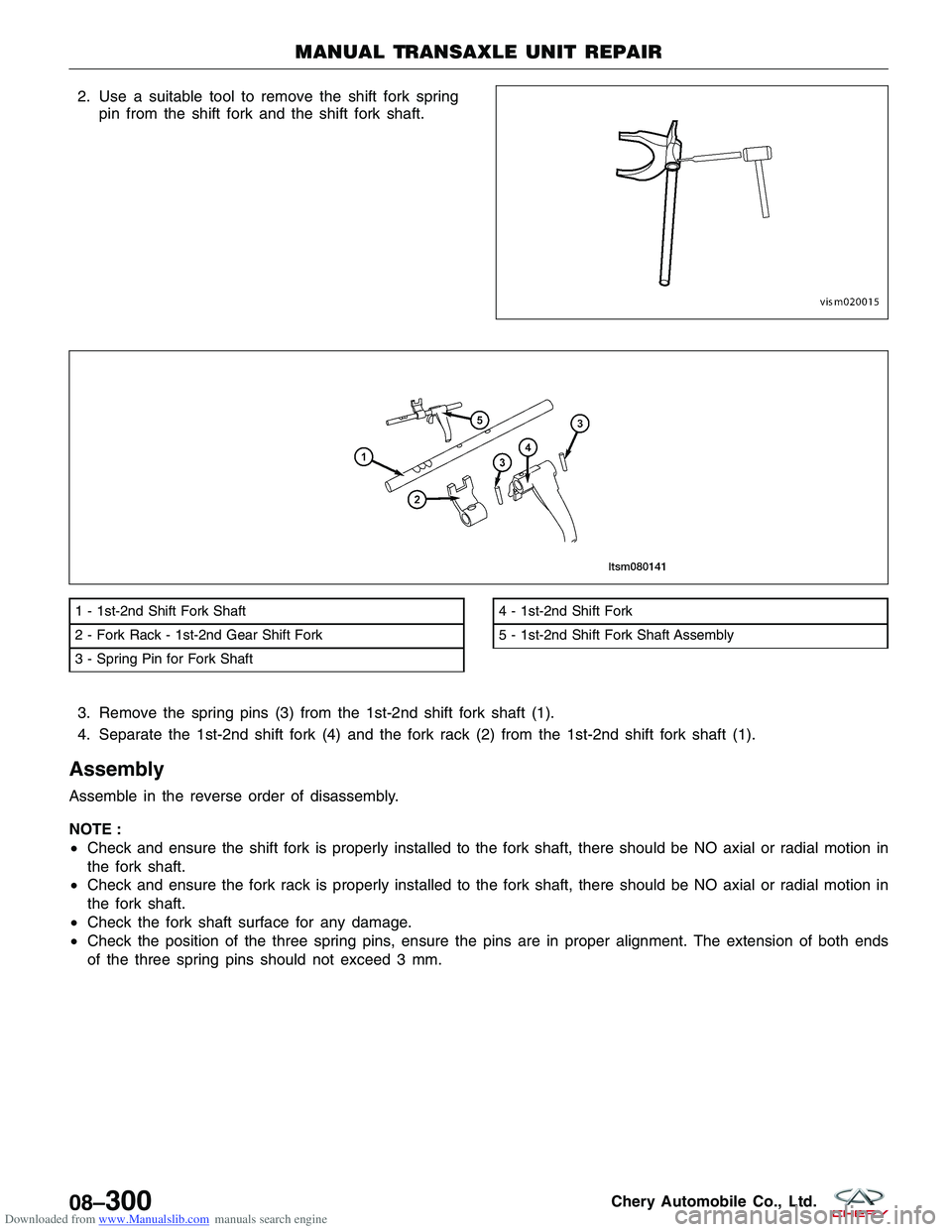
Downloaded from www.Manualslib.com manuals search engine 2. Use a suitable tool to remove the shift fork springpin from the shift fork and the shift fork shaft.
3. Remove the spring pins (3) from the 1st-2nd shift fork shaft (1).
4. Separate the 1st-2nd shift fork (4) and the fork rack (2) from the 1st-2nd shift fork shaft (1).
Assembly
Assemble in the reverse order of disassembly.
NOTE :
• Check and ensure the shift fork is properly installed to the fork shaft, there should be NO axial or radial motion in
the fork shaft.
• Check and ensure the fork rack is properly installed to the fork shaft, there should be NO axial or radial motion in
the fork shaft.
• Check the fork shaft surface for any damage.
• Check the position of the three spring pins, ensure the pins are in proper alignment. The extension of both ends
of the three spring pins should not exceed 3 mm.
1 - 1st-2nd Shift Fork Shaft
2 - Fork Rack - 1st-2nd Gear Shift Fork
3 - Spring Pin for Fork Shaft4 - 1st-2nd Shift Fork
5 - 1st-2nd Shift Fork Shaft Assembly
MANUAL TRANSAXLE UNIT REPAIR
VISM020015
LTSM080141
08–300Chery Automobile Co., Ltd.
Page 1263 of 1903
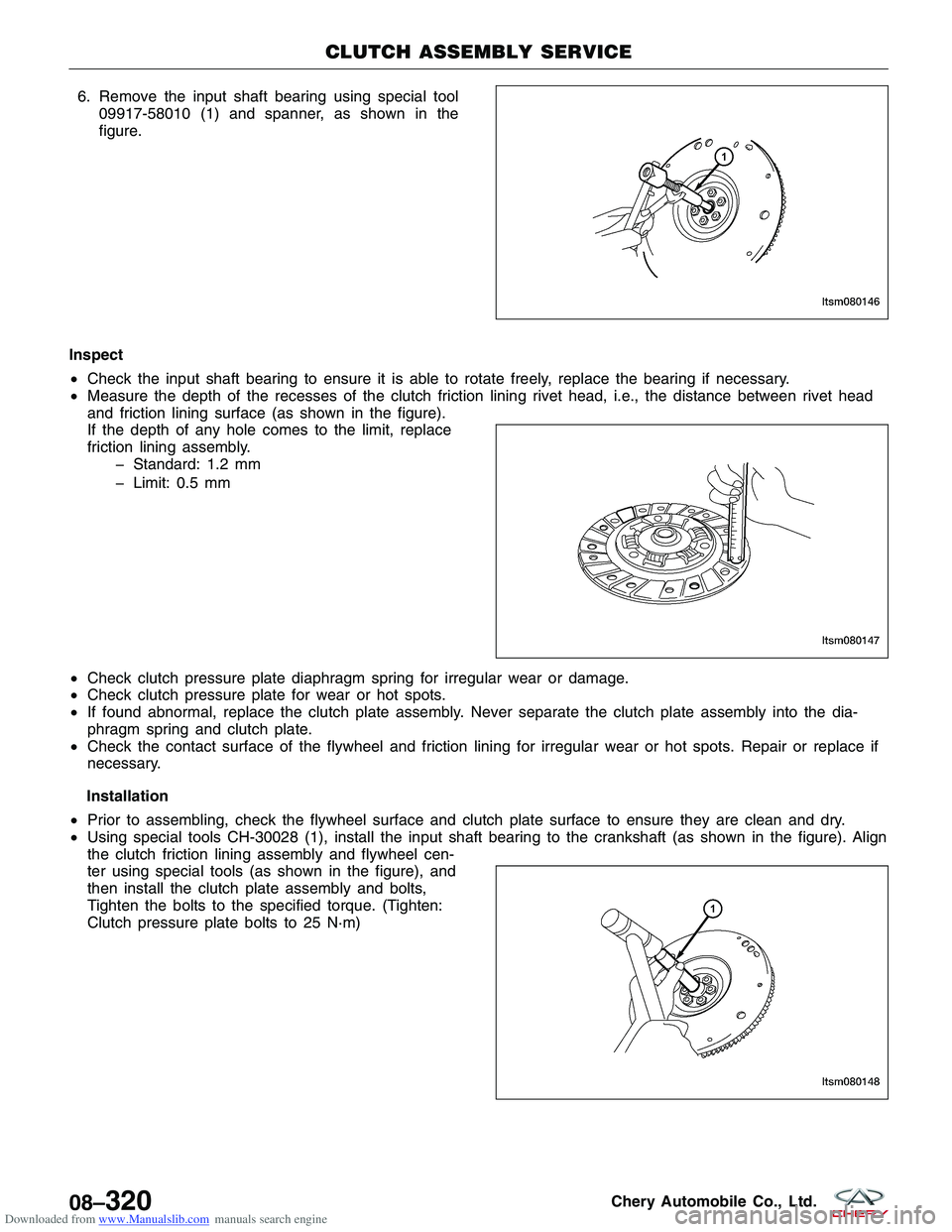
Downloaded from www.Manualslib.com manuals search engine 6. Remove the input shaft bearing using special tool09917-58010 (1) and spanner, as shown in the
figure.
Inspect
• Check the input shaft bearing to ensure it is able to rotate freely, replace the bearing if necessary.
• Measure the depth of the recesses of the clutch friction lining rivet head, i.e., the distance between rivet head
and friction lining surface (as shown in the figure).
If the depth of any hole comes to the limit, replace
friction lining assembly.
Standard: 1.2 mm
Limit: 0.5 mm
• Check clutch pressure plate diaphragm spring for irregular wear or damage.
• Check clutch pressure plate for wear or hot spots.
• If found abnormal, replace the clutch plate assembly. Never separate the clutch plate assembly into the dia-
phragm spring and clutch plate.
• Check the contact surface of the flywheel and friction lining for irregular wear or hot spots. Repair or replace if
necessary.
Installation
• Prior to assembling, check the flywheel surface and clutch plate surface to ensure they are clean and dry.
• Using special tools CH-30028 (1), install the input shaft bearing to the crankshaft (as shown in the figure). Align
the clutch friction lining assembly and flywheel cen-
ter using special tools (as shown in the figure), and
then install the clutch plate assembly and bolts,
Tighten the bolts to the specified torque. (Tighten:
Clutch pressure plate bolts to 25 N·m)
CLUTCH ASSEMBLY SERVICE
LTSM080146
LTSM080147
LTSM080148
08–320Chery Automobile Co., Ltd.
Page 1264 of 1903
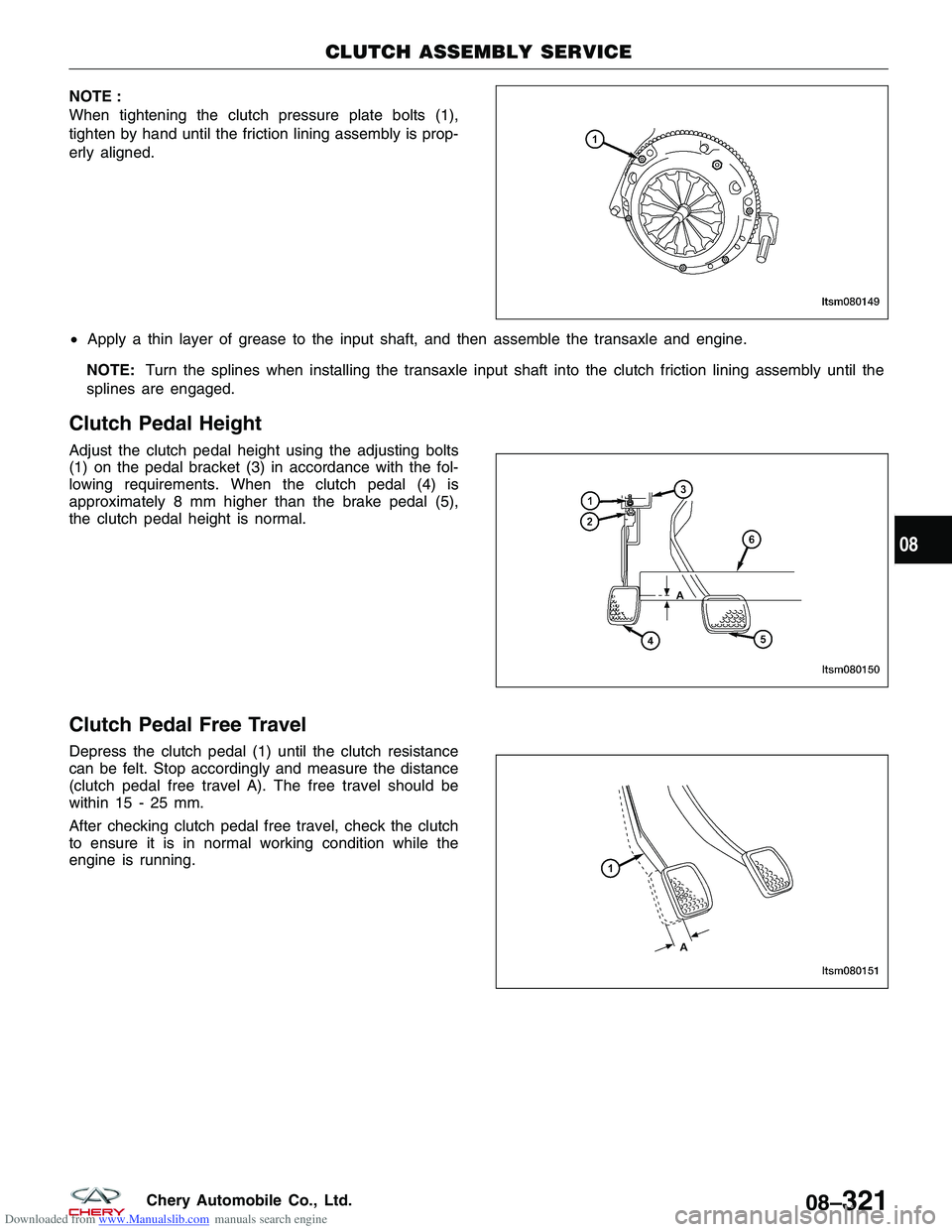
Downloaded from www.Manualslib.com manuals search engine NOTE :
When tightening the clutch pressure plate bolts (1),
tighten by hand until the friction lining assembly is prop-
erly aligned.
•Apply a thin layer of grease to the input shaft, and then assemble the transaxle and engine.
NOTE: Turn the splines when installing the transaxle input shaft into the clutch friction lining assembly until the
splines are engaged.
Clutch Pedal Height
Adjust the clutch pedal height using the adjusting bolts
(1) on the pedal bracket (3) in accordance with the fol-
lowing requirements. When the clutch pedal (4) is
approximately 8 mm higher than the brake pedal (5),
the clutch pedal height is normal.
Clutch Pedal Free Travel
Depress the clutch pedal (1) until the clutch resistance
can be felt. Stop accordingly and measure the distance
(clutch pedal free travel A). The free travel should be
within 15 - 25 mm.
After checking clutch pedal free travel, check the clutch
to ensure it is in normal working condition while the
engine is running.
CLUTCH ASSEMBLY SERVICE
LTSM080149
LTSM080150
LTSM080151
08
08–321Chery Automobile Co., Ltd.
Page 1267 of 1903
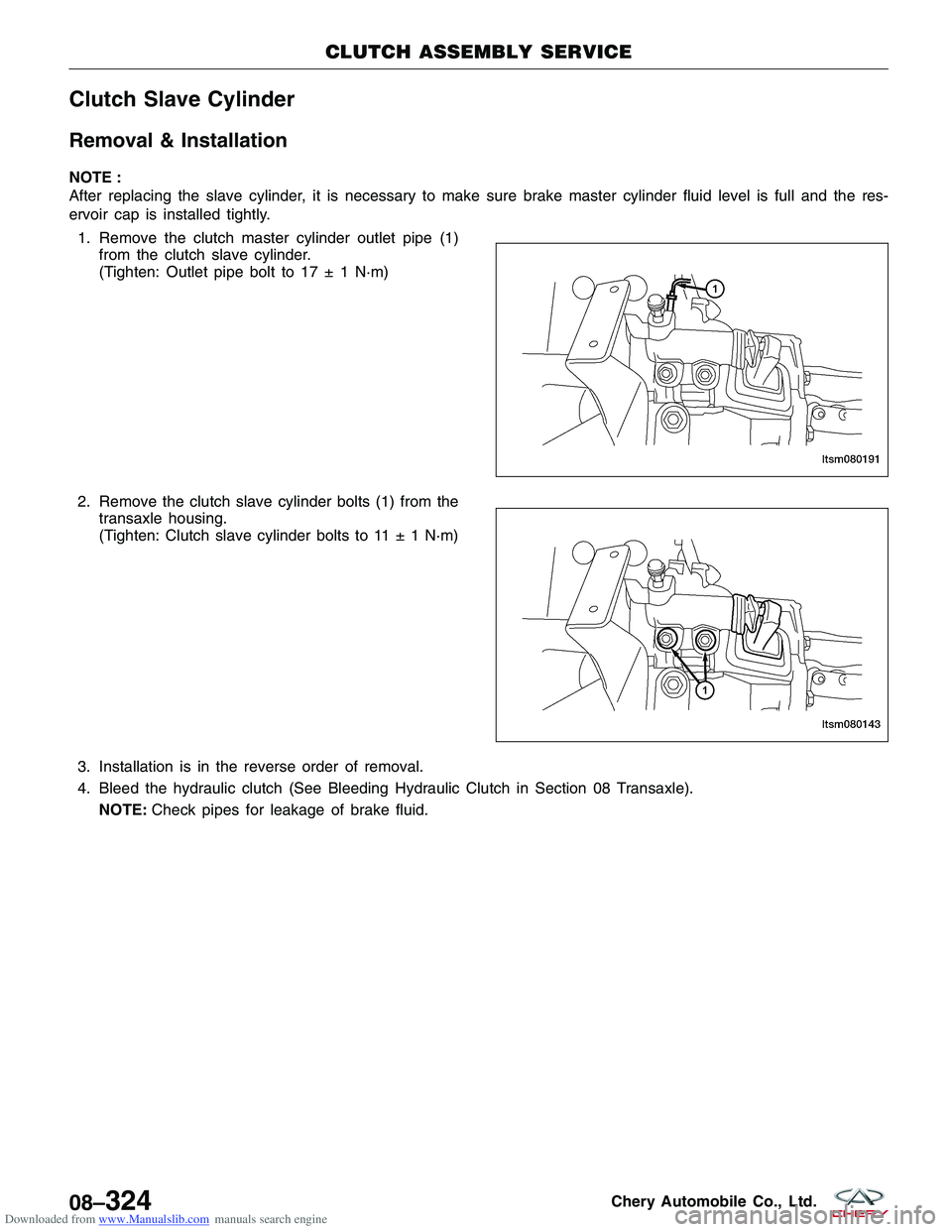
Downloaded from www.Manualslib.com manuals search engine Clutch Slave Cylinder
Removal & Installation
NOTE :
After replacing the slave cylinder, it is necessary to make sure brake master cylinder fluid level is full and the res-
ervoir cap is installed tightly.1. Remove the clutch master cylinder outlet pipe (1) from the clutch slave cylinder.
(Tighten: Outlet pipe bolt to 17 ± 1 N·m)
2. Remove the clutch slave cylinder bolts (1) from the transaxle housing.
(Tighten: Clutch slave cylinder bolts to 11 ± 1 N·m)
3. Installation is in the reverse order of removal.
4. Bleed the hydraulic clutch (See Bleeding Hydraulic Clutch in Section 08 Transaxle). NOTE: Check pipes for leakage of brake fluid.
CLUTCH ASSEMBLY SERVICE
LTSM080191
LTSM080143
08–324Chery Automobile Co., Ltd.
Page 1278 of 1903
Downloaded from www.Manualslib.com manuals search engine DIAGNOSIS & TESTING
Vehicle Inspection
Inspect the following for leaks or damage:
•Check for grease in the vicinity of the inboard tripod joint and outboard CV joint.
• Check the inner or outer joint seal boot or seal boot clamp for damage.
Noise Or Vibration On Turns
A clicking noise or a vibration in turns could be caused by one of the following conditions:
•Damaged outer CV joint or damaged CV seal boot or seal boot clamps.
• Damaged inner CV joint or damaged CV seal boot or seal boot clamps.
• Noise may also be caused by another component of the vehicle coming in contact with the half shafts.
NOTE :
If the CV seal boot is damaged, this will result in the loss and/or contamination of the joint grease, resulting in inad-
equate lubrication of the joint.
Clunking Noise During Acceleration
This noise may be a result of one of the following conditions:
• A torn seal boot on the inner or outer joint of the half shaft assembly.
• A loose or missing clamp on the inner or outer joint of the half shaft assembly.
• A damaged or worn half shaft CV joint.
Shudder Or Vibration During Acceleration
This problem could be a result of:
•A worn or damaged half shaft inner tripod joint.
• Improper wheel alignment.
Vibration At High Speeds
This problem could be a result of:
•Foreign material (mud, etc.) packed on the backside of the wheel(s).
• Out of balance tires or wheels.
• Improper tire or wheel runout.
09–4Chery Automobile Co., Ltd.
Page 1281 of 1903
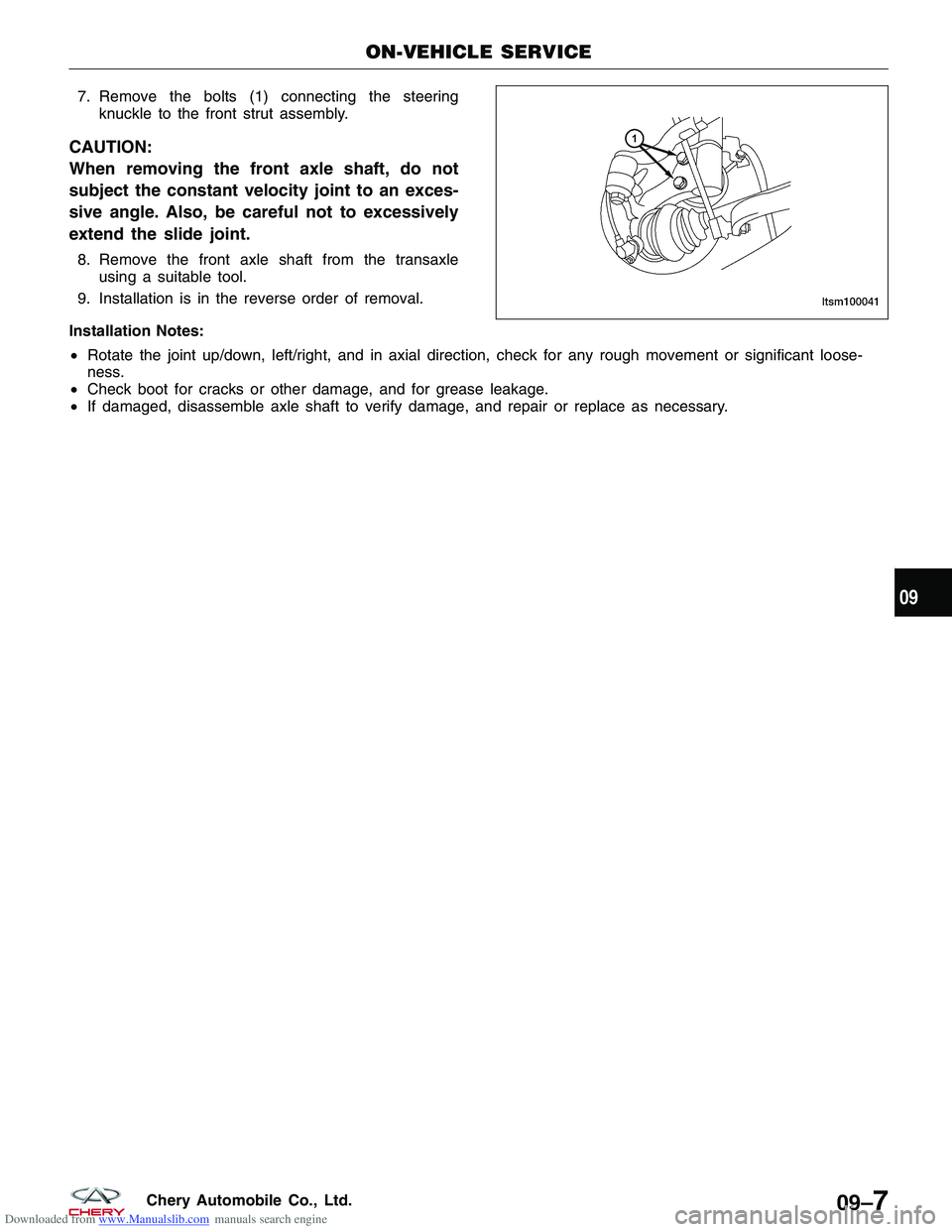
Downloaded from www.Manualslib.com manuals search engine 7. Remove the bolts (1) connecting the steeringknuckle to the front strut assembly.
CAUTION:
When removing the front axle shaft, do not
subject the constant velocity joint to an exces-
sive angle. Also, be careful not to excessively
extend the slide joint.
8. Remove the front axle shaft from the transaxleusing a suitable tool.
9. Installation is in the reverse order of removal.
Installation Notes:
• Rotate the joint up/down, left/right, and in axial direction, check for any rough movement or significant loose-
ness.
• Check boot for cracks or other damage, and for grease leakage.
• If damaged, disassemble axle shaft to verify damage, and repair or replace as necessary.
ON-VEHICLE SERVICE
LTSM100041
09
09–7Chery Automobile Co., Ltd.
Page 1285 of 1903
Downloaded from www.Manualslib.com manuals search engine DIAGNOSIS & TESTING
Vehicle Inspection
Inspect the rear axle for the following:
•Check the rear axle for loose bearings.
• Check the rear axle hub for any damage or excessive runout.
Shudder Or Vibration During Acceleration
This problem could be a result of:
•A worn or damaged half shaft inner tripod joint (4x4).
• Improper wheel alignment.
Vehicle Inspection
Inspect the following for leaks or damage:
•Check for grease in the vicinity of the inboard tripod joint and outboard CV joint (4x4).
• Check the inner or outer joint seal boot or seal boot clamp for damage (4x4).
Noise Or Vibration On Turns
A clicking noise or a vibration in turns could be caused by one of the following conditions:
•Damaged outer CV joint or damaged CV seal boot or seal boot clamps (4x4).
• Damaged inner CV joint or damaged CV seal boot or seal boot clamps (4x4).
• Noise may also be caused by another component of the vehicle coming in contact with the half shafts (4x4).
NOTE :
If the CV seal boot is damaged, this will result in the loss and/or contamination of the joint grease, resulting in inad-
equate lubrication of the joint.
Clunking Noise During Acceleration
This noise may be a result of one of the following conditions:
• A torn seal boot on the inner or outer joint of the half shaft assembly (4x4).
• A loose or missing clamp on the inner or outer joint of the half shaft assembly (4x4).
• A damaged or worn half shaft CV joint (4x4).
Shudder Or Vibration During Acceleration
This problem could be a result of:
•A worn or damaged half shaft inner tripod joint (4x4).
• Improper wheel alignment.
Vibration At High Speeds
This problem could be a result of:
•Foreign material (mud, etc.) packed on the backside of the wheel(s).
• Out of balance tires or wheels.
• Improper tire or wheel runout.
Visual Inspection For Fluid Leaks (4x4)
This problem could be a result of:
•Where seals are used: There should be no appearance of fluid leakage or abnormal abrasions.
• Where sealant is applied: There should be no appearance of fluid leakage or fluid seepage.
• Where attaching bolts are used, fluid-fill and fluid-draining plugs are used: There should be no appearance of
fluid leakage, fluid seepage or loose bolts.
• The housing: There should be no appearance of fluid leakage or fluid seepage.
09
09–11Chery Automobile Co., Ltd.
Page 1300 of 1903
Downloaded from www.Manualslib.com manuals search engine DIAGNOSIS & TESTING
Vehicle Inspection
Inspect the drive shaft for the following:
•Check the drive shaft for loose bearings.
• Check the drive shaft for any damage or excessive runout.
Shudder Or Vibration During Acceleration
This problem could be a result of:
•A worn or damaged drive shaft joint.
• Improper wheel alignment.
Clunking Noise During Acceleration
This noise may be a result of one of the following conditions:
•A worn drive shaft assembly.
• A loose drive shaft assembly.
• A damaged or worn drive shaft joint.
Shudder Or Vibration During Acceleration
This problem could be a result of:
•A worn or damaged drive shaft joint.
• Improper wheel alignment.
Vibration At High Speeds
This problem could be a result of:
•Foreign material (mud, etc.) packed on the backside of the wheel(s).
• Out of balance tires or wheels.
• Improper tire or wheel runout.
09–26Chery Automobile Co., Ltd.