check engine CHERY TIGGO 2009 Service Repair Manual
[x] Cancel search | Manufacturer: CHERY, Model Year: 2009, Model line: TIGGO, Model: CHERY TIGGO 2009Pages: 1903, PDF Size: 33.38 MB
Page 1307 of 1903
Downloaded from www.Manualslib.com manuals search engine DIAGNOSIS & TESTING
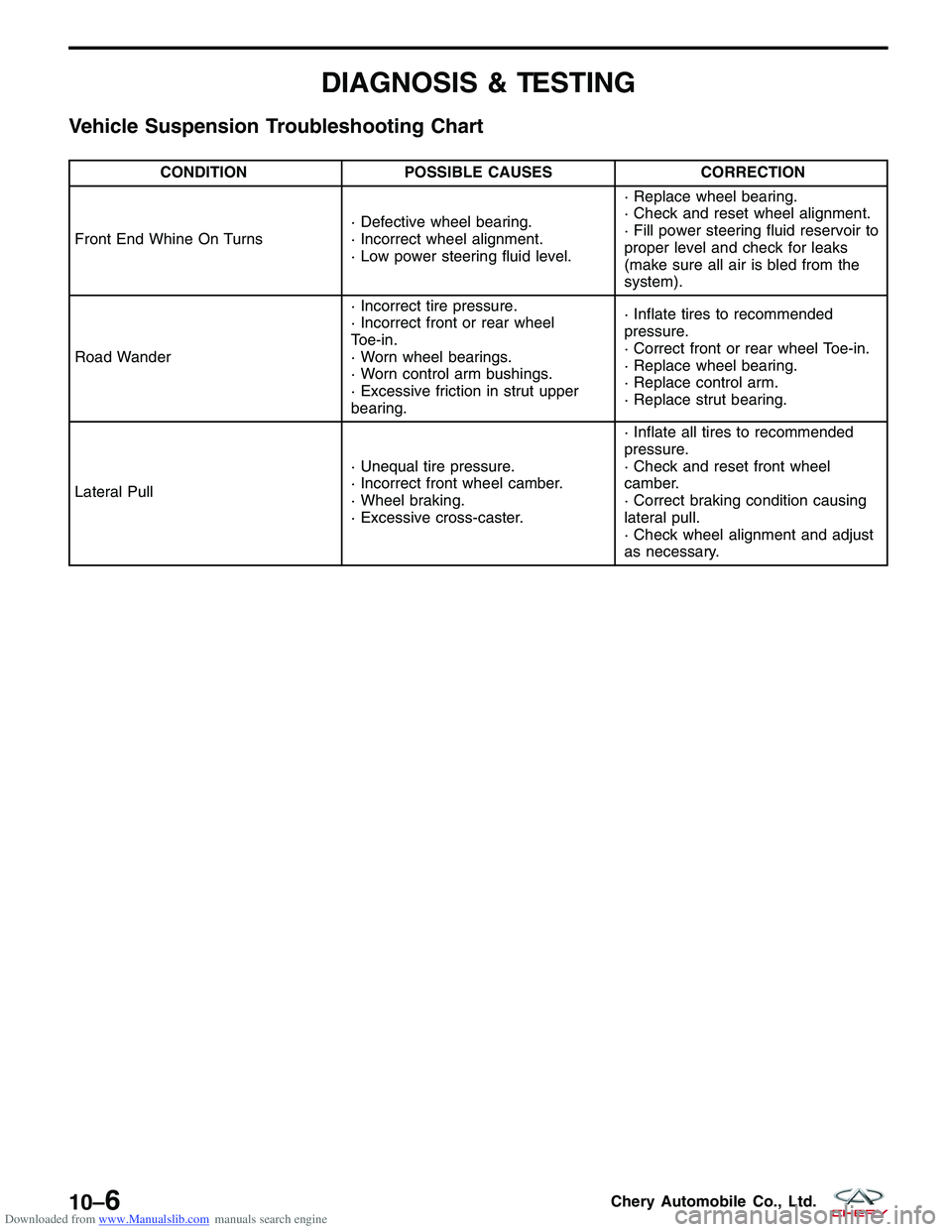
Vehicle Suspension Troubleshooting Chart
CONDITIONPOSSIBLE CAUSES CORRECTION
Front End Whine On Turns · Defective wheel bearing.
· Incorrect wheel alignment.
· Low power steering fluid level.· Replace wheel bearing.
· Check and reset wheel alignment.
· Fill power steering fluid reservoir to
proper level and check for leaks
(make sure all air is bled from the
system).
Road Wander · Incorrect tire pressure.
· Incorrect front or rear wheel
Toe-in.
· Worn wheel bearings.
· Worn control arm bushings.
· Excessive friction in strut upper
bearing.· Inflate tires to recommended
pressure.
· Correct front or rear wheel Toe-in.
· Replace wheel bearing.
· Replace control arm.
· Replace strut bearing.
Lateral Pull · Unequal tire pressure.
· Incorrect front wheel camber.
· Wheel braking.
· Excessive cross-caster.· Inflate all tires to recommended
pressure.
· Check and reset front wheel
camber.
· Correct braking condition causing
lateral pull.
· Check wheel alignment and adjust
as necessary.
10–6Chery Automobile Co., Ltd.
Page 1312 of 1903
Downloaded from www.Manualslib.com manuals search engine Inspection
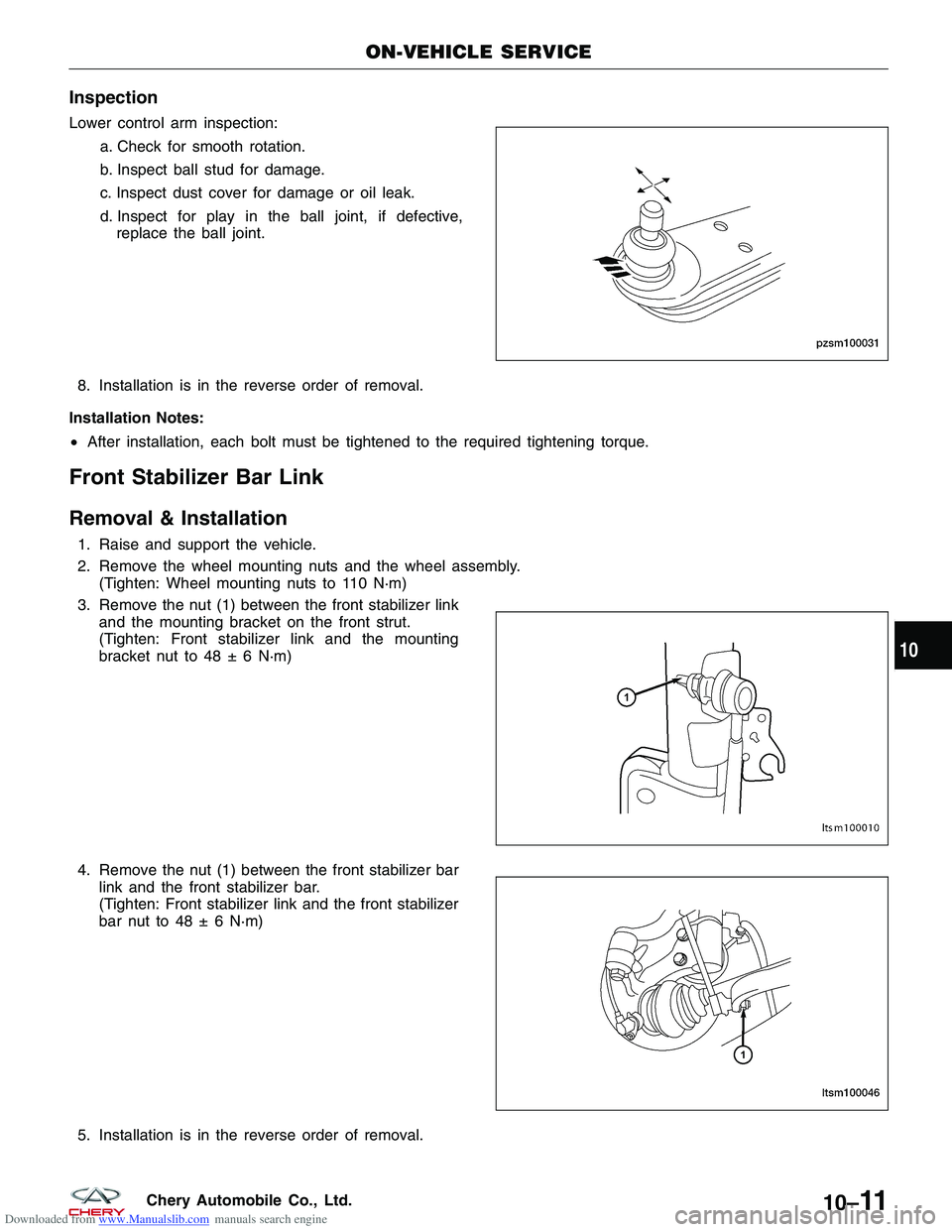
Lower control arm inspection:a. Check for smooth rotation.
b. Inspect ball stud for damage.
c. Inspect dust cover for damage or oil leak.
d. Inspect for play in the ball joint, if defective,
replace the ball joint.
8. Installation is in the reverse order of removal.
Installation Notes:
• After installation, each bolt must be tightened to the required tightening torque.
Front Stabilizer Bar Link
Removal & Installation
1. Raise and support the vehicle.
2. Remove the wheel mounting nuts and the wheel assembly.
(Tighten: Wheel mounting nuts to 110 N·m)
3. Remove the nut (1) between the front stabilizer link and the mounting bracket on the front strut.
(Tighten: Front stabilizer link and the mounting
bracket nut to 48 ± 6 N·m)
4. Remove the nut (1) between the front stabilizer bar link and the front stabilizer bar.
(Tighten: Front stabilizer link and the front stabilizer
bar nut to 48 ± 6 N·m)
5. Installation is in the reverse order of removal.
ON-VEHICLE SERVICE
PZSM100031
LTSM100010
LTSM100046
10
10–11Chery Automobile Co., Ltd.
Page 1323 of 1903
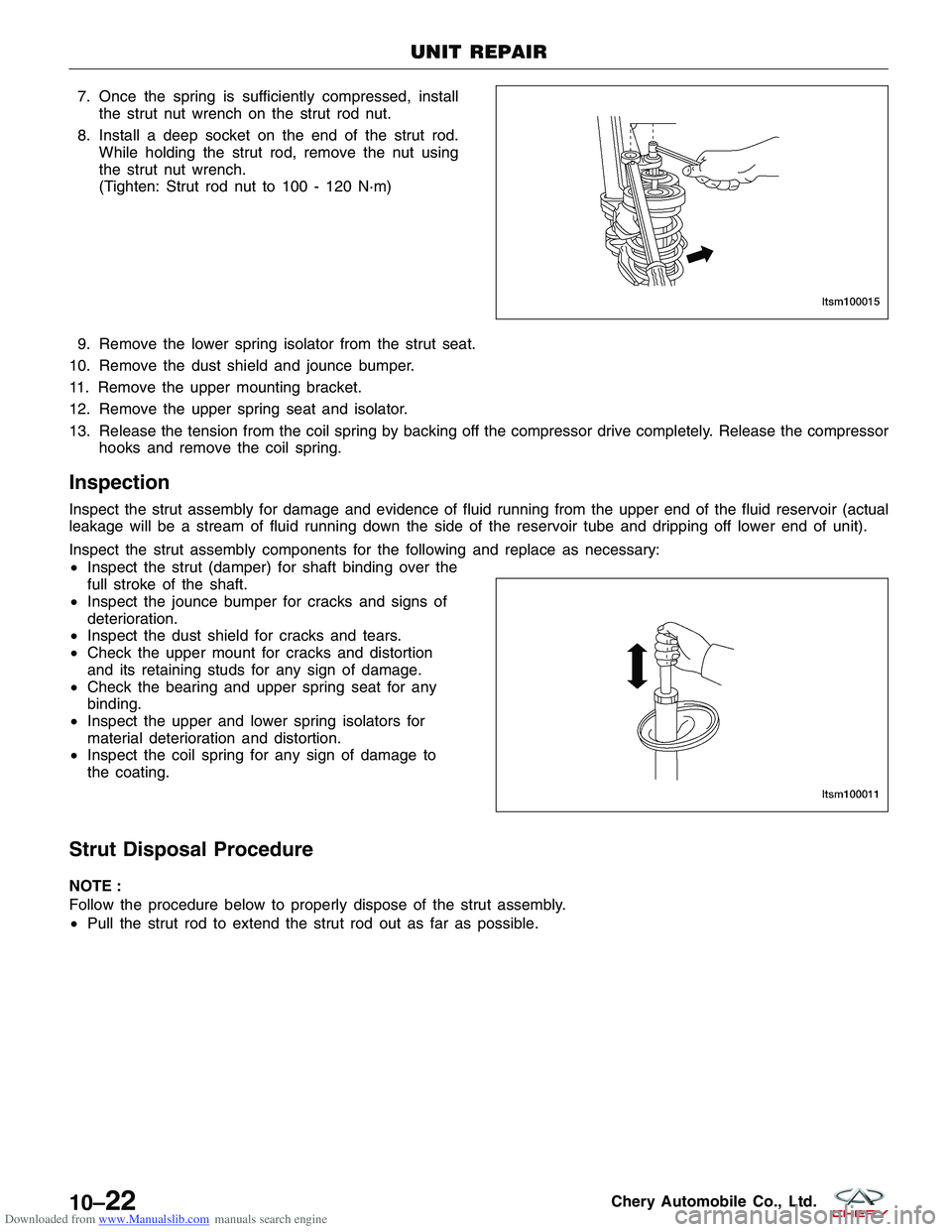
Downloaded from www.Manualslib.com manuals search engine 7. Once the spring is sufficiently compressed, installthe strut nut wrench on the strut rod nut.
8. Install a deep socket on the end of the strut rod. While holding the strut rod, remove the nut using
the strut nut wrench.
(Tighten: Strut rod nut to 100 - 120 N·m)
9. Remove the lower spring isolator from the strut seat.
10. Remove the dust shield and jounce bumper.
11. Remove the upper mounting bracket.
12. Remove the upper spring seat and isolator.
13. Release the tension from the coil spring by backing off the compressor drive completely. Release the compressor hooks and remove the coil spring.
Inspection
Inspect the strut assembly for damage and evidence of fluid running from the upper end of the fluid reservoir (actual
leakage will be a stream of fluid running down the side of the reservoir tube and dripping off lower end of unit).
Inspect the strut assembly components for the following and replace as necessary:
•Inspect the strut (damper) for shaft binding over the
full stroke of the shaft.
• Inspect the jounce bumper for cracks and signs of
deterioration.
• Inspect the dust shield for cracks and tears.
• Check the upper mount for cracks and distortion
and its retaining studs for any sign of damage.
• Check the bearing and upper spring seat for any
binding.
• Inspect the upper and lower spring isolators for
material deterioration and distortion.
• Inspect the coil spring for any sign of damage to
the coating.
Strut Disposal Procedure
NOTE :
Follow the procedure below to properly dispose of the strut assembly.
•Pull the strut rod to extend the strut rod out as far as possible.
UNIT REPAIR
LTSM100015
LTSM100011
10–22Chery Automobile Co., Ltd.
Page 1330 of 1903
Downloaded from www.Manualslib.com manuals search engine DIAGNOSIS & TESTING
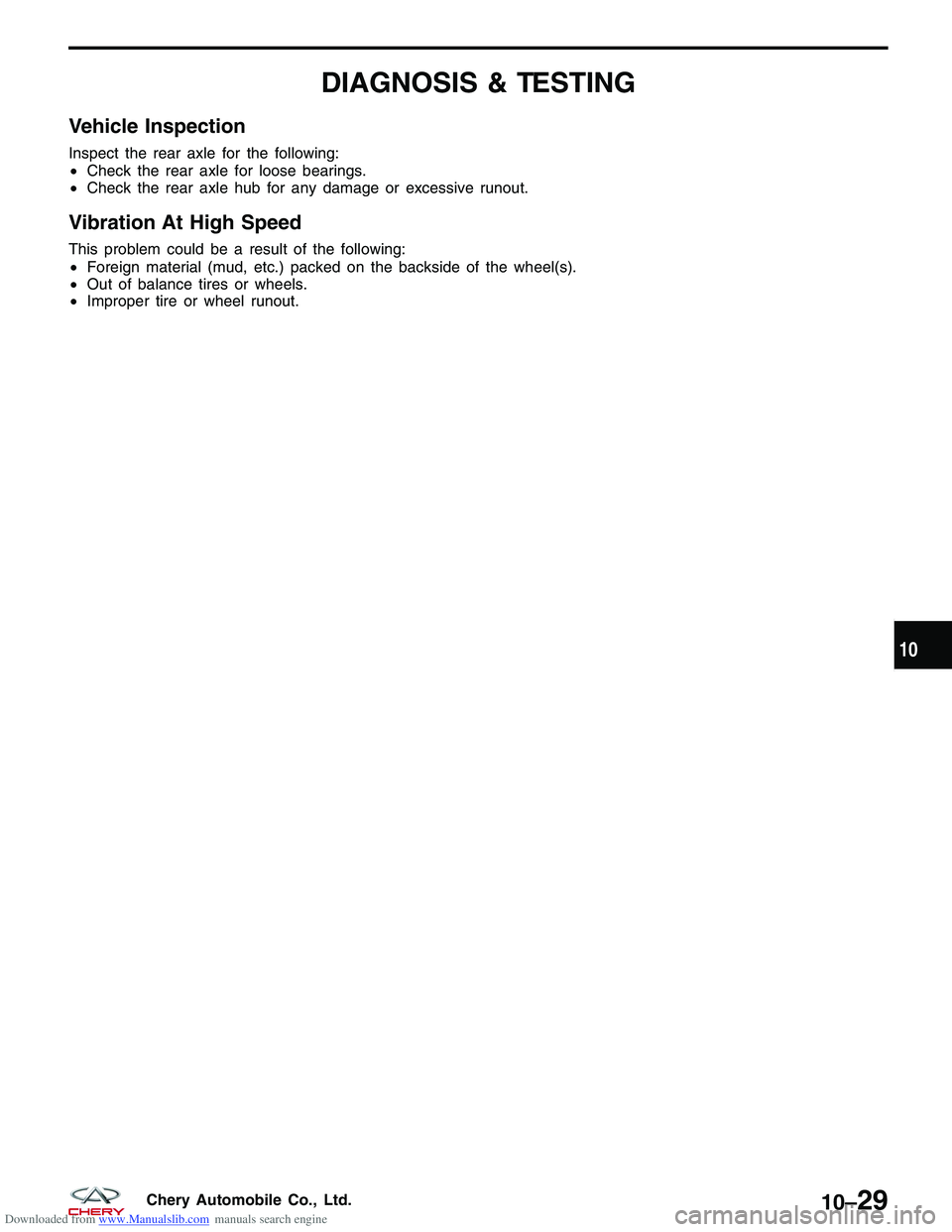
Vehicle Inspection
Inspect the rear axle for the following:
•Check the rear axle for loose bearings.
• Check the rear axle hub for any damage or excessive runout.
Vibration At High Speed
This problem could be a result of the following:
•Foreign material (mud, etc.) packed on the backside of the wheel(s).
• Out of balance tires or wheels.
• Improper tire or wheel runout.
10
10–29Chery Automobile Co., Ltd.
Page 1340 of 1903
Downloaded from www.Manualslib.com manuals search engine GENERAL INFORMATION
Description
Vehicle wheel alignment is the positioning of all interrelated front and rear suspension angles. These angles affect the
handling and steering of the vehicle when it is in motion. Proper wheel alignment is essential for efficient steering,
good directional stability, and proper tire wear.
The method of checking a vehicle’s front and rear wheel alignment varies depending on the manufacturer and type
of equipment used. The manufacturer’s instructions should always be followed to ensure accuracy of the alignment.
On this vehicle, the suspension angles that can be adjusted are as follows:
Front Axle
•Camber
• Caster
• Toe-in
Rear Axle
• Camber
• Toe-in
Check the wheel alignment and make all wheel alignment adjustments with the vehicle standing at its proper curb
height specification. Curb height is the normal riding height of the vehicle. It is measured from a certain point on the
vehicle to the ground or a designated area while the vehicle is sitting on a flat, level surface.
Operation
Curb Height Measurement
The wheel alignment is to be checked and all alignment adjustments made with the vehicle at its required curb height
specification.
• Vehicle height is to be checked with the vehicle on a flat, level surface, preferably a vehicle alignment rack.
• The tires are to be inflated to the recommended pressure.
• All tires are to be the same size as standard equipment.
• Vehicle height is checked with the fuel tank full of fuel, and no passenger or luggage compartment load.
• Vehicle height is not adjustable.
• If the measurement is not within specifications, inspect the vehicle for bent or weak suspension components.
• Compare the parts tag on the suspect coil spring(s) to the parts book and the vehicle sales code, checking for
a match.
• Once removed from the vehicle, compare the coil spring height to a new or known good coil spring. The
heights should vary if the suspect spring is weak.
NOTE :
Prior to reading the curb height measurement, the front and rear of the vehicle must be jounced to settle the sus-
pension. Induce jounce by pushing down on the center of the bumper (fascia), using care not to damage the vehicle,
moving the vehicle up and down, gradually increasing the suspension travel with each stroke. Release the bumper at
the bottom of each stroke, repeating this action several times. Perform this to both front and rear suspensions an
equal number of times.
Pre-Wheel Alignment Inspection
Before any attempt is made to change or correct the wheel alignment, the following inspection and necessary cor-
rections must be made to the vehicle to ensure proper alignment. 1. Verify the fuel tank is full of fuel. If the fuel tank is not full, the reduction in weight will affect the curb height of the vehicle and the alignment specifications.
2. The passenger and luggage compartments of the vehicle should be free of any load that is not factory equip- ment.
10
10–39Chery Automobile Co., Ltd.
Page 1341 of 1903
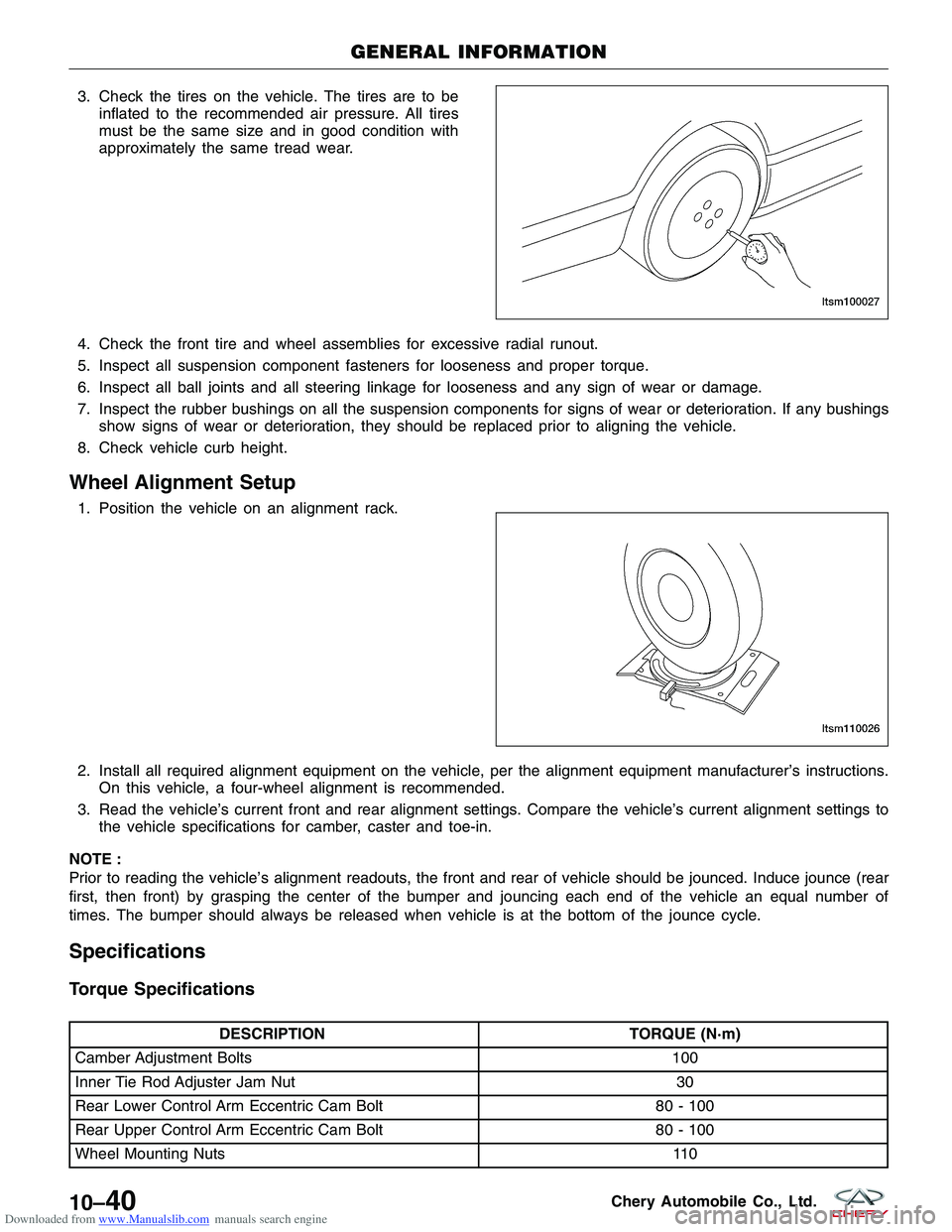
Downloaded from www.Manualslib.com manuals search engine 3. Check the tires on the vehicle. The tires are to beinflated to the recommended air pressure. All tires
must be the same size and in good condition with
approximately the same tread wear.
4. Check the front tire and wheel assemblies for excessive radial runout.
5. Inspect all suspension component fasteners for looseness and proper torque.
6. Inspect all ball joints and all steering linkage for looseness and any sign of wear or damage.
7. Inspect the rubber bushings on all the suspension components for signs of wear or deterioration. If any bushings show signs of wear or deterioration, they should be replaced prior to aligning the vehicle.
8. Check vehicle curb height.
Wheel Alignment Setup
1. Position the vehicle on an alignment rack.
2. Install all required alignment equipment on the vehicle, per the alignment equipment manufacturer’s instructions. On this vehicle, a four-wheel alignment is recommended.
3. Read the vehicle’s current front and rear alignment settings. Compare the vehicle’s current alignment settings to the vehicle specifications for camber, caster and toe-in.
NOTE :
Prior to reading the vehicle’s alignment readouts, the front and rear of vehicle should be jounced. Induce jounce (rear
first, then front) by grasping the center of the bumper and jouncing each end of the vehicle an equal number of
times. The bumper should always be released when vehicle is at the bottom of the jounce cycle.
Specifications
Torque Specifications
DESCRIPTION TORQUE (N·m)
Camber Adjustment Bolts 100
Inner Tie Rod Adjuster Jam Nut 30
Rear Lower Control Arm Eccentric Cam Bolt 80 - 100
Rear Upper Control Arm Eccentric Cam Bolt 80 - 100
Wheel Mounting Nuts 110
GENERAL INFORMATION
LTSM100027
LTSM110026
10–40Chery Automobile Co., Ltd.
Page 1343 of 1903
Downloaded from www.Manualslib.com manuals search engine DIAGNOSIS & TESTING
Vehicle Inspection
Inspect the following for damage:
•Inspect the tires.
• Inspect the rims.
Replace any tire or rim that is found to be damaged.
Tire Wear
Inspect the following for accurate tire wear:
• Check the depth of tire remaining tread.
• Standard tire: not less than 1.6 mm.
• Snow tire: 50% tire tread.
If the tread is below the specifications, the tire should be replaced.
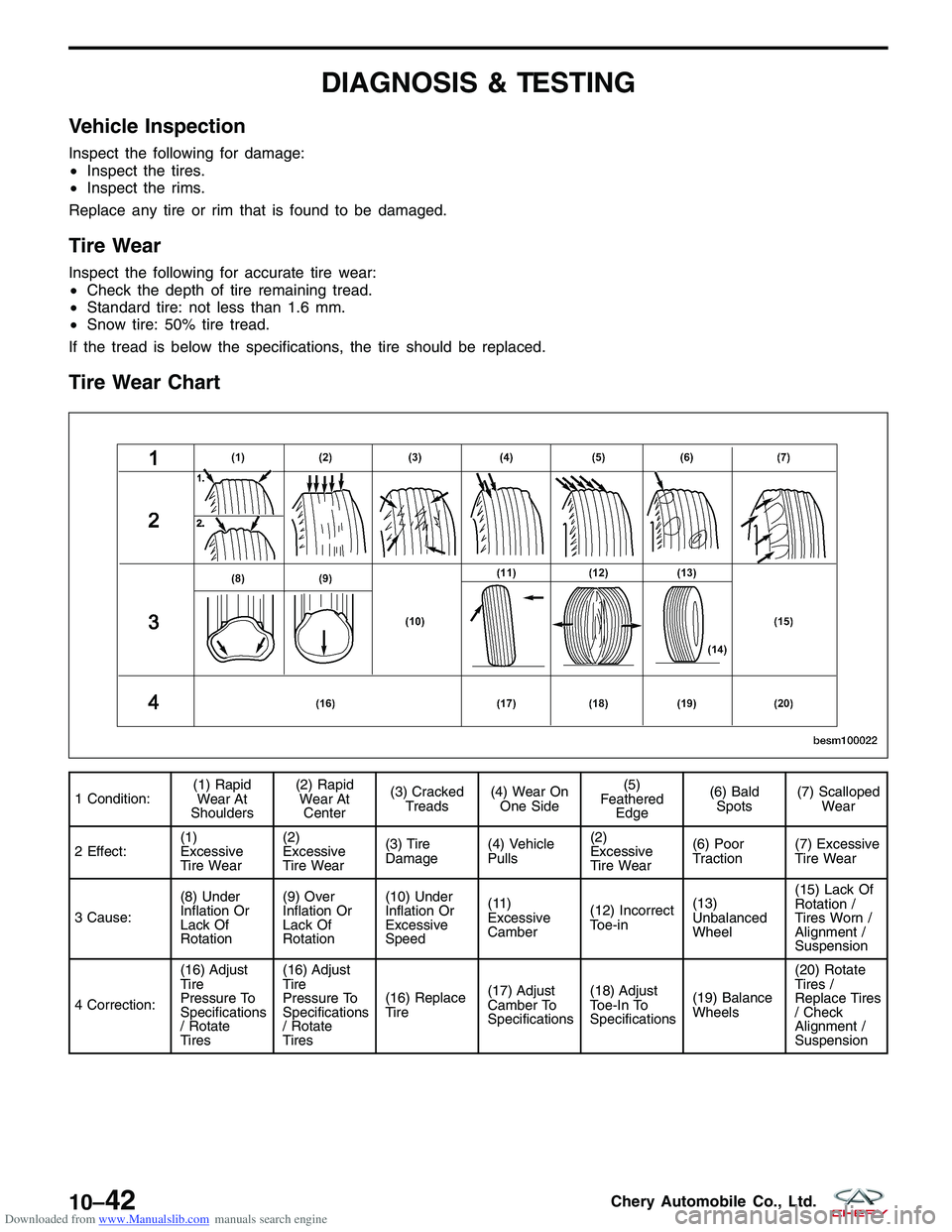
Tire Wear Chart
1 Condition: (1) Rapid
Wear At
Shoulders (2) Rapid
Wear At Center (3) Cracked
Treads (4) Wear On
One Side (5)
Feathered Edge (6) Bald
Spots (7) Scalloped
Wear
2 Effect: (1)
Excessive
Tire Wear(2)
Excessive
Tire Wear
(3) Tire
Damage
(4) Vehicle
Pulls(2)
Excessive
Tire Wear(6) Poor
Traction
(7) Excessive
Tire Wear
3 Cause: (8) Under
Inflation Or
Lack Of
Rotation(9) Over
Inflation Or
Lack Of
Rotation(10) Under
Inflation Or
Excessive
Speed
(11)
Excessive
Camber
(12) Incorrect
Toe-in(13)
Unbalanced
Wheel(15) Lack Of
Rotation /
Tires Worn /
Alignment /
Suspension
4 Correction: (16) Adjust
Tire
Pressure To
Specifications
/ Rotate
Tires(16) Adjust
Tire
Pressure To
Specifications
/ Rotate
Tires
(16) Replace
Tire
(17) Adjust
Camber To
Specifications(18) Adjust
Toe-In To
Specifications
(19) Balance
Wheels(20) Rotate
Tires /
Replace Tires
/ Check
Alignment /
Suspension
BESM100022
10–42Chery Automobile Co., Ltd.
Page 1344 of 1903
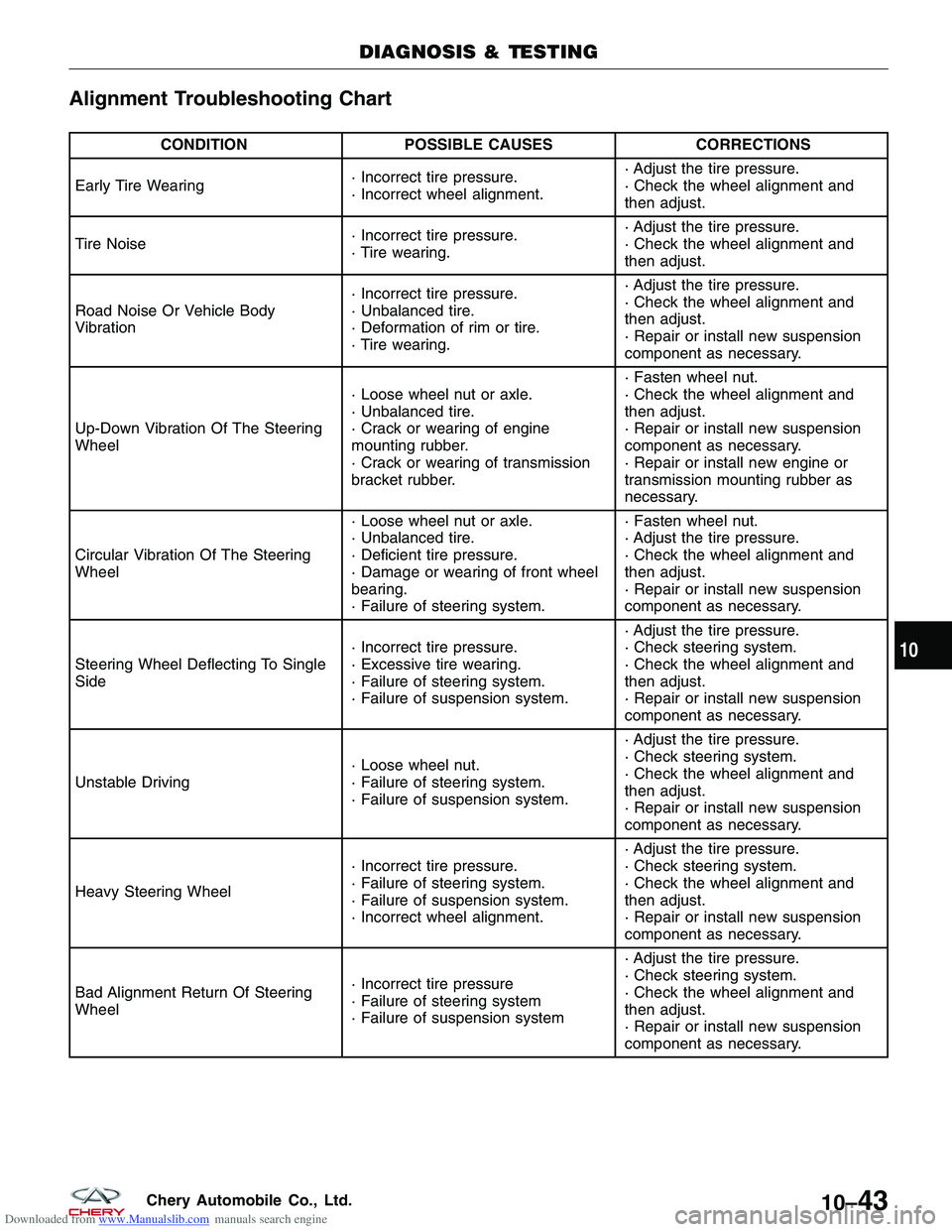
Downloaded from www.Manualslib.com manuals search engine Alignment Troubleshooting Chart
CONDITIONPOSSIBLE CAUSES CORRECTIONS
Early Tire Wearing · Incorrect tire pressure.
· Incorrect wheel alignment.· Adjust the tire pressure.
· Check the wheel alignment and
then adjust.
Tire Noise · Incorrect tire pressure.
· Tire wearing.· Adjust the tire pressure.
· Check the wheel alignment and
then adjust.
Road Noise Or Vehicle Body
Vibration · Incorrect tire pressure.
· Unbalanced tire.
· Deformation of rim or tire.
· Tire wearing.· Adjust the tire pressure.
· Check the wheel alignment and
then adjust.
· Repair or install new suspension
component as necessary.
Up-Down Vibration Of The Steering
Wheel · Loose wheel nut or axle.
· Unbalanced tire.
· Crack or wearing of engine
mounting rubber.
· Crack or wearing of transmission
bracket rubber.· Fasten wheel nut.
· Check the wheel alignment and
then adjust.
· Repair or install new suspension
component as necessary.
· Repair or install new engine or
transmission mounting rubber as
necessary.
Circular Vibration Of The Steering
Wheel · Loose wheel nut or axle.
· Unbalanced tire.
· Deficient tire pressure.
· Damage or wearing of front wheel
bearing.
· Failure of steering system.· Fasten wheel nut.
· Adjust the tire pressure.
· Check the wheel alignment and
then adjust.
· Repair or install new suspension
component as necessary.
Steering Wheel Deflecting To Single
Side · Incorrect tire pressure.
· Excessive tire wearing.
· Failure of steering system.
· Failure of suspension system.· Adjust the tire pressure.
· Check steering system.
· Check the wheel alignment and
then adjust.
· Repair or install new suspension
component as necessary.
Unstable Driving · Loose wheel nut.
· Failure of steering system.
· Failure of suspension system.· Adjust the tire pressure.
· Check steering system.
· Check the wheel alignment and
then adjust.
· Repair or install new suspension
component as necessary.
Heavy Steering Wheel · Incorrect tire pressure.
· Failure of steering system.
· Failure of suspension system.
· Incorrect wheel alignment.· Adjust the tire pressure.
· Check steering system.
· Check the wheel alignment and
then adjust.
· Repair or install new suspension
component as necessary.
Bad Alignment Return Of Steering
Wheel · Incorrect tire pressure
· Failure of steering system
· Failure of suspension system· Adjust the tire pressure.
· Check steering system.
· Check the wheel alignment and
then adjust.
· Repair or install new suspension
component as necessary.
DIAGNOSIS & TESTING
10
10–43Chery Automobile Co., Ltd.
Page 1351 of 1903
Downloaded from www.Manualslib.com manuals search engine DIAGNOSIS & TESTING
Vehicle Inspection
Visual inspection of the vehicle is recommended prior to road testing or performing any other procedure. Raise the
vehicle on a suitable hoist.
Inspect the following:
•Inspect tires and wheels for damage, mud packing and unusual wear; correct as necessary.
• Check and adjust tire pressure to the pressure listed on the label attached to the driver’s door opening.
Tire and Wheel Vibration
Tire and wheel imbalance, runout and force variation can cause vehicles to exhibit steering wheel vibration.
NOTE :
Balance equipment must be calibrated and maintained per equipment manufacturer’s specifications.
Tire Wear Patterns
Tire wear patterns can be traced to the following tire conditions:
•Under inflation will cause wear on the shoulders of tire.
• Over inflation will cause wear at the center of tire.
• Excessive camber causes the tire to run at an angle to the road. One side of tread is then worn more than the
other.
• Excessive toe-in or toe-out causes wear on the tread edges and a feathered effect across the tread.
NOTE :
Tread wear indicators are molded into the bottom of the tread grooves. When tread depth is 1.6 mm, the tread wear
indicators will appear as a band. Tire replacement is necessary when indicators appear in two or more grooves, or
if localized balding occurs.
Wheel Out-Of-Round Inspection
• Raise vehicle and securely support it.
• Attach a dial indicator on the edge of the rim and measure its unevenness.
• Replace the rim if necessary.10
10–50Chery Automobile Co., Ltd.
Page 1358 of 1903
Downloaded from www.Manualslib.com manuals search engine Manual steering control of the vehicle can be maintained if power steering assist is lost. However, under this condi-
tion, steering effort is significantly increased.
WARNING!
Power steering fluid, engine parts and exhaust system may be extremely hot if engine has been running. Do not
start engine with any loose or disconnected hoses. Do not allow hoses to touch hot exhaust manifold or cata-
lyst. Fluid level should be checked with the engine off to prevent personal injury from moving parts.
Specifications
Fluid Specifications
DESCRIPTIONCAPACITY (L)
Power Steering Fluid (ATF III) 1.1
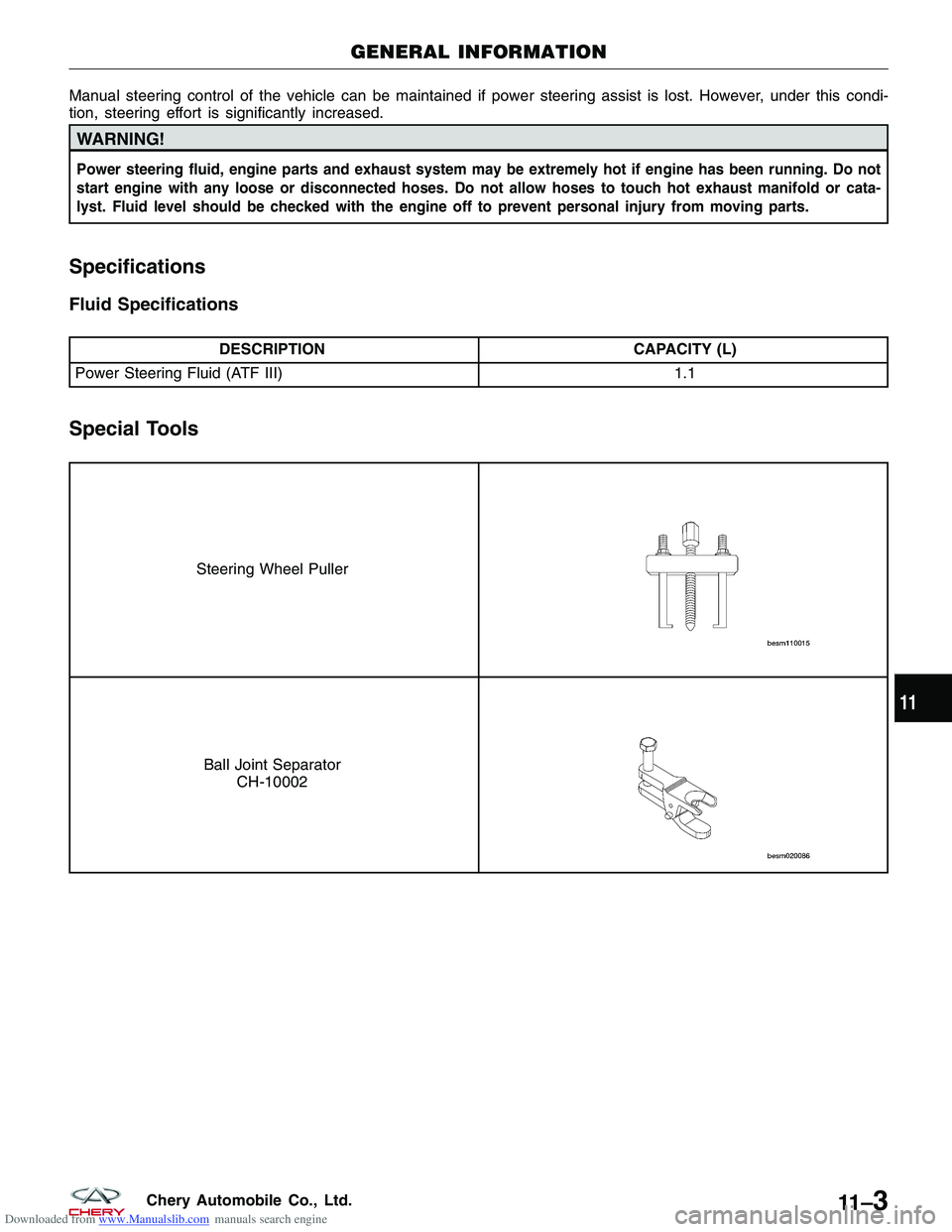
Special Tools
Steering Wheel Puller
Ball Joint Separator
CH-10002
GENERAL INFORMATION
11
11 –3Chery Automobile Co., Ltd.