belt CHERY TIGGO 2009 Service Manual Online
[x] Cancel search | Manufacturer: CHERY, Model Year: 2009, Model line: TIGGO, Model: CHERY TIGGO 2009Pages: 1903, PDF Size: 33.38 MB
Page 932 of 1903
Downloaded from www.Manualslib.com manuals search engine Removal & Installation - 2.4L
WARNING!
Always allow the engine to cool before opening the cooling system. Do not remove the coolant pressure relief
cap when the engine is operating or the cooling system is hot. The cooling system is under pressure; steam and
hot liquid can come out forcefully when the cap is loosened slightly. Failure to follow these instructions may
result in serious personal injury.
1. Drain the cooling system (See Cooling System Draining Procedure in Section 06 Cooling System).
2. Remove the accessory drive belt (See Accessory Drive Belt Removal & Installation in Section 02 Engine).
3. Remove the engine timing belt (See Engine Timing Belt Removal & Installation in Section 02 Engine).
4. Remove the upper balance shaft timing belt (See Upper Balance Shaft Timing Belt Removal & Installation inSection 02 Engine).
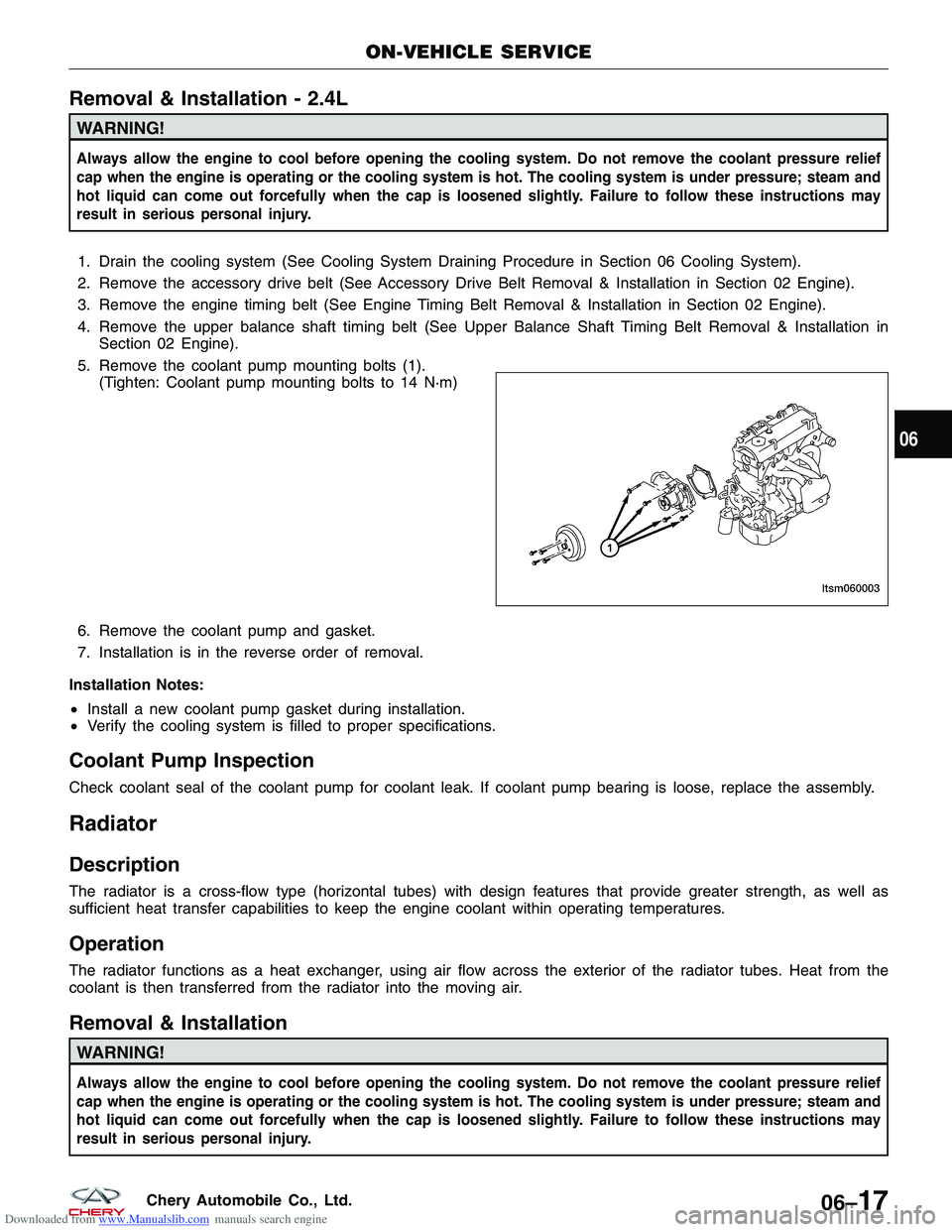
5. Remove the coolant pump mounting bolts (1). (Tighten: Coolant pump mounting bolts to 14 N·m)
6. Remove the coolant pump and gasket.
7. Installation is in the reverse order of removal.
Installation Notes:
• Install a new coolant pump gasket during installation.
• Verify the cooling system is filled to proper specifications.
Coolant Pump Inspection
Check coolant seal of the coolant pump for coolant leak. If coolant pump bearing is loose, replace the assembly.
Radiator
Description
The radiator is a cross-flow type (horizontal tubes) with design features that provide greater strength, as well as
sufficient heat transfer capabilities to keep the engine coolant within operating temperatures.
Operation
The radiator functions as a heat exchanger, using air flow across the exterior of the radiator tubes. Heat from the
coolant is then transferred from the radiator into the moving air.
Removal & Installation
WARNING!
Always allow the engine to cool before opening the cooling system. Do not remove the coolant pressure relief
cap when the engine is operating or the cooling system is hot. The cooling system is under pressure; steam and
hot liquid can come out forcefully when the cap is loosened slightly. Failure to follow these instructions may
result in serious personal injury.
ON-VEHICLE SERVICE
LTSM060003
06
06–17Chery Automobile Co., Ltd.
Page 1357 of 1903
Downloaded from www.Manualslib.com manuals search engine GENERAL INFORMATION
Description
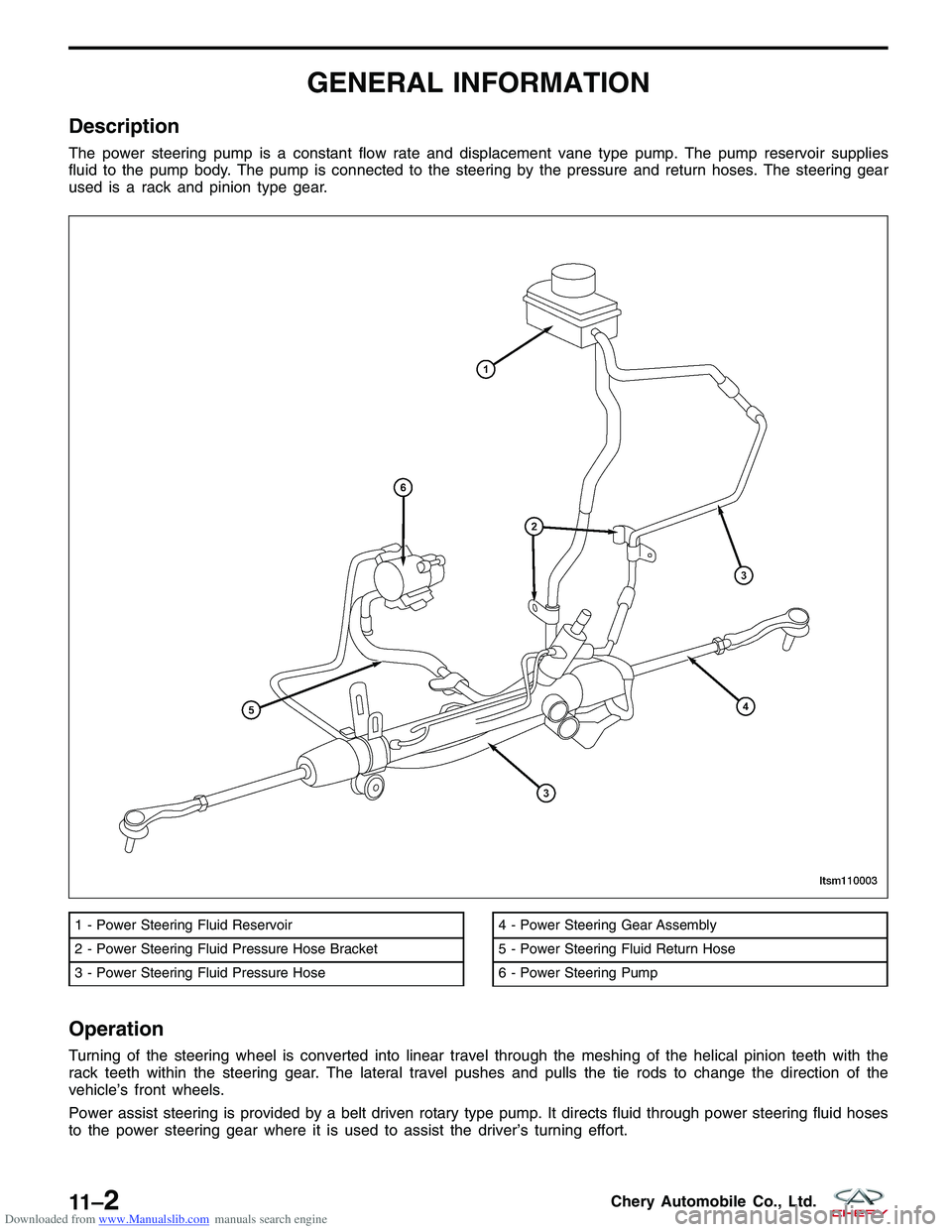
The power steering pump is a constant flow rate and displacement vane type pump. The pump reservoir supplies
fluid to the pump body. The pump is connected to the steering by the pressure and return hoses. The steering gear
used is a rack and pinion type gear.
Operation
Turning of the steering wheel is converted into linear travel through the meshing of the helical pinion teeth with the
rack teeth within the steering gear. The lateral travel pushes and pulls the tie rods to change the direction of the
vehicle’s front wheels.
Power assist steering is provided by a belt driven rotary type pump. It directs fluid through power steering fluid hoses
to the power steering gear where it is used to assist the driver’s turning effort.
1 - Power Steering Fluid Reservoir
2 - Power Steering Fluid Pressure Hose Bracket
3 - Power Steering Fluid Pressure Hose4 - Power Steering Gear Assembly
5 - Power Steering Fluid Return Hose
6 - Power Steering Pump
LTSM110003
11 –2Chery Automobile Co., Ltd.
Page 1359 of 1903
Downloaded from www.Manualslib.com manuals search engine DIAGNOSIS & TESTING
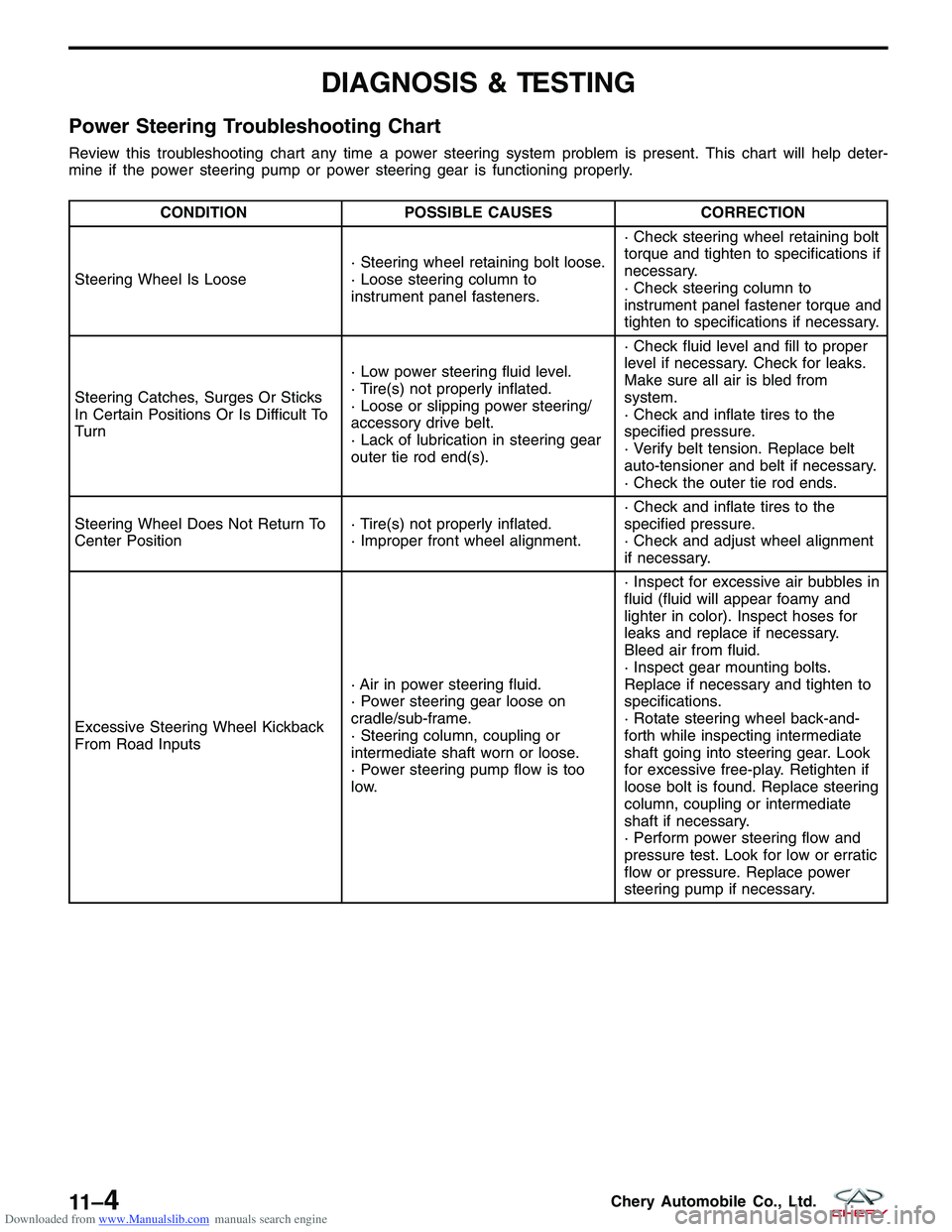
Power Steering Troubleshooting Chart
Review this troubleshooting chart any time a power steering system problem is present. This chart will help deter-
mine if the power steering pump or power steering gear is functioning properly.
CONDITIONPOSSIBLE CAUSES CORRECTION
Steering Wheel Is Loose · Steering wheel retaining bolt loose.
· Loose steering column to
instrument panel fasteners.· Check steering wheel retaining bolt
torque and tighten to specifications if
necessary.
· Check steering column to
instrument panel fastener torque and
tighten to specifications if necessary.
Steering Catches, Surges Or Sticks
In Certain Positions Or Is Difficult To
Turn · Low power steering fluid level.
· Tire(s) not properly inflated.
· Loose or slipping power steering/
accessory drive belt.
· Lack of lubrication in steering gear
outer tie rod end(s).· Check fluid level and fill to proper
level if necessary. Check for leaks.
Make sure all air is bled from
system.
· Check and inflate tires to the
specified pressure.
· Verify belt tension. Replace belt
auto-tensioner and belt if necessary.
· Check the outer tie rod ends.
Steering Wheel Does Not Return To
Center Position · Tire(s) not properly inflated.
· Improper front wheel alignment.· Check and inflate tires to the
specified pressure.
· Check and adjust wheel alignment
if necessary.
Excessive Steering Wheel Kickback
From Road Inputs · Air in power steering fluid.
· Power steering gear loose on
cradle/sub-frame.
· Steering column, coupling or
intermediate shaft worn or loose.
· Power steering pump flow is too
low.· Inspect for excessive air bubbles in
fluid (fluid will appear foamy and
lighter in color). Inspect hoses for
leaks and replace if necessary.
Bleed air from fluid.
· Inspect gear mounting bolts.
Replace if necessary and tighten to
specifications.
· Rotate steering wheel back-and-
forth while inspecting intermediate
shaft going into steering gear. Look
for excessive free-play. Retighten if
loose bolt is found. Replace steering
column, coupling or intermediate
shaft if necessary.
· Perform power steering flow and
pressure test. Look for low or erratic
flow or pressure. Replace power
steering pump if necessary.
11 –4Chery Automobile Co., Ltd.
Page 1375 of 1903
Downloaded from www.Manualslib.com manuals search engine DIAGNOSIS & TESTING
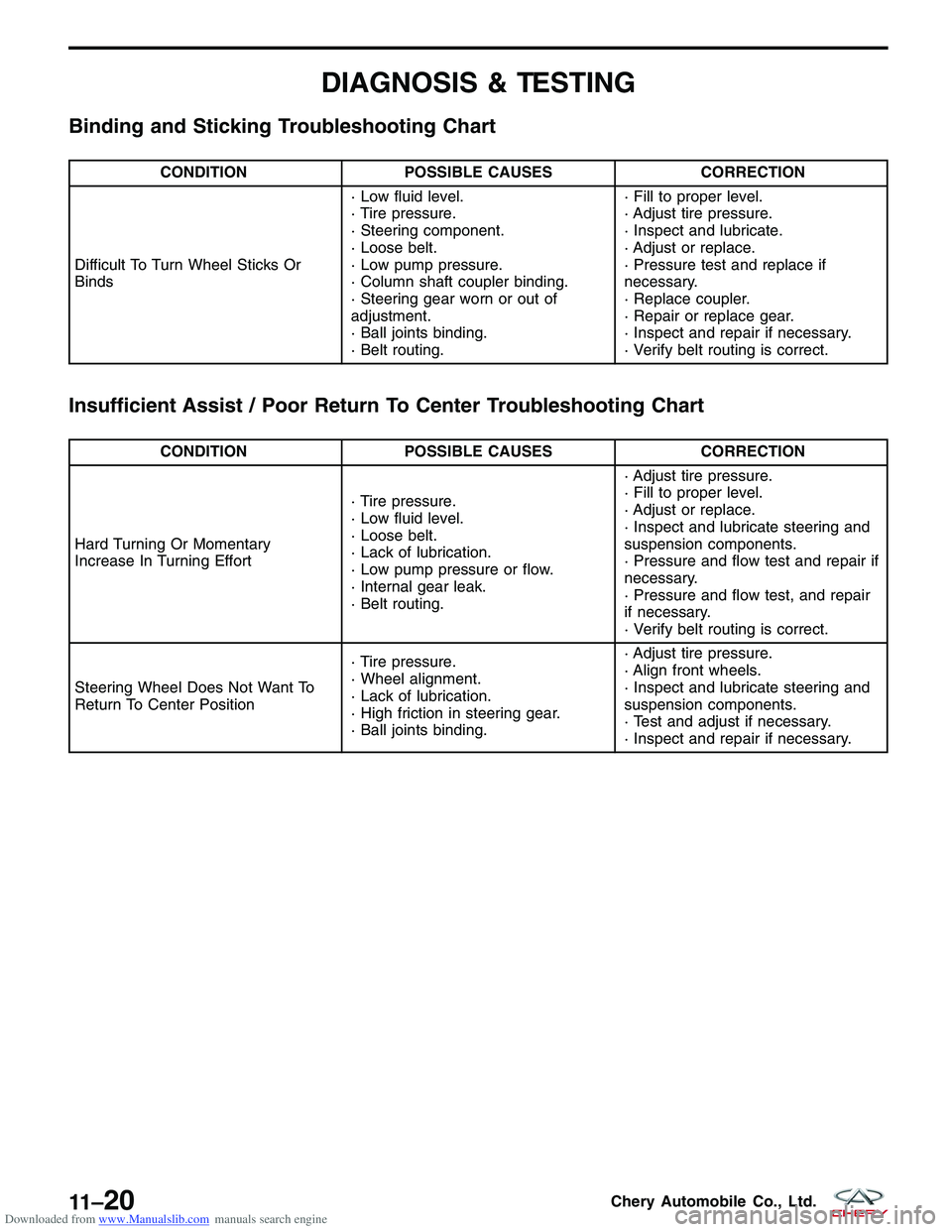
Binding and Sticking Troubleshooting Chart
CONDITIONPOSSIBLE CAUSES CORRECTION
Difficult To Turn Wheel Sticks Or
Binds · Low fluid level.
· Tire pressure.
· Steering component.
· Loose belt.
· Low pump pressure.
· Column shaft coupler binding.
· Steering gear worn or out of
adjustment.
· Ball joints binding.
· Belt routing.· Fill to proper level.
· Adjust tire pressure.
· Inspect and lubricate.
· Adjust or replace.
· Pressure test and replace if
necessary.
· Replace coupler.
· Repair or replace gear.
· Inspect and repair if necessary.
· Verify belt routing is correct.
Insufficient Assist / Poor Return To Center Troubleshooting Chart
CONDITION
POSSIBLE CAUSES CORRECTION
Hard Turning Or Momentary
Increase In Turning Effort · Tire pressure.
· Low fluid level.
· Loose belt.
· Lack of lubrication.
· Low pump pressure or flow.
· Internal gear leak.
· Belt routing.· Adjust tire pressure.
· Fill to proper level.
· Adjust or replace.
· Inspect and lubricate steering and
suspension components.
· Pressure and flow test and repair if
necessary.
· Pressure and flow test, and repair
if necessary.
· Verify belt routing is correct.
Steering Wheel Does Not Want To
Return To Center Position · Tire pressure.
· Wheel alignment.
· Lack of lubrication.
· High friction in steering gear.
· Ball joints binding.· Adjust tire pressure.
· Align front wheels.
· Inspect and lubricate steering and
suspension components.
· Test and adjust if necessary.
· Inspect and repair if necessary.
11 –20Chery Automobile Co., Ltd.
Page 1387 of 1903
Downloaded from www.Manualslib.com manuals search engine GENERAL INFORMATION
Description
The power steering pump is a constant flow rate and displacement vane type pump. The pump reservoir is detached
from the pump body. The pump is connected to the steering gear by the pressure and return lines.
Operation
The power steering pump is mounted to the engine and driven by the engine accessory drive belt. Power steering
fluid enters the pump from the reservoir. The power steering fluid is then trapped between the pump vanes and
moved to the high-pressure side of the pump creating a flow of steering fluid. The restriction of this flow by the
steering gear creates the pressure that provides the steering assist.
CAUTION:
•Operating the power steering with a low steering fluid level will damage the power steering sys-
tem.
• Holding the steering wheel in the full lock position for more than 3 seconds will damage the
power steering system.
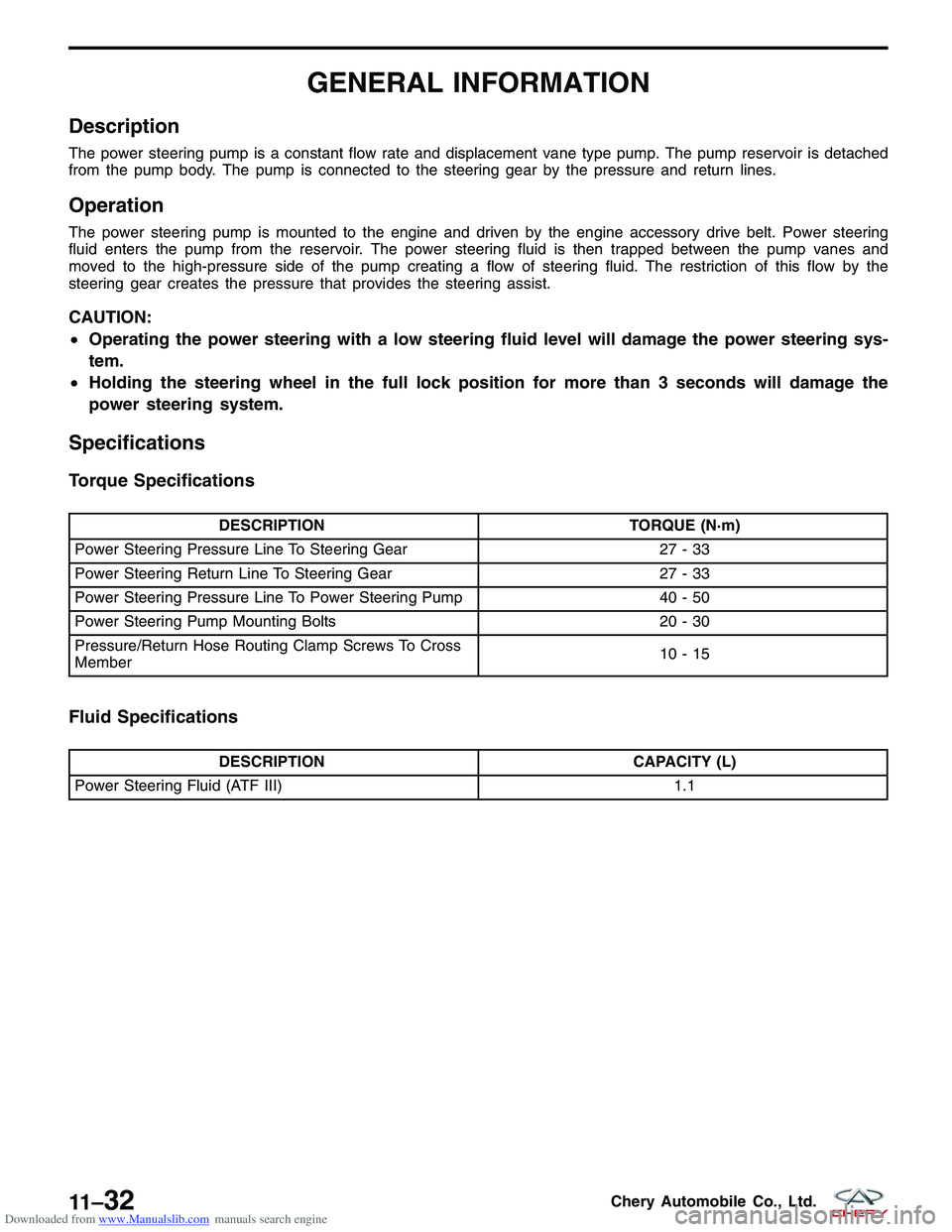
Specifications
Torque Specifications
DESCRIPTION TORQUE (N·m)
Power Steering Pressure Line To Steering Gear 27 - 33
Power Steering Return Line To Steering Gear 27 - 33
Power Steering Pressure Line To Power Steering Pump 40 - 50
Power Steering Pump Mounting Bolts 20 - 30
Pressure/Return Hose Routing Clamp Screws To Cross
Member 10-15
Fluid Specifications
DESCRIPTION
CAPACITY (L)
Power Steering Fluid (ATF III) 1.1
11 –32Chery Automobile Co., Ltd.
Page 1388 of 1903
Downloaded from www.Manualslib.com manuals search engine DIAGNOSIS & TESTING
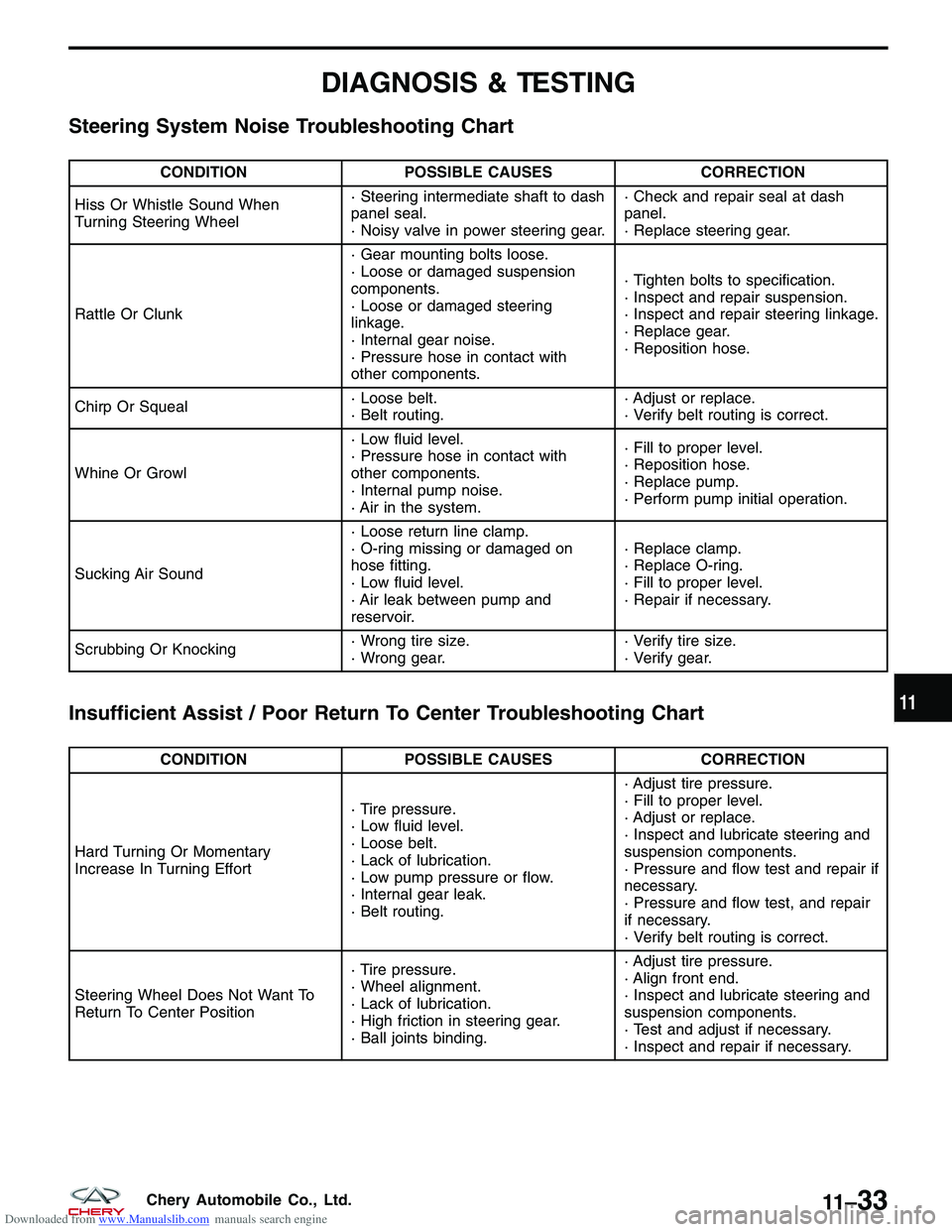
Steering System Noise Troubleshooting Chart
CONDITIONPOSSIBLE CAUSES CORRECTION
Hiss Or Whistle Sound When
Turning Steering Wheel · Steering intermediate shaft to dash
panel seal.
· Noisy valve in power steering gear.· Check and repair seal at dash
panel.
· Replace steering gear.
Rattle Or Clunk · Gear mounting bolts loose.
· Loose or damaged suspension
components.
· Loose or damaged steering
linkage.
· Internal gear noise.
· Pressure hose in contact with
other components.· Tighten bolts to specification.
· Inspect and repair suspension.
· Inspect and repair steering linkage.
· Replace gear.
· Reposition hose.
Chirp Or Squeal · Loose belt.
· Belt routing.· Adjust or replace.
· Verify belt routing is correct.
Whine Or Growl · Low fluid level.
· Pressure hose in contact with
other components.
· Internal pump noise.
· Air in the system.· Fill to proper level.
· Reposition hose.
· Replace pump.
· Perform pump initial operation.
Sucking Air Sound · Loose return line clamp.
· O-ring missing or damaged on
hose fitting.
· Low fluid level.
· Air leak between pump and
reservoir.· Replace clamp.
· Replace O-ring.
· Fill to proper level.
· Repair if necessary.
Scrubbing Or Knocking · Wrong tire size.
· Wrong gear.· Verify tire size.
· Verify gear.
Insufficient Assist / Poor Return To Center Troubleshooting Chart
CONDITION
POSSIBLE CAUSES CORRECTION
Hard Turning Or Momentary
Increase In Turning Effort · Tire pressure.
· Low fluid level.
· Loose belt.
· Lack of lubrication.
· Low pump pressure or flow.
· Internal gear leak.
· Belt routing.· Adjust tire pressure.
· Fill to proper level.
· Adjust or replace.
· Inspect and lubricate steering and
suspension components.
· Pressure and flow test and repair if
necessary.
· Pressure and flow test, and repair
if necessary.
· Verify belt routing is correct.
Steering Wheel Does Not Want To
Return To Center Position · Tire pressure.
· Wheel alignment.
· Lack of lubrication.
· High friction in steering gear.
· Ball joints binding.· Adjust tire pressure.
· Align front end.
· Inspect and lubricate steering and
suspension components.
· Test and adjust if necessary.
· Inspect and repair if necessary.
11
11 –33Chery Automobile Co., Ltd.
Page 1389 of 1903
Downloaded from www.Manualslib.com manuals search engine ON-VEHICLE SERVICE
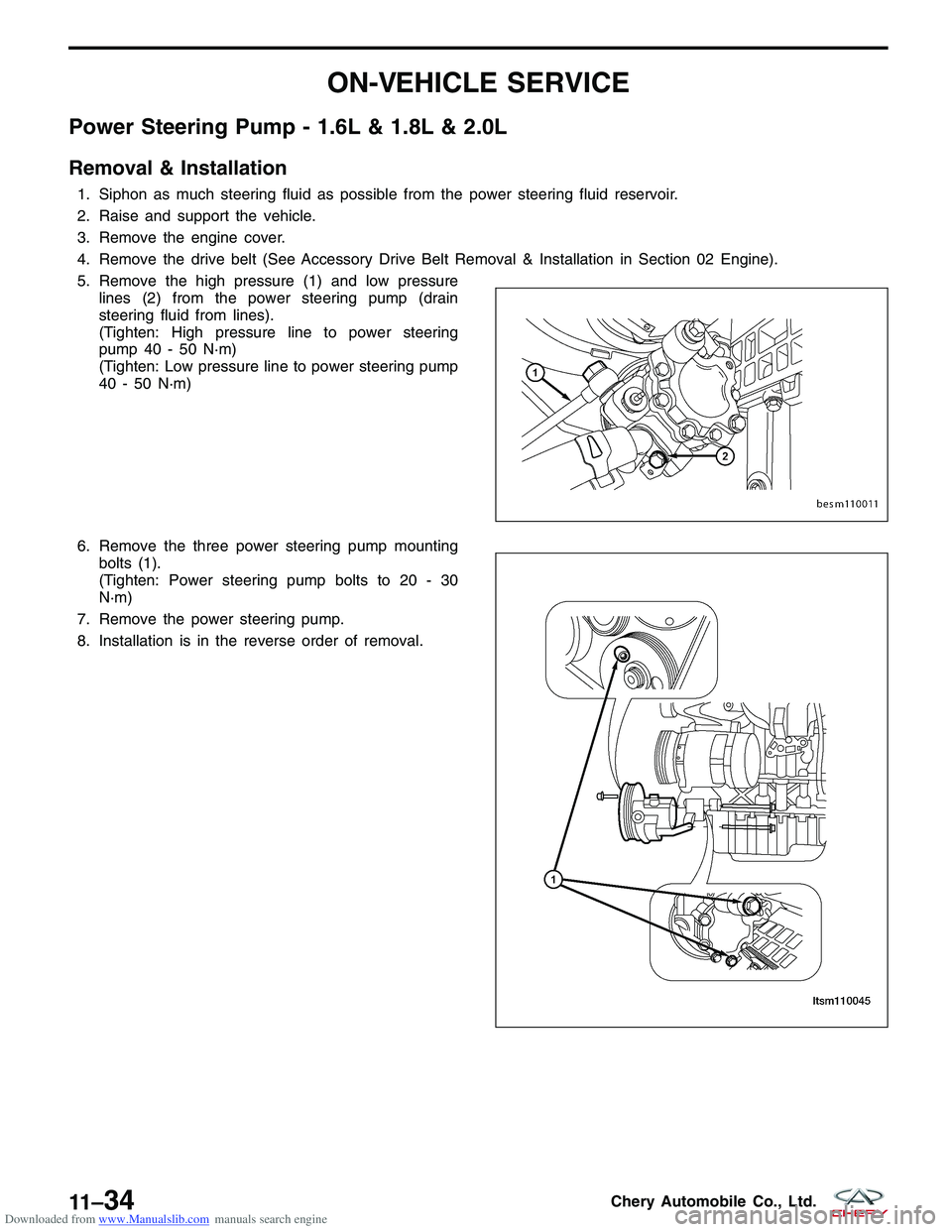
Power Steering Pump - 1.6L & 1.8L & 2.0L
Removal & Installation
1. Siphon as much steering fluid as possible from the power steering fluid reservoir.
2. Raise and support the vehicle.
3. Remove the engine cover.
4. Remove the drive belt (See Accessory Drive Belt Removal & Installation in Section 02 Engine).
5. Remove the high pressure (1) and low pressurelines (2) from the power steering pump (drain
steering fluid from lines).
(Tighten: High pressure line to power steering
pump 40 - 50 N·m)
(Tighten: Low pressure line to power steering pump
40 - 50 N·m)
6. Remove the three power steering pump mounting bolts (1).
(Tighten: Power steering pump bolts to 20 - 30
N·m)
7. Remove the power steering pump.
8. Installation is in the reverse order of removal.
BESM110011
LTSM110045
11 –34Chery Automobile Co., Ltd.
Page 1390 of 1903
Downloaded from www.Manualslib.com manuals search engine Power Steering Pump - 2.4L
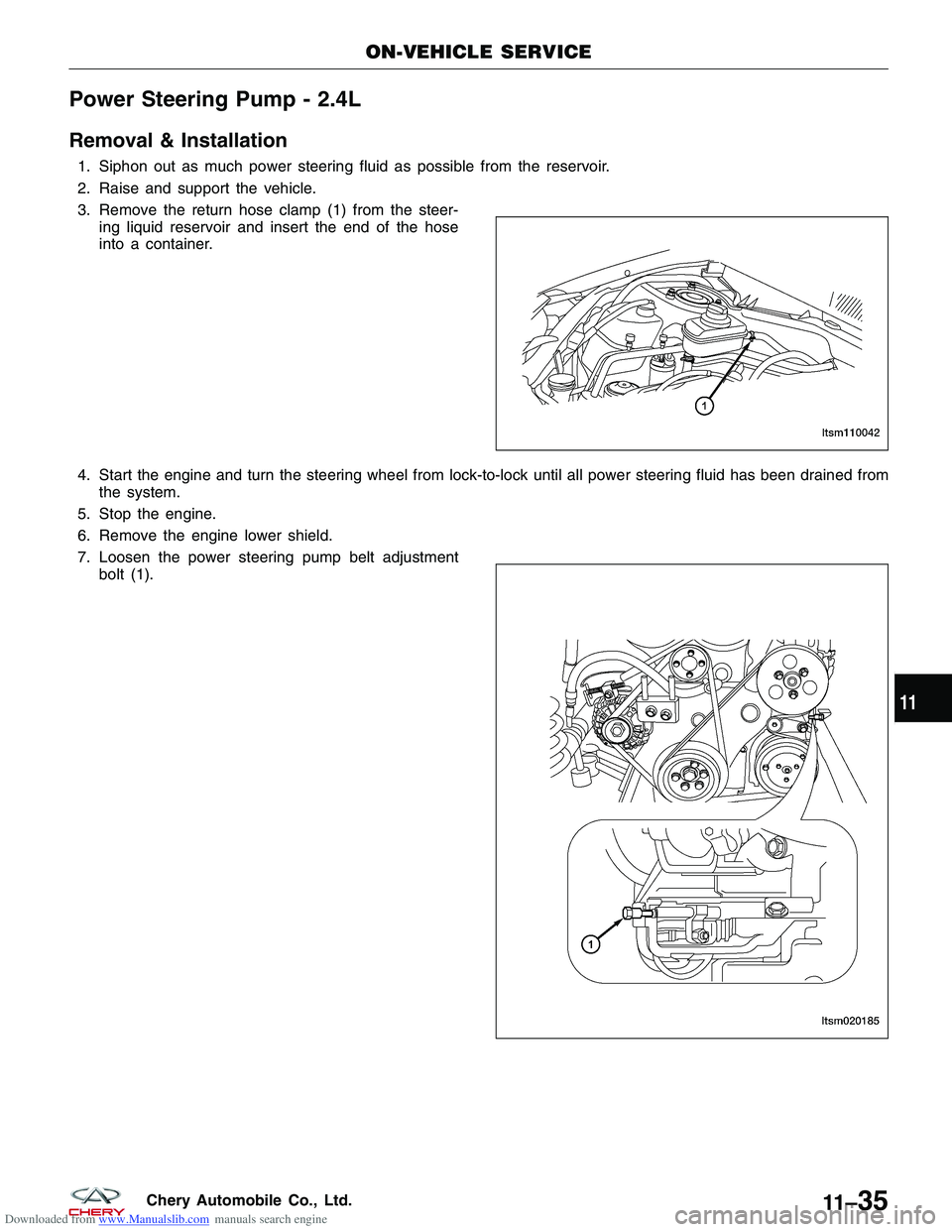
Removal & Installation
1. Siphon out as much power steering fluid as possible from the reservoir.
2. Raise and support the vehicle.
3. Remove the return hose clamp (1) from the steer-ing liquid reservoir and insert the end of the hose
into a container.
4. Start the engine and turn the steering wheel from lock-to-lock until all power steering fluid has been drained from the system.
5. Stop the engine.
6. Remove the engine lower shield.
7. Loosen the power steering pump belt adjustment bolt (1).
ON-VEHICLE SERVICE
LTSM110042
LTSM020185
11
11 –35Chery Automobile Co., Ltd.
Page 1495 of 1903
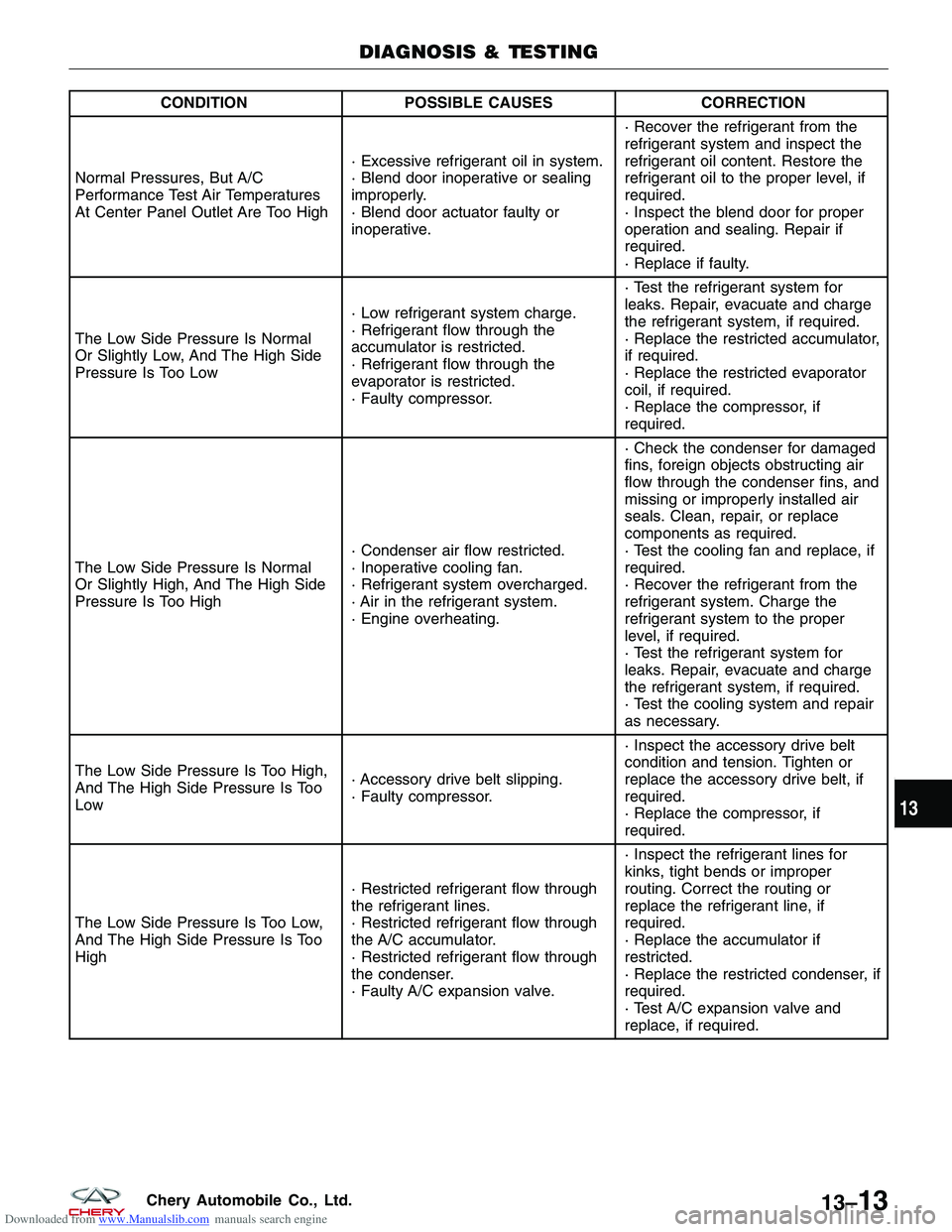
Downloaded from www.Manualslib.com manuals search engine CONDITIONPOSSIBLE CAUSES CORRECTION
Normal Pressures, But A/C
Performance Test Air Temperatures
At Center Panel Outlet Are Too High · Excessive refrigerant oil in system.
· Blend door inoperative or sealing
improperly.
· Blend door actuator faulty or
inoperative.· Recover the refrigerant from the
refrigerant system and inspect the
refrigerant oil content. Restore the
refrigerant oil to the proper level, if
required.
· Inspect the blend door for proper
operation and sealing. Repair if
required.
· Replace if faulty.
The Low Side Pressure Is Normal
Or Slightly Low, And The High Side
Pressure Is Too Low · Low refrigerant system charge.
· Refrigerant flow through the
accumulator is restricted.
· Refrigerant flow through the
evaporator is restricted.
· Faulty compressor.· Test the refrigerant system for
leaks. Repair, evacuate and charge
the refrigerant system, if required.
· Replace the restricted accumulator,
if required.
· Replace the restricted evaporator
coil, if required.
· Replace the compressor, if
required.
The Low Side Pressure Is Normal
Or Slightly High, And The High Side
Pressure Is Too High · Condenser air flow restricted.
· Inoperative cooling fan.
· Refrigerant system overcharged.
· Air in the refrigerant system.
· Engine overheating.· Check the condenser for damaged
fins, foreign objects obstructing air
flow through the condenser fins, and
missing or improperly installed air
seals. Clean, repair, or replace
components as required.
· Test the cooling fan and replace, if
required.
· Recover the refrigerant from the
refrigerant system. Charge the
refrigerant system to the proper
level, if required.
· Test the refrigerant system for
leaks. Repair, evacuate and charge
the refrigerant system, if required.
· Test the cooling system and repair
as necessary.
The Low Side Pressure Is Too High,
And The High Side Pressure Is Too
Low · Accessory drive belt slipping.
· Faulty compressor.· Inspect the accessory drive belt
condition and tension. Tighten or
replace the accessory drive belt, if
required.
· Replace the compressor, if
required.
The Low Side Pressure Is Too Low,
And The High Side Pressure Is Too
High · Restricted refrigerant flow through
the refrigerant lines.
· Restricted refrigerant flow through
the A/C accumulator.
· Restricted refrigerant flow through
the condenser.
· Faulty A/C expansion valve.· Inspect the refrigerant lines for
kinks, tight bends or improper
routing. Correct the routing or
replace the refrigerant line, if
required.
· Replace the accumulator if
restricted.
· Replace the restricted condenser, if
required.
· Test A/C expansion valve and
replace, if required.
DIAGNOSIS & TESTING
13
13–13Chery Automobile Co., Ltd.
Page 1517 of 1903
Downloaded from www.Manualslib.com manuals search engine DIAGNOSIS & TESTING
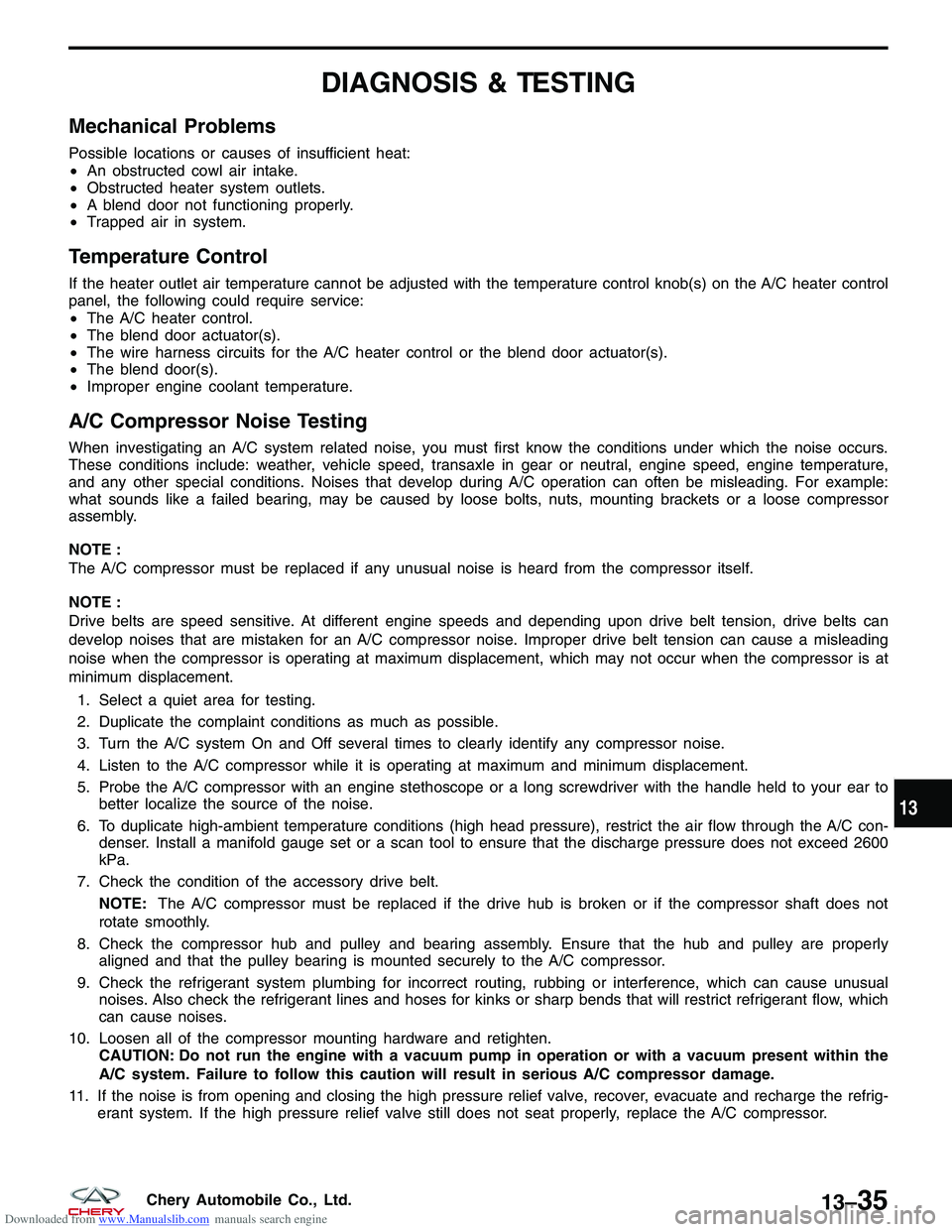
Mechanical Problems
Possible locations or causes of insufficient heat:
•An obstructed cowl air intake.
• Obstructed heater system outlets.
• A blend door not functioning properly.
• Trapped air in system.
Temperature Control
If the heater outlet air temperature cannot be adjusted with the temperature control knob(s) on the A/C heater control
panel, the following could require service:
•The A/C heater control.
• The blend door actuator(s).
• The wire harness circuits for the A/C heater control or the blend door actuator(s).
• The blend door(s).
• Improper engine coolant temperature.
A/C Compressor Noise Testing
When investigating an A/C system related noise, you must first know the conditions under which the noise occurs.
These conditions include: weather, vehicle speed, transaxle in gear or neutral, engine speed, engine temperature,
and any other special conditions. Noises that develop during A/C operation can often be misleading. For example:
what sounds like a failed bearing, may be caused by loose bolts, nuts, mounting brackets or a loose compressor
assembly.
NOTE :
The A/C compressor must be replaced if any unusual noise is heard from the compressor itself.
NOTE :
Drive belts are speed sensitive. At different engine speeds and depending upon drive belt tension, drive belts can
develop noises that are mistaken for an A/C compressor noise. Improper drive belt tension can cause a misleading
noise when the compressor is operating at maximum displacement, which may not occur when the compressor is at
minimum displacement.
1. Select a quiet area for testing.
2. Duplicate the complaint conditions as much as possible.
3. Turn the A/C system On and Off several times to clearly identify any compressor noise.
4. Listen to the A/C compressor while it is operating at maximum and minimum displacement.
5. Probe the A/C compressor with an engine stethoscope or a long screwdriver with the handle held to your ear to better localize the source of the noise.
6. To duplicate high-ambient temperature conditions (high head pressure), restrict the air flow through the A/C con- denser. Install a manifold gauge set or a scan tool to ensure that the discharge pressure does not exceed 2600
kPa.
7. Check the condition of the accessory drive belt. NOTE: The A/C compressor must be replaced if the drive hub is broken or if the compressor shaft does not
rotate smoothly.
8. Check the compressor hub and pulley and bearing assembly. Ensure that the hub and pulley are properly aligned and that the pulley bearing is mounted securely to the A/C compressor.
9. Check the refrigerant system plumbing for incorrect routing, rubbing or interference, which can cause unusual noises. Also check the refrigerant lines and hoses for kinks or sharp bends that will restrict refrigerant flow, which
can cause noises.
10. Loosen all of the compressor mounting hardware and retighten. CAUTION: Do not run the engine with a vacuum pump in operation or with a vacuum present within the
A/C system. Failure to follow this caution will result in serious A/C compressor damage.
11. If the noise is from opening and closing the high pressure relief valve, recover, evacuate and recharge the refrig- erant system. If the high pressure relief valve still does not seat properly, replace the A/C compressor.
13
13–35Chery Automobile Co., Ltd.