tow CHEVROLET ASTRO 1996 User Guide
[x] Cancel search | Manufacturer: CHEVROLET, Model Year: 1996, Model line: ASTRO, Model: CHEVROLET ASTRO 1996Pages: 372, PDF Size: 21.51 MB
Page 74 of 372
: This position")
Ignition Positions
Use your ignition key to start your vehicle. The ignition key \
lets you turn the ignition switch
to five different positions.
C
ACCESSORY (A): This position lets you use things like
the radio and the windshield wipers when the engine is
off. To get into ACCESSORY, push in the key and turn
it toward
you. Your steering wheel will remain locked,
just as it was before
you inserted the key.
NOTICE:
Don’t operate accessories in the ACCESSORY
position for long periods
of time. Prolonged
operation of accessories in the ACCESSORY
position could drain your battery and prevent
you from starting your vehicle.
LOCK (B): This position locks your ignition, steering
wheel and transmission shift lever
in PARK (P). It’s a
theft-deterrent feature. You will only be able to remove
your key when the ignition is turned to
LOCK.
OFF (C): This position lets you turn off the engine but
still turn the steering wheel. Use
OFF if you must have
your vehicle in motion while the engine is off (for
example,
if your vehicle is being towed).
RUN (D): This is the position for driving.
START (E): This starts your engine.
Page 76 of 372
2. If it doesn’t start right away, hold your key in
START. If it doesn’t start in 10 seconds, push the
accelerator pedal
all the way down for five more
seconds, or until it starts.
3. If your engine still won’t start (or starts but then
stops), wait
15 seconds and start over.
When the engine starts, let go
of the key and the
accelerator pedal.
I NOTICE:
Your engine is designed to work with the
electronics in your vehicle.
If you add electrical
parts or accessories, you could change the
way
the engine operates. Before adding electrical
equipment, check with your dealer. If you don’t,
your engine might not perform properly.
If you ever have to have your vehicle towed, see
the part of this manual that tells how to do it
without damaging your vehicle. See “Towing
Your Vehicle” in the Index.
Fuel Regulator
You have a fuel regulator that shuts the fuel off when the
engine reaches
5,600 rpm.
Engine Coolant Heater (Option)
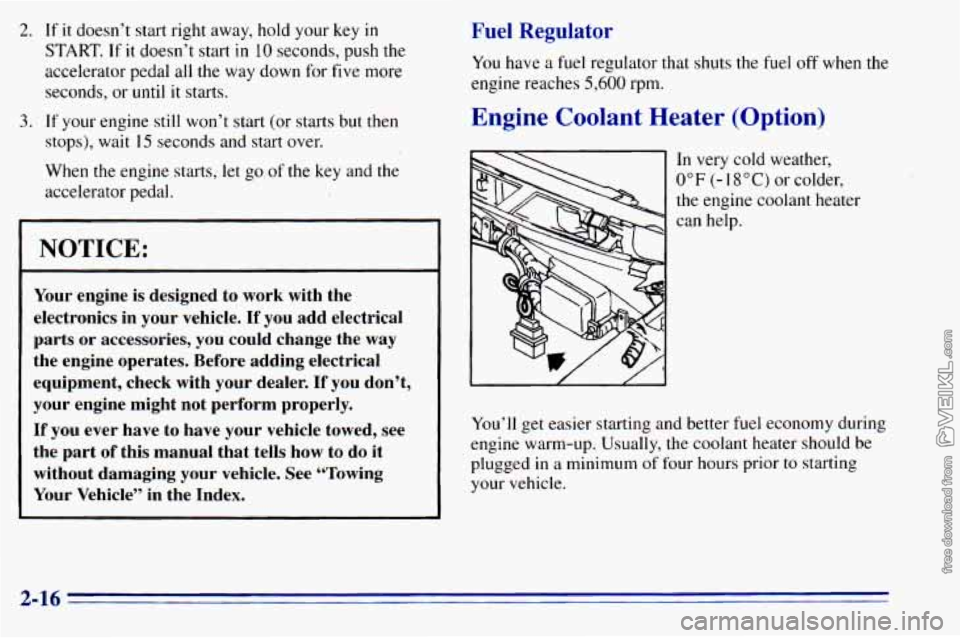
In very cold weather,
0°F (- 18°C) or colder,
the engine coolant heater
can help.
You’ll get easier starting and better fuel economy during
engine warm-up. Usually, the coolant heater should be
plugged
in a minimum of four hours prior to starting
your vehicle.
3 IL
Page 78 of 372
Automatic Transmission Operation
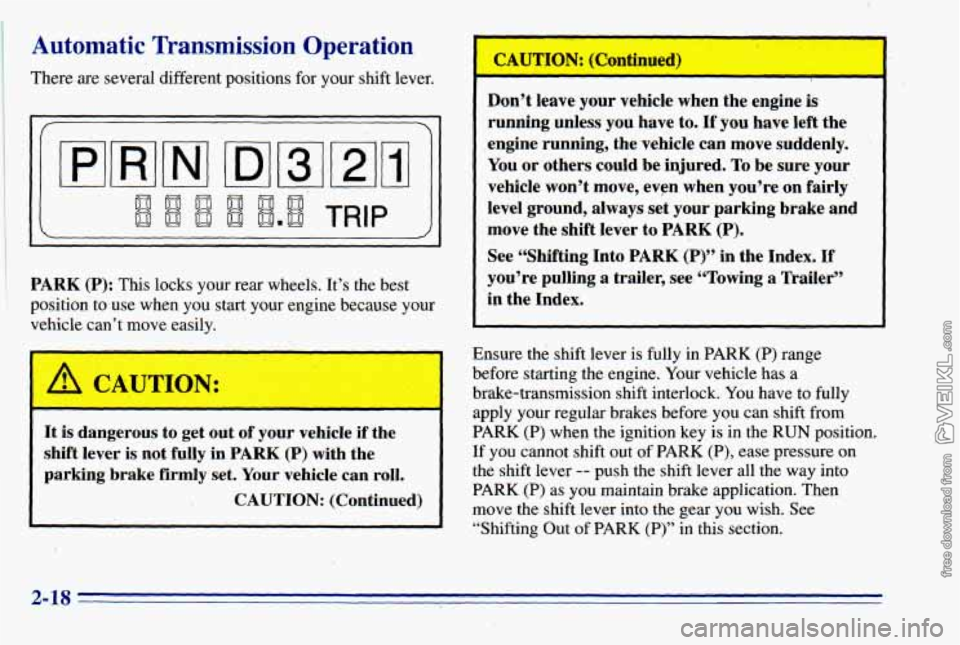
There are several different positions for your shift lever.
PARK (P): This locks your rear wheels. It’s the best
position to use when you start your engine because your
vehicle can’t move easily.
, ’
I
It is dangerous to get out of your vehicle if the
shift lever
is not fully in PARK (P) with the
parking brake firmly set. Your vehicle can roll.
CAUTION: (Continued)
I I
I CAUTION: (Continued)
Don’t leave your vehicle when the engine
is
running unless you have to. If you have left the
.engine running, the vehicle can move suddenly.
You or others could be injured. To be sure your
vehicle won’t move, even when you’re on fairly
level ground, always set your parking brake and
move the shift lever to
PARK (P).
See “Shifting Into PARK (P)” in the Index. If
you’re pulling a trailer, see “Towing a Trailer”
in the Index.
I
v
Ensure the shift lever is fully in PARK (P).range
before starting the engine. Your vehicle has a
brake-transmission shift interlock. You have to fully
apply your regular brakes before you can shift from
PARK
(P) when the ignition key is in the RUN position.
If you cannot shift out of PARK
(P), ease pressure on’
the shift lever
-- push the shift lever all the way into
PARK (P) as you maintain brake application. Then
move the shift lever into the gear you wish. See
’‘Shifting Out of PARK
(P)” in this section.
2-1s
Page 79 of 372
REVERSE (R): Use this gear to back up.
1 NOTICE:
Shifting to REVERSE (R) while your vehicle is
moving forward could damage your transmission.
Shift to
REVERSE (R) only after your vehicle
is stopped.
To rock your vehicle back and forth to get out of snow,
ice or sand without damaging your transmission, see
“Stuck: In Sand, Mud, Ice or Snow” in the Index.
NEUTRAL (N): In this position, your engine doesn’t
connect with the wheels.
To restart when you’re already
moving, use NEUTRAL
(N) only. Also, use
NEUTRAL (N) when your vehicle is being towed.
A CAUTION:
Shifting out of PARK (P) or NEUTRAL (N) while
your engine is “racing” (running at high speed) is
dangerous. Unless your foot is firmly on the
brake pedal, your vehicle could move very
rapidly. You could lose control and hit people
or objects. Don’t shift out of
PARK (P) or
NEUTRAL (N) while your engine is racing.
I NOTICE:
Damage to your transmission caused by shifting
out of
PARK (P) or NEUTRAL (N) with the
engine racing isn’t covered
by your warranty.
Page 80 of 372
DRIVE (D): This position is for normal driving. If you
need more power for passing, and you’re:
Going less than about 35 mph (56 km/h), push your
accelerator pedal about halfway down.
Going about 35 mph (56 km/h) or more, push the
accelerator pedal all the way down. You’ll shift
down to
the next gear and have more power.
DRIVE
(D) should be used for normal trailer towing.
THIRD
(3): This position is also used for normal
driving, however it offers more power and lower
fuel
economy than DRIVE (D). You should use THIRD (3)
when carrying a heavy load or driving on steep hills.
SECOND
(2): This position gives you more power but
lower fuel economy.
You can use SECOND (2) on hills.
It can help control your speed
as you go down steep
mountain roads, but
then you would also want to use
your brakes off and on.
If you manually select SECOND
(2)’ the transmission
will drive
in second gear. You may use this feature
for reducing torque to
the rear wheels when you are
trying to start your vehicle from a stop on slippery
road surfaces. FIRST
(1): This
position gives you even more power
(but lower
fuel economy) than SECOND (2). You can .
use it on very steep hills, or in deep snow or mud. If the
selector lever is put
in FIRST (1)’ the transmission
won’t shift
into first gear until the vehicle is going
slowly enough.
NOTICE:
If your rear wheels can’t rotate, don’t try to
drive. This might happen if you were stuck in
very deep sand or mud or were up against
a solid
object. You could damage your transmission or
transfer case or both.
Also, if you stop when going uphill, don’t hold
your vehicle there with only the accelerator
pedal. This could overheat and damage the
transmission. Use your brakes or shift into
PARK
(P) to hold your vehicle in position on
a hill.
2-20
Page 82 of 372
NOTICE:
Driving with the parking brake on can cause
your rear brakes to overheat. You may have to
replace them, and you could also damage other
parts of your vehicle.
If you are towing a trailer and are parking on any hill,
see “Towing a Trailer” in the Index. That section shows
what to
do first to keep the trailer from moving.
Shifting Into PARK (P)
CAUTION:
It can be dangerous to get out of your vehicle if
the shift lever is not fully in PARK (P) with the
parking brake firmly set. Your vehicle can roll.
If you have left the engine running, the vehicle
can move suddenly. You or others could be
injured.
To be sure your vehicle won’t move, even
when you’re on fairly level ground, use the steps
that follow.
If you’re pulling a trailer, see
“Towing
a Trailer” in the Index.
1. Hold the brake pedal down with your right foot and
set the parking brake.
2-22
Page 83 of 372
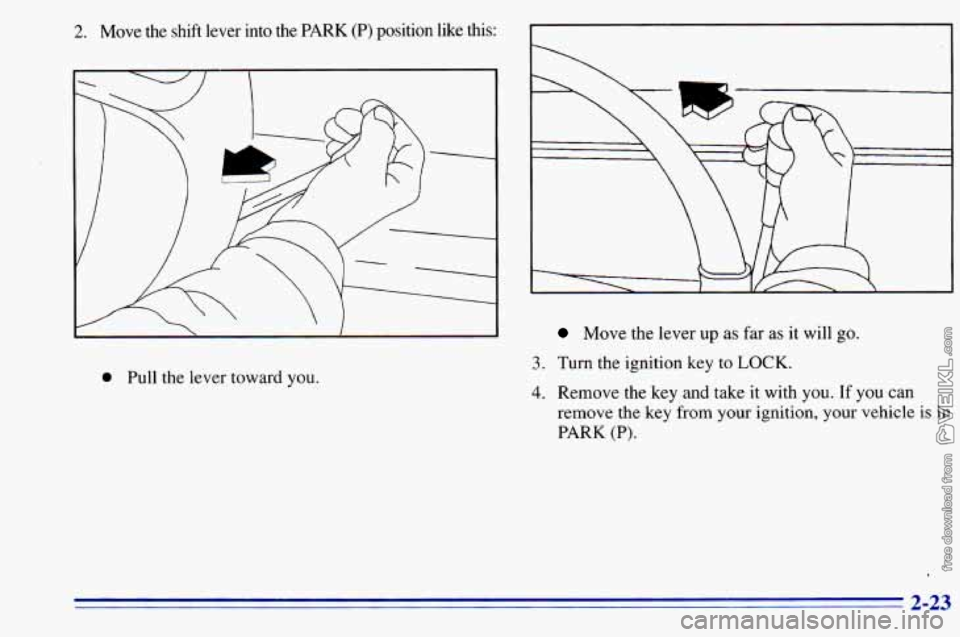
2. Move the shift lever into the PARK (P) position like this:
0 Pull the lever toward you.
Move the lever up as far as it will go.
3. Turn the ignition key to LOCK.
4. Remove the key and take it with you. If you can
remove the key from your ignition, your vehicle is in
PARK (P).
2-23
Page 84 of 372
Leaving Your Vehicle With the
E.noiqe Rmnnjnq
r
can be ( lgerous to we your vt cle wi
the engine running. Your vehicle could move
suddenly if the shift lever
is not fully in PARK (P)
with the parking brake firmly set. And, if you
leave the vehicle with the engine running, it could
overheat and even catch fire. You or others could
be injured. Don’t leave your vehicle with the
engine running unless you have
to.
If you have to leave your vehicle with the engine
running, be sure your vehicle is in PARK (P) and your
parking brake is firmly set before you leave it. After
you’ve moved the shift lever into the PARK (P)
position, hold the regular brake pedal down. Then, see
if you can move
the shift lever away from PARK (P)
without first pulling it toward
you. If you can, it means
that the shift lever wasn’t fully locked into PARK (P).
Torque Lock I
If you are parking on a hill and you don’t shift your
transmission
into PARK (P) properly, the weight of the
vehicle may put
too much force on the parking pawl in
the transmission. You may find it difficult to pull the
shift lever out of PARK (P). This is called “torque lock.”
To prevent torque lock, set the parking brake and then
shift into PARK (P) properly before you leave the
driver’s seat.
To find out how, see “Shifting Into
PARK (P)” in the Index.
When you are ready to drive, move the shift lever out
of
PARK (P) before you release the parking brake.
If torque lock does occur,
you may need to have another
vehicle push yours a little uphill
to take some of the
pressure from the transmission, so you can pull the shift
lever out
of PARK (P).
2-24
Page 87 of 372
CAUTION:
It can be dangerous to get out of your vehicle if
the shift lever is not fully in
PARK (P) with the
parking brake firmly set. Your vehicle can roll.
Don’t leave your vehicle when the engine is
running unless you have to.
If you’ve left the
engine running, the vehicle can move suddenly.
You or others could be injured.
To be sure your
vehicle won’t move, even when you’re on fairly
level ground, always set your parking brake and
move the shift lever to
PARK (P).
Follow the proper steps to be sure your vehicle won’t
move. See “Shifting Into
PARK (P)” in the Index.
If you’re pulling a trailer, see “Towing
a Trailer” in
the Index.
Windows
Manual Windows
To open your manual windows, turn the hand crank on
each door to raise or lower your side door windows.
Power Windows
If you have the optional power windows, the controls
are
on each of the front side doors. The driver’s door has
a switch for the front passenger window
as well. Your
power windows will not move unless the ignition has
been turned to the
RUN position.
2-27
Page 88 of 372
Exprer- ’ wn Window
The driver
s window switch also has an “express”
feature that allows
it to lower without holding the
window switch. Hold the driver’s window switch down
for more than 112 second to activate the express-down
feature. Lightly tap the switch to open the window
slightly. The express-down feature can be interrupted
at any time by pressing the up arrow end of the switch.
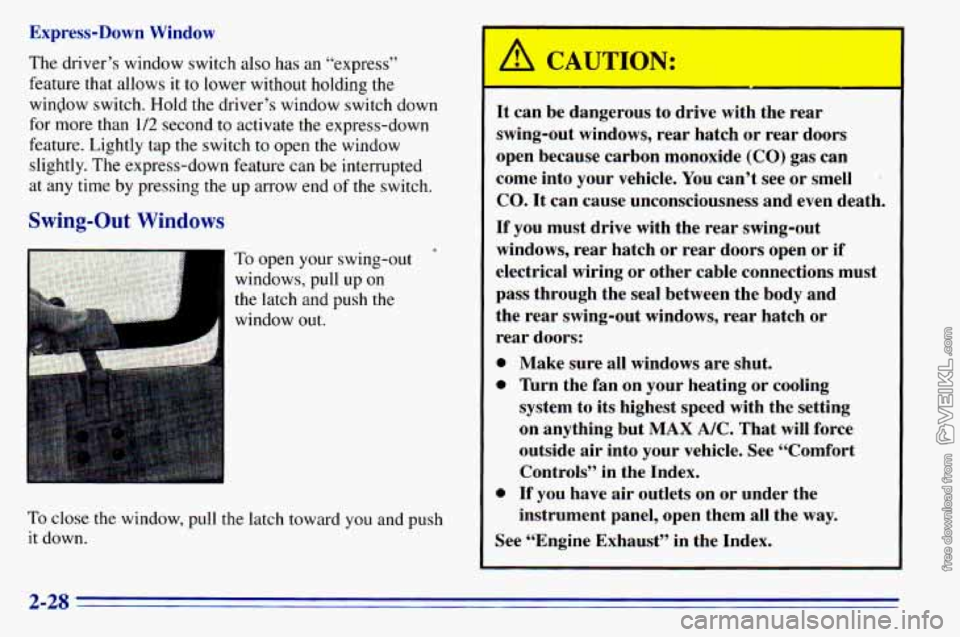
Swing-Out Windows
‘D‘. : .,,: TO open your swing-out +
windows, pull up on
the latch and push the
window out.
e
It can be dangerous to drive with the rear
swing-out windows, rear hatch or rear doors
open because carbon monoxide
(CO) gas can
come into your vehicle. You can’t see or smell
*
CO. It can cause unconsciousness and even death.
If you must drive with the rear swing-out
windows, rear hatch or rear doors open or if
electrical wiring or other cable connections must
pass through the seal between the body and
the rear swing-out windows, rear hatch
or
rear doors:
TO close the window, pull the latch toward you and push
it down.
e
e Make sure all windows are shut.
”urn the fan on your heating or cooling
system to its highest speed with the setting
on anything but MAX
A/C. That will force
outside air into your vehicle. See “Comfort
Controls” in the Index.
If you have air outlets on or under the
instrument panel, open them all the way.
See “Engine Exhaust’’ in the Index.
2-28