service CHEVROLET ASTRO 1996 Owner's Manual
[x] Cancel search | Manufacturer: CHEVROLET, Model Year: 1996, Model line: ASTRO, Model: CHEVROLET ASTRO 1996Pages: 372, PDF Size: 21.51 MB
Page 208 of 372
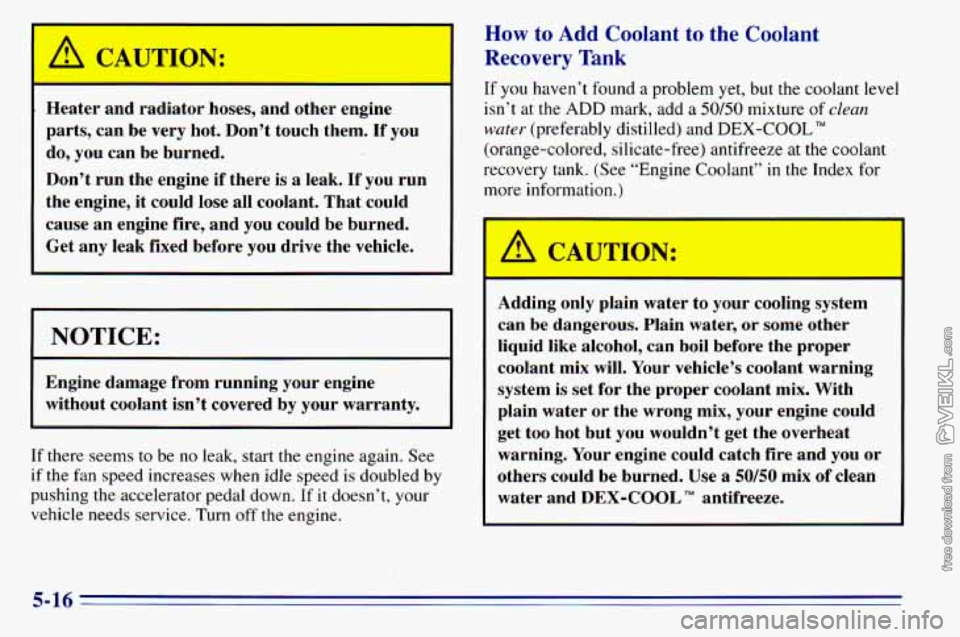
Heater and radiator hoses, and other engine
parts, can be
very hot. Don’t touch them. If you
do, you can be burned.
Don’t run the engine if there is a leak.
If you run
the engine, it could lose
all coolant. That could
cause an engine fire, and you could be burned.
Get any leak fixed before you drive the vehicle.
Engine damage from running your engine without coolant isn’t covered by your warranty.
If there seems to be
no leak, start the engine again. See
if the fan speed increases when idle speed
is doubled by
pushing the accelerator pedal down.
If it doesn’t, your
vehicle needs service. Turn off the engine.
How to Add Coolant to the Coolant
Recovery Tank
If you haven’t found a problem yet, but the coolant level
isn’t at the
ADD mark, add a 50/50 mixture of clean
water (preferably distilled) and DEX-COOL TM
(orange-colored, silicate-free) antifreeze at the coolant
recovery tank. (See “Engine Coolant’’
in the Index for
more information.)
Adding only plain water to your cooling system
can be dangerous. Plain water,
or some other
liquid like alcohol, can boil before the proper
coolant mix
will. Your vehicle’s coolant warning
system is set
for the proper coolant mix. With
plain water or the wrong mix, your engine could
get too hot but you wouldn’t get the overheat
warning. Your engine could catch fire and you or
others could be burned. Use a
50/50 mix of clean
water and
DEX-COOL TM antifreeze.
5-16
Page 231 of 372
Section 6 Service and Appearance Care
Here you will find information about the care of your vehicle.
This section begins with service and fuel information, and then it shows how
to check important fluid and lubricant
levels. There is also technical information about your
vehicle, and a part devoted to its appearance care.
Service
Your GM dealer knows your vehicle best and wants you
to be happy with it. We hope you’ll go to your dealer for
all your service needs. You’ll
get genuine GM parts and
GM-trained and supported service people. We
hope
you’ll want to keep your GM vehicle all GM.
Genuine GM parts have one
of these marks:
n
Delco
6-1
Page 232 of 372
Doing Your Own Service Work
If you want to do some of your own service work, you’ll
want to get the proper GM Service Manual. It tells you
much more about how to service your vehicle than this
manual can.
To order the proper service manual, see
“Service and Owner Publications” in the Index.
Your vehicle has an air bag system. Before attempting
to do your own service work, see “Servicing Your
Air Bag-Equipped Vehicle” in the Index.
You should keep a record with all parts receipts and list
the mileage and the date
of any service work you
perform. See “Maintenance Record” in the Index.
I A CAUTION:
You can be injured and your vehicle could be
damaged if you try to do service work on
a
vehicle without knowing enough about it.
Be sure you have sufficient knowledge,
experience, and the proper replacement
parts and tools before you attempt any
vehicle maintenance task.
Be sure to use the proper nuts, bolts and
other fasteners. “English” and “metric”
fasteners can be easily confused. If you use
the wrong fasteners, parts can later break
or fall
off. You could be hurt.
6-2
Page 233 of 372
Fuel
Use regular unleaded ‘gasoline rated at 87 octane or
higher. At a minimum, it should meet specifications
\.
ASTM D4814 in the United States and CGSB 3.5-M93
in Canada. Improved gasoline specifications have been
developed by the American Automobile Manufacturers
Association (AAMA) for better vehicle performance
and engine protection. Gasolines meeting the AAMA
specification could provide improved driveability and
emission control system protection compared-to
other gasolines.
Be sure the posted octane is at least
87. If the octane is
less than
87, you may get a heavy knocking noise when
you drive. If it’s bad enough, it can damage your engine.
If you’re using fuel rated at 87 octane or hgher and you
still hear heavy knocking, your engine needs service. But
don’t worry
if you hear a little pinging noise when you’re
accelerating or driving
up a hill. That’s nomal, and you don’t
have to buy a higher octane fuel to get rid of pinging. It’s the
heavy, constant knock that means you have a problem. If
your vehicle is certified’ to meet California Emission
Standards (indicated on the underhood tune-up label),
it is designed to operate on fuels that meet California
I
specifications. If such fuels are not available in states
adopting California emissions standards, your vehicle
will operate satisfactorily on fuels meeting federal
specifications, but emission control system performance
may be affected. The malfunction indicator lamp on
your instrument panel may turn on and/or your vehicle
may fail a smog-check test. If this occurs, return to your
authorized GM dealer for diagnosis to determine the
cause of failure. In the event it is determined that the
cause of the condition is the type of fuels used, repairs
may not be covered by your warranty.
.In Canada, some gasolines contain an octane-enhancing
additive called MMT. If you use such fuels, your
emission control system performance may deteriorate
and the malfunction indicator lamp on your instrument
panel may turn on.
If this happens, return to your
authorized GM dealer for service.
6-3
Page 244 of 372
As shown in the chart, SAE 5W-30 is best for your
vehicle. However,
you can use SAE 1OW-30 if it’s going
to be
0°F (- 18 “C) or above. These numbers on an oil
container show its viscosity,
or thickness. Do not use
other viscosity oils, such as
SAE 20W-50.
NOTICE:
Use only engine oil with the American Petroleum
Institute Certified For Gasoline Engines
“Starburst” symbol. Failure to use the
recommended oil can result in engine damage
not covered
by your warranty.
GM Goodwrench@ oil meets all the requirements for
your vehicle.
Engine Oil Additives
Don’t add anything to your oil. Your GM dealer is ready
to advise if
you think something should be added.
When to Change Engine Oil
See if any one of these is true for you:
0
0
e
e
e
Most trips are less than 5 to 10 miles (8 to 16 km).
This is particularly important when outside
temperatures are below freezing.
Most trips include extensive idling (such
as frequent
driving in stop-and-go traffic).
Most trips are through dusty areas.
You frequently tow a trailer or use a carrier on top
of
your vehicle.
The vehicle is used for delivery service, police, taxi
or other commercial application.
Driving under these conditions causes engine oil to
break down sooner. If any
one of these is true for your
vehicle, then
you need to change your oil and filter
every 3,000 miles
(5 000 km) or 3 months -- whichever
occurs first.
If
none of them is true, change the oil and filter every
7,500 miles (12 500 km) or 12 months -- whichever
occurs first. Driving a vehicle with
a fully warmed
engine under highway conditions causes engine oil to
break down slower.
6-14
Page 245 of 372
What to Do with Used Oil
Did you know that used engine oil contains certain
elements that may be unhealthy for your skin and could
even cause cancer? Don’t let used
oil stay on your skin
for very long. Clean your skin and nails with soap and
water, or a good hand cleaner. Wash or properly throw
away clothing or rags containing used engine oil. (See
the manufacturer’s warnings about
the use and disposal
of
oil products.)
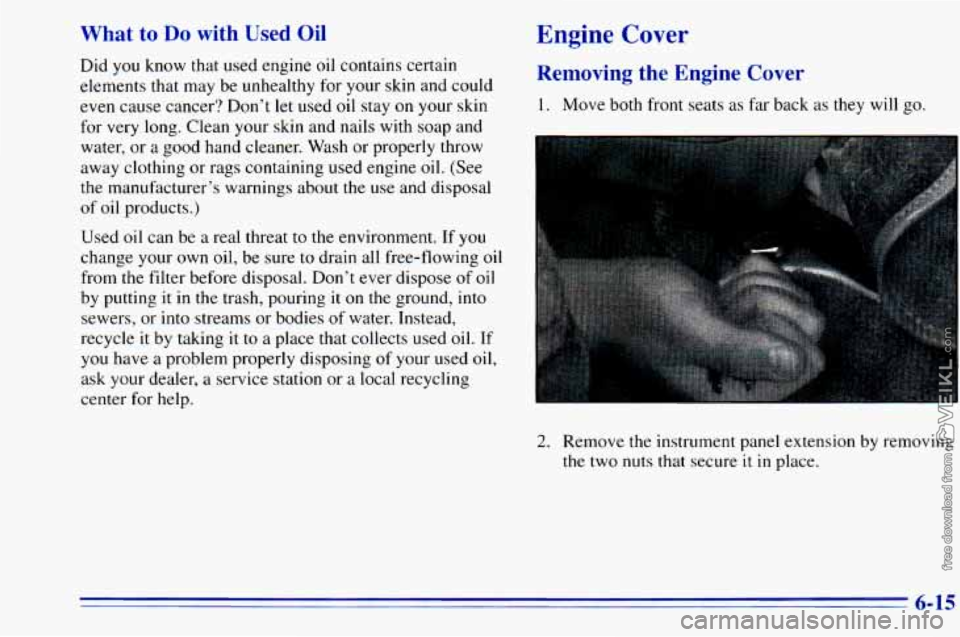
Engine Cover
Removing the Engine Cover
1. Move both front seats as far back as they will go.
Used oil can be a real threat to the environment.
If you
change your own oil, be sure to drain all free-flowing
oil
from the filter before disposal. Don’t ever dispose of oil
by putting
it in the trash, pouring it on the ground, into
sewers, or into streams or bodies of water. Instead,
recycle
it by taking it to a place that collects used oil. If
you have a problem properly disposing of your used oil,
ask your dealer, a service station or a local recycling
center
for help.
2. Remove the instrument panel extension
by removing
the two nuts that secure it in place.
6-15
Page 250 of 372
Refer to the Maintenance Schedule to determine when to
replace the air filter and the crankcase ventilation filter.
See “Scheduled
N ntenance Services” in the Index.
Operating th, mgine with the air cleaner off
can cause
you or others to be burned. The air
cleaner not only cleans the air, it stops flame if
the engine backfires. If it isn’t there, and the
engine backfires, you could be burned. Don’t
drive with it
off, and be careful working on the
engine with the
air cleaner off.
NOTICE:
If the air cleaner is off, a backfire can cause a
damaging engine fire. And, dirt can easily get
into your engine, which will damage it. Always
have the air cleaner in place when you’re driving.
Automatic Transmission Fluid
When to Check and Change
A good time to check your automatic transmission fluid
level is when the engine oil is changed,
Change both the fluid and filter every
15,000 miles
(25 000 km) if the vehicle is mainly driven under one
or more of these conditions:
In heavy city traffic where the outside temperature
In hilly or mountainous terrain.
When doing frequent trailer towing.
Uses such as found in taxi, police or delivery service.
If
you do not use your vehicle under any of these
conditions, change
the fluid and filter every
30,000 miles (50 000 km).
See “Scheduled Maintenance Services” in
the Index.
regularly reaches
90°F (32°C) or
higher.
6-20
Page 251 of 372
How to Check
Because this operation can be a little difficult, you
may choose to have this done at your GM dealer
Service Department.
If you do it yourself,
be sure to follow all the instructions
here, or
you could get a false reading on the dipstick.
NOTICE:
Too much or too little fluid can damage your
transmission.
Too much can mean that some of
the fluid could come out and fall on hot engine
parts or exhaust system parts, starting a fire. Be
sure to get an accurate reading if you check your
transmission fluid.
Wait at least 30 minutes before checking the
transmission fluid level if you have been driving:
0 When outside temperatures are above 90°F (32°C).
At high speed for quite a while.
0 In heavy traffic -- especially in hot weather.
0 While pulling a trailer.
To get the right reading, the fluid should be at normal
operating temperature, which is 180°F
to ,200"F
(82°C
to 93°C).
Checking Transmission Fluid Hot
Get the vehicle warmed up by driving about 15 miles
(24 km) when outside temperatures are above 50°F
(10°C). If it's colder than 50°F (lO"C), drive the
vehicle in DRIVE
(D) until the engine temperature gage
moves and then remains steady for
10 minutes. Then
follow the hot check procedures.
6-21
Page 254 of 372
How to Check Lubricant Front Axle
When to Check and Change Lubricant
Refer to the Maintenance Schedule to determine how
often to check the lubricant and when to change it. See
“Scheduled Maintenance Services” in the Index.
How to Check Lubricant
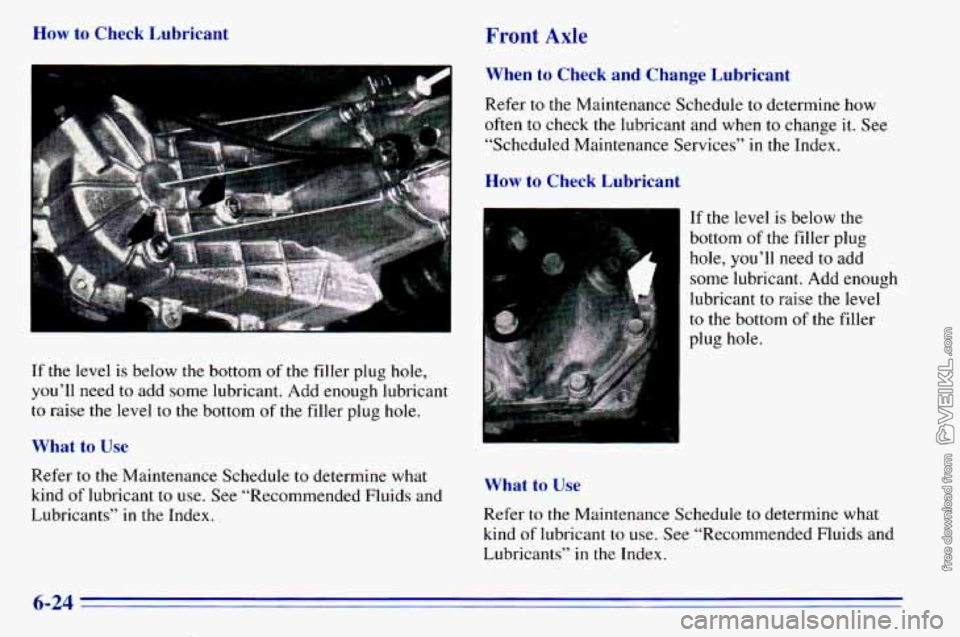
If the level is below the bottom of the filler plug hole,
you’ll need to add some lubricant. Add enough lubricant
to raise the level to the bottom of the filler plug hole.
What to Use
Refer to the Maintenance Schedule to determine what
kind
of lubricant to use. See “Recommended Fluids and
Lubricants” in the Index. If
the level is below the
bottom
of the filler plug
hole,
you’ll need to add
some lubricant. Add enough
lubricant
to raise the level
to the bottom of the filler
plug hole.
What to Use
Refer to the Maintenance Schedule to determine what
kind of lubricant
to use. See “Recommended Fluids and
Lubricants” in the Index.
6-24
Page 255 of 372
What to Use Rear Axle
When to Check and Change Lubricant
Refer to the Maintenance Schedule to determine how
often to check the lubricant and when
to change it. See
“Scheduled Maintenance Services” in the Index.
How to Check Lubricant
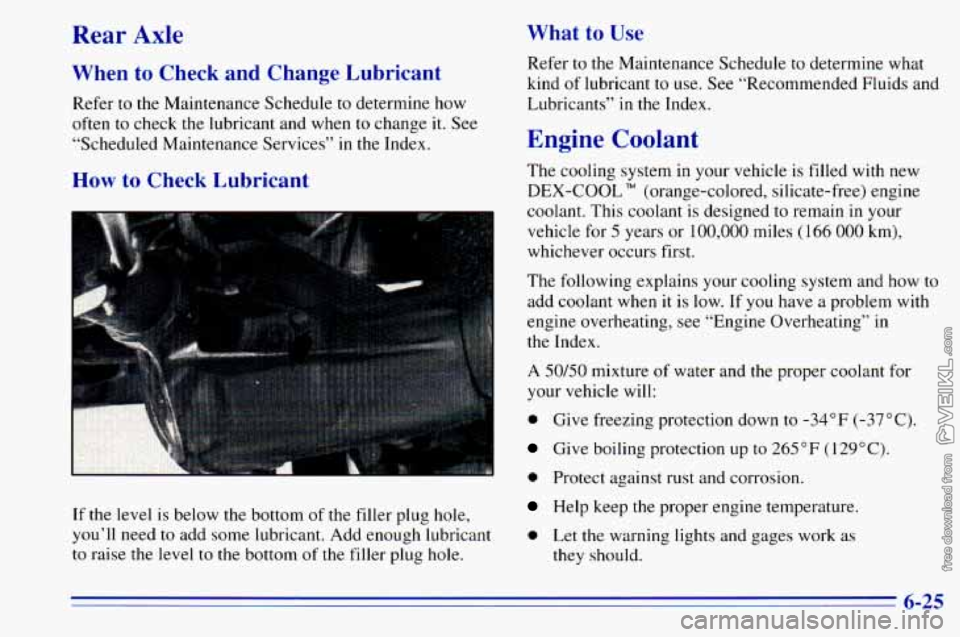
If the level is below the bottom of the filler plug hole,
you’ll need to add some lubricant. Add enough lubricant
to raise the level to the bottom of the filler plug hole. Refer
to the Maintenance Schedule to determine what
kind of lubricant
to use. See “Recommended Fluids and
Lubricants” in the Index.
Engine Coolant
The cooling system in your vehicle is filled with new
DEX-COOL (orange-colored, silicate-free) engine
coolant. This coolant is designed to remain in your
vehicle for
5 years or 100,000 miles (166 000 km),
whichever occurs first.
The following explains your cooling system and how to
add coolant when it is low. If
you have a problem with
engine overheating, see “Engine Overheating’’ in
the Index.
A 50/50 mixture of water and the proper coolant for
your vehicle will:
0 Give freezing protection down to -34°F (-37°C).
Give boiling protection up to 265 “F (1 29°C).
0 Protect against rust and corrosion.
Help keep the proper engine temperature.
0 Let the warning lights and gages work as
they should.
6-25