wheel CHEVROLET ASTRO 1996 Owner's Manual
[x] Cancel search | Manufacturer: CHEVROLET, Model Year: 1996, Model line: ASTRO, Model: CHEVROLET ASTRO 1996Pages: 372, PDF Size: 21.51 MB
Page 184 of 372
If You Do Decide To Pull A Trailer
If you do, here are some important points:
0
0
0
0
0
There are many different laws, including speed limit
restrictions, having
to do with trailering. Make sure
your rig will be legal,
not only where you live but
also where
you’ll be driving. A good source for this
information can be state or provincial police.
Consider using a sway control
if your trailer will
weigh 2,000 lbs.
(900 kg) or less. You should always
use a sway control if your trailer will weigh more
than 2,000 lbs.
(900 kg). You can ask a hitch dealer
about sway controls.
Don’t tow a trailer
at all during the first 500 miles
(800 km) your new vehicle is driven. Your engine,
axle or other parts could be damaged.
Then, during the first
500 miles (800 km) that you
tow a trailer, don’t drive over
50 mph (80 km/h) and
don’t make starts at
full throttle. This helps your
engine and other parts of your vehicle wear in at
the
heavier loads.
You should
use DRIVE (D) (or, as you need to,
a lower gear) when towing
a trailer. Operating your
vehicle in DRIVE
(D) when towing a trailer will
minimize heat buildup and extend the
life of
your transmission. Three
important considerations have to do with weight:
the weight
of the trailer,
the weight
of the trailer tongue
and the weight
on your vehicle’s tires.
Weight of the Trailer
How heavy can a trailer safely be?
It depends on how you plan to use your rig. For
example, speed, altitude, road grades, outside
temperature and how much your vehicle is used to pull a
trailer are all important. And, it can also depend
on any
special equipment
that you have on your vehicle.
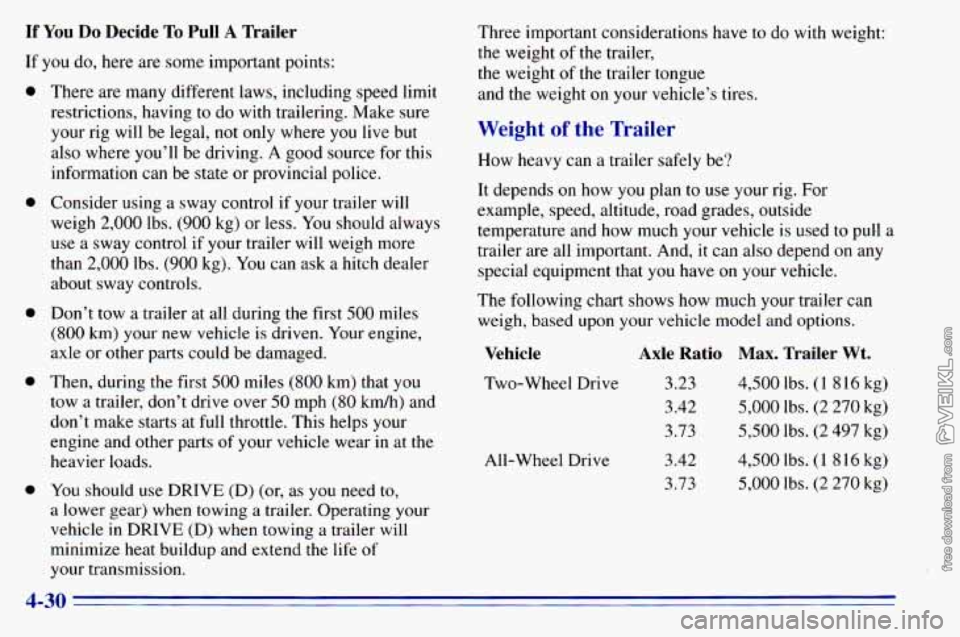
The following chart shows how much your trailer can
weigh, based upon your vehicle model and options.
Vehicle
Two-Wheel Drive
All-Wheel Drive
Axle Ratio Max. Trailer Wt.
3.23
3.42
3.73
3.42
3.73 4,500 lbs. (1 8 16 kg)
5,000 lbs. (2 270 kg)
5,500 lbs. (2 497 kg)
4,500 lbs.
(1 8 16 kg)
5,000 lbs. (2 270 kg)
4-30
Page 188 of 372
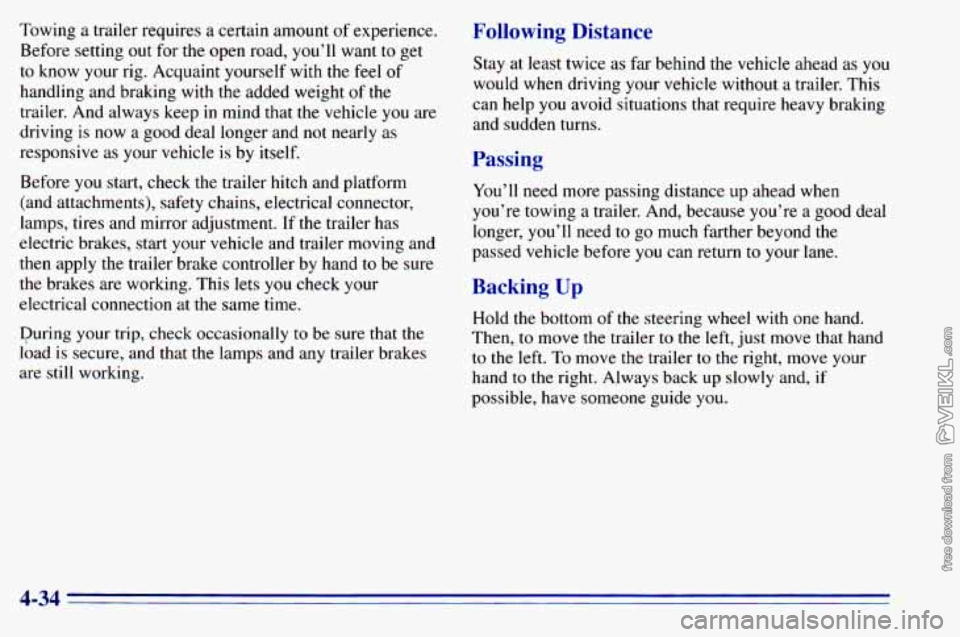
Towing a trailer requires a certain amount of experience.
Before setting out for the open road,
you’ll want to get
to know your rig. Acquaint yourself with the
feel of
handling and braking with the added weight of
the
trailer. And always keep in mind that the vehicle you are
driving is now a good deal longer and not nearly as
responsive as your vehicle is by itself.
Before
you start, check the trailer hitch and platform
(and attachments), safety chains, electrical connector,
lamps, tires and mirror adjustment. If the trailer has
electric brakes, start your vehicle and trailer moving and
then apply the trailer brake controller by hand to be sure
the brakes are working. This lets you check your
electrical connection at the same time.
During your trip, check occasionally to be sure that the
load is secure, and that the lamps and any trailer brakes
are still working.
lowing Distance
>ray at least twice as far behind the vehicle ahead as you
would when driving your vehicle without a trailer. This
can help you avoid situations that require heavy braking
and sudden turns.
Passing
You’ll need more passing distance up ahead when
you’re towing
a trailer. And, because you’re a good deal
longer,
you’ll need to go much farther beyond the
passed vehicle before you can return to your lane.
Backing Up
Hold the bottom of the steering wheel with one hand.
Then, to move the trailer
to the left, just move that hand
to the left. To move the trailer to the right, move your
hand to the right. Always back up slowly and,
if
possible, have someone guide you.
4-34
Page 190 of 372
Parking on Hills
Youereally should not park your vehicle, with a trailer
attached,
on a hill. If something goes wrong, your rig
could start to move. People can be injured, and both
your vehicle and the trailer can be damaged.
But
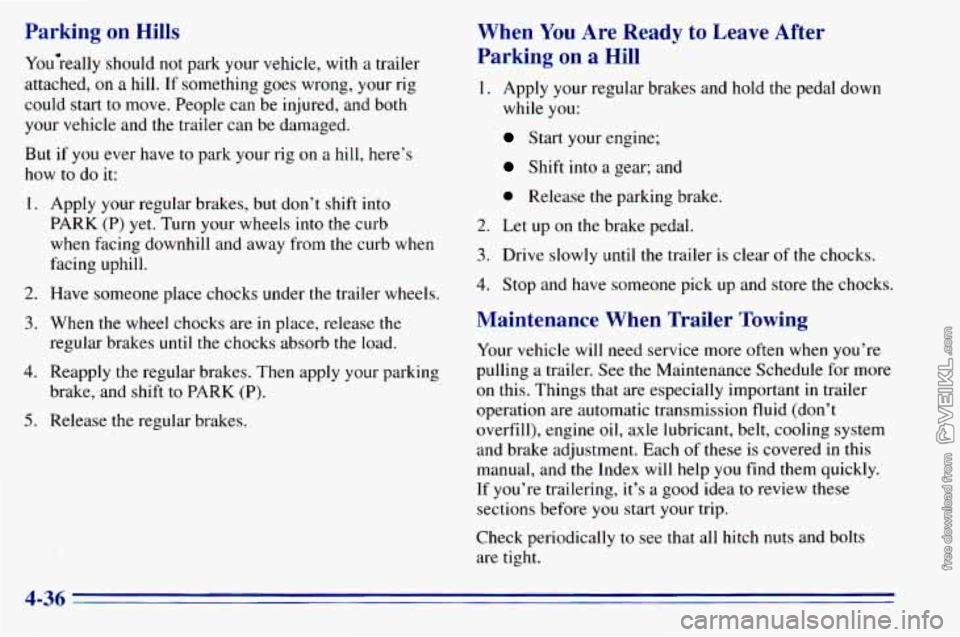
if you ever have to park your rig on a hill, here’s
how to do it:
1. Apply your regular brakes, but don’t shift into
PARK
(P) yet. Turn your wheels into the curb
when facing downhill and away from the curb when
facing uphill.
2. Have someone place chocks under the trailer wheels.
3, When the wheel chocks are in place, release the
regular brakes until the chocks absorb the load.
4. Reapply the regular brakes. Then apply your parking
brake, and shift to PARK
(P).
5. Release the regular brakes.
When You Are Ready to Leave After
Parking on a
Hill
1. Apply your regular brakes and hold the pedal down
while you:
Start your engine;
Shift into a gear; and
0 Release the parking brake.
2. Let up on the brake pedal.
3. Drive slowly until the trailer is clear of the chocks.
4. Stop and have someone pick up and store the chocks.
Maintenance When Trailer Towing
Your vehicle will need service more often when you’re
pulling a trailer. See the Maintenance Schedule for more
on this. Things that are especially important in trailer
operation are automatic transmission fluid (don’t
overfill), engine
oil, axle lubricant, belt, cooling system
and brake adjustment. Each
of these is covered in this
manual, and
the Index will help you find them quickly.
If you’re trailering, it’s a good idea
to review these
sections before you start your trip.
Check periodically
to see that all hitch nuts and bolts
are tight.
4-36
Page 191 of 372
Trailer Wiring Harness
If you have the optional trailering package, your vehicle
will have an eight-wire harness, including the center
high-mounted stoplamp battery feed wire. The harness
is stored on the passenger side
of the vehicle near the
rear wheel well. This harness
has a 30 amp battery feed
wire and no connector, and should be wired by a
qualified electrical technician. After choosing an
aftermarket trailer mating connector pair, have the
technician attach one connector to the eight-wire trailer
harness and the other connector to the wiring harness on
the trailer, Be sure the wiring harness on the trailer is
taped or strapped
to the trailer’s frame rail and leave it
loose enough
so the wiring doesn’t bend or break, but
not
so loose that it drags on the ground. The eight-wire
harness must be routed out
of your vehicle between the
rear door and the floor, with enough of the harness left
on both sides
so that the trailer or the body won’t pull it.
If you do not have the optional trailering package, your
vehicle will still have a trailering harness.
The harness is
located near the passenger’s side rear wheel well. It
consists of six wires that may be used
by after-market
trailer hitch installers. The technician can use the
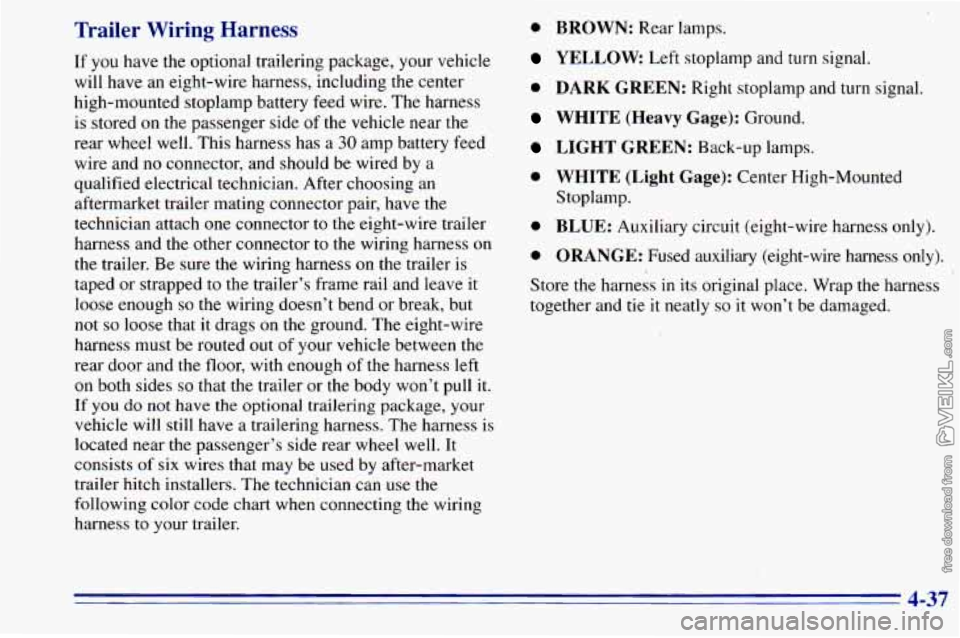
following color code chart when connecting the wiring
harness to your trailer.
0 BROWN: Rear lamps.
YELLOW Left stoplamp and turn signal.
0 DARK GREEN: Right stoplamp and turn signal.
WHITE (Heavy Gage): Ground.
LIGHT GREEN: Back-up lamps.
0 WHITE (Light Gage): Center High-Mounted
0 BLUE: Auxiliary circuit (eight-wire harness only).
0 ORANGE: Fused auxiliary (eight-wire harness only).
xore the harness in its original place. Wrap the harness
together and
tie it neatly so it won’t be damaged.
Stoplamp.
4-37
Page 195 of 372
1. Check the other vehicle. It must have a 12-volt
battery with
a negative ground system.
NOTICE:
If the other system isn’t a 12-volt system with a
negative ground, both vehicles can be damaged.
2. Get the vehicles close enough so the jumper cables
can reach, but be sure the vehicles aren’t touching
each other.
If they are, it could cause a ground
connection you don’t want.
You wouldn’t be able to
start your vehicle, and the bad grounding could
damage the electrical systems.
You could be injured
if the vehicles roll. Set the
parking brake firmly on each vehicle. Put an
automatic transmission
in PARK (P) or a manual
transmission in NEUTRAL (N). If you have a
four-wheel-drive vehicle
with a manual transfer case
shift lever, be sure the transfer case
is not in
NEUTRAL (N).
3. Turn off the ignition on both vehicles. Unplug
unnecessary accessories plugged into
the cigarette
lighter or accessory power outlets. Turn off all lamps
that aren’t needed
as well as radios. This will avoid
sparks and help save both batteries.
In addition, it
could save your radio!
I NOTICE:
If you leave your radio on, it could be badly
damaged. The repairs wouldn’t be covered by
your warranty.
4. Open the hoods and locate the batteries. Find the
positive
(+) and negative (-) terminals on
each battery.
5-3
Page 198 of 372
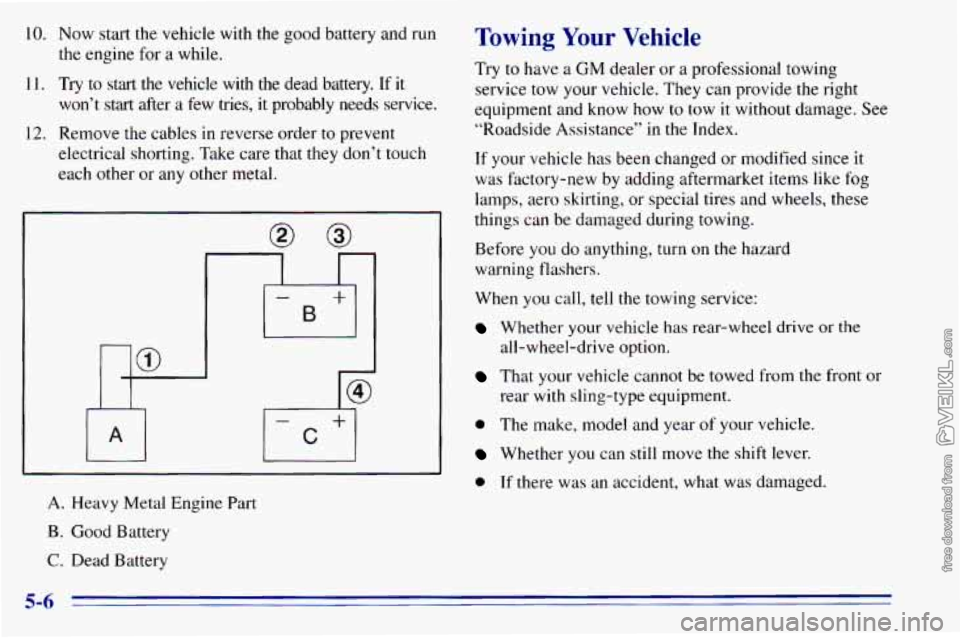
10. Now start the vehicle with the good battery and run
11. Try to start the vehicle with
the dead battery. If it
the engine for a while.
won’t start after a
few tries, it probably needs service.
12. Remove the cables in reverse order to prevent
electrical shorting. Take care that they don’t
touch
each other or any other metal.
0
1 I
I-B
+
A. Heavy Metal Engine Part
B. Good Battery
C. Dead Battery
Towing Your Vehicle
Try to have a GM dealer or a professional towing
service tow your vehicle. They can provide the right
equipment and know how to tow it without damage. See
“Roadside Assistance” in the Index.
If your vehicle has been changed or modified since
it
was factory-new by adding aftermarket items like fog
lamps, aero skirting, or special tires and wheels, these
things can be damaged during towing.
Before
you do anything, turn on the hazard
warning flashers.
When
you call, tell the towing service:
Whether your vehicle has rear-wheel drive or the
all-wheel-drive option.
That your vehicle cannot be towed from the front or
rear with sling-type equipment.
0 The make, model and year of your vehicle.
Whether you can still move the shift lever.
0 If there was an accident, what was damaged.
5-6
Page 200 of 372
When your vehicle is being towed, have the ignition
key in the
OFF position. The steering wheel should
be clamped in a straight-ahead position, with
a
clamping device designed for towing service. Do not
use the vehicle’s steering column lock for this. The
transmission should be in NEUTRAL
(N) and the
parking brake released.
If your vehicle has the all-wheel-drive option,
it can
only be towed with all four wheels
off the ground. A
dolly must be used under the un-raised wheels when
towing or the vehicle must be transported
on a flat
bed carrier.
Don’t have your vehicle towed
with the wheels in
contact with the ground if it has all-wheel drive. If a
vehicle with all-wheel drive must be towed with
sling-type or wheel-lift equipment, then either the front
or rear wheels must be supported on a dolly.
NOTICE:
If your vehicle has all-wheel drive, do not have
it towed with the wheels in contact with the
ground or vehicle damage may occur.
A dolly
must be used under the un-raised wheels when
towing or the vehicle must be transported
on a
flat bed carrier.
5-8
Page 201 of 372
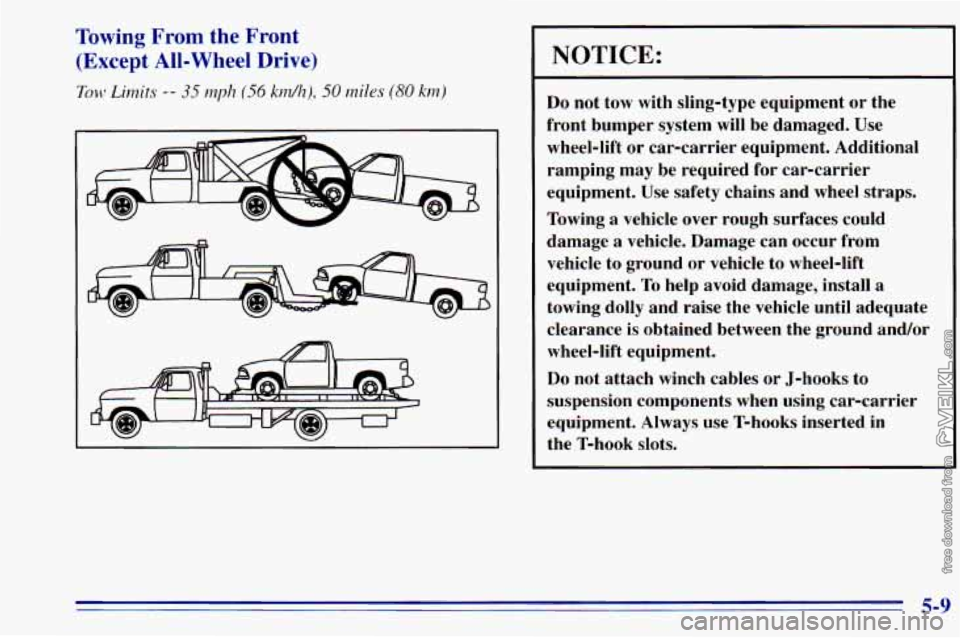
Towing From the Front
(Except All-Wheel Drive)
Tow Limits -- 35 mp11 (56 krnh), 50 rniles (80 km)
NOTICE:
Do not tow with sling-type equipment or the
front bumper system will be damaged. Use
wheel-lift or car-carrier equipment. Additional
ramping
may be required for car-carrier
equipment. Use safety chains and wheel straps.
Towing
a vehicle over rough surfaces could
damage a vehicle. Damage can occur from
vehicle to ground or vehicle to wheel-lift
equipment. To help avoid damage, install
a
towing dolly and raise the vehicle until adequate
clearance
is obtained between the ground and/or
wheel-lift equipment.
Do not attach winch cables or J-hooks to
suspension components when using car-carrier
equipment. Always use T-hooks inserted in
the T-hook slots.
Page 202 of 372
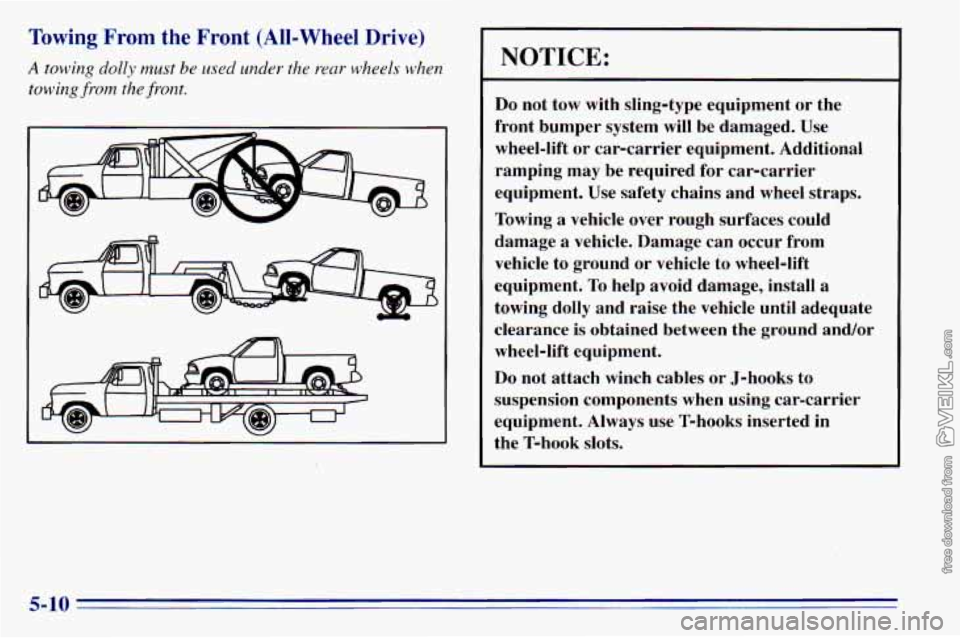
Towing From the Front (All-Wheel Drive)
A towing dolly must be used under the rear wheels when
towing front the front.
NOTICE:
Do not tow with sling-type equipment or the
front bumper system will be damaged. Use
wheel-lift or car-carrier equipment. Additional
ramping may be required
for car-carrier
equipment. Use safety chains and wheel straps.
Towing a vehicle over rough surfaces could
damage a vehicle. Damage can occur from
vehicle to ground or vehicle
to wheel-lift
equipment. To help avoid damage, install a
towing dolly and raise the vehicle until adequate
clearance is obtained between the ground and/or
wheel-lift equipment.
Do not attach winch cables or J-hooks to
suspension components when using car-carrier
equipment. Always use T-hooks inserted in
the T-hook slots.
5-10
Page 203 of 372
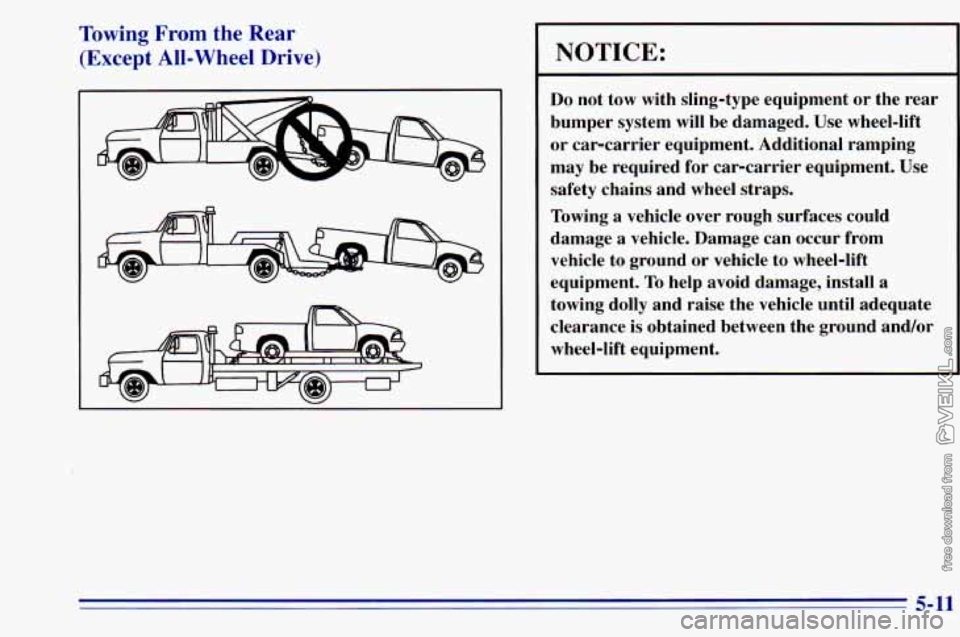
Towing From the Rear
(Except All-Wheel Drive)
NOTICE:
Do not tow with sling-type equipment or the rear
bumper system will be damaged. Use wheel-lift
or car-carrier equipment. Additional ramping
may be required for car-carrier equipment. Use
safety chains and wheel straps.
Towing a vehicle over rough surfaces could
damage a vehicle. Damage can occur from
vehicle to ground or vehicle to wheel-lift
equipment. To help avoid damage, install a
towing dolly and raise the vehicle until adequate
clearance is obtained between the ground and/or wheel-lift equipment.