wheel CHEVROLET ASTRO 1996 Workshop Manual
[x] Cancel search | Manufacturer: CHEVROLET, Model Year: 1996, Model line: ASTRO, Model: CHEVROLET ASTRO 1996Pages: 372, PDF Size: 21.51 MB
Page 279 of 372
rire Chains
NOTICE:
If your vehicle has P235/65R15 size tires, don’t
use tire chains. They can damage your vehicle.
If you have other size tires, use tire chains only
where legal and only when you must.
Use only
SAE Class “S” type chains that are the proper size
for your tires. Install them on the
rear axle tires
and tighten them as tightly as possible with the
ends securely fastened. Drive slowly and follow
the chain manufacturer’s instructions.
If you can
hear the chains contacting your vehicle, stop and
retighten them.
If the contact continues, slow down
until it stops.
Driving too fast or spinning the
wheels with chains on
will damage your vehicle.
Appearance Care
Remember, cleaning products can be hazardous. Some
are toxic. Others can burst into flame if you strike a
match or get them
on a hot part of the vehicle. Some are
dangerous
if you breathe their fumes in a closed space.
When you use anything from a container to clean your
vehicle, be sure to follow
the manufacturer’s warnings
and instructions. And always open your doors or
windows when you’re cleaning the inside.
Never use these to clean your vehicle:
Gasoline
Benzene
0 Naphtha
0 Carbon Tetrachloride
Acetone
Paint Thinner
Turpentine
Lacquer Thinner
Nail Polish Remover
They can all be hazardous
-- some more than
others
-- and they can all damage your vehicle, too.
6-49
Page 285 of 372
Foreign materials such as calcium chloride and other
salts, ice melting agents, road oil and tar, tree sap, bird
droppings, chemicals from industrial chimneys, etc., can
damage your vehicle’s finish if they remain on painted
surfaces. Wash the vehicle as soon as possible. If
necessary,
use non-abrasive cleaners that are marked
safe for painted surfaces
to remove foreign matter.
Exterior painted surfaces are subject to aging, weather
and chemical fallout that can take their toll over a period
of years. You can help to keep the paint finish looking
new by keeping your vehicle garaged or covered
whenever possible.
Protecting Exterior Bright Metal Parts
Bright metal parts should be cleaned regularly to keep
their luster. Washing with water is all that is usually
needed. However, you may use
GM Chrome Polish on
chrome or stainless steel trim,
if necessary.
Use special care with aluminum trim. To avoid damaging
protective trim, never use auto or chrome polish, steam
or caustic soap
to clean aluminum. A coating of wax,
rubbed to high polish, is recommended for all bright
metal parts.
Aluminum Wheels (If So Equipped)
Keep your wheels clean using a soft clean cloth with
mild soap and water. Rinse with
clean water. After
rinsing thoroughly, dry with
a soft clean towel. A wax
may
then be applied.
The surface of these wheels is similar
to the painted
surface of your vehicle. Don’t use strong soaps,
chemicals, abrasive polishes, abrasive cleaners or
abrasive cleaning brushes
on them because you could
damage the surface.
Don’t take your vehicle through an automatic vehicle
wash that has silicon carbide tire cleaning brushes.
These brushes can also damage the surface of
these wheels.
6-55
Page 286 of 372
Tires
To clean your tires, use a stiff brush with a tire cleaner.
NOTICE:
When applying a tire dressing always take care to
wipe
off any overspray or splash from all painted
surfaces on the body or wheels
of the vehicle.
Petroleum-based products may damage the
paint finish.
Sheet Metal Damage
If your vehicle is damaged and requires sheet metal
repair or replacement, make sure the body repair shop
applies anti-corrosion material to the parts repaired or
replaced
to restore corrosion protection.
Finish Damage
Any stone chips, fractures or deep scratches in the finish
should be repaired right away. Bare metal will corrode
quickly and may develop into a major repair expense.
Minor chips and scratches can be repaired with touch-up
materials available from your dealer or other service
outlets. Larger areas of finish damage can be corrected
in your dealer’s body and paint shop.
Underbody Maintenance
Chemicals used for ice and snow removal and dust
control can collect on the underbody. If these are not
removed, accelerated corrosion (rust) can occur on
the underbody parts such as fuel lines, frame,
floor
pan and exhaust system even though they have
corrosion protection.
At least every spring, flush these materials from the
underbody with plain water. Clean any areas where mud
and other debris can collect. Dirt packed in closed areas
of the frame should be loosened before being flushed.
Your dealer
or an underbody vehicle washing system
can do this for you.
6-56
Page 288 of 372
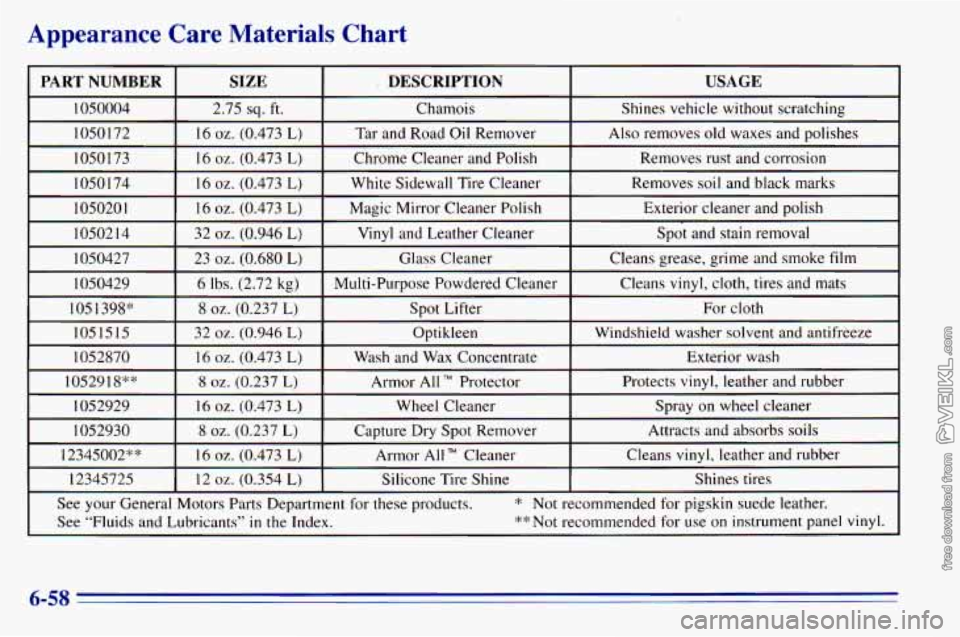
Appearance Care Materials Chart
PART NUMBER USAGE DESCRIPTION
SIZE
1050004
Exterior cleaner and polish
Magic Mirror Cleaner Polish
16
oz. (0.473 L) I05020 1
Removes soil and black marks White Sidewall Tire Cleaner 16 oz. (0.473 L) 10501 74 Removes rust and corrosion
Chrome Cleaner and Polish 16
oz. (0.473 L)
1050173 Also removes old waxes and polishes
Tar and Road Oil Remover 16
oz. (0.473 L)
1050172 Shines vehicle without scratching
Chamois
2.75
sq. ft.
~ ~~
1050214
1050427 Spot and stain removal Vinyl and Leather Cleaner
32 oz. (0.946 L)
Exterior wash
Wash and
Wax Concentrate
16 oz. (0.473 L) 1052870 Windshield washer solvent and
antifreeze
Optikleen
32
oz. (0.946 L) 1051515 For cloth
Spot Lifter
8 oz. (0.237 L) 105 1398” Cleans
vinyl, cloth, tires and mats
Multi-Purpose Powdered Cleaner 6 lbs. (2.72 kg) 1050429 Cleans
grease, grime and smoke
film Glass Cleaner 23
oz. (0.680 L)
I I I
I 1052918** I 8 oz. (0.237 L) I Armor All TM Protector I Protects vinyl, leather and rubber 1
1052929
Cleans
vinyl, leather and rubber
Armor All Cleaner
16 oz. (0.473 L) 12345002** Attracts and absorbs
soils
Capture Dry Spot Remover
8 oz. (0.237 L) 1052930 Spray on wheel cleaner Wheel Cleaner 16
oz. (0.473 L)
12345725 Shines tires
Silicone Tire Shine
12 oz. (0.354 L)
See
your General Motors Parts Department for these products. * Not recommended for pigskin suede leather.
See “Fluids and Lubricants’’
in the Index. **Not
recommended for use on instrument panel vinyl.
6-58
Page 297 of 372
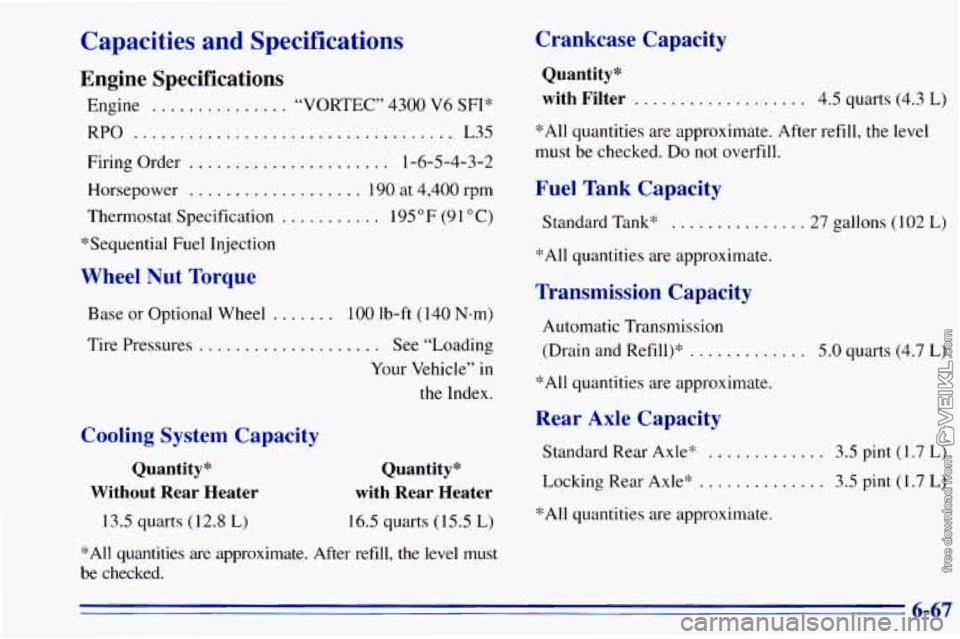
Capacities and Specifications
Engine Specifications
Engine ............... “VORTEC” 4300 V6 SFI‘k
RPO ................................... L35
Firing Order
...................... 1-6-5-4-3-2
Horsepower
................... 190 at 4,400 rpm
Thermostat Specification
......... 195 “F (9 1 O C)
“Sequential Fuel Injection
Wheel Nut Torque
Base or Optional Wheel ....... 100 lb-ft (140 Nem)
Tire Pressures ......... .... See “Loading
Your Vehicle” in
the Index.
Cooling System Capacity
Quantity*
Without Rear Heater
13.5 quarts (12.8 L)
Quantity*
with Rear Heater
16.5 quarts (15.5 L)
*All quantities are approximate. After refill, the level must
be checked.
Crankcase Capacity
Quantity*
with Filter
................... 4.5 quarts (4.3 L)
*All quantities are approximate. After refill, the level
must be checked. Do not overfill.
Fuel Tank Capacity
Standard Tank* ...........
*All quantities are approximate,
Transmission Capacity
Automatic Transmission
(Drain and Refill)“
.........
*All quantities are approximate.
Rear Axle Capacity
Standard Rear Axle* . .
Locking Rear Axle” ..........
*All quantities are approximate.
. . 27 gallons (102 L)
. . 5.0 quarts (4.7 L)
. . 3.5 pint (1.7 L)
3.5 pint (1.7 L)
6-67
Page 299 of 372
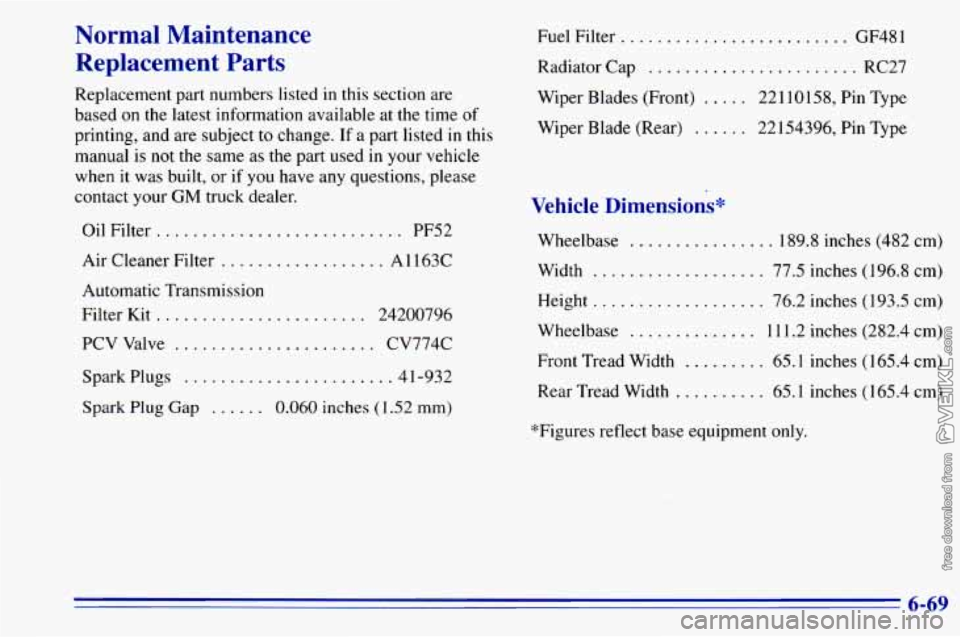
Normal Maintenance Replacement
Parts
Replacement part numbers listed in this section are
based on the latest information available at the time of
printing, and are subject to change.
If a part listed in this
manual is
not the same as the part used in your vehicle
when it was built, or
if you have any questions, please
contact your
GM truck dealer.
Oil Filter..
......................... PF52
Air Cleaner Filter
.................. A 1 163C
Automatic Transmission
Filter Kit
............ ... 24200796
PCV Valve
...................... CV774C
Spark Plugs
....................... 41-932
Spark
Plug Gap ...... 0.060 inches (1.52 mm) Fuel
Filter
...
Radiator Cap .......
Wiper Blades (Front) .
Wiper Blade (Rear) . .
. . GF481
............ RC27
. . 22110158, Pin Type
. . 22154396, Pin Type
Vehicle Dimensions*
Wheelbase .............. 189.8 inches (482 cm)
Width
................... 77.5 inches (1 96.8 cm)
Height.
.................. 76.2 inches (193.5 cm)
Wheelbase
.............. 11 1.2 inches (282.4 cm)
Front Tread Width
......... 65.1 inches (165.4 cm)
Rear Tread Width
........ 65.1 inches (1 65.4 cm)
*Figures reflect base equipment only.
6-69
Page 304 of 372
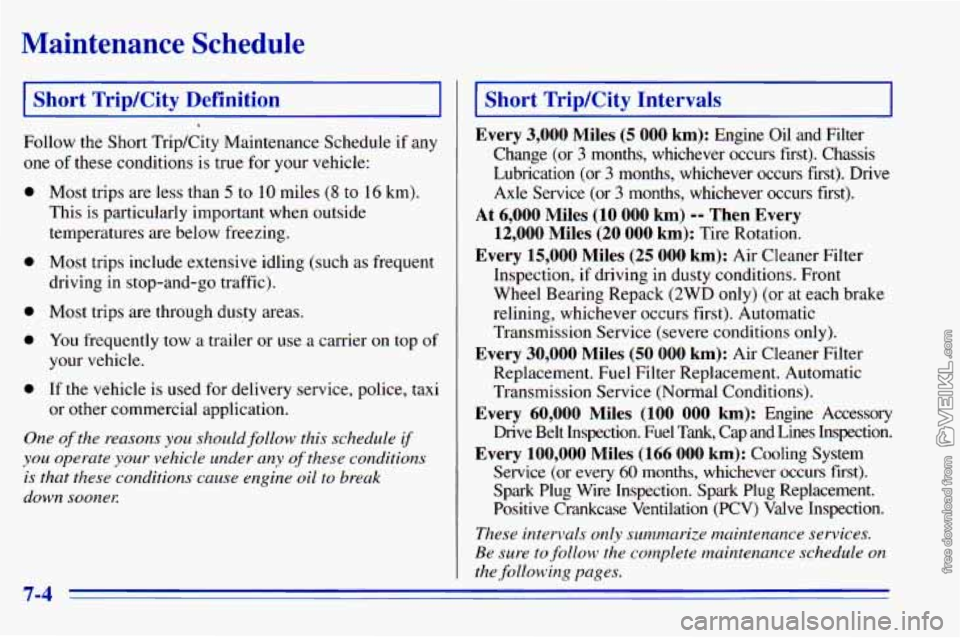
Maintenance Schedule
Short TripKity Definition
Follow the Short TripKity Maintenance Schedule if any
one
of these conditions is true for your vehicle:
0
0
0
0
0
Most trips are less than 5 to 10 miles (8 to 16 km).
This is particularly important when outside
temperatures are below freezing.
Most trips include extensive idling (such
as frequent
driving in stop-and-go traffic).
Most trips are through dusty areas.
You frequently tow a trailer or use a carrier on top of
your vehicle.
If the vehicle is used for delivery service, police, taxi
or other commercial application.
One of the reasons yo~l should follow this schedule if
you operate your vehicle under any of these conditions
is
that these conditions cause engine oil to break
down soonex
Short Trip/City Intervals
Every 3,000 Miles (5 000 km): Engine Oil and Filter
Change (or
3 months, whichever occurs first). Chassis
Lubrication (or
3 months, whichever occurs first). Drive
Axle Service (or
3 months, whichever occurs fust).
At 6,000 Miles (10 000 km) -- Then Every
12,000 Miles
(20 000 km): Tire Rotation.
Every 15,000 Miles (25 000 km): Air Cleaner Filter
Inspection,
if driving in dusty conditions. Front
Wheel Bearing Repack (2WD only) (or at each brake
relining, whichever occurs first). Automatic
Transmission Service (severe conditions only).
Every 30,000 Miles (50 000 km): Air Cleaner Filter
Replacement.
Fuel Filter Replacement. Automatic
Transmission Service (Normal Conditions).
Every 60,000 Miles (100 000 km): Engine Accessory
Drive Belt Inspection. Fuel
Tank, Cap and Lines Inspection.
Every 100,000 Miles (166 000 km): Cooling System
Service (or every
60 months, whichever occurs first).
Spark Plug Wire Inspection. Spark Plug Replacement.
Positive Crankcase Ventilation (PCV) Valve Inspection.
These intervals only summarize nzaintenance services.
Be sure to follow the complete maintenance schedule on
the following pages.
7-4
Page 305 of 372
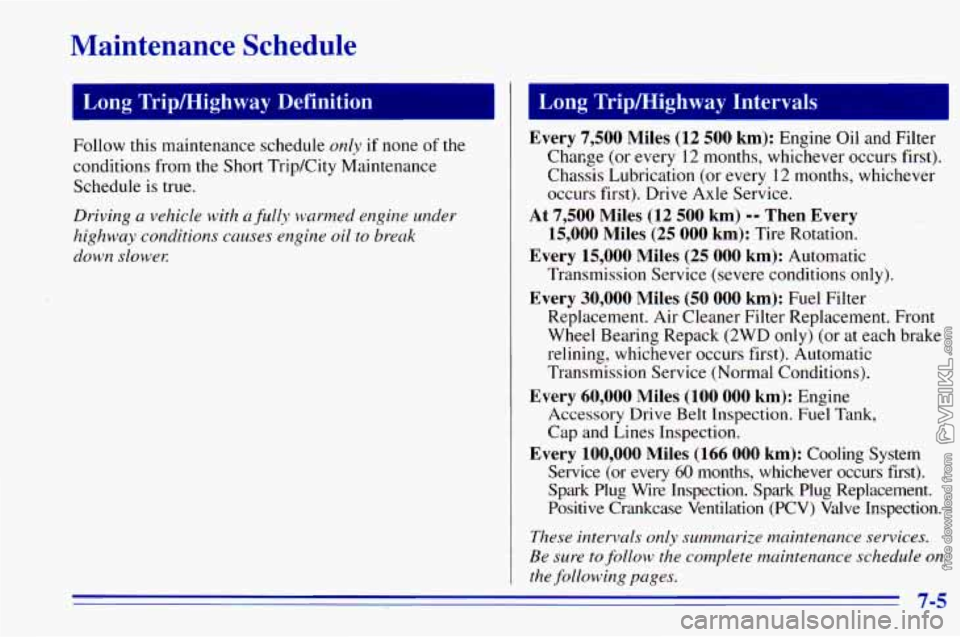
Maintenance Schedule
Long Tripmighway Definition Long Trip/Highway Intervals
Follow this maintenance schedule only if none of the
conditions from the Short Trip/City Maintenance
Schedule is true.
Driving a vehicle with nf.lly warmed engine under
highway conditions causes engine oil to break
down sloweE
Every 7,500 Miles (12 500 km): Engine Oil and Filter
Char,ge (or every 12 months, whichever occurs first).
Chassis Lubrication (or every 12 months, whichever
occurs first). Drive Axle Service.
At 7,500 Miles (12 500 km) -- Then Every
15,000 Miles
(25 000 km): Tire Rotation.
Every 15,000 Miles (25 000 km): Automatic
Transmission Service (severe conditions only).
Every 30,000 Miles (50 000 km): Fuel Filter
Replacement. Air Cleaner Filter Replacement. Front
Wheel Bearing Repack (2WD only)
(or at each brake
relining, whichever occurs first). Automatic
Transmission Service (Normal Conditions).
Accessory Drive Belt Inspection.
Fuel Tank,
Cap and Lines Inspection.
Every 100,000 Miles (166 000 km): Cooling System
Service (or every
60 months, whichever occurs first).
Spark Plug Wire Inspection. Spark Plug Replacement.
Positive Crankcase Ventilation (PCV) Valve Inspection.
These intervals only swnnzarize maintenance services.
Be sure to
follow the complete maintenance schedule on
the following pages.
Every 60,000 Miles (100 000 km): Engine
7-5
Page 309 of 372
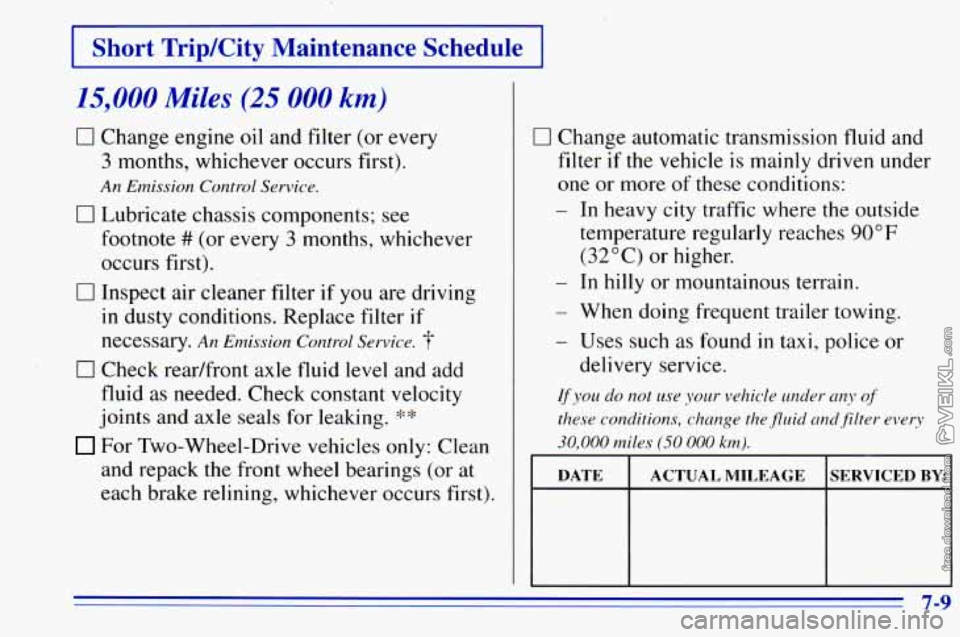
I Short Trip/City Maintenance Schedule I
15,000 Miles (25 000 km)
0 Change engine oil and filter (or every 3 months, whichever occurs first).
0 Lubricate chassis components; see
An Emission Control Service.
footnote ## (or every 3 months, whichever
occurs first).
0 Inspect air cleaner filter if you are driving
in dusty conditions. Replace filter
if
necessary. An Emission Control Service.
0 Check readfront axle fluid level and add
fluid as needed. Check constant velocity
joints and axle seals for leaking.
**
For Two-Wheel-Drive vehicles only: Clean
and repack the front wheel bearings (or at
each brake relining, whichever occurs first).
0 Change automatic transmission flr lid and
filter
if the vehicle is mainly driven under
one or more of these conditions:
- In heavy city traffic where the outside
temperature regularly reaches
90°F
(32°C) or higher.
- In hilly or mountainous terrain.
- When doing frequent trailer towing.
- Uses such as found in taxi, police or
delivery service.
[f you do not use your vehicle under my of
these conditions, change the fluid and filter every
30,000 miles (50 000 km).
7-9
Page 312 of 372
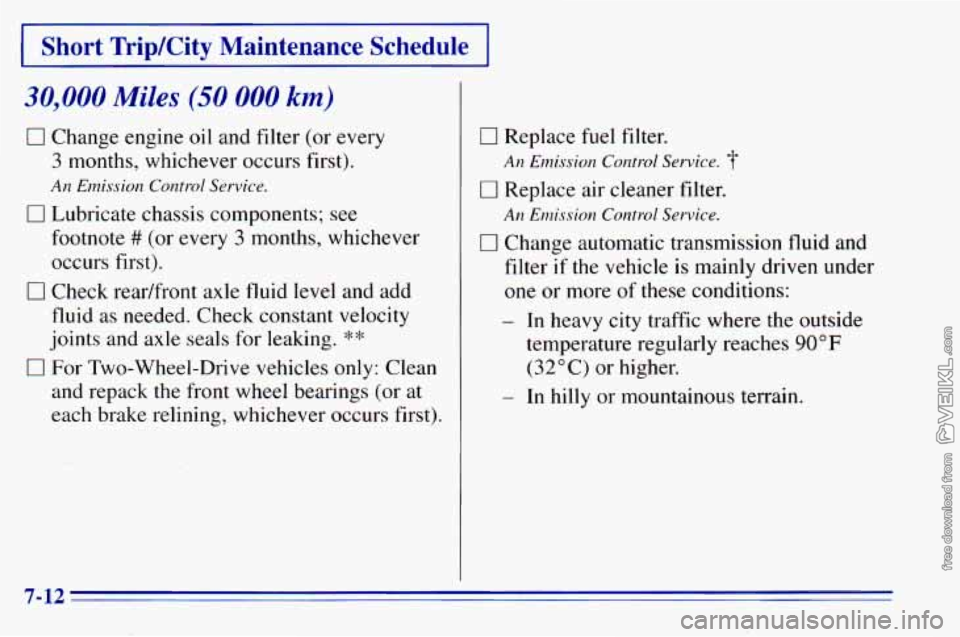
30,000 Miles (50 000 km)
0 Change engine oil and filter (or every
3 months, whichever occurs first).
An Emission Control Service.
0 Lubricate chassis components; see
footnote
# (or every 3 months, whichever
occurs first).
0 Check readfront axle fluid level and add
fluid as needed. Check constant velocity
joints and axle seals for leaking.
**
0 For Two-Wheel-Drive vehicles only: Clean
and repack the front wheel bearings (or at
each brake relining, whichever occurs first).
0 Replace fuel filter.
An Emission Control Service.
0 Replace air cleaner filter.
0 Change automatic transmission fluid and
filter
if the vehicle is mainly driven under
one or more of these conditions:
- In heavy city traffic where the outside
temperature regularly reaches
90 OF
(32°C) or higher.
An Emission Control Service.
- In hilly or mountainous terrain.
Short TripKity Maintenance Schedule
7-12