ECU CHEVROLET ASTRO 1997 2.G Owner's Guide
[x] Cancel search | Manufacturer: CHEVROLET, Model Year: 1997, Model line: ASTRO, Model: CHEVROLET ASTRO 1997 2.GPages: 404, PDF Size: 20.63 MB
Page 205 of 404
Downloaded from www.Manualslib.com manuals search engine I A CAUTION:
Do not load your vehicle any heavier than the
GVWR, or either the maximum
front or rear
GAWR.
If you do, parts on your vehicle can
break, or it can change the way your vehicle
handles. These could cause you to lose control.
Also, overloading can shorten the life of
your vehicle.
Using heavier suspension components to get added
durability might
not change your weight ratings. Ask
your dealer
to help you load your vehicle the right way.
NOTICE:
Your warranty does not cover parts or
components that fail because
of overloading.
If you put things inside your vehicle -- like suitcases,
tools, packages,
or anything else -- they will go as fast
as
the vehicle goes. If you have to stop or turn quickly,
or if there is a crash, they’ll keep going.
I
Things you put inside your vehicle can strik
injure people in
a sudden stop or turn, or in a crash.
0 Put things in the cargo area of your vehicle.
Try to spread the weight evenly.
Never stack heavier things, like suitcases,
inside the vehicle
so that some of them are
above the tops of the seats.
Don’t leave an unsecured child restraint in
your vehicle.
0 When you carry something inside the
vehicle, secure it whenever you can.
0 Don’t leave a seat folded down unless you
need to.
4-29
Page 212 of 404
Downloaded from www.Manualslib.com manuals search engine Towing a trailer requires a certain amount of experience.
Before setting out for the open road, you’ll want
to get
to know your rig. Acquaint yourself with the feel
of
handling and braking with the added weight of the
trailer. And always keep in mind that the vehicle
you are
driving is now a good deal longer and not nearly as
responsive as your vehicle is by itself.
Before
you start, check the trailer hitch and platform
(and attachments), safety chains, electrical connector,
lamps, tires and mirror adjustment. If the trailer has
electric brakes, start your vehicle and trailer moving and
then apply the trailer brake controller by hand to be sure
the brakes are working. This lets you check your
electrical connection at the same time.
During your trip, check occasionally
to be sure that the
load is secure, and that the lamps and any trailer brakes
are still working.
Following Distance
Stay at least twice as far behind the vehicle ahead as you
would when driving your vehicle without a trailer. This
can help
you avoid situations that require heavy braking
and sudden turns.
Passing
You’ll need more passing distance up ahead when
you’re towing a trailer. And, because you’re
a good deal
longer, you’ll need
to go much farther beyond the
passed vehicle before
you can return to your lane.
Backing Up
Hold the bottom of the steering wheel with one hand.
Then, to move the trailer to the left, just move that hand
to the left. To move the trailer to the right, move your
hand
to the right. Always back up slowly and, if
possible, have someone guide
you.
Making Turns
NOTICE:
Making very sharp turns while trailering could
cause the trailer to come in contact with the
vehicle. Your vehicle could be damaged. Avoid
making very sharp turns while trailering.
When you’re turning with a trailer, make wider turns than
normal. Do this so your trailer won’t strike soft shoulders,
curbs, road signs, trees or other objects. Avoid jerky or
sudden maneuvers. Signal well in advance.
4-36
Page 225 of 404
Downloaded from www.Manualslib.com manuals search engine Towing Your Vehicle
Try to have a GM dealer or a professional towing
service tow your vehicle. They can provide the right
equipment and know how to tow
it without damage. See
“Roadside Assistance”
in the Index.
If your vehicle has been changed or modified since it
was factory-new by adding aftermarket items like fog
lamps, aero skirting, or special tires and wheels, these
things can be damaged during towing.
Before
you do anything, turn on the hazard
warning flashers.
When
you call, tell the towing service:
Whether your vehicle has rear-wheel drive or the
all-wheel-drive option.
That your vehicle cannot be towed from the front or
The make, model and year of your vehicle.
Whether you can still move the shift lever.
If there was an accident, what was damaged.
rear
with sling-type equipment.
I A CAUTION:
To help avoid injury to you or others:
Never let passengers ride in a vehicle that is
Never tow faster than safe or posted speeds.
Never tow with damaged parts not
Never get under your vehicle after it has
Always use separate safety chains on each
Use T-hooks on front or rear of vehicle.
being towed.
fully
secured.
been lifted by the tow truck.
side when towing
a vehicle.
5-7
Page 226 of 404
Downloaded from www.Manualslib.com manuals search engine A vehicle can fall from a car carrier if it isn’t
adequately secured. This can cause a collision,
serious personal injury and vehicle damage. The
vehicle should be tightly secured with chains
or
steel cables before it is transported.
Don’t use substitutes (ropes, leather straps,
canvas webbing, etc.) that can be cut by sharp
edges underneath the towed vehicle.
When your vehicle is being towed, have the ignition key
in the
OFF position. The steering wheel should be
clamped in a straight-ahead position, with a clamping
device designed for towing service.
Do not use the
vehicle’s steering column lock for this. The transmission
should be in
NEUTRAL (N) and the parking
brake released.
If your vehicle has the all-wheel-drive option, it can
only be towed with all four wheels off the ground.
A
dolly must be used under the un-raised wheels when
towing
or the vehicle must be transported on a flat
bed carrier.
Don’t have your vehicle towed with the wheels in
contact with the ground if it has all-wheel drive. If a
vehicle with all-wheel drive must be towed with
sling-type or wheel-lift equipment, then either
the front
or rear wheels must be supported
on a dolly.
I NOTICE:
If your vehicle has all-wheel drive, do not have it
towed with the wheels in contact with the ground
or vehicle damage may occur. A dolly must be
used under the un-raised wheels when towing or
the vehicle must be transported on a flat
bed carrier.
Page 242 of 404
Downloaded from www.Manualslib.com manuals search engine Removing the Spare Tire and Tools
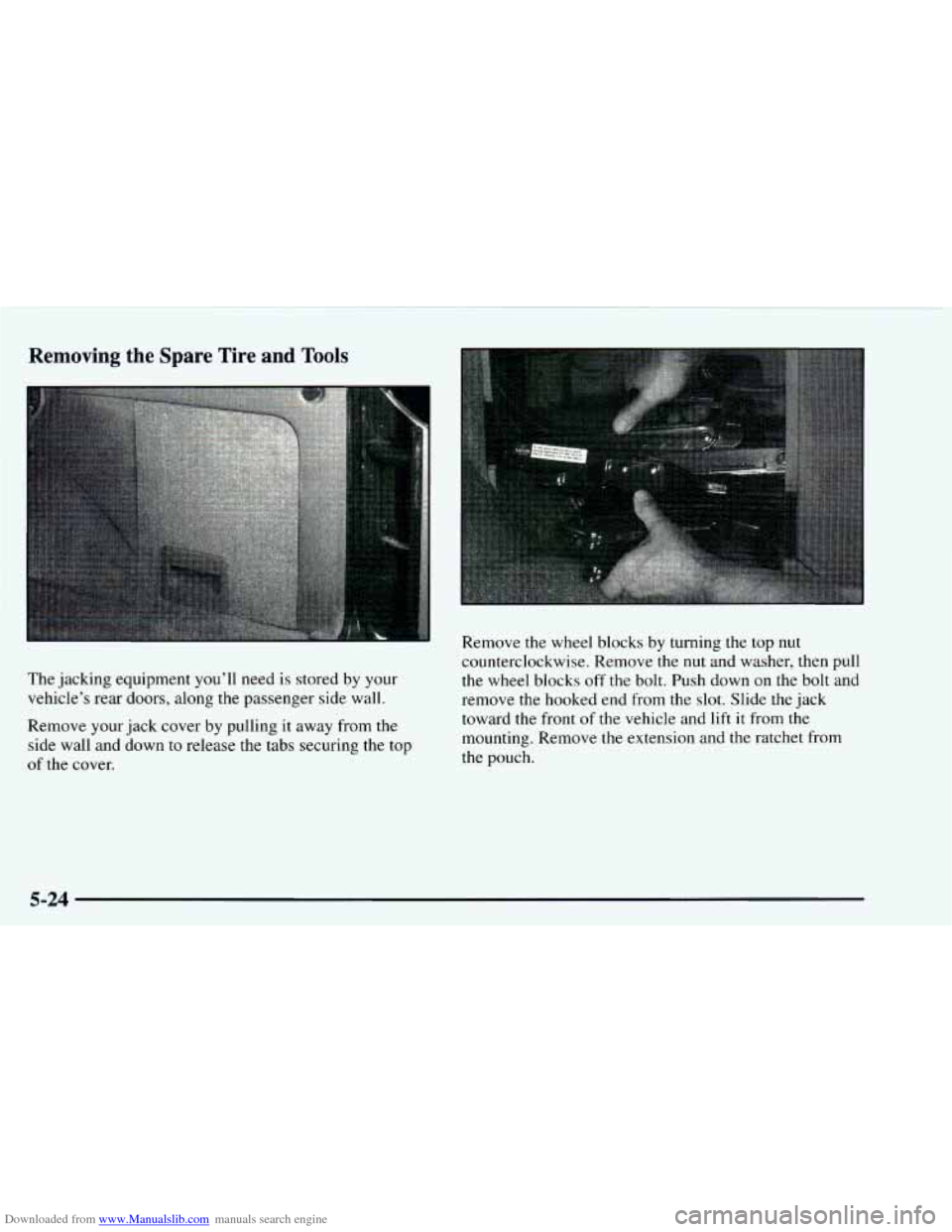
The jacking equipment you’ll need is stored by your
vehicle’s rear doors, along the passenger side wall.
Remove your jack cover by pulling it away from the
side wall and down
to release the tabs securing the top
of the cover. Remove the wheel blocks
by turning the top nut
counterclockwise. Remove the nut and washer, then pull
the wheel blocks off the bolt. Push down on the bolt and
remove
the hooked end from the slot. Slide the jack
toward the front
of the vehicle and lift it from the
mounting. Remove the extension and
the ratchet from
the pouch.
5-24
Page 252 of 404
Downloaded from www.Manualslib.com manuals search engine 3. Put the flat end of the extension on an angle through
the hole in the rear door frame, above the bumper.
Turn the ratchet clockwise until the tire is against the
underside
of the vehicle.
You will feel two “clicks” when the tire is up all the
way. Try
to move the tire with your hands to make
sure it is securely in place.
The compact spare is for temporary use
only. Replace
the compact spare tire with a full-size tire as soon as you
can. See “Compact Spare Tire”
in the Index. See the
storage instructions label to restore your compact
spare properly.
Return the jacking equipment
to its proper location.
I
3
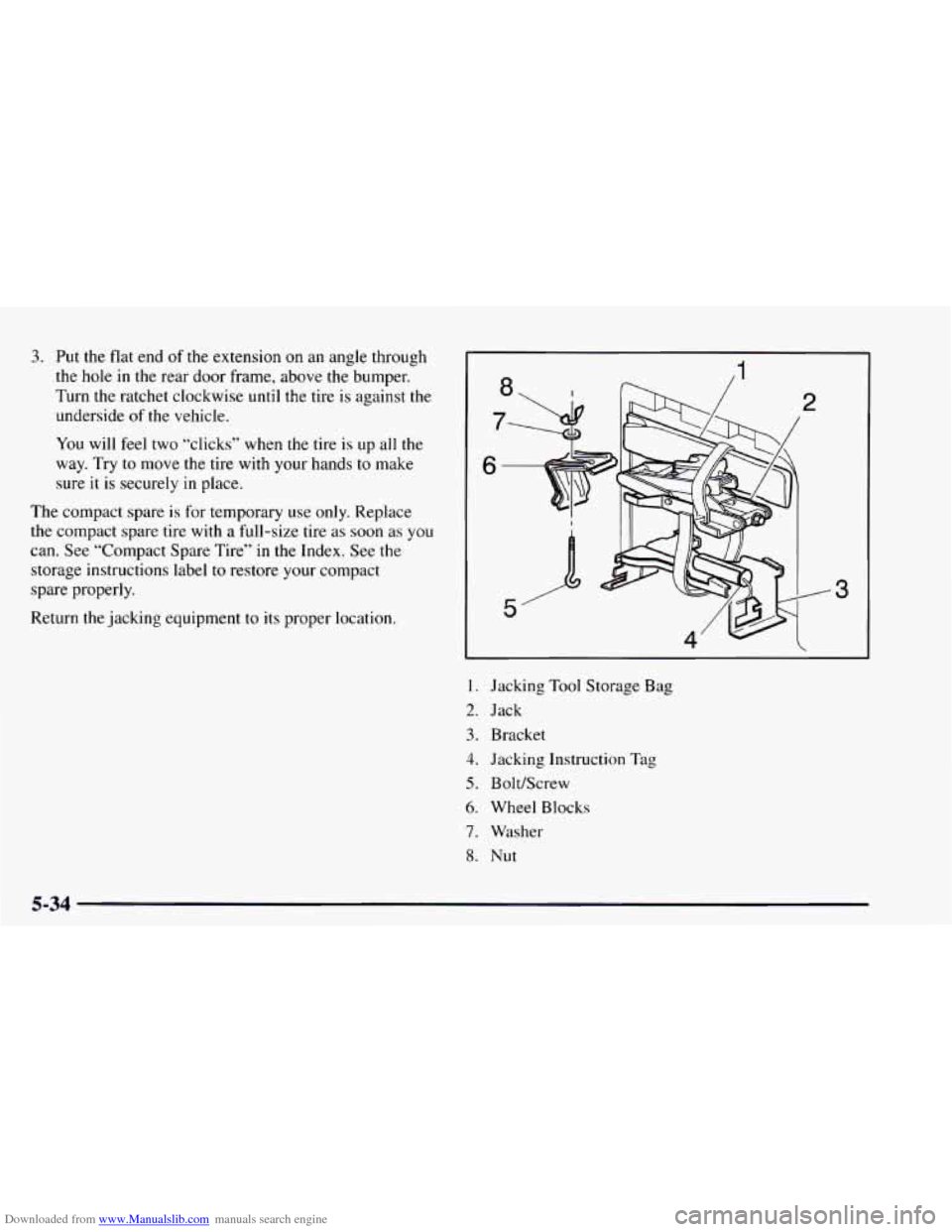
. Jacking Tool Storage Bag
2. Jack
3. Bracket
4. Jacking Instruction Tag
5. Bolt/Screw
6. Wheel Blocks
7. Washer
8. Nut
5-34
Page 271 of 404
Downloaded from www.Manualslib.com manuals search engine Engine Cover
Removing the Engine Cover
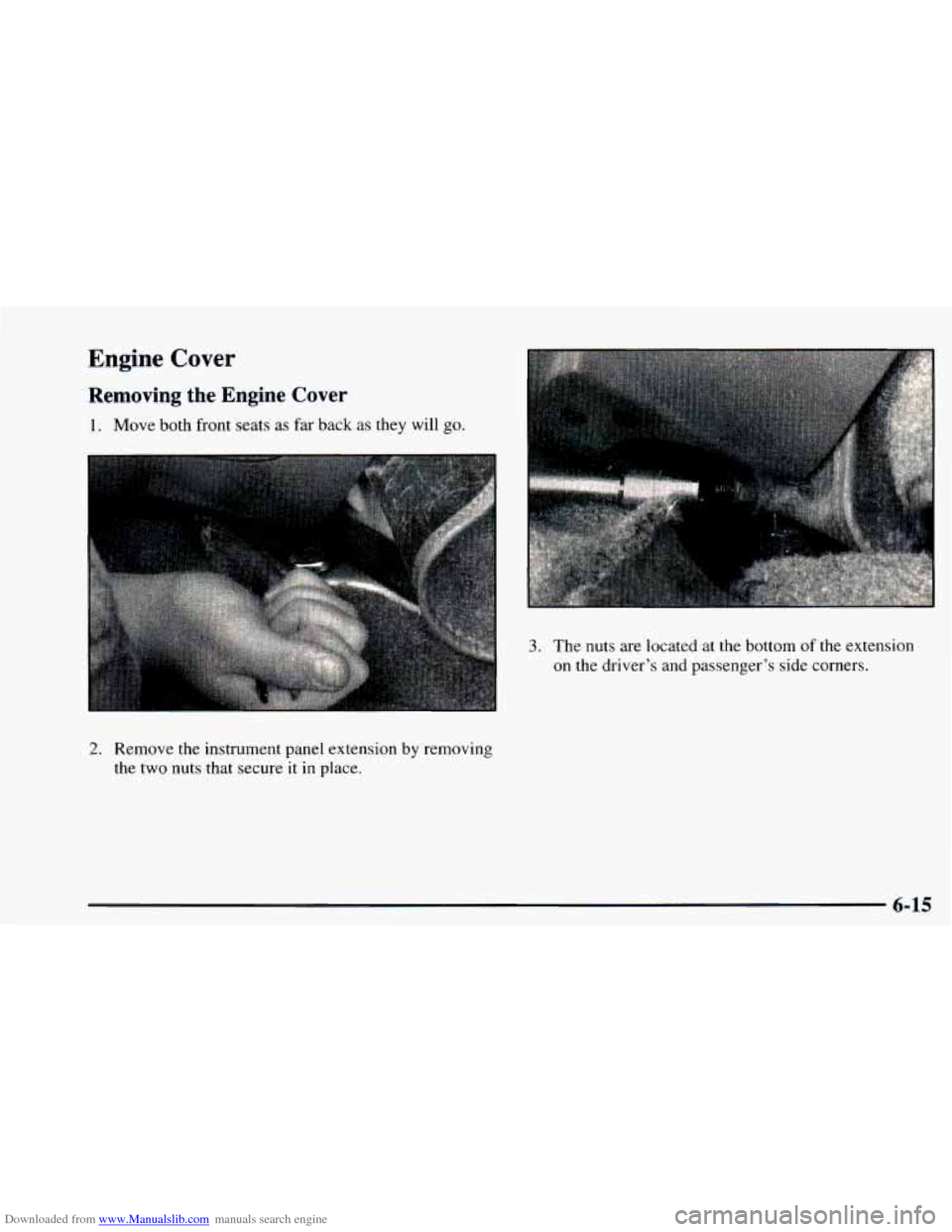
1. Move both front seats as far back as they will go.
2.
Remove the instrument panel extension by removing
the two nuts that secure it in place.
3. The nuts are located at the bottom of the extension
on the driver’s and passenger’s side corners.
6-15
Page 274 of 404
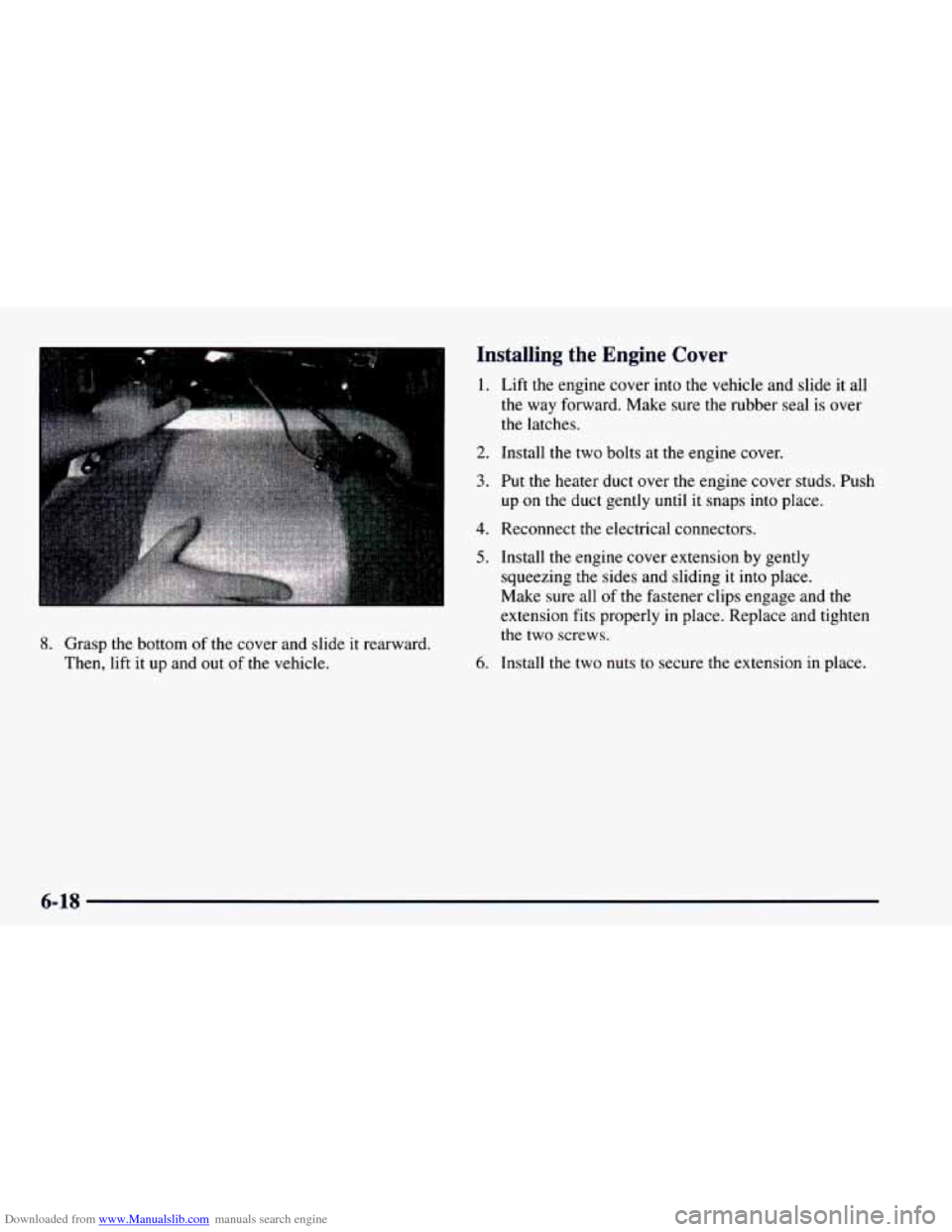
Downloaded from www.Manualslib.com manuals search engine 8. Grasp the bottom of the cover and slide it rearward.
Then, lift it up and out
of the vehicle.
Installing the Engine Cover
1. Lift the engine cover into the vehicle and slide it all
the way forward. Make sure the rubber seal
is over
the latches.
2. Install the two bolts at the engine cover.
3. Put the heater duct over the engine cover studs. Push
up
on the duct gently until it snaps into place.
4. Reconnect the electrical connectors.
5. Install the engine cover extension by gently
squeezing the sides and sliding it into place.
Make sure all of the fastener clips engage and the
extension fits properly in place. Replace and tighten
the two screws.
6. Install the two nuts to secure the extension in place.
6-18
Page 275 of 404
Downloaded from www.Manualslib.com manuals search engine 4ir Cleaner
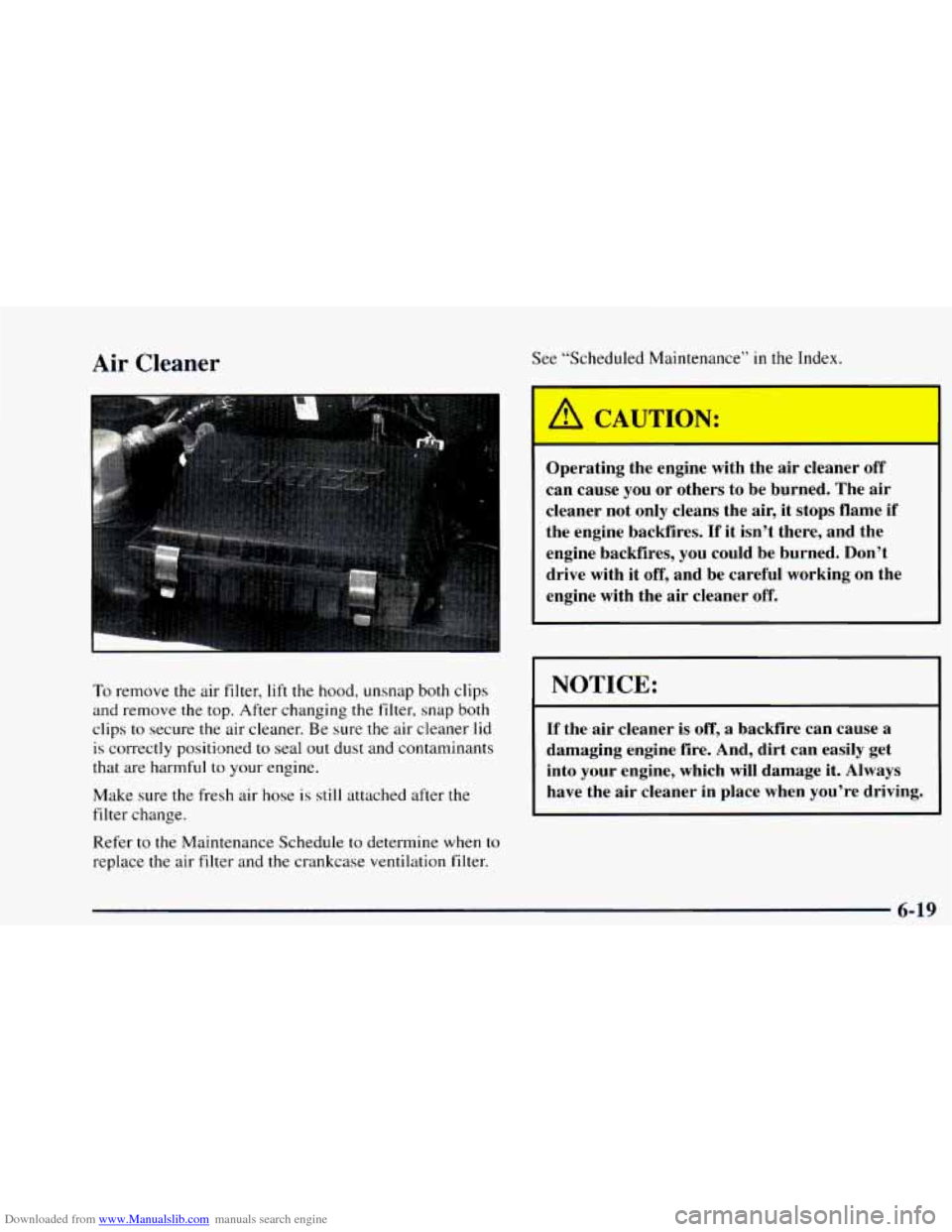
To remove the air filter, lift the hood, unsnap both clips
and remove the top. After changing the filter, snap both
clips to secure the air cleaner. Be sure
the air cleaner lid
is correctly positioned
to seal out dust and contaminants
that are harmful to your engine.
Make sure
the fresh air hose is still attached after the
filter change.
Refer to
the Maintenance Schedule to determine when to
replace the air filter and the crankcase ventilation filter.
See “Scheduled Maintenance” in the Index.
Operating the engine with the air cleaner off
can cause
you or others to be burned. The air
cleaner not only cleans the air, it stops flame if
the engine backfires. If it isn’t there, and the
engine backfires, you could be burned. Don’t
drive with it
off, and be careful working on the
engine with the air cleaner off.
I NOTICE:
If the air cleaner is off, a backfire can cause a
damaging engine fire. And, dirt can easily get
into your engine, which will damage it. Always
have the air cleaner in place when you’re driving.
- 6-19
Page 306 of 404
Downloaded from www.Manualslib.com manuals search engine Tire Chains Appearance Care
Remember, cleaning products can be hazardous. Some
are toxic. Others can burst
into flame if you strike a
match or get them on
a hot part of the vehicle. Some are
dangerous
if you breathe their fumes in a closed space.
When you use anything from
a container to clean your
vehicle, be sure to follow the manufacturer’s warnings
and instructions. And always open your doors
or
windows when you’re cleaning the inside.
Never use these to clean your vehicle:
NOTICE:
If your vehicle has P235/65R15 size tires, don’t
use tire chains. They can damage your vehicle
because there’s not enough clearance.
If you have other size tires, use tire chains only
where legal and only when you must. Use only
SAE Class “S” type chains that are the proper
size for your tires. Install them on the rear axle
tires and tighten them as tightly
as possible with
the ends securely fastened. Drive
slowly and
follow the chain manufacturer’s instructions. If
you can hear the chains contacting your vehicle,
stop and retighten them.
If the contact continues,
slow down until it stops. Driving
too fast or
spinning the wheels with chains on will damage
your vehicle.
0 Gasoline
Benzene
Naphtha
0 Carbon Tetrachloride
0 Acetone
a Paint Thinner
Turpentine
0 Lacquer Thinner
0 Nail Polish Remover
They can
all be hazardous -- some more than
others
-- and they can all damage your vehicle, too.