air condition CHEVROLET ASTRO 2003 User Guide
[x] Cancel search | Manufacturer: CHEVROLET, Model Year: 2003, Model line: ASTRO, Model: CHEVROLET ASTRO 2003Pages: 386, PDF Size: 17.31 MB
Page 262 of 386
Brake Wear
Your vehicle has four-wheel disc brakes,
Disc brake pads have built-in wear indicators that make
a high-pitched warning sound when the brake
pads
are worn and new pads are needed. The sound
may come and go or be heard all the time your vehicle
is moving (except when you are pushing on the
brake pedal firmly).
The brake wear warning sound means that soon
your brakes won’t work well. That could lead to
an accident. When
you hear the brake wear
Notice: Continuing to drive with worn-out brake
pads could result in costly brake repair.
Some driving conditions or climates may cause a brake
squeal when the brakes are first applied or lightly
applied. This does not mean something is wrong with
your brakes.
Properly torqued wheei nuts are necessary to heip
prevent brake pulsation. When tires are rotated, inspect
brake pads for wear and evenly tighten wheel nuts in
the proper sequence to
GM torque specifications.
Brake linings should always be replaced as complete
axle sets.
See
Brake System Inspection on page 6-31.
Brake Pedal Travel
See your dealer if the brake pedal does not return to
normal height, or if there is a rapid increase in
pedal travel. This could be a sign of brake trouble.
Brake Adjustment
Every time you make a brake stop, your disc brakes
adjust for wear.
5-45
Page 286 of 386
Wheel Alignment and Tire Balance If you need to replace any of your wheels, wheel bolts
or wheel nuts, replace them only with new
GM
The wheels on your vehicle were aligned and balanced original
equipment parts. This way, you will be sure to
carefully at the factory to give you the longest tire life have
the right wheel, wheel bolts and wheel nuts for
and best overall performance.
your
vehicle.
Scheduled wheel alignment and wheel balancing are
not needed. However,
if you notice unusual tire wear or
your vehicle pulling one way or the other, the alignment
may need to be reset.
If you notice your vehicle
vibrating when driving on a smooth road, your wheels
may need to be rebalanced.
Wheel Replacement
Replace any wheel that is bent, cracked or badly
rusted or corroded.
If wheel nuts keep coming loose,
the wheel, wheel bolts and wheel nuts should be
replaced. If the wheel leaks air, replace it (except some
aluminum wheels, which can sometimes be repaired).
See your dealer
if any of these conditions exist.
Your dealer will know the kind of wheel you need.
Each new wheel should have the same load-carrying
capacity, diameter, width, offset and be mounted
the same way as the one it replaces. the wrong replacement wheels, wheel
bolts or wheel nuts on your vehicle can be
dangerous.
It could affect the braking and
handling of your vehicle, make your tires lose
air and make you lose control. You could have
a collision
in which you or others could be
injured. Always use the correct wheel, wheel
bolts and wheel nuts for replacement.
Notice: The wrong wheel can also cause problems
with bearing life, brake cooling, speedometer or
odometer calibration, headlamp aim, bumper height,
vehicle ground clearance and tire or tire chain clearance to the body and chassis.
See
Changing a Flat Tire on page 5-71 for more
information.
-~
5-69
Page 306 of 386
Underbody Maintenance
Chemicals used for ice and snow removal and dust
control can collect on the underbody.
If these are not
removed, accelerated corrosion (rust} can occur on
the underbody parts such as fuel lines, frame, floor pan
and exhaust system even though they have corrosion
protection.
At least every spring, flush these materials from the
underbody with plain water. Clean any areas where mud
and debris can collect. Dirt packed in close areas of
the frame should be loosened before being flushed.
Your dealer or an underbody car washing system can
do this for you.
Chemical Paint Spotting
Some weather and atmospheric conditions can create a
chemical fallout. Airborne pollutants can fall upon and
attack painted surfaces on your vehicle. This damage can
take two forms; blotchy, ringlet-shaped discolorations,
and small irregular dark spots etched into the paint
surface.
Although no defect in the paint job causes this, GM will
repair, at no charge to the owner, the surfaces of
new vehicles damaged by this fallout condition within
12 months or 12,000 miles (20 000 km) of purchase,
whichever occurs first.
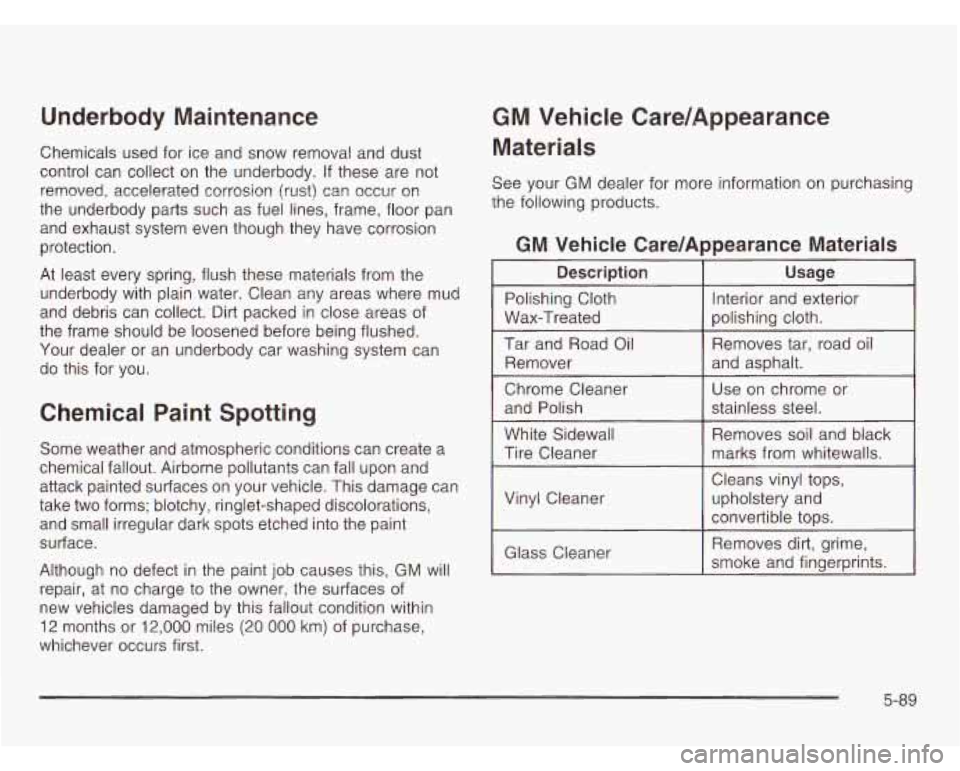
GM Vehicle Care/Appearance
Materials
See your GM dealer for more information on purchasing
the following products.
GM Vehicle Care/Appearance Materials
Descrbtion Usaae I
Polishing Cloth
Dolishina cloth.
Wax-Treated Interior and exterior
Tar and Road Oil
and asPhalt.
Remover Removes
tar, road oil
Chrome Cleaner
stainless steel.
and Polish Use on chrome or
White Sidewall
marks from whitewalls.
Tire Cleaner Removes
soil and black
Vinyl Cleaner Cleans
vinyl tops,
upholstery and
convertible tom.
Glass Cleaner Removes
dirt, grime,
smoke and finaerprints.
5-89
Page 312 of 386
13
14
15
16
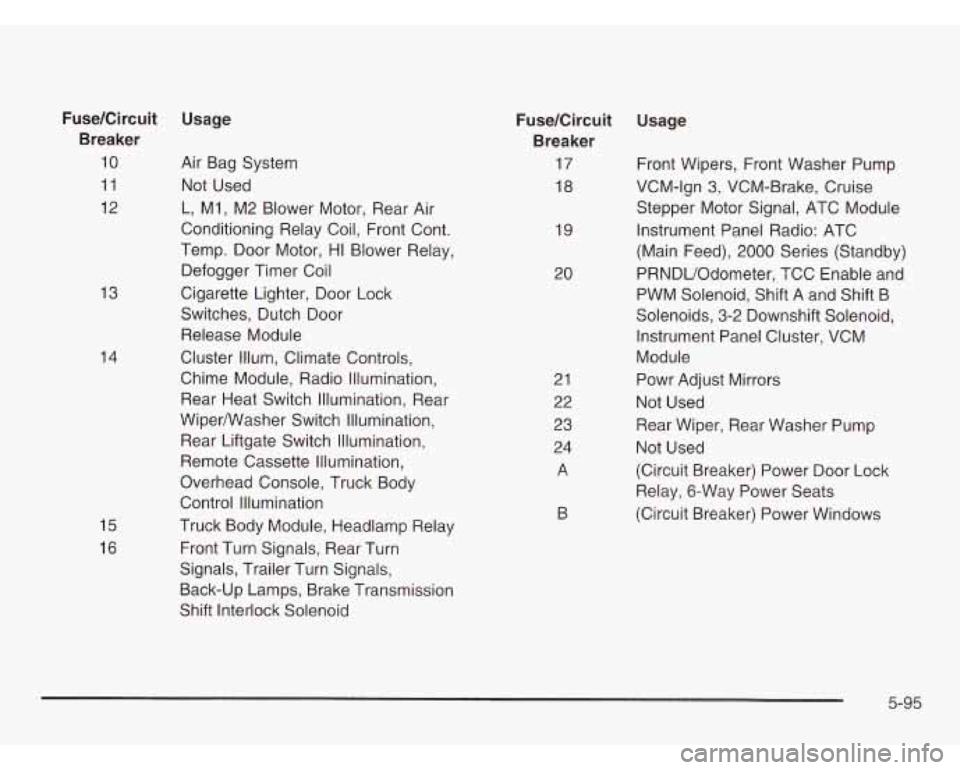
Fuse/Circuit Usage Breaker
10 Air Bag System
11 Not Used
12 L, MI, M2 Blower Motor, Rear Air
Conditioning Relay Coil, Front Cont.
Temp. Door Motor, HI Blower Relay.
Defogger Timer Coil
Cigarette Lighter, Door Lock
Switches, Dutch Door Release Module
Cluster Illum, Climate Controls,
Chime Module, Radio Illumination,
Rear Heat Switch Illumination, Rear
Wipermasher Switch Illumination,
Rear Liftgate Switch Illumination,
Remote Cassette Illumination,
Overhead Console, Truck Body
Control Illurnination
Truck Body Module, Headlamp Relay
Front Turn Signals, Rear Turn
Signals, Trailer Turn Signals,
Back-up Lamps, Brake Transmission
Shift Interlock Solenoid 21
22
23
24
A
19
20
FuseKircuit
Usage
Breaker
17 Front Wipers, Front Washer Pump
18 VCM-lgn
3, VCM-Brake, Cruise
Stepper Motor Signal, ATC Module
Instrument Panel Radio: ATC
(Main Feed),
2000 Series (Standby)
PRNDUOdometer, TCC Enable and
PWM Solenoid, Shift A and Shift B
Solenoids, 3-2 Downshift Solenoid, Instrument Panel Cluster, VCM
Module
Powr Adjust Mirrors
Not Used
Rear Wiper, Rear Washer Pump
Not Used
(Circuit Breaker) Power Door Lock
Relay, 6-Way Power Seats
(Circuit Breaker) Power Windows
B
5-95
Page 314 of 386
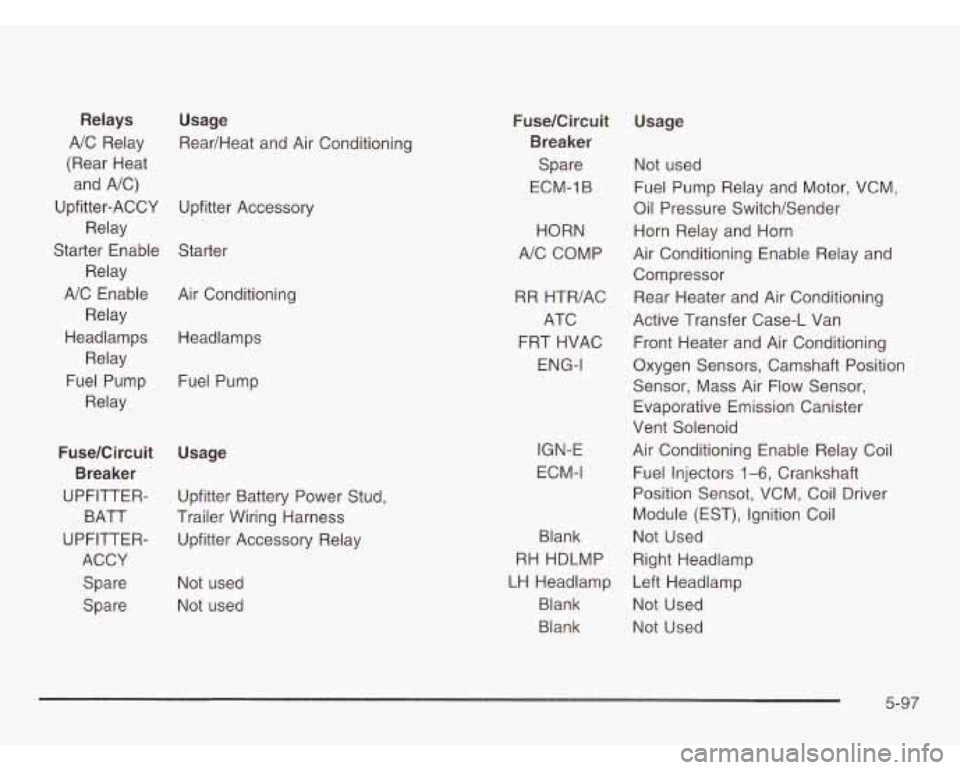
Usage
Rear/Heat and Air Conditioning
Relays
AIC Relay
(Rear Heat
and AIC)
Relay
Relay
A/C Enable
Relay
Upfitter-ACCY
Upfitter Accessory
Starter Enable Starter
Headlamps Relay
Fuel Pump
Relay Air
Conditioning
Headlamps
Fuel Pump
FuselCircuit
Usage
UPFITTER- Upfitter Battery Power Stud,
BATT Trailer Wiring Harness
UPFITTER- Upfitter Accessory Relay
ACCY
Spare Not used
Spare Not used
Breaker FuselCircuit
Breaker
Spare
ECM-1 B
HORN
AIC COMP
RR HTR/AC ATC
FRT HVAC
ENG-I
IGN-E
ECM-I
Blank
RH HDLMP
LH Headlamp
Blank
Blank
Usage
Not used
Fuel Pump Relay and Motor, VCM,
Oil Pressure Switch/Sender
Horn Relay and Horn
Air Conditioning Enable Relay and
Compressor
Rear Heater and Air Conditioning
Active Transfer Case-L Van
Front Heater and Air Conditioning
Oxygen Sensors, Camshaft Position
Sensor, Mass Air Flow Sensor,
Evaporative Emission Canister
Vent Solenoid
Air Conditioning Enable Relay Coil
Fuel Injectors
1-6, Crankshaft
Position Sensot, VCM, Coil Driver
Module (EST), Ignition Coil
Not Used
Right Headlamp
Left Headlamp
Not Used
Not Used
5-97
Page 315 of 386
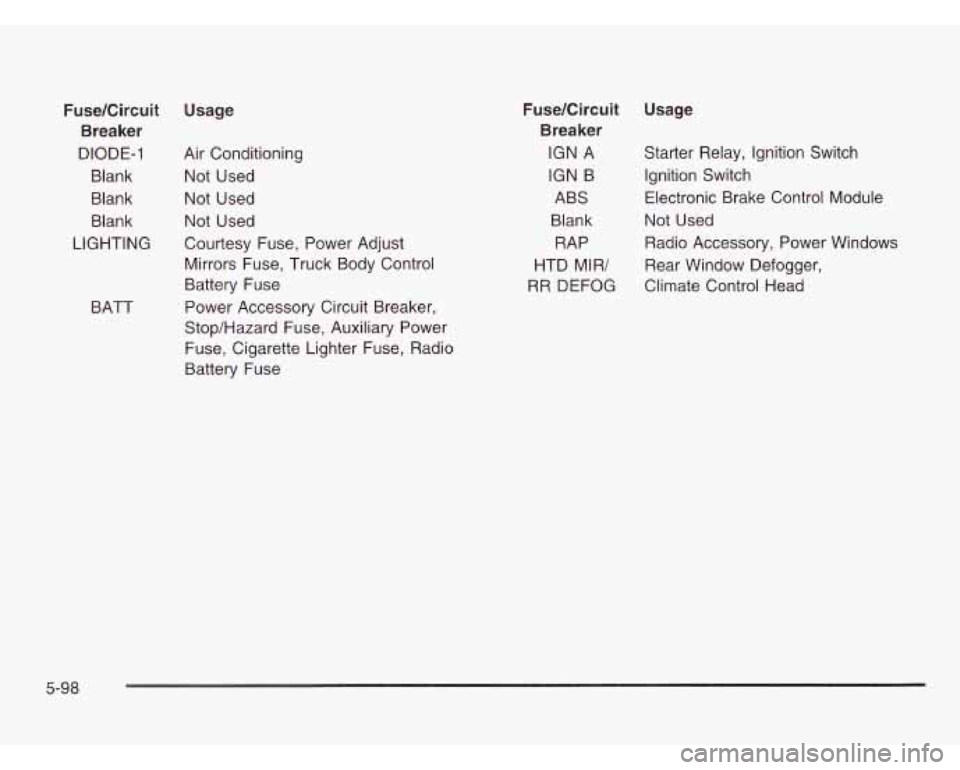
Fuse/Circuit Usage
Breaker
DIODE-I Air Conditioning
Blank Not Used
Blank
Not Used
Blank Not Used
LIGHTING Courtesy Fuse, Power Adjust
Mirrors Fuse, Truck Body Control
Battery Fuse
Power Accessory Circuit Breaker,
Stop/Hazard Fuse, Auxiliary Power
Fuse, Cigarette Lighter Fuse, Radio
Battery Fuse
BATT
Fuse/Circuit
Breaker
IGN A
IGN
B
ABS
Blank RAP
HTD MIRI
RR DEFOG
Usage
Starter Relay, Ignition Switch
Ignition Switch
Electronic Brake Control Module
Not Used Radio Accessory, Power Windows
Rear Window Defogger,
Climate Control Head
5-98
Page 321 of 386
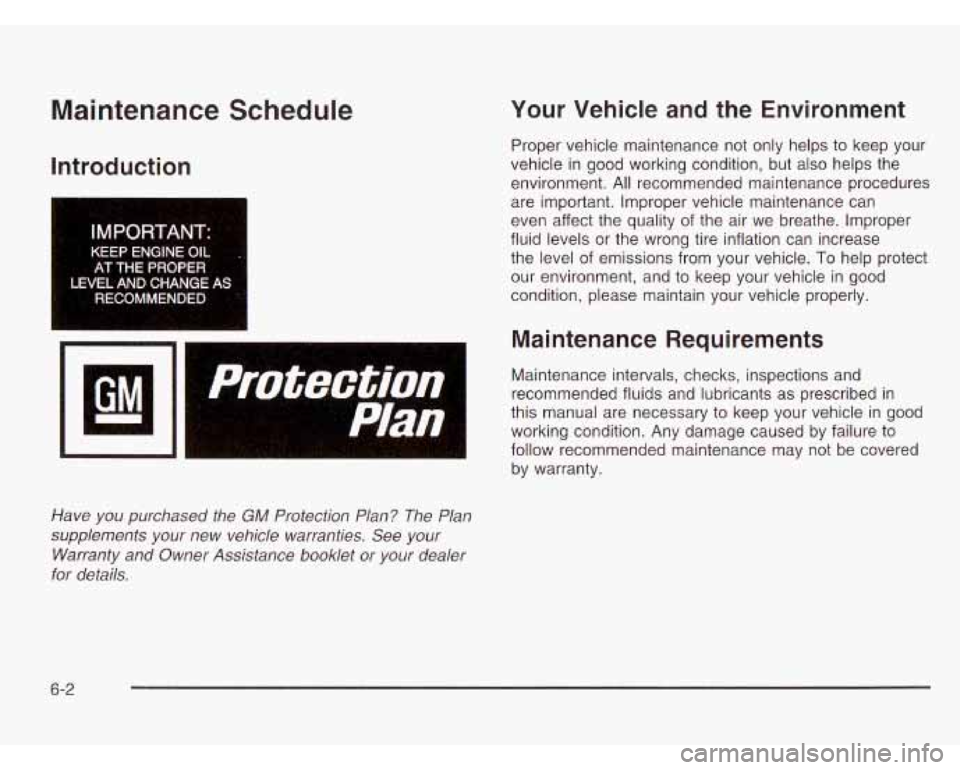
Maintenance Schedule
Introduction
IMPORTANT-
KEEP ENGINE C ~~
AT THE PROPER
1 LEVEL AND CHANGE AS 1
RECOMMENDED
Have you purchased the GM Protection Plan? The Plan
supplements your new vehicle warranties. See your
Warranty and Owner Assistance booklet or your dealer
for details.
Your Vehicle and the Environment
Proper vehicle maintenance not only helps to keep your
vehicle in good working condition, but also helps the
environment.
All recommended maintenance procedures
are important. Improper vehicle maintenance can
even affect the quality
of the air we breathe. Improper
fluid levels or the wrong tire inflation can increase
the level
of emissions from your vehicle. To help protect
our environment, and to keep your vehicle in good
condition, please maintain your vehicle properly.
Maintenance Requirements
Maintenance intervals, checks, inspections and
recommended fluids and lubricants as prescribed in
this manual are necessary to keep your vehicle in good
working condition. Any damage caused by failure to
follow recommended maintenance may not be covered
by warranty.
6-2
Page 322 of 386
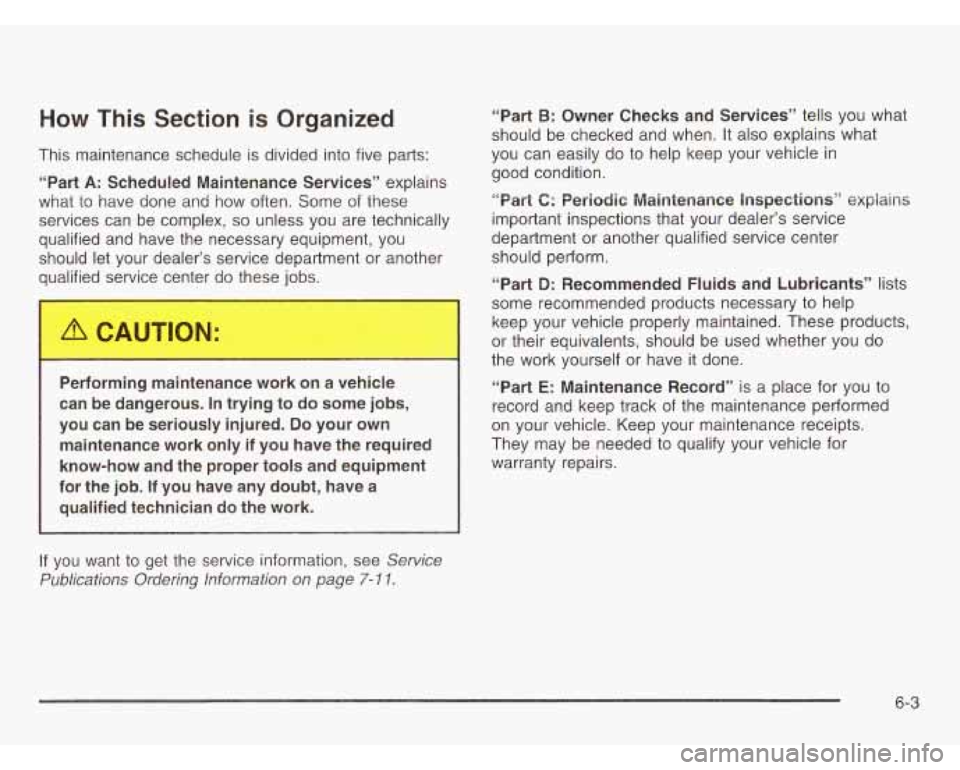
How This Section is Organized
This maintenance schedule is divided into five parts:
“Part
A: Scheduled Maintenance Services” explains
what to have done and how often. Some of these
services can be complex,
so unless you are technically
qualified and have the necessary equipment, you
should let your dealer’s service department or another
qualified serIine center do these
jobs.
Performing maintenance work on a vehicle
can be dangerous. In trying to do some jobs,
you can be seriously injured.
Do your own
maintenance work only if you have the required
know-how and the proper tools and equipment
for the job.
If you have any doubt, have a
qualified technician do the work. “Part
B: Owner Checks and Services”
tells you what
should be checked and when.
It also explains what
you can easily do to help keep your vehicle
in
good condition.
“Part C: Periodic Maintenance Inspections” explains
important inspections that your dealer’s service
department or another qualified service center
should perform.
“Part
D: Recommended Fluids and Lubricants” lists
some recommended products necessary to help
keep your vehicle properly maintained. These products,
or their equivalents, should be used whether you do
the work yourself or have
it done.
“Part
E: Maintenance Record” is a place for you to
record and keep track
of the maintenance performed
on your vehicle. Keep your maintenance receipts.
They may be needed to qualify your vehicle for
warranty repairs.
If you want to get the service information, see Service
Publications Ordering Information
on page 7- I 1.
6-3
Page 323 of 386
Part A: Scheduled Maintenance
Services
In this part are scheduled maintenance services which
are to be performed at the mileage intervals specified.
Using Your Maintenance Schedule
We at General Motors want to help you to keep
your vehicle in good working condition. But we don’t
know exactly how you’ll drive it. You may drive
short distances only a few times a week. Or you may
drive long distances all the time in very hot, dusty
weather. You may use your vehicle in making deliveries.
Or you may drive it to work, to do errands or in many
other ways.
Because of all the different ways people use their
vehicles, maintenance needs vary. You may need more
frequent checks and replacements.
So please read
the following and note how you drive.
If you have any
questions on how to keep your vehicle in good condition,
see your dealer. This part tells
you the maintenance services you should
have done and when you should schedule them.
When you go to your dealer for your service needs,
you’ll know that GM-trained and supported sewice
people will perform the work using GM parts.
The proper fluids and lubricants to use are listed in
Part D. Make sure whoever services your vehicle uses
them.
All parts should be replaced and all necessary
repairs done before you or anyone else drives the
vehicle.
These schedules are for vehicles that:
carry passengers and cargo within recommended
limits. You will find these limits on your vehicle’s
CertificationRire label. See
Loading Your Vehicle
on page
4-29.
are driven on reasonable road surfaces within
driving limits.
use the recommended fuel. See Gasoline Octane
on page
5-5.
6-4
Page 324 of 386
Selecting the Right Schedule
First you’ll need to decide which of the two schedules
is right for your vehicle. Here’s how to decide which
schedule to follow:
Short Trip/City Definition
Follow the Short Trip/City Scheduled Maintenance if any
one of these conditions is true for your vehicle:
e
e
e
e
Most trips are less than 5 miles (8 km). This is
particularly important when outside temperatures
are below freezing.
Most trips include extensive idling (such as frequent
driving in stop-and-go traffic).
You frequently tow a trailer or use a carrier on top
of your vehicle.
If the vehicle is used for delivery service, police,
taxi or other commercial application.
One of the reasons you should follow this schedule if
you operate your vehicle under any of these conditions
is that these conditions cause engine oil to break
down sooner.
Short Trip/City Intervals
Every 3,000 Miles (5 000 km): Engine Oil and Filter
Change (or
3 months, whichever occurs first). Chassis
Lubrication (or
3 months, whichever occurs first).
Drive Axle Fluid Check.
Every 6,000 Miles (IO 000 km): Tire Rotation.
Every 15,000 Miles (25 000 km): Engine Air
Cleaner Filter Inspection,
if driving in dusty conditions.
Front Wheel Bearing Repack (two-wheel drive only)
(or at each brake relining, whichever occurs first).
Automatic Transmission Service (severe conditions only).
Every 30,000 Miles (50 000 km): Engine Air Cleaner
Filter Replacement. Fuel Filter Replacement.
Every 50,000 Miles (83 000 km): Automatic
Transmission Service (normal conditions).
Transfer Case Fluid Change.
Every 100,000 Miles (166 000 km): Spark Plug Wire
Inspection. Spark Plug Replacement. Positive
Crankcase Ventilation (PCV) Valve Inspection.
Every 150,000 Miles (240 000 km): Cooling System
Service (or every
60 months, whichever occurs
first). Engine Accessory Drive Belt Inspection.
These intervals only summarize maintenance services.
Be sure to follow the complete scheduled maintenance
on the following pages.
6-5