heating CHEVROLET ASTRO 2003 User Guide
[x] Cancel search | Manufacturer: CHEVROLET, Model Year: 2003, Model line: ASTRO, Model: CHEVROLET ASTRO 2003Pages: 386, PDF Size: 17.31 MB
Page 245 of 386
Engine Coolant
The cooling system in your vehicle is filled with
DEX-COOL@ engine coolant. This coolant is designed
to remain in your vehicle for 5 years or 150,000 miles
(240
000 km), whichever occurs first, if you add
only DEX-COOL@ extended life coolant.
The following explains your cooling system and how to
add coolant when it
is low. If you have a problem
with engine overheating, see
Engine Overheating on
page
5-3 I.
A 50/50 mixture of clean, drinkable water and
DEX-COOL@ coolant will:
Give freezing protection down to -34°F (-37°C).
Give boiling protection up to 265°F (129°C).
Protect against rust and corrosion.
Help keep the proper engine temperature.
Let the warning lights and gages work as they
should.
Notice: When adding coolant, it is important that
you use only
DEX-COOL@ (silicate-free) coolant.
If coolant other than DEX-COOL@
is added to the
system, premature engine, heater core or radiator
corrosion may result.
In addition, the engine coolant
will require change sooner
- at 30,000 miles
(50,000 km) or 24 months, whichever occurs first. Damage
caused by the use
of coolant other than
DEX-COOL@
is not covered by your new vehicle
warranty.
What to Use
Use a mixture of one-half clean, drinkable water and
one-half DEX-COOL@ coolant which won’t damage
aluminum parts.
If you use this coolant mixture,
you don’t need to add anything else.
Adding only plain water to your cooling
system can be dangerous. Plain water, or
some other liquid such as alcohol, can boil
before the proper coolant mixture will. Your
vehicle’s coolant warning system is set for the
proper coolant mixture.
With plain water or the
wrong mixture, your engine could get too hot but you wouldn’t get the overheat warning.
Your engine could catch fire and you or others could be burned. Use a
50/50 mixture of clean,
drinkable water and the proper coolant.
5-28
Page 247 of 386
Add coolant mixture at the recovery tank, but be careful
not to
mill it.
You can be burned if you
spill coolant on hot
engine parts. Coolant contains ethylene glycol, and
it will burn if the engine parts are hot
Radiator Pressure Cap
Occasionally check the coolant level in the radiator.
For information on how to add coolant to the radiator,
see
Cooling System on page 5-33.
A L
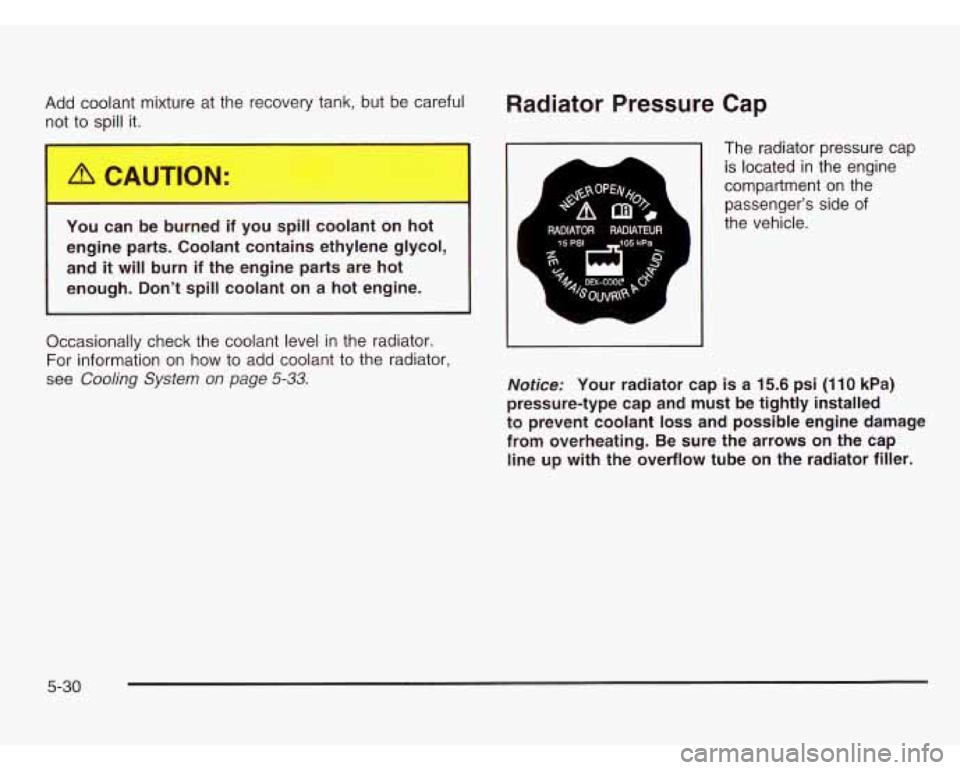
The radiator pressure cap is located in the engine
compartment on the
passenger's side of
the vehicle.
Notice: Your radiator cap is a 15.6 psi (1 10 kPa)
pressure-type cap and must be tightly installed
to prevent coolant
loss and possible engine damage
from overheating. Be sure the arrows on the cap
line up with the overflow tube on the radiator filler.
5-30
Page 248 of 386
Engine Overheating
You will find an engine coolant temperature gage on
your vehicle’s instrument panel. See Engine Coolant
Temperature Gage on page 3-30.
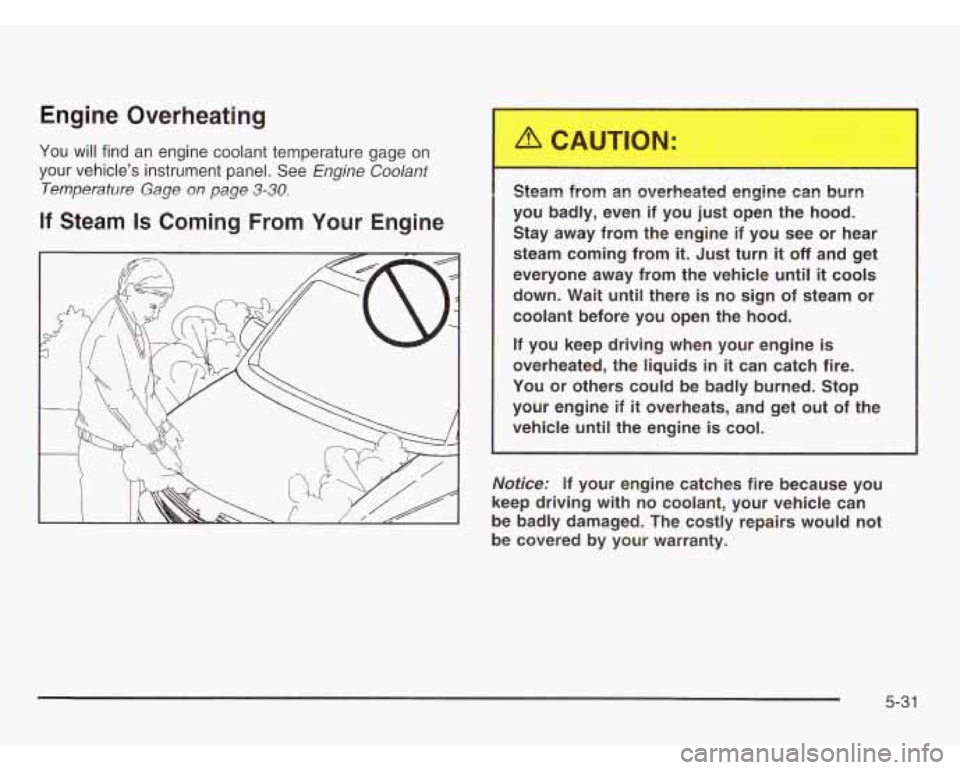
If Steam Is Coming From Your Engine
Sean, ,ram an overheated engine can burn
you badly, even if you just open the hood. Stay away from the engine if you see or hear
steam coming from
it. Just turn it off and get
everyone away from the vehicle
until it cools
down. Wait until there
is no sign of steam or
coolant before you open the hood.
If you keep driving when your engine
is
overheated, the liquids in it can catch fire.
You or others could be badly burned. Stop
your engine if
it overheats, and get out of the
vehicle
until the engine is cool.
Notice: If your engine catches fire because you
keep driving with no coolant, your vehicle can
be badly damaged. The costly repairs would not
be covered by your warranty.
5-31
Page 280 of 386
Tires
Your new vehicle comes with high-quality tires made by
a leading tire manufacturer.
If you ever have questions
about your tire warranty
and where to obtain service,
see your GMC Warranty booklet for details.
Poorl! lail -Jned anc. ..nproy-. ly used tires
are dangerous.
Overloading your tires can cause
overheating as a result of too much
friction. You could have an air-out and a
serious accident. See “Loading Your
Vehicle” in the Index.
CAUTION: (Continued)
0 Underinflated tires pose the same danger
as overloaded tires. The resulting accident
could cause serious injury. Check
all tires
frequently to maintain the recommended pressure. Tire pressure should be checked
when your tires are cold.
Overinflated tires are more likely to be
cut, punctured or broken by
a sudden
impact
- such as when you hit a pothole.
Keep tires at the recommended pressure.
Worn, old tires can cause accidents.
If your tread
is badly worn, or if your tires
have been damaged, replace them.
5-63
Page 370 of 386
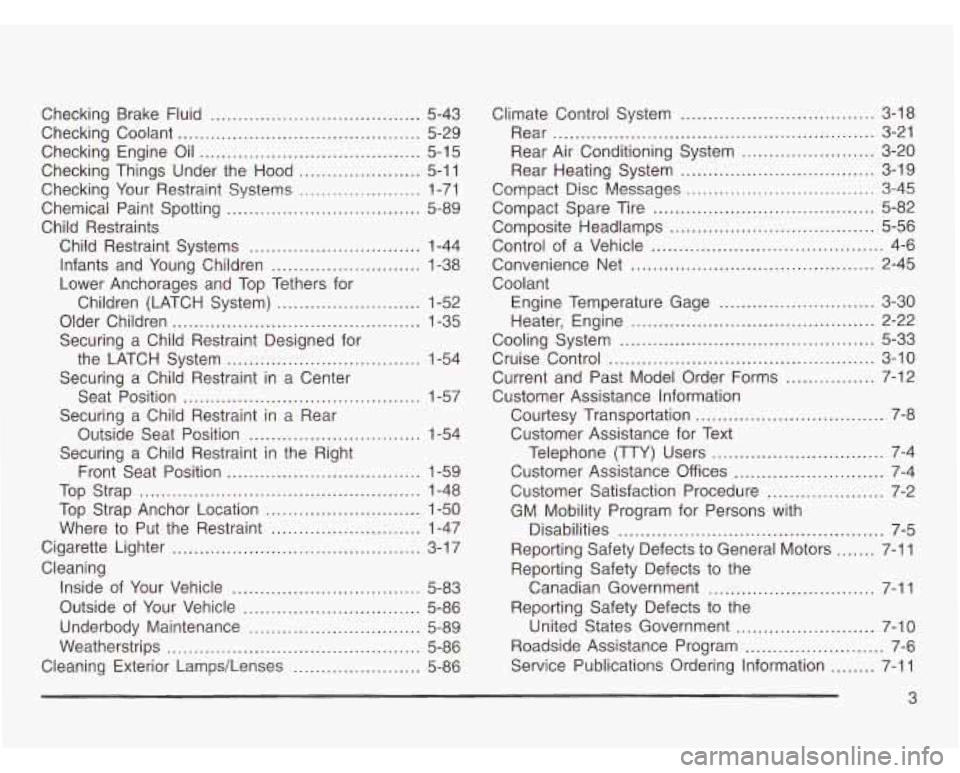
Checking Brake Fluid .................................. 5-43
Checking Coolant ............................................ 5-29
Checking Engine Oil ........................................ 5-15
Checking Things Under the Hood ...................... 5-1 1
Checking Your Restraint Systems ...................... 1-71
Chemical Paint Spotting ................................... 5-89
Child Restraints
Child Restraint Systems
............................... 1-44
Infants and Young Children ........................... 1-38
Lower Anchorages and Top Tethers for
Children (LATCH System)
.......................... 1-52
Older Children ............................................. 1-35
Securing a Child Restraint Designed for
the LATCH System
................................ 1-54
Securing a Child Restraint in a Center
Seat Position
....................................... 1-57
Securing a Child Restraint in a Rear
Outside Seat Position
............................... 1-54
Securing a Child Restraint in the Right
Front Seat Position
................................... 1-59
Top Strap ................................................... 1-48
Top Strap Anchor Location ............................ 1-50
Where to Put the Restraint ........................... 1-47
Cigarette Lighter ............................................. 3-1 7
Cleaning
Inside of Your Vehicle
.................................. 5-83
Outside of Your Vehicle ................................ 5-86
Underbody Maintenance ............................... 5-89
Weatherstrips .............................................. 5-86
Cleaning Exterior Lamps/Lenses ....................... 5-86
Climate Control System ................................... 3-18
Rear .......................................................... 3-21
Rear Heating System ................................... 3-19
Compact Disc Messages .................................. 3-45
Compact Spare Tire ........................................ 5-82
Composite Headlamps ..................................... 5-56
Control of a Vehicle .......................................... 4-6
Convenience Net ............................................ 2-45
Coolant
Engine Temperature Gage
............................ 3-30
Heater, Engine ............................................ 2-22
Cooling System .............................................. 5-33
Cruise Control ................................................ 3-10
Current and Past Model Order Forms ................ 7-12
Customer Assistance Information
Customer Assistance for Text
Customer Assistance
Off ices ........................... 7-4
Customer Satisfaction Procedure ..................... 7-2
GM Mobility Program for Persons with
Disabilities
................................................ 7-5
Reporting Safety Defects to General Motors ....... 7-11
Reporting Safety Defects to the
Canadian Government
.............................. 7-11
Reporting Safety Defects to the United States Government
......................... 7-10
Roadside Assistance Program ......................... 7-6
Service Publications Ordering Information ........ 7-11
Rear Air Conditioning System ........................ 3-20
Courtesy Transportation ......... ...... 7-8
Telephone (TTY) Users ............................... 7-4
3
Page 371 of 386
Daytime Running Lamps (DRL) ...................... 3-14
Defensive Driving
............................................. 4-2
Defogging and Defrosting
................................. 3-1 9
Directing the Airflow
........................................ 3-20
Disabling the Theft-Deterrent Feature
................. 3-49
Doing Your Own Service Work
........................... 5-3
Dome Lamps
.......................................... ~ ~~~ 3-16
Door Front Doors
............................................... 2-8
Locks
.......................................................... 2-7
Power Door Locks
......................................... 2-8
Programmable Automatic Door Locks
............... 2-9
Rear Doors
................................................. 2-13
Sliding Side Door
........................................ 2-10
Position, Safety Belt
..................................... 1-1 8
Driver Information System
................................ 2-42
At Night
..................................................... 4-14
City
........................................................... 4-19
Defensive
..................................................... 4-2
Drunken
....................................................... 4-3
Freeway
..................................................... 4-20
Hill and Mountain Roads
.............................. 4-22
In Rain and on Wet Roads ........................... 4-16
Winter
........................................................ 4-24
Driving On Grades
.......................................... 4-39
Driving on Snow or Ice
.................................... 4-24
Driver
Driving Driving
Through Deep Standing Water
............... 4-18
Driving Through Flowing Water
......................... 4-18
Driving with a Trailer
....................................... 4-37
E
Electrical System
Add-on Equipment
...................................... 5-92
Headlamp Wiring
......................................... 5-92
Fuses and
Circuit Breakers
........................... 5-93
Power Windows and Other Power Options
......... 5-92
Windshield Wiper Fuses
............................... 5-92
Emissions Inspection and
Engine Maintenance Programs
................................. 3-33
Air Cleaner/Filter
......................................... 5-24
Battery
....................................................... 5-46
Check and Service Engine Soon Light
............ 3-30
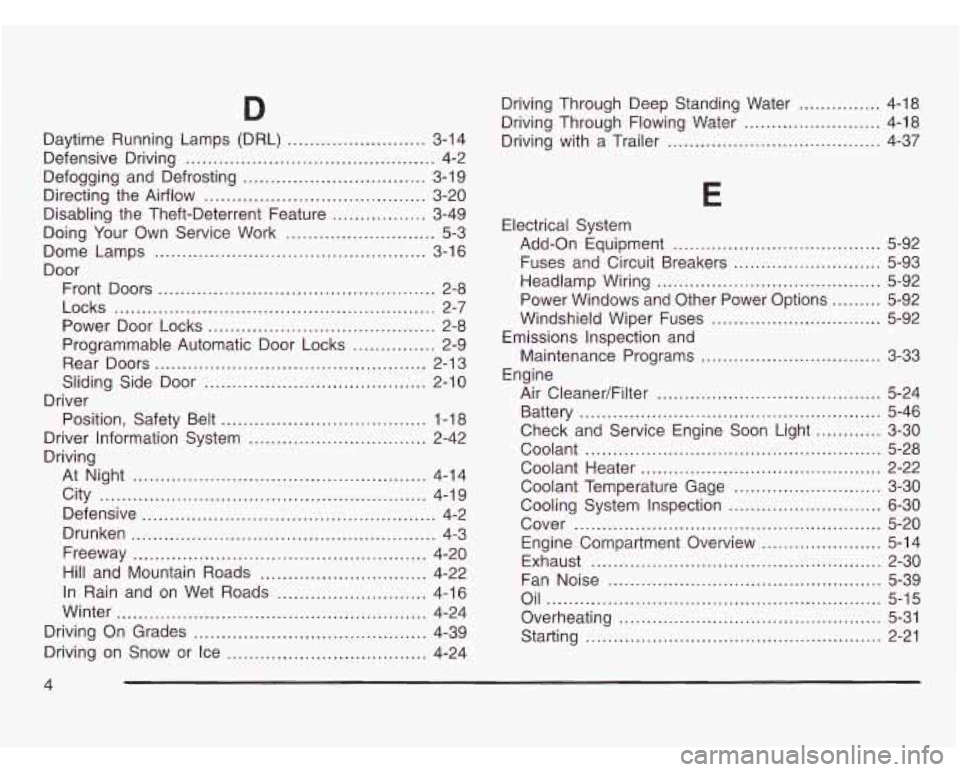
Coolant
...................................................... 5-28
Coolant Heater
............................................ 2-22
Coolant Temperature Gage
........................... 3-30
Cooling System Inspection
............................ 6-30
Cover
........................................................ 5-20
Engine Compartment Overview
...................... 5-14
Exhaust
..................................................... 2-30
Fan Noise
.................................................. 5-39
Oil
............................................................. 5-15
Starting
...................................................... 2-21
Overheating
................................................ 5-31
4
Page 377 of 386
Power Steering ................................................ 4-9
Programming the HomeLink Transmitter
............. 2-35
Programmable Automatic Door Locks
.................. 2-9
Q
Questions and Answers About
Safety Belts ......... 1-17
R
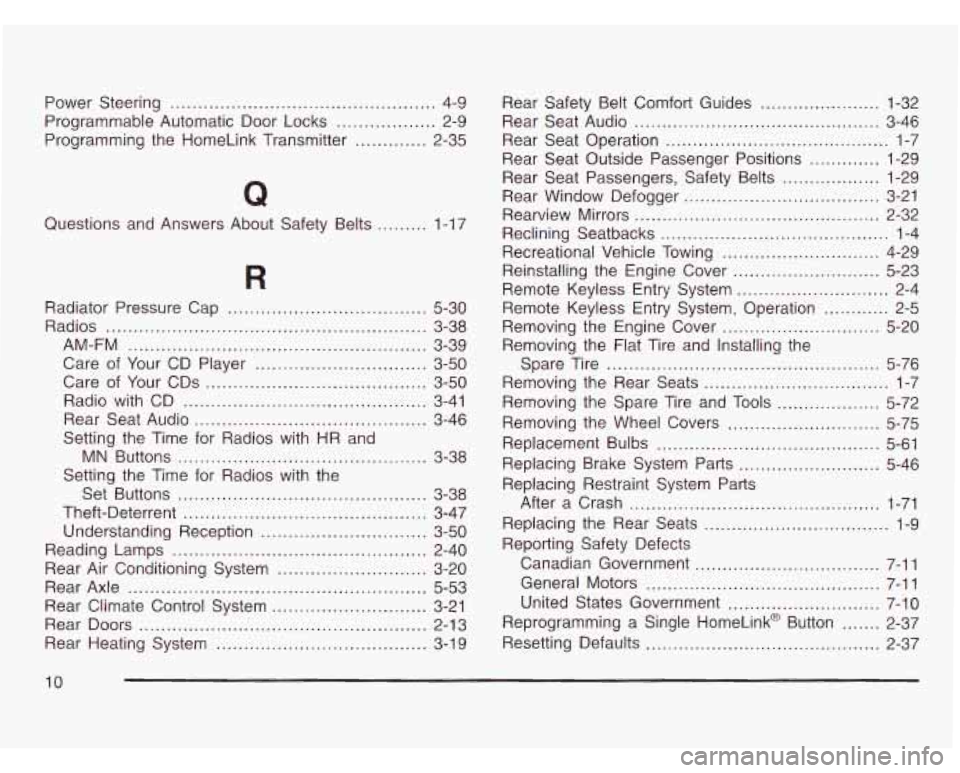
Radiator Pressure Cap ................. ............ 5-30
Radios
....................................... ............ 3-38
AM-FM
....................................... ........ 3-39
Care of Your CD Player
........................... 3-50
Care of Your CDs
.................................... 3-50
Radio with CD
............................................ 3-41
Rear Seat Audio
.......................................... 3-46
Setting the Time for Radios with HR and
MN Buttons
......................................... 3-38
Setting the Time for Radios with the
Set Buttons
............................. ........ 3-38
Theft-Deterrent
........................ ........ 3-47
Understanding Reception
.......................... 3-50
Reading Lamps
.............................................. 2-40
Rear Air Conditioning System
........................... 3-20
Rear Axle
...................................................... 5-53
Rear Climate Control System
............................ 3-21
Rear Doors
.................................................... 2-13
Rear Heating System
...................................... 3-19 Rear
Rear
Rear Rear
Rear
Rear Safety Belt
Comfort Guides
...................... 1-32
Seat Audio
............................................. 3-46
Seat Operation
......................................... 1-7
Seat Outside Passenger Positions
............. 1-29
Seat Passengers, Safety Belts
.................. 1-29
Window Defoqqer
.................................... 3-21
Rearview Mirrors 2-32 -- .............................................
Reclining Seatbacks .......................................... 1-4
Recreational Vehicle Towing
............................. 4-29
Reinstalling the Engine Cover
........................... 5-23
Remote Keyless Entry System
............................ 2-4
Remote Keyless Entry System, Operation
............ 2-5
Removing the Engine Cover
............................. 5-20
Removing the Flat Tire and Installing the
Spare Tire
.................................................. 5-76
Removing the Rear Seats
.................................. 1-7
Removing the Spare Tire and
Tools ................... 5-72
Removing the Wheel Covers
............................ 5-75
Replacement Bulbs
......................................... 5-61
Replacing Brake System Parts
.......................... 5-46
Replacing Restraint System Parts
After a Crash
.............................................. 1-71
Replacing the Rear Seats
.................................. 1-9
Reporting Safety Defects Canadian Government
.................................. 7-11
General Motors
........................................... 7-11
United States Government
............................ 7-10
Reprogramming a Single HomeLink@ Button
....... 2-37
Resetting Defaults
........................................... 2-37
10