wheel CHEVROLET ASTRO 2003 Workshop Manual
[x] Cancel search | Manufacturer: CHEVROLET, Model Year: 2003, Model line: ASTRO, Model: CHEVROLET ASTRO 2003Pages: 386, PDF Size: 17.31 MB
Page 292 of 386
B
Removing the Wheel Covers
YOU will have to take off the hub caps to reach the
wheel nuts.
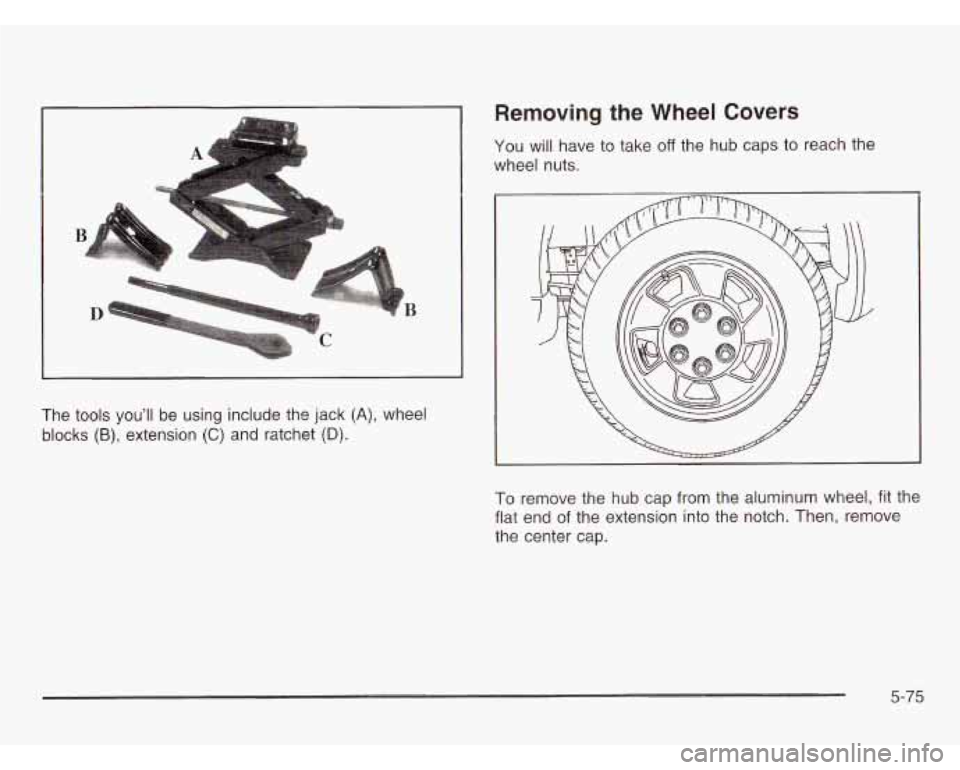
The tools you’ll be using include the jack
(A), wheel
blocks
(B), extension (C) and ratchet (D).
To remove the hub cap from the aluminum wheel, fit the
flat end
of the extension into the notch. Then, remove
the center cap.
5-75
Page 293 of 386
Removing the Flat Tire and Installing
the Spare Tire
1. Before you start, block the front and rear of the
tire farthest away from the one being changed.
Then put your cor-xt spare tire near the flat tire.
I
Getting under a vehicle when it is jacked .I is
dangerous. If the vehicle slips off the jack you
could be badly injured or killed. Never get under
a vehicle when
it is supported only by a jack.
Ra.,.ng your vehicle
..ICIm Lhe jack improperly
positioned can damage the vehicle and even
make the vehicle fall.
To help avoid personal
injury and vehicle damage, be sure to fit the
jack
lift head into the proper location before
raising the vehicle.
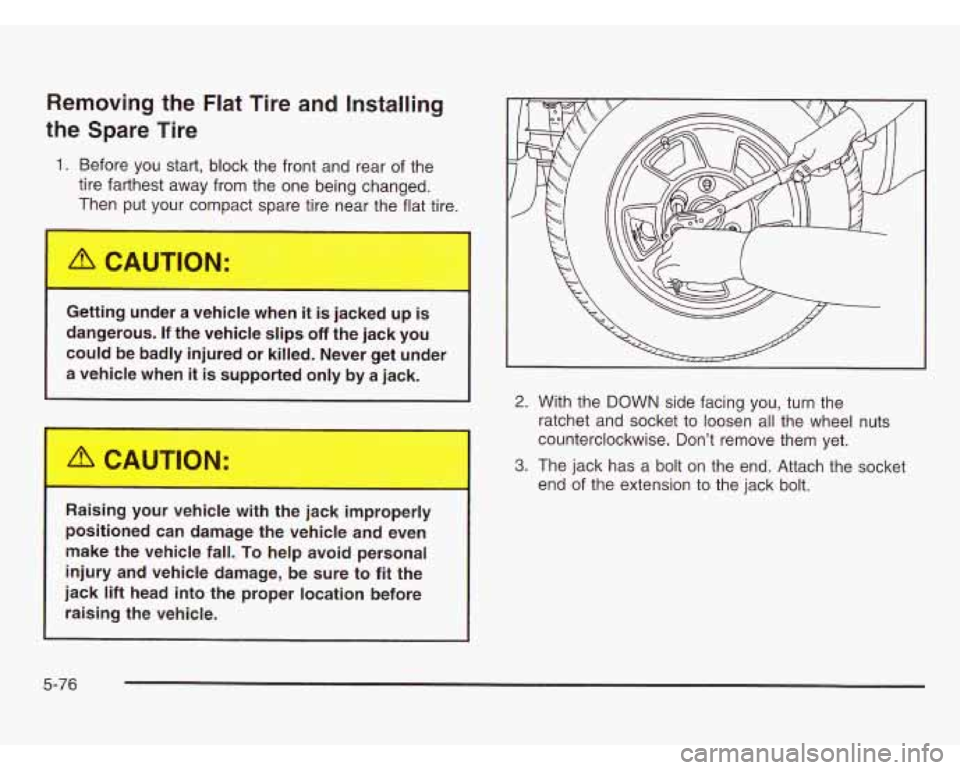
2. With the DOWN side facing you, turn the
ratchet and socket to loosen all the wheel nuts
counterclockwise. Don’t remove them yet.
3. The jack has a bolt on the end. Attach the socket
end of the extension to the jack bolt.
5-76
Page 295 of 386
B' C
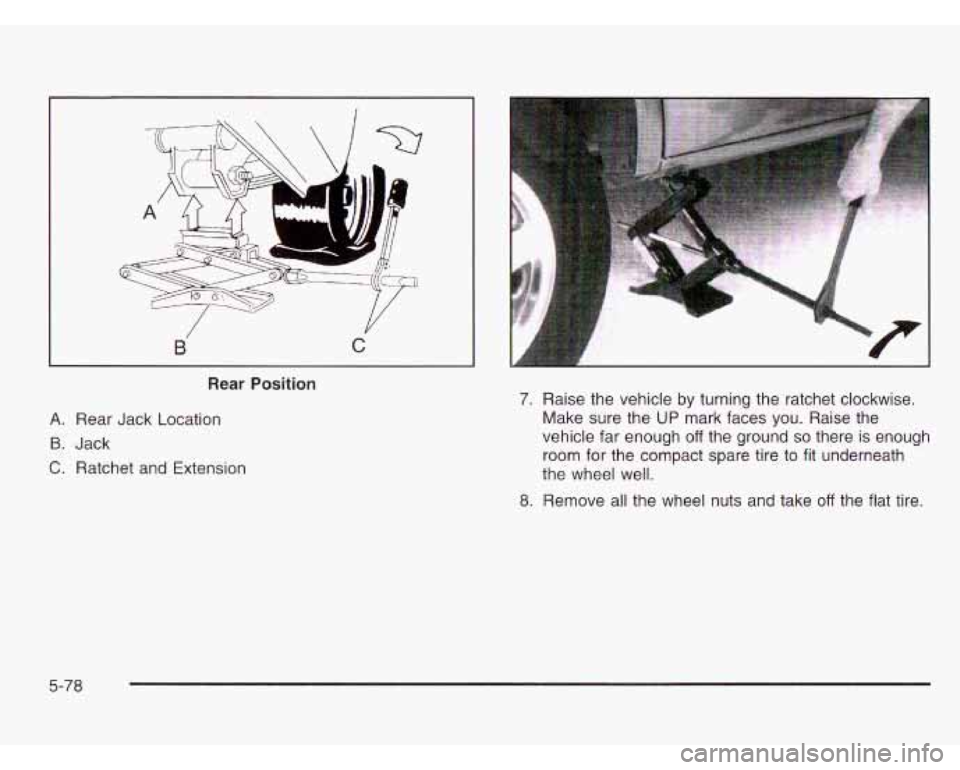
Rear Position
A. Rear Jack Location
B. Jack
C. Ratchet and Extension
..
7. Raise the vehicle by turning the ratchet clockwise.
Make sure the
UP mark faces you. Raise the
vehicle far enough
off the ground so there is enough
room for the compact spare tire to fit underneath
the wheel well.
8. Remove all the wheel nuts and take off the flat tire.
5-78
Page 296 of 386
9. Remove any rust or dirt from the wheel bolts,
mounting surfaces and spare wheel.
Rust or dirt on
the wheel, or on the parts to
which
it is fastened, can make the wheel nuts
become loose after
a time. The wheel could
come
off and cause an accident. When you
change a wheel, remove any rust or
dirt from
the places where the wheel attaches to the
vehicle. In an emergency, you can use a cloth
or a paper towel to do this; but be sure to use
a scraper or wire brush later, if you need to,
to get all the rust
or dirt off.
10. Put on the compact spare tire. Put the nuts on by
hand. Make sure the cone-shaped end is toward
the wheel. Tighten each nut by hand until the wheel
is held against the hub.
If a nut can’t be turned
by hand, use the extension and see your dealer as
soon as possible.
Never use oil or grease on studs or nuts. If you
do, the nuts might come
loose. Your wheel
could fall
off, causing a serious accident.
-
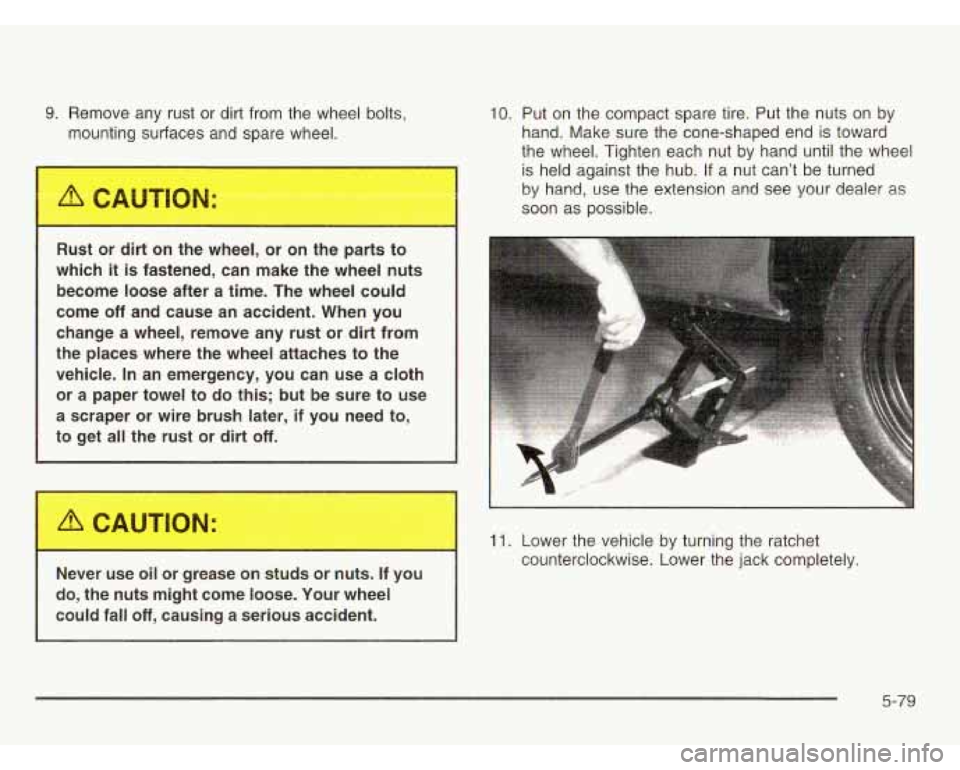
11. Lower the vehicle by turning the ratchet
counterclockwise. Lower the jack completely.
5-79
Page 297 of 386
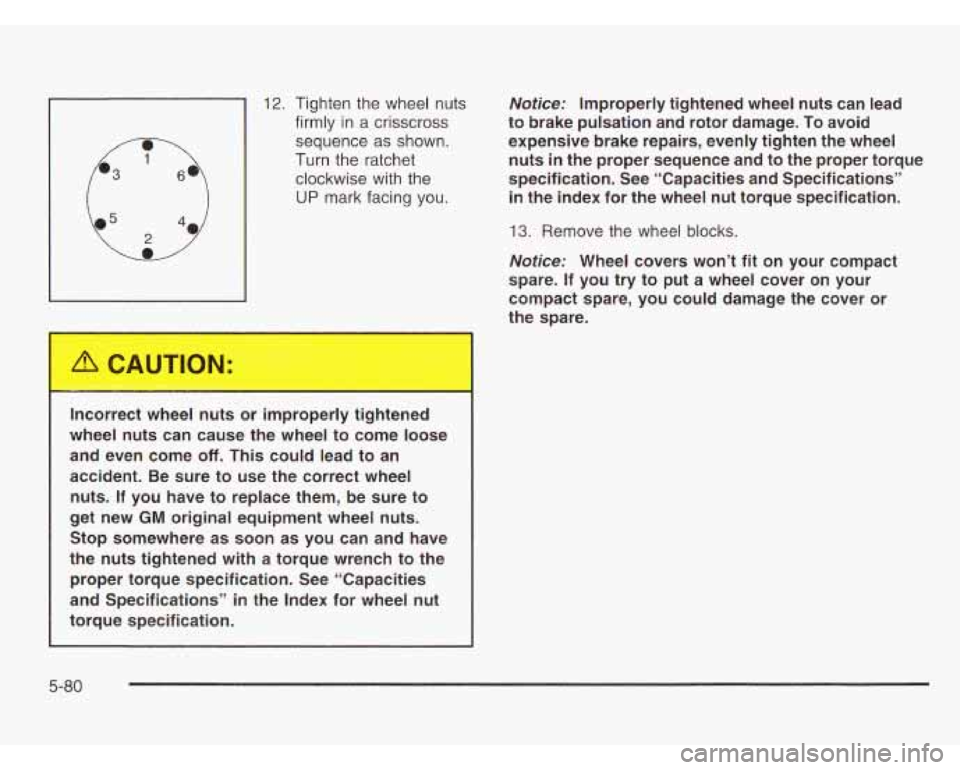
12. Tighten the wheel nuts
firmly in a crisscross
sequence as shown.
Turn the ratchet
clockwise with the
UP mark facing you.
Incorrect wheel nuts or improperly tightened
wheel nuts can cause the wheel to come loose and even come
off. This could lead to an
accident. Be sure to use the correct wheel
nuts.
If you have to replace them, be sure to
get new
GM original equipment wheel nuts.
Stop somewhere as soon as you can and have
the nuts tightened with a torque wrench to the
proper torque specification. See “Capacities
and Specifications” in the Index for wheel
nut
torque specification.
Notice: Improperly tightened wheel nuts can lead
to brake pulsation and rotor damage. To avoid
expensive brake repairs, evenly tighten the wheel
nuts in the proper sequence and to the proper torque
specification. See “Capacities and Specifications”
in the index for the wheel nut torque specification.
13. Remove the wheel blocks.
Notice: Wheel covers won’t fit on your compact
spare.
If you try to put a wheel cover on your
compact spare, you could damage the cover or
the spare.
5-80
Page 298 of 386
Stori J a Flat or Spare Tire and Tools
Storing a jack, a tire, or other equipment in the
passenger compartment
of the vehicle could
cause injury. In
a sudden stop or collision,
loose equipment could strike someone.
Store all these in the proper place.
1. Put the flat tire on the ground at the rear of the
vehicle with the valve stem pointed down.
2. Tilt the retainer plate downward and through the
wheel opening. Make sure
it is fully seated across
the underside of the wheel. Attach the ratchet,
with the UP side facing you, to the extension.
3. Put the flat end of the extension on an angle
through the hole in the rear door frame, above
the bumper.
The compact spare is for temporary use only.
Replace the compact spare tire with a full-size tire
as soon as you can. See Compact Spare Tire
on page 5-82. See the storage instructions label to
restore your compact spare properly.
vehicle by turning the ratchevwheel wrench until
you hear two clicks or feel it skip twice. The spare
tire hoist cannot be overtightened.
4. Raise the tire fully against the underside of the
5. Make sure the tire is stored securely. Push, pull,
and then try to rotate or turn the tire. If the tire
moves, use the ratchet/wheel wrench
to tighten
the cable.
Return the jacking equipment to its proper location.
5-81
Page 299 of 386
Compact Spare Tire
Although the compact spare tire was fully inflated when
your vehicle was new, it can lose air after a time.
Check the inflation pressure regularly. It should be
60 psi (420 kPa).
After installing the compact spare on your vehicle,
you should stop as soon as possible and make sure
your spare tire is correctly inflated. The compact spare
is made to perform well at speeds up to
65 mph
(1 05 km/h) for distances up to 3,000 miles (5 000 km),
so you can finish your trip and have your full-size
tire repaired or replaced where you want.
Of course,
it’s best to replace your spare with a full-size tire as soon
as you can. Your spare will last longer and be in good
shape in case you need it again.
Notice: When the compact spare is installed, don’t
take your vehicle through an automatic car wash
with guide rails. The compact spare can get caught
on the rails. That can damage the tire and wheel,
and maybe other parts of your vehicle.
Don’t use your compact spare on other vehicles.
And don’t mix your compact spare tire or wheel with
other wheels or tires. They won’t fit. Keep your spare tire
and its wheel together.
Notice: Tire chains won’t fit your compact spare.
Using them can damage your vehicle and can
damage the chains too. Don’t use tire chains on
your compact spare.
5-82
Page 305 of 386
Aluminum Wheels
Keep your wheels clean using a soft clean cloth
with mild soap and water. Rinse with clean water.
After rinsing thoroughly, dry with a
soft clean towel.
A wax may then be applied.
The surface of these wheels is similar
to the painted
surface of your vehicle. Don’t use strong soaps,
chemicals, abrasive polishes, abrasive cleaners,
cleaners with acid, or abrasive cleaning brushes on
them because you could damage the surface.
Do not use chrome polish on aluminum wheels.
Don’t take your vehicle through an automatic car wash
that has silicone carbide tire cleaning brushes. These
brushes can also damage the surface of these wheels.
Tires
To clean your tires, use a stiff brush with tire cleaner.
Nofice: When applying a tire dressing, always take
care to wipe
off any overspray or splash from all
painted surfaces
on the body or wheels of the
vehicle. Petroleum-based products may damage
the paint finish and tires.
Sheet Metal Damage
If your vehicle is damaged and requires sheet metal
repair or replacement, make sure the body repair shop
applies anti-corrosion material to parts repaired or
replaced
to restore corrosion protection.
Original manufacturer replacement parts will provide the
corrosion protection while maintaining the warranty.
Finish Damage
Any stone chips, fractures or deep scratches in the
finish should be repaired right away. Bare metal
will corrode quickly and may develop into major
repair expense.
Minor chips and scratches can be repaired with touch-up
materials avaliable from your dealer or other service
outlets. Larger areas
of finish damage can be corrected
in your dealer’s body and paint shop.
5-88
Page 307 of 386
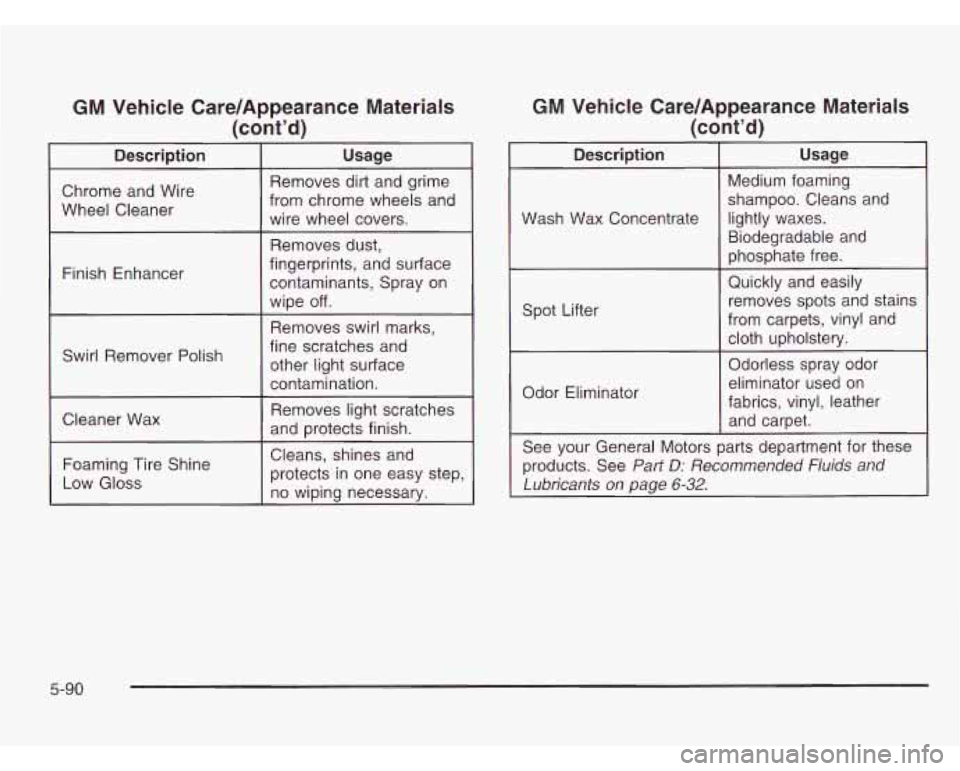
GM Vehicle Care/Appearance Materials (cont’d)
I DescriDtion I Usage
Chrome and Wire
Wheel Cleaner Removes
dirt and grime
from chrome wheels and
wire wheel covers.
I
I Removes dust, I
Finish Enhancer fingerprints,
and surface
contaminants, Spray on
wipe
off.
I I Removes swirl marks, I
I Swirl Remover Polish fine scratches and
other light surface
I I contamination.
Removes light scratches
and protects finish.
Foaming Tire Shine
Low Gloss Cleans, shines
and
protects in one easy step,
no wiDinq necessary.
GM Vehicle Care/Appearance Materials
(cont’d)
I Description I Usage
Wash Wax Concentrate Medium foaming
shampoo. Cleans and lightly waxes.
Biodegradable and
DhosDhate free.
Spot Lifter Quickly and easily
removes spots and stains
from carpets, vinyl and
cloth upholstery.
Odor Eliminator Odorless
spray odor
eliminator used on
fabrics, vinyl, leather
and carpet.
See your General Motors parts department for these
products. See
Part D: Recommended Fluids and
Lubricants on page
6-32.
5-90
Page 320 of 386
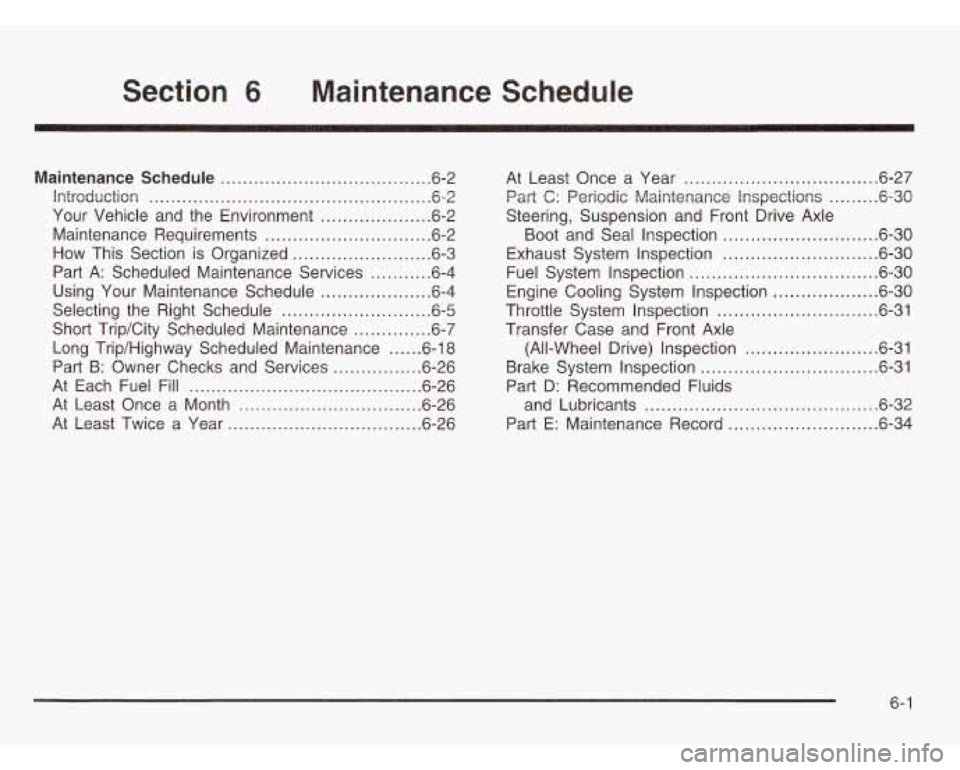
Section 6 Maintenance Schedule
Maintenance Schedule ............................... 6.2
Introduction
................................................... 6.2
Your Vehicle and the Environment
.................... 6-2
Maintenance Requirements
.............................. 6-2
How This Section
is Organized ......................... 6-3
Part
A: Scheduled Maintenance Services ........... 6.4
Using Your Maintenance Schedule
.................... 6.4
Selecting the Right Schedule
........................... 6-5
Short Trip/City Scheduled Maintenance
.............. 6.7
Long Trip/Highway Scheduled Maintenance
...... 6.18
Part B: Owner Checks and Services
................ 6.26
At Each Fuel Fill
.......................................... 6-26
At Least Once a Month
................................. 6.26
At Least Twice a Year
................................... 6.26 At
Least Once a Year
................................... 6-27
Part C: Periodic Maintenance inspections
......... 6.30
Steering. Suspension and Front Drive Axle
Boot and Seal Inspection
............................ 6.30
Exhaust System Inspection
............................ 6.30
Fuel System Inspection
.................................. 6.30
Engine Cooling System Inspection
................... 6.30
Throttle System Inspection
............................ -6-31
Transfer Case and Front Axle
(All-Wheel Drive) Inspection
....................... -6-31
Brake System Inspection
................................ 6.31
Part D: Recommended Fluids
and Lubricants
.......................................... 6.32
Part E: Maintenance Record
........................... 6.34
6-
1