wiper blades CHEVROLET ASTRO 2005 Owners Manual
[x] Cancel search | Manufacturer: CHEVROLET, Model Year: 2005, Model line: ASTRO, Model: CHEVROLET ASTRO 2005Pages: 376, PDF Size: 2.45 MB
Page 125 of 376
To use it, pull the turn signal lever toward you, but not
so far that you hear a click.
If your headlamps are in automatic or on low beam,
your high-beam headlamps will turn on. They will stay
on as long as you hold the lever toward you and
the high-beam indicator located on the cluster comes
on. Release the lever to return to normal operation.
Windshield Wipers
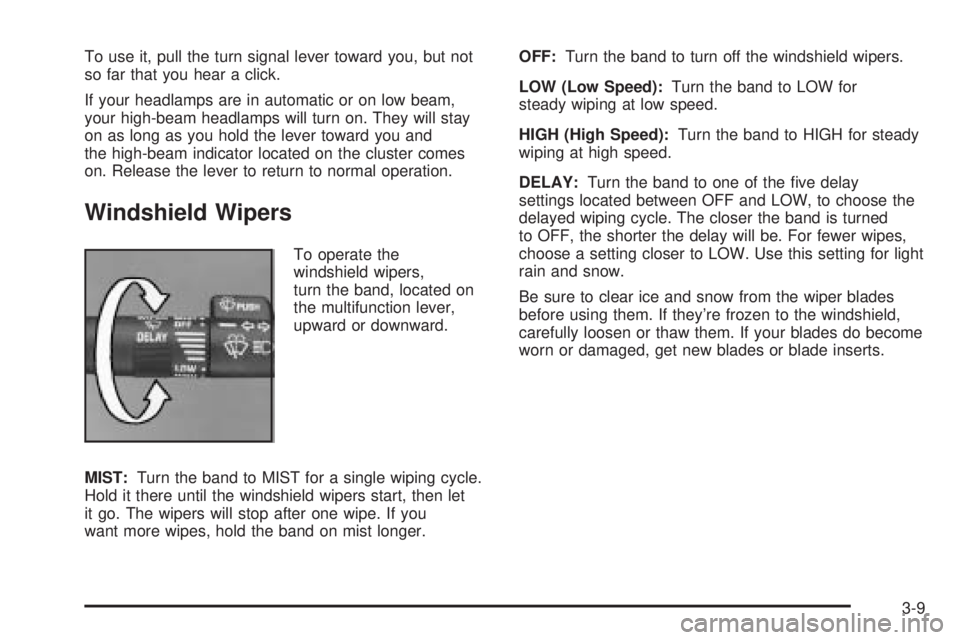
To operate the
windshield wipers,
turn the band, located on
the multifunction lever,
upward or downward.
MIST:Turn the band to MIST for a single wiping cycle.
Hold it there until the windshield wipers start, then let
it go. The wipers will stop after one wipe. If you
want more wipes, hold the band on mist longer.OFF:Turn the band to turn off the windshield wipers.
LOW (Low Speed):Turn the band to LOW for
steady wiping at low speed.
HIGH (High Speed):Turn the band to HIGH for steady
wiping at high speed.
DELAY:Turn the band to one of the ve delay
settings located between OFF and LOW, to choose the
delayed wiping cycle. The closer the band is turned
to OFF, the shorter the delay will be. For fewer wipes,
choose a setting closer to LOW. Use this setting for light
rain and snow.
Be sure to clear ice and snow from the wiper blades
before using them. If they’re frozen to the windshield,
carefully loosen or thaw them. If your blades do become
worn or damaged, get new blades or blade inserts.
3-9
Page 182 of 376
The heavier the rain, the harder it is to see. Even if
your windshield wiper blades are in good shape, a heavy
rain can make it harder to see road signs and traffic
signals, pavement markings, the edge of the road, and
even people walking.
It is wise to keep your wiping equipment in good shape
and keep your windshield washer tank lled with
washer uid. Replace your windshield wiper inserts
when they show signs of streaking or missing areas on
the windshield, or when strips of rubber start to
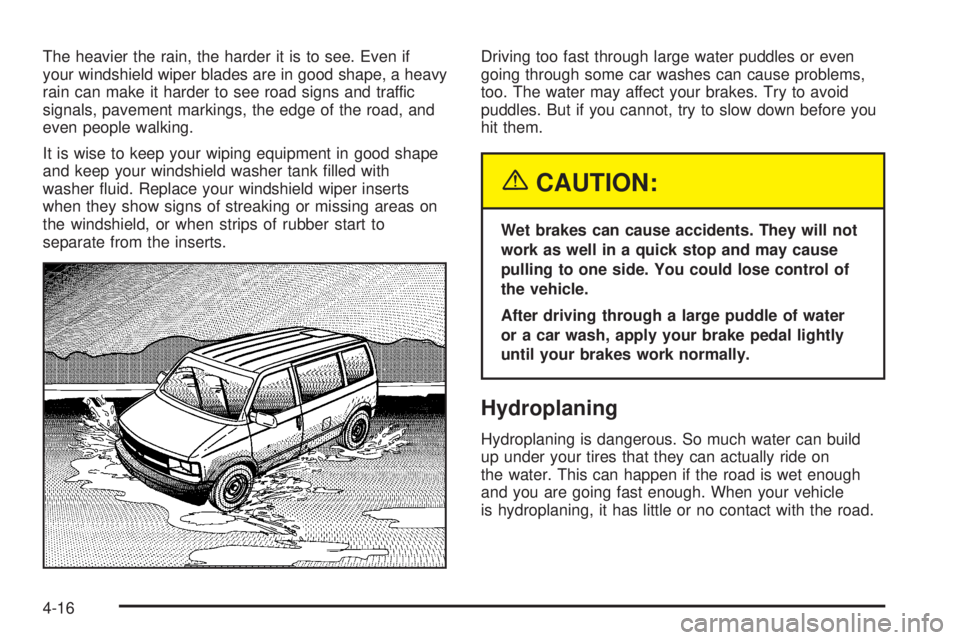
separate from the inserts.Driving too fast through large water puddles or even
going through some car washes can cause problems,
too. The water may affect your brakes. Try to avoid
puddles. But if you cannot, try to slow down before you
hit them.
{CAUTION:
Wet brakes can cause accidents. They will not
work as well in a quick stop and may cause
pulling to one side. You could lose control of
the vehicle.
After driving through a large puddle of water
or a car wash, apply your brake pedal lightly
until your brakes work normally.
Hydroplaning
Hydroplaning is dangerous. So much water can build
up under your tires that they can actually ride on
the water. This can happen if the road is wet enough
and you are going fast enough. When your vehicle
is hydroplaning, it has little or no contact with the road.
4-16
Page 186 of 376
Once you are moving on the freeway, make certain
you allow a reasonable following distance. Expect
to move slightly slower at night.
When you want to leave the freeway, move to the
proper lane well in advance. If you miss your exit,
do not, under any circumstances, stop and back up.
Drive on to the next exit.
The exit ramp can be curved, sometimes quite sharply.
The exit speed is usually posted.
Reduce your speed according to your speedometer, not
to your sense of motion. After driving for any distance
at higher speeds, you may tend to think you are
going slower than you actually are.
Before Leaving on a Long Trip
Make sure you are ready. Try to be well rested. If you
must start when you are not fresh — such as after
a day’s work — do not plan to make too many miles
that rst part of the journey. Wear comfortable clothing
and shoes you can easily drive in.Is your vehicle ready for a long trip? If you keep it
serviced and maintained, it is ready to go. If it needs
service, have it done before starting out. Of course, you
will nd experienced and able service experts in GM
dealerships all across North America. They will be ready
and willing to help if you need it.
Here are some things you can check before a trip:
Windshield Washer Fluid:Is the reservoir full?
Are all windows clean inside and outside?
Wiper Blades:Are they in good shape?
Fuel, Engine Oil, Other Fluids:Have you checked
all levels?
Lamps:Are they all working? Are the lenses clean?
Tires:They are vitally important to a safe,
trouble-free trip. Is the tread good enough for
long-distance driving? Are the tires all inated to
the recommended pressure?
Weather Forecasts:What is the weather outlook
along your route? Should you delay your trip a
short time to avoid a major storm system?
Maps:Do you have up-to-date maps?
4-20
Page 214 of 376
Wheel Replacement......................................5-70
Tire Chains..................................................5-71
If a Tire Goes Flat........................................5-71
Changing a Flat Tire.....................................5-72
Removing the Spare Tire and Tools................5-73
Removing the Flat Tire and Installing
the Spare Tire..........................................5-76
Storing a Flat or Spare Tire and Tools............5-82
Compact Spare Tire......................................5-84
Appearance Care............................................5-84
Fabric/Carpet...............................................5-85
Vinyl...........................................................5-86
Leather.......................................................5-87
Instrument Panel..........................................5-87
Interior Plastic Components............................5-87
Glass Surfaces.............................................5-87
Care of Safety Belts......................................5-87
Weatherstrips...............................................5-88
Washing Your Vehicle...................................5-88
Cleaning Exterior Lamps/Lenses.....................5-88
Finish Care..................................................5-88
Windshield and Wiper Blades.........................5-89Aluminum Wheels.........................................5-90
Tires...........................................................5-90
Sheet Metal Damage.....................................5-91
Finish Damage.............................................5-91
Underbody Maintenance................................5-91
Chemical Paint Spotting.................................5-91
Vehicle Care/Appearance Materials..................5-92
Vehicle Identication......................................5-93
Vehicle Identication Number (VIN).................5-93
Service Parts Identication Label.....................5-93
Electrical System............................................5-94
Add-On Electrical Equipment..........................5-94
Headlamp Wiring..........................................5-94
Windshield Wiper Fuses................................5-94
Power Windows and Other Power Options.......5-94
Fuses and Circuit Breakers............................5-95
Instrument Panel Fuse Block..........................5-96
Underhood Fuse Block..................................5-98
Capacities and Specications........................5-101
Normal Maintenance Replacement Parts.........5-102
Section 5 Service and Appearance Care
5-2
Page 269 of 376
Windshield Wiper Blade
Replacement
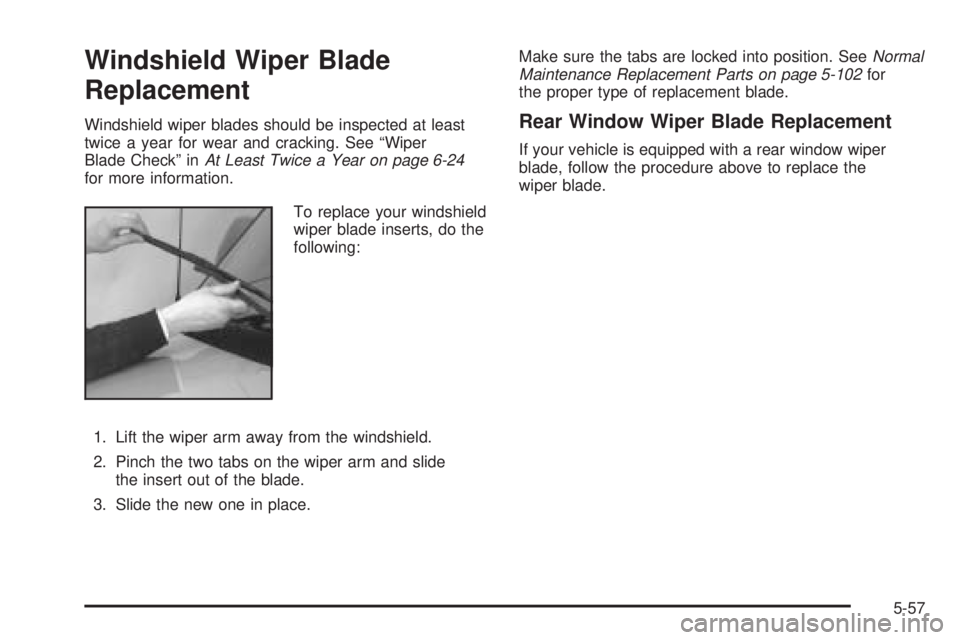
Windshield wiper blades should be inspected at least
twice a year for wear and cracking. See “Wiper
Blade Check” inAt Least Twice a Year on page 6-24
for more information.
To replace your windshield
wiper blade inserts, do the
following:
1. Lift the wiper arm away from the windshield.
2. Pinch the two tabs on the wiper arm and slide
the insert out of the blade.
3. Slide the new one in place.Make sure the tabs are locked into position. SeeNormal
Maintenance Replacement Parts on page 5-102for
the proper type of replacement blade.Rear Window Wiper Blade Replacement
If your vehicle is equipped with a rear window wiper
blade, follow the procedure above to replace the
wiper blade.
5-57
Page 301 of 376
Notice:Machine compounding or aggressive
polishing on a basecoat/clearcoat paint nish may
damage it. Use only non-abrasive waxes and
polishes that are made for a basecoat/clearcoat
paint nish on your vehicle.
Foreign materials such as calcium chloride and other
salts, ice melting agents, road oil and tar, tree sap, bird
droppings, chemicals from industrial chimneys, etc.,
can damage your vehicle’s nish if they remain
on painted surfaces. Wash the vehicle as soon as
possible. If necessary, use non-abrasive cleaners that
are marked safe for painted surfaces to remove
foreign matter.
Exterior painted surfaces are subject to aging, weather
and chemical fallout that can take their toll over a
period of years. You can help to keep the paint nish
looking new by keeping your vehicle garaged or covered
whenever possible.
Protecting Exterior Bright Metal Parts
Bright metal parts should be cleaned regularly to keep
their luster. Washing with water is all that is usually
needed. However, you may use chrome polish on
chrome or stainless steel trim, if necessary.Use special care with aluminum trim. To avoid damaging
protective trim, never use auto or chrome polish,
steam or caustic soap to clean aluminum. A coating of
wax, rubbed to high polish, is recommended for all
bright metal parts.
Windshield and Wiper Blades
If the windshield is not clear after using the windshield
washer, or if the wiper blade chatters when running,
wax, sap, or other material may be on the blade
or windshield.
Clean the outside of the windshield with a glass
cleaning liquid or powder and water solution. The
windshield is clean if beads do not form when it is
rinsed with water.
Grime from the windshield will stick to the wiper blades
and affect their performance. Clean the blade by
wiping vigorously with a cloth soaked in full-strength
windshield washer solvent. Then rinse the blade
with water.
Check the wiper blades and clean them as necessary;
replace blades that look worn.
5-89
Page 314 of 376
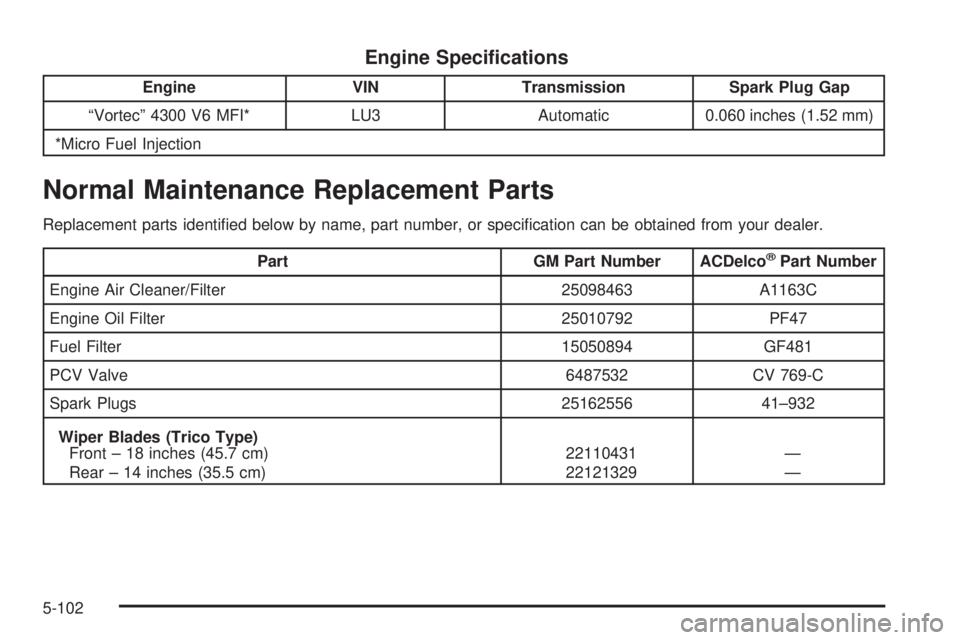
Engine Specications
Engine VIN Transmission Spark Plug Gap
“Vortec” 4300 V6 MFI* LU3 Automatic 0.060 inches (1.52 mm)
*Micro Fuel Injection
Normal Maintenance Replacement Parts
Replacement parts identied below by name, part number, or specication can be obtained from your dealer.
Part GM Part Number ACDelco®Part Number
Engine Air Cleaner/Filter 25098463 A1163C
Engine Oil Filter 25010792 PF47
Fuel Filter 15050894 GF481
PCV Valve 6487532 CV 769-C
Spark Plugs 25162556 41–932
Wiper Blades (Trico Type)
Front – 18 inches (45.7 cm)
Rear – 14 inches (35.5 cm)22110431
22121329—
—
5-102
Page 339 of 376
Also look for any opened or broken airbag coverings,
and have them repaired or replaced. (The airbag system
does not need regular maintenance.)
Wiper Blade Check
Inspect wiper blades for wear or cracking. Replace
blade inserts that appear worn or damaged or that
streak or miss areas of the windshield. Also see
Windshield and Wiper Blades on page 5-89.
Spare Tire Check
At least twice a year, after the monthly ination check
of the spare tire determines that the spare is inated to
the correct tire ination pressure, make sure that the
spare tire is stored securely. Push, pull, and then try
to rotate or turn the tire. If it moves, use the wheel
wrench to tighten the cable. SeeChanging a Flat Tire
on page 5-72.
Weatherstrip Lubrication
Silicone grease on weatherstrips will make them last
longer, seal better, and not stick or squeak. Apply
silicone grease with a clean cloth. During very cold,
damp weather more frequent application may be
required. SeePart D: Recommended Fluids and
Lubricants on page 6-29.
Automatic Transmission Check
Check the transmission uid level; add if needed. See
Automatic Transmission Fluid on page 5-23. A uid loss
may indicate a problem. Check the system and repair
if needed.
At Least Once a Year
Key Lock Cylinders Service
Lubricate the key lock cylinders with the lubricant
specied in Part D.
Body Lubrication Service
Lubricate all body door hinges, the body hood, fuel door
and rear compartment hinges, latches and locks
including interior glove box and console doors, hood
latch assembly, secondary latch, pivots, spring anchor,
release pawl and any moving seat hardware. Lubricate
the hood safety lever pivot and prop rod pivot. Part D
tells you what to use. More frequent lubrication may be
required when exposed to a corrosive environment.
6-25
Page 363 of 376
A
Accessory Power Outlets.................................3-17
Adding Equipment to Your Airbag-Equipped
Vehicle.......................................................1-70
Additives, Fuel................................................. 5-6
Add-On Electrical Equipment............................5-94
Air Cleaner/Filter, Engine.................................5-21
Air Conditioning..............................................3-19
Airbag
Readiness Light..........................................3-26
Airbag Sensing and Diagnostic Module (SDM)....7-10
Airbag System................................................1-63
Adding Equipment to Your Airbag-Equipped
Vehicle...................................................1-70
How Does an Airbag Restrain?......................1-68
Servicing Your Airbag-Equipped Vehicle..........1-69
What Makes an Airbag Inate?......................1-67
What Will You See After an Airbag Inates?....1-68
When Should an Airbag Inate?....................1-66
Where Are the Airbags?...............................1-65
All-Wheel Drive...............................................5-47
All-Wheel Drive (AWD) System.........................2-23
All-Wheel-Drive Service Light............................3-34
AM-FM Radio.................................................3-40
Antenna, Fixed Mast.......................................3-50
Anti-Lock Brake System (ABS)........................... 4-7
Anti-Lock Brake, System Warning Light..............3-29Appearance Care............................................5-84
Aluminum Wheels........................................5-90
Care of Safety Belts....................................5-87
Chemical Paint Spotting...............................5-91
Cleaning Exterior Lamps/Lenses....................5-88
Fabric/Carpet..............................................5-85
Finish Care.................................................5-88
Finish Damage............................................5-91
Glass Surfaces............................................5-87
Instrument Panel.........................................5-87
Interior Plastic Components...........................5-87
Leather......................................................5-87
Sheet Metal Damage...................................5-91
Tires..........................................................5-90
Underbody Maintenance...............................5-91
Vehicle Care/Appearance Materials................5-92
Vinyl..........................................................5-86
Washing Your Vehicle...................................5-88
Weatherstrips..............................................5-88
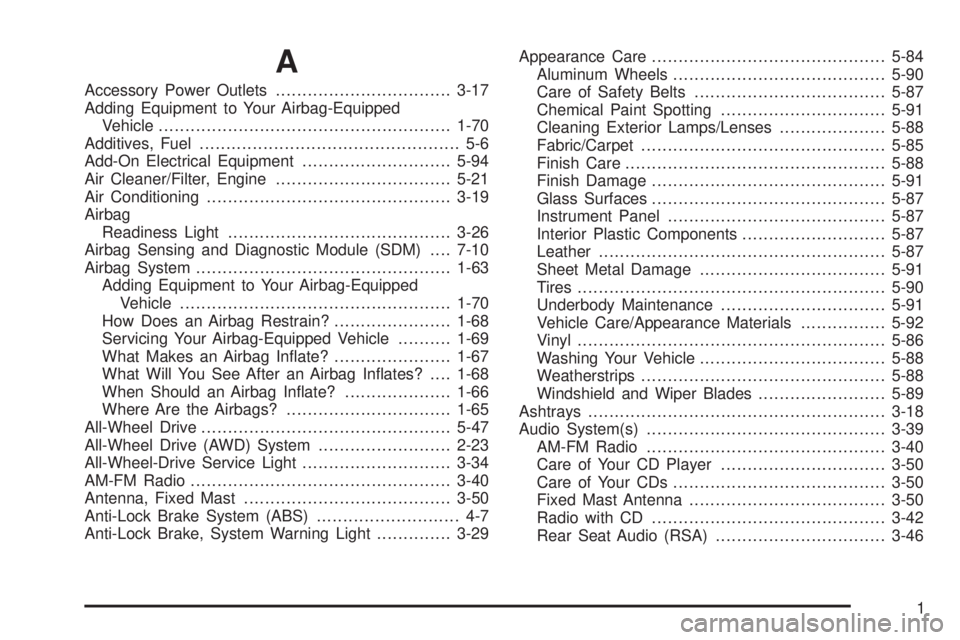
Windshield and Wiper Blades........................5-89
Ashtrays........................................................3-18
Audio System(s).............................................3-39
AM-FM Radio.............................................3-40
Care of Your CD Player...............................3-50
Care of Your CDs........................................3-50
Fixed Mast Antenna.....................................3-50
Radio with CD............................................3-42
Rear Seat Audio (RSA)................................3-46
1
Page 365 of 376
Child Restraints (cont.)
Lower Anchorages and Top Tethers for
Children (LATCH System)..........................1-54
Older Children.............................................1-38
Securing a Child Restraint Designed for
the LATCH System...................................1-56
Securing a Child Restraint in a
Center Rear Seat Position.........................1-58
Securing a Child Restraint in a
Rear Outside Seat Position........................1-57
Securing a Child Restraint in the
Right Front Seat Position..........................1-60
Top Strap...................................................1-50
Top Strap Anchor Location............................1-52
Where to Put the Restraint...........................1-49
Cigarette Lighter.............................................3-18
Cleaning
Aluminum Wheels........................................5-90
Exterior Lamps/Lenses.................................5-88
Fabric/Carpet..............................................5-85
Finish Care.................................................5-88
Glass Surfaces............................................5-87
Instrument Panel.........................................5-87
Interior Plastic Components...........................5-87
Leather......................................................5-87
Tires..........................................................5-90
Underbody Maintenance...............................5-91
Vinyl..........................................................5-86
Washing Your Vehicle...................................5-88Cleaning (cont.)
Weatherstrips..............................................5-88
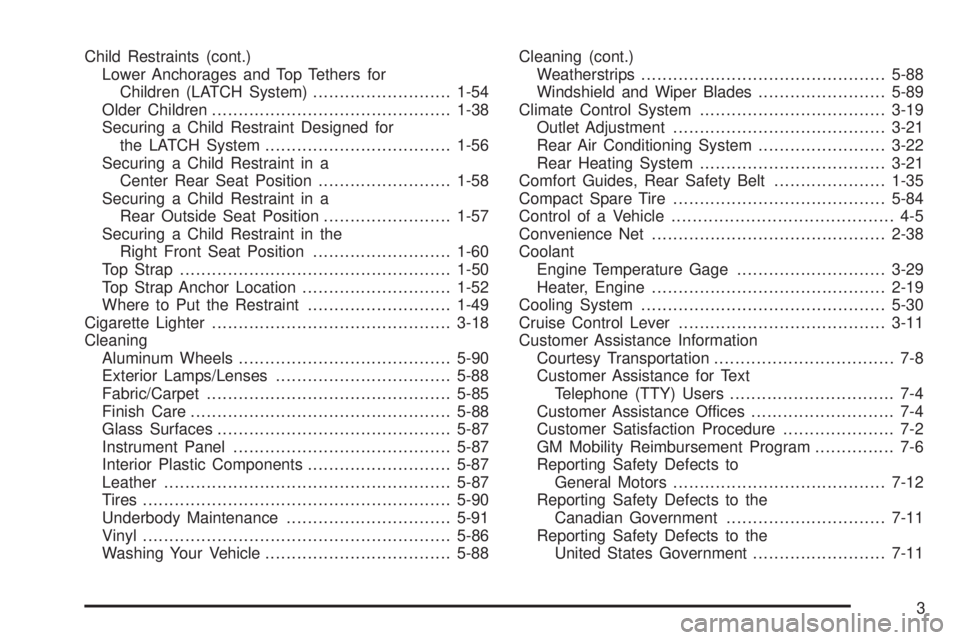
Windshield and Wiper Blades........................5-89
Climate Control System...................................3-19
Outlet Adjustment........................................3-21
Rear Air Conditioning System........................3-22
Rear Heating System...................................3-21
Comfort Guides, Rear Safety Belt.....................1-35
Compact Spare Tire........................................5-84
Control of a Vehicle.......................................... 4-5
Convenience Net............................................2-38
Coolant
Engine Temperature Gage............................3-29
Heater, Engine............................................2-19
Cooling System..............................................5-30
Cruise Control Lever.......................................3-11
Customer Assistance Information
Courtesy Transportation.................................. 7-8
Customer Assistance for Text
Telephone (TTY) Users............................... 7-4
Customer Assistance Offices........................... 7-4
Customer Satisfaction Procedure..................... 7-2
GM Mobility Reimbursement Program............... 7-6
Reporting Safety Defects to
General Motors........................................7-12
Reporting Safety Defects to the
Canadian Government..............................7-11
Reporting Safety Defects to the
United States Government.........................7-11
3