light CHEVROLET ASTRO PASSENGER 1993 1.G Repair Manual
[x] Cancel search | Manufacturer: CHEVROLET, Model Year: 1993, Model line: ASTRO PASSENGER, Model: CHEVROLET ASTRO PASSENGER 1993 1.GPages: 345, PDF Size: 19 MB
Page 201 of 345
Downloaded from www.Manualslib.com manuals search engine Will the trailer brake parts take 3,000 psi (20 650 kPa) of pressure? If
not, the trailer brake system must not be used with your vehi\
cle.
if everything checks out this far, then make the brake fluid tap at the
port on the master cylinder that sends fluid to the rear brak\
es. But don’t use copper tubing for this.
If you do, it will bend and finally break off.
Use steel brake tubing.
Driving with a Trailer
Towing a trailer requires a certain amount of experience. Before setting out
for the open road, you’ll want to get to know your rig. Acquaint yourself with
the feel of handling and braking with the added weight of the trailer. And
always keep in mind that the vehicle you are driving is now a good deal
longer and not nearly
so responsive as your vehicle is by itself.
Before you start, check the trailer hitch and platform, safety \
chains, electrical
connector, lights, tires and mirror adjustment.
If the trailer has electric brakes,
start your vehicle and trailer moving and then apply the trail\
er brake controller
by hand to be sure the brakes are working. This lets you check your
electrical connection at the same time.
If you have a rear-most window open and you pull a trailer with your
vehicle, carbon monoxide (CO) could come into your vehicle. You
can’t see or smell CO. It can cause unconsciousness or death (see
“Engine Exhaust” in the Index).
To maximize your safety when towing
a trailer:
Have your exhaust system inspected for leaks and make
Keep the rear-most windows closed.
If exhaust does come into your vehicle through a window in the
rear, or another opening, drive with your front, main heating \
or
cooling system
on and with the fan on any speed. This will
bring fresh, outside air into your vehicle.
Do not use MAX NC
because it only recirculates the air inside your vehicle. See
“Comfort Controls” in the Index.
necessary repairs before starting
on your trip.
During your trip, check occasionally to be sure that the load is secure, and
that the lights and any trailer brakes are still working.
4-47
Page 202 of 345

Downloaded from www.Manualslib.com manuals search engine Your Driving and the Road
Following Distance
Stay at least twice as far behind the vehicle ahead as you w\
ould when
driving your vehicle without a trailer. This can help you avoi\
d situations that require heavy braking and sudden turns.
Passing
You’ll need more passing distance up ahead when you’re to\
wing a trailer.
And, because you’re a good deal longer, you’ll need
to go much farther
beyond the passed vehicle before you can return
to your lane.
Backing Up
Hold the bottom of the steering wheel with one hand. Then, to move the
trailer to the left, just move your hand to the left.
To move the trailer to the
right, move your hand to the right. Always back up slowly and\
, if possible,
have someone guide you.
Making Turns
When you’re turning with a trailer, make wider turns than n\
ormal. Do this so
your trailer wheels won’t strike soft shoulders, curbs, road \
signs, trees, or
other objects. Avoid jerky or sudden maneuvers. Signal well in advance.
Turn Signals When Towing a Trailer
When you tow a trailer, your vehicle has to have a different turn signal
flasher and extra wiring. The green arrows on your instrument \
panel will flash
whenever you signal a turn or lane change. Properly hooked up,\
the trailer lights will also flash, telling other drivers you’re about to turn, change lanes,
or stop.
When towing a trailer, the green arrows on your instrument pan\
el will flash for
turns even
if the bulbs on the trailer are burned out. Thus, you may think \
drivers behind you are seeing your signal when they are not. \
It’s important to
check occasionally
to be sure the trailer bulbs are still working.
Driving on Grades
Reduce speed and shift to a lower gear before you start down a long or
steep downgrade. If you don’t shift down, you might have to use your brakes
so much that they would get hot and no longer work well.
On a long uphill grade, shift down and reduce your speed to \
around
45 mph
(70 km/h) to reduce the possibility of engine and transmission overheating.
You should use
D (or as you need to, a lower gear) when towing a trailer.
Operating your vehicle in
D when towing a trailer will minimize heat buildup
and extend the life
of your transmission.
4-48
Page 203 of 345

Downloaded from www.Manualslib.com manuals search engine Parking on Hills
You really should not park your vehicle, with a trailer attached, \
on a hill. If
something goes wrong, your rig could start to move. People can be injured,
and both your vehicle and the trailer can be damaged.
But
if you ever have to park your rig on a hill, here’s how to do it:
1. Apply your regular brakes, but don’t shift into P (Park) yet.
2. Have someone place chocks under the trailer wheels.
3. When the wheel chocks are in place, release the regular brakes until the
chocks absorb
the load.
4. Reapply the regular brakes. Then apply your parking brake, and \
shift to
P (Park).
5. Release the regular brakes.
When You Are Ready to Leave After Parking on a Hill
1. Apply your regular brakes and hold the pedal down while you:
Start your engine.
Shift into a gear; and
Release the parking brake.
2. Let up on the brake pedal.
3. Drive slowly until the trailer is clear of the chocks.
4. Stop and have someone pick up and store the chocks.
Maintenance When Trailer Towing
Your vehicle will need service more often when you’re pulling a trailer. See
the Maintenance Schedule for more
on this. Things that are especially
important in trailer operation are automatic transmission fluid (don’t ove\
rfill),
engine oil, axle lubricant, belt, cooling system, and brake adj\
ustment. Each of
these is covered in this manual, and the Index will help you find them
quickly. If you’re trailering, it’s a good idea
to review these sections before
you start your trip.
Check periodically
to see that all hitch nuts and bolts are tight.
mailer Light Wiring
See “Trailer Wiring Harness” in the Index.
4-49
Page 206 of 345
Downloaded from www.Manualslib.com manuals search engine Hazard Warning Flashers
---'-- I
r
1
AN505006
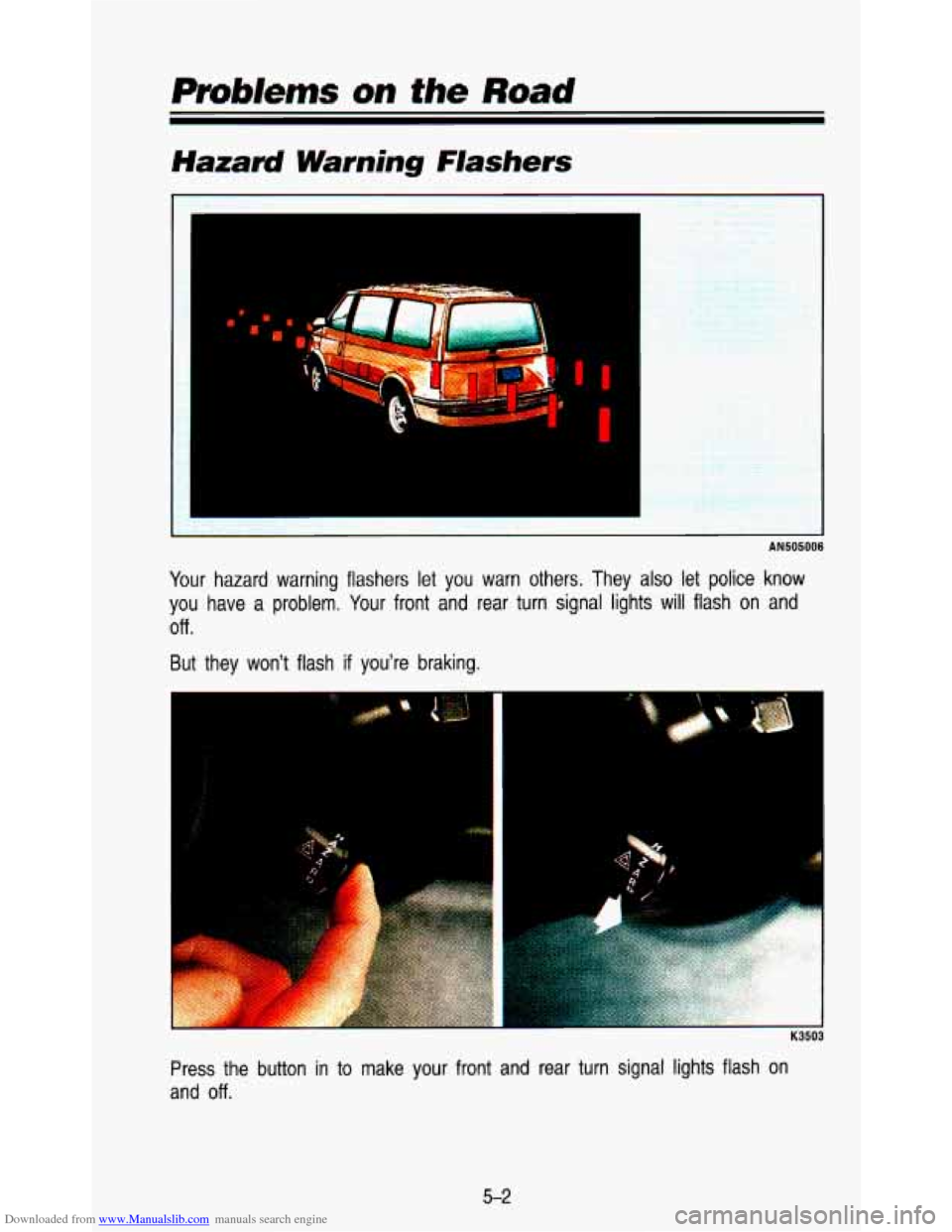
Your hazard warning flashers let you warn others. They also let police know
you have a problem. Your front and rear turn signal lights will flash on and
Off m
But they won't flash if you're braking.
I
...
Press the button in to make your front and rear turn signal lights flash on
and
off.
5-2
Page 208 of 345
Downloaded from www.Manualslib.com manuals search engine 2. Get the vehicles close enough so the jumper cables can reach, but be
sure the vehicles aren’t touching each other.
If they are, it could cause a
ground .connection you don’t want. You wouldn’t be able
to start your
vehicle, and the bad grounding could damage the electrical syst\
ems.
1 CAUTION
I
A You could be injured if the vehicles roll. Set the parking brake firmly
b on each vehicle. Put an automatic transmission in P (Park) or a
I manual transmission in N (Neutral).
3. Turn off the ignition on both vehicles. Turn off all lights that aren’t
needed, and radios. This will avoid sparks and help save both \
batteries.
And
it could save your radio!
1’ NOTICE
Iv dar li 1. The Pairs f you leave your radio on, it could be t
Nouldn’t be covered bv vour warrallLv I
4. Open the hoods and locate the batteries. Find the positive (t) and the
negative
(-) terminals on each battery.
1 CAUTION
A Using a match near a battery can cause battery gas to explode.
People have been hurt doing this, and some have been blinded. \
Use
a flashlight
if you need more light.
You don’t need
to add water to the Delco Freedom@ battery installed
in every new
GM vehicle. But if a battery has filler caps, be sure the
right amount of fluid is there.
If it is low, add water to take care of
that first. If you don’t, explosive gas could be present.
Battery fluid contains acid that can burn you. Don’t get
it on you. If
you accidentally get it in your eyes or on your skin, flush the place
I with water and get medical help immediately.
5. Check that the jumper cables don’t have loose or missing in\
sulation. If
they do, you could get a shock. The vehicles could be damaged\
, too.
Before you connect the cables, here are some things you should\
know.
Positive
(t) will go to positive (+) and negative (-) will go to negative
(-) or a metal engine part. Don’t connect (t) to (-) or you’ll get a
short that would damage the battery and maybe other parts,
too.
5-4
Page 212 of 345
Downloaded from www.Manualslib.com manuals search engine Don’t have your vehicle towed with the wheels in contact with the ground if
it has all-wheel drive. If a vehicle with all-wheel drive must be towed with
sling-type
or wheel lift equipment, then either the front or rear wheels must
be supported on a dolly.
If your vehicle has rear-wheel drive, don’t have it towed on t\
he rear wheels
unless you must.
If a vehicle with rear-wheel drive must be towed on the rear
wheels, don’t go more than
35 mph (56 kmlh) or farther than 50 miles
(80 km) or your transmission will be damaged. If these limits must be
exceeded, then the rear wheels have to be supported on a doll\
y.
1 CAUTION
L A vehicle can fall from a car carrier if it isn’t properly secured. This
b can cause a collision, serious personal injury and vehicle dama\
ge.
The vehicle should be tightly secured with chains or steel cab\
les
before it is transported.
Don’t use substitutes (ropes, leather straps, canvas webbing,\
etc.)
that can be
cut by sharp edges underneath the towed vehicle.
Engine Overheating
You will find a coolant temperature gage and the warning light about a hot
engine on your vehicle’s instrument panel.
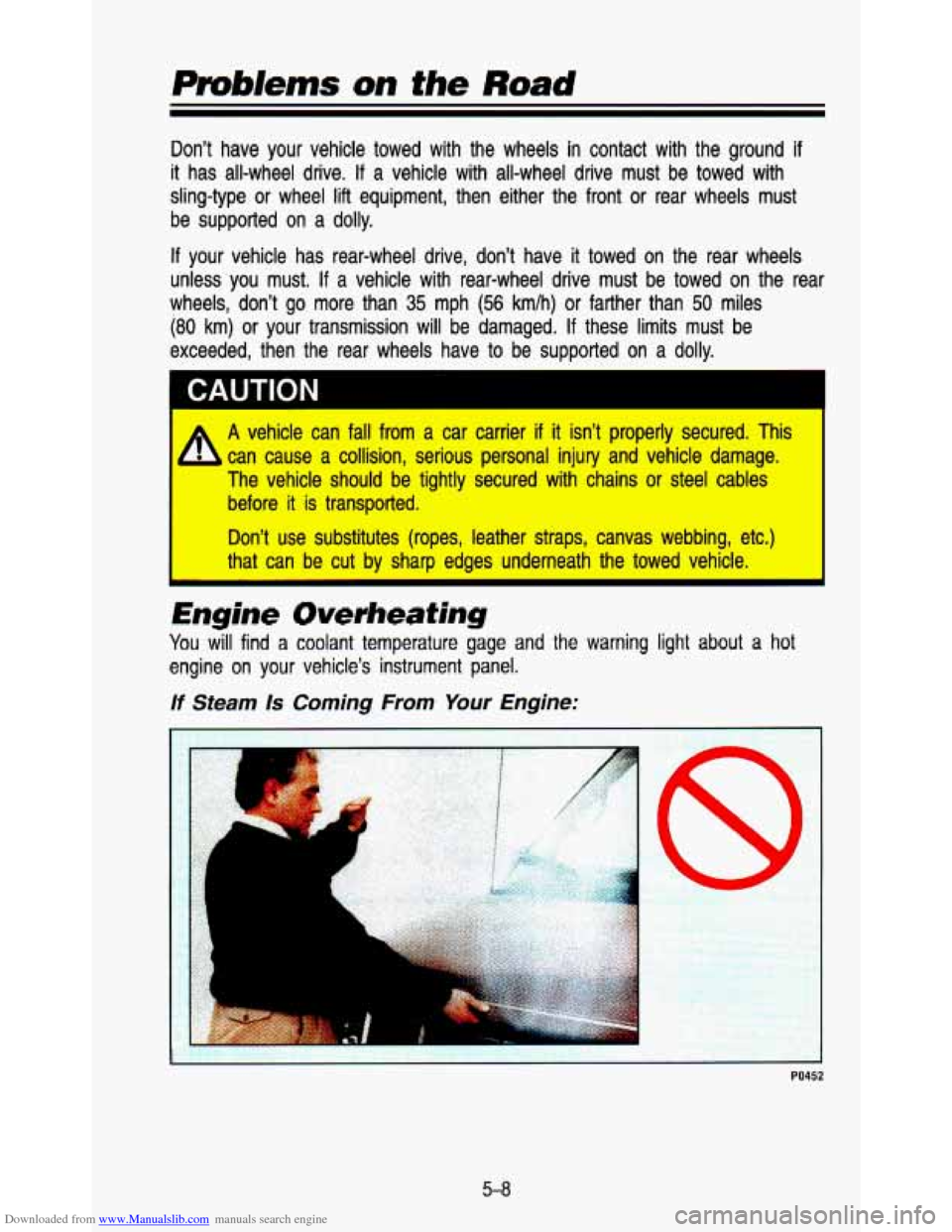
If Steam Is Coming From Your Engine:
PO452
5-8
Page 236 of 345
Downloaded from www.Manualslib.com manuals search engine Problems on the Road
If You’m Stuck: In Sand, Mud,
Ice or Snow
What you don’t want to do when your vehicle is stuck is to spin your
wheels. The method known as “rocking” can help you get o\
ut when you’re
stuck, but you must use caution.
I CAUTION
A
If you let your tires spin at high speed, they can explode and \
you or
others could be injured. And, the transmission or other parts of the
vehicle can overheat. That could cause an engine compartment fire
or other damage. When you’re stuck, spin the wheels as
little as
possible. Don’t spin the wheels above
35 mph (55 km/h) as shown
on the speedometer.
NOTICE
Spinning your wheels can destroy parts of your vehicle as well as the
tires.
If you spin the wheels too fast while shifting VOUI ;mission bal
and forth, you can destroy your transmissioi
Rocking your vehicle to get it out:
First, turn your steering wheel left and right. That will clea\
r the area around
your front wheels. Then shift back and forth between
R (Reverse) and a
forward gear, spinning the wheels
as little as possible. Release the
accelerator pedal while you shift, and press lightly on the ac\
celerator pedal
when the transmission is in gear.
If that doesn’t get you out after a few tries,
you may need to be towed out.
If you do need to be towed out, see “Towing Your Vehicle” in the Index.
5-32
Page 240 of 345
 sho\
ws the code letter for")
Downloaded from www.Manualslib.com manuals search engine Service & Appearance Care
NOTICE I-
Fuel
The 8th digit of your Vehicle Identification Number (VIN) sho\
ws the code letter for your engine. You will find the VIN at the top left of your instrument
panel. (See “Vehicle Identification Number” in the Index.)\
Use regular unleaded gasoline rated at 87 octane or higher. Wi\
th the 4.3L
(Code
W) engine, use premium unleaded gasoline rated at 91 octane or .
higher for high power performance, when towing a trailer or wi\
th a high
payload requirement. But when operating with a light load as a\
normal
condition, you may use middle grade or regular unleaded gasolin\
es.
The gasoline you use should meet specifications ASTM D4814 in the U.S.
and CGSB 3.5-92 in Canada. These fuels should have the proper \
additives,
so you should not have to add anything to the fuel.
In the
U.S. and Canada, it’s easy to be sure you get the right kind o\
f
gasoline (unleaded). You’ll see
UNLEADED right on the pump. And only
unleaded nozzles
will fit into your vehicle’s filler neck.
Be sure the posted octane
is at least 91 for premium, 89 for middle grade
and
87 for regular. If the octane is less than 87, you may get a heavy
knocking noise when you drive. If it’s bad enough,
it can damage your
engine.
6-4
Page 252 of 345
Downloaded from www.Manualslib.com manuals search engine Service & Appearance Care
PO383
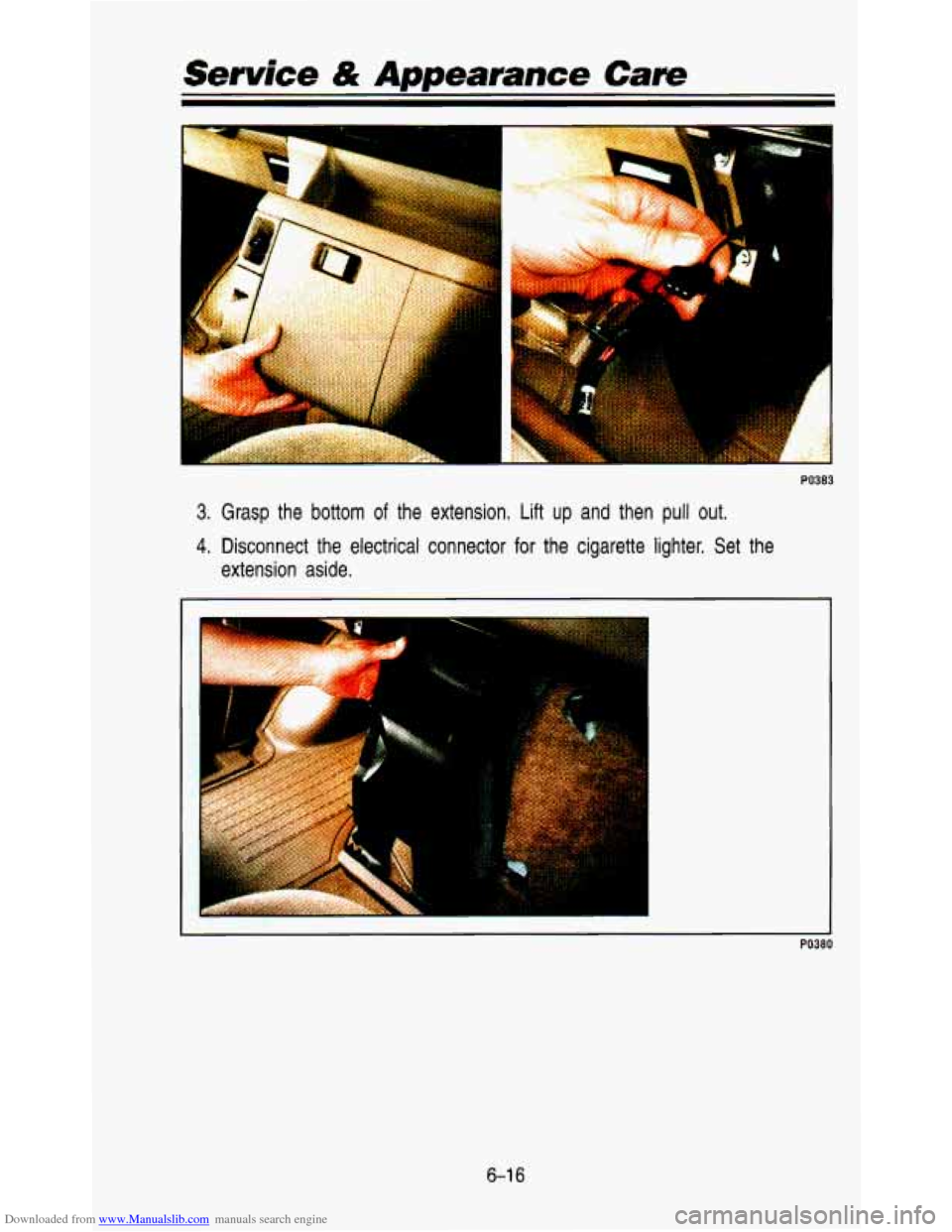
3. Grasp the bottom of the extension. Lift up and then pull out.
4. Disconnect the electrical connector for the cigarette lighter. S\
et the
extension aside.
6-1 6
Page 254 of 345
Downloaded from www.Manualslib.com manuals search engine Senrice & Appearance Cam
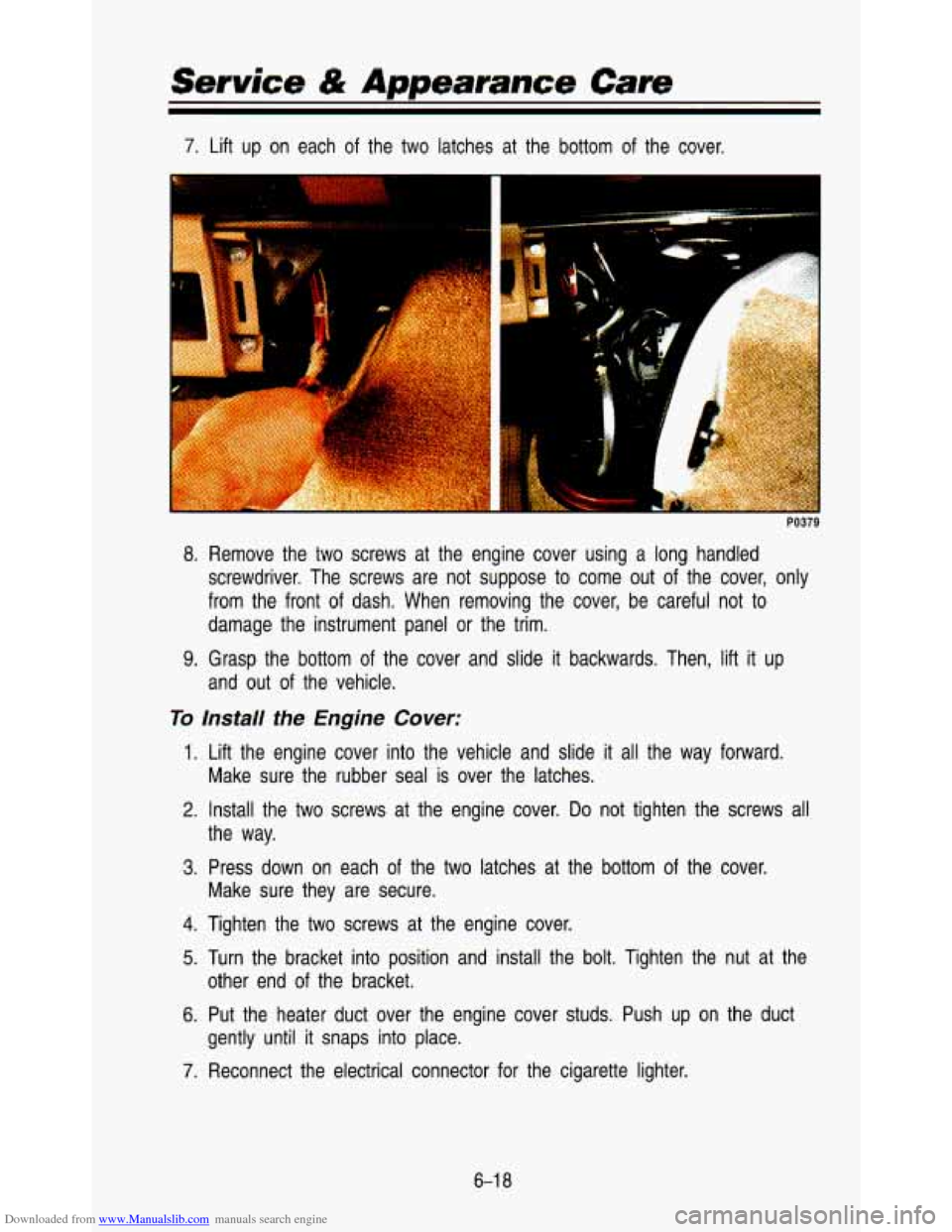
7. Lift up on each of the two latches at the bottom of the cover.
-
8. Remove the two screws at the engine cover using a long handle\
d
screwdriver. The screws are not suppose to come out of the co\
ver, only
from the front of dash. When removing the cover, be careful n\
ot to
damage the instrument panel or the trim.
9. Grasp the bottom of the cover and slide it backwards. Then, lift it up
and out of the vehicle.
To Install the Engine Cover:
1. Lift the engine cover into the vehicle and slide it all the way forward.
Make sure the rubber seal is over the latches.
2. Install the two screws at the engine cover. Do not tighten the screws all
3. Press down on each of the two latches at the bottom of the cover.
the way.
Make sure they are secure.
4. Tighten the two screws at the engine cover.
5. Turn the bracket into position and install the bolt. Tighten t\
he nut at the
6. Put the heater duct over the engine cover studs. Push up on \
the duct
other end
of the bracket.
gently until
it snaps into place.
7. Reconnect the electrical connector for the cigarette lighter.
6-1 8