light CHEVROLET ASTRO PASSENGER 1994 1.G Workshop Manual
[x] Cancel search | Manufacturer: CHEVROLET, Model Year: 1994, Model line: ASTRO PASSENGER, Model: CHEVROLET ASTRO PASSENGER 1994 1.GPages: 340, PDF Size: 16.86 MB
Page 186 of 340
Downloaded from www.Manualslib.com manuals search engine Hazard Warning Flashers
.I - -- .‘ -----
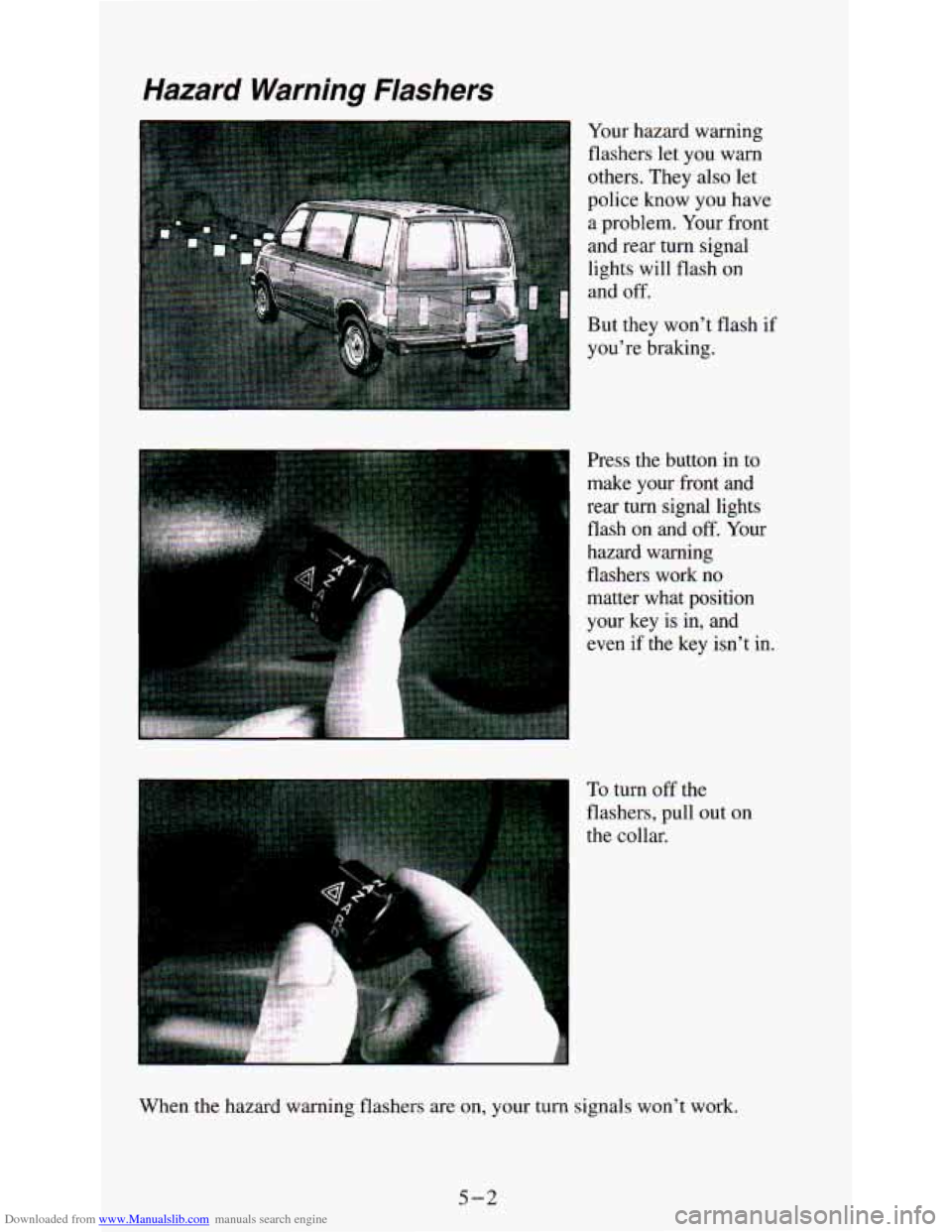
others. They also let
police know you have
a problem. Your front
and rear turn signal
lights will flash on
and
off.
But they won’t flash if
you’re braking.
. :
Press the button in to
make your front and
rear turn signal lights
flash on
and off. Your
hazard warning
flashers work
no
matter what position
your key is in, and
even
if the key isn’t in.
To turn off the
flashers, pull out on
the collar.
When the hazard warning flashers are on, your turn signals won’t work.
5-2
Page 188 of 340
Downloaded from www.Manualslib.com manuals search engine 2. Get the vehicles close enough so the jumper cables can reach, but be
sure the vehicles aren’t touching each other. If they are, it could cause a
ground connection you don’t want. You wouldn’t be able to start your
vehicle, and the bad grounding could damage the electrical systems.
You could be injured if the vehicles roll. Set the parking brake firmly
on each vehicle. Put an automatic transmission
in “P” (Park) or a
manual transmission in
“N’ (Neutral). If you have a four-wheel-drive
vehicle with a manual transfer case shift lever, be sure the transfer case
is not in
“N’ (Neutral).
needed, and radios. This will avoid sparks and help save both batteries.
And it could save your radio!
3. Turn off the ignition on both vehicles. Turn off all lights that aren’t
NOTICE:
If you leave your radio on, it could be badly damaged. The
repairs wouldn’t be covered by your warranty.
4. Open the hoods and locate the batteries. Find the positive (+) and
negative
(-) terminals on each battery.
5-4
Page 217 of 340
Downloaded from www.Manualslib.com manuals search engine If You’re Stuck: In Sand, Mud, Ice or Snow
What you don’t want to do when your vehicle is stuck is to spin your
wheels. The method known as “rocking” can help you get out when you’re
stuck, but you must use caution.
.. .. .. ., ..., . ....
1 NOTICE: I
Spinning your wheels can destroy parts of your vehicle as well as
the tires. If
you spin the wheels too fast while shifting your
transmission back and forth, you can destroy your transmission.
I
Rocking your vehicle to get it out:
First, turn your steering wheel left and right. That will clear the area around
your front wheels. Then shift back and forth between
“R’ (Reverse) and a
forward gear, spinning the wheels as little as possible. Release the
accelerator pedal while you shift, and press lightly on the accelerator pedal
when the transmission is in gear. If that doesn’t get you out after a few tries,
you may need to be towed out. If you do need to be towed out, see “Towing
Your Vehicle’’ in the Index.
5-33
Page 221 of 340
Downloaded from www.Manualslib.com manuals search engine NOTICE:
If you try to do your own service work without knowing enough
about it, your vehicle could be damaged.
The 8th digit of your Vehicle Identification Number (VTN) shows the code
letter for your engine. You will find the VIN at the top left
of your
instrument panel. (See “Vehicle Identification Number”
in the Index.)
Use regular unleaded gasoline rated at
87 octane or higher. With the
4.3L (Code
W) engine, use premium unleaded gasoline rated at 9 1 octane or
higher for high power performance, when towing a trailer or with a high
payload requirement. But when operating with a light load as a normal
condition, you may
use middle grade or regular unleaded gasolines.
The gasoline
you use should meet specifications ASTM D48 14 in the U.S.
and CGSB 3.5-92 in Canada. These fuels should have the proper additives,
so you should not have to add anything to the fuel.
In the U.S. and Canada, it’s easy to be sure
you get the right kind of
gasoline (unleaded). You’ll see “UNLEADED” right on the pump. And only
unleaded nozzles will fit into your vehicle’s filler neck.
Be sure the posted octane is at least
91 for premium, 89 for middle grade
and
87 for regular. If the octane is less than 87, you may get a heavy
knocking noise when you drive. If it’s bad enough, it can damage your
engine.
If you’re using fuel rated at 91 octane or higher and you still hear heavy
knocking, your engine needs service. But don’t worry if
you hear a little
pinging noise when you’re accelerating or driving up a hill. That’s normal,
and you don’t have
to buy a higher octane fuel to get rid of it. It’s the heavy,
constant knock that means
you have a problem.
What about gasoline with blending materials that contain oxygen \
(oxygenates), such as MTBE or alcohol?
MTBE is “methyl tertiary-butyl ether.” Fuel that is no more than
15% MTBE is fine for your vehicle.
6-3
Page 234 of 340
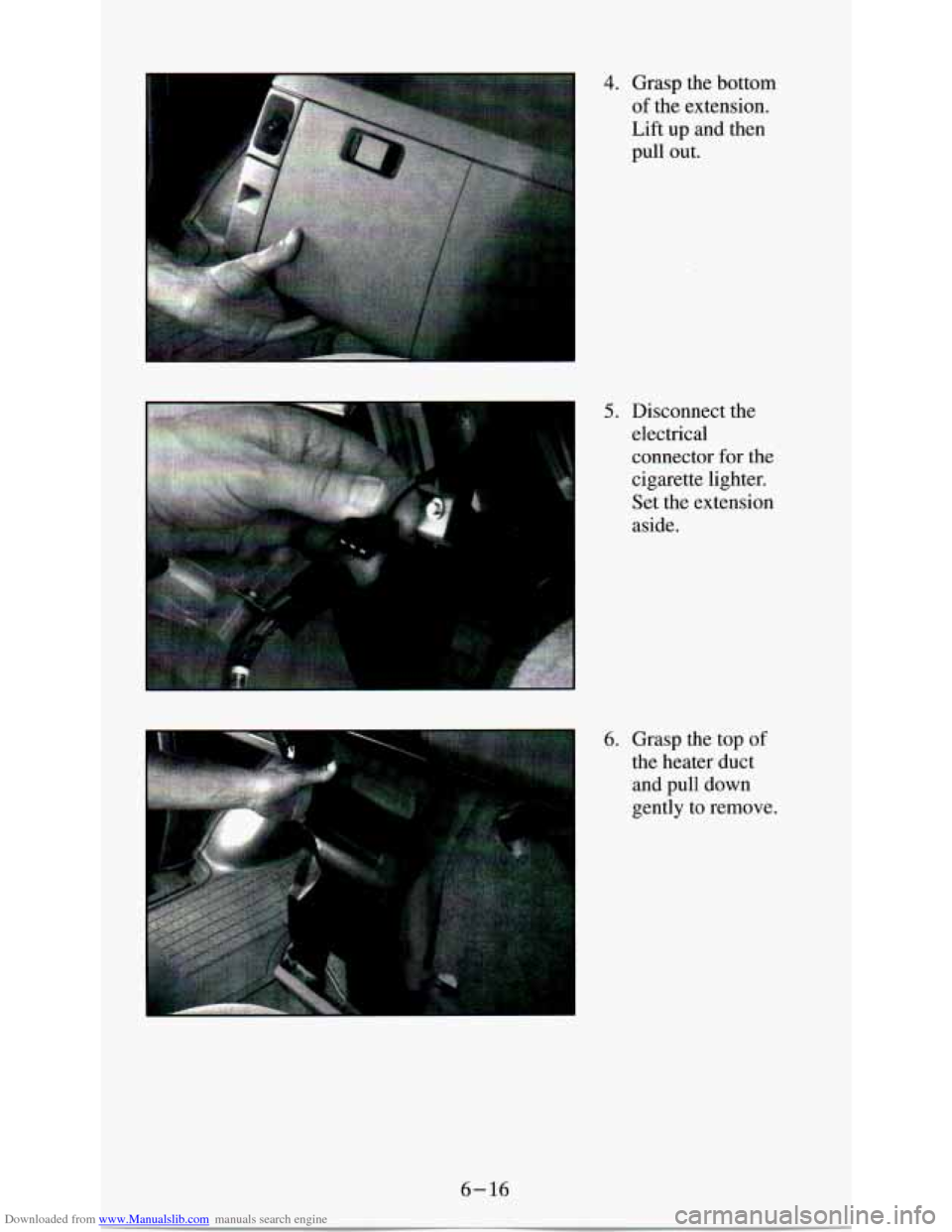
Downloaded from www.Manualslib.com manuals search engine 4. Grasp the bottom
of the extension.
Lift up and then
pull out.
5. Disconnect the
electrical
connector for the
cigarette lighter.
Set the extension
aside.
6. Grasp the top of
the heater duct and pull down
gently to remove.
6- 16
Page 236 of 340
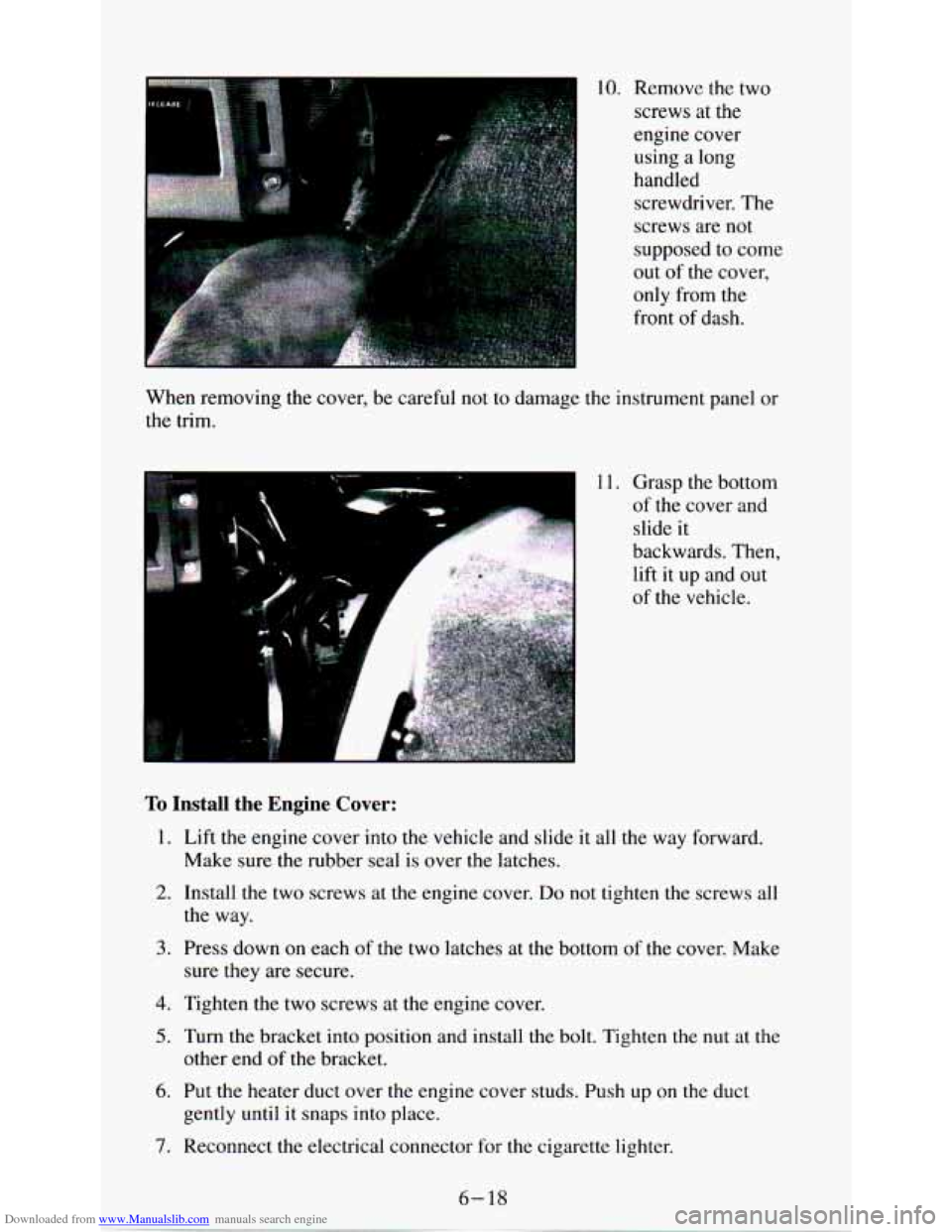
Downloaded from www.Manualslib.com manuals search engine 10. Remove the two screws
at the
engine cover
using
a long
handled screwdriver. The
screws are
not
supposed to come
out of the cover,
only from the
front of dash.
When removing the cover, be careful
not to damage the instrument panel or
the trim.
11. Grasp the bottom
of the cover and
slide it
backwards. Then,
lift
it up and out
of the vehicle.
To Install the Engine Cover:
1. Lift the engine cover into the vehicle and slide it all the way forward.
Make sure the rubber seal is over the latches.
2. Install the two screws at the engine cover. Do not tighten the screws all
the way.
3. Press down on each of the two latches at the bottom of the cover. Make
sure they are secure.
4. Tighten the two screws at the engine cover.
5. Turn the bracket into position and install the bolt. Tighten the nut at the
other end
of the bracket.
6. Put the heater duct over the engine cover studs. Push up on the duct
gently until it snaps into place.
7. Reconnect the electrical connector for the cigarette lighter.
6- 18
Page 252 of 340
Downloaded from www.Manualslib.com manuals search engine Brake Wear
Your vehicle has front disc brakes and rear drum brakes.
Disc brake pads have built-in wear indicators that make a high-pitched
warning sound when the brake pads are worn and new pads are needed. The
sound may come and go or be heard all the time your vehicle is moving
(except when you are pushing on the brake pedal firmly).
NOTICE:
Continuing to drive with worn-out brake pads could result in
costly brake repair.
Some driving conditions or climates may cause a brake squeal when the
brakes are first applied or lightly applied. This does not mean something is
wrong with your brakes.
Your rear drum brakes don't have wear indicators, but
if you ever hear a
rear brake rubbing noise, have the rear brake linings inspected. Also,
the
rear brake drums should be removed and inspected each time the tires are
removed for rotation or changing. When you have the front brakes replaced,
have the rear brakes inspected, too.
Brake linings should always be replaced as complete axle sets.
Brake Pedal Travel
See your dealer if the brake pedal does not return to normal height, or if
there is a rapid increase in pedal travel. This could be a sign of brake
trouble.
Brake Adjustment
Every time you make a brake stop, your disc brakes adjust for wear.
If your brake pedal goes down farther than normal, your rear drum brakes
may need adjustment. Adjust them by backing
up and firmly applying the
brakes a few times.
6-34
Page 254 of 340
Downloaded from www.Manualslib.com manuals search engine For more information on vehicle storage, contact your dealer’s service
department,
or write to:
Adistra Corporation
17 1 Hamilton Street
Plymouth, MI
48 170
In Canada, write to:
General Motors of Canada, Limited
Customer Services Department
Oshawa, Ontario
L1 J 5Z6
Fluid Leak Check
After the vehicle has been parked for awhile, inspect the surface beneath the
vehicle for water, oil, fuel or other fluids. Water dripping from the air
conditioning system
is normal. If you notice fuel leaks or fumes, the causes
should be found and corrected at once.
Bulb Replacement
Before replacing any bulbs, make sure all lights are off and the vehicle is
not running.
Halogen Bulbs
1_
6-36
Page 255 of 340
Downloaded from www.Manualslib.com manuals search engine Headlights
x ~.- P
m I
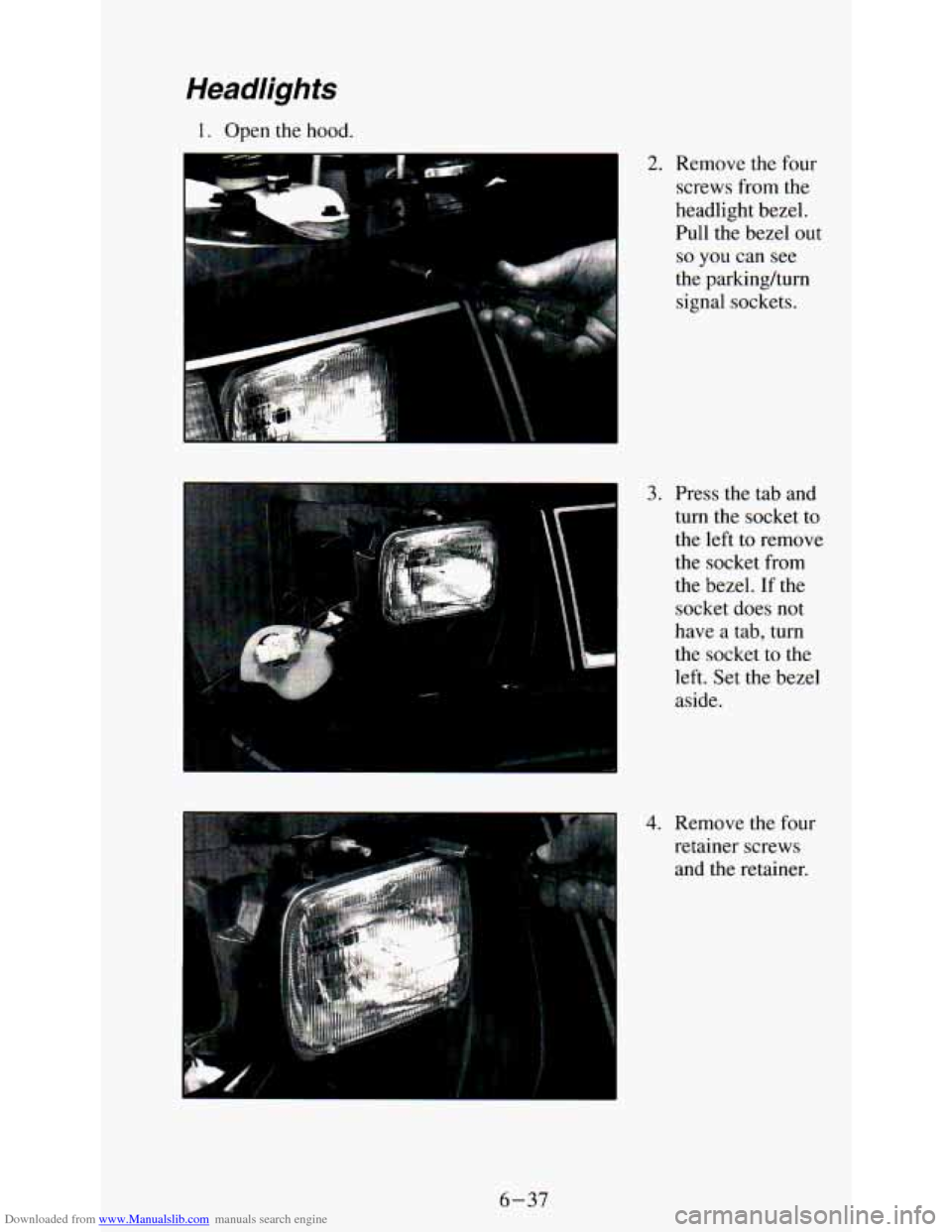
1. Open the hood.
2. Remove the four
screws from the
headlight bezel.
Pull the bezel out
so you can see
the parkingkurn
signal sockets. I
Press the tab and
turn the socket to
the left to remove
the socket from
the bezel. If
the
socket does not
have
a tab, turn
the socket to the
left. Set
the bezel
aside.
4. Remove the four
retainer screws
and the retainer.
6-37
Page 256 of 340
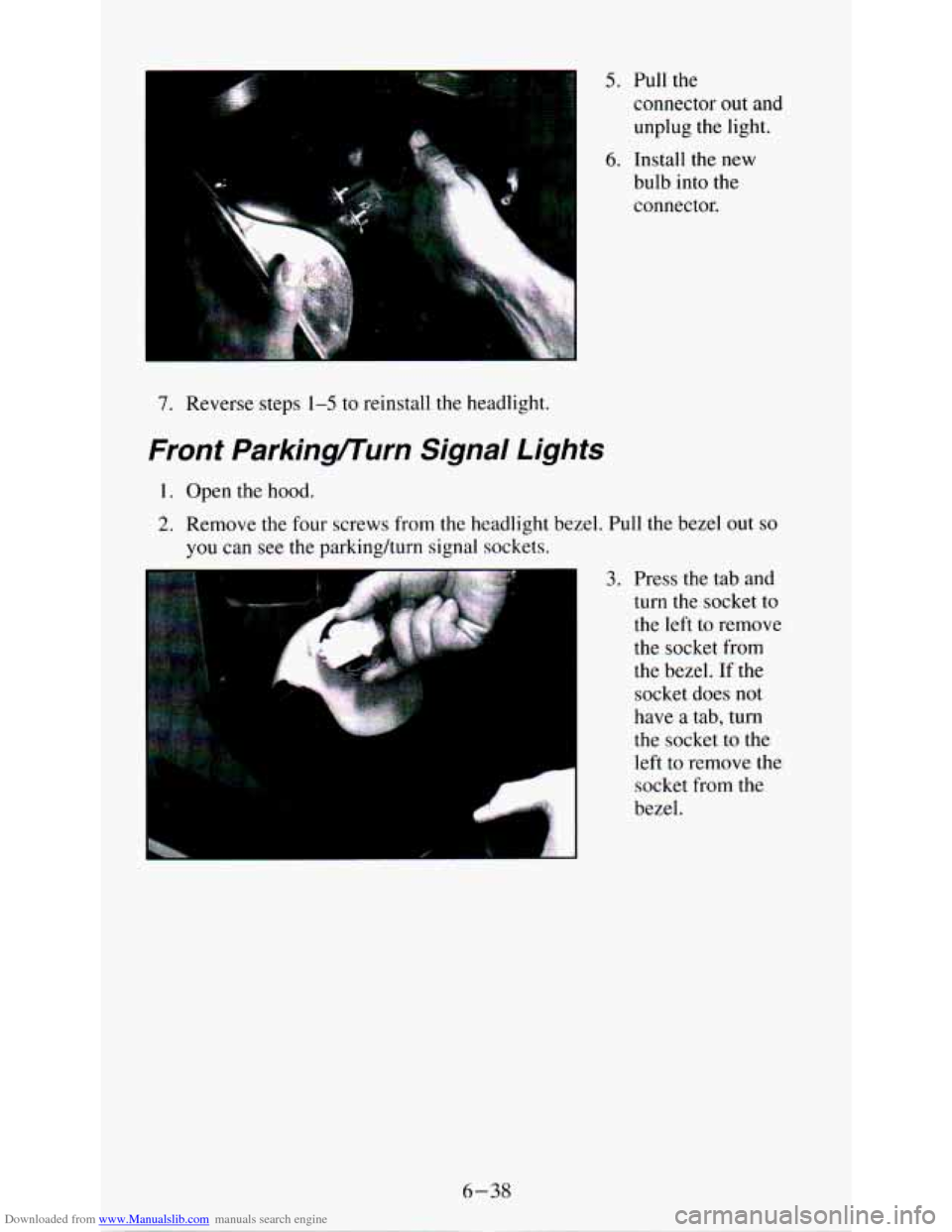
Downloaded from www.Manualslib.com manuals search engine 5. Pull the
connector out and
unplug the light.
6. Install the new
bulb into
the
connector.
7. Reverse steps 1-5 to reinstall the headlight.
Front Parkingflurn Signal Lights
1. Open the hood.
2. Remove the four screws from the headlight bezel. Pull the bezel out so
you can see the parkinghum signal sockets.
6-38
3. Press the tab and
turn the socket to
the left to remove
the socket from
the bezel.
If the
socket does
not
have a tab, turn
the socket to the
left to remove the
socket from the
bezel.