ECU CHEVROLET AVALANCHE 2007 2.G Repair Manual
[x] Cancel search | Manufacturer: CHEVROLET, Model Year: 2007, Model line: AVALANCHE, Model: CHEVROLET AVALANCHE 2007 2.GPages: 618, PDF Size: 3.25 MB
Page 370 of 618
Before You Go Off-Roading
There are some things to do before you go out.
For example, be sure to have all necessary
maintenance and service work done. Check to
make sure all underbody shields, if the vehicle has
them, are properly attached. Be sure you read
all the information about your four-wheel-drive
vehicle in this manual. Is there enough fuel? Is the
spare tire fully inated? Are the uid levels up
where they should be? What are the local
laws that apply to off-roading where you will be
driving? If you do not know, you should check with
law enforcement people in the area. Will you be
on someone’s private land? If so, be sure to
get the necessary permission.
Loading Your Vehicle for Off-Road
Driving
{CAUTION:
Cargo on the load oor piled higher
than the seatbacks can be thrown
forward during a sudden stop. You
or your passengers could be injured.
Keep cargo below the top of the
seatbacks.
Unsecured cargo on the load oor
can be tossed about when driving
over rough terrain. You or your
passengers can be struck by ying
objects. Secure the cargo properly.
CAUTION: (Continued)
370
Page 371 of 618
CAUTION: (Continued)
Heavy loads on the roof raise the
vehicle’s center of gravity, making it
more likely to roll over. You can be
seriously or fatally injured if the
vehicle rolls over. Put heavy loads
inside the cargo area, not on the roof.
Keep cargo in the cargo area as far
forward and low as possible.
There are some important things to remember
about how to load your vehicle.
The heaviest things should be on the load
oor and forward of the rear axle. Put
heavier items as far forward as you can.
Be sure the load is secured properly, so
driving on the off-road terrain does not
toss things around.
You will nd other important information in this
manual. SeeLoading Your Vehicle on page 402,
Luggage Carrier on page 171, andTires on
page 492.
Environmental Concerns
Off-road driving can provide wholesome and
satisfying recreation. However, it also raises
environmental concerns. We recognize these
concerns and urge every off-roader to follow these
basic rules for protecting the environment:
Always use established trails, roads, and areas
that have been specially set aside for public
off-road recreational driving; obey all
posted regulations.
Avoid any driving practice that could damage
the environment — shrubs, owers, trees,
grasses — or disturb wildlife. This includes
wheel-spinning, breaking down trees, or
unnecessary driving through streams or over
soft ground.
Always carry a litter bag — make sure all
refuse is removed from any campsite
before leaving.
Take extreme care with open res where
permitted, camp stoves, and lanterns.
Never park your vehicle over dry grass or
other combustible materials that could
catch re from the heat of the vehicle’s
exhaust system.
371
Page 396 of 618
Winter Driving
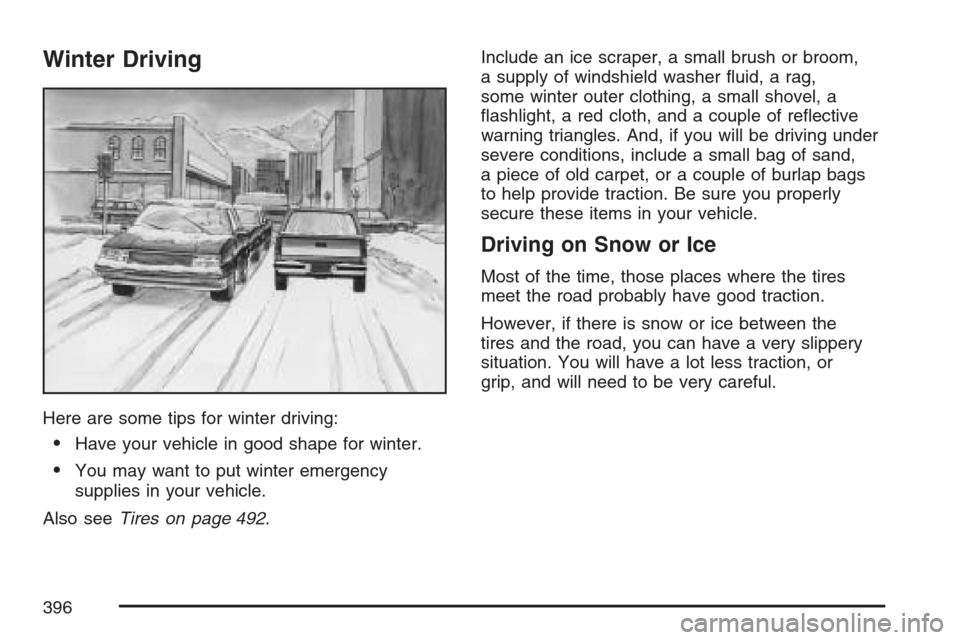
Here are some tips for winter driving:
Have your vehicle in good shape for winter.
You may want to put winter emergency
supplies in your vehicle.
Also seeTires on page 492.Include an ice scraper, a small brush or broom,
a supply of windshield washer uid, a rag,
some winter outer clothing, a small shovel, a
ashlight, a red cloth, and a couple of reective
warning triangles. And, if you will be driving under
severe conditions, include a small bag of sand,
a piece of old carpet, or a couple of burlap bags
to help provide traction. Be sure you properly
secure these items in your vehicle.
Driving on Snow or Ice
Most of the time, those places where the tires
meet the road probably have good traction.
However, if there is snow or ice between the
tires and the road, you can have a very slippery
situation. You will have a lot less traction, or
grip, and will need to be very careful.
396
Page 406 of 618
The Certication/Tire label also tells you the
maximum weights for the front and rear axles,
called Gross Axle Weight Rating (GAWR).
To nd out the actual loads on your front and
rear axles, you need to go to a weigh station and
weigh your vehicle. Your dealer can help you
with this. Be sure to spread out your load equally
on both sides of the centerline.
Never exceed the GVWR for your vehicle, or the
GAWR for either the front or rear axle.
And, if you do have a heavy load, you should
spread it out.
{CAUTION:
In the case of a sudden stop or collision,
things carried in the bed of your truck
could shift forward and come into the
passenger area, injuring you and others.
If you put things in the bed of your truck,
you should make sure they are properly
secured.
{CAUTION:
Do not load your vehicle any heavier than
the Gross Vehicle Weight Rating (GVWR),
or either the maximum front or rear Gross
Axle Weight Rating (GAWR). If you do,
parts on your vehicle can break, and it
can change the way your vehicle handles.
These could cause you to lose control
and crash. Also, overloading can shorten
the life of your vehicle.
Your warranty does not cover parts or components
that fail because of overloading.
The label will help you decide how much cargo
and installed equipment your truck can carry.
Using heavier suspension components to
get added durability might not change your weight
ratings. Ask your dealer to help you load your
vehicle the right way.
406
Page 407 of 618
If you put things inside your vehicle — like
suitcases, tools, packages, or anything else — they
will go as fast as the vehicle goes. If you have to
stop or turn quickly, or if there is a crash, they will
keep going.
{CAUTION:
Things you put inside your vehicle can
strike and injure people in a sudden stop
or turn, or in a crash.
Put things in the cargo area of your
vehicle. Try to spread the weight
evenly.
Never stack heavier things, like
suitcases, inside the vehicle so that
some of them are above the tops
of the seats.
Do not leave an unsecured child
restraint in your vehicle.
When you carry something inside the
vehicle, secure it whenever you can.
Do not leave a seat folded down
unless you need to.There is also important loading information for
off-road driving in this manual. See “Loading Your
Vehicle for Off-Road Driving” underOff-Road
Driving on page 368.
Add-On Equipment
When you carry removable items, you may need
to put a limit on how many people you can
carry inside your vehicle. Be sure to weigh your
vehicle before you buy and install the new
equipment.
Notice:Overloading your vehicle may cause
damage. Repairs would not be covered by your
warranty. Do not overload your vehicle.
Truck-Camper Loading Information
Your vehicle was neither designed nor intended
to carry a slide-in type camper.
Notice:Adding a slide-in camper or similar
equipment to your vehicle can damage it, and
the repairs would not be covered by your
warranty. Do not install a slide-in camper or
similar equipment on your vehicle.
407
Page 409 of 618
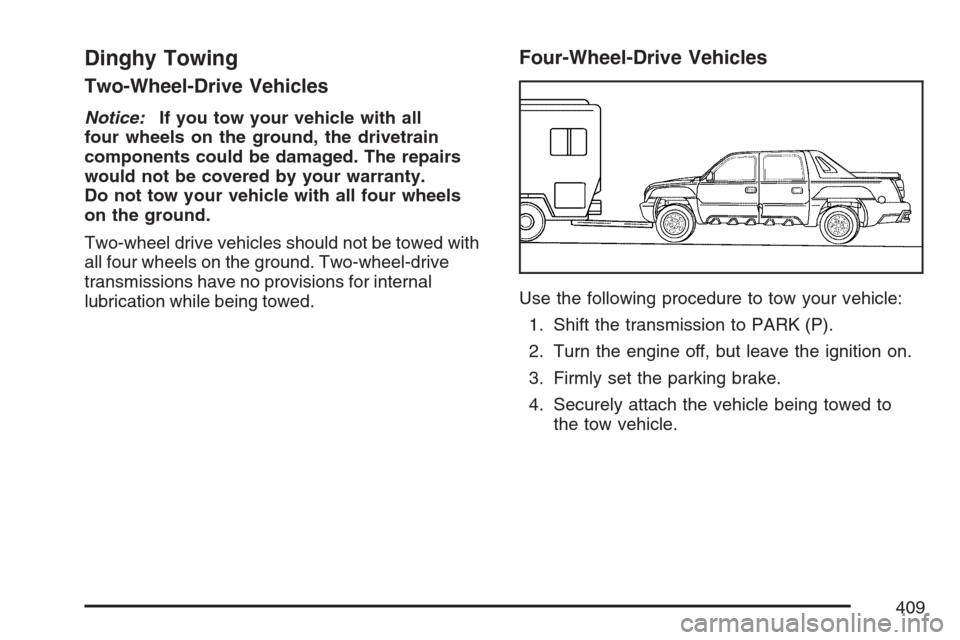
Dinghy Towing
Two-Wheel-Drive Vehicles
Notice:If you tow your vehicle with all
four wheels on the ground, the drivetrain
components could be damaged. The repairs
would not be covered by your warranty.
Do not tow your vehicle with all four wheels
on the ground.
Two-wheel drive vehicles should not be towed with
all four wheels on the ground. Two-wheel-drive
transmissions have no provisions for internal
lubrication while being towed.
Four-Wheel-Drive Vehicles
Use the following procedure to tow your vehicle:
1. Shift the transmission to PARK (P).
2. Turn the engine off, but leave the ignition on.
3. Firmly set the parking brake.
4. Securely attach the vehicle being towed to
the tow vehicle.
409
Page 411 of 618
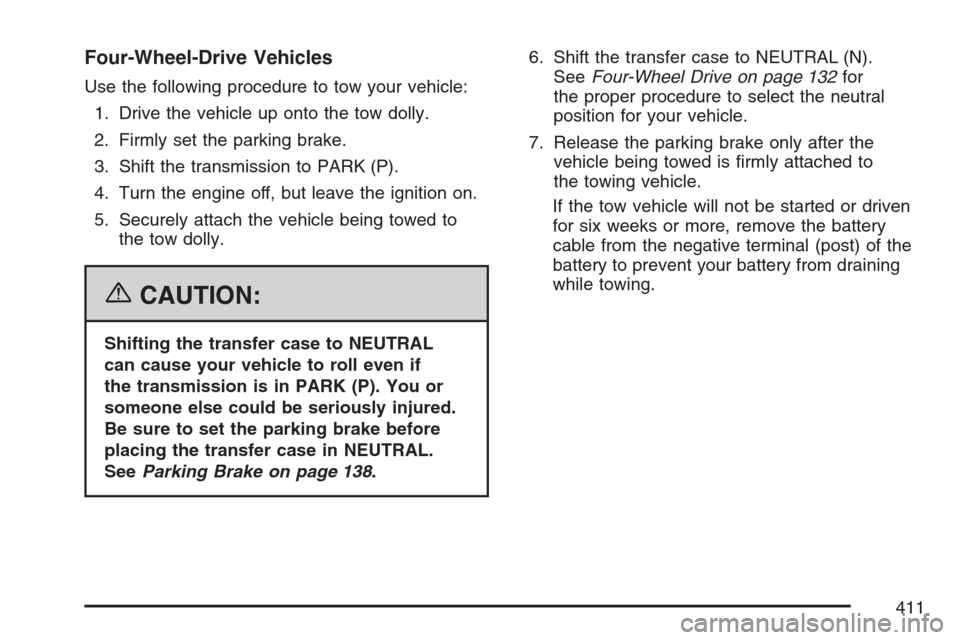
Four-Wheel-Drive Vehicles
Use the following procedure to tow your vehicle:
1. Drive the vehicle up onto the tow dolly.
2. Firmly set the parking brake.
3. Shift the transmission to PARK (P).
4. Turn the engine off, but leave the ignition on.
5. Securely attach the vehicle being towed to
the tow dolly.
{CAUTION:
Shifting the transfer case to NEUTRAL
can cause your vehicle to roll even if
the transmission is in PARK (P). You or
someone else could be seriously injured.
Be sure to set the parking brake before
placing the transfer case in NEUTRAL.
SeeParking Brake on page 138.6. Shift the transfer case to NEUTRAL (N).
SeeFour-Wheel Drive on page 132for
the proper procedure to select the neutral
position for your vehicle.
7. Release the parking brake only after the
vehicle being towed is rmly attached to
the towing vehicle.
If the tow vehicle will not be started or driven
for six weeks or more, remove the battery
cable from the negative terminal (post) of the
battery to prevent your battery from draining
while towing.
411
Page 412 of 618
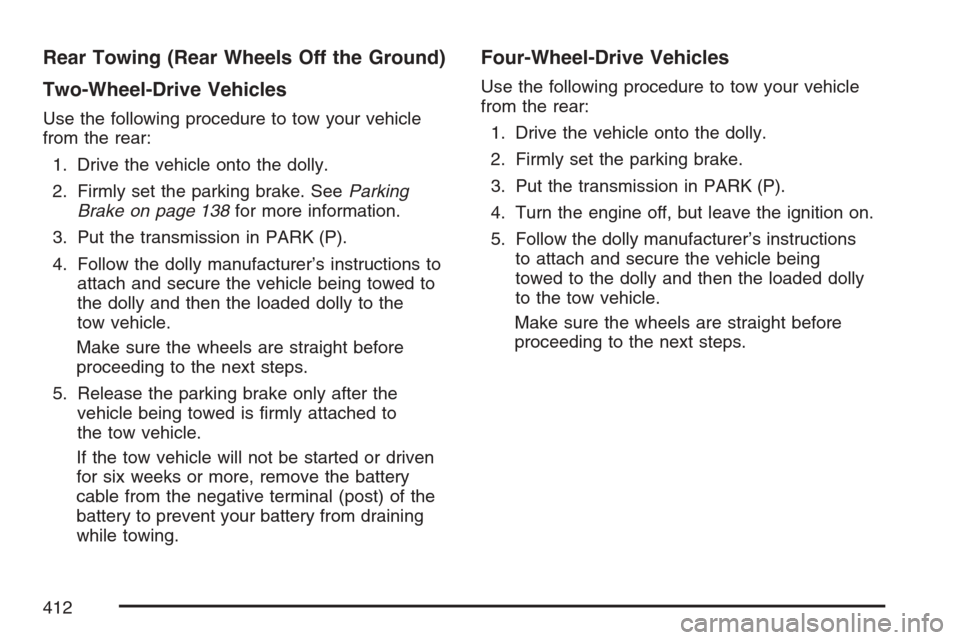
Rear Towing (Rear Wheels Off the Ground)
Two-Wheel-Drive Vehicles
Use the following procedure to tow your vehicle
from the rear:
1. Drive the vehicle onto the dolly.
2. Firmly set the parking brake. SeeParking
Brake on page 138for more information.
3. Put the transmission in PARK (P).
4. Follow the dolly manufacturer’s instructions to
attach and secure the vehicle being towed to
the dolly and then the loaded dolly to the
tow vehicle.
Make sure the wheels are straight before
proceeding to the next steps.
5. Release the parking brake only after the
vehicle being towed is rmly attached to
the tow vehicle.
If the tow vehicle will not be started or driven
for six weeks or more, remove the battery
cable from the negative terminal (post) of the
battery to prevent your battery from draining
while towing.
Four-Wheel-Drive Vehicles
Use the following procedure to tow your vehicle
from the rear:
1. Drive the vehicle onto the dolly.
2. Firmly set the parking brake.
3. Put the transmission in PARK (P).
4. Turn the engine off, but leave the ignition on.
5. Follow the dolly manufacturer’s instructions
to attach and secure the vehicle being
towed to the dolly and then the loaded dolly
to the tow vehicle.
Make sure the wheels are straight before
proceeding to the next steps.
412
Page 417 of 618
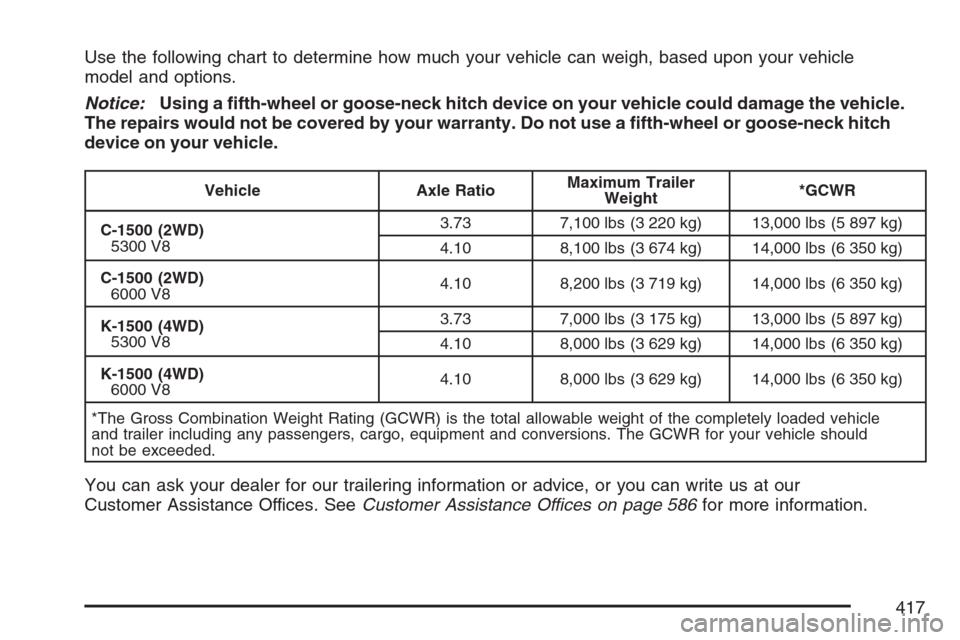
Use the following chart to determine how much your vehicle can weigh, based upon your vehicle
model and options.
Notice:Using a fth-wheel or goose-neck hitch device on your vehicle could damage the vehicle.
The repairs would not be covered by your warranty. Do not use a fth-wheel or goose-neck hitch
device on your vehicle.
Vehicle Axle RatioMaximum Trailer
Weight*GCWR
C-1500 (2WD)
5300 V83.73 7,100 lbs (3 220 kg) 13,000 lbs (5 897 kg)
4.10 8,100 lbs (3 674 kg) 14,000 lbs (6 350 kg)
C-1500 (2WD)
6000 V84.10 8,200 lbs (3 719 kg) 14,000 lbs (6 350 kg)
K-1500 (4WD)
5300 V83.73 7,000 lbs (3 175 kg) 13,000 lbs (5 897 kg)
4.10 8,000 lbs (3 629 kg) 14,000 lbs (6 350 kg)
K-1500 (4WD)
6000 V84.10 8,000 lbs (3 629 kg) 14,000 lbs (6 350 kg)
*The Gross Combination Weight Rating (GCWR) is the total allowable weight of the completely loaded vehicle
and trailer including any passengers, cargo, equipment and conversions. The GCWR for your vehicle should
not be exceeded.
You can ask your dealer for our trailering information or advice, or you can write us at our
Customer Assistance Offices. SeeCustomer Assistance Offices on page 586for more information.
417
Page 422 of 618
Trailer Brakes
If your trailer weighs more than 2,000 lbs (900 kg)
loaded, then it needs its own brakes — and
they must be adequate. Be sure to read and
follow the instructions for the trailer brakes so
you’ll be able to install, adjust and maintain
them properly.
Since your vehicle is equipped with the
StabiliTrak
®system, your trailer brake system
cannot tap into the vehicle’s hydraulic brake
system.
Driving with a Trailer
Towing a trailer requires a certain amount of
experience. Before setting out for the open road,
you’ll want to get to know your rig. Acquaint
yourself with the feel of handling and braking
with the added weight of the trailer. And always
keep in mind that the vehicle you are driving
is now a good deal longer and not nearly
as responsive as your vehicle is by itself.Before you start, check all trailer hitch parts and
attachments, safety chains, electrical connector,
lamps, tires and mirror adjustment. If the trailer
has electric brakes, start your vehicle and
trailer moving and then apply the trailer brake
controller by hand to be sure the brakes are
working. This lets you check your electrical
connection at the same time.
During your trip, check occasionally to be sure
that the load is secure, and that the lamps and
any trailer brakes are still working.
Following Distance
Stay at least twice as far behind the vehicle ahead
as you would when driving your vehicle without
a trailer. This can help you avoid situations
that require heavy braking and sudden turns.
Passing
You’ll need more passing distance up ahead when
you’re towing a trailer. And, because you’re a
good deal longer, you’ll need to go much farther
beyond the passed vehicle before you can
return to your lane.
422