ECU CHEVROLET AVALANCHE 2007 2.G Manual PDF
[x] Cancel search | Manufacturer: CHEVROLET, Model Year: 2007, Model line: AVALANCHE, Model: CHEVROLET AVALANCHE 2007 2.GPages: 618, PDF Size: 3.25 MB
Page 460 of 618
Adding Coolant
If you need more coolant, add the proper
DEX-COOL®coolant mixture at the surge tank,
but only when the engine is cool. SeeCooling
System on page 464.
{CAUTION:
You can be burned if you spill coolant
on hot engine parts. Coolant contains
ethylene glycol, and it will burn if the
engine parts are hot enough. Do not
spill coolant on a hot engine.
When replacing the pressure cap, make sure
it is hand-tight and fully seated.
Coolant Surge Tank Pressure Cap
Notice:If the pressure cap is not tightly
installed, coolant loss and possible engine
damage may occur. Be sure the cap is properly
and tightly secured.
The coolant surge tank pressure cap must be fully
installed on the coolant surge tank. SeeEngine
Compartment Overview on page 444for more
information on location.
Engine Overheating
You will nd a coolant temperature gage on your
vehicle’s instrument panel. SeeEngine Coolant
Temperature Gage on page 249.
In addition, you will nd an ENGINE
OVERHEATED STOP ENGINE, ENGINE
OVERHEATED IDLE ENGINE, and an ENGINE
POWER IS REDUCED message in the Driver
Information Center (DIC) on the instrument panel.
SeeDIC Warnings and Messages on page 267.
460
Page 506 of 618
Federal Communications
Commission (FCC) and Industry
and Science Canada
The Tire Pressure Monitor System (TPMS)
operates on a radio frequency and complies with
Part 15 of the FCC Rules. Operation is subject
to the following two conditions:
1. This device may not cause harmful
interference.
2. This device must accept any interference
received, including interference that may
cause undesired operation.
The Tire Pressure Monitor System (TPMS)
operates on a radio frequency and complies with
RSS-210 of Industry and Science Canada.
Operation is subject to the following two conditions:
1. This device may not cause interference.
2. This device must accept any interference
received, including interference that may
cause undesired operation of the device.
Changes or modications to this system by other
than an authorized service facility could void
authorization to use this equipment.
Tire Inspection and Rotation
Tires should be rotated every 5,000 to 8,000 miles
(8 000 to 13 000 km).
Any time you notice unusual wear, rotate your
tires as soon as possible and check wheel
alignment. Also check for damaged tires or wheels.
SeeWhen It Is Time for New Tires on page 508
andWheel Replacement on page 512for
more information.
Make sure the spare tire is stored securely. Push,
pull, and then try to rotate or turn the tire. If it
moves, use the ratchet/wheel wrench to tighten the
cable. SeeChanging a Flat Tire on page 516.
The purpose of regular rotation is to achieve
more uniform wear for all tires on the vehicle.
The rst rotation is the most important. See
Scheduled Maintenance on page 563.
506
Page 514 of 618
Tire Chains
{CAUTION:
If your vehicle has P265/65R18 or
P275/55R20 size tires, do not use tire
chains. They can damage your vehicle
because there is not enough clearance.
Tire chains used on a vehicle without the
proper amount of clearance can cause
damage to the brakes, suspension, or
other vehicle parts. The area damaged by
the tire chains could cause you to lose
control of your vehicle and you or others
may be injured in a crash.
Use another type of traction device only if
its manufacturer recommends it for use
on your vehicle and tire size combination
and road conditions. Follow that
manufacturer’s instructions.
CAUTION: (Continued)
CAUTION: (Continued)
To help avoid damage to your vehicle,
drive slowly, readjust or remove the
device if it is contacting your vehicle,
and do not spin your vehicle’s wheels.
If you do nd traction devices that will t,
install them on the rear tires.
Notice:If your vehicle has P265/70R17 size
tires, use tire chains only where legal and
only when you must. Use chains that are the
proper size for your vehicle’s tires. Install them
on the rear tires only.
Do not use chains on the front tires.
Tighten them as tightly as possible with the
ends securely fastened. Drive slowly and follow
the chain manufacturer’s instructions. If you
can hear the chains contacting your vehicle,
stop and retighten them. If the contact
continues, slow down until it stops. Driving
too fast or spinning the wheels with chains
on will damage your vehicle.
514
Page 530 of 618
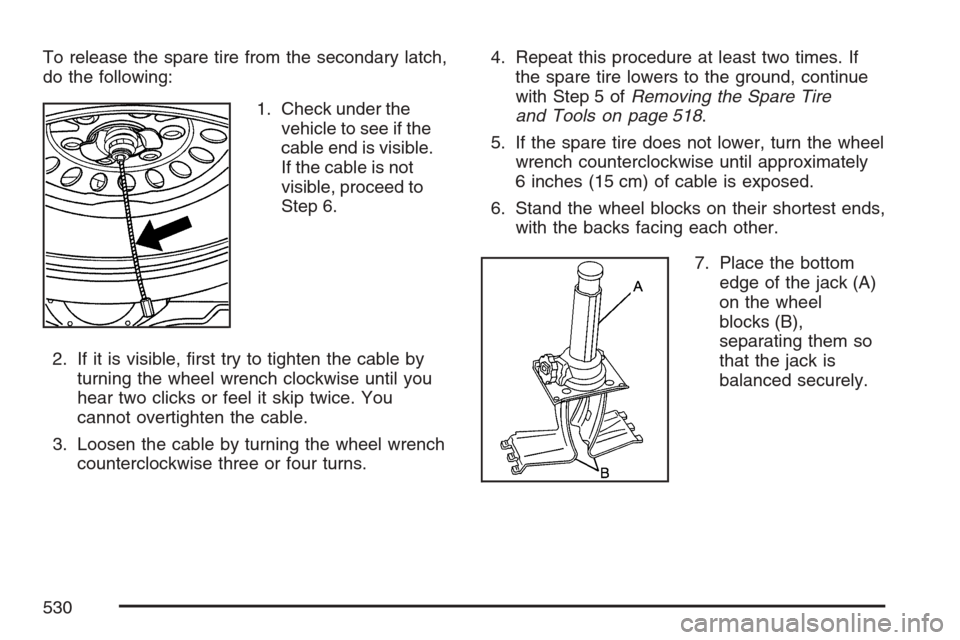
To release the spare tire from the secondary latch,
do the following:
1. Check under the
vehicle to see if the
cable end is visible.
If the cable is not
visible, proceed to
Step 6.
2. If it is visible, rst try to tighten the cable by
turning the wheel wrench clockwise until you
hear two clicks or feel it skip twice. You
cannot overtighten the cable.
3. Loosen the cable by turning the wheel wrench
counterclockwise three or four turns.4. Repeat this procedure at least two times. If
the spare tire lowers to the ground, continue
with Step 5 ofRemoving the Spare Tire
and Tools on page 518.
5. If the spare tire does not lower, turn the wheel
wrench counterclockwise until approximately
6 inches (15 cm) of cable is exposed.
6. Stand the wheel blocks on their shortest ends,
with the backs facing each other.
7. Place the bottom
edge of the jack (A)
on the wheel
blocks (B),
separating them so
that the jack is
balanced securely.
530
Page 535 of 618
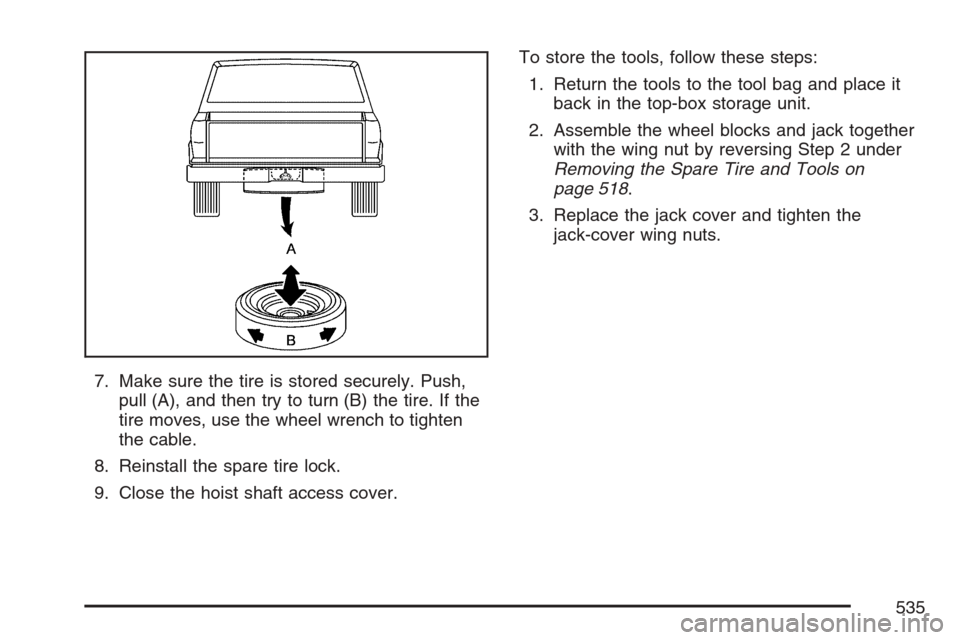
7. Make sure the tire is stored securely. Push,
pull (A), and then try to turn (B) the tire. If the
tire moves, use the wheel wrench to tighten
the cable.
8. Reinstall the spare tire lock.
9. Close the hoist shaft access cover.To store the tools, follow these steps:
1. Return the tools to the tool bag and place it
back in the top-box storage unit.
2. Assemble the wheel blocks and jack together
with the wing nut by reversing Step 2 under
Removing the Spare Tire and Tools on
page 518.
3. Replace the jack cover and tighten the
jack-cover wing nuts.
535
Page 571 of 618
At Least Once a Month
Tire Ination Check
Visually inspect your vehicle’s tires and make
sure they are inated to the correct pressures.
Do not forget to check the spare tire. See
Ination - Tire Pressure on page 500. Check to
make sure the spare tire is stored securely.
SeeChanging a Flat Tire on page 516.
Tire Wear Inspection
Tire rotation may be required for high mileage
highway drivers prior to the Engine Oil Life
System service notication. Check the tires for
wear and, if necessary, rotate the tires. See
Tire Inspection and Rotation on page 506.
At Least Once a Year
Starter Switch Check
{CAUTION:
When you are doing this inspection, the
vehicle could move suddenly. If the vehicle
moves, you or others could be injured.
1. Before you start, be sure you have enough
room around the vehicle.
2. Firmly apply both the parking brake and
the regular brake. SeeParking Brake
on page 138.
Do not use the accelerator pedal, and be ready
to turn off the engine immediately if it starts.
3. Try to start the engine in each gear.
The vehicle should start only in PARK (P) or
NEUTRAL (N). If the vehicle starts in any
other position, contact your GM Goodwrench
®
dealer for service.
571
Page 589 of 618
Who is Covered?
Roadside Assistance coverage is for the vehicle
operator, regardless of ownership. A person driving
this vehicle without the consent of the owner is
not eligible for coverage.
The following services are provided in the U.S.
during the Bumper-to-Bumper warranty period and,
in Canada, during the Base Warranty coverage
period of the New Vehicle Limited Warranty, up to
a maximum coverage of $100.
Fuel Delivery:Delivery of enough fuel for the
customer to get to the nearest service station
(about $5 in the U.S. and 10 litres in
Canada). Service to provide diesel may be
restricted. For safety reasons, propane
and other alternative fuels will not be provided
through this service.
Lock-out Service:To ensure security, the
driver must present the vehicle registration
and personal ID before lock-out service
is provided. Lock-out service will be covered
at no charge if you are unable to gain
entry into your vehicle.If your vehicle will not start, Roadside
Assistance will arrange to have your vehicle
towed to the nearest authorized dealership.
In the U.S., replacement keys made at
the customer’s expense will be covered within
10 miles (16 km).
Emergency Tow From a Public Roadway
or Highway:Tow to the nearest dealership
for warranty service or in the event of a
vehicle-disabling accident. Winch-out
assistance when the vehicle is mired in
sand, mud, or snow.
Flat Tire Change:If your vehicle has a spare
tire, installation of the tire in good condition
will be covered at no charge. The customer is
responsible for the repair or replacement of
the tire if not covered by a warrantable failure.
Jump Start:No-start occurrences which
require a battery jump start will be covered
at no charge.
589
Page 590 of 618
Additional Services for Canadian
Customers
Trip Routing Service:Upon Request,
Roadside Assistance will send you detailed,
computer-personalized maps, highlighting
your choice of either the most direct route or
the most scenic route to your destination,
anywhere in North America, along with
any helpful travel information we may have
pertaining to your trip. To request this service,
please call us toll-free at 1-800-268-6800.
We will make every attempt to send your
personalized trip routing as quickly as possible,
but it is best to allow three weeks before your
planned departure date. Trip routing requests
will be limited to six per calendar year.
Trip Interruption Benets and Assistance:
In the event of a warranty related vehicle
disablement, while en route and over
250 kilometres from original point of departure,
you may qualify for trip interruption expense
assistance. This assistance covers reasonable
reimbursement of up to a maximum of $500
(Canadian) for (A) meals (maximum of $50/
day), (B) lodging (maximum of $100/night)and (C) alternate ground transportation
(maximum of $40/day). This benet is to assist
you with some of the unplanned expense you
may incur while waiting for your vehicle to be
repaired.
Pre-authorization, original detailed receipts and
a copy of the repair order are required.
Once authorization has been given, your
advisor will help you make any necessary
arrangements and explain how to claim for trip
interruption expense assistance.
Alternative Service:There may be times,
when Roadside Assistance cannot provide
timely assistance, your advisor may authorize
you to secure local emergency road service,
and you will be reimbursed up to $100 upon
submission of the original receipt to Roadside
Assistance.
In many instances, mechanical failures are
covered under Chevrolet’s Bumper-to-Bumper
warranty, and the duration of the Base Warranty
Coverage for Canadian customers of the new
Vehicle Limited Warranty. However, any cost
for parts and labor for non-warranty repairs are
the responsibility of the driver.
590
Page 591 of 618
For prompt and efficient assistance when calling,
please provide the following to the Roadside
Assistance Representative:
Your name, home address, and home
telephone number.
Telephone number of your location.
Location of the vehicle.
Model, year, color, and license plate number.
Odometer reading, Vehicle Identication
Number (VIN), and delivery date of the vehicle.
Description of the problem.
While we hope you never have the occasion to
use our service, it is added security while traveling
for you and your family. Remember, we are
only a phone call away. U.S. customers call
Chevrolet Roadside Assistance:1-800-CHEV-USA
(1-800-243-8872), text telephone (TTY) users,
call1-888-889-2438, Canadian customers
call1-800-268-6800.Chevrolet and General Motors of Canada Limited
reserve the right to limit services or reimbursement
to an owner or driver when, in their sole
discretion, the claims become excessive in
frequency or type of occurrence.
Roadside Assistance is not part of or included in
the coverage provided by the New Vehicle Limited
Warranty. Chevrolet and General Motors of
Canada Limited reserve the right to make any
changes or discontinue the Roadside Assistance
program at any time without notication.Towing and Road Service Exclusions
Specically excluded from Roadside Assistance
coverage are towing or services for vehicles
operated on a non-public roadway or highway,
nes, impound towing caused by a violation
of local, Municipal, State, Provincial, or Federal
law, and mounting, dismounting or changing
of snow tires, chains, or other traction devices.
591
Page 605 of 618
Care of
Safety Belts............................................. 540
Your CD and DVD Player........................ 349
Your CDs and DVDs................................ 349
Cargo Area, All-Weather.............................. 186
Cargo Cover Panels.................................... 173
CD, MP3 ............................................319, 325
Center Console Storage Area...................... 171
Center Front Passenger Position,
Safety Belts............................................... 36
Center Overhead Console........................... 171
Center Seat.................................................. 18
Chains, Tire................................................. 514
Charging System Light................................ 245
Check
Engine Light............................................ 250
Checking Things Under the Hood................ 442
Chemical Paint Spotting.............................. 544
Child Restraints
Child Restraint Systems............................. 51
Infants and Young Children........................ 48
Lower Anchors and Tethers for Children....... 57
Older Children........................................... 45
Securing a Child Restraint in a
Rear Seat Position................................. 65
Securing a Child Restraint in the
Center Front Seat Position..................... 67Child Restraints (cont.)
Securing a Child Restraint in the
Right Front Seat Position........................ 68
Where to Put the Restraint........................ 55
Cigarette Lighter.......................................... 226
Cleaning
Aluminum or Chrome-Plated Wheels........ 542
Exterior Lamps/Lenses............................. 541
Fabric/Carpet........................................... 538
Finish Care.............................................. 541
Inside of Your Vehicle .............................. 537
Instrument Panel, Vinyl, and
Other Plastic Surfaces.......................... 540
Leather.................................................... 539
Tires........................................................ 543
Underbody Maintenance........................... 544
Washing Your Vehicle .............................. 541
Weatherstrips........................................... 540
Windshield and Wiper Blades................... 542
Climate Control System
Dual......................................................... 227
Dual Automatic......................................... 230
Outlet Adjustment..................................... 238
Clock.........................................288, 289, 290
Collision Damage Repair............................. 595
Comfort Guides, Rear Safety Belt................. 41
Compass............................................145, 148
605