tow CHEVROLET AVALANCHE 2007 2.G Repair Manual
[x] Cancel search | Manufacturer: CHEVROLET, Model Year: 2007, Model line: AVALANCHE, Model: CHEVROLET AVALANCHE 2007 2.GPages: 618, PDF Size: 3.25 MB
Page 428 of 618
Electric Brake Control Wiring
Provisions
These wiring provisions are included with your
vehicle as part of the heavy-duty trailer wiring
package. These provisions are for an electric
brake controller. The instrument panel contains
blunt cut wires near the data link connector for
the trailer brake controller. The harness contains
the following wires:
Dark Blue: Auxiliary
Red/Black: Battery #
Light Blue: Brake Switch
White: Ground
The trailer brake controller should be installed
by your dealer or a qualied service center.
Trailer Recommendations
You must subtract your hitch loads from the
Cargo Weight Rating (CWR). CWR is the
maximum weight of the load your vehicle can
carry. It doesn’t include the weight of the people
inside, but you can gure about 150 lbs. (68 kg)
for each seat. The total cargo load must not
be more than your vehicles CWR.
Weigh your vehicle with your trailer attached,
so that you won’t go over the GVWR or GAWR.
If you are using a weight-distributing hitch,
weigh the vehicle without the spring bars in place.
You’ll get the best performance if you spread
out the weight of your load the right way, and if
you choose the correct hitch and trailer brakes.
For more information seeTowing a Trailer
on page 414.
428
Page 446 of 618
Engine Oil
If the CHECK OIL LEVEL message in the Driver
Information Center (DIC) comes on, check the
engine oil level right away. For more information,
see CHECK OIL LEVEL underDIC Warnings and
Messages on page 267. You should check the
engine oil level regularly; this is an added reminder.
Checking Engine Oil
It is a good idea to check the engine oil every time
you get fuel. In order to get an accurate reading,
the oil must be warm and the vehicle must be
on level ground.The engine oil dipstick handle is a yellow loop.
SeeEngine Compartment Overview on page 444
for the location of the engine oil dipstick.
1. Turn off the engine and give the oil several
minutes to drain back into the oil pan. If you
do not do this, the oil dipstick might not
show the actual level.
2. Pull out the dipstick and clean it with a paper
towel or cloth, then push it back in all the
way. Remove it again, keeping the tip down,
and check the level.
446
Page 456 of 618
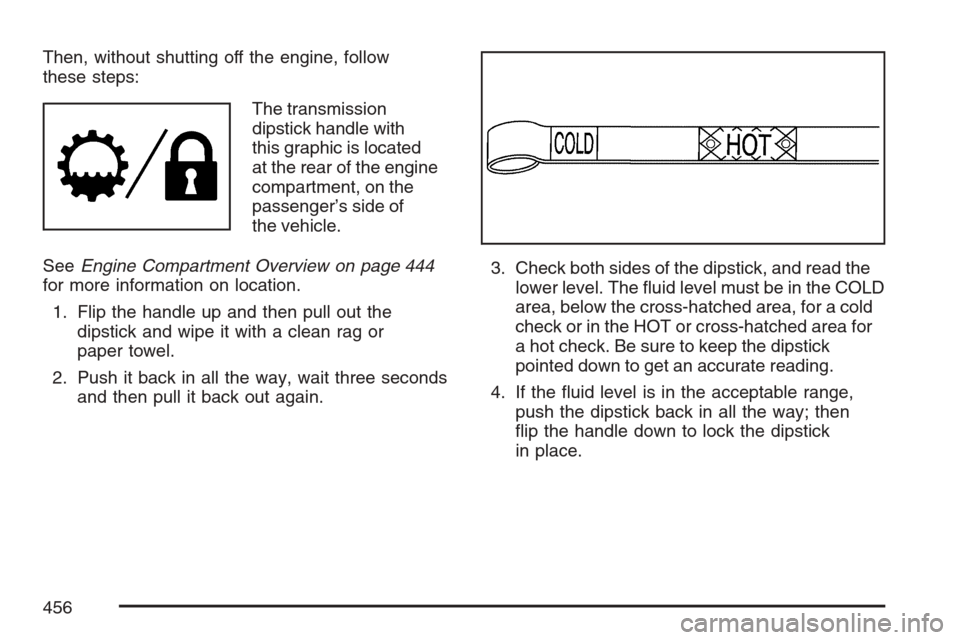
Then, without shutting off the engine, follow
these steps:
The transmission
dipstick handle with
this graphic is located
at the rear of the engine
compartment, on the
passenger’s side of
the vehicle.
SeeEngine Compartment Overview on page 444
for more information on location.
1. Flip the handle up and then pull out the
dipstick and wipe it with a clean rag or
paper towel.
2. Push it back in all the way, wait three seconds
and then pull it back out again.3. Check both sides of the dipstick, and read the
lower level. The uid level must be in the COLD
area, below the cross-hatched area, for a cold
check or in the HOT or cross-hatched area for
a hot check. Be sure to keep the dipstick
pointed down to get an accurate reading.
4. If the uid level is in the acceptable range,
push the dipstick back in all the way; then
ip the handle down to lock the dipstick
in place.
456
Page 462 of 618
If No Steam Is Coming From
Your Engine
The ENGINE OVERHEATED STOP ENGINE
or the ENGINE OVERHEATED IDLE ENGINE
message, along with a low coolant condition,
can indicate a serious problem.
If you get an engine overheat warning, but see
or hear no steam, the problem may not be
too serious. Sometimes the engine can get a
little too hot when you:
Climb a long hill on a hot day.
Stop after high-speed driving.
Idle for long periods in traffic.
Tow a trailer. SeeTowing a Trailer
on page 414.If you get the ENGINE OVERHEATED STOP
ENGINE or the ENGINE OVERHEATED IDLE
ENGINE message with no sign of steam, try this
for a minute or so:
1. If you have an air conditioner and it is on,
turn it off.
2. Turn on your heater to full hot at the highest
fan speed and open the windows as
necessary.
3. In heavy traffic, let the engine idle in
NEUTRAL (N) while stopped. If it is safe to
do so, pull off the road, shift to PARK (P)
or NEUTRAL (N) and let the engine idle.
If you no longer have the overheat warning,
you can drive. Just to be safe, drive slower for
about 10 minutes. If the warning does not
come back on, you can drive normally.
If the warning continues, pull over, stop, and
park your vehicle immediately.
462
Page 463 of 618
If there is still no sign of steam and your vehicle
is equipped with an engine-driven cooling fan,
push down the accelerator until the engine speed
is about twice as fast as normal idle speed for
at least ve minutes while you are parked.
If there is still no sign of steam and your vehicle
is equipped with an electric cooling fan, idle
the engine for ve minutes while you are parked.
If you still have the warning, turn off the engine
and get everyone out of the vehicle until it
cools down. Also, see “Overheated Engine
Protection Operating Mode” later in this section.
You may decide not to lift the hood but to get
service help right away.Overheated Engine Protection
Operating Mode
If an overheated engine condition exists and the
REDUCED ENGINE POWER message is
displayed, an overheat protection mode which
alternates ring groups of cylinders helps prevent
engine damage. In this mode, you will notice a
loss in power and engine performance. This
operating mode allows your vehicle to be driven to
a safe place in an emergency. Driving extended
miles (km) and/or towing a trailer in the overheat
protection mode should be avoided.
Notice:After driving in the overheated engine
protection operating mode, to avoid engine
damage, allow the engine to cool before
attempting any repair. The engine oil will be
severely degraded. Repair the cause of coolant
loss, change the oil and reset the oil life
system. SeeEngine Oil on page 446.
463
Page 469 of 618
5. Then replace the pressure cap. Be sure the
pressure cap is hand-tight and fully seated.
6. Verify coolant level after engine is shut off
and the coolant is cold. If necessary, repeat
coolant ll procedure steps 1 through 6.
Engine Fan Noise
Your vehicle has electric cooling fans, you may
hear the fans spinning at low speed during
most everyday driving. The fans may turn off if no
cooling is required. Under heavy vehicle loading,
trailer towing, and/or high outside temperatures,
or if you are operating your air conditioning
system, the fans may change to high speed and
you may hear an increase in fan noise. This
is normal and indicates that the cooling system
is functioning properly. The fans will change to
low speed when additional cooling is no longer
required.
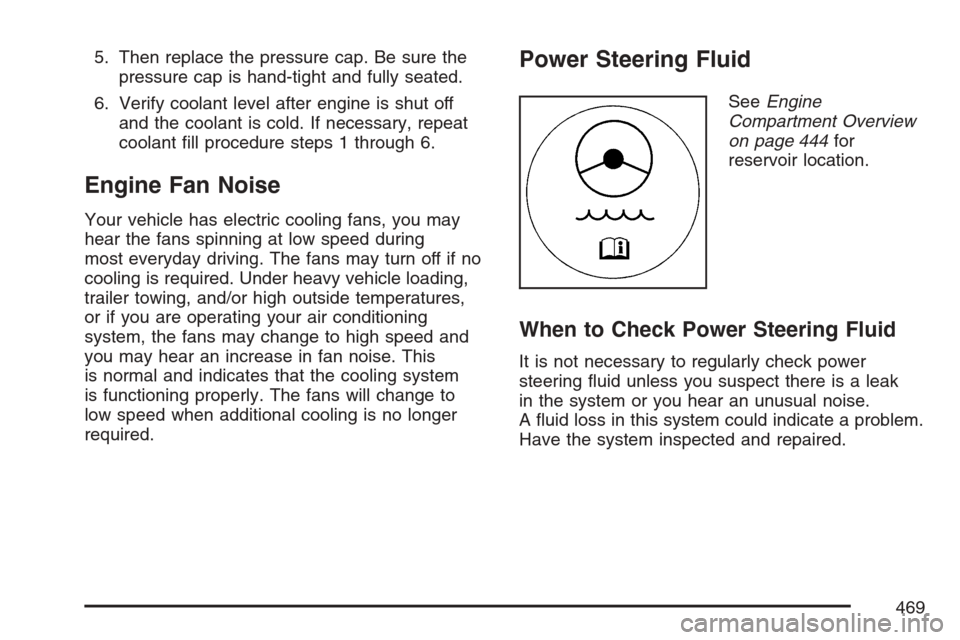
Power Steering Fluid
SeeEngine
Compartment Overview
on page 444for
reservoir location.
When to Check Power Steering Fluid
It is not necessary to regularly check power
steering uid unless you suspect there is a leak
in the system or you hear an unusual noise.
A uid loss in this system could indicate a problem.
Have the system inspected and repaired.
469
Page 507 of 618

When rotating your vehicle’s tires, always use the
correct rotation pattern shown here.
Do not include the spare tire in the tire rotation.
After the tires have been rotated, adjust the
front and rear ination pressures as shown on the
tire and loading information label. SeeLoading
Your Vehicle on page 402andInation - Tire
Pressure on page 500, for more information.
Vehicles that have the Tire Pressure Monitor
System (TPMS) will need to have the TPMS
sensors reset after a tire rotation. See “TPMS
Sensor Identication Codes” underTire Pressure
Monitor System on page 501.Make certain that all wheel nuts are properly
tightened. See “Wheel Nut Torque” under
Capacities and Specications on page 556.
{CAUTION:
Rust or dirt on a wheel, or on the parts to
which it is fastened, can make wheel nuts
become loose after time. The wheel could
come off and cause an accident. When
you change a wheel, remove any rust or
dirt from places where the wheel attaches
to the vehicle. In an emergency, you can
use a cloth or a paper towel to do this;
but be sure to use a scraper or wire brush
later, if needed, to get all the rust or dirt
off. SeeChanging a Flat Tire on page 516.
507
Page 515 of 618
If a Tire Goes Flat
It is unusual for a tire to blowout while you are
driving, especially if you maintain your vehicle’s
tires properly. If air goes out of a tire, it is
much more likely to leak out slowly. But if you
should ever have a blowout, here are a few tips
about what to expect and what to do:
If a front tire fails, the at tire will create a drag
that pulls the vehicle toward that side. Take
your foot off the accelerator pedal and grip the
steering wheel rmly. Steer to maintain lane
position, and then gently brake to a stop well
out of the traffic lane.
A rear blowout, particularly on a curve, acts much
like a skid and may require the same correction
you would use in a skid. In any rear blowout
remove your foot from the accelerator pedal.
Get the vehicle under control by steering the
way you want the vehicle to go. It may be very
bumpy and noisy, but you can still steer. Gently
brake to a stop, well off the road if possible.{CAUTION:
Lifting a vehicle and getting under it to
do maintenance or repairs is dangerous
without the appropriate safety equipment
and training. The jack provided with your
vehicle is designed only for changing a
at tire. If it is used for anything else, you
or others could be badly injured or killed
if the vehicle slips off the jack. Use the
jack provided with your vehicle only for
changing a at tire.
If a tire goes at, the next part shows how to use
the jacking equipment to change a at tire safely.
515
Page 521 of 618
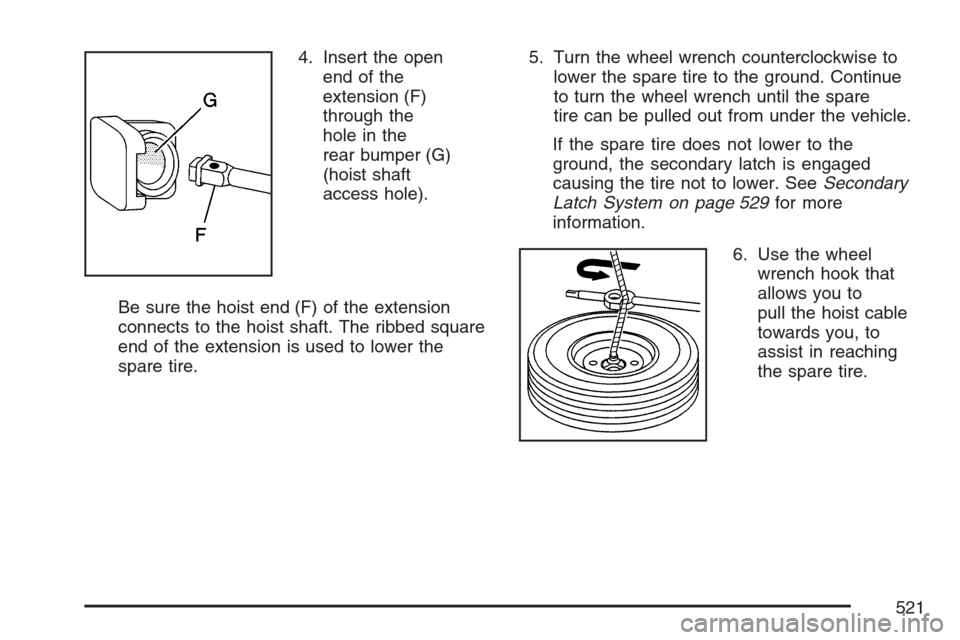
4. Insert the open
end of the
extension (F)
through the
hole in the
rear bumper (G)
(hoist shaft
access hole).
Be sure the hoist end (F) of the extension
connects to the hoist shaft. The ribbed square
end of the extension is used to lower the
spare tire.5. Turn the wheel wrench counterclockwise to
lower the spare tire to the ground. Continue
to turn the wheel wrench until the spare
tire can be pulled out from under the vehicle.
If the spare tire does not lower to the
ground, the secondary latch is engaged
causing the tire not to lower. SeeSecondary
Latch System on page 529for more
information.
6. Use the wheel
wrench hook that
allows you to
pull the hoist cable
towards you, to
assist in reaching
the spare tire.
521
Page 527 of 618
{CAUTION:
Rust or dirt on the wheel, or on the parts to
which it is fastened, can make the wheel
nuts become loose after time. The wheel
could come off and cause an accident.
When you change a wheel, remove any rust
or dirt from the places where the wheel
attaches to the vehicle. In an emergency,
you can use a cloth or a paper towel to do
this; but be sure to use a scraper or wire
brush later, if needed, to get all the rust
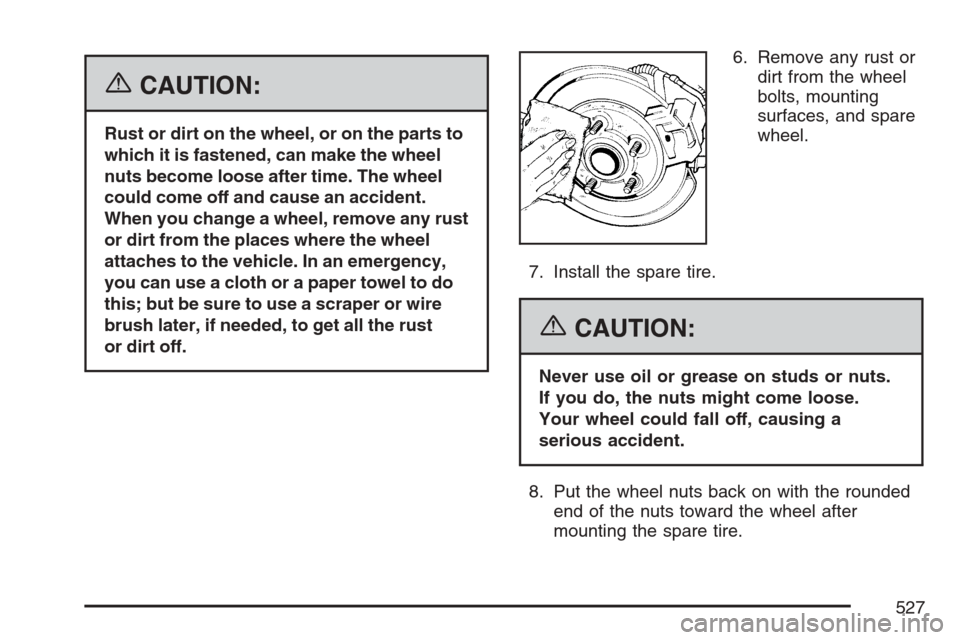
or dirt off.6. Remove any rust or
dirt from the wheel
bolts, mounting
surfaces, and spare
wheel.
7. Install the spare tire.
{CAUTION:
Never use oil or grease on studs or nuts.
If you do, the nuts might come loose.
Your wheel could fall off, causing a
serious accident.
8. Put the wheel nuts back on with the rounded
end of the nuts toward the wheel after
mounting the spare tire.
527