radiator CHEVROLET AVEO 2002 Service User Guide
[x] Cancel search | Manufacturer: CHEVROLET, Model Year: 2002, Model line: AVEO, Model: CHEVROLET AVEO 2002Pages: 5127, PDF Size: 41.82 MB
Page 1730 of 5127

❑Replace spark plugs.An Emission Control Service.
❑Inspect drive belts.
❑Inspect timing belt.
❑Drain, flush and refill cooling system. SeeEngine
Coolant on page 5-23for what to use. Inspect
hoses. Clean radiator, condenser, pressure cap
and neck. Pressure test the cooling system and
pressure cap.An Emission Control Service.
❑Inspect EVAP canister, vapor lines and solenoid valve
filter.An Emission Control Service. (See footnote †.)
❑Inspect PCV system.An Emission Control Service.
(See footnote †.)
❑Change brake/clutch fluid (or every 24 months,
whichever occurs first).
33,000 Miles (55 000 km)
❑Change engine oil and filter (or every 3 months,
whichever occurs first).An Emission Control Service.
36,000 Miles (60 000 km)
❑Change engine oil and filter (or every 3 months,
whichever occurs first).An Emission Control Service.
❑Rotate tires. SeeTire Inspection and Rotation
on page 5-60for proper rotation pattern and
additional information.(See footnote +.)
39,000 Miles (65 000 km)
❑Change engine oil and filter (or every 3 months,
whichever occurs first).An Emission Control Service.
42,000 Miles (70 000 km)
❑Change engine oil and filter (or every 3 months,
whichever occurs first).An Emission Control Service.
❑Rotate tires. SeeTire Inspection and Rotation
on page 5-60for proper rotation pattern and
additional information.(See footnote +.)
6-9
Page 1732 of 5127

❑Replace spark plugs.An Emission Control Service.
❑Replace spark plug wires.An Emission Control
Service.
❑Inspect drive belts.
❑Replace timing belt.
❑Drain, flush and refill cooling system. SeeEngine
Coolant on page 5-23for what to use. Inspect
hoses. Clean radiator, condenser, pressure cap
and neck. Pressure test the cooling system
and pressure cap.An Emission Control Service.
❑Inspect EVAP canister, vapor lines and solenoid valve
filter.An Emission Control Service. (See footnote †.)
❑Inspect PCV system.An Emission Control Service.
(See footnote †.)
❑Change brake/clutch fluid (or every 24 months,
whichever occurs first).63,000 Miles (105 000 km)
❑Change engine oil and filter (or every 3 months,
whichever occurs first).An Emission Control Service.
66,000 Miles (110 000 km)
❑Change engine oil and filter (or every 3 months,
whichever occurs first).An Emission Control Service.
❑Rotate tires. SeeTire Inspection and Rotation
on page 5-60for proper rotation pattern and
additional information.(See footnote +.)
69,000 Miles (115 000 km)
❑Change engine oil and filter (or every 3 months,
whichever occurs first).An Emission Control Service.
72,000 Miles (120 000 km)
❑Change engine oil and filter (or every 3 months,
whichever occurs first).An Emission Control Service.
❑Rotate tires. SeeTire Inspection and Rotation
on page 5-60for proper rotation pattern and
additional information.(See footnote +.)
6-11
Page 1734 of 5127

❑Replace spark plugs.An Emission Control Service.
❑Replace fuel filter.An Emission Control Service.
(See footnote †.)
❑Inspect drive belts.
❑Inspect timing belt.
❑Drain, flush and refill cooling system. SeeEngine
Coolant on page 5-23for what to use. Inspect
hoses. Clean radiator, condenser, pressure cap
and neck. Pressure test the cooling system
and pressure cap.An Emission Control Service.
❑Inspect EVAP canister, vapor lines and solenoid valve
filter.An Emission Control Service. (See footnote †.)
❑Inspect PCV system.An Emission Control Service.
(See footnote †.)
❑Change brake/clutch fluid (or every 24 months,
whichever occurs first).93,000 Miles (155 000 km)
❑Change engine oil and filter (or every 3 months,
whichever occurs first).An Emission Control Service.
96,000 Miles (160 000 km)
❑Change engine oil and filter (or every 3 months,
whichever occurs first).An Emission Control Service.
❑Rotate tires. SeeTire Inspection and Rotation
on page 5-60for proper rotation pattern and
additional information.(See footnote +.)
99,000 Miles (165 000 km)
❑Change engine oil and filter (or every 3 months,
whichever occurs first).An Emission Control Service.
6-13
Page 1736 of 5127

22,500 Miles (37 500 km)
❑Change engine oil and filter (or every 12 months,
whichever occurs first).An Emission Control Service.
❑Rotate tires. SeeTire Inspection and Rotation on
page 5-60for proper rotation pattern and additional
information.(See footnote +.)
30,000 Miles (50 000 km)
❑Change engine oil and filter (or every 12 months,
whichever occurs first).An Emission Control Service.
❑Replace passenger compartment air filter. If you drive
regularly under dusty conditions, the filter may require
replacement more often.
❑Replace engine air cleaner filter. SeeEngine Air
Cleaner/Filter on page 5-20for more information.
An Emission Control Service.
❑Rotate tires. SeeTire Inspection and Rotation on
page 5-60for proper rotation pattern and additional
information.(See footnote +.)
❑Replace spark plugs.An Emission Control Service.
❑Inspect drive belts.❑Inspect timing belt.
❑Drain, flush and refill cooling system. SeeEngine
Coolant on page 5-23for what to use. Inspect hoses.
Clean radiator, condenser, pressure cap and neck.
Pressure test the cooling system and pressure cap.
An Emission Control Service.
❑Inspect EVAP canister, vapor lines and solenoid valve
filter.An Emission Control Service. (See footnote †.)
❑Inspect PCV system.An Emission Control Service.
(See footnote †.)
❑Change brake/clutch fluid (or every 24 months,
whichever occurs first).
37,500 Miles (62 500 km)
❑Change engine oil and filter (or every 12 months,
whichever occurs first).An Emission Control Service.
❑Rotate tires. SeeTire Inspection and Rotation on
page 5-60for proper rotation pattern and additional
information.(See footnote +.)
6-15
Page 1738 of 5127

❑Drain, flush and refill cooling system. SeeEngine
Coolant on page 5-23for what to use. Inspect hoses.
Clean radiator, condenser, pressure cap
and neck. Pressure test the cooling system and
pressure cap.An Emission Control Service.
❑Inspect EVAP canister, vapor lines and solenoid valve
filter.An Emission Control Service. (See footnote †.)
❑Inspect PCV system.An Emission Control Service.
(See footnote †.)
❑Change brake/clutch fluid (or every 24 months,
whichever occurs first).
67,500 Miles (112 500 km)
❑Change engine oil and filter (or every 12 months,
whichever occurs first).An Emission Control Service.
❑Rotate tires. SeeTire Inspection and Rotation on
page 5-60for proper rotation pattern and additional
information.(See footnote +.)
75,000 Miles (125 000 km)
❑Change engine oil and filter (or every 12 months,
whichever occurs first).An Emission Control Service.
❑Replace passenger compartment air filter. If you drive
regularly under dusty conditions, the filter may require
replacement more often.
❑Inspect engine air cleaner filter. SeeEngine Air
Cleaner/Filter on page 5-20for more information.
An Emission Control Service. (See footnote †.)
❑Rotate tires. SeeTire Inspection and Rotation on
page 5-60for proper rotation pattern and additional
information.(See footnote +.)
❑Inspect drive belts.
82,500 Miles (137 500 km)
❑Change engine oil and filter (or every 12 months,
whichever occurs first).An Emission Control Service.
❑Rotate tires. SeeTire Inspection and Rotation on
page 5-60for proper rotation pattern and additional
information.(See footnote +.)
6-17
Page 1739 of 5127

90,000 Miles (150 000 km)
❑Change engine oil and filter (or every 12 months,
whichever occurs first).An Emission Control Service.
❑Replace passenger compartment air filter. If you drive
regularly under dusty conditions, the filter may require
replacement more often.
❑Replace engine air cleaner filter. SeeEngine Air
Cleaner/Filter on page 5-20for more information.
An Emission Control Service.
❑Rotate tires. SeeTire Inspection and Rotation on
page 5-60for proper rotation pattern and additional
information.(See footnote +.)
❑Replace spark plugs.An Emission Control Service.
❑Replace fuel filter.An Emission Control Service.
(See footnote †.)
❑Inspect drive belts.
❑Inspect timing belt.❑Drain, flush and refill cooling system. SeeEngine
Coolant on page 5-23for what to use. Inspect hoses.
Clean radiator, condenser, pressure cap and neck.
Pressure test the cooling system and pressure cap.
An Emission Control Service.
❑Inspect EVAP canister, vapor lines and solenoid valve
filter.An Emission Control Service. (See footnote †.)
❑Inspect PCV system.An Emission Control Service.
(See footnote †.)
❑Change brake/clutch fluid (or every 24 months,
whichever occurs first).
97,500 Miles (162 500 km)
❑Change engine oil and filter (or every 12 months,
whichever occurs first).An Emission Control Service.
❑Rotate tires. SeeTire Inspection and Rotation on
page 5-60for proper rotation pattern and additional
information.(See footnote +.)
6-18
Page 1746 of 5127

Fuel System Inspection
Inspect the complete fuel system for damage or leaks.
Engine Cooling System Inspection
Inspect the hoses and have them replaced if they
are cracked, swollen or deteriorated. Inspect all pipes,
fittings and clamps; replace as needed. Clean the
outside of the radiator and air conditioning condenser.
To help ensure proper operation, a pressure test of
the cooling system and pressure cap is recommended
at least once a year.
Throttle System Inspection
Inspect the throttle system for interference or binding,
and for damaged or missing parts. Replace parts
as needed. Replace any components that have high
effort or excessive wear. Do not lubricate accelerator
and cruise control cables.
Brake System Inspection
Inspect the complete system. Inspect brake lines and
hoses for proper hook-up, binding, leaks, cracks,
chafing, etc. Inspect disc brake pads for wear and rotors
for surface condition. Also inspect drum brake linings
for wear and cracks. Inspect other brake parts, including
drums, wheel cylinders, calipers, parking brake, etc.
Check parking brake adjustment. You may need to have
your brakes inspected more often if your driving
habits or conditions result in frequent braking.
6-25
Page 2021 of 5127
Engine Coolant
The following explains your cooling system and how to
add coolant when it is low. If you have a problem
with engine overheating, seeEngine Overheating on
page 5-24.
A 50/50 mixture of clean, drinkable water and proper
coolant will:
•Give freezing protection down to−34°F (−37°C).
•Give boiling protection up to 265°F (129°C).
•Protect against rust and corrosion.
•Help keep the proper engine temperature.
•Let the warning lights and gages work as they
should.
What to Use
Use a 50/50 mixture of clean, drinkable water and coolant
that meets GM Specification 1825M, which will not
damage aluminum parts. You can also use a recycled
coolant conforming to GM Specification 1825M with a
complete coolant flush and refill. If you use this coolant
mixture, you do not need to add anything else.
{CAUTION:
Adding only plain water to your cooling
system can be dangerous. Plain water, or
some other liquid such as alcohol, can boil
before the proper coolant mixture will. Your
vehicle’s coolant warning system is set for the
proper coolant mixture. With plain water or the
wrong mixture, your engine could get too hot
but you would not get the overheat warning.
Your engine could catch re and you or others
could be burned. Use a 50/50 mixture of clean,
drinkable water and the proper coolant.
Notice:If you use an improper coolant mixture, your
engine could overheat and be badly damaged. The
repair cost would not be covered by your warranty.
Too much water in the mixture can freeze and crack
the engine, radiator, heater core, and other parts.
If you have to add coolant more than four times a year,
have your dealer check your cooling system.
5-22
Page 2022 of 5127
Notice:If you use extra inhibitors and/or additives in
your vehicle’s cooling system, you could damage
your vehicle. Use only the proper mixture of the
engine coolant listed in this manual for the cooling
system. SeePart D: Recommended Fluids and
Lubricants on page 6-25for more information.
Checking Coolant
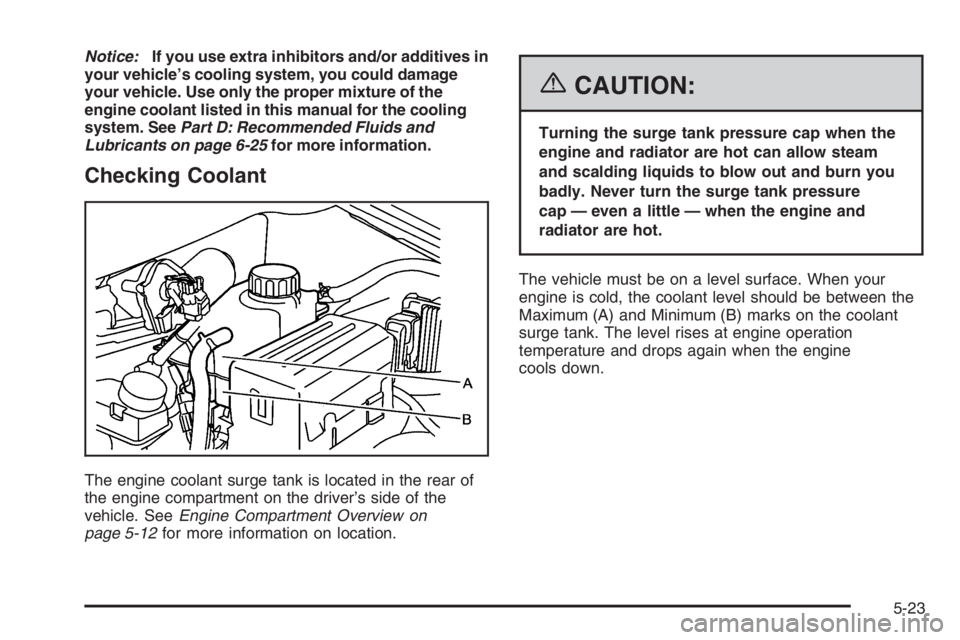
The engine coolant surge tank is located in the rear of
the engine compartment on the driver’s side of the
vehicle. SeeEngine Compartment Overview on
page 5-12for more information on location.
{CAUTION:
Turning the surge tank pressure cap when the
engine and radiator are hot can allow steam
and scalding liquids to blow out and burn you
badly. Never turn the surge tank pressure
cap — even a little — when the engine and
radiator are hot.
The vehicle must be on a level surface. When your
engine is cold, the coolant level should be between the
Maximum (A) and Minimum (B) marks on the coolant
surge tank. The level rises at engine operation
temperature and drops again when the engine
cools down.
5-23
Page 2025 of 5127

Cooling System
When you decide it is safe to lift the hood, here is what
you will see:
A. Coolant Surge Tank with Pressure Cap
B. Electric Engine Cooling Fan{CAUTION:
An electric engine cooling fan under the hood
can start up even when the engine is not
running and can injure you. Keep hands,
clothing and tools away from any underhood
electric fan.
If the coolant inside the coolant surge tank is boiling, do
not do anything else until it cools down. The vehicle
should be parked on a level surface. Make sure that the
air conditioning is turned off.
The coolant level should be between the Minimum and
Maximum marks on the coolant surge tank when the
engine is cool. If it is not, you may have a leak at
the pressure cap or in the radiator hoses, heater hoses,
radiator, water pump, or somewhere else in the
cooling system.
5-26