belt CHEVROLET AVEO 2006 1.G Manual PDF
[x] Cancel search | Manufacturer: CHEVROLET, Model Year: 2006, Model line: AVEO, Model: CHEVROLET AVEO 2006 1.GPages: 362, PDF Size: 2.24 MB
Page 315 of 362
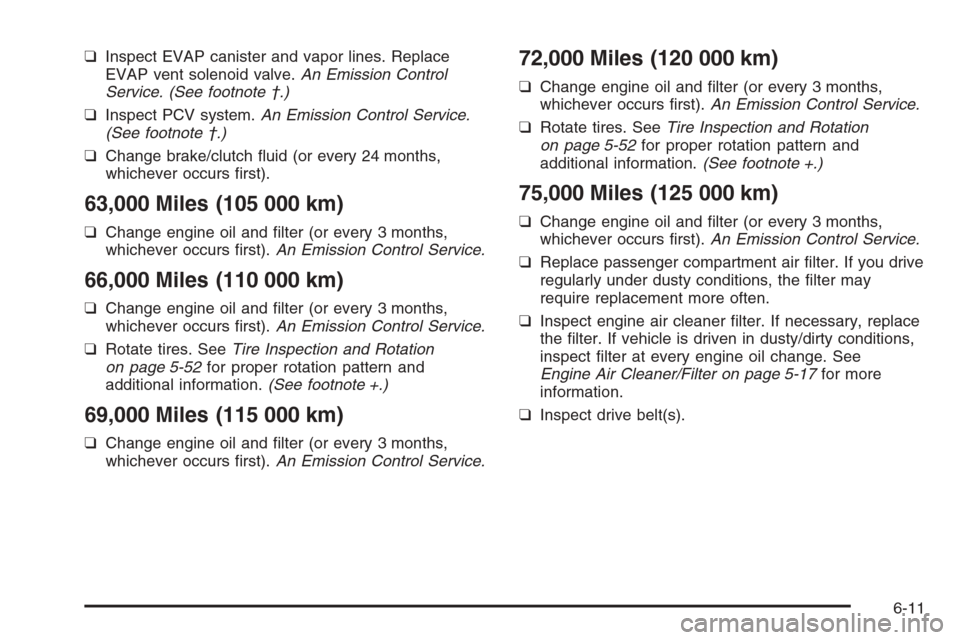
❑Inspect EVAP canister and vapor lines. Replace
EVAP vent solenoid valve.An Emission Control
Service. (See footnote †.)
❑Inspect PCV system.An Emission Control Service.
(See footnote †.)
❑Change brake/clutch fluid (or every 24 months,
whichever occurs first).
63,000 Miles (105 000 km)
❑Change engine oil and filter (or every 3 months,
whichever occurs first).An Emission Control Service.
66,000 Miles (110 000 km)
❑Change engine oil and filter (or every 3 months,
whichever occurs first).An Emission Control Service.
❑Rotate tires. SeeTire Inspection and Rotation
on page 5-52for proper rotation pattern and
additional information.(See footnote +.)
69,000 Miles (115 000 km)
❑Change engine oil and filter (or every 3 months,
whichever occurs first).An Emission Control Service.
72,000 Miles (120 000 km)
❑Change engine oil and filter (or every 3 months,
whichever occurs first).An Emission Control Service.
❑Rotate tires. SeeTire Inspection and Rotation
on page 5-52for proper rotation pattern and
additional information.(See footnote +.)
75,000 Miles (125 000 km)
❑Change engine oil and filter (or every 3 months,
whichever occurs first).An Emission Control Service.
❑Replace passenger compartment air filter. If you drive
regularly under dusty conditions, the filter may
require replacement more often.
❑Inspect engine air cleaner filter. If necessary, replace
the filter. If vehicle is driven in dusty/dirty conditions,
inspect filter at every engine oil change. See
Engine Air Cleaner/Filter on page 5-17for more
information.
❑Inspect drive belt(s).
6-11
Page 316 of 362
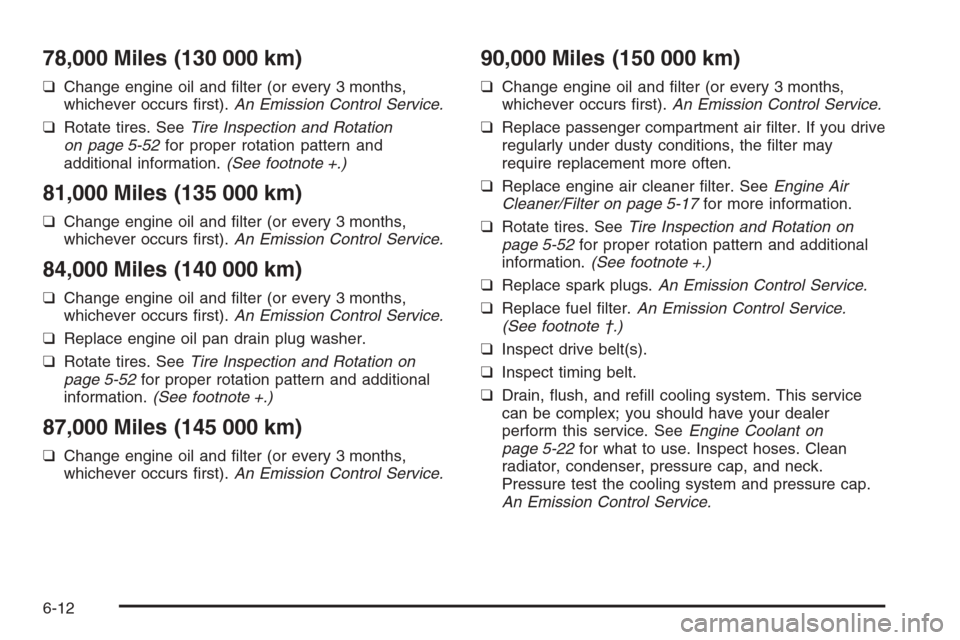
78,000 Miles (130 000 km)
❑Change engine oil and filter (or every 3 months,
whichever occurs first).An Emission Control Service.
❑Rotate tires. SeeTire Inspection and Rotation
on page 5-52for proper rotation pattern and
additional information.(See footnote +.)
81,000 Miles (135 000 km)
❑Change engine oil and filter (or every 3 months,
whichever occurs first).An Emission Control Service.
84,000 Miles (140 000 km)
❑Change engine oil and filter (or every 3 months,
whichever occurs first).An Emission Control Service.
❑Replace engine oil pan drain plug washer.
❑Rotate tires. SeeTire Inspection and Rotation on
page 5-52for proper rotation pattern and additional
information.(See footnote +.)
87,000 Miles (145 000 km)
❑Change engine oil and filter (or every 3 months,
whichever occurs first).An Emission Control Service.
90,000 Miles (150 000 km)
❑Change engine oil and filter (or every 3 months,
whichever occurs first).An Emission Control Service.
❑Replace passenger compartment air filter. If you drive
regularly under dusty conditions, the filter may
require replacement more often.
❑Replace engine air cleaner filter. SeeEngine Air
Cleaner/Filter on page 5-17for more information.
❑Rotate tires. SeeTire Inspection and Rotation on
page 5-52for proper rotation pattern and additional
information.(See footnote +.)
❑Replace spark plugs.An Emission Control Service.
❑Replace fuel filter.An Emission Control Service.
(See footnote †.)
❑Inspect drive belt(s).
❑Inspect timing belt.
❑Drain, flush, and refill cooling system. This service
can be complex; you should have your dealer
perform this service. SeeEngine Coolant on
page 5-22for what to use. Inspect hoses. Clean
radiator, condenser, pressure cap, and neck.
Pressure test the cooling system and pressure cap.
An Emission Control Service.
6-12
Page 318 of 362
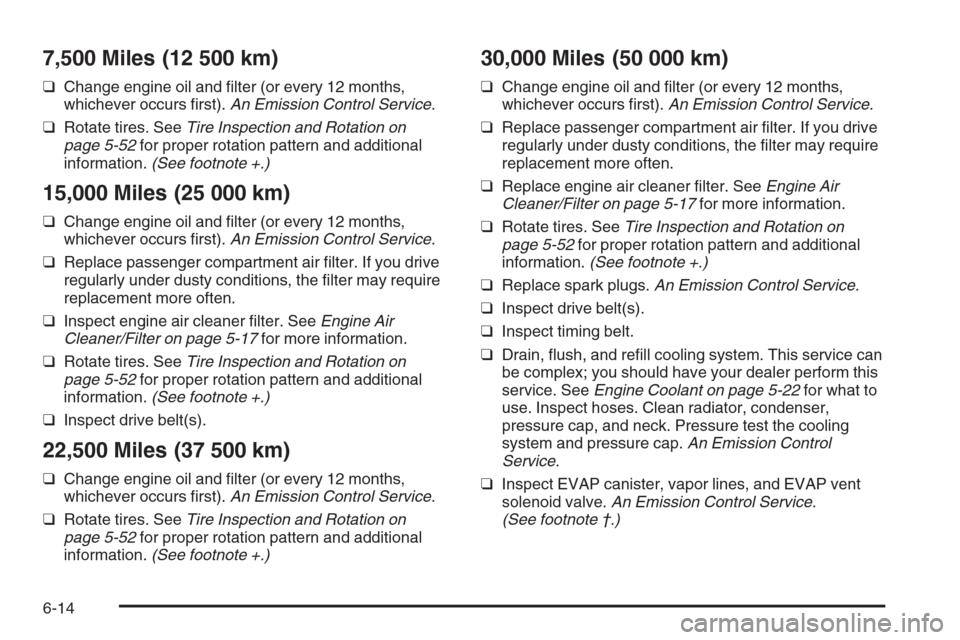
7,500 Miles (12 500 km)
❑Change engine oil and filter (or every 12 months,
whichever occurs first).An Emission Control Service.
❑Rotate tires. SeeTire Inspection and Rotation on
page 5-52for proper rotation pattern and additional
information.(See footnote +.)
15,000 Miles (25 000 km)
❑Change engine oil and filter (or every 12 months,
whichever occurs first).An Emission Control Service.
❑Replace passenger compartment air filter. If you drive
regularly under dusty conditions, the filter may require
replacement more often.
❑Inspect engine air cleaner filter. SeeEngine Air
Cleaner/Filter on page 5-17for more information.
❑Rotate tires. SeeTire Inspection and Rotation on
page 5-52for proper rotation pattern and additional
information.(See footnote +.)
❑Inspect drive belt(s).
22,500 Miles (37 500 km)
❑Change engine oil and filter (or every 12 months,
whichever occurs first).An Emission Control Service.
❑Rotate tires. SeeTire Inspection and Rotation on
page 5-52for proper rotation pattern and additional
information.(See footnote +.)
30,000 Miles (50 000 km)
❑Change engine oil and filter (or every 12 months,
whichever occurs first).An Emission Control Service.
❑Replace passenger compartment air filter. If you drive
regularly under dusty conditions, the filter may require
replacement more often.
❑Replace engine air cleaner filter. SeeEngine Air
Cleaner/Filter on page 5-17for more information.
❑Rotate tires. SeeTire Inspection and Rotation on
page 5-52for proper rotation pattern and additional
information.(See footnote +.)
❑Replace spark plugs.An Emission Control Service.
❑Inspect drive belt(s).
❑Inspect timing belt.
❑Drain, flush, and refill cooling system. This service can
be complex; you should have your dealer perform this
service. SeeEngine Coolant on page 5-22for what to
use. Inspect hoses. Clean radiator, condenser,
pressure cap, and neck. Pressure test the cooling
system and pressure cap.An Emission Control
Service.
❑Inspect EVAP canister, vapor lines, and EVAP vent
solenoid valve.An Emission Control Service.
(See footnote †.)
6-14
Page 319 of 362
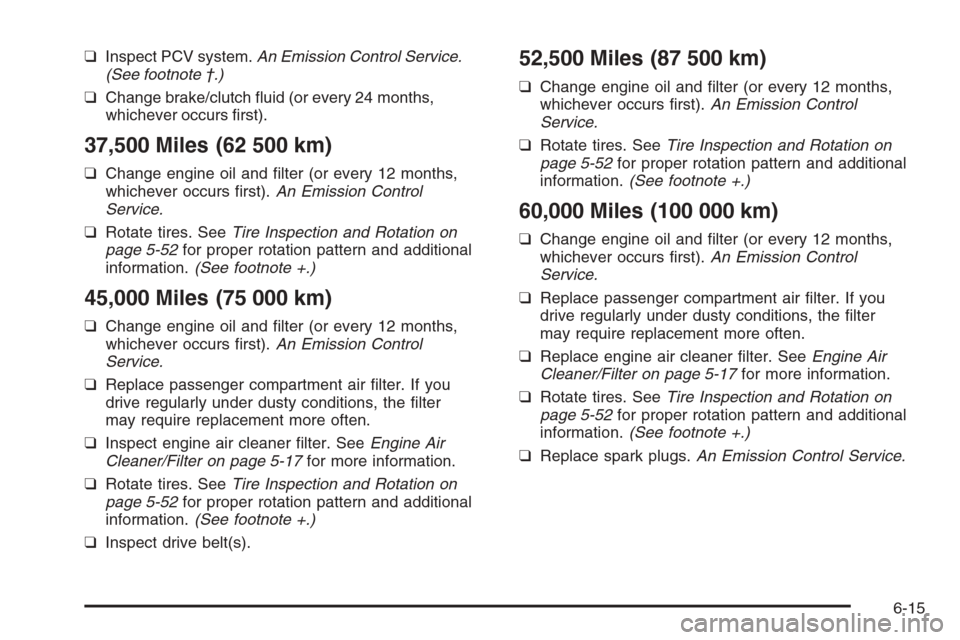
❑Inspect PCV system.An Emission Control Service.
(See footnote †.)
❑Change brake/clutch fluid (or every 24 months,
whichever occurs first).
37,500 Miles (62 500 km)
❑Change engine oil and filter (or every 12 months,
whichever occurs first).An Emission Control
Service.
❑Rotate tires. SeeTire Inspection and Rotation on
page 5-52for proper rotation pattern and additional
information.(See footnote +.)
45,000 Miles (75 000 km)
❑Change engine oil and filter (or every 12 months,
whichever occurs first).An Emission Control
Service.
❑Replace passenger compartment air filter. If you
drive regularly under dusty conditions, the filter
may require replacement more often.
❑Inspect engine air cleaner filter. SeeEngine Air
Cleaner/Filter on page 5-17for more information.
❑Rotate tires. SeeTire Inspection and Rotation on
page 5-52for proper rotation pattern and additional
information.(See footnote +.)
❑Inspect drive belt(s).
52,500 Miles (87 500 km)
❑Change engine oil and filter (or every 12 months,
whichever occurs first).An Emission Control
Service.
❑Rotate tires. SeeTire Inspection and Rotation on
page 5-52for proper rotation pattern and additional
information.(See footnote +.)
60,000 Miles (100 000 km)
❑Change engine oil and filter (or every 12 months,
whichever occurs first).An Emission Control
Service.
❑Replace passenger compartment air filter. If you
drive regularly under dusty conditions, the filter
may require replacement more often.
❑Replace engine air cleaner filter. SeeEngine Air
Cleaner/Filter on page 5-17for more information.
❑Rotate tires. SeeTire Inspection and Rotation on
page 5-52for proper rotation pattern and additional
information.(See footnote +.)
❑Replace spark plugs.An Emission Control Service.
6-15
Page 320 of 362
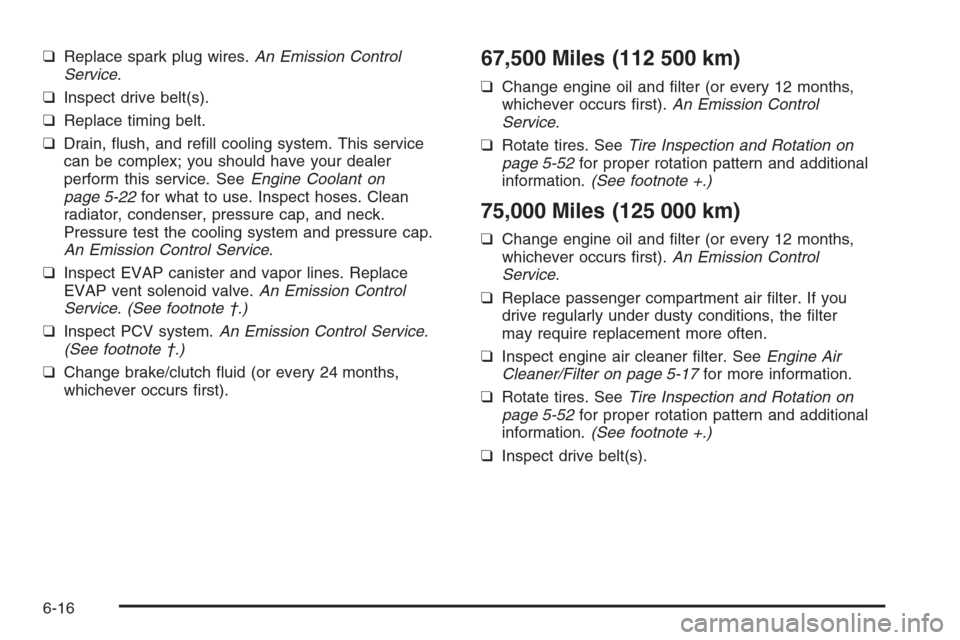
❑Replace spark plug wires.An Emission Control
Service.
❑Inspect drive belt(s).
❑Replace timing belt.
❑Drain, flush, and refill cooling system. This service
can be complex; you should have your dealer
perform this service. SeeEngine Coolant on
page 5-22for what to use. Inspect hoses. Clean
radiator, condenser, pressure cap, and neck.
Pressure test the cooling system and pressure cap.
An Emission Control Service.
❑Inspect EVAP canister and vapor lines. Replace
EVAP vent solenoid valve.An Emission Control
Service. (See footnote †.)
❑Inspect PCV system.An Emission Control Service.
(See footnote †.)
❑Change brake/clutch fluid (or every 24 months,
whichever occurs first).67,500 Miles (112 500 km)
❑Change engine oil and filter (or every 12 months,
whichever occurs first).An Emission Control
Service.
❑Rotate tires. SeeTire Inspection and Rotation on
page 5-52for proper rotation pattern and additional
information.(See footnote +.)
75,000 Miles (125 000 km)
❑Change engine oil and filter (or every 12 months,
whichever occurs first).An Emission Control
Service.
❑Replace passenger compartment air filter. If you
drive regularly under dusty conditions, the filter
may require replacement more often.
❑Inspect engine air cleaner filter. SeeEngine Air
Cleaner/Filter on page 5-17for more information.
❑Rotate tires. SeeTire Inspection and Rotation on
page 5-52for proper rotation pattern and additional
information.(See footnote +.)
❑Inspect drive belt(s).
6-16
Page 321 of 362
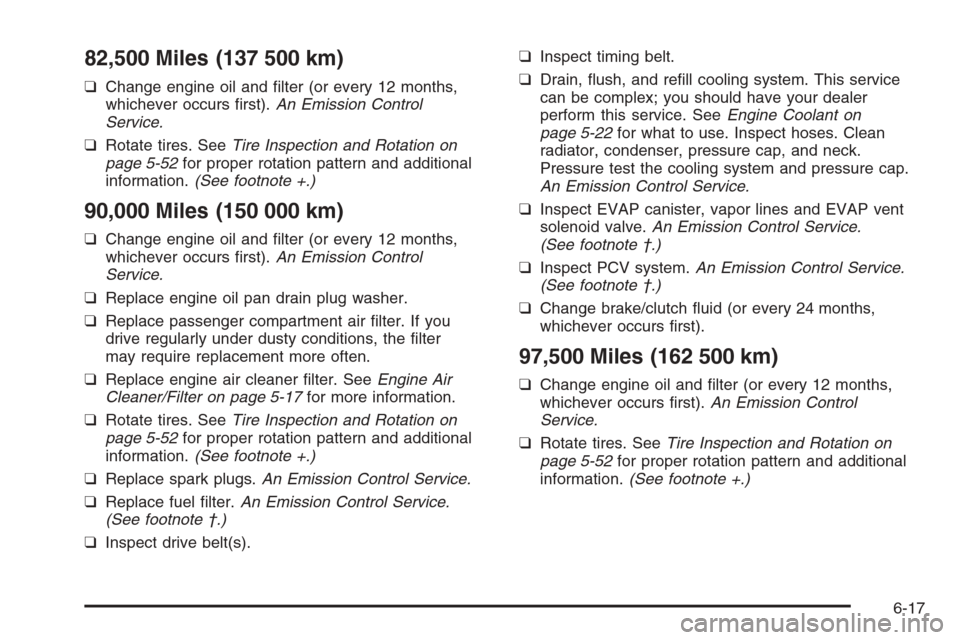
82,500 Miles (137 500 km)
❑Change engine oil and filter (or every 12 months,
whichever occurs first).An Emission Control
Service.
❑Rotate tires. SeeTire Inspection and Rotation on
page 5-52for proper rotation pattern and additional
information.(See footnote +.)
90,000 Miles (150 000 km)
❑Change engine oil and filter (or every 12 months,
whichever occurs first).An Emission Control
Service.
❑Replace engine oil pan drain plug washer.
❑Replace passenger compartment air filter. If you
drive regularly under dusty conditions, the filter
may require replacement more often.
❑Replace engine air cleaner filter. SeeEngine Air
Cleaner/Filter on page 5-17for more information.
❑Rotate tires. SeeTire Inspection and Rotation on
page 5-52for proper rotation pattern and additional
information.(See footnote +.)
❑Replace spark plugs.An Emission Control Service.
❑Replace fuel filter.An Emission Control Service.
(See footnote †.)
❑Inspect drive belt(s).❑Inspect timing belt.
❑Drain, flush, and refill cooling system. This service
can be complex; you should have your dealer
perform this service. SeeEngine Coolant on
page 5-22for what to use. Inspect hoses. Clean
radiator, condenser, pressure cap, and neck.
Pressure test the cooling system and pressure cap.
An Emission Control Service.
❑Inspect EVAP canister, vapor lines and EVAP vent
solenoid valve.An Emission Control Service.
(See footnote †.)
❑Inspect PCV system.An Emission Control Service.
(See footnote †.)
❑Change brake/clutch fluid (or every 24 months,
whichever occurs first).
97,500 Miles (162 500 km)
❑Change engine oil and filter (or every 12 months,
whichever occurs first).An Emission Control
Service.
❑Rotate tires. SeeTire Inspection and Rotation on
page 5-52for proper rotation pattern and additional
information.(See footnote +.)
6-17
Page 323 of 362
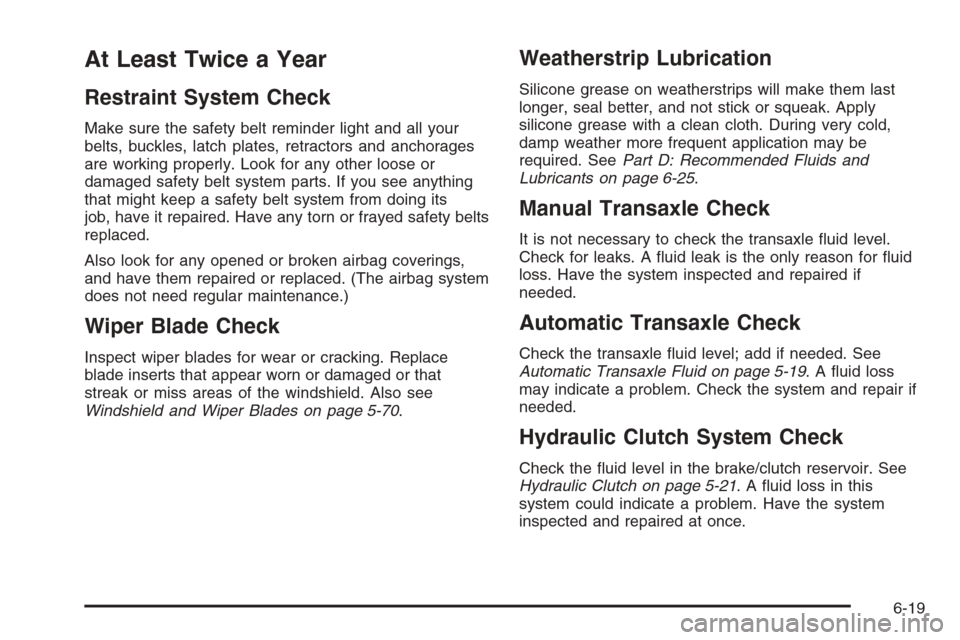
At Least Twice a Year
Restraint System Check
Make sure the safety belt reminder light and all your
belts, buckles, latch plates, retractors and anchorages
are working properly. Look for any other loose or
damaged safety belt system parts. If you see anything
that might keep a safety belt system from doing its
job, have it repaired. Have any torn or frayed safety belts
replaced.
Also look for any opened or broken airbag coverings,
and have them repaired or replaced. (The airbag system
does not need regular maintenance.)
Wiper Blade Check
Inspect wiper blades for wear or cracking. Replace
blade inserts that appear worn or damaged or that
streak or miss areas of the windshield. Also see
Windshield and Wiper Blades on page 5-70.
Weatherstrip Lubrication
Silicone grease on weatherstrips will make them last
longer, seal better, and not stick or squeak. Apply
silicone grease with a clean cloth. During very cold,
damp weather more frequent application may be
required. SeePart D: Recommended Fluids and
Lubricants on page 6-25.
Manual Transaxle Check
It is not necessary to check the transaxle fluid level.
Check for leaks. A fluid leak is the only reason for fluid
loss. Have the system inspected and repaired if
needed.
Automatic Transaxle Check
Check the transaxle fluid level; add if needed. See
Automatic Transaxle Fluid on page 5-19. A fluid loss
may indicate a problem. Check the system and repair if
needed.
Hydraulic Clutch System Check
Check the fluid level in the brake/clutch reservoir. See
Hydraulic Clutch on page 5-21. A fluid loss in this
system could indicate a problem. Have the system
inspected and repaired at once.
6-19
Page 344 of 362
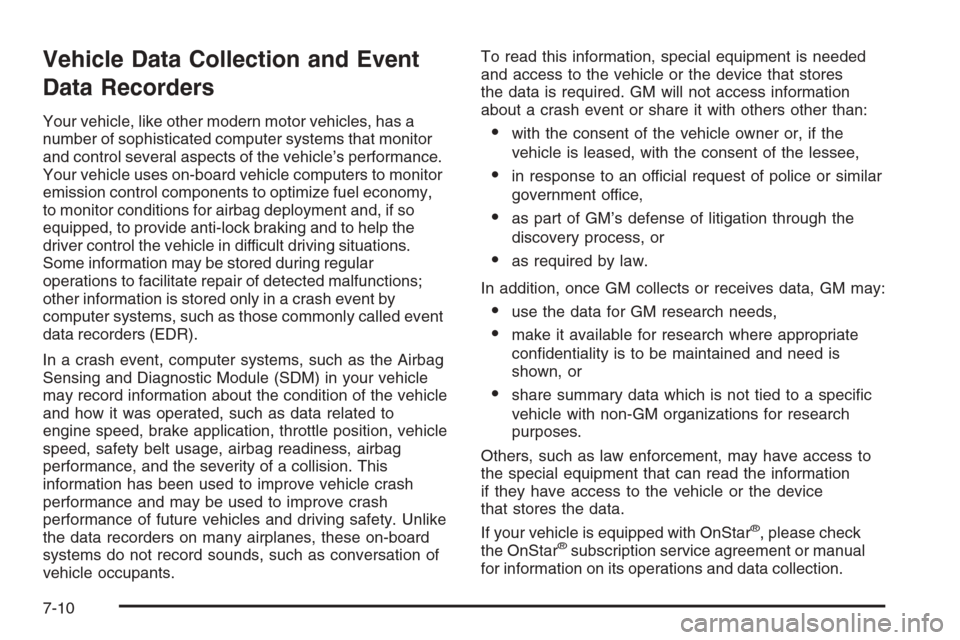
Vehicle Data Collection and Event
Data Recorders
Your vehicle, like other modern motor vehicles, has a
number of sophisticated computer systems that monitor
and control several aspects of the vehicle’s performance.
Your vehicle uses on-board vehicle computers to monitor
emission control components to optimize fuel economy,
to monitor conditions for airbag deployment and, if so
equipped, to provide anti-lock braking and to help the
driver control the vehicle in difficult driving situations.
Some information may be stored during regular
operations to facilitate repair of detected malfunctions;
other information is stored only in a crash event by
computer systems, such as those commonly called event
data recorders (EDR).
In a crash event, computer systems, such as the Airbag
Sensing and Diagnostic Module (SDM) in your vehicle
may record information about the condition of the vehicle
and how it was operated, such as data related to
engine speed, brake application, throttle position, vehicle
speed, safety belt usage, airbag readiness, airbag
performance, and the severity of a collision. This
information has been used to improve vehicle crash
performance and may be used to improve crash
performance of future vehicles and driving safety. Unlike
the data recorders on many airplanes, these on-board
systems do not record sounds, such as conversation of
vehicle occupants.To read this information, special equipment is needed
and access to the vehicle or the device that stores
the data is required. GM will not access information
about a crash event or share it with others other than:•with the consent of the vehicle owner or, if the
vehicle is leased, with the consent of the lessee,
•in response to an official request of police or similar
government office,
•as part of GM’s defense of litigation through the
discovery process, or
•as required by law.
In addition, once GM collects or receives data, GM may:
•use the data for GM research needs,
•make it available for research where appropriate
confidentiality is to be maintained and need is
shown, or
•share summary data which is not tied to a specific
vehicle with non-GM organizations for research
purposes.
Others, such as law enforcement, may have access to
the special equipment that can read the information
if they have access to the vehicle or the device
that stores the data.
If your vehicle is equipped with OnStar
®, please check
the OnStar®subscription service agreement or manual
for information on its operations and data collection.
7-10
Page 351 of 362
A
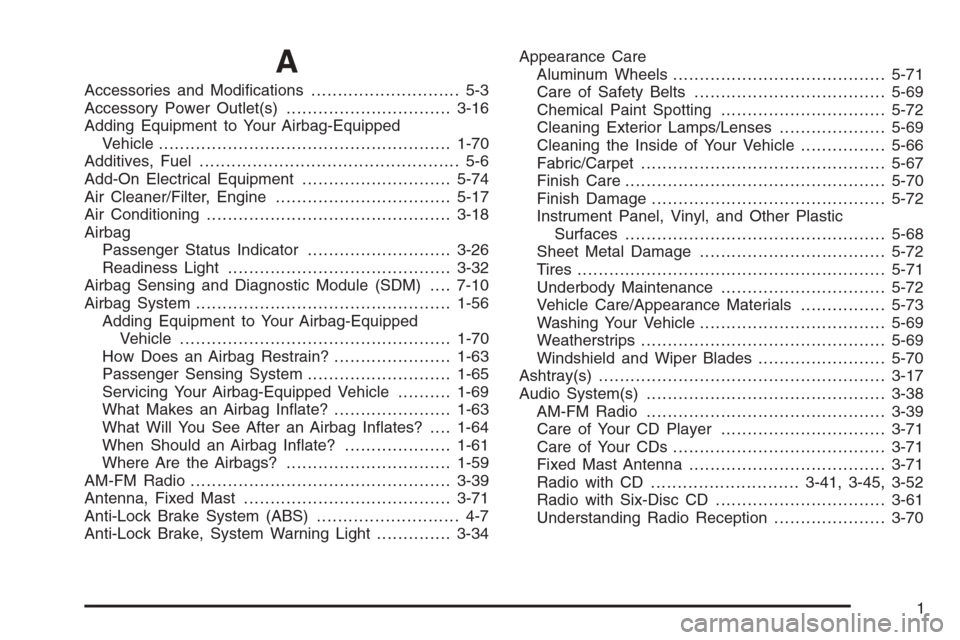
Accessories and Modifications............................ 5-3
Accessory Power Outlet(s)...............................3-16
Adding Equipment to Your Airbag-Equipped
Vehicle.......................................................1-70
Additives, Fuel................................................. 5-6
Add-On Electrical Equipment............................5-74
Air Cleaner/Filter, Engine.................................5-17
Air Conditioning..............................................3-18
Airbag
Passenger Status Indicator...........................3-26
Readiness Light..........................................3-32
Airbag Sensing and Diagnostic Module (SDM)....7-10
Airbag System................................................1-56
Adding Equipment to Your Airbag-Equipped
Vehicle...................................................1-70
How Does an Airbag Restrain?......................1-63
Passenger Sensing System...........................1-65
Servicing Your Airbag-Equipped Vehicle..........1-69
What Makes an Airbag Inflate?......................1-63
What Will You See After an Airbag Inflates?....1-64
When Should an Airbag Inflate?....................1-61
Where Are the Airbags?...............................1-59
AM-FM Radio.................................................3-39
Antenna, Fixed Mast.......................................3-71
Anti-Lock Brake System (ABS)........................... 4-7
Anti-Lock Brake, System Warning Light..............3-34Appearance Care
Aluminum Wheels........................................5-71
Care of Safety Belts....................................5-69
Chemical Paint Spotting...............................5-72
Cleaning Exterior Lamps/Lenses....................5-69
Cleaning the Inside of Your Vehicle................5-66
Fabric/Carpet..............................................5-67
Finish Care.................................................5-70
Finish Damage............................................5-72
Instrument Panel, Vinyl, and Other Plastic
Surfaces.................................................5-68
Sheet Metal Damage...................................5-72
Tires..........................................................5-71
Underbody Maintenance...............................5-72
Vehicle Care/Appearance Materials................5-73
Washing Your Vehicle...................................5-69
Weatherstrips..............................................5-69
Windshield and Wiper Blades........................5-70
Ashtray(s)......................................................3-17
Audio System(s).............................................3-38
AM-FM Radio.............................................3-39
Care of Your CD Player...............................3-71
Care of Your CDs ........................................3-71
Fixed Mast Antenna.....................................3-71
Radio with CD............................3-41, 3-45, 3-52
Radio with Six-Disc CD................................3-61
Understanding Radio Reception.....................3-70
1
Page 352 of 362
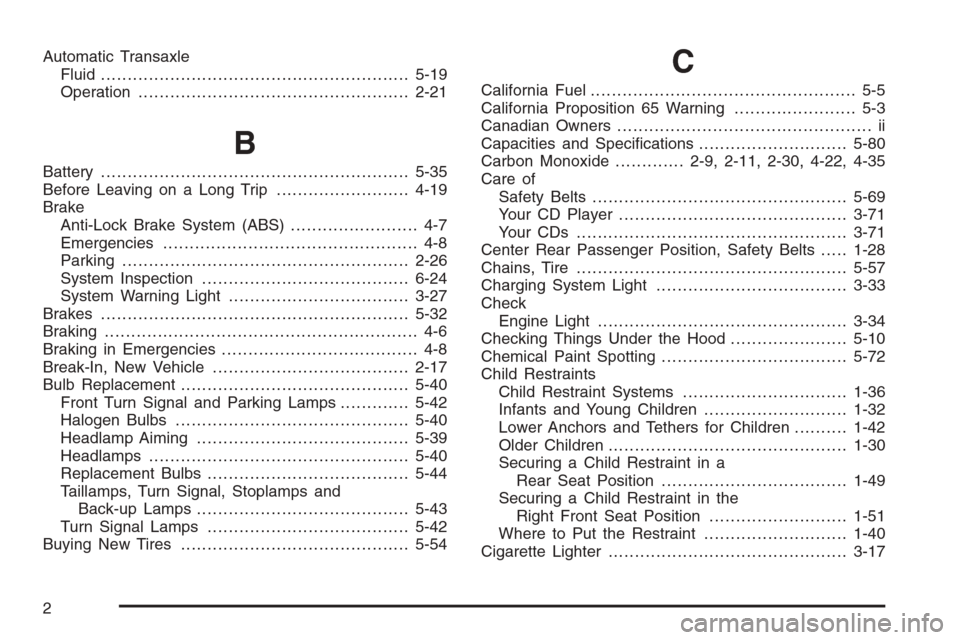
Automatic Transaxle
Fluid..........................................................5-19
Operation...................................................2-21
B
Battery..........................................................5-35
Before Leaving on a Long Trip.........................4-19
Brake
Anti-Lock Brake System (ABS)........................ 4-7
Emergencies................................................ 4-8
Parking......................................................2-26
System Inspection.......................................6-24
System Warning Light..................................3-27
Brakes..........................................................5-32
Braking........................................................... 4-6
Braking in Emergencies..................................... 4-8
Break-In, New Vehicle.....................................2-17
Bulb Replacement...........................................5-40
Front Turn Signal and Parking Lamps.............5-42
Halogen Bulbs............................................5-40
Headlamp Aiming........................................5-39
Headlamps.................................................5-40
Replacement Bulbs......................................5-44
Taillamps, Turn Signal, Stoplamps and
Back-up Lamps........................................5-43
Turn Signal Lamps......................................5-42
Buying New Tires...........................................5-54
C
California Fuel.................................................. 5-5
California Proposition 65 Warning....................... 5-3
Canadian Owners................................................ ii
Capacities and Specifications............................5-80
Carbon Monoxide.............2-9, 2-11, 2-30, 4-22, 4-35
Care of
Safety Belts................................................5-69
Your CD Player...........................................3-71
Your CDs ...................................................3-71
Center Rear Passenger Position, Safety Belts.....1-28
Chains, Tire...................................................5-57
Charging System Light....................................3-33
Check
Engine Light...............................................3-34
Checking Things Under the Hood......................5-10
Chemical Paint Spotting...................................5-72
Child Restraints
Child Restraint Systems...............................1-36
Infants and Young Children...........................1-32
Lower Anchors and Tethers for Children..........1-42
Older Children.............................................1-30
Securing a Child Restraint in a
Rear Seat Position...................................1-49
Securing a Child Restraint in the
Right Front Seat Position..........................1-51
Where to Put the Restraint...........................1-40
Cigarette Lighter.............................................3-17
2