Red CHEVROLET AVEO 2008 1.G Owners Manual
[x] Cancel search | Manufacturer: CHEVROLET, Model Year: 2008, Model line: AVEO, Model: CHEVROLET AVEO 2008 1.GPages: 384, PDF Size: 6.67 MB
Page 2 of 384
GENERAL MOTORS, GM, the GM Emblem,
CHEVROLET, the CHEVROLET Emblem, and
the name AVEO are registered trademarks of
General Motors Corporation.
This manual includes the latest information at the time it
was printed. We reserve the right to make changes after
that time without further notice. For vehicles first sold
in Canada, substitute the name “General Motors of
Canada Limited” for Chevrolet Motor Division whenever
it appears in this manual.
This manual describes features that may be available in
this model, but your vehicle may not have all of them.
For example, more than one entertainment system may
be offered or your vehicle may have been ordered
without a front passenger or rear seats.
Keep this manual in the vehicle, so it will be there if it
is needed while you are on the road. If the vehicle
is sold, leave this manual in the vehicle.
Canadian Owners
A French language copy of this manual can be obtained
from your dealer/retailer or from:
Helm, Incorporated
P.O. Box 07130
Detroit, MI 48207
1-800-551-4123
www.helminc.com
Propriétaires Canadiens
On peut obtenir un exemplaire de ce guide en français
auprès de concessionnaire ou à l’adresse suivante:
Helm Incorporated
P.O. Box 07130
Detroit, MI 48207
1-800-551-4123
www.helminc.com
Using this Manual
Many people read the owner manual from beginning
to end when they first receive their new vehicle to
learn about the vehicle’s features and controls.
Pictures and words work together to explain things.
Litho in U.S.A.
Part No. 25810501 A First Printing
©2007 General Motors Corporation. All Rights Reserved.
ii
Page 3 of 384
Index
A good place to quickly locate information about the
vehicle is the Index in the back of the manual. It is
an alphabetical list of what is in the manual and
the page number where it can be found.
Safety Warnings and Symbols
There are a number of safety cautions in this book.
A box with the word CAUTION is used to tell about
things that could hurt you or others if you were to
ignore the warning.
{CAUTION:
These mean there is something that could hurt
you or other people.We tell you what the hazard is and what to do to help
avoid or reduce the hazard. Please read these cautions.
If you do not, you or others could be hurt.
A circle with a slash
through it is a safety
symbol which means
“Do Not,” “Do Not do
this” or “Do Not let
this happen.”
iii
Page 4 of 384
Vehicle Damage Warnings
You will also find notices in this manual.
Notice:These mean there is something that could
damage your vehicle.
A notice tells about something that can damage the
vehicle. Many times, this damage would not be covered
by your vehicle’s warranty, and it could be costly.
The notice tells what to do to help avoid the damage.
When you read other manuals, you might see CAUTION
and NOTICE warnings in different colors or in different
words.
There are also warning labels on the vehicle which use
the same words, CAUTION or NOTICE.
Vehicle Symbols
The vehicle has components and labels that use
symbols instead of text. Symbols are shown along
with the text describing the operation or information
relating to a specific component, control, message,
gage, or indicator.
iv
Page 8 of 384
Reclining Seatbacks
{CAUTION:
You can lose control of the vehicle if you try to
adjust a manual driver’s seat while the vehicle
is moving. The sudden movement could startle
and confuse you, or make you push a pedal
when you do not want to. Adjust the driver’s
seat only when the vehicle is not moving.
{CAUTION:
If the seatback is not locked, it could move
forward in a sudden stop or crash. That could
cause injury to the person sitting there. Always
push and pull on the seatback to be sure it
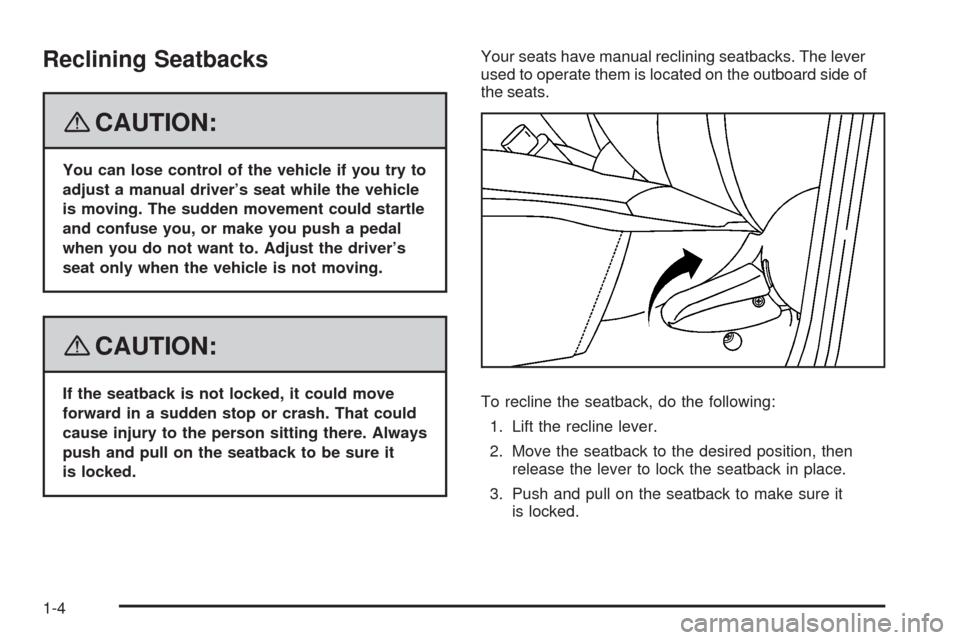
is locked.Your seats have manual reclining seatbacks. The lever
used to operate them is located on the outboard side of
the seats.
To recline the seatback, do the following:
1. Lift the recline lever.
2. Move the seatback to the desired position, then
release the lever to lock the seatback in place.
3. Push and pull on the seatback to make sure it
is locked.
1-4
Page 10 of 384
Head Restraints
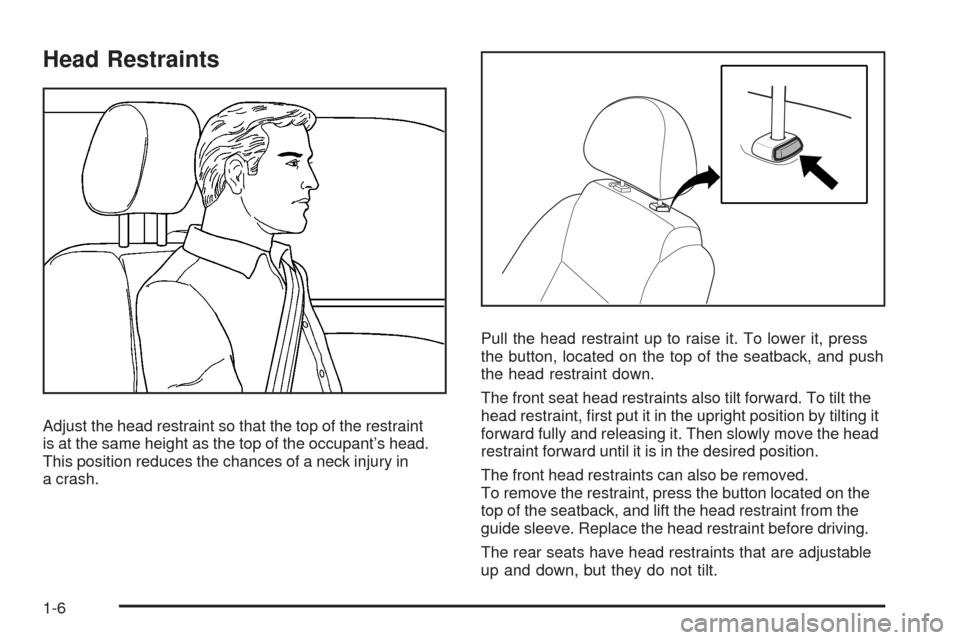
Adjust the head restraint so that the top of the restraint
is at the same height as the top of the occupant’s head.
This position reduces the chances of a neck injury in
a crash.Pull the head restraint up to raise it. To lower it, press
the button, located on the top of the seatback, and push
the head restraint down.
The front seat head restraints also tilt forward. To tilt the
head restraint, first put it in the upright position by tilting it
forward fully and releasing it. Then slowly move the head
restraint forward until it is in the desired position.
The front head restraints can also be removed.
To remove the restraint, press the button located on the
top of the seatback, and lift the head restraint from the
guide sleeve. Replace the head restraint before driving.
The rear seats have head restraints that are adjustable
up and down, but they do not tilt.
1-6
Page 11 of 384
Rear Seats
Rear Seat Operation (Sedan)
Folding the Seatback
The rear seatbacks can be folded down to increase
cargo space.
To fold down the seatback:
Notice:Folding a rear seat with the safety belts
still fastened may cause damage to the seat or
the safety belts. Always unbuckle the safety belts
and return them to their normal stowed position
before folding a rear seat.
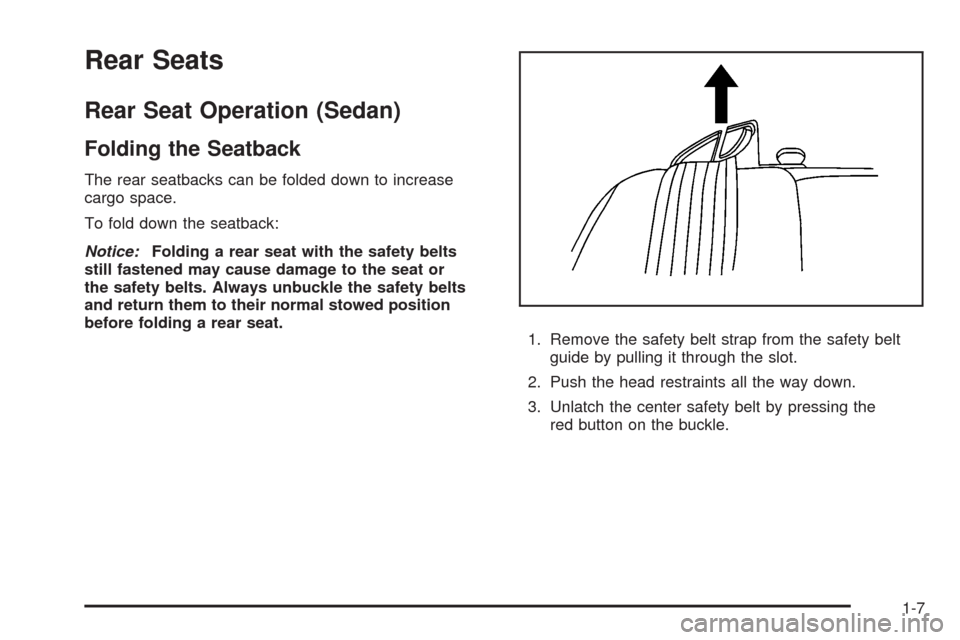
1. Remove the safety belt strap from the safety belt
guide by pulling it through the slot.
2. Push the head restraints all the way down.
3. Unlatch the center safety belt by pressing the
red button on the buckle.
1-7
Page 13 of 384
{CAUTION:
If the seatback is not locked, it could move
forward in a sudden stop or crash. That could
cause injury to the person sitting there. Always
push and pull on the seatback to be sure it
is locked.
3. Push down and rearward firmly on the top of the
seatback until it latches securely in the fully
upright position.
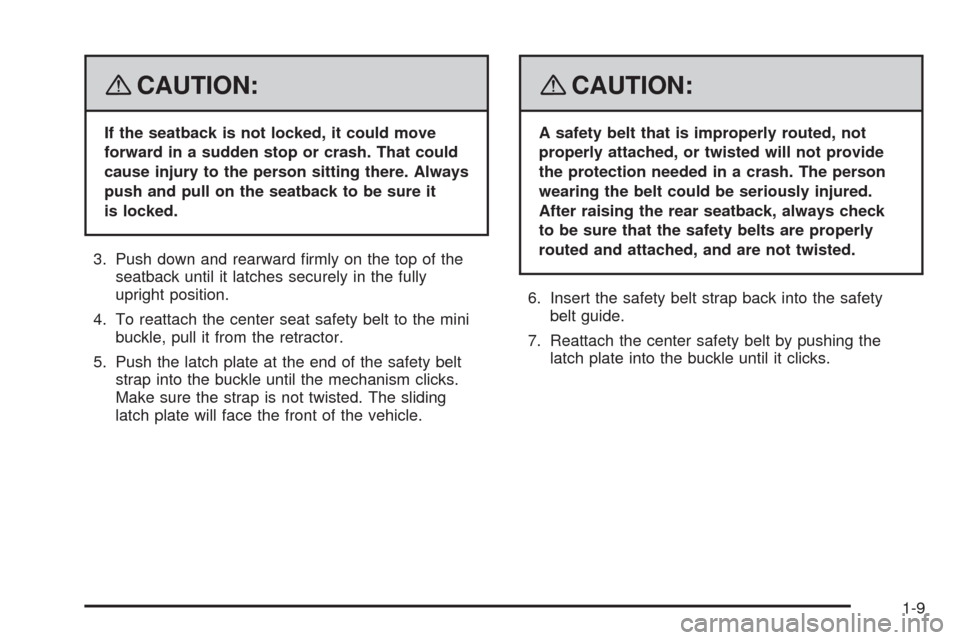
4. To reattach the center seat safety belt to the mini
buckle, pull it from the retractor.
5. Push the latch plate at the end of the safety belt
strap into the buckle until the mechanism clicks.
Make sure the strap is not twisted. The sliding
latch plate will face the front of the vehicle.
{CAUTION:
A safety belt that is improperly routed, not
properly attached, or twisted will not provide
the protection needed in a crash. The person
wearing the belt could be seriously injured.
After raising the rear seatback, always check
to be sure that the safety belts are properly
routed and attached, and are not twisted.
6. Insert the safety belt strap back into the safety
belt guide.
7. Reattach the center safety belt by pushing the
latch plate into the buckle until it clicks.
1-9
Page 14 of 384
Rear Seat Operation (Hatchback)
Folding the Rear Seats
The rear seats can be folded to increase cargo space.
To fold the rear seats:
1. Lower the head restraints completely.
2. Unlatch the center safety belt by pressing the
red button on the buckle.
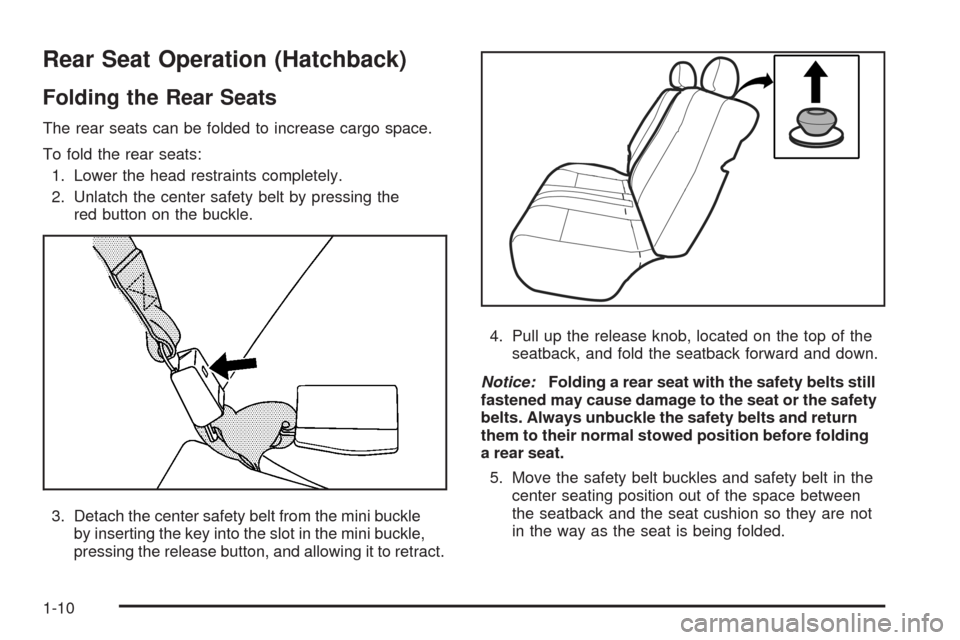
3. Detach the center safety belt from the mini buckle
by inserting the key into the slot in the mini buckle,
pressing the release button, and allowing it to retract.4. Pull up the release knob, located on the top of the
seatback, and fold the seatback forward and down.
Notice:Folding a rear seat with the safety belts still
fastened may cause damage to the seat or the safety
belts. Always unbuckle the safety belts and return
them to their normal stowed position before folding
a rear seat.
5. Move the safety belt buckles and safety belt in the
center seating position out of the space between
the seatback and the seat cushion so they are not
in the way as the seat is being folded.
1-10
Page 17 of 384
{CAUTION:
A safety belt that is improperly routed, not
properly attached, or twisted will not provide
the protection needed in a crash. The person
wearing the belt could be seriously injured.
After raising the rear seatback, always check
to be sure that the safety belts are properly
routed and attached, and are not twisted.
5. Lift the seatback up and push it back to its original
latched position.
6. Unhook the safety belts in the outboard seating
positions from the retaining clips.
7. Return the safety belt buckles and the center seat
safety belt to their original position between the
rear seatback and the seat cushion. Make sure
the straps of the safety belt and buckles are
not twisted.8. To reattach the center seat safety belt to the mini
buckle, pull it from the retractor.
9. Reattach the center safety belt by pushing the latch
plate into the buckle until it clicks.
{CAUTION:
If the seatback is not locked, it could move
forward in a sudden stop or crash. That could
cause injury to the person sitting there. Always
push and pull on the seatback to be sure it
is locked.
10. Push down and rearward firmly on the top of
the seatback until it latches securely in the fully
upright position.
1-13
Page 18 of 384
Safety Belts
Safety Belts: They Are for Everyone
This part of the manual tells you how to use safety
belts properly. It also tells you some things you should
not do with safety belts.
{CAUTION:
Do not let anyone ride where he or she cannot
wear a safety belt properly. If you are in a
crash and you are not wearing a safety belt,
your injuries can be much worse. You can hit
things inside the vehicle harder or be ejected
from it and be seriously injured or killed.
In the same crash, you might not be, if you
are buckled up. Always fasten your safety
belt, and check that your passenger(s) are
restrained properly too.
{CAUTION:
It is extremely dangerous to ride in a cargo
area, inside or outside of a vehicle. In a
collision, people riding in these areas are more
likely to be seriously injured or killed. Do not
allow people to ride in any area of your vehicle
that is not equipped with seats and safety
belts. Be sure everyone in your vehicle is in
a seat and using a safety belt properly.
Your vehicle has indicators as a reminder to buckle your
safety belts. SeeSafety Belt Reminders on page 3-30.
In most states and in all Canadian provinces, the
law requires wearing safety belts. Here is why:
You never know if you will be in a crash. If you do have
a crash, you do not know if it will be a serious one.
A few crashes are mild, and some crashes can be so
serious that even buckled up, a person would not
survive. But most crashes are in between. In many of
them, people who buckle up can survive and sometimes
walk away. Without belts they could have been badly
hurt or killed.
1-14