Red CHEVROLET AVEO 2008 1.G User Guide
[x] Cancel search | Manufacturer: CHEVROLET, Model Year: 2008, Model line: AVEO, Model: CHEVROLET AVEO 2008 1.GPages: 384, PDF Size: 6.67 MB
Page 26 of 384
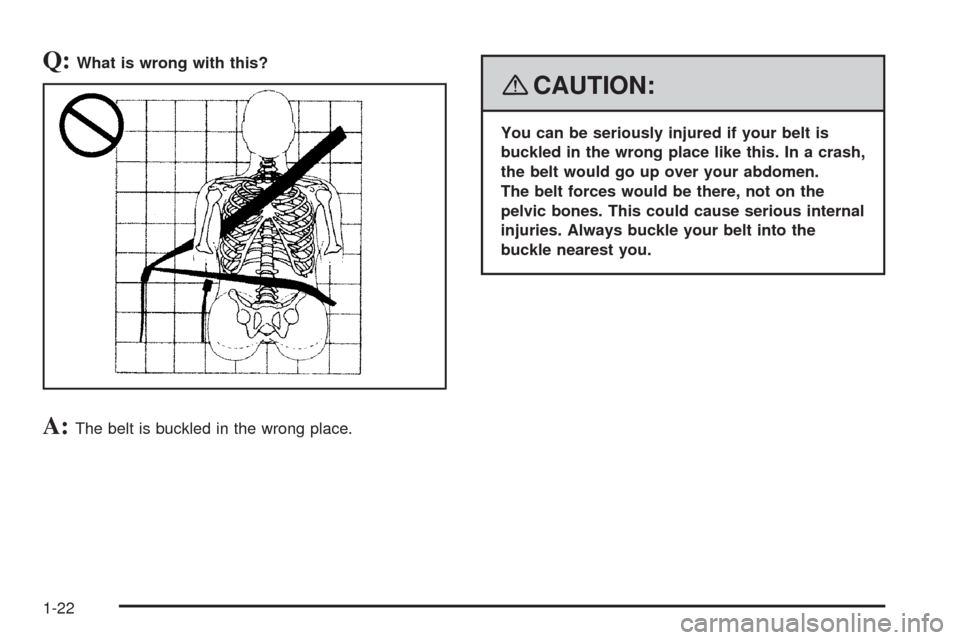
Q:What is wrong with this?
A:The belt is buckled in the wrong place.
{CAUTION:
You can be seriously injured if your belt is
buckled in the wrong place like this. In a crash,
the belt would go up over your abdomen.
The belt forces would be there, not on the
pelvic bones. This could cause serious internal
injuries. Always buckle your belt into the
buckle nearest you.
1-22
Page 27 of 384
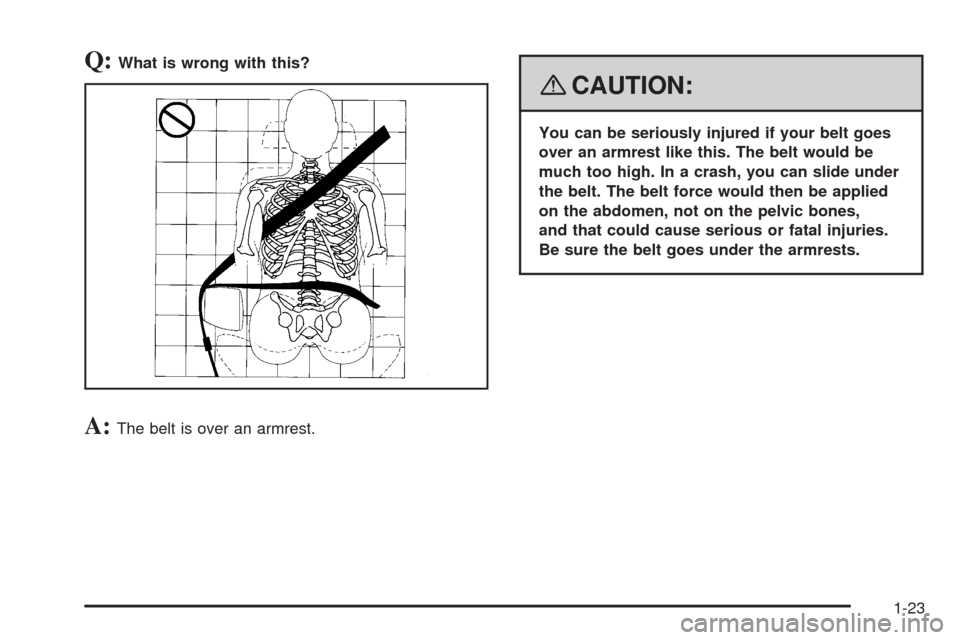
Q:What is wrong with this?
A:The belt is over an armrest.
{CAUTION:
You can be seriously injured if your belt goes
over an armrest like this. The belt would be
much too high. In a crash, you can slide under
the belt. The belt force would then be applied
on the abdomen, not on the pelvic bones,
and that could cause serious or fatal injuries.
Be sure the belt goes under the armrests.
1-23
Page 28 of 384
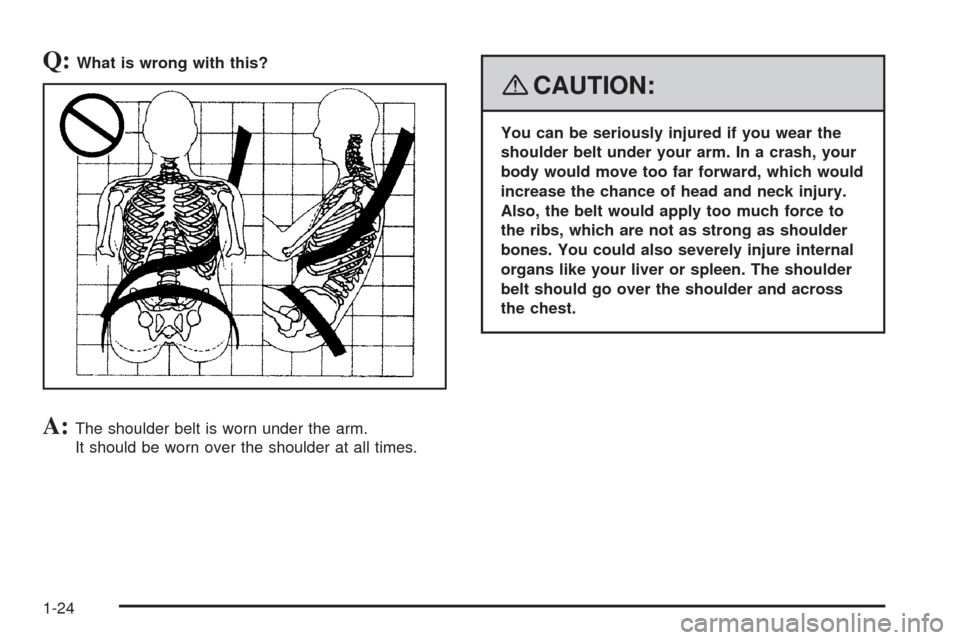
Q:What is wrong with this?
A:The shoulder belt is worn under the arm.
It should be worn over the shoulder at all times.
{CAUTION:
You can be seriously injured if you wear the
shoulder belt under your arm. In a crash, your
body would move too far forward, which would
increase the chance of head and neck injury.
Also, the belt would apply too much force to
the ribs, which are not as strong as shoulder
bones. You could also severely injure internal
organs like your liver or spleen. The shoulder
belt should go over the shoulder and across
the chest.
1-24
Page 29 of 384
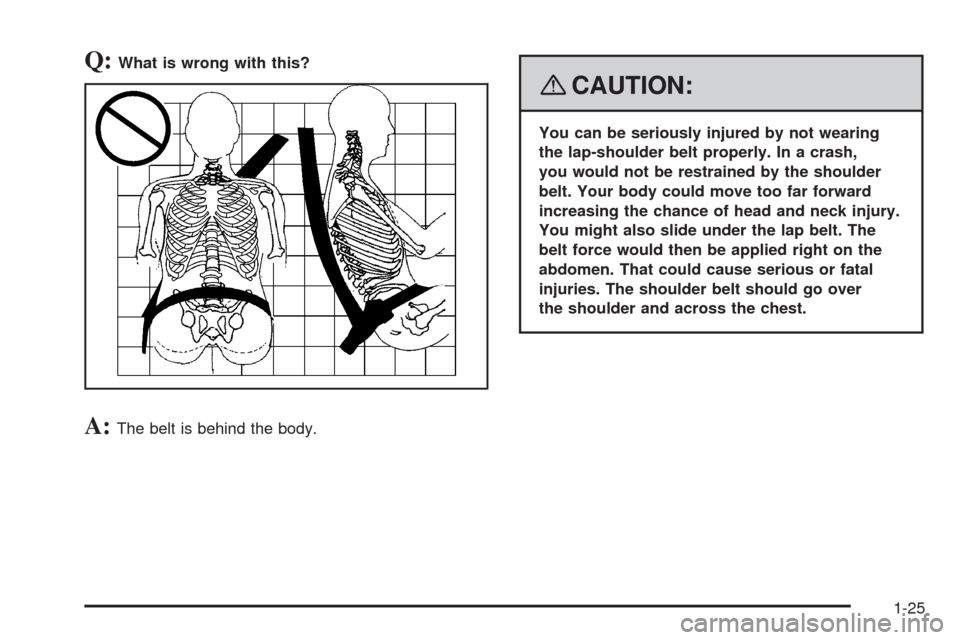
Q:What is wrong with this?
A:The belt is behind the body.
{CAUTION:
You can be seriously injured by not wearing
the lap-shoulder belt properly. In a crash,
you would not be restrained by the shoulder
belt. Your body could move too far forward
increasing the chance of head and neck injury.
You might also slide under the lap belt. The
belt force would then be applied right on the
abdomen. That could cause serious or fatal
injuries. The shoulder belt should go over
the shoulder and across the chest.
1-25
Page 30 of 384
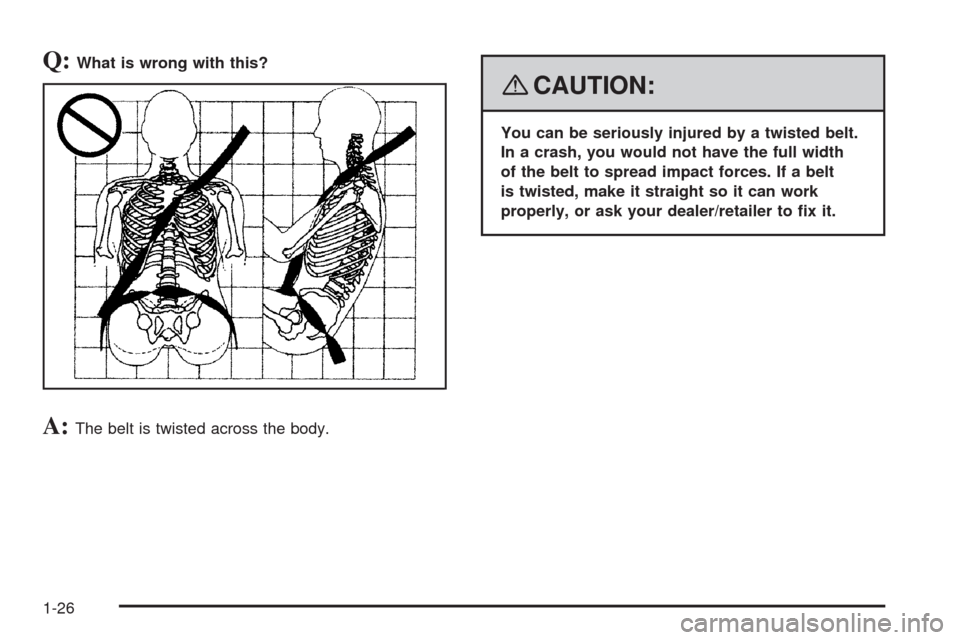
Q:What is wrong with this?
A:The belt is twisted across the body.
{CAUTION:
You can be seriously injured by a twisted belt.
In a crash, you would not have the full width
of the belt to spread impact forces. If a belt
is twisted, make it straight so it can work
properly, or ask your dealer/retailer to x it.
1-26
Page 32 of 384
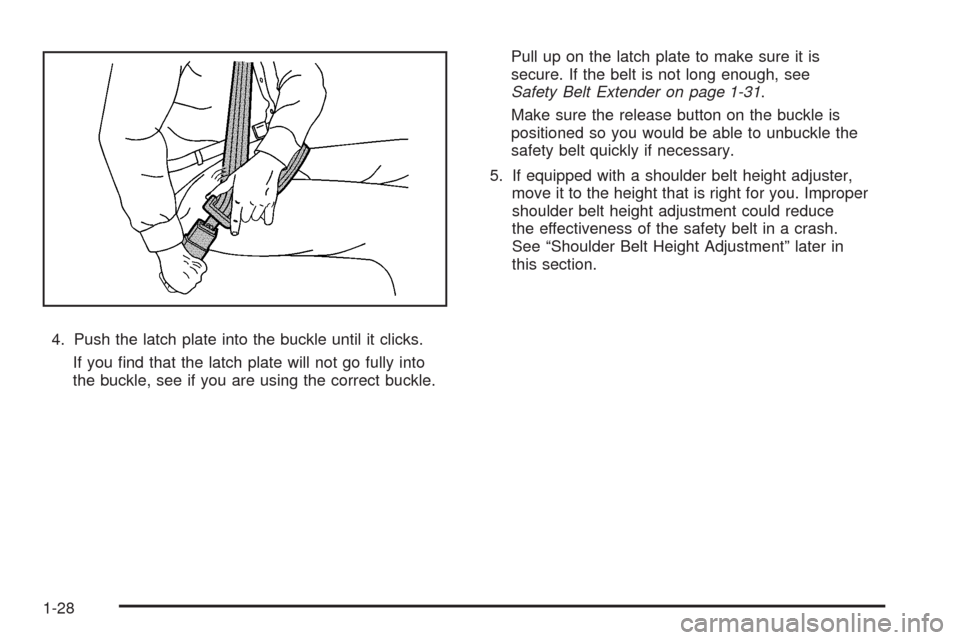
4. Push the latch plate into the buckle until it clicks.
If you find that the latch plate will not go fully into
the buckle, see if you are using the correct buckle.Pull up on the latch plate to make sure it is
secure. If the belt is not long enough, see
Safety Belt Extender on page 1-31.
Make sure the release button on the buckle is
positioned so you would be able to unbuckle the
safety belt quickly if necessary.
5. If equipped with a shoulder belt height adjuster,
move it to the height that is right for you. Improper
shoulder belt height adjustment could reduce
the effectiveness of the safety belt in a crash.
See “Shoulder Belt Height Adjustment” later in
this section.
1-28
Page 34 of 384
Shoulder Belt Height Adjuster
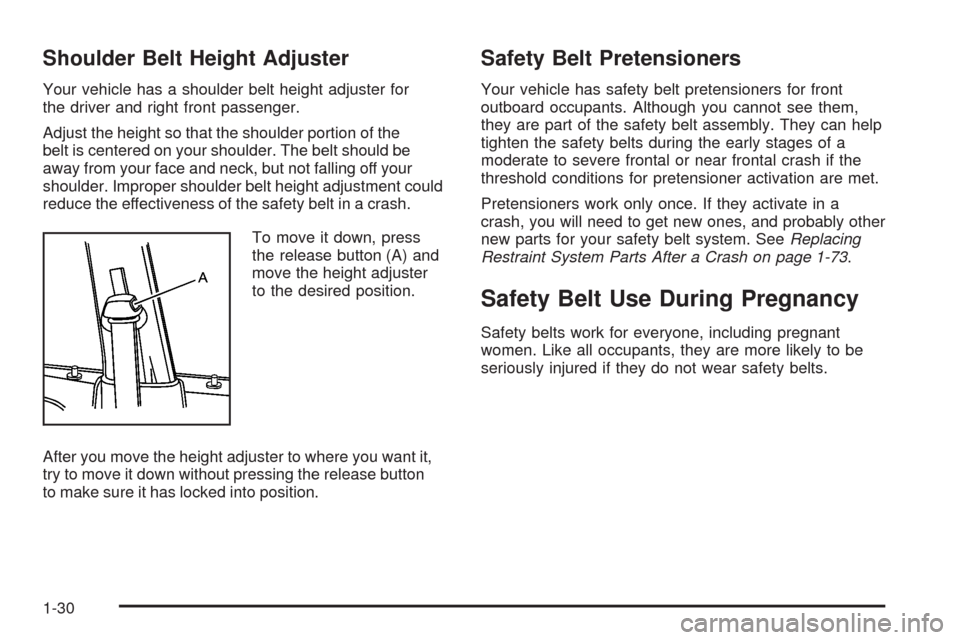
Your vehicle has a shoulder belt height adjuster for
the driver and right front passenger.
Adjust the height so that the shoulder portion of the
belt is centered on your shoulder. The belt should be
away from your face and neck, but not falling off your
shoulder. Improper shoulder belt height adjustment could
reduce the effectiveness of the safety belt in a crash.
To move it down, press
the release button (A) and
move the height adjuster
to the desired position.
After you move the height adjuster to where you want it,
try to move it down without pressing the release button
to make sure it has locked into position.
Safety Belt Pretensioners
Your vehicle has safety belt pretensioners for front
outboard occupants. Although you cannot see them,
they are part of the safety belt assembly. They can help
tighten the safety belts during the early stages of a
moderate to severe frontal or near frontal crash if the
threshold conditions for pretensioner activation are met.
Pretensioners work only once. If they activate in a
crash, you will need to get new ones, and probably other
new parts for your safety belt system. SeeReplacing
Restraint System Parts After a Crash on page 1-73.
Safety Belt Use During Pregnancy
Safety belts work for everyone, including pregnant
women. Like all occupants, they are more likely to be
seriously injured if they do not wear safety belts.
1-30
Page 37 of 384
Q:What is the proper way to wear safety belts?
A:An older child should wear a lap-shoulder belt and
get the additional restraint a shoulder belt can
provide. The shoulder belt should not cross the face
or neck. The lap belt should fit snugly below the hips,
just touching the top of the thighs. This applies belt
force to the child’s pelvic bones in a crash. It should
never be worn over the abdomen, which could cause
severe or even fatal internal injuries in a crash.
According to accident statistics, children and infants
are safer when properly restrained in the rear seating
positions than in the front seating positions.
In a crash, children who are not buckled up can strike
other people who are buckled up, or can be thrown
out of the vehicle. Older children need to use safety
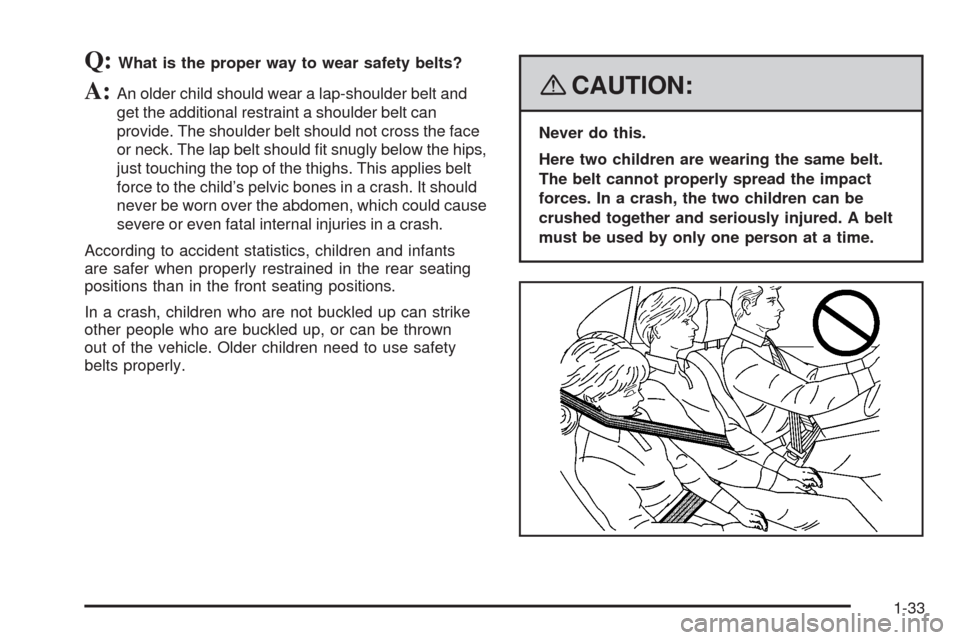
belts properly.{CAUTION:
Never do this.
Here two children are wearing the same belt.
The belt cannot properly spread the impact
forces. In a crash, the two children can be
crushed together and seriously injured. A belt
must be used by only one person at a time.
1-33
Page 39 of 384
{CAUTION:
Children can be seriously injured or strangled
if a shoulder belt is wrapped around their
neck and the safety belt continues to tighten.
Never leave children unattended in a vehicle
and never allow children to play with the
safety belts.
Every time infants and young children ride in vehicles,
they should have the protection provided by appropriate
restraints. Children who are not restrained properly
can strike other people, or can be thrown out of
the vehicle. In addition, young children should not use
the vehicle’s adult safety belts alone; they need to
use a child restraint.
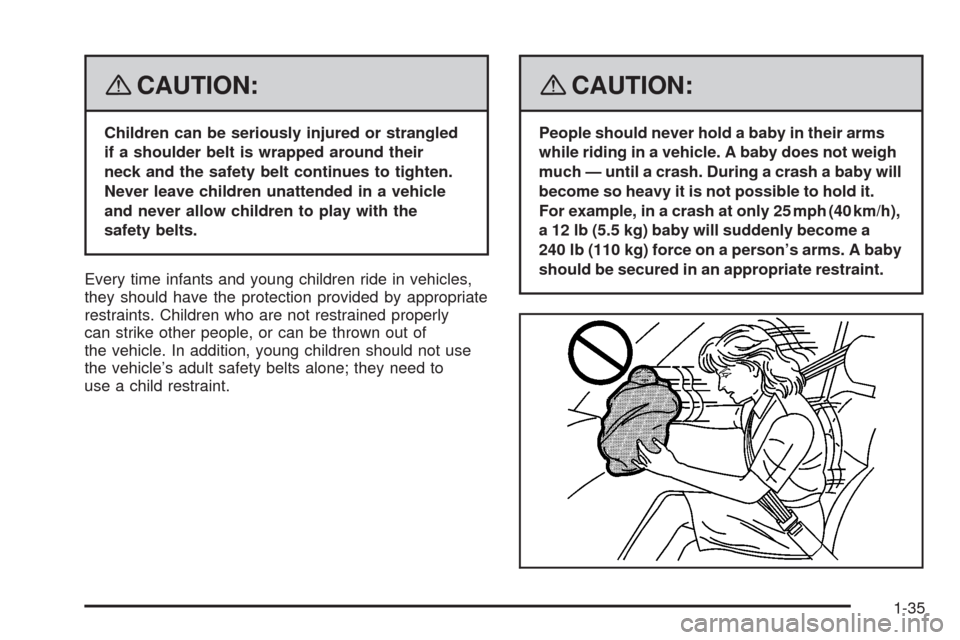
{CAUTION:
People should never hold a baby in their arms
while riding in a vehicle. A baby does not weigh
much — until a crash. During a crash a baby will
become so heavy it is not possible to hold it.
For example, in a crash at only 25 mph (40 km/h),
a 12 lb (5.5 kg) baby will suddenly become a
240 lb (110 kg) force on a person’s arms. A baby
should be secured in an appropriate restraint.
1-35
Page 40 of 384
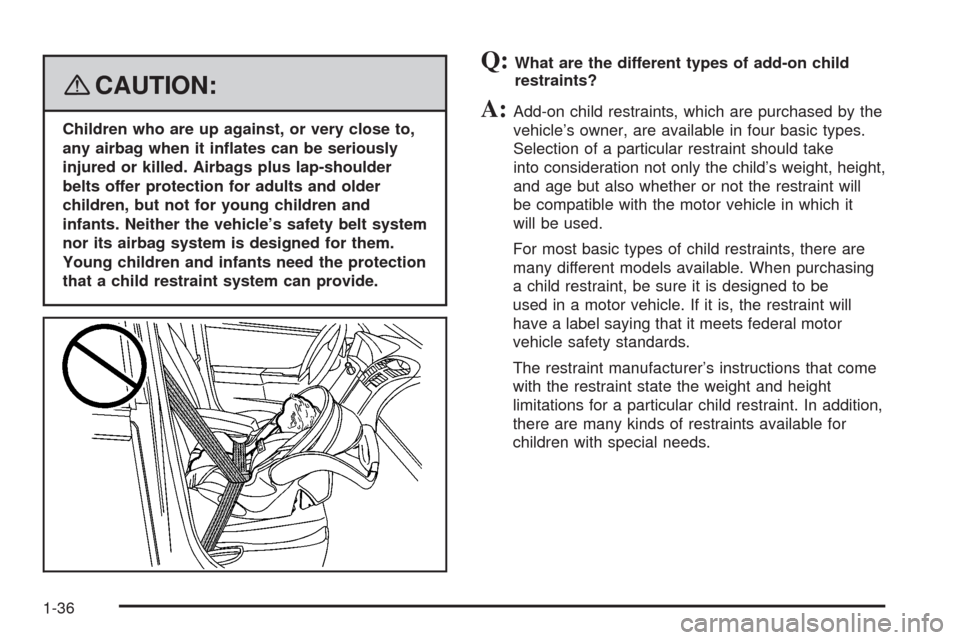
{CAUTION:
Children who are up against, or very close to,
any airbag when it inates can be seriously
injured or killed. Airbags plus lap-shoulder
belts offer protection for adults and older
children, but not for young children and
infants. Neither the vehicle’s safety belt system
nor its airbag system is designed for them.
Young children and infants need the protection
that a child restraint system can provide.
Q:What are the different types of add-on child
restraints?
A:Add-on child restraints, which are purchased by the
vehicle’s owner, are available in four basic types.
Selection of a particular restraint should take
into consideration not only the child’s weight, height,
and age but also whether or not the restraint will
be compatible with the motor vehicle in which it
will be used.
For most basic types of child restraints, there are
many different models available. When purchasing
a child restraint, be sure it is designed to be
used in a motor vehicle. If it is, the restraint will
have a label saying that it meets federal motor
vehicle safety standards.
The restraint manufacturer’s instructions that come
with the restraint state the weight and height
limitations for a particular child restraint. In addition,
there are many kinds of restraints available for
children with special needs.
1-36