headlamp CHEVROLET AVEO 2009 1.G User Guide
[x] Cancel search | Manufacturer: CHEVROLET, Model Year: 2009, Model line: AVEO, Model: CHEVROLET AVEO 2009 1.GPages: 354, PDF Size: 2.07 MB
Page 190 of 354
Driving at Night
Night driving is more dangerous than day driving because
some drivers are likely to be impaired — by alcohol or
drugs, with night vision problems, or by fatigue.
Night driving tips include:
Drive defensively.
Do not drink and drive.
Reduce headlamp glare by adjusting the inside
rearview mirror.
Slow down and keep more space between you and
other vehicles because headlamps can only light up
so much road ahead.
Watch for animals.
When tired, pull off the road.
Do not wear sunglasses.
Avoid staring directly into approaching headlamps.
Keep the windshield and all glass on your vehicle
clean — inside and out.
Keep your eyes moving, especially during turns or
curves.
No one can see as well at night as in the daytime.
But, as we get older, these differences increase.
A 50-year-old driver might need at least twice as much
light to see the same thing at night as a 20-year-old.
Driving in Rain and on Wet Roads
Rain and wet roads can reduce vehicle traction
and affect your ability to stop and accelerate. Always
drive slower in these types of driving conditions
and avoid driving through large puddles and
deep-standing or owing water.
{CAUTION:
Wet brakes can cause crashes. They might not
work as well in a quick stop and could cause
pulling to one side. You could lose control of the
vehicle.
After driving through a large puddle of water or a
car/vehicle wash, lightly apply the brake pedal until
the brakes work normally.
Flowing or rushing water creates strong forces.
Driving through owing water could cause your
vehicle to be carried away. If this happens, you
and other vehicle occupants could drown. Do not
ignore police warnings and be very cautious about
trying to drive through owing water.
4-10
Page 195 of 354
Run the engine for short periods only as needed to
keep warm, but be careful.
To save fuel, run the engine for only short periods as
needed to warm the vehicle and then shut the engine off
and close the window most of the way to save heat.
Repeat this until help arrives but only when you feel
really uncomfortable from the cold. Moving about
to keep warm also helps.
If it takes some time for help to arrive, now and then
when you run the engine, push the accelerator
pedal slightly so the engine runs faster than the idle
speed. This keeps the battery charged to restart
the vehicle and to signal for help with the headlamps.
Do this as little as possible to save fuel.If Your Vehicle is Stuck in Sand,
Mud, Ice, or Snow
Slowly and cautiously spin the wheels to free the
vehicle when stuck in sand, mud, ice, or snow.
SeeRocking Your Vehicle to Get It Out on page 4-16.
{CAUTION:
If you let your vehicle’s tires spin at high speed,
they can explode, and you or others could be
injured. The vehicle can overheat, causing an
engine compartment re or other damage.
Spin the wheels as little as possible and avoid
going above 35 mph (55 km/h) as shown on the
speedometer.
For information about using tire chains on the vehicle,
seeTire Chains on page 5-68.
4-15
Page 209 of 354
Service............................................................5-3
Accessories and Modications..........................5-3
California Proposition 65 Warning.....................5-4
California Perchlorate Materials Requirements.....5-4
Doing Your Own Service Work.........................5-4
Adding Equipment to the Outside of
the Vehicle.................................................5-5
Fuel................................................................5-5
Gasoline Octane............................................5-5
Gasoline Specications....................................5-5
California Fuel...............................................5-6
Additives.......................................................5-6
Fuels in Foreign Countries...............................5-7
Filling the Tank..............................................5-8
Filling a Portable Fuel Container.....................5-11
Checking Things Under the Hood....................5-11
Hood Release..............................................5-12
Engine Compartment Overview.......................5-14
Engine Oil...................................................5-16
Engine Oil Life System..................................5-18
Engine Air Cleaner/Filter................................5-19
Automatic Transmission Fluid.........................5-21
Manual Transmission Fluid.............................5-23
Hydraulic Clutch...........................................5-23
Cooling System............................................5-24
Engine Coolant.............................................5-25Engine Overheating.......................................5-30
Power Steering Fluid.....................................5-32
Windshield Washer Fluid................................5-33
Brakes........................................................5-34
Battery........................................................5-37
Jump Starting...............................................5-38
Headlamp Aiming...........................................5-43
Bulb Replacement..........................................5-43
Halogen Bulbs
..............................................5-43
Headlamps..................................................5-44
Front Turn Signal, Sidemarker and
Parking Lamps..........................................5-45
Center High-Mounted Stoplamp (CHMSL)
(Hatchback)..............................................5-47
Center High-Mounted Stoplamp (CHMSL)
(Sedan)...................................................5-47
Taillamps, Turn Signal, Sidemarker,
Stoplamps and Back-up Lamps...................5-48
License Plate Lamp......................................5-49
Replacement Bulbs.......................................5-49
Windshield Wiper Blade Replacement..............5-50
Tires..............................................................5-51
Tire Sidewall Labeling...................................5-52
Tire Terminology and Denitions.....................5-54
Ination - Tire Pressure.................................5-57
Tire Pressure Monitor System.........................5-59
Section 5 Service and Appearance Care
5-1
Page 210 of 354
Tire Pressure Monitor Operation.....................5-60
Tire Inspection and Rotation...........................5-62
When It Is Time for New Tires.......................5-63
Buying New Tires.........................................5-64
Different Size Tires and Wheels......................5-65
Uniform Tire Quality Grading..........................5-66
Wheel Alignment and Tire Balance..................5-67
Wheel Replacement......................................5-67
Tire Chains..................................................5-68
If a Tire Goes Flat........................................5-69
Changing a Flat Tire.....................................5-70
Removing the Spare Tire and Tools................5-71
Removing the Flat Tire and Installing the
Spare Tire................................................5-73
Storing a Flat or Spare Tire and Tools............5-78
Compact Spare Tire......................................5-78
Appearance Care............................................5-79
Interior Cleaning...........................................5-79
Fabric/Carpet...............................................5-80
Leather.......................................................5-81
Instrument Panel, Vinyl, and Other Plastic
Surfaces..................................................5-81
Care of Safety Belts......................................5-82
Weatherstrips...............................................5-82Washing Your Vehicle...................................5-82
Cleaning Exterior Lamps/Lenses.....................5-83
Finish Care..................................................5-83
Windshield and Wiper Blades.........................5-84
Aluminum Wheels.........................................5-84
Tires...........................................................5-85
Sheet Metal Damage.....................................5-85
Finish Damage.............................................5-85
Underbody Maintenance................................5-85
Chemical Paint Spotting.................................5-85
Vehicle Identication......................................5-86
Vehicle Identication Number (VIN).................5-86
Service Parts Identication Label.....................5-86
Electrical System............................................5-86
Add-On Electrical Equipment..........................5-86
Headlamp Wiring..........................................5-87
Windshield Wiper Fuses................................5-87
Power Windows and Other Power Options.......5-87
Fuses and Circuit Breakers............................5-87
Instrument Panel Fuse Block..........................5-88
Engine Compartment Fuse Block....................5-89
Capacities and Specications..........................5-93
Section 5 Service and Appearance Care
5-2
Page 251 of 354
To disconnect the jumper cables from both vehicles, do
the following:
1. Disconnect the black negative (−) cable from the
vehicle that had the dead battery.
2. Disconnect the black negative (−) cable from the
vehicle with the good battery.
3. Disconnect the red positive (+) cable from the
vehicle with the good battery.
4. Disconnect the red positive (+) cable from the other
vehicle.
Headlamp Aiming
Headlamp aim has been preset at the factory and
should need no further adjustment.
However, if your vehicle is damaged in a crash, the
headlamp aim may be affected. Aim adjustment to the
low-beam headlamps may be necessary if oncoming
drivers ash their high-beam headlamps at you
(for vertical aim).
If the headlamps need to be re-aimed, it is recommended
that you take the vehicle to your dealer/retailer for
service.
Bulb Replacement
For the proper type of replacement bulbs, see
Replacement Bulbs on page 5-49.
For any bulb changing procedure not listed in this
section, contact your dealer/retailer.
Halogen Bulbs
{CAUTION:
Halogen bulbs have pressurized gas inside and
can burst if you drop or scratch the bulb. You or
others could be injured. Be sure to read and follow
the instructions on the bulb package.
5-43
Page 252 of 354
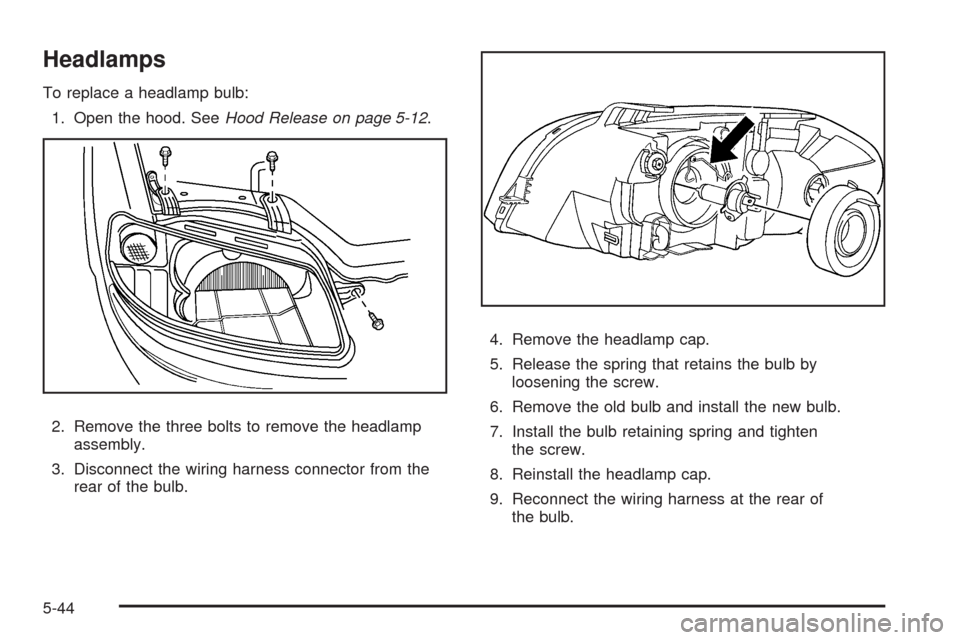
Headlamps
To replace a headlamp bulb:
1. Open the hood. SeeHood Release on page 5-12.
2. Remove the three bolts to remove the headlamp
assembly.
3. Disconnect the wiring harness connector from the
rear of the bulb.4. Remove the headlamp cap.
5. Release the spring that retains the bulb by
loosening the screw.
6. Remove the old bulb and install the new bulb.
7. Install the bulb retaining spring and tighten
the screw.
8. Reinstall the headlamp cap.
9. Reconnect the wiring harness at the rear of
the bulb.
5-44
Page 253 of 354
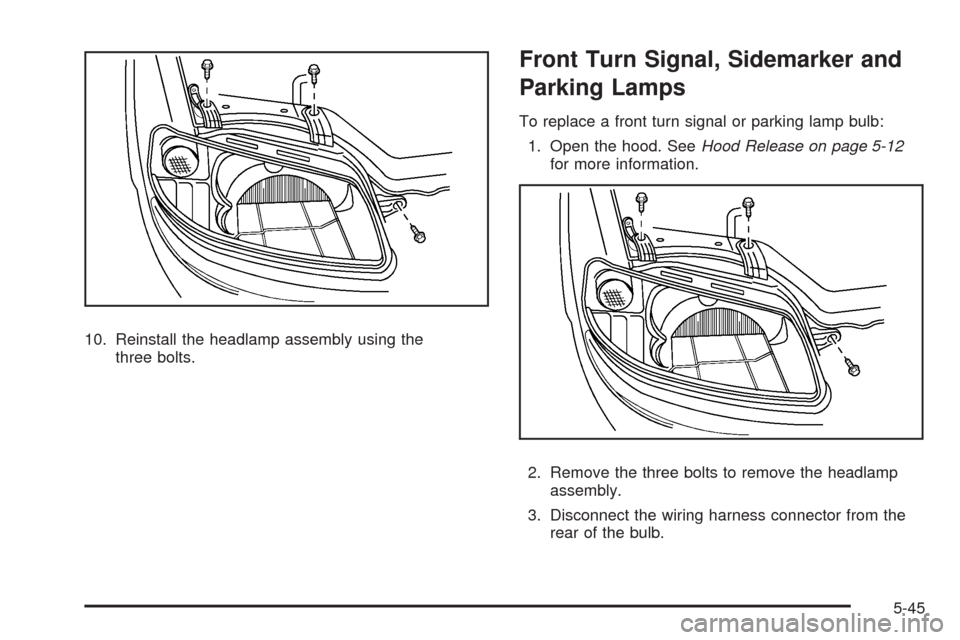
10. Reinstall the headlamp assembly using the
three bolts.
Front Turn Signal, Sidemarker and
Parking Lamps
To replace a front turn signal or parking lamp bulb:
1. Open the hood. SeeHood Release on page 5-12
for more information.
2. Remove the three bolts to remove the headlamp
assembly.
3. Disconnect the wiring harness connector from the
rear of the bulb.
5-45
Page 254 of 354
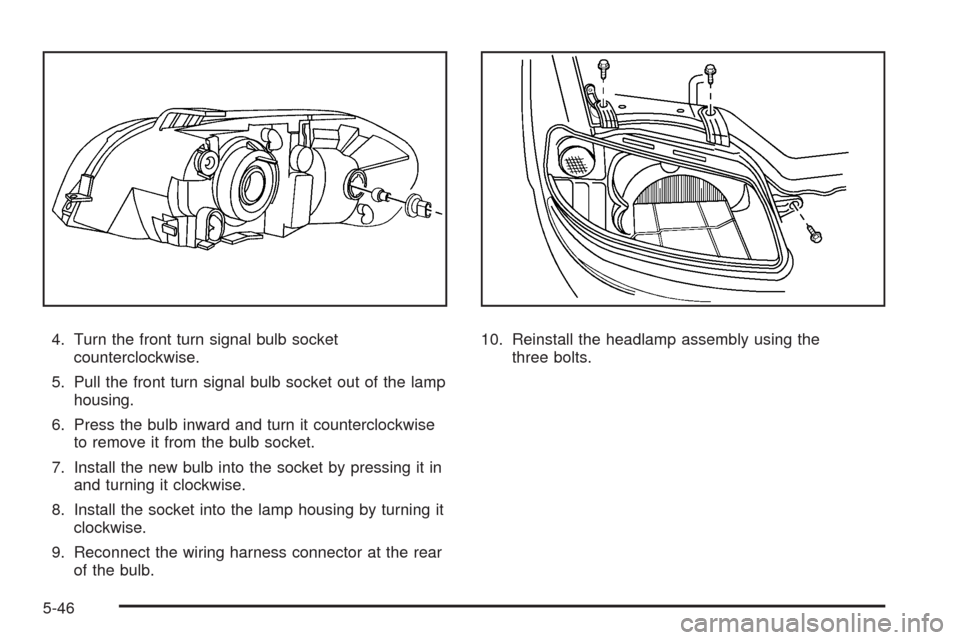
4. Turn the front turn signal bulb socket
counterclockwise.
5. Pull the front turn signal bulb socket out of the lamp
housing.
6. Press the bulb inward and turn it counterclockwise
to remove it from the bulb socket.
7. Install the new bulb into the socket by pressing it in
and turning it clockwise.
8. Install the socket into the lamp housing by turning it
clockwise.
9. Reconnect the wiring harness connector at the rear
of the bulb.10. Reinstall the headlamp assembly using the
three bolts.
5-46
Page 257 of 354
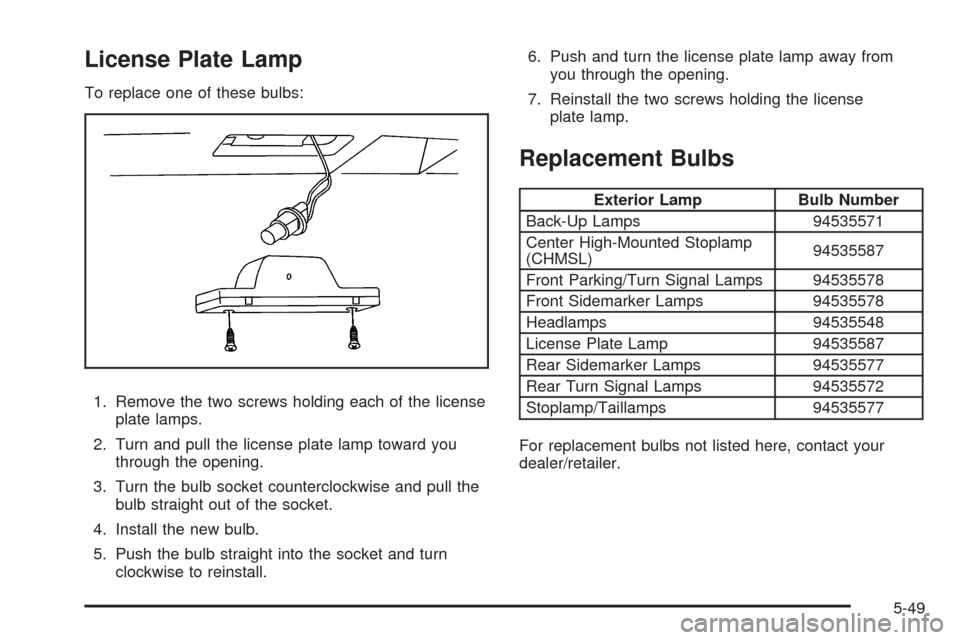
License Plate Lamp
To replace one of these bulbs:
1. Remove the two screws holding each of the license
plate lamps.
2. Turn and pull the license plate lamp toward you
through the opening.
3. Turn the bulb socket counterclockwise and pull the
bulb straight out of the socket.
4. Install the new bulb.
5. Push the bulb straight into the socket and turn
clockwise to reinstall.6. Push and turn the license plate lamp away from
you through the opening.
7. Reinstall the two screws holding the license
plate lamp.
Replacement Bulbs
Exterior Lamp Bulb Number
Back-Up Lamps 94535571
Center High-Mounted Stoplamp
(CHMSL)94535587
Front Parking/Turn Signal Lamps 94535578
Front Sidemarker Lamps 94535578
Headlamps 94535548
License Plate Lamp 94535587
Rear Sidemarker Lamps 94535577
Rear Turn Signal Lamps 94535572
Stoplamp/Taillamps 94535577
For replacement bulbs not listed here, contact your
dealer/retailer.
5-49
Page 276 of 354
If you need to replace any of your wheels, wheel bolts,
wheel nuts, or Tire Pressure Monitor System (TPMS)
sensors, replace them only with new GM original
equipment parts. This way, you will be sure to have the
right wheel, wheel bolts, wheel nuts, and TPMS
sensors for your vehicle.
{CAUTION:
Using the wrong replacement wheels, wheel bolts,
or wheel nuts on your vehicle can be dangerous. It
could affect the braking and handling of your
vehicle, make your tires lose air and make you
lose control. You could have a collision in which
you or others could be injured. Always use the
correct wheel, wheel bolts, and wheel nuts for
replacement.
Notice:The wrong wheel can also cause problems
with bearing life, brake cooling, speedometer or
odometer calibration, headlamp aim, bumper height,
vehicle ground clearance, and tire or tire chain
clearance to the body and chassis.
SeeChanging a Flat Tire on page 5-70for more
information.
Used Replacement Wheels
{CAUTION:
Putting a used wheel on the vehicle is dangerous.
You cannot know how it has been used or how far it
has been driven. It could fail suddenly and cause a
crash. If you have to replace a wheel, use a new
GM original equipment wheel.
Tire Chains
Notice:Use tire chains only where legal and only
when you must. Use only SAE Class “S” type chains
that are the proper size for your tires. Install them
on the front tires and tighten them as tightly as
possible with the ends securely fastened. Drive
slowly and follow the chain manufacturer’s
instructions. If you can hear the chains contacting
your vehicle, stop and retighten them. If the contact
continues, slow down until it stops. Driving too
fast or spinning the wheels with chains on will
damage your vehicle.
5-68