service CHEVROLET BLAZER 1993 User Guide
[x] Cancel search | Manufacturer: CHEVROLET, Model Year: 1993, Model line: BLAZER, Model: CHEVROLET BLAZER 1993Pages: 386, PDF Size: 20.7 MB
Page 170 of 386
LO w
SHOULDER WORKERS
AHEAD
e D
u
FLAGGER AHEAD
AM402003
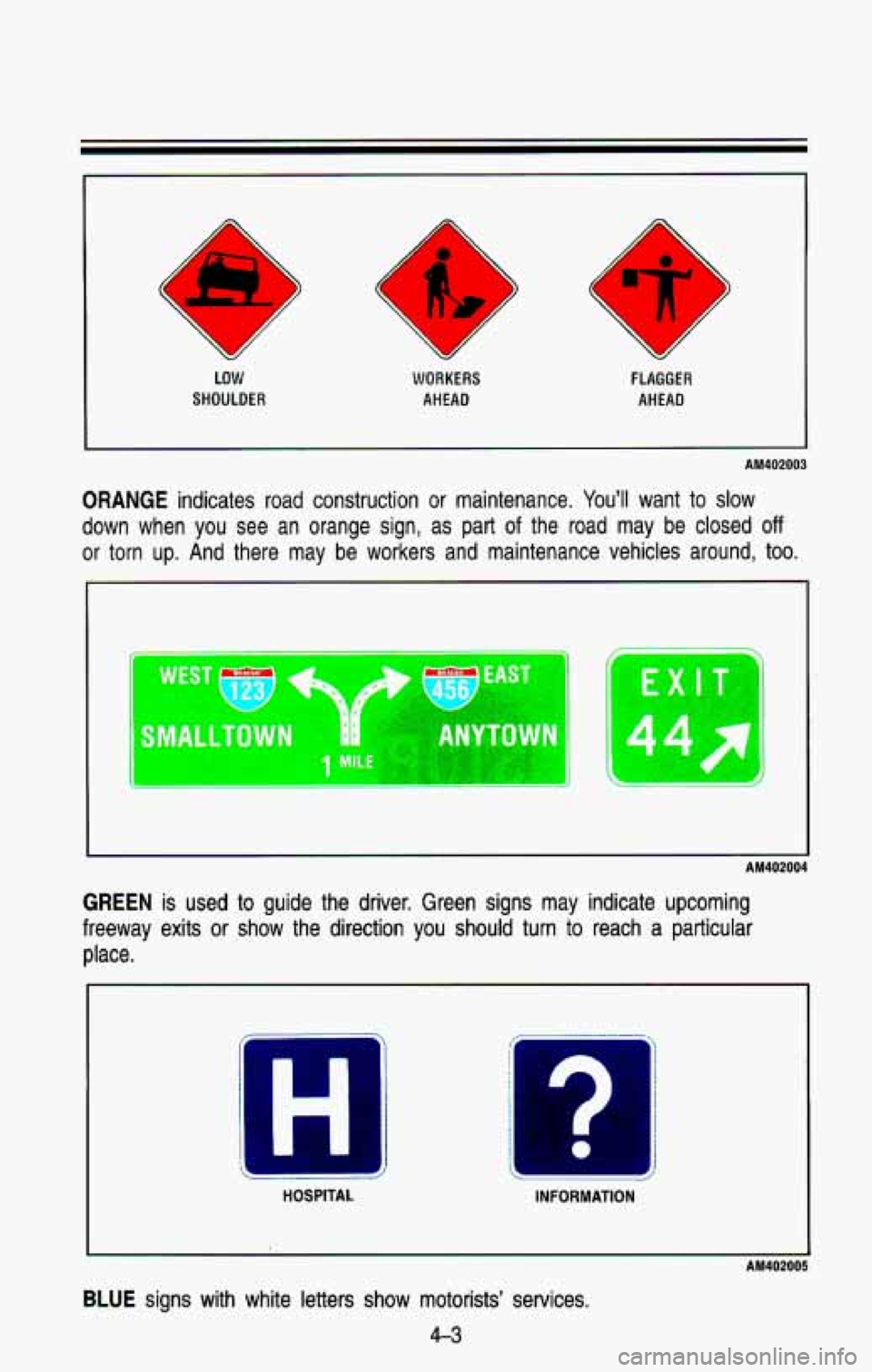
ORANGE indicates road construction or maintenance. You’ll want to slow
down when you see an orange sign, as part
of the road may be closed off
or torn up. And there may be workers and maintenance vehicles around, \
too.
SMALLTOWN WEsTr- ! lt -
c J 1UI I 1 MILE
AM40200
GREEN is used to guide the driver. Green signs may indicate upcoming
freeway exits or show the direction you should turn to reach a particular
place.
H
HOSPITAL
~~ ~
!AST I
roWN
I
EXIT
44
4.
-
AM402005
BLUE signs with white letters show motorists’ services.
4-3
a
INFORMATION
Page 184 of 386

Brake System Warning Light
K2325
This light appears on your instrument cluster to warn you if your regular
braking system needs service. See “Brake System Warning Light\
”
in the
Index.
Disc Brake Wear lndicators
Disc brake pads have built-in wear indicators that make a high\
-pitched
warning sound when the brake pads are worn and new pads are \
needed.
The sound may come and go or be heard all the time your veh\
icle is moving
(except when you are pushing on the brake pedal firmly).
I
CAUTION
The brake wear warning sound means that sooner or later your \
your
brakes won’t work well. That could lead to an accident. When you
hear the brake wear warning sound, have your vehicle serviced. \
I
NOTICE
Continuing to drive with worn-out brake pads could result in costly brakt
repair.
ome driving conditions
or climates may cause a brake squeal when the
brakes are first applied or lightly applied. This does
not mean something is
wrong with your brakes.
4-1 7
Page 191 of 386

This multipurpose passenger vehicle is defined as a utility vehicle in
Consumer Information Regulations issued by the National Highway \
Traffic")
Driving Guidelines (Utility Models)
This multipurpose passenger vehicle is defined as a utility vehicle in
Consumer Information Regulations issued by the National Highway \
Traffic
Safety Administration (NHTSA) of the United States Department of
Transportation. Utility vehicles have higher ground clearance and\
a narrower
track to make them capable
of performing in a wide variety of off-road
applications. Specific design characteristics give them a higher center of
gravity than ordinary cars. An advantage of the higher ground clearance is a
better view
of the road allowing you to anticipate problems. They are not
designed for cornering at the same speeds as conventional 2-whe\
el drive
vehicles any more than low-slung sports cars are designed to p\
erform
satisfactorily under off-road conditions. If at
all possible, avoid sharp turns or
abrupt maneuvers.
As with other vehicles of this type, failure to operate this
vehicle correctly may result in
loss of control or vehicle rollover.
OffmRoad Driving with Your Four-Wheel
Drive Vehicle
This off-road guide is for vehicles that have four-wheel drive. (Also, see
“Anti-lock Brakes” in the Index.)
If your vehicle doesn’t have four-wheel drive,
you shouldn’t drive off-road unless you’re on
a level, solid surface.
Off-road driving can be great fun. But it does have some definite hazards.
The greatest of these is the terrain itself.
“Off-roading” means you’ve left the great North American road system behind.
Traffic lanes aren’t marked. Curves aren’t banked. There a\
re no road signs.
Surfaces can be slippery, rough, uphill
or downhill. In short, you’ve gone right
back to nature.
Off-road driving involves some new skills. And that’s why it’s very important
that you read this guide. You’ll find many driving tips and suggestions. These
will help make your off-road driving safer and more enjoyable.
Before You Go Off-Roading
There are some things to do before you go out. For example, be sure to
have all necessary maintenance and service work done. Be sure you read \
all
the information about your four-wheel drive vehicle in this manual.
Is there
enough fuel?
Is the spare tire fully inflated? Are the fluid levels up where
they should be? What are the local laws that apply to off-roading where you’ll
be driving?
If you don’t know, you should check with law enforcement people
in the area. Will you be on someone’s private land?
If so, be sure to get the
necessary permission.
4-24
Page 201 of 386
CAUTION I
If Driving on frozen lakes, ponds or rivers can be dangerous.
-L Underwater springs, currents under the ice, or sudden thaws can
weaken the ice. Your vehicle could fall through the ice and you and
your passengers could drown. Drive your vehicle on safe surfaces
only.
I
t
Driving In Water
Light rain causes no special off-road driving problems. But hea\
vy rain can
mean flash flooding, and flood waters demand extreme caution.
Find out how deep the water is before you drive through it. If it’s deep
enough to cover your wheel hubs, axles, or exhaust pipe, don’t try it\
-you
probably won’t get through. Also, water that deep can damage\
your axle and
other vehicle parts.
If the water isn’t too deep, then drive through it slowly. At fast speeds, water
splashes on your ignition system and your vehicle can stall. S\
talling can also
occur
if you get your tailpipe under water. And, as long as your tailpipe is
under water, you’ll never be able to start your engine. When you go through
water, remember that when your brakes get wet,
it may take you longer to
stop.
CAUTION
C
Driving through rushing water can be dangerous. Deep water can \
sweep your vehicle downstream and you and your passengers could\
drown. If it’s only inches deep, it can still wash away the ground
from under your tires, and you could lose traction and roll t\
he vehiclc
over. Don’t drive through rushing water.
I
After Off-Road Driving
Remove any brush or debris that has collected on the underbody\
, chassis, or
under the hood. These accumulations can be a fire hazard.
After operation in mud or sand, have the brake linings cleaned and checked.
These substances can cause glazing and uneven braking. Check th\
e body
structure, steering, suspension, wheels, tires, and exhaust syste\
m for damage.
Also, check the fuel lines and cooling system for any leakage.
Your vehicle will require more frequent service due
to off-road use, Refer to
Section
7 for additional information.
4-34
Page 203 of 386
Your Driving and the Road
What you do in the daytime can also affect your night vision. For example, if
you spend the day in bright sunshine you are wise to wear sunglasses. Your
eyes will have less trouble adjusting to night.
But
if you’re driving, don’t wear sunglasses at night. They may \
cut down on
glare from headlights, but they also make a lot of things invisible that should
remain visible-such as parked cars, obstacles, pedestrians, or e\
ven trains
blocking railway crossings. You may want
to put on your sunglasses after you
have pulled into a brightly-lighted service or refreshment area. Eyes shielded
from that glare may adjust more quickly
to darkness back on the road. But
be sure
to remove your sunglasses before you leave the service area.
You can be temporarily blinded by approaching lights. It can take a second or
two, or even several seconds, for your eyes to readjust
to the dark. When
you are faced with severe glare (as from a driver who doesn’\
t lower the high beams, or a vehicle with misaimed headlights), slow down a li\
ttle. Avoid
staring directly into the approaching lights.
If there is a line of opposing
traffic, make occasional glances over the line of headlights
to make certain
that one
of the vehicles isn’t starting to move into your lane. Once you are
past the bright lights, give your eyes time to readjust before resuming speed.
High Beams
If the vehicle approaching you has its high beams on, signal by \
flicking yours
to high and then back to low beam. This is the usual signal to lower the
headlight beams. If the other driver still doesn’t lower the beams, resist the
temptation
to put your high beams on. This only makes two half-blinded
drivers.
On a freeway, use your high beams only in remote areas where you w\
on’t
impair approaching drivers. In some places, like cities, using \
high beams is
illegal.
When you follow another vehicle on a freeway or highway, use \
low beams.
True, most vehicles now have day-night mirrors that enable the \
driver to reduce glare. But outside mirrors are not
of this type and high beams from
behind can bother the driver ahead.
A Few More Night Driving Suggesiions
Keep your windshield and all the glass on your vehicle clean-inside and out.
Glare at night is made much worse by dirt
on the glass. Even the inside of
the glass can build up a film caused by dust. Tobacco smoke also makes
inside
glass surfaces very filmy and can be a vision hazard if it’s left there.
Dirty glass makes lights dazzle and flash more than clean glas\
s would,
making the pupils of your eyes contract repeatedly. You might even want
to
4-36
Page 212 of 386
Before Leaving on a Long Trip
Make sure you’re ready. Try to be well rested. If you must start when you’re
not fresh-such as after a day’s work-don’t plan to make too many miles
that first part of the journey. Wear comfortable clothing and shoes you can
easily drive in.
Is your vehicle ready for a long trip? If you keep it serviced and maintained,
it’s ready to go. If it needs service, have it done before starting out. Of
course, you’ll find experienced and able service experts
in your vehicle’s
dealerships all across North America. They’ll be ready and w\
illing to help
if
you need it.
Here are some things you can check before a trip:
e
e
On
Windshield Washer Fluid: Is the reservoir full? Are all windows clean
inside and outside?
Wiper Blades: Are they in good shape?
Fuel, Engine Oil, Other Fluids: Have you checked all levels?
Lights: Are they all working? Are the lenses clean?
Tires: They are vitally important to a safe, trouble-free trip. Is the tread
good enough for long distance driving? Are the tires all inflated to the
recommended pressure?
Weather Forecasts: What’s the weather outlook along your route?
Should you delay your trip a short time to avoid a major storm system?
Maps: Do you have up-to-date maps?
the Road
Unless you are the only driver, it is good to share the driving task with
others. Limit turns behind the wheel to about
100 miles (160 km) or two
hours at a sitting. Then, either change drivers or stop for s\
ome refreshment
like coffee, tea or soft drinks and some limbering up. But do stop and move
around. Eat lightly along the way. Heavier meals tend
to make some people
sleepy.
On two-lane highways or undivided multilane highways that do not have
controlled access, you’ll want to watch for some situations not usually found
on freeways. Examples are: stop signs and signals, shopping cen\
ters with
direct access to the highway, no passing zones and school zones, vehicles
turning left and right
off the road, pedestrians, cyclists, parked vehicles, and
even animals.
4-45
Page 213 of 386

Your Driving and the Road
Highway Hypnosis
Is there actually such a condition as “highway hypnosis?” Or \
is it just plain
falling asleep at the wheel? Call
it highway hypnosis, lack of awareness, or
whatever.
There is something about an easy stretch of road with the sam\
e scenery, along with the hum of the tires on the road, the drone of the engine, and the
rush
of the wind against the vehicle that can make you sleepy. Don’\
t let it
happen to you! If it does, your vehicle can leave the road in less than a
second,
and you could crash and be injured.
What can you do about highway hypnosis? First, be aware that
it can
happen.
Then here are some tips:
Make sure your vehicle is well ventilated, with a comfortably \
cool interior.
Keep your eyes moving. Scan the road ahead and to the sides. Check
your rearview mirrors frequently and your instruments from time \
to time.
This can help you avoid a fixed stare.
Wear good sunglasses in bright light. Glare can cause drowsiness. But
don’t wear sunglasses at night. They will drastically reduce your overall
vision at the very time you need all the seeing power you have.
If you get sleepy, pull off the road into a rest, service, or parking area
and take a nap, get some exercise, or both. For safety, treat\
drowsiness
on the highway as an emergency.
As in any driving situation, keep pace with traffic and allow ade\
quate
following distances.
4-46
Page 230 of 386
. .
6. Release the regular brakes.
CAUTION
It can be dangerous to get out of your vehicle if the shift lever is no
fully in
P (Park) wi-. the parking brake firmly set. Your vehicle can
roll.
If you have left the engine running, the vehicle can move suddenl\
y.
You or others could be injured.
To be sure your vehicle won’t move,
when you’re on fairly level ground, use the steps that foll\
ow.
If you have four-wheel drive and your transfer case is in N (Neutral),
your vehicle will be free to
roll, even if your shift lever is in P (Park)
So, be sure the transfer case is in a drive gear-not in N (Neutral).
If you are parking on a hill, or if you’re pulling a trailer, also see
I “Parking On Hills” in the Index. I
When You Are Ready to Leave After Parking on a Hill
1. Apply your regular brakes and hold the pedal down while you:
Start your engine.
Shift into a gear; and
Release the parking brake.
2. Let up on the brake pedal.
3. Drive slowly until the trailer is clear of the chocks.
4. Stop and have someone pick up and stow the chocks.
Maintenance When Trailer Towing
Your vehicle will need service more often when you’re pulling a \
trailer. .See
the Maintenance Schedule for more on this. Things that are especially
important in trailer operation are automatic transmission fluid (don’t overfill),
engine oil, axle lubricant, belts, cooling system, and brake ad\
justment. Each
of these is covered in this manual, and the Index will help you find them
quickly.
If you’re trailering, it’s a good idea to review these sections before
you start your trip.
Check periodically to see that all hitch nuts and bolts are tight.
4-63
Page 237 of 386

Good Battery Dead Battery
4
K2506
10. Now start the vehicle with the good battery and run the engin\
e for
11. Try to start the vehicle with the dead battery.
awhile.
If it won’t start after a few tries, it probably needs service.
12. Remove the cables in reverse order to prevent electrical shorti\
ng.
Take
REMOVE CABLES IN THIS ORDER I
5-6
Page 238 of 386
Tiwing Your Vehicle
Try to have a GM dealer or a professional towing service tow your vehicle.
They can provide the right equipment and know how to tow
it without
damage.
If your vehicle has been changed since it was factory-new, by adding things
like fog lamps, aero skirting,
or special tires and wheels, these things could
be damaged during towing.
Before you
do anything, turn on the hazard warning flashers.
When you call, tell the towing service:
That your vehicle has rear-wheel drive, or that it has the four-wheel drive
option.
The make, model, and year of your vehicle.
Whether you can move the shift lever for the transmission and \
transfer
If there was an accident, what was damaged.
case,
if you have one.
CAUTION I
To help avoid
injury to you or others:
A 9 Never let passengers ride in a vehicle that is being towed.
e Never tow faster than safe or posted speeds.
e Never tow with damaged parts not fully secured.
Never get under your vehicle after it has been lifted by the tow
truck.
* Always use separate safety chains on each side when towing a
vehicle.
When your vehicle is being towed, have the ignition key off. The steering
wheel should be clamped in a straight-ahead position, with a clamping device
designed for towing service.
Do not use the vehicle’s steering column lock for
this. The transmission and transfer case,
if you have one, should be in
Neutral and the parking brake released.
If you have a two-wheel drive vehicle, don’t have your vehicle \
towed on the
rear wheels, unless you must.
If the vehicle must be towed on the rear
wheels, don’t
go more than 35 mph (56 kmlh) or farther than 50 miles (80
km) or your transmission will be damaged. If these limits must be exceeded,
then the rear drive wheels have to be supported on a dolly.
5-7