service CHEVROLET BLAZER 1993 Workshop Manual
[x] Cancel search | Manufacturer: CHEVROLET, Model Year: 1993, Model line: BLAZER, Model: CHEVROLET BLAZER 1993Pages: 386, PDF Size: 20.7 MB
Page 319 of 386

Service & Appearance Care
If you ever replace your tires with those not having a TPC Spec number,
make sure they are the same size, load range, speed rating an\
d construction
type (bias, bias-belted or radial) as your original tires.
I CAUTION
A
Mixing tires could cause you to lose control while driving. If you mix
tires
of different sizes or types (radial and bias-belted tires) the
vehicle may not handle properly, and you could have a crash. Be
sure
to use the same size and type tires on all wheels.
I
Uniform Tire Quarity Grading
The following information relates to the system developed by the United
States National Highway Traffic Safety Administration which grade\
s tires by
treadwear, traction and temperature performance. (This applies o\
nly to
vehicles sold in the United States.)
Treadwear
The treadwear grade is a comparative rating based on the wear \
rate of the
tire when tested under controlled conditions on a specified government test
course.
For example, a tire graded 150 would wear one and a half (1 1/2)
times as well on the government course as a tire graded 100. The relative
performance
of tires depends upon the actual conditions of their use,
however, and may depart significantly from the norm due to var\
iations
in
driving habits, service practices and differences in road characteristics and
climate.
Traction-A, B, C
The traction grades, from highest to lowesr are: A, 8, and C. They represent
the tire’s ability to stop on wet pavement as measured under controlled
conditions on specified government test surfaces of asphalt and concrete. A
tire marked
C may have poor traction performance.
Warning: The traction grade assigned to this tire is based on braking
(straight-ahead) traction tests and does not include cornering \
(turning) traction.
Temperature-A, B, C
The temperature grades are A (the highest), B, and C, representing the tire’s
resistance to the generation
of heat and its ability to dissipate heat when
tested under controlled conditions on a specified indoor laborat\
ory test wheel.
Sustained high temperature can cause the material
of the tire to degenerate
and reduce tire life, and excessive temperature can lead to sudden tire
failure. The grade
C corresponds to a level of performance which all
passenger car tires must meet under the Federal Motor Vehicle \
Safety
6-54
Page 323 of 386

Service & Appearance Care
Cleaning the Inside of Your Vehjcle
Use a vacuum cleaner often to get rid of dust and loose dirt\
. Wipe vinyl with
a clean, damp cloth.
Your GM dealer has
two GM cleaners-a solvent-type spot lifter and a foam-type
powdered cleaner. They will clean normal spots and stains very \
well.
Here are some cleaning tips:
Always read the instructions on the cleaner label.
Clean up stains as soon as you can-before they set.
Use a clean cloth or sponge, and change to a clean area often. A soft
brush may be used
if stains are stubborn.
Use solvent-type cleaners in a well ventilated area only. If you use them,
don’t saturate the stained area.
If a ring forms after spot cleaning, clean the entire area immedi\
ately or it
will set.
Using Foam-Type CIeaner on Fabric
Vacuum and brush the area to remove any loose dirt.
Always clean a whole trim panel or section. Mask surrounding trim along
stitch or welt lines.
Mix Multi-Purpose Powdered Cleaner following the directions on t\
he
Use suds only and apply with a clean sponge.
container label.
Don’t saturate the material.
Don’t rub
it roughly.
As soon as you’ve cleaned the section, use a sponge to remove the
suds.
Rinse the section with a clean, wet sponge.
Wipe off what’s left with a slightly damp paper towel or cloth.
Then dry it immediately with an air hose, a hair dryer or a heat lamp.
NOTICE I
Be careful with a hair dryer or heat lamp. You could scorch the fabric
Wipe with a clean cloth.
6-58
Page 325 of 386

Service & Appearance Care
Combination Stains: Like candy, ice cream, mayonnaise, chili sauce and
unknown stains,
Carefully scrape off excess stain, then clean with cool water \
and allow to
If a stain remains, clean it with solvent-type cleaner.
dry.
Cleaning Vinyl or Leather
Just use warm water and a clean cloth.
Rub with a clean, damp cloth to remove dirt. You may have to do it
more than once.
Things like tar, asphalt and shoe polish will stain if you don’t get them
off quickly. Use a clean cloth and solvent-type vinylheather cleaner\
.
Cleaning the Top of the Instrument Panel
Use only mild soap and water to clean the top surfaces of th\
e instrument
panel. Sprays containing silicones or waxes may cause annoying \
reflections in
the windshield and even make
it difficult to see through the windshield under
certain conditions.
Care of Safety Belts
Keep belts clean and dry.
Do not bleach or dye safety belts. If you do, it may severely weaken
them. In a crash they might not be able to provide adequate
protection. Clean
safety belts only with mild soap and lukewarm
I water.
Glass
Glass should be cleaned often. GM Glass Cleaner (GM Part No. 1050427) or
a liquid household glass cleaner will remove normal tobacco smoke \
and dust
films.
Don’t use abrasive cleaners
on glass, because they may cause scratches.
Avoid placing decals on the inside rear window, since they may\
have to be scraped
off later. If abrasive cleaners are used on the inside of the rear
window, an electric defogger element may be damaged. Any temporary
iicense should not be attached across the defogger grid.
6-60
Page 328 of 386

Minor chips and scratches can be repaired with touch-up materia\
ls available
from your dealer or other service outlets. Larger areas of fin\
ish damage can be corrected in your dealer’s body and paint shop.
Underbody Maintenance
Chemicals used for ice and snow removal and dust control can collect on the
underbody.
If these are not removed, accelerated corrosion (rust) can occur
on the underbody parts such as fuel lines, frame, floor pan, and exhaust
system even though they have corrosion protection.
At least every spring, flush these materials from the underbody wi\
th plain
water. Clean any areas where mud and other debris can collect.\
Dirt packed in closed areas of the frame should be loosened before being flushed. Your
dealer or an underbody washing system can do this for you.
Chemical Paint Spotting
Some weather and atmospheric conditions can create a chemical fallout.
Airborne pollutants fall upon and attack painted surfaces on yo\
ur vehicle. This
damage can take two forms: blotchy, ringlet-shaped discolorations\
, and small irregular dark spots etched into the paint surface.
Although no defect in the paint
job causes this, General Motors will repair, at
no charge to the owner, the surfaces of new vehicles damaged by \
this fallout
condition within
12 months or 12,000 miles (20 000 km) of purchase,
whichever comes first.
6-63
Page 329 of 386
Service & Appearance Care
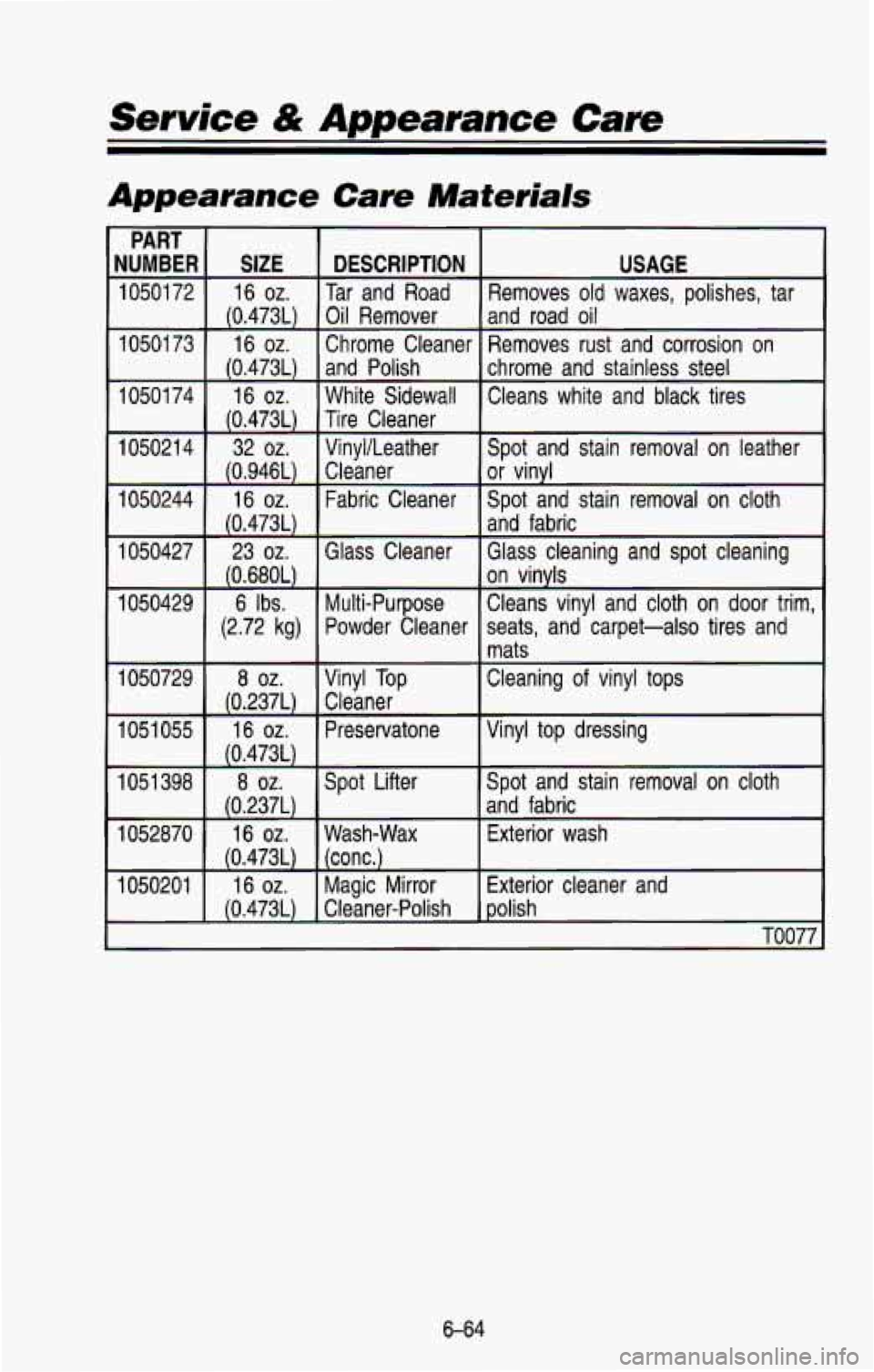
Appearance Care Materials
PART I I I
NUMBER SIZE DESCRIPTION USAGE
1050172 16 02. Tar and Road Removes old waxes, polishes, tar
1050173 16
oz. Chrome Cleaner Removes rust and corrosion on
I0501 74 16
02. White Sidewall Cleans white and black tires
(0.473L)
Oil Remover and road oil
(0.473L) and Polish chrome and stainless steel
(0.473L) Tire Cleaner
1050214 32
oz. VinvVLeather Spot and stain removal on leather
(0.946L) Cleaner or vinyl
(0.473L) and fabric
1050244 16 02. Fabric Cleaner Spot and stain removal on cloth
I050427 23
02. Glass Cleaner Glass cleanina and sDot cleaning I
(0.680L)
"
on vinyls
-
1050429 6 Ibs. Multi-PurDose Cleans vinvl and cloth on door tr\
im,
(2.72 kg) Powder cleaner seats, and'carpet-also tires and
mats
1050729 8
02. Vinyl Top
Cleaning of vinyl tops
1051
055 16 02. Preservatone Vinyl top dressing
IO51
398 8 02. Spot Lifter Spot and stain removal on cloth
1052870 16
02. Wash-Wax Exterior wash
(0.237L) Cleaner
(0.473L)
(0.237L)
and fabric
(0.473L) (conc.)
1050201 16
02. Magic Mirror Exterior cleaner and
I (0.473L) I Cleaner-Polish 1 polish
TO077
6-64
Page 330 of 386
Vehicle ldentification Number ( I) m
t-
KO641
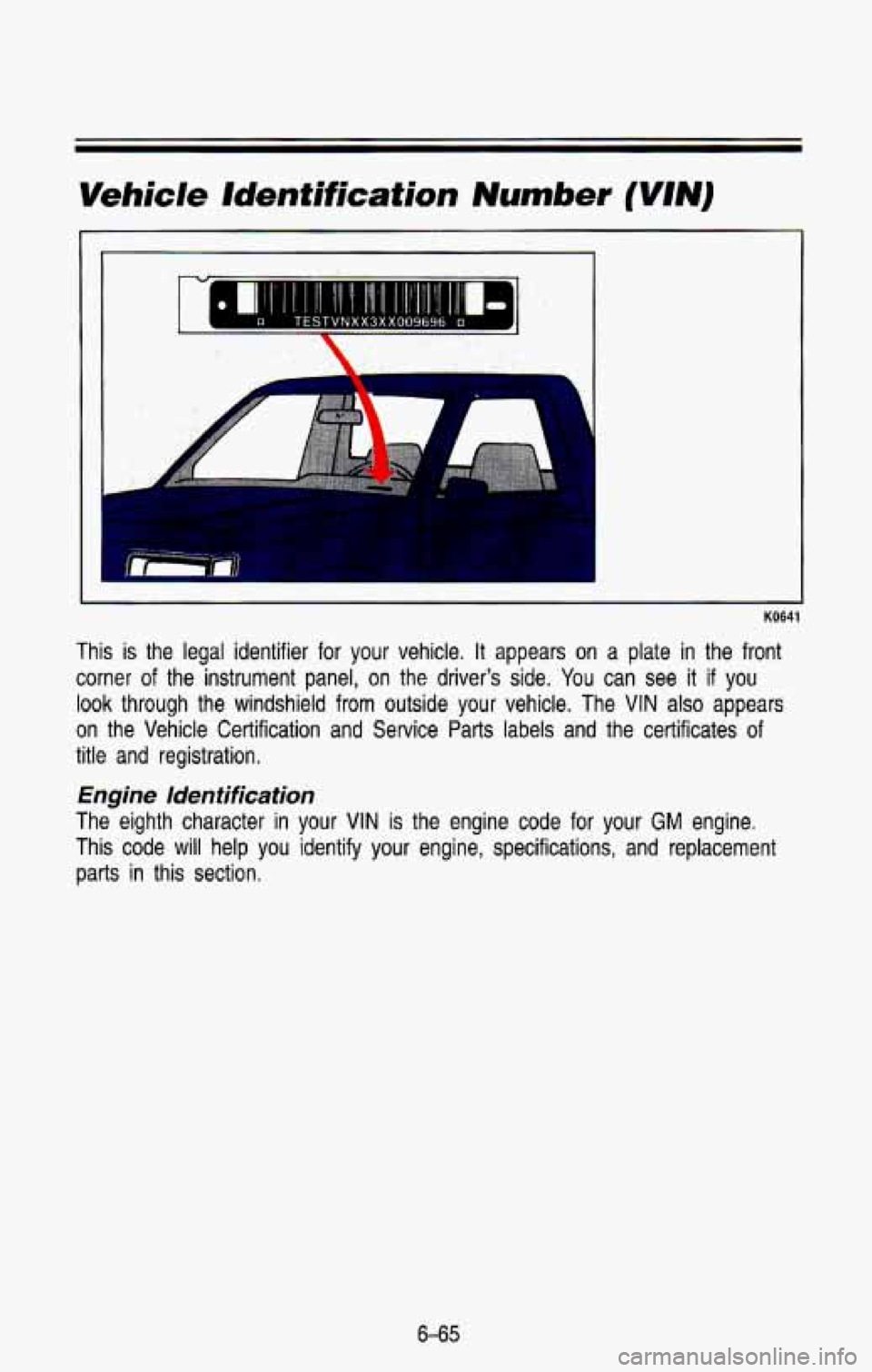
This is the legal identifier for your vehicle. It appears on a plate in the front
corner of the instrument panel,
on the driver's side. You can see it if you
look through the windshield from outside your vehicle. The VIN also appears
on the Vehicle Certification and Service Parts labels and the \
certificates
of
title and registration.
Engine Identification
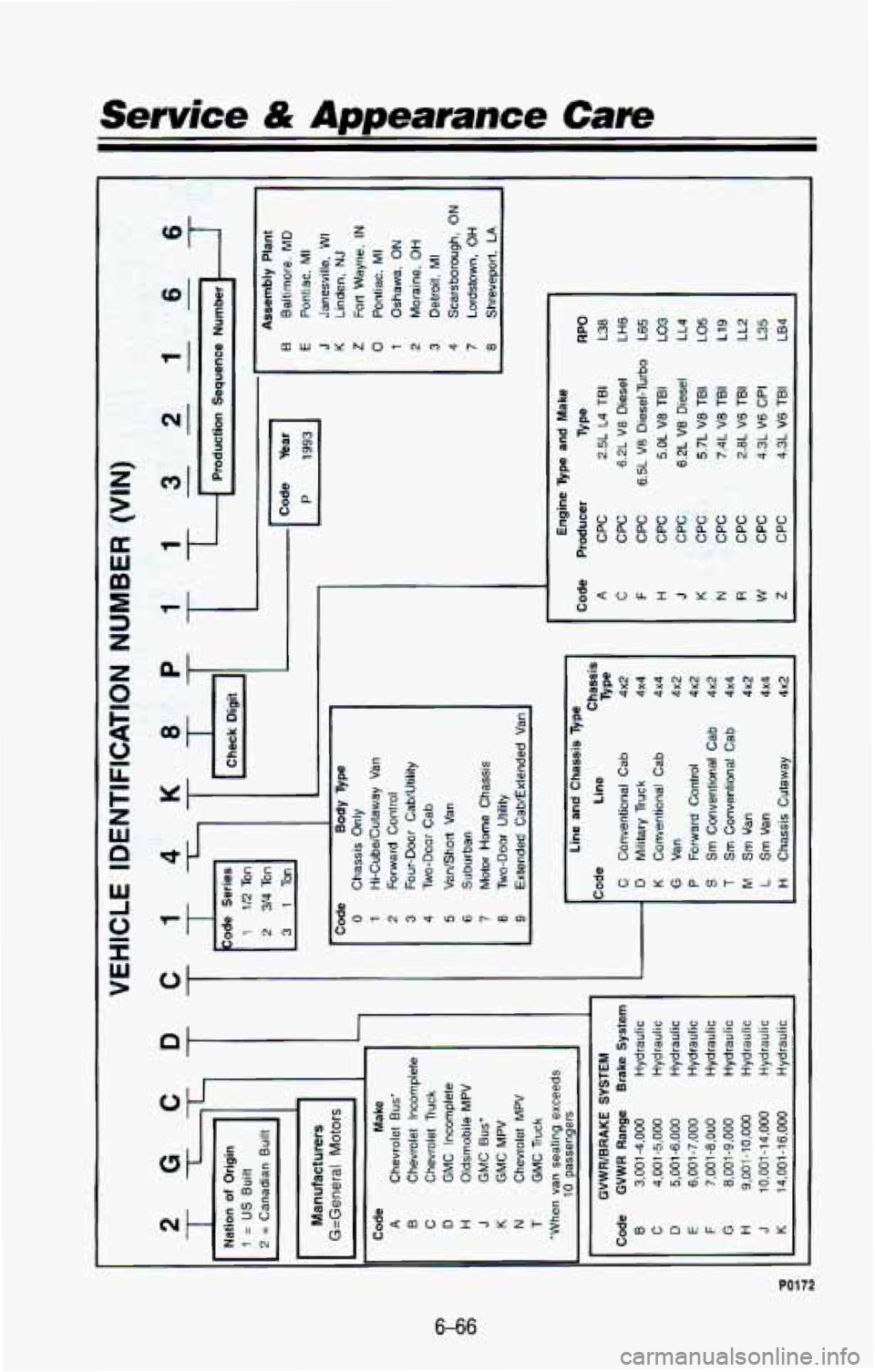
The eighth character in your VIN is the engine code for your GM engine.
This code will help
you identify your engine, specifications, and replacement
parts in this section.
6-65
Page 331 of 386
Service & Appearance Cam
L
pe:
w
I
3
z
m
I-
Z
1
I I
L
e
Qo
1
It
C 9
- Q, v) 0 a
w
OtJ
POI 72
6-66
Page 332 of 386
Service Parts Iden Mfl cation Label
VEH!CLE
NUMBER IDENTfFlCATlOb
WHEELBASE
I
6BJ 621. 62U 670 671 679 763 BHJ 9HJ
PAINT TECHNOLOGY I ORDER NUMBER
EXTERIORCOLORS MODELMSIGNATION
OPTIONCONTENT
t
-
- K2680
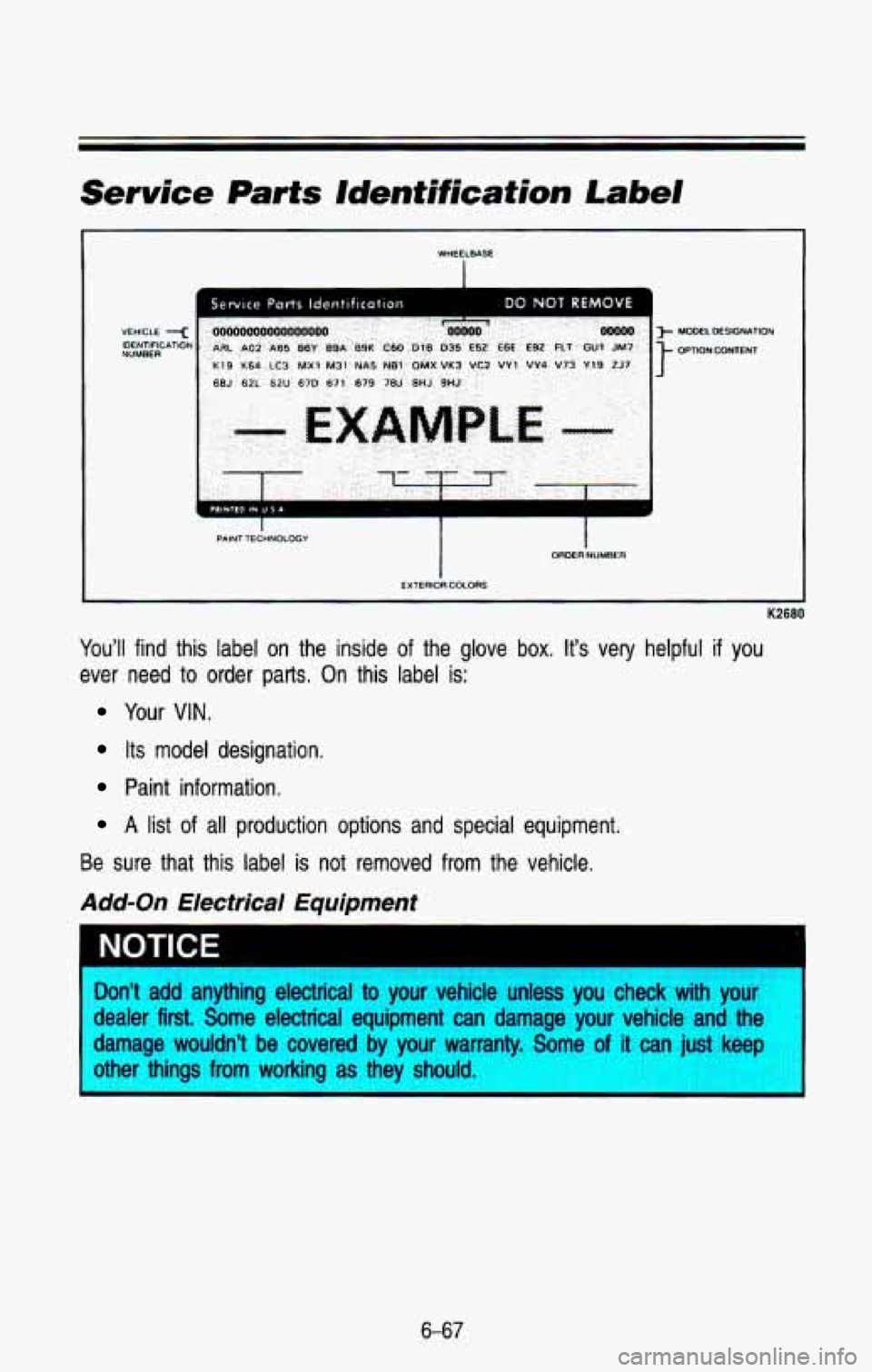
You’ll find this label on the inside of the glove box. It’s very helpful if you
ever need
to order parts. On this label is:
Your VIN.
Its model designation.
Paint information.
A list of all production options and special equipment.
Be sure that this label is not removed from the vehicle.
Add-on Electrical Equipment
Don’t add anything electrical to your vehicle unless you check with your
dealer
first. Some electrical equipment can damage your vehicle and the
damage wouldn’t be covered
by your warranty. Some of it can just keep
ther things
from working as they should.
6-67
Page 333 of 386
Service & Appearance Care
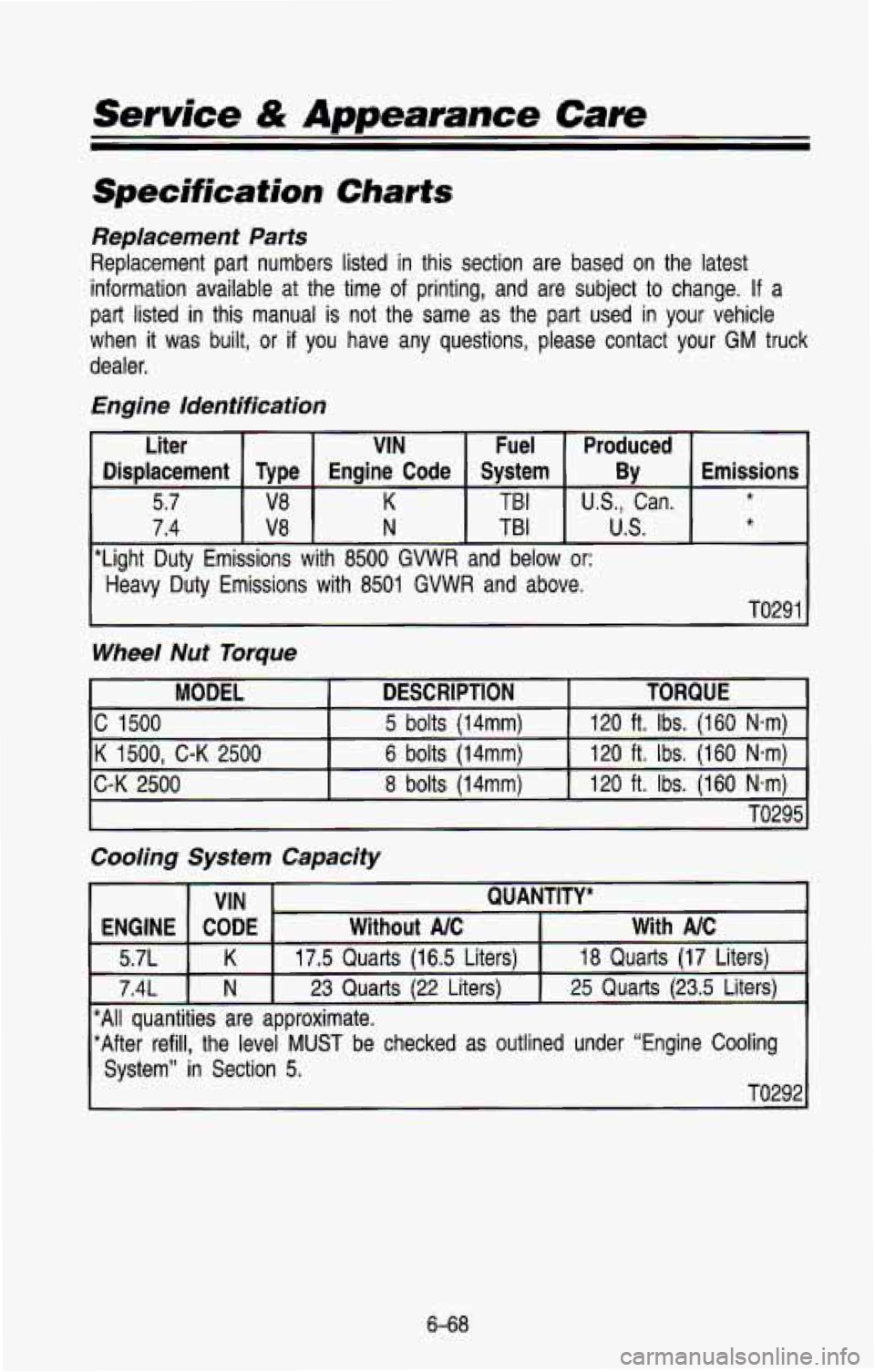
Specification Charts
Replacement Parts
Replacement part numbers listed in this section are based on the latest
information available at the time
of printing, and are subject to change. If a
part listed in this manual is not the same as the part used in your vehicle
when
it was built, or if you have any questions, please contact your GM truck
dealer.
Engine identification
Liter VIN Fuel Produced
Displacement Type Engine Code System BY Emissions
5.7 V8 K TB I U.S., Can.
7.4 V8 N TB I us.
*
*
*Light Duty Emissions with 8500 GVWR and below or:
Heavy Duty Emissions with 8501 GVWR and
above.
TO291
Wheel Nut Torque
MODEL DESCRIPTION TORQUE
C 1500 5 bolts (14mm) 120 ft. Ibs. (1 60 Nmm)
K 1500, C-K 2500 6 bolts (1 4mm) 120 ft. Ibs. (160
N-m)
C-K 2500 8 bolts (14mm) 120 ft. Ibs. (160 Nem)
I TO2951
Cooling System Capacity
VIN QUANTITY*
ENGINE CODE Without NC With AIC
5.7L K 17.5 Quarts (16.5 Liters)
18 Quarts (1 7 Liters)
7.4- N 23 Quarts
(22 Liters) 25 Quarts (23.5 Liters)
*All quantities are approximate.
*After refill, the level
MUST be checked as outlined under “Engine Cooling
System” in Section
5.
TO292
6-68
Page 334 of 386
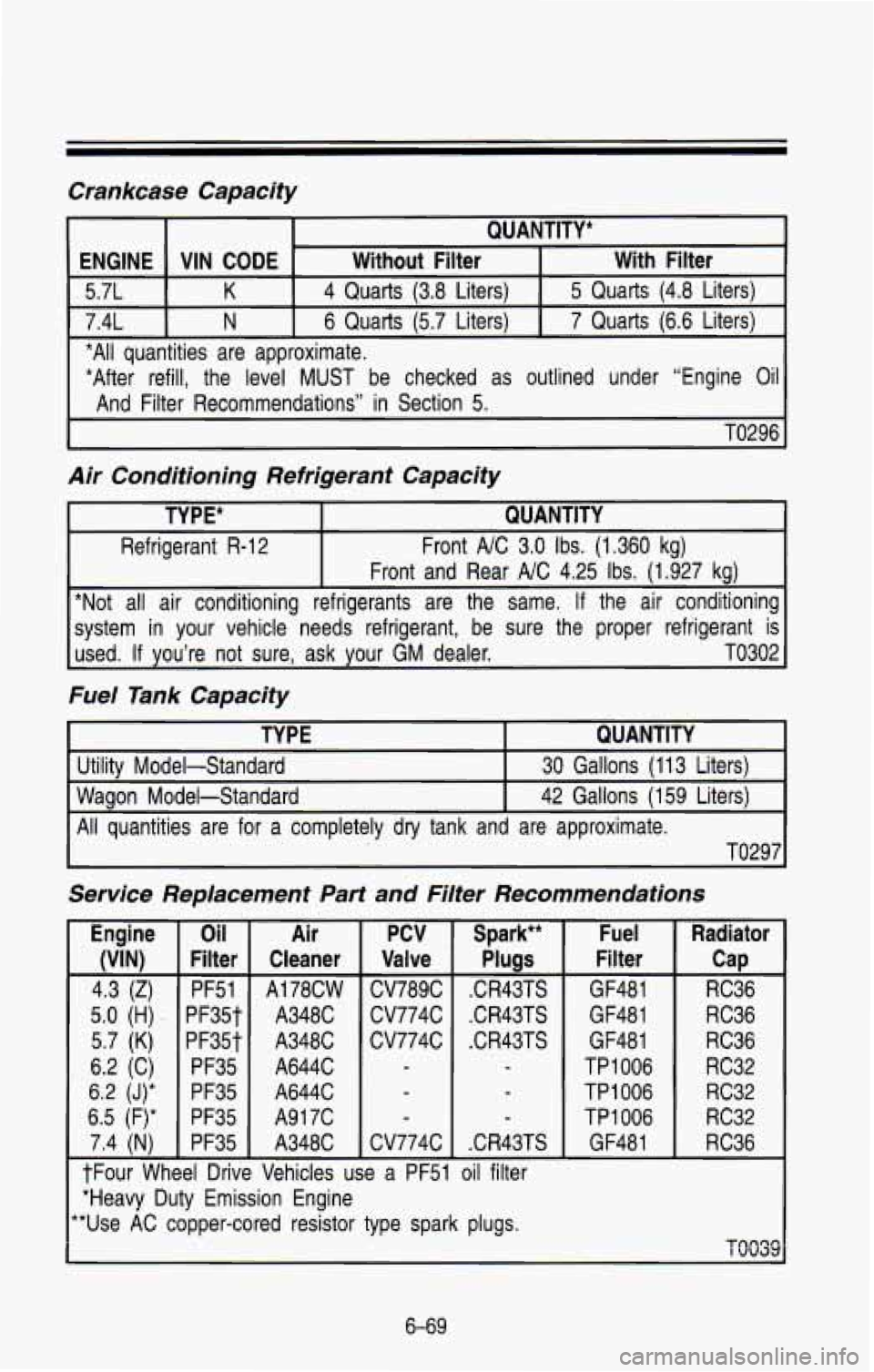
Crankcase Capacify
QUANTITY*
ENGINE VIN CODE Without Filter With Filter
5.7L K 4 Quarts (3.8 Liters) 5 Quarts (4.8 Liters)
7.4L N 6 Quarts (5.7 Liters) 7 Quarts (6.6 Liters)
*All quantities are approximate.
*After refill, the level MUST be checked as outlined under “\
Engine Oil
TO296
And Filter Recommendations” in Section
5.
Air Condifioning Refrigeranf Capacify
TYPE* QUANTITY
Refrigerant R-12 Front
AJC 3.0 Ibs. (1.360 kg)
Front and Rear AJC 4.25 Ibs. (1.927 kg)
*Not all air conditioning refrigerants are the same.
If the air conditioning
system in your vehicle needs refrigerant, be sure the proper r\
efrigerant is
used. If you’re not sure, ask your GM dealer. TO302
Fuel Tank Capacify
I -1
Utility Model-Standard 30 Gallons (113 Liters)
Wagon Model-Standard 42 Gallons (159 Liters)
All quantities are for a completely dry tank and are approxima\
te. TO2971
Service Replacemenf Part and Filfer Recommendations
5.7 (K)
6.2 (C)
6.2
(J)*
6.5 (F)*
-
Oil
Filter
PF5 1
PF35t PF35t
PF35
PF35
PF35
PF35
-
1
Air PCV
Cleaner Valve
A348C
cv774c
A348C cv774c
A644C
A644C
A91 7C
A348C cv774c
AI 7acw cv7agc
Spark**
Plugs
.CR43TS
.CR43TS
.CR43TS
-
.CR43TS i
use a PF51 oil filter
*Heavy Duty Emission Engine
**Use
AC copper-cored resistor type spark plugs.
Fuel
Filter
GF481
GF481
GF481
TP
1 006
TP 1 006
TP 1 006 G F48 1
Radiator
RC36
RC36
RC36
RC32
RC32
RC32
RC36
Cap
6-69