warning light CHEVROLET BLAZER 1993 User Guide
[x] Cancel search | Manufacturer: CHEVROLET, Model Year: 1993, Model line: BLAZER, Model: CHEVROLET BLAZER 1993Pages: 386, PDF Size: 20.7 MB
Page 208 of 386
Tips
You’ll
If you
on Driving in Fog
get caught in fog, turn your headlights on low beam, even in daytime.
see-and be seen-better. Use your fog lights
if your vehicle has them.
Don’t use your high beams. The light will bounce
off the water droplets that
make up fog and reflect back at you.
Use your defogger. In high humidity, even
a light buildup of moisture on the
inside of the glass
will cut down on your already limited visibility. Run your
windshield wiper and washer occasionally. Moisture can build up \
on the
outside glass, and what seems to be fog may actually be moist\
ure on the
outside of your windshield.
Treat dense fog as an emergency. Try to find a place
to pull off the road. Of
course you want to respect another’s property, but you might\
need to put
something between you and moving vehicles-space, trees, telephone\
poles,
a private driveway, anything that removes you from other traffi\
c.
If visibility is near zero and you must stop but are unsure whet\
her you are
away from the road, turn your lights
on, start your hazard warning flasher,
and sound your horn at intervals or when you hear approaching \
traffic.
Pass other vehicles in fog only
if you can see far enough ahead to pass
safely. Even then, be prepared to delay your pass if you susp\
ect the fog is
worse up ahead.
If other vehicles try to pass you, make it easy for them.
4-41
Page 209 of 386
Your Driving and the Road
City Driving
AN460004
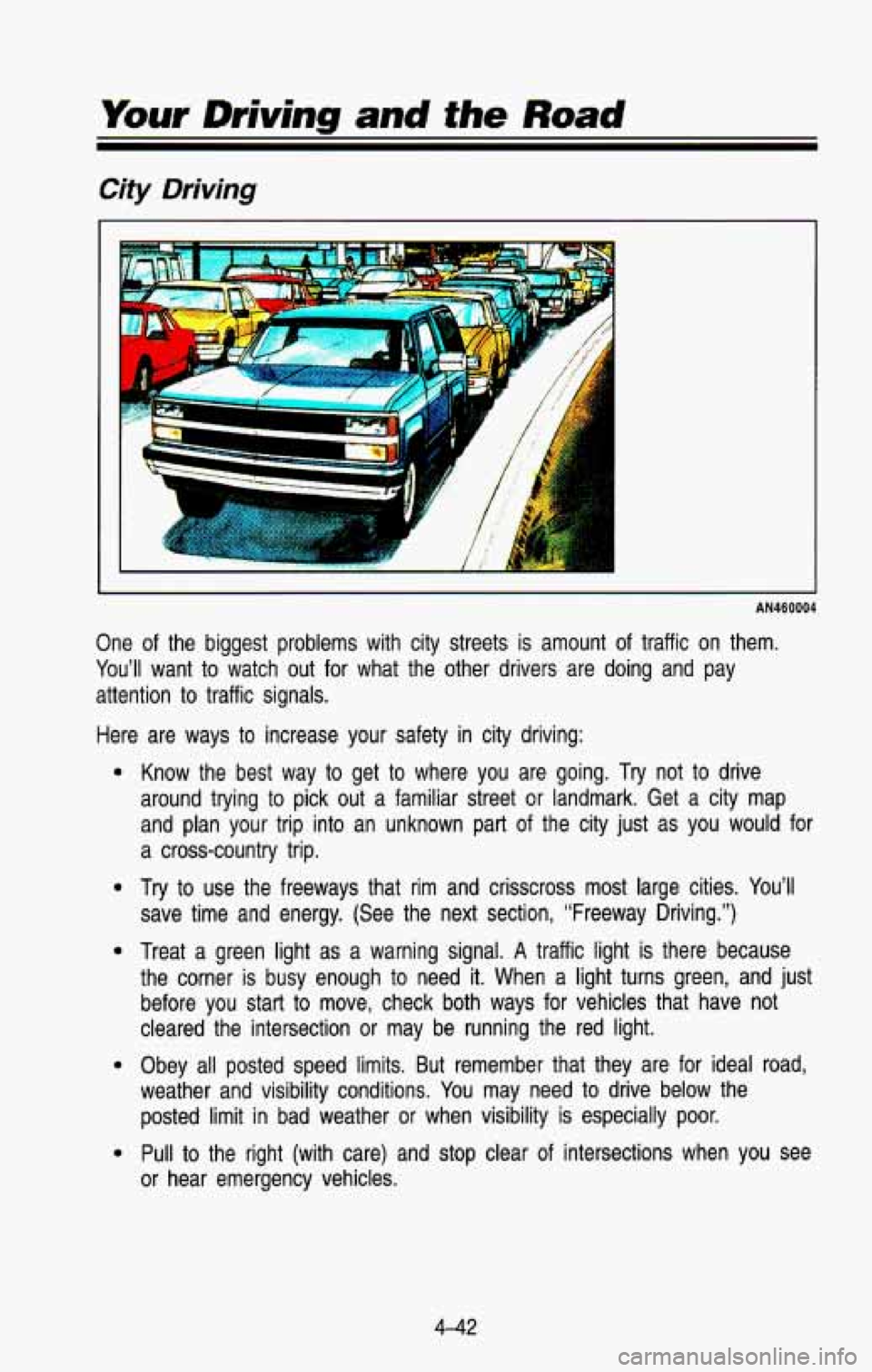
One of the biggest problems with city streets is amount of traffic on them.
You’ll want to watch out for what the other drivers are doing and pay
attention to traffic signals.
Here are ways to increase your safety in city driving:
e
e
e
e
Know the best way to get to where you are going. Try not to drive
around trying to pick out a familiar street or landmark. Get \
a city map
and plan your trip into an unknown part of the city just as you would for
a cross-country trip.
Try
to use the freeways that rim and crisscross most large cities. Yo\
u’ll
save time and energy. (See the next section, “Freeway Drivi\
ng.”)
Treat
a green light as a warning signal. A traffic light is there because
the corner
is busy enough to need it. When a light turns green, and just
before you start
to move, check both ways for vehicles that have not
cleared the intersection or may be running the red light.
Obey all posted speed limits.
But remember that they are for ideal road,
weather and visibility conditions. You may need to drive below the
posted limit in bad weather or when visibility is especially poor.
Pull to the right (with care) and stop clear
of intersections when you see
or hear emergency vehicles.
4-42
Page 211 of 386

Your Driving and the Road
Before changing lanes, check your rearview mirrors. Then use yo\
ur turn
signal. Just before you leave the lane, glance quickly over yo\
ur shoulder to
make sure there isn’t another vehicle in your “blind” spot.
If you are moving from an outside to a center lane on a freeway\
having
more than two lanes, make sure another vehicle isn’t about to move into the
same spot. Look at the vehicles two lanes over and watch for \
telltale signs:
turn signals flashing, an increase in speed, or moving toward \
the edge of the
lane. Be prepared to delay your move.
Once you are moving on the freeway, make certain you allow a \
reasonable
following distance. Expect to move slightly slower at night.
Leaving the Freeway
When you want to leave the freeway, move to the proper lane \
well in
advance. Dashing across lanes at the last minute is dangerous. \
If you miss
your exit do not, under any circumstances, stop and back up. \
Drive
on to the
next exit.
At each exit point is a deceleration lane. Ideally it should be long enough for
you to enter it at freeway speed (after signaling, of course) and then do your
braking before moving onto the exit ramp. Unfortunately, not al\
l deceleration
lanes are long enough-some are too short for
all the braking. Decide when
to start braking.
If you must brake on the through lane, and if there is traffic
close behind you, you can allow a little extra time and flash\
your brake lights
(in addition to your turn signal) as extra warning that you are about to slow
down and exit.
The exit ramp can be curved, sometimes quite sharply. The exit\
speed
is
usually posted. Reduce your speed according to your speedometer, not to
your sense of motion. After driving for any distance at higher speeds, you
may tend to think you are going slower than you actually are. For example,
40 mph (65 km/h) might seem like only 20 mph (30 kmlh). Obviously, this
could lead to serious trouble on a ramp designed for
20 mph (30 km/h)!
Driving a Long Distance
Although most long trips today are made on freeways, there are\
still many
made on regular highways.
Long-distance driving on freeways and regular highways is the same in some
ways. The trip has to be planned and the vehicle prepared, yo\
u drive at higher-than-city speeds, and there are longer turns behind the wheel. You’ll
enjoy your trip more
if you and your vehicle are in good shape. Here are
some tips for
a successful long trip.
4-44
Page 220 of 386

Winter Driving
r
AM480003
Here are some tips for winter driving.
Have your vehicle in good shape for winter. Be sure your engi\
ne coolant
mix is correct.
Snow tires can help in loose snow, but they may give you les\
s traction
on ice than regular tires.
If you do not expect to be driving in deep
snow, but may have to travel over ice, you may not want
to switch to
snow tires at all.
You may want to put winter emergency supplies in your vehicle.
Include
an ice scraper, a small brush or broom, a supply of windshield
washer fluid, a rag, some winter outer clothing, a small shovel, a flashlight, a
red cloth, and a couple of reflective warning triangles. And, if you will be
driiing under severe conditions, include a small bag of sand, a piece of
old
carpet or a couple of burlap bags to help provide traction. Be sure you
properly secure these items in your vehicle.
Driving on Snow or Ice
Most of the time, those places where your tires meet the road probably\
have
good traction.
However,
if there is snow or ice between your tires and the road, you can
have a very slippery situation. You’ll have a lot less traction or “grip” and
will
need to be very careful.
4-53
Page 233 of 386
Pm6/ems on the R~ad
Hazard Warning Flashers
AN505005
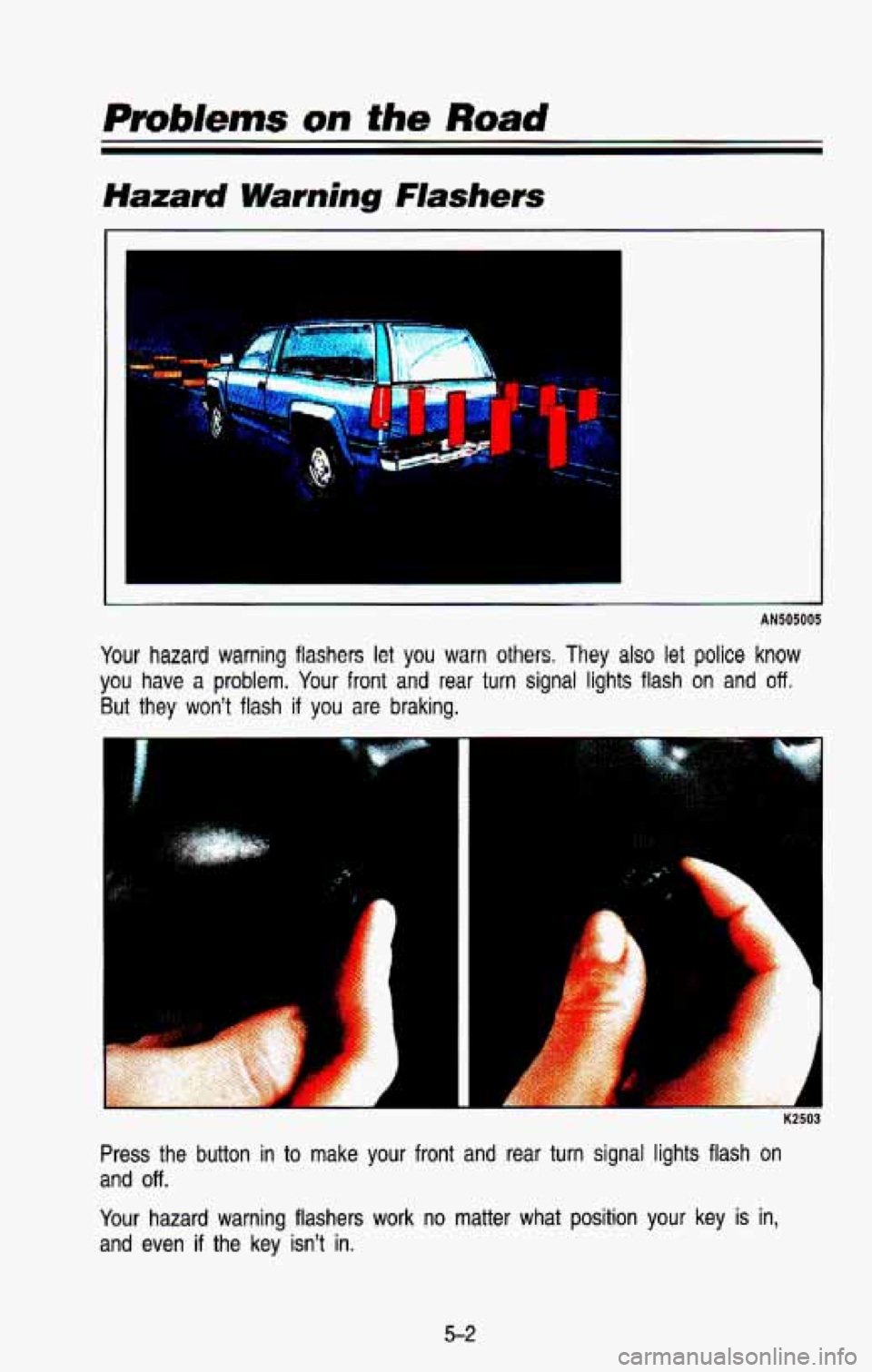
Your hazard warning flashers let you warn others. They also let police know
you have a problem. Your front and rear turn signal lights flash on and off.
But they won't flash if you are braking.
F
1
K2503
Press the button in to make your front and rear turn signal lights flash on
and off.
Your hazard warning flashers work no matter what position your key \
is in,
and even
if the key isn't in.
Page 291 of 386

Service & Appearance Care
The following explains your cooling system and how to add cool\
ant when it is
low.
If you have a problem with engine overheating, see “Engine
Overheating” in the Index.
The proper coolant for your vehicle
will:
Give freezing protection down to -34°F (-37°C).
Give boiling protection up to 258°F (125°C).
Protect against rust and corrosion.
Help keep the proper engine temperature.
Let the warning lights and gages work as they should.
What to Use:
Use a mixture of clean water (preferably distilled), and antifreeze that meets
“GM Specification
6038-M,” which won’t damage aluminum parts. Also use
GM Engine Coolant Supplement (sealer) with a complete coolant change.
If
you use these, you don’t need to add anything else.
Adding only plain water to your cooling system can be dangerous.
I
Plain water, or some other liquid like alcohol, can boil before the \
proper coolant mix will. Your vehicle’s coolant warning system is set
for the proper coolant mix. With plain water or the wrong mix, your
engine could get too hot but you wouldn’t get the overheat \
warning. Your engine could catch fire and you or others could be burned. Us\
e
a 50/50 mix of clean water and a proper antifreeze.
jIi ,yo.w use an improper coolant mix, your engine .coutd overheat andi
badly damaged. The repair cost wouldn’t be covered by your warranty.’ TP~
much water in ;the mix can freeze and crack the engine, radiator, .heater
wre-ad -.other parts.
Some conditions, such as air trapped in the cooling system, can affect the
coolant level in the radiator. Check the coolant level when th\
e engine is cold
and follow the steps under “Adding Coolant” for the prope\
r way to
add
coolant.
.. .. ..
If you have to add coolant mdre than four times a year, have your dealer
check
your cooling system.
6-26
Page 335 of 386
Fuses and Circuit Breakers
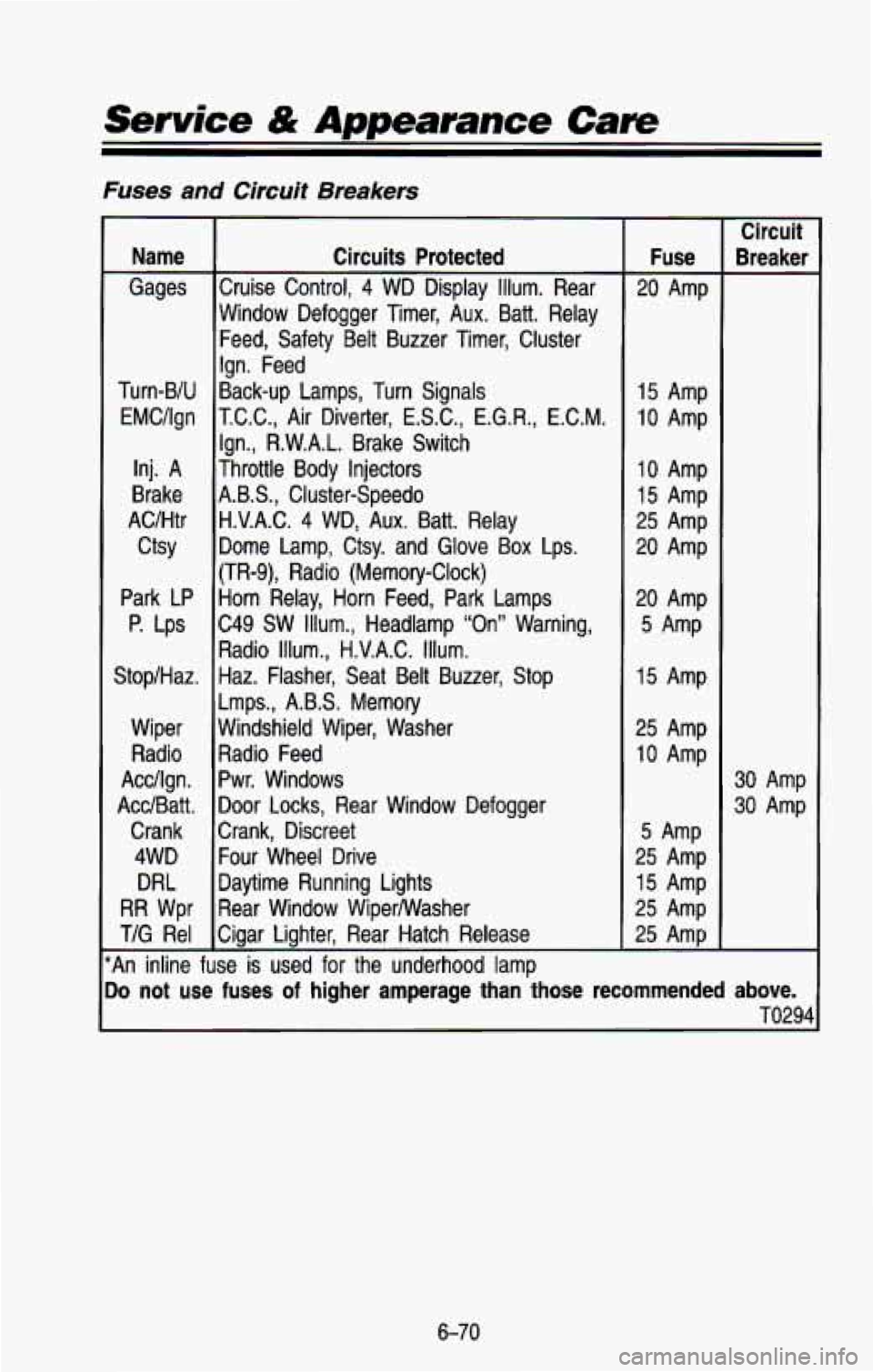
Name
Gages
Turn-BIU EMCIIgn
Inj.
A
Brake
AC/Htr
ctsy
Park LP
P. Lps
StopiHaz.
Wiper Radio
Acc/lgn.
AcdBatt. Crank 4WD
DRL
RR Wpr
TIG Re1
Circuits Protected
Cruise Control, 4 WD Display Illum. Rear
Window Defogger Timer, Aux. Batt. Relay Feed, Safety Belt Buzzer Timer, Cluster
Ign. Feed
Back-up Lamps, Turn Signals
T.C.C., Air Diverter, E.S.C.,
E.G.R., E.C.M.
Ign., R.W.A.L. Brake Switch
Throttle Body Injectors
A.B.S., Cluster-Speed0
H.V.A.C.
4 WD, Aux. Batt. Relay
Dome Lamp, Ctsy. and Glove Box Lps.
(TR-9), Radio (Memory-Clock)
Horn Relay, Horn Feed, Park Lamps C49 SW Illum., Headlamp
“On” Warning,
Radio Illum., H.V.A.C. Illum.
Haz. Flasher, Seat Belt Buzzer, Stop
Lmps., A.B.S. Memory
Windshield Wiper, Washer
Radio Feed
Pwr. Windows
Door Locks, Rear Window Defogger Crank, Discreet
Four Wheel Drive
Daytime Running Lights
Rear Window Wiperwasher
Cigar Lighter, Rear Hatch Release
Fuse
20 Amp
15 Amp
10 Amp
10 Amp
15 Amp
25
Amp
20 Amp
20 Amp
5 Amp
15 Amp
25 Amp
10 Amp
5 Amp
25 Amp
15 Amp
25 Amp
25 Amp
Circuit
Breaker
30 Amp
30 Amp
An inline fuse is used for the underhood lamp
Jo not use fuses of higher amperage than those recommended above.
TO291
6-70
Page 376 of 386
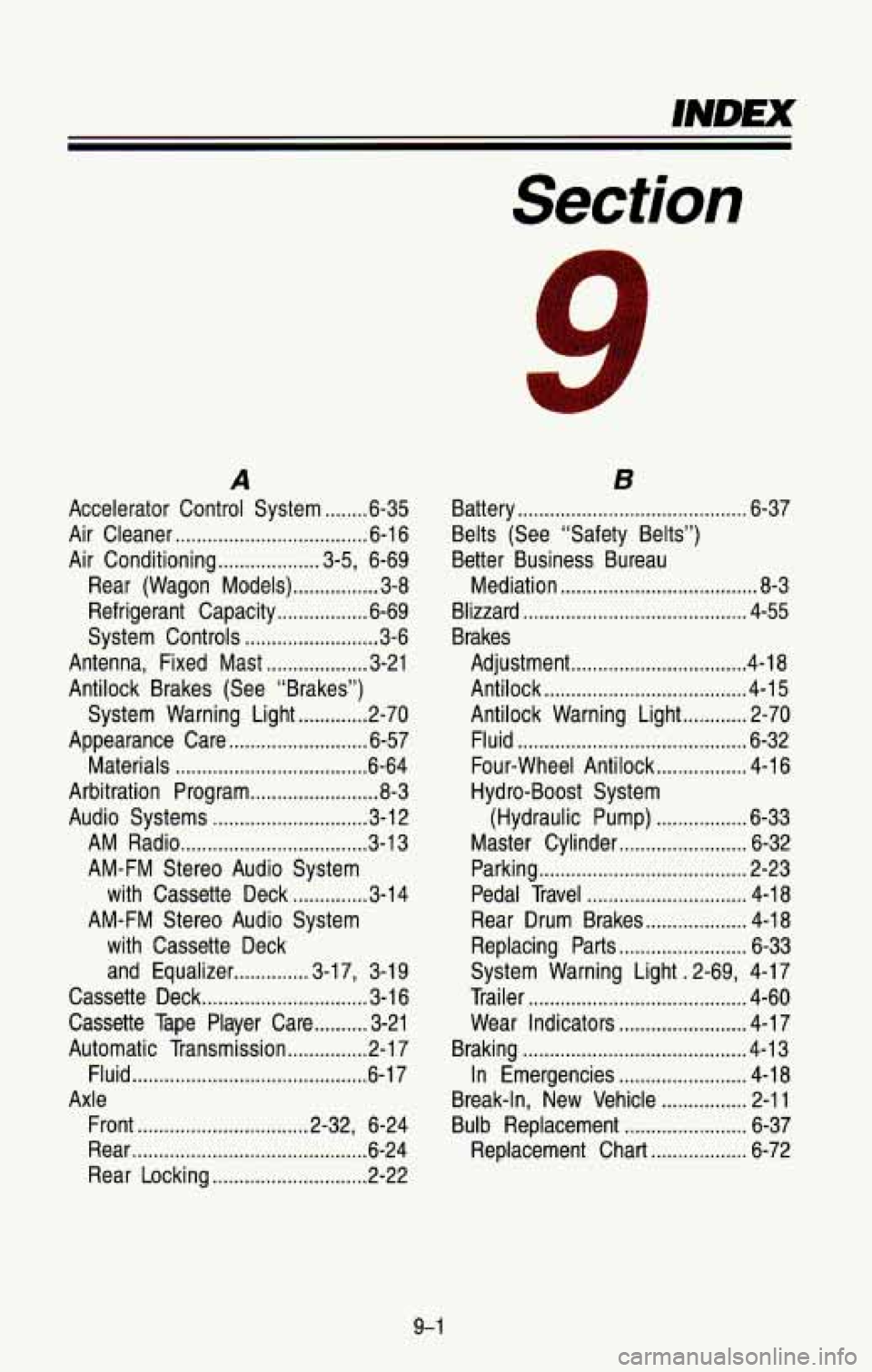
Section
A
Accelerator Control System ........ 6-35
Air Cleaner
.................................... 6-1 6
Air Conditioning
................... 3.5. 6-69
Rear (Wagon Models)
................ 3-8
Refrigerant Capacity
................. 6-69
System Controls
......................... 3-6
Antenna. Fixed Mast
................... 3-21
Antilock Brakes (See “Brakes”)
System Warning Light
............. 2-70
Appearance Care
.......................... 6-57
Materials
.................................... 6-64
Arbitration Program
........................ 8-3
Audio Systems
............................. 3-1 2
AM Radio
................................... 3-1 3
AM-FM Stereo Audio System
with Cassette Deck
.............. 3-14
AM-FM Stereo Audio System
with Cassette Deck and Equalizer
.............. 3-1 7. 3-1 9
Cassette Deck ............................... 3-1 6
Cassette Tape Player Care
.......... 3-21
Automatic Transmission
............... 2-1 7
FI uid
............................................ 6. 1 7
Axle
Front
................................ 2.32. 6-24
Rear
............................................ 6-24
Rear Locking
............................. 2-22
B
Battery ........................................... 6-37
Belts (See “Safety Belts”)
Better Business Bureau Mediation
..................................... 8-3
Blizzard
.......................................... 4-55
Brakes
Adjustment
................................. 4-18
Antilock
...................................... 4-15
Antilock Warning Light
............ 2-70
Fluid
........................................... 6-32
Four-wheel Antilock
................. 4-16
Hydro-Boost System
(Hydraulic Pump)
................. 6-33
Master Cylinder
........................ 6-32
Parking
....................................... 2-23
Pedal Travel
.............................. 4-18
Rear Drum Brakes
................... 4-18
Replacing Parts
........................ 6-33
System Warning Light .2-69, 4-17
Trailer
......................................... 4-60
Wear Indicators
........................ 4-17
Braking
.......................................... 4-13
In Emergencies
........................ 4-18
Break-In, New Vehicle
................ 2-11
Bulb Replacement ....................... 6-37
Replacement Chart
.................. 6-72
9-1
Page 379 of 386
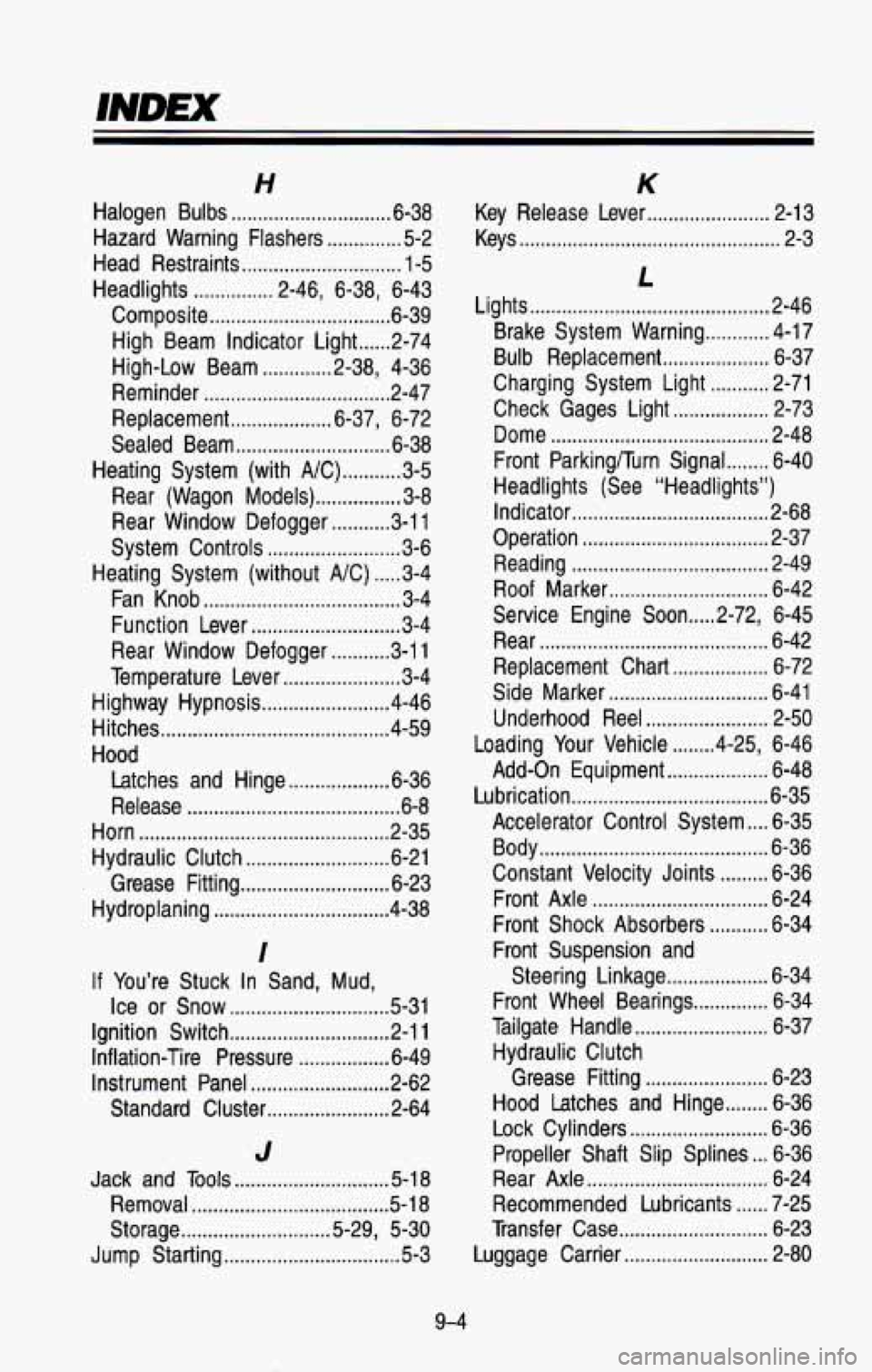
INDEX
H
Halogen Bulbs .............................. 6.38
Hazard Warning Flashers
.............. 5-2
Head Restraints
.............................. 1-5
Headlights
............... 2-46, 6-38, 6-43
Composite
.................................. 6-39
High Beam Indicator Light
...... 2-74
High-Low Beam
............. 2-38, 4-36
Reminder
................................... 2-47
Replacement
................... 6-37, 6-72
Sealed Beam
............................. 6-38
Heating System (with AIC)
........... 3-5
Rear (Wagon Models)
................ 3-8
Rear Window Defogger
........... 3-11
System Controls
......................... 3-6
Heating System (without AIC)
..... 3-4
Fan Knob ..................................... 3-4
Function Lever
............................ 3-4
Rear Window Defogger
........... 3-1 1
Temperature Lever ...................... 3-4
Highway Hypnosis
........................ 4-46
Hitches
........................................... 4-59
Hood
Latches and Hinge ................... 6-36
Release
........................................ 6-8
Horn
............................................... 2-35
Hydraulic Clutch
........................... 6-21
Grease Fitting
............................ 6-23
Hydroplaning
................................. 4-38
1
If You’re Stuck In Sand, Mud,
Ice or Snow
.............................. 5-31
Ignition Switch
.............................. 2-1 1
Inflation-Tire Pressure ................. 6-49
Instrument Panel
.......................... 2-62
Standard Cluster
....................... 2-64
J
Jack and Tools ............................. 5-18
Removal ..................................... 5-1 8
Storage
............................ 5-29, 5-30
Jump Starting
................................. 5-3
K
Key Release Lever ....................... 2-13
Keys
................................................. 2-3
L
Lights ............................................. 2-46
Brake System Warning
............ 4-17
Bulb Replacement .................... 6-37
Charging System Light
........... 2-71
Check Gages Light
.................. 2-73
Dome
......................................... 2-48
Front Parkingnurn Signal
........ 6-40
Headlights (See “Headlights”)
Indicator
..................................... 2-68
Operation
................................... 2-37
Reading
..................................... 2-49
Roof Marker
.............................. 6-42
Service Engine
Soon ..... 2-72, 6-45
Rear
........................................... 6-42
Replacement Chart
.................. 6-72
Side Marker
.............................. 6-41
Underhood Reel
....................... 2-50
Loading Your Vehicle
........ 4-25, 6-46
Add-on Equipment
................... 6-48
Lubrication
..................................... 6-35
Accelerator Control System
.... 6-35
Constant Velocity Joints
......... 6-36
Front Axle
................................. 6-24
Front Shock Absorbers
........... 6-34
Front Suspension and Steering Linkage
................... 6-34
Front Wheel Bearings
.............. 6-34
Tailgate Handle
......................... 6-37
Hydraulic Clutch Grease Fitting
....................... 6-23
Hood Latches and Hinge
........ 6-36
Lock Cylinders
.......................... 6-36
Propeller Shaft Slip Splines
... 6-36
Rear Axle
.................................. 6-24
Recommended Lubricants
...... 7-25
Transfer Case
............................ 6-23
Luggage Carrier
........................... 2-80
Body
........................................... 6-36
9-4
Page 381 of 386
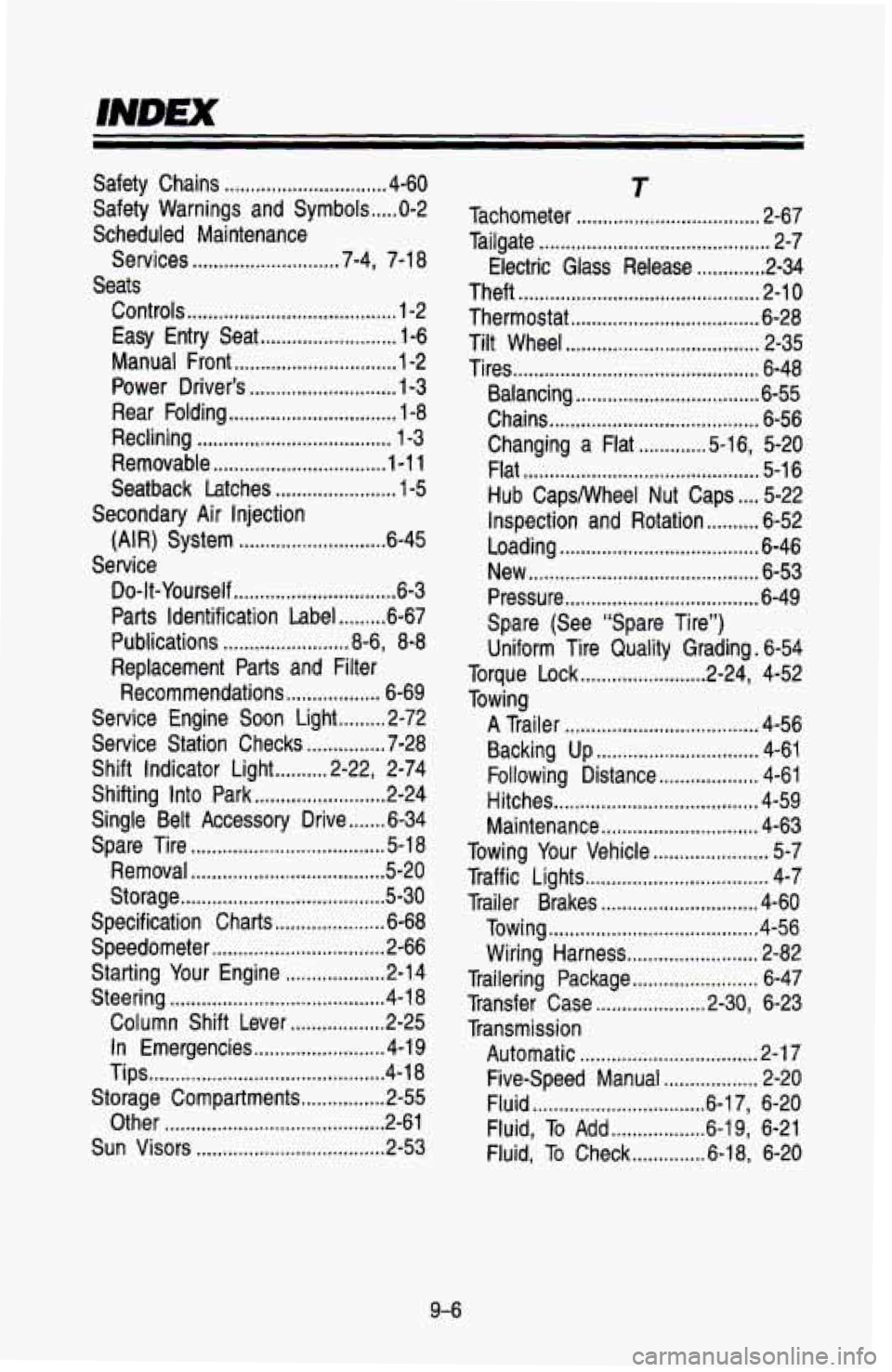
Safety Chains ............................... 4-60
Scheduled Maintenance
Seats Safety Warnings and Symbols
..... 0-2
Services
............................ 7-4, 7-1 8
Controls
........................................ 1-2
Easy Entry Seat
.......................... 1 -6
Manual Front
............................... 1 -2
Power Driver‘s
............................ 1-3
Rear Folding
................................ 1-8
Reclining
..................................... 1-3
Removable
................................. 1-1 1
Seatback Latches
....................... 1-5
(AIR) System
............................ 6-45
Do-It-Yourself
............................... 6-3
Parts Identification Label
......... 6-67
Publications
........................ 8-6, 8-8
Replacement Parts and Filter Recommendations
.................. 6-69
Service Engine
Soon Light ......... 2-72
Service Station Checks
............... 7-28
Shift Indicator Light
.......... 2-22, 2-74
Shifting Into Park
......................... 2-24
Single Belt Accessory Drive
....... 6-34
Spare Tire
..................................... 5-1 8
Removal ..................................... 5-20
Storage ....................................... 5-30
Specification Charts ..................... 6-68
Speedometer
................................. 2-66
Starting Your Engine
................... 2-1 4
Column Shift Lever
.................. 2-25
In Emergencies
......................... 4-1 9
Tips ............................................. 4-1 8
Storage Compartments ................ 2-55
Other
.......................................... 2-6 1
Sun Visors .................................... 2-53
Secondary
Air Injection
Service
Steering
......................................... 4-18
T
Tachometer ................................... 2-67
Tailgate
............................................ 2-7
Electric Glass Release ............. 2-34
Theft
.............................................. 2-10
Thermostat
.................................... 6-28
Tilt Wheel
..................................... 2-35
Tires
............................................... 6-48
Balancing
................................... 6-55
Chains
........................................ 6-56
Changing a Flat
............. 5-16, 5-20
Flat
............................................. 5-16
Hub CapsNVheel Nut Caps
.... 5-22
Inspection and Rotation
.......... 6-52
Loading
...................................... 6-46
New ............................................
Pressure ..................................... 6-49
Spare (See “Spare Tire”)
Uniform Tire Quality Grading
. 6-54
Torque Lock
........................ 2-24, 4-52
Towing
A Trailer ..................................... 4-56
Backing Up
............................... 4-61
Following Distance
................... 4-61
Hitches
....................................... 4-59
Maintenance
.............................. 4-63
Towing Your Vehicle
...................... 5-7
Traffic Lights
................................... 4-7
Trailer Brakes
.............................. 4-60
Towing
........................................ 4-56
Wiring Harness
......................... 2-82
Trailering Package
........................ 6-47
Transfer Case
..................... 2-30, 6-23
Transmission Automatic
.................................. 2-17
Five-Speed Manual
.................. 2-20
Fluid ................................. 6-1 7, 6-20
Fluid, To Add
.................. 6-1 9. 6-21
Fluid.
To Check .............. 6-18. 6-20
6-53
9-6