light CHEVROLET BLAZER 1993 Workshop Manual
[x] Cancel search | Manufacturer: CHEVROLET, Model Year: 1993, Model line: BLAZER, Model: CHEVROLET BLAZER 1993Pages: 386, PDF Size: 20.7 MB
Page 189 of 386
Your Driving and the Road
Watch for traffic signs, pavement markings, and lines. If you can see a
sign up ahead that might indicate a turn
or an intersection, delay your
pass.
A broken center line usually indicates it’s all right to pass
(providing the road ahead is clear). Never cross a solid lin\
e on your side
of the lane
or a double solid line, even if the road seems empty of
approaching traffic.
If you suspect that the driver of the vehicle you want to pass isn’t aware
of your presence, tap the horn a couple of times before passi\
ng.
Do not get too close to the vehicle you want to pass while you’re
awaiting an opportunity.
For one thing, following too closely reduces your
area
of vision, especially if you’re following a larger vehicle. Also, you
won’t have adequate space
if the vehicle ahead suddenly slows or stops.
Keep back a reasonable distance.
When it looks like a chance
to pass is coming up, start to accelerate
but stay in the right lane and don’t get too close. Time your move
so
you will be increasing speed as the time comes to move into the other
lane.
If the way is clear to pass, you will have a “running start” that
more than makes up for the distance you would lose by dropping back.
And
if something happens to cause you to cancel your pass, you need
only slow down and drop back again and wait for another opportunity.
If other cars are lined up to pass a slow vehicle, wait your turn. But
take care that someone isn’t trying
to pass you as you pull out to pass
the
slow vehicle. Remember to glance over your shoulder and check the
blind spot.
Check your mirrors, glance over your shoulder, and start your
left lane
change signal before moving out of the right lane to pass. When you
are far enough ahead of the passed vehicle to see its front in your
inside mirror, activate your right lane change signal and move \
back into
the right lane. (Remember that your right outside mirror is convex. The
vehicle
you just passed may seem to be farther away from you than it
really is).
Try not to pass more than one vehicle at a time on two-lane roads.
Reconsider before passing the next vehicle.
Don’t overtake a slowly moving vehicle too rapidly. Even tho\
ugh the
brake lights are not flashing,
it may be slowing down or starting to turn.
If you’re being passed, make it easy for the following driver to get ahead
of you. Perhaps you can ease a little to the right.
4-22
Page 194 of 386
Does the travel take you uphill or downhill? (There’s more discussion of
these subjects later.)
Will you have to stop suddenly or change direction quickly?
When you drive over obstacles
or rough terrain, keep a firm grip on the
steering wheel. Ruts, troughs, or other surface features can jerk the wheel
out of your hands
if you’re not prepared.
When you drive over bumps, rocks, or other obstacles, your wheels can leave
the ground.
If this happens, even with one or two wheels, you can’t control
the vehicle as well or at all.
Because you will
be on an unpaved surface, it’s especially important to avoid
sudden acceleration, sudden turns, or sudden braking.
In a way, off-road driving requires a different kind of alertness from driving on
paved roads and highways. There are no road signs, posted spee\
d limits or
signal lights. You have to use your
own good judgment about what is safe
and what isn’t.
I CAUTION
Drinking and driving can be very dangerous on any road. And this is
- b certainly true for off-road driving. At the very time you need special
alertness and driving skills, your reflexes, perceptions and jud\
gment
can be affected by even a small amount
of alcohol. You could have
a serious-or even fatal-accident
if you drink and drive or ride with
a driver who has been drinking. (See “Drunken Driving” in the
Index.)
Driving On Oft-Road Hills
Off-road driving often takes you up, down, or across a hill. Driving safely on
hills requires good judgment and an understanding of what your vehicle can
and can’t do. There are some hills that simply can’t be driven, no matter how
well-built the vehicle.
I CAUTION
A Many hills are simply too steep for any vehicle. If you drive up them,
62 you will stall. If you drive down them, you can’t control your speed. If
you drive across them, you will roll over. You could be seriously
injured or killed.
If you have any doubt about the steepness, don’t
drive the hill.
4-27
Page 196 of 386
h
Turning or driving across steep hills can be dangerous. You could
lose traction, slide sideways, and possibly roll over. You could be
seriously injured or killed. When driving up hills, always try to
go
I straight up.
Ease up on your speed as you approach the top of the hill.
Attach a flag to the vehicle to make you more visible to approaching
Sound the horn as you approach the top of hill to let opposing traffic
Use your headlights even during the day. They make you more visible to
traffic on trails
or hills.
know you’re there.
oncoming traffic.
I CAUTION
’ rf Driving to the top (crest) of a hill at full speed can cause an
1 the top of a hill, slow down and stay alert.
ccident.
There could be a drop-off, embankment, cliff, or even
another vehicle. You could be seriously injured or killed.
As you near
Q: What should I do if my vehicle stalls, or is about to stall, and I can’t
make it up the hill?
A: If this happens, there are some things you should do, and there \
are some
things you must not do. First, here’s what you should do:
Push the brake pedal to stop the vehicle and keep it from rolling
backwards.
Also, apply the parking brake.
If your engine is still running, shift the transmission into reverse, release
the parking brake, and slowly back down the hill in reverse.
If your engine has stopped running, you’ll need to restart it. With the
brake pedal depressed and the parking brake still applied, shift the
transmission to
P (Park) (or, shift to N (Neutral) if your vehicle has a
manual transmission) and restart the engine. Then, shift
to reverse,
release the parking brake, and slowly back down the hill
in reverse.
As you are backing down the hill, put your left hand on the steering
wheel at the
12 o’clock position. This way, you’ll be able to tell if your
wheels are straight or turned to the left or right as you back down.
4-29
Page 198 of 386
What’s at the bottom of the hill? Is there a hidden creek bank or even a
river bottom with large rocks?
If you decide you can go down a hill safely, then try to keep your vehicle
headed straight down, and use a low gear. This way, engine drag can help
your brakes and they won’t have to do all the work. Descend slowly, keeping
your vehicle under control at all times.
’ [ Heavy braking when going down a hill can cause your brakes to
overheat and fade. This could cause
loss of control and a serious
accident. Apply the brakes lightly when descending a hill and use a
I low gear to keep vehicle speed under control. 1
Q: Are there some things I should not do when driving down a hill?
A: Yes! These are important because if you ignore them you could lose
control and have
a serious accident.
When driving downhill, avoid turns that take you &%C>Ss the incline of the
hill.
A hill that’s not too steep to drive down may be too steep to drive
across. You could roll over
if you don’t drive straight down.
Never go downhill with the transmission in N (Neutral), or with the clutch
pedal depressed in a manual shift. This is called “free-wheeling.” Your
brakes will have to do all the work and could overheat and fade.
Q: Am I likely to stall when going downhill?
A: It’s much more likely to happen going uphill, But if it happens going
downhill, here’s what to do.
Stop your vehicle by applying the regular brakes. Apply the parking
Shift to P (Park) (or to Neutral with the manual transmission) and, while
Shift back to a low gear, release the parking brake, and drive straight
brake.
still braking, restart the engine.
down.
If the engine won’t start, get out and get help.
Driving Across an Incline
Sooner or later, an off-road trail will probably go across the incline of a hill. If
this happens, you have to decide whether to try
to drive across the incline.
Here are
some things to consider:
4-3 1
Page 200 of 386
AM440002
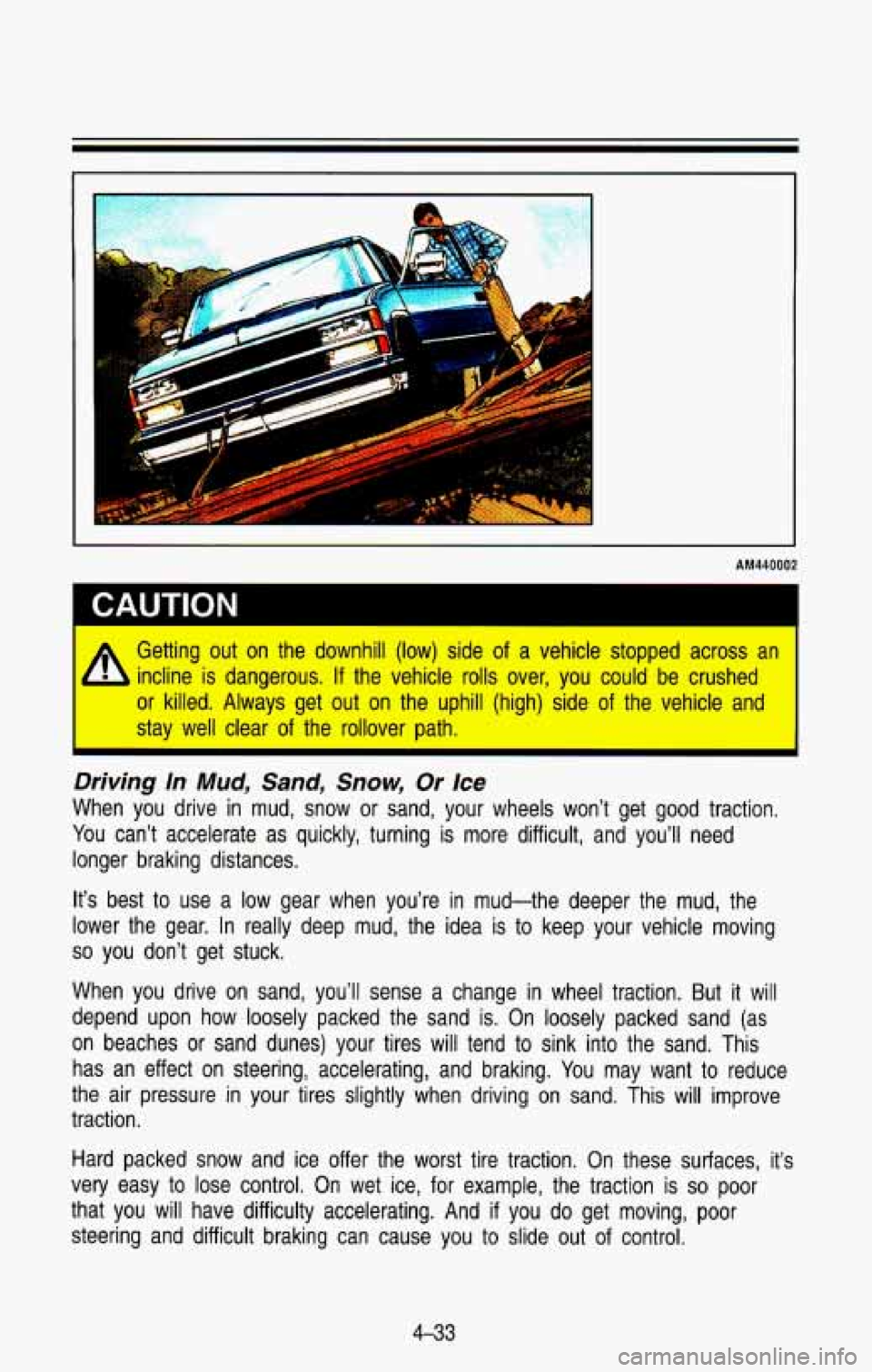
I Getting out on the downhill (low) side of a vehicle stopped across an
- , incline is dangerous. If the vehicle rolls over, you could be crushed
or killed. Always get out on the uphill (high) side of the vehicle and
stay well clear of the rollover path. F
Driving In Mud, Sand, Snow, Or Ice
When you drive in mud, snow or sand, your wheels won’t get\
good traction.
You can’t accelerate as quickly, turning is more difficult, and \
you’ll need
longer braking distances.
It’s best to use a low gear when you’re in mud-the deeper the \
mud, the
lower the gear. In really deep mud, the idea is
to keep your vehicle moving
so you don’t get stuck.
When you drive on sand, you’ll sense a change in wheel tra\
ction. But
it will
depend upon how loosely packed the sand is. On loosely packed \
sand (as
on beaches or sand dunes) your tires will tend to sink into the\
sand. This
has an effect on steering, accelerating, and braking. You may want to reduce
the air pressure
in your tires slightly when driving on sand. This will improve
traction.
Hard packed snow and ice offer the worst tire traction. On these surfaces, it’s
very easy to lose control. On wet ice, for example, the tract\
ion is
so poor
that you will have difficulty accelerating. And
if you do get moving, poor
steering and difficult braking can cause you to slide out
of control.
4-33
Page 201 of 386
CAUTION I
If Driving on frozen lakes, ponds or rivers can be dangerous.
-L Underwater springs, currents under the ice, or sudden thaws can
weaken the ice. Your vehicle could fall through the ice and you and
your passengers could drown. Drive your vehicle on safe surfaces
only.
I
t
Driving In Water
Light rain causes no special off-road driving problems. But hea\
vy rain can
mean flash flooding, and flood waters demand extreme caution.
Find out how deep the water is before you drive through it. If it’s deep
enough to cover your wheel hubs, axles, or exhaust pipe, don’t try it\
-you
probably won’t get through. Also, water that deep can damage\
your axle and
other vehicle parts.
If the water isn’t too deep, then drive through it slowly. At fast speeds, water
splashes on your ignition system and your vehicle can stall. S\
talling can also
occur
if you get your tailpipe under water. And, as long as your tailpipe is
under water, you’ll never be able to start your engine. When you go through
water, remember that when your brakes get wet,
it may take you longer to
stop.
CAUTION
C
Driving through rushing water can be dangerous. Deep water can \
sweep your vehicle downstream and you and your passengers could\
drown. If it’s only inches deep, it can still wash away the ground
from under your tires, and you could lose traction and roll t\
he vehiclc
over. Don’t drive through rushing water.
I
After Off-Road Driving
Remove any brush or debris that has collected on the underbody\
, chassis, or
under the hood. These accumulations can be a fire hazard.
After operation in mud or sand, have the brake linings cleaned and checked.
These substances can cause glazing and uneven braking. Check th\
e body
structure, steering, suspension, wheels, tires, and exhaust syste\
m for damage.
Also, check the fuel lines and cooling system for any leakage.
Your vehicle will require more frequent service due
to off-road use, Refer to
Section
7 for additional information.
4-34
Page 202 of 386
Driving at Night
me--===
AN450003
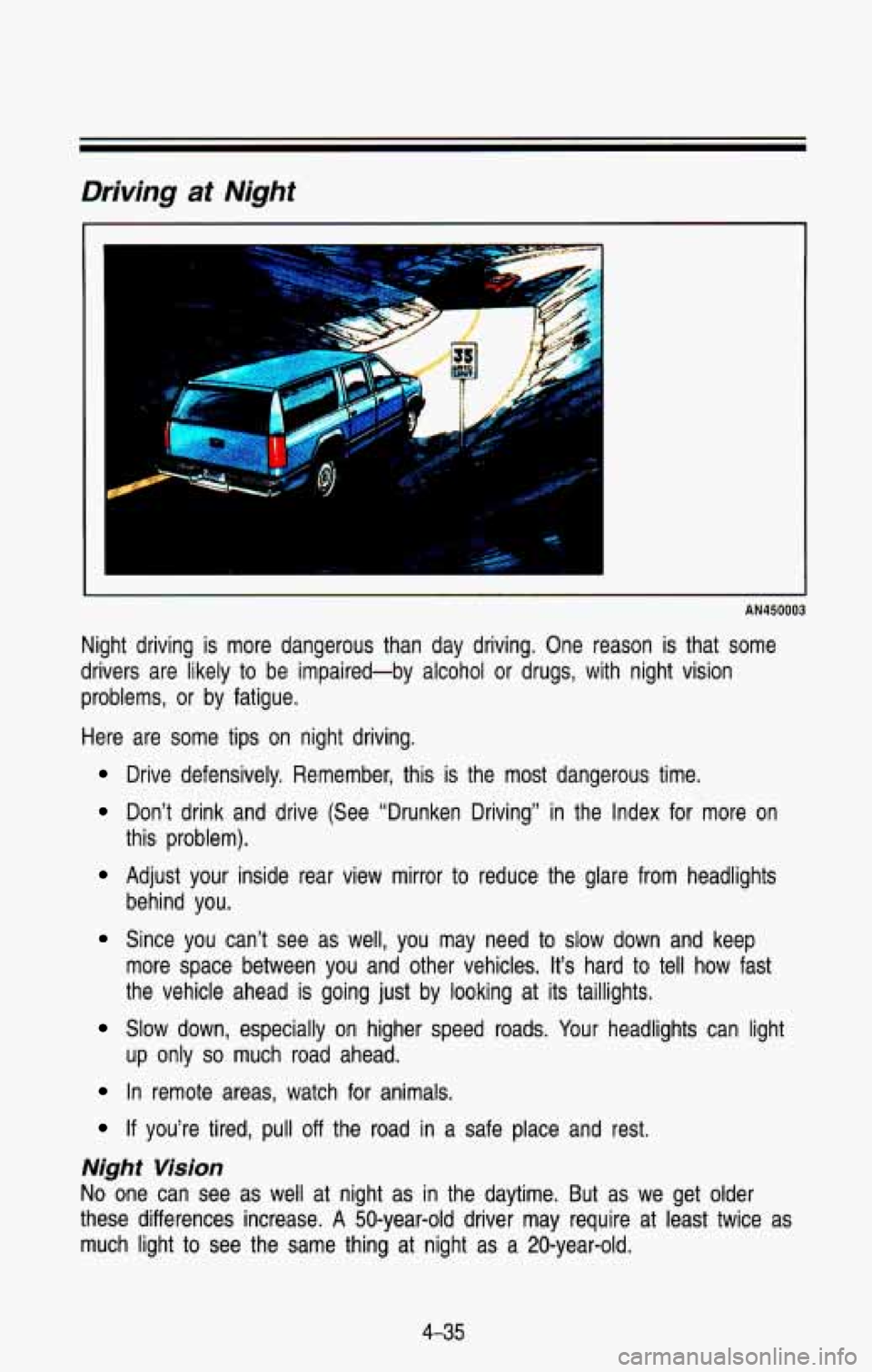
Night driving is more dangerous than day driving. One reason is that some
drivers are likely to be impaired-by alcohol
or drugs, with night vision
problems, or by fatigue.
Here are some tips on night driving.
Drive defensively. Remember, this is the most dangerous time.
Don’t drink and drive (See “Drunken Driving” in the Index for more on
this problem).
Adjust your inside rear view mirror to reduce the glare from \
headlights
behind you.
Since you can’t see as well, you may need to slow down and keep
more space between you and other vehicles. It’s hard to tell how fast
the vehicle ahead is going just by looking at its taillights.
Slow down, especially on higher speed roads. Your headlights can light
In remote areas, watch for animals.
up only
so much road ahead.
If you’re tired,
pull off the road in a safe place and rest.
Night Vision
No one can see as well at night as in the daytime. But as we get older
these differences increase.
A 50-year-old driver may require at least twice as
much light
to see the same thing at night as a 20-year-old.
4-35
Page 203 of 386
Your Driving and the Road
What you do in the daytime can also affect your night vision. For example, if
you spend the day in bright sunshine you are wise to wear sunglasses. Your
eyes will have less trouble adjusting to night.
But
if you’re driving, don’t wear sunglasses at night. They may \
cut down on
glare from headlights, but they also make a lot of things invisible that should
remain visible-such as parked cars, obstacles, pedestrians, or e\
ven trains
blocking railway crossings. You may want
to put on your sunglasses after you
have pulled into a brightly-lighted service or refreshment area. Eyes shielded
from that glare may adjust more quickly
to darkness back on the road. But
be sure
to remove your sunglasses before you leave the service area.
You can be temporarily blinded by approaching lights. It can take a second or
two, or even several seconds, for your eyes to readjust
to the dark. When
you are faced with severe glare (as from a driver who doesn’\
t lower the high beams, or a vehicle with misaimed headlights), slow down a li\
ttle. Avoid
staring directly into the approaching lights.
If there is a line of opposing
traffic, make occasional glances over the line of headlights
to make certain
that one
of the vehicles isn’t starting to move into your lane. Once you are
past the bright lights, give your eyes time to readjust before resuming speed.
High Beams
If the vehicle approaching you has its high beams on, signal by \
flicking yours
to high and then back to low beam. This is the usual signal to lower the
headlight beams. If the other driver still doesn’t lower the beams, resist the
temptation
to put your high beams on. This only makes two half-blinded
drivers.
On a freeway, use your high beams only in remote areas where you w\
on’t
impair approaching drivers. In some places, like cities, using \
high beams is
illegal.
When you follow another vehicle on a freeway or highway, use \
low beams.
True, most vehicles now have day-night mirrors that enable the \
driver to reduce glare. But outside mirrors are not
of this type and high beams from
behind can bother the driver ahead.
A Few More Night Driving Suggesiions
Keep your windshield and all the glass on your vehicle clean-inside and out.
Glare at night is made much worse by dirt
on the glass. Even the inside of
the glass can build up a film caused by dust. Tobacco smoke also makes
inside
glass surfaces very filmy and can be a vision hazard if it’s left there.
Dirty glass makes lights dazzle and flash more than clean glas\
s would,
making the pupils of your eyes contract repeatedly. You might even want
to
4-36
Page 204 of 386
keep a cloth and some glass cleaner in your vehicle if you need to clean
your glass frequently.
Remember that your headlights light up far less of a roadway when you are
in a turn or curve.
Keep your eyes moving; that way, it’s easier to pick out dimly lighted objects.
Just as your headlights should be checked regularly for proper \
aim,
so should
your eyes be examined regularly. Some drivers suffer from night\
blindness-the inability to see in dim light-and aren’t even aware of it.
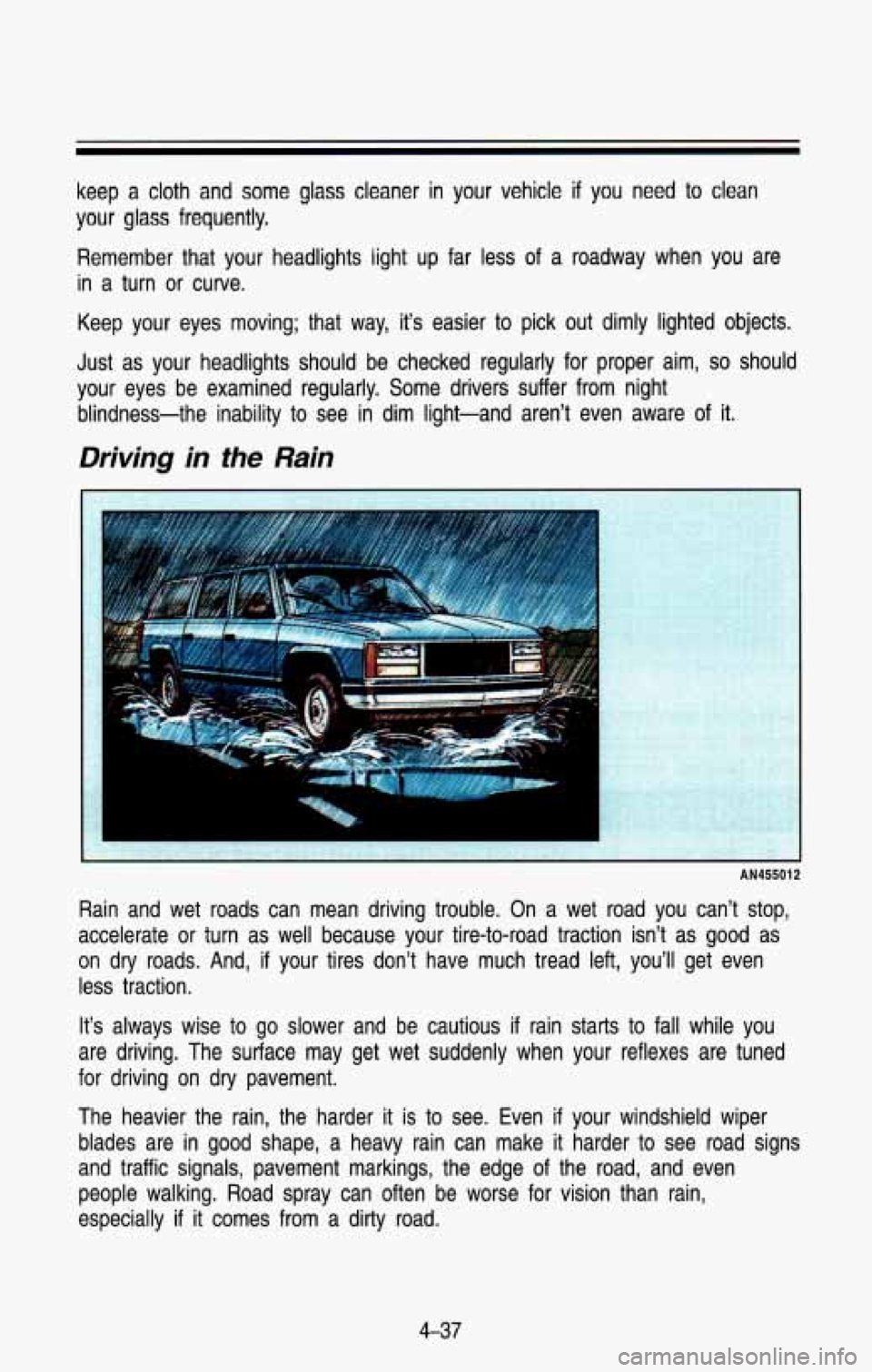
Driving in the Rain
AN455012
Rain and wet roads can mean driving trouble. On a wet road y\
ou can’t stop,
accelerate or turn as well because your tire-to-road traction isn’t as good as
on dry roads. And,
if your tires don’t have much tread left, you’ll get even
less traction.
It’s always wise to go slower and be cautious
if rain starts to fall while you
are driving. The surface may get wet suddenly when your reflex\
es are tuned
for driving on
dry pavement.
The heavier the rain, the harder it is to see. Even
if your windshield wiper
blades are in good shape, a heavy rain can make it harder to see road signs
and traffic signals, pavement markings, the edge of the road, and even
people walking. Road spray can often be worse for vision than rain,
especially
if it comes from a dirty road.
4-37
Page 205 of 386

So it is wise to keep your wiping equipment in good shape and keep your
windshield washer tank filled. Replace your windshield wiper ins\
erts when they
show signs of streaking or missing areas on the windshield,
or when strips of
rubber start to separate from the inserts,
AN455018
Driving too fast through large water puddles or even going thr\
ough some car
washes can cause problems,
too. The water may affect your brakes. Try to
avoid puddles. But
if you can’t, try to slow down before you hit them.
Wet brakes can cause accidents. They won’t work well
in a quick
stop
and may cause pulling to one side. You could lose control of
the vehicle.
After driving through
a large puddle of water or a car wash, apply
your brake pedal lightly until your brakes
work normally.
Hydroplaning
Hydroplaning is dangerous. So much water can build up under your tires that
they can actually ride on the water. This can happen
if the road is wet
enough and you’re going fast enough. When your vehicle is h\
ydroplaning,
it
has little or no contact with the road.
You might not be aware of hydroplaning. You could drive along for some time \
without realizing your tires aren’t in constant contact with \
the road.
You could
find out the hard way: when you have
to slow, turn, move out to pass-or if
you get hit by a gust of wind. You could suddenly find yourself out of control.
4-38