turn signal CHEVROLET BLAZER 1993 Owners Manual
[x] Cancel search | Manufacturer: CHEVROLET, Model Year: 1993, Model line: BLAZER, Model: CHEVROLET BLAZER 1993Pages: 386, PDF Size: 20.7 MB
Page 12 of 386
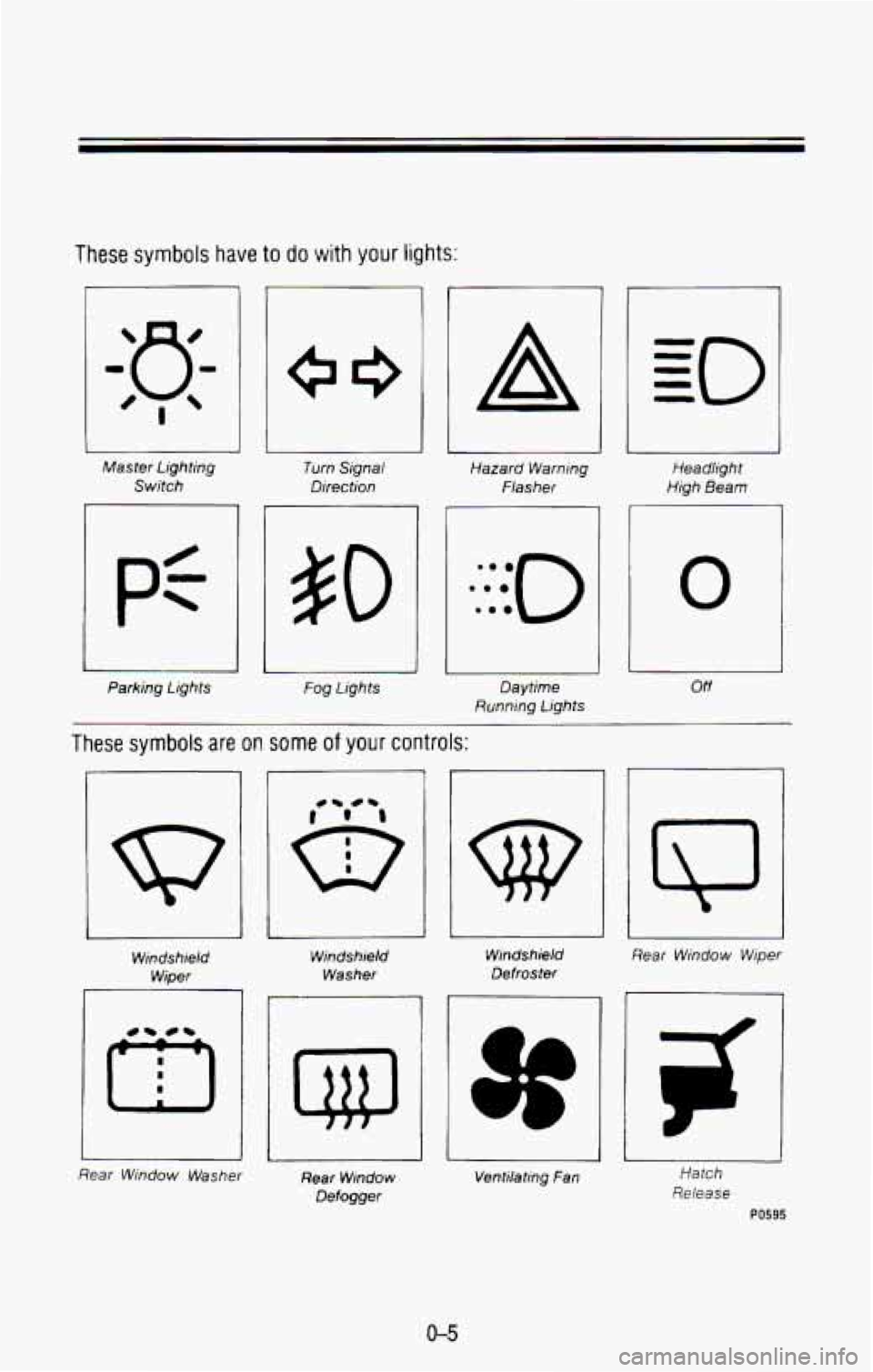
These symbols have to do with your lights:
A
Master Lighting Switch Turn Signal
Direction Hazard
Warning
Flasher Headlight
High Beam
0 50
I
Parking Lights Fog Lights Off Daytime
Running
Lights
These symbols are on some of your controls:
w
1 I
Rear Window Wiper
-~ ~
Windshield
Washer Windshield
Defroster
I
Windshield
Wiper
I
CYT
I
Rear Window
Defogger
L
Ventilating Fan
I I
Hatch
Release
Rear Window Washer
PO595
0-5
Page 65 of 386

Features & Controls
Locking Rear Axle ........................................................................\
....................... 2-22
Parking Brake
........................................................................\
.............................. 2-23
Parking Over Things That Burn
........................................................................\
. 2-27
Engine Exhaust
........................................................................\
........................... 2-28
Running Your Engine While You’re Parked
...................................................... 2-29
Four-wheel Drive
........................................................................\
........................ 2-30
Transfer Case
........................................................................\
.......................... 2-30
Front Axle Locking Feature
........................................................................\
.... 2-32
Windows
........................................................................\
....................................... 2-33
Horn
........................................................................\
.............................................. 2-35
Tilt Wheel
........................................................................\
..................................... 2-35
Multifunction Lever
........................................................................\
...................... 2-36
Turn Signal and Lane Change Indicator
....................................................... 2-37
Headlight High-Low Beam
........................................................................\
...... 2-38
Windshield Wipers
........................................................................\
................... 2-39
Windshield Washer
........................................................................\
.................. 2-40
Cruise Control
........................................................................\
.......................... 2-41
Headlights and Vehicle Lighting
........................................................................\
. 2-46
Mirrors
........................................................................\
.......................................... 2-51
Sun Visors ........................................................................\
................................... 2-53
Rear Window Wiper and Washer
...................................................................... 2-54
Cigarette LightedAshtrays
........................................................................\
........... 2-55
Storage Compartments ........................................................................\
............... 2-55
Warning Lights, Gages and Indicators
.......................................................... 2-68
Instrument Cluster
........................................................................\
....................... 2-62
Gages
........................................................................\
....................................... 2-76
Luggage Carrier
........................................................................\
........................... 2-80
Trailer Wiring Harness
........................................................................\
................ 2-82
2-2
Page 99 of 386
Features & Contuvls
To tilt the wheel, hold the steering wheel and pull the lever. Move the
steering wheel
to a comfortable level, then release the lever to lock the wheel
in place.
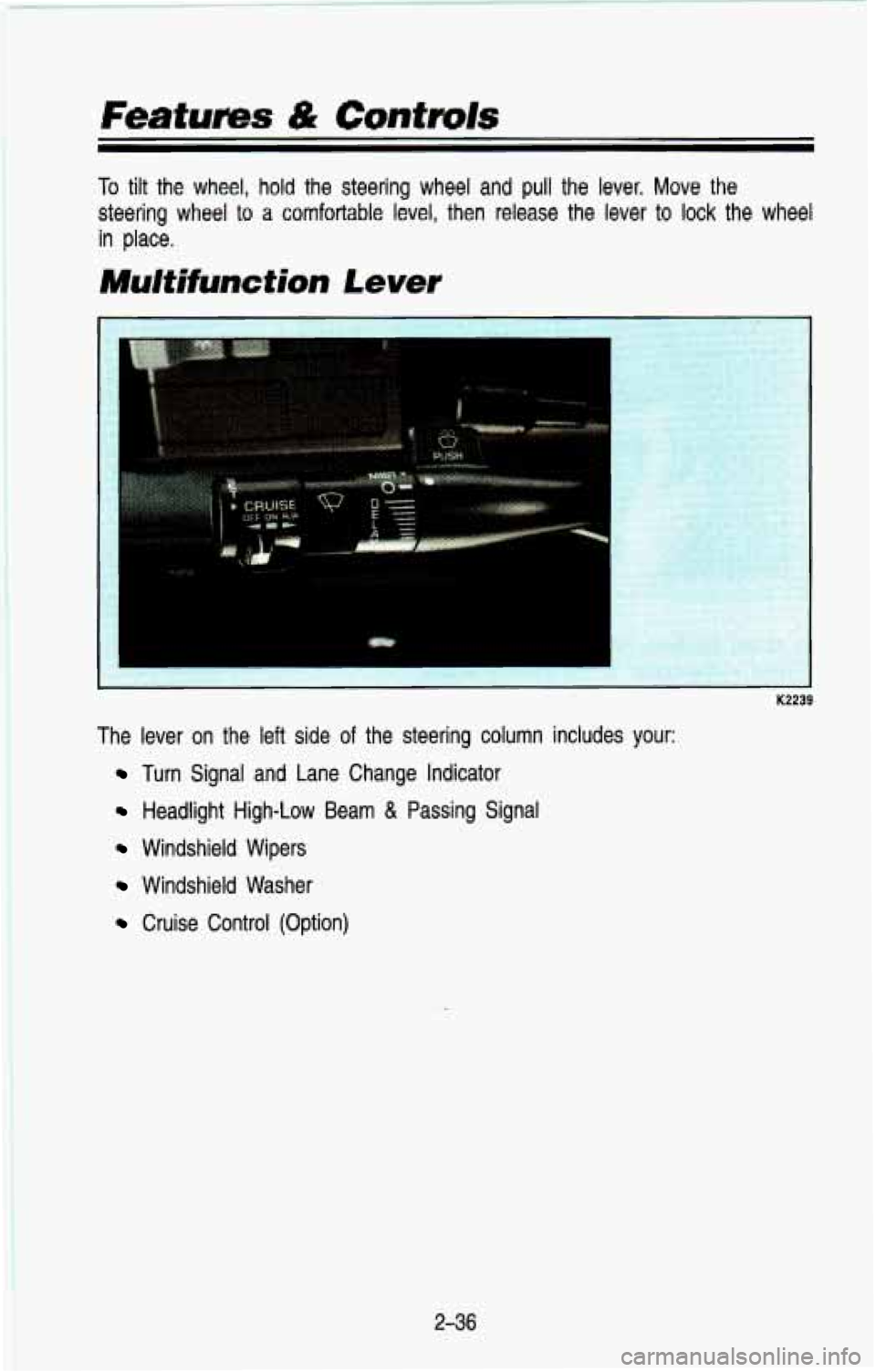
Multifunction Lever
K2239
The lever on the left side of the steering column includes your:
Turn Signal and Lane Change Indicator
Headlight High-Low Beam & Passing Signal
Windshield Wipers
Windshield Washer
Cruise Control (Option)
236
Page 100 of 386
 and two downward \
(for Left) positions. These positions allow you")
Turn Signal and Lane Change indicator
..
1
." I .. . ..,." .
K2240
The turn signal has two upward (for Right) and two downward \
(for Left) positions. These positions allow you to signal a turn or a lane change.
To signal a turn, move the lever all the way up or down. When the turn is
finished, the lever will return automatically.
A green arrow on the instrument panel will flash in the direction of the turn
or lane change.
To signal a lane change, just raise or lower the lever until the green arrow
starts to flash.
Hold it there until you complete your lane change. The lever
will return by itself when you release it.
As you signal a turn or a lane change, if the arrows flash twice as fast as
normal, a signal bulb may be burned out and other drivers won\
't see your
turn signal.
If a bulb is burned out, replace it to help avoid an accident. If the green
arrows don't go on at all when you signal a turn, check the \
fuse (see
"Fuses" in the Index) and for burned-out bulbs.
Operation of Lights
Although your vehicle's lighting system (headlights, parking lig\
hts, fog lamps,
side marker lights and taillights) meet all applicable federal lighting
requirements, certain states and provinces may apply their own \
lighting
regulations that may require special attention before you operate these lights.
For example, some jurisdictions may require that you operate yo\
ur lower
2-37
Page 101 of 386
Features & Contmls
beam lights with fog lamps at all times, or that headlights be turned on
whenever you must use your windshield wipers. In addition, most jurisdictions
prohibit driving solely with parking lights, especially
at dawn or dusk. It is
recommended that you check with your own state or provincial h\
ighway
authority for applicable lighting regulations.
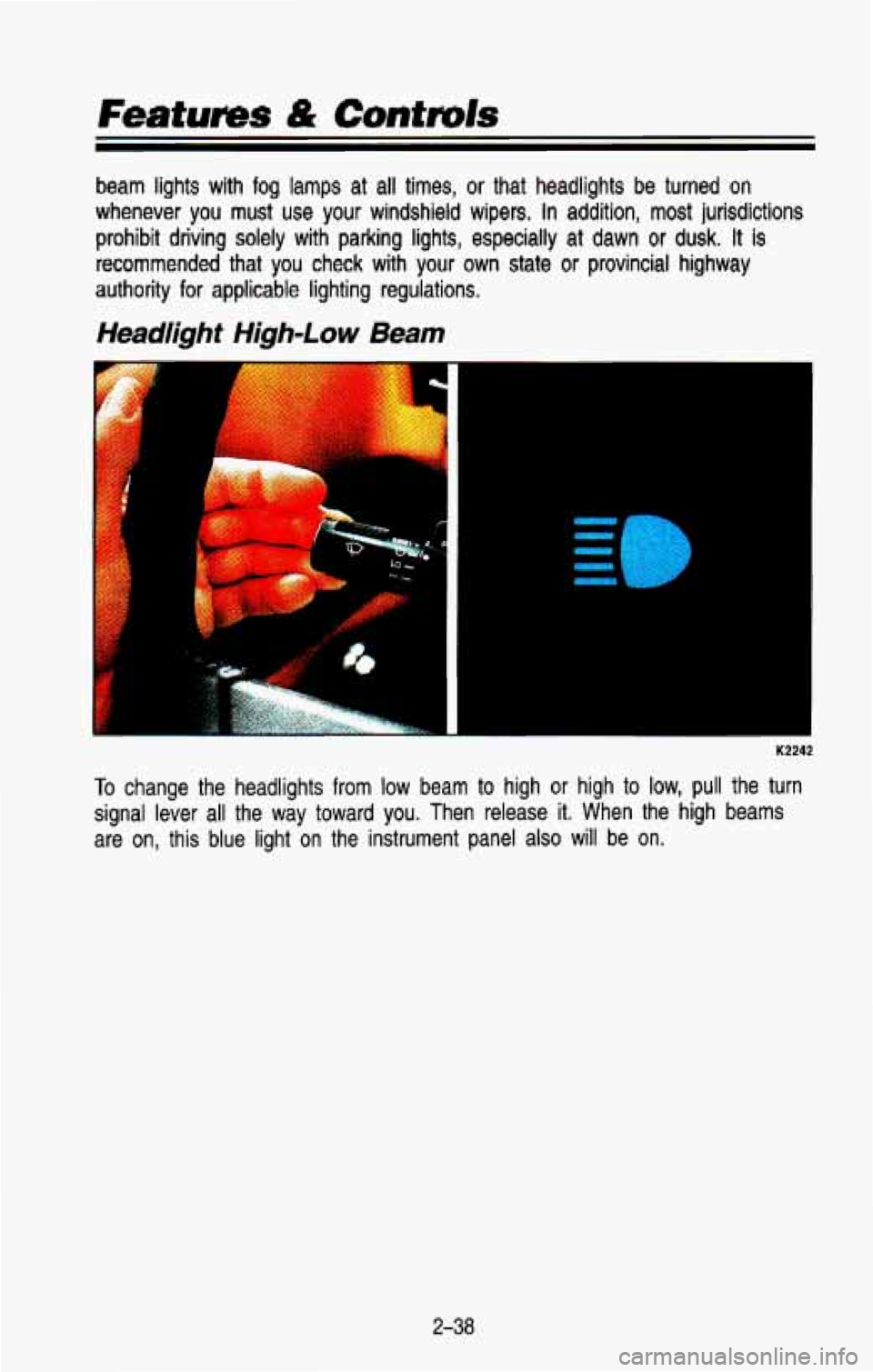
Head/ight Hiah-Low Beam
F. p h*' .- ..
K2242
To change the headlights from low beam to high or high to low, pull the turn
signal lever all the way toward you. Then release it. When the high beams
are on, this blue light on the instrument panel
also will be on.
2-38
Page 131 of 386
Features & Controls
Do not operate the engine with the tachometer in the red area, or engine
damage may occur.
Damage
to your engine or vehicle caused by operating the engine in the
red area isn’t covered by your vehicle warranty.
Warning Lights, Gages and lndicafors
This part describes the warning lights and gages that are on \
your vehicle.
The pictures will help you locate them.
Warning lights and gages can signal that something is wrong be\
fore it
becomes serious enough
to cause an expensive repair or replacement. Paying
attention to your warning lights and gages could also save you or others from
injury.
Warning lights go on when there may be or is a problem with one of your
vehicle’s functions.
As you will see in the details on the next few pages,
some warning lights come on briefly when you turn the ignition\
key just
to let
you know they’re working.
If you are familiar with this part, you should not be
alarmed when this happens.
Gages can indicate when there may be
or is a problem with one of your
vehicle’s functions. Often gages and warning lights work together to let you
know when there’s
a problem with your vehicle.
When one of the warning lights comes on and stays on when you are
driving, or when one of the gages shows there may be a problem, check the
part that tells you what to
do about it. Please follow the manual’s advice.
Waiting
to do repairs can be costly-and even dangerous. So please get to
know your warning lights and gages. They’re a big help.
2-68
Page 138 of 386
beam headlights. For more details about high beams, see “Headlight
High-Low
Beam Changer” earlier in this section,
Turn Signal and Lane Change Indicator
K2444
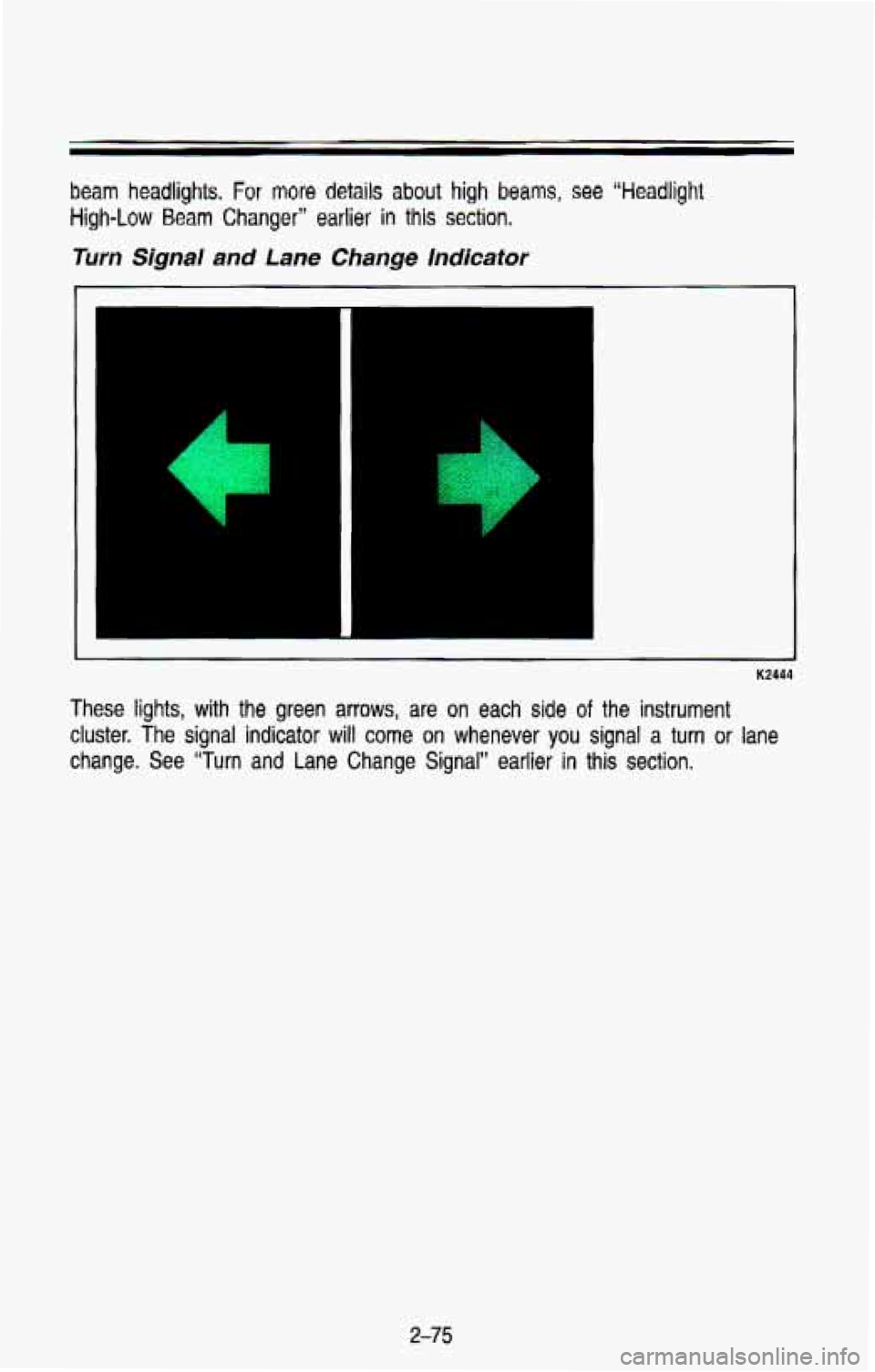
These lights, with the green arrows, are on each side of the instrument
cluster. The signal
indicator will come on whenever you signal a turn or lane
change. See “Turn and Lane Change Signal” earlier
in this section.
2-75
Page 164 of 386
AmSt
The AmSt button is just below the PWR button. Push this when you tune to
an AM station that broadcasts
in stereo. Your STEREO light will come on
when you’re receiving AM stereo.
If you push AmSt and there is no more
noise, it means the station is weak. You’ll hear the station better
if you don’t
use
AmSt. Just push the AmSt button again to cancel stereo.
NOTE: Your Delco system may be able to receive C-QUAM@ stereo
broadcasts. Many AM stations around the country use
C-QUAM@ to produce
stereo, though some
do not. C-QUAM@ is a registered trademark of Motorola
Inc.
If your Delco system can get C-QUAM@ signals, your STEREO light will
come on when you are receiving stereo.
Cassette Deck with Graphic Equalizer
I
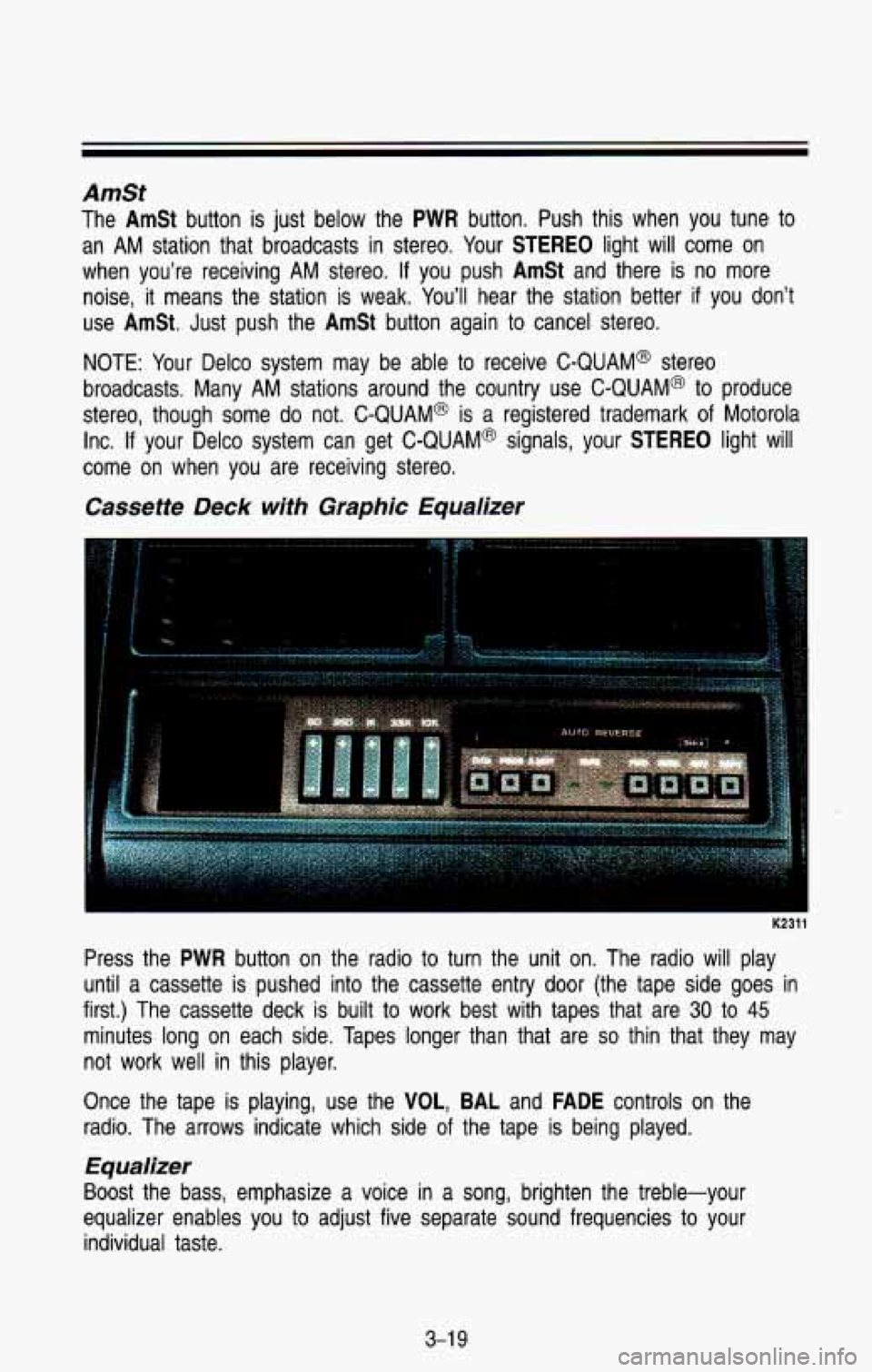
Press the PWR button on the radio to turn the unit on. The radio will play
until a cassette is pushed into the cassette entry door (the tape \
side goes in
first.) The cassette deck is built
to work best with tapes that are 30 to 45
minutes long on each side. Tapes longer than that are so thin that they may
not work well in this player.
Once the tape is playing, use the
VOL, BAL and FADE controls on the
radio. The arrows indicate which side
of the tape is being played.
1
Equalizer
Boost the bass, emphasize a voice in a song, brighten the treble-your
equalizer enables you
to adjust five separate sound frequencies to your
individual taste.
3-1 9
Page 175 of 386
Pavement Markings
NO PASSING ZONE
AM40201 6
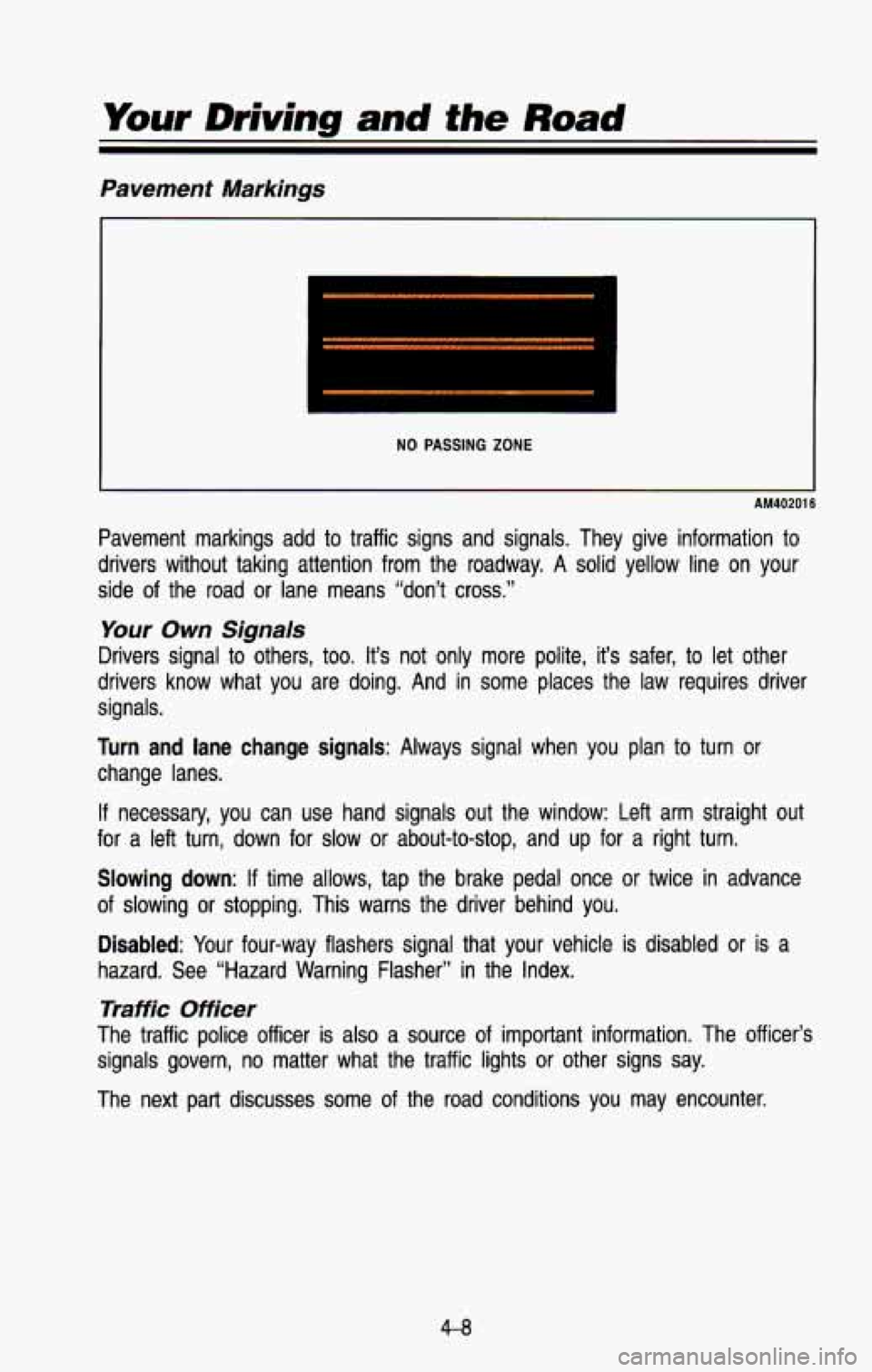
Pavement markings add to traffic signs and signals. They give information to
drivers without taking attention from the roadway. A solid yell\
ow line on your
side of the road or lane means “don’t cross.”
Your Own Signals
Drivers signal to others, too. It’s not only more polite, it’s safer, to let other
drivers know what you are doing. And in some places the law requires driver
signals.
Turn and lane change signals: Always signal when you plan to turn or
change lanes.
If necessary, you can use hand signals out the window: Left arm straight out
for
a left turn, down for slow or about-to-stop, and up for a right\
turn.
Slowing down: If time allows, tap the brake pedal once or twice in advance
of slowing or stopping. This warns the driver behind you.
Disabled: Your four-way flashers signal that your vehicle is disabled or \
is a
hazard. See “Hazard Warning Flasher” in the Index.
Traffic Officer
The traffic police officer is also a source of important information. The officer’s
signals govern, no matter what the traffic lights or other signs say. \
The next part discusses some of the road conditions you may e\
ncounter.
4-8
Page 189 of 386
Your Driving and the Road
Watch for traffic signs, pavement markings, and lines. If you can see a
sign up ahead that might indicate a turn
or an intersection, delay your
pass.
A broken center line usually indicates it’s all right to pass
(providing the road ahead is clear). Never cross a solid lin\
e on your side
of the lane
or a double solid line, even if the road seems empty of
approaching traffic.
If you suspect that the driver of the vehicle you want to pass isn’t aware
of your presence, tap the horn a couple of times before passi\
ng.
Do not get too close to the vehicle you want to pass while you’re
awaiting an opportunity.
For one thing, following too closely reduces your
area
of vision, especially if you’re following a larger vehicle. Also, you
won’t have adequate space
if the vehicle ahead suddenly slows or stops.
Keep back a reasonable distance.
When it looks like a chance
to pass is coming up, start to accelerate
but stay in the right lane and don’t get too close. Time your move
so
you will be increasing speed as the time comes to move into the other
lane.
If the way is clear to pass, you will have a “running start” that
more than makes up for the distance you would lose by dropping back.
And
if something happens to cause you to cancel your pass, you need
only slow down and drop back again and wait for another opportunity.
If other cars are lined up to pass a slow vehicle, wait your turn. But
take care that someone isn’t trying
to pass you as you pull out to pass
the
slow vehicle. Remember to glance over your shoulder and check the
blind spot.
Check your mirrors, glance over your shoulder, and start your
left lane
change signal before moving out of the right lane to pass. When you
are far enough ahead of the passed vehicle to see its front in your
inside mirror, activate your right lane change signal and move \
back into
the right lane. (Remember that your right outside mirror is convex. The
vehicle
you just passed may seem to be farther away from you than it
really is).
Try not to pass more than one vehicle at a time on two-lane roads.
Reconsider before passing the next vehicle.
Don’t overtake a slowly moving vehicle too rapidly. Even tho\
ugh the
brake lights are not flashing,
it may be slowing down or starting to turn.
If you’re being passed, make it easy for the following driver to get ahead
of you. Perhaps you can ease a little to the right.
4-22