wheel CHEVROLET BLAZER 1993 Repair Manual
[x] Cancel search | Manufacturer: CHEVROLET, Model Year: 1993, Model line: BLAZER, Model: CHEVROLET BLAZER 1993Pages: 386, PDF Size: 20.7 MB
Page 254 of 386
PO205
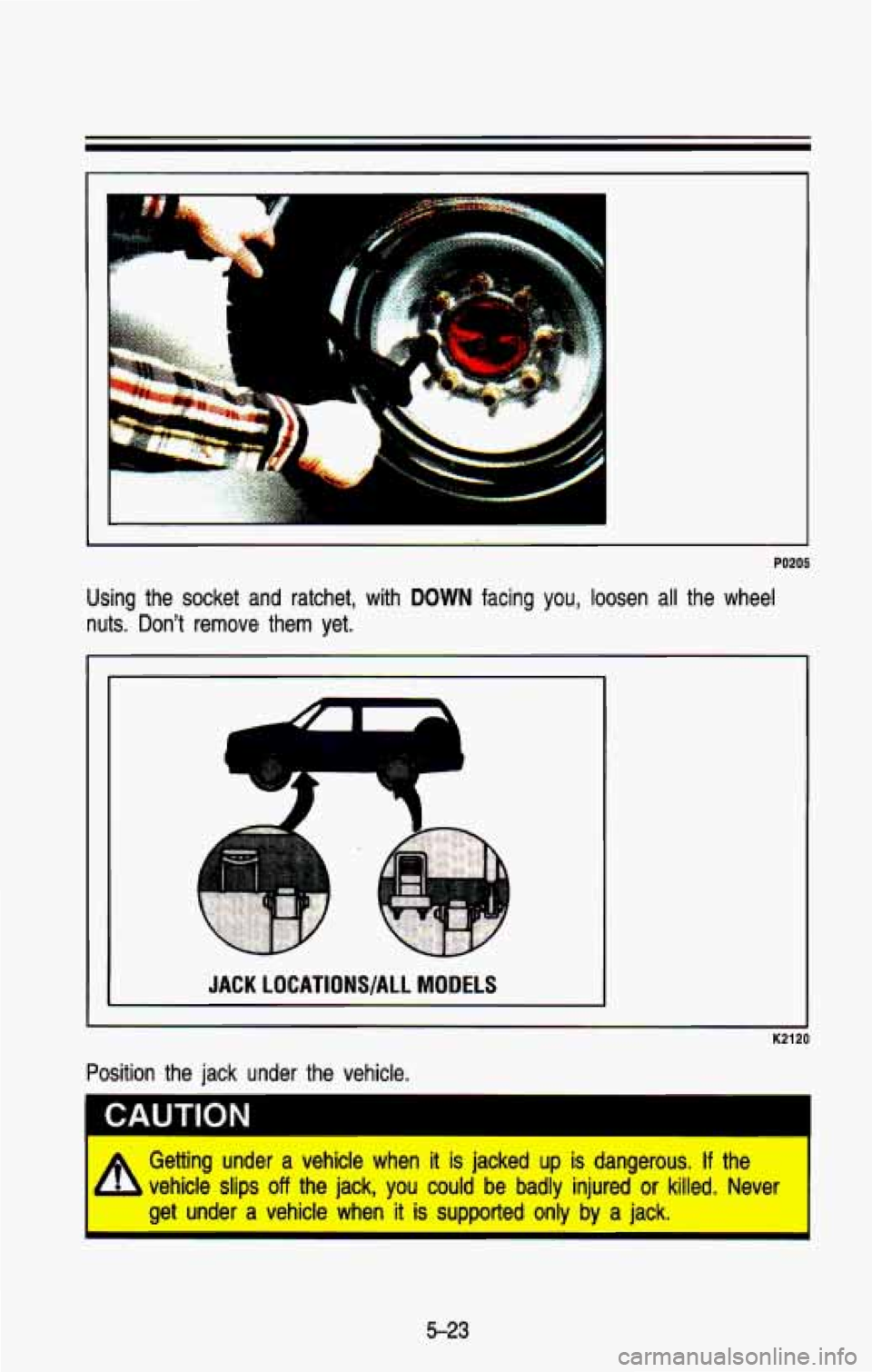
Using the socket and ratchet, with DOWN facing you, loosen all the wheel
nuts. Don’t remove them yet.
I JACK LOCATIONS/ALL MODELS
K2120
CAUTION
I A Getting under a vehicle when it is jacked up is dangerous. If the I
vehicle slips off the jack, you could be badly injured or killed. Never
get under
a vehicle when it is supported only by a jack. I
5-23
Page 256 of 386
K2527
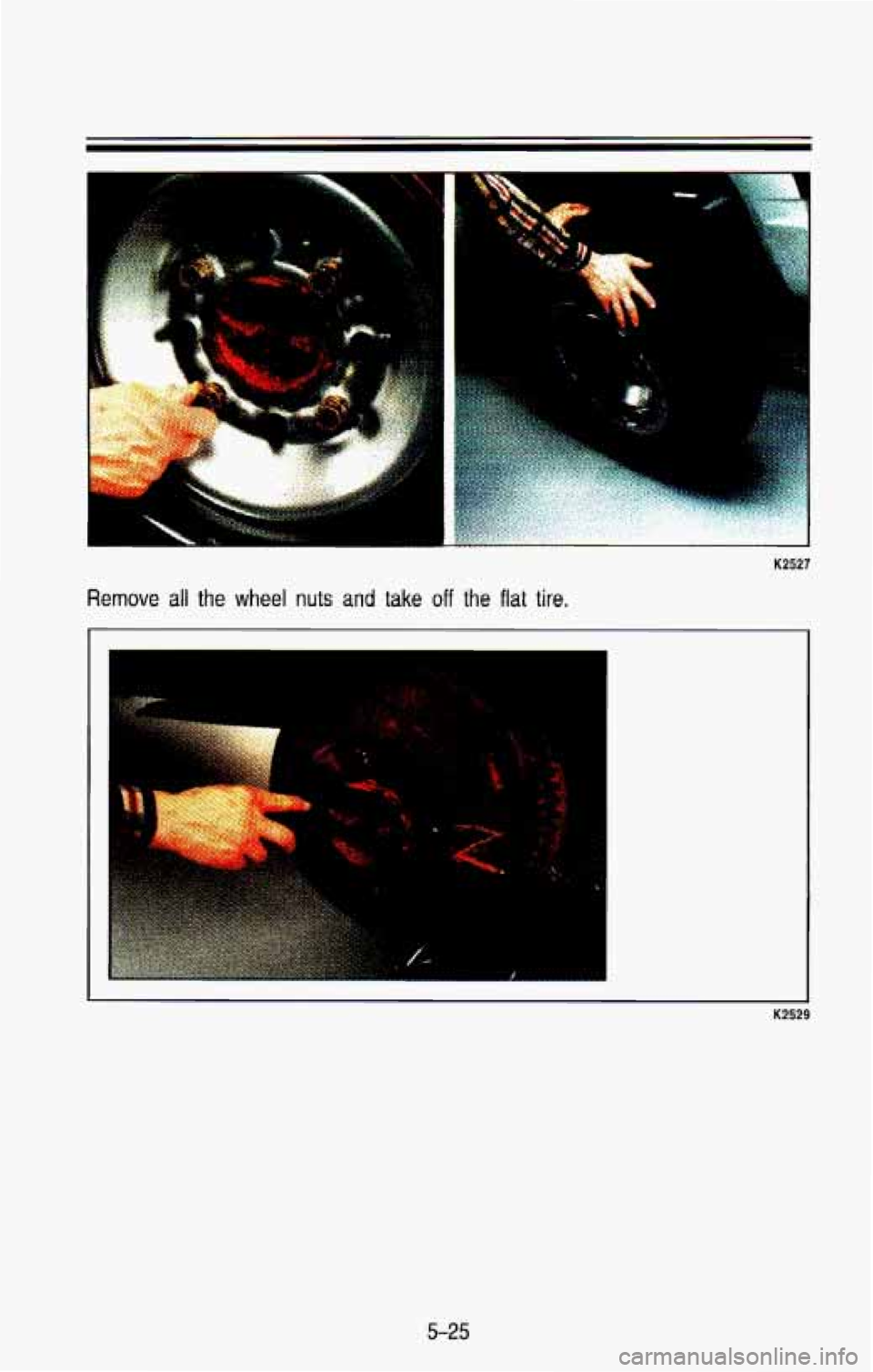
qemove all the wheel nuts and take off the flat tire.
1
K2529
5-25
Page 257 of 386
1 CAUTION
* Rust or dirt on the wheel, or on the parts to which it is fastened, ’
h can make the wheel nuts become loose after a time. The wheel
I could corne off and cause an accident. When you change a wheel,
remove any rust or dirt fmm the places where the wheel attaches to
the vehicle. In an emergency, you can use a cloth or a paper towel
to do this; but be sure to use a scraper ~r wire brush later, if you
need to, to get all the rust or dirt off.
Remove any rust or dirt from the wheel bolts, mounting surfaces or spare
wheel. Place the spare on the wheel mounting
surface.
CAUTION
Never use oil or grease on studs or nuts. If you do, the nuts might
come loose. Your wheel could fall
off, causing a serious accident.
I
K2127
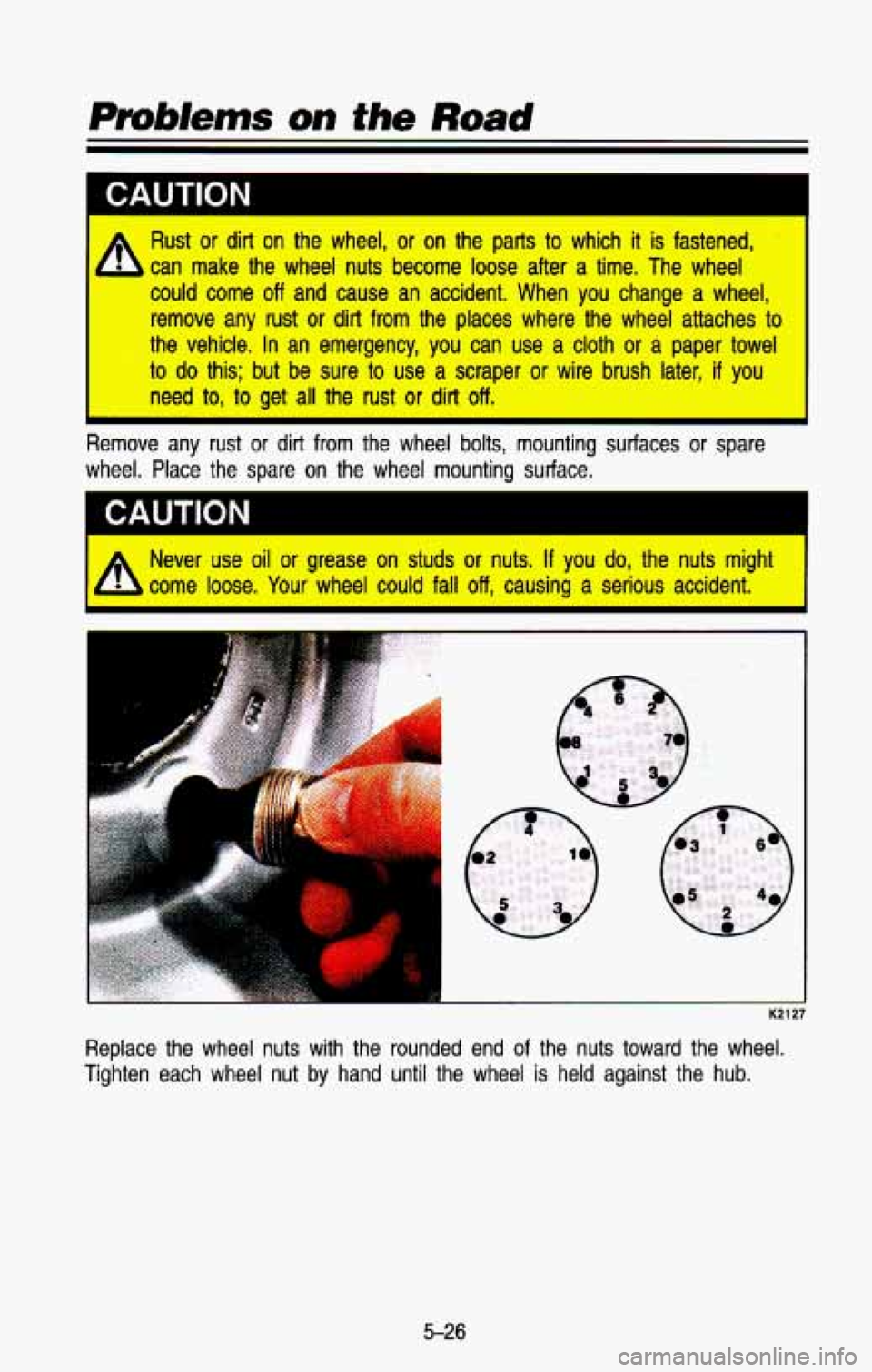
Replace the wheel nuts with the rounded end of the nuts toward the wheel.
Tighten each wheel
nut by hand until the wheel is held against the hub.
5-26
Page 259 of 386

CAUTION I
Incorrect wheel nuts or improperly tightened wheel nuts can cau\
se
the wheel
to become loose and even come off. This could lead to
an accident. Be sure to use the correct wheel nuts. If you have to
replace them, be
sure to get the right kind.
Stop somewhere as soon as you can and have the nuts tightened
with a torque wrench
to the promr toraue. I
For proper torque, see “Wheel Nut Torque” in the Index.
Put the wheel trim back on. For vehicles with plastic nut cap\
s, tighten the
caps until they are finger tight, then tighten them an additio\
nal one-half turn
with the ratchet. Remove any wheel blocks.
Storing
a jack, a tire or other equipment in the passenger
compartment
of the vehicle could cause injury. In a sudden stop or
collision, loose equipment could strike someone. Store all these\
in
the proper place.
5-28
Page 262 of 386
K2143
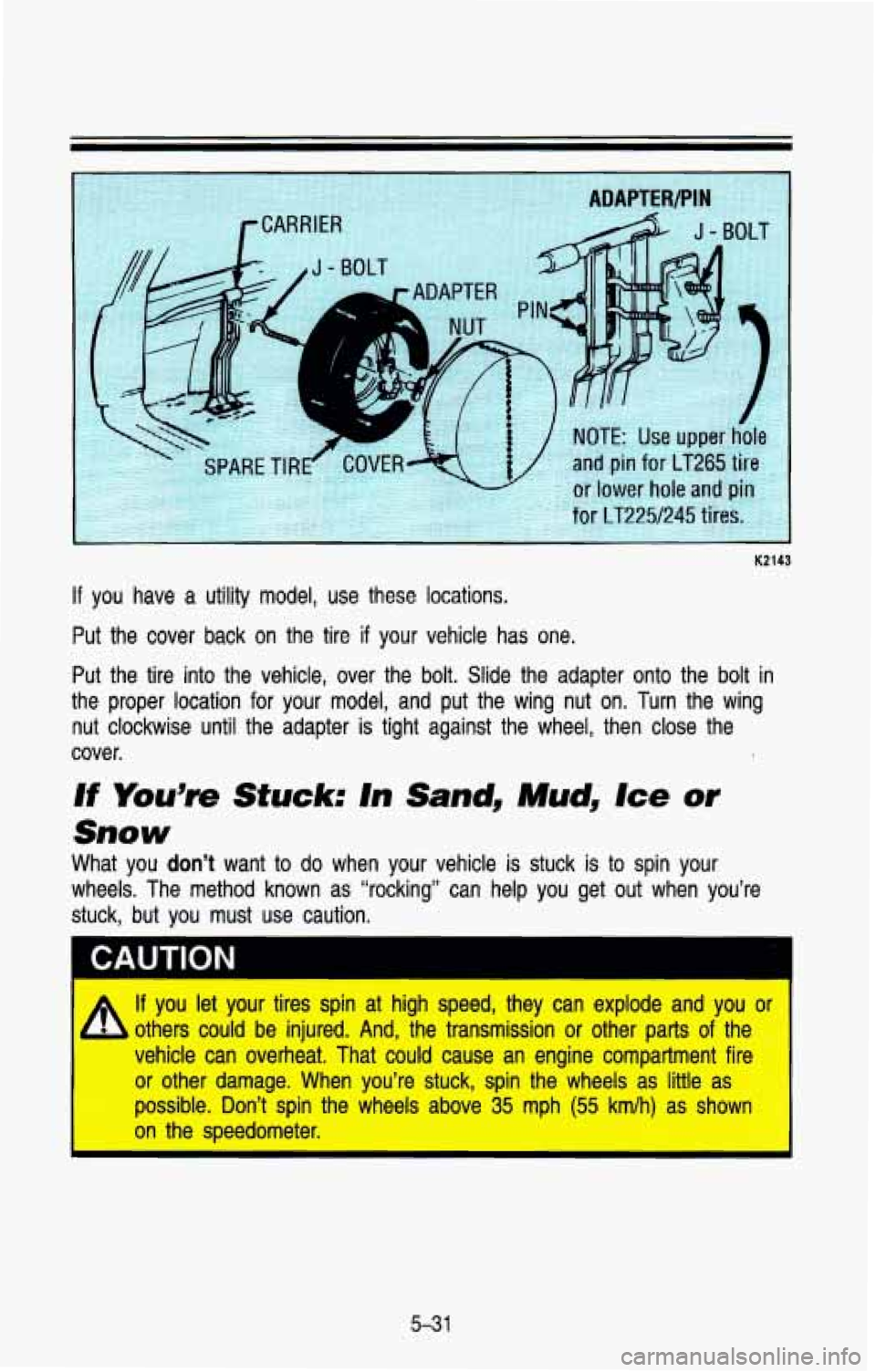
If you have a utility model, use these locations.
Put the cover back on the tire if your vehicle has one.
Put the tire into the vehicle, over the bolt. Slide the adapter onto the bolt in
the proper location for your model, and put the wing nut on. Turn\
the wing
nut clockwise until the adapter is tight against the wheel, then close the
cover.
If You’re Stuck: In Sand, Mud, Ice or
Snow
What you don’t want to do when your vehicle is stuck is to spin your
wheels. The method known as “rocking” can help you get o\
ut when you’re stuck, but you must use caution.
If you let your tires spin at high speed, they can explode and \
you or I
I-, others could be injured. And, the transmission or other parts of the
vehicle can overheat. That could cause an engine compartment fi\
re or other damage. When you’re stuck, spin the wheels as litt\
le as
possible. Don’t spin the wheels above
35 mph (55 kmlh) as shown
on the speedometer.
5-31
Page 263 of 386
Pmb/ems on the Road
Spinning your wheels can destroy parts of your vehicle as well as the
Rocking your vehicle to get it out:
First, turn your steering wheel left and right. That will clear the area around
your front wheels. Then shift back and forth between R and a forward gear
(or with a manual transmission, between First or Second gear and Reverse),
spinning the wheels as little as possible. Release the accelerator pedal while
you shift, and press lightly on the accelerator pedal when the transmission is
in gear. If that doesn’t get you out after a few tries, you may need to be
towed out. Or, you can use your recovery hooks, if your vehicle has them. If
you do need to be towed out, see “Towing Your Vehicle” in the Index.
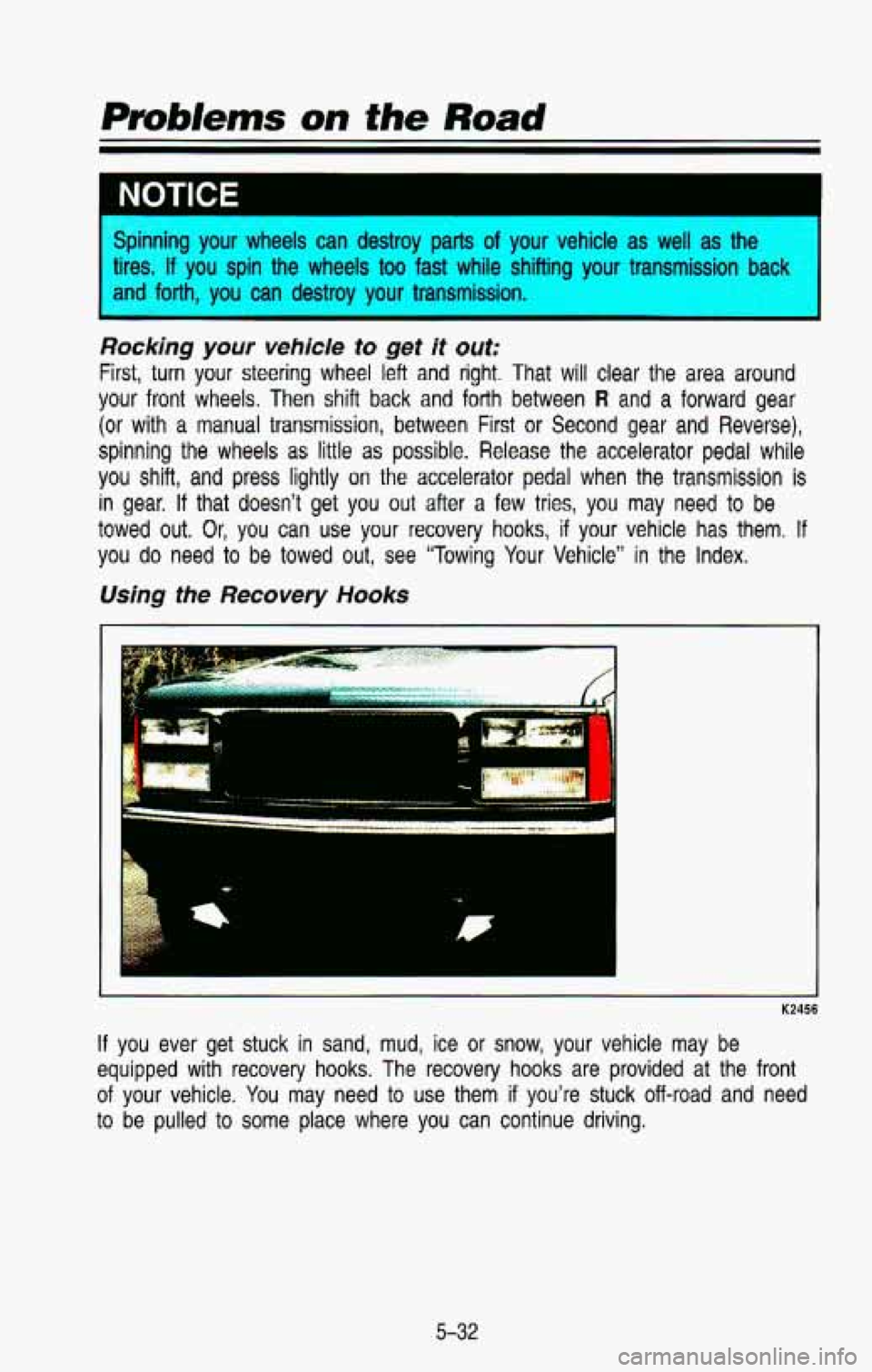
Using the Recovery Hooks
m
K2456
If you ever get stuck in sand, mud, ice or snow, your vehicle may be
equipped with recovery hooks. The recovery hooks are provided a\
t the front
of your vehicle. You may need to use them if you’re stuck off-road and need
to be pulled to some place where you can continue driving.
5-32
Page 267 of 386

Service & Appearance Care
Replacing Brake System Parts ........................................................................\
.. 6-33
Other Maintenance Items
........................................................................\
........... 6-34
Lubrication
........................................................................\
.................................... 6-35
Electrical System
........................................................................\
......................... 6-37
Battery
........................................................................\
...................................... 6-37
Bulb Replacement
........................................................................\
.................... 6-37
Fuses and Circuit Breakers
........................................................................\
.... 6-43
Exhaust System
........................................................................\
........................... 6-45
Loading Your Vehicle
........................................................................\
.................. 6-46
Tires
........................................................................\
.............................................. 6-48
Inflation-Tire Pressure
........................................................................\
........... 6-49
Tire Inspection and Rotation
........................................................................\
.. 6-52
When It’s Time for New Tires ........................................................................\
6-53
Buying New Tires
........................................................................\
.................... 6-53
Uniform Tire Quality Grading
........................................................................\
.. 6-54
Wheel Alignment and Tire Balance
............................................................... 6-55
Wheel Replacement
........................................................................\
................. 6-55
Tire Chains
........................................................................\
............................... 6-56
Appearance Care
........................................................................\
........................ 6-57
Cleaning the Inside Of Your Vehicle
............................................................. 6-58
Cleaning the Outside
Of Your Vehicle .......................................................... 6-61
Appearance Care Materials
........................................................................\
........ 6-64
Vehicle Identification Number
........................................................................\
..... 6-65
Service Parts Identification Label
...................................................................... 6-67
Specification Charts ........................................................................\
..................... 6-68
6-2
Page 288 of 386
Hydraulic Clufch Grease Fittrhg
A grease fitting is on the clutch housing for lubricating the clutch fork ball
stud. See your Maintenance Schedule for when to lubricate the clutch
housing. See “Recommended Fluids and Lubricants” in the In\
dex for the
proper lubricant to use.
Be sure not to over-fill because you could damage your clutch.
Four- Wheel Drive
Most lubricant checks in this section also apply to four-wheel-drive vehicles.
However, they have
two additional systems that need lubrication.
Transfer Case
When to Check Lubricant:
Refer to the Maintenance Schedule to determine how often to check the
lubricant. See “Periodic Maintenance Inspections” in the In\
dex.
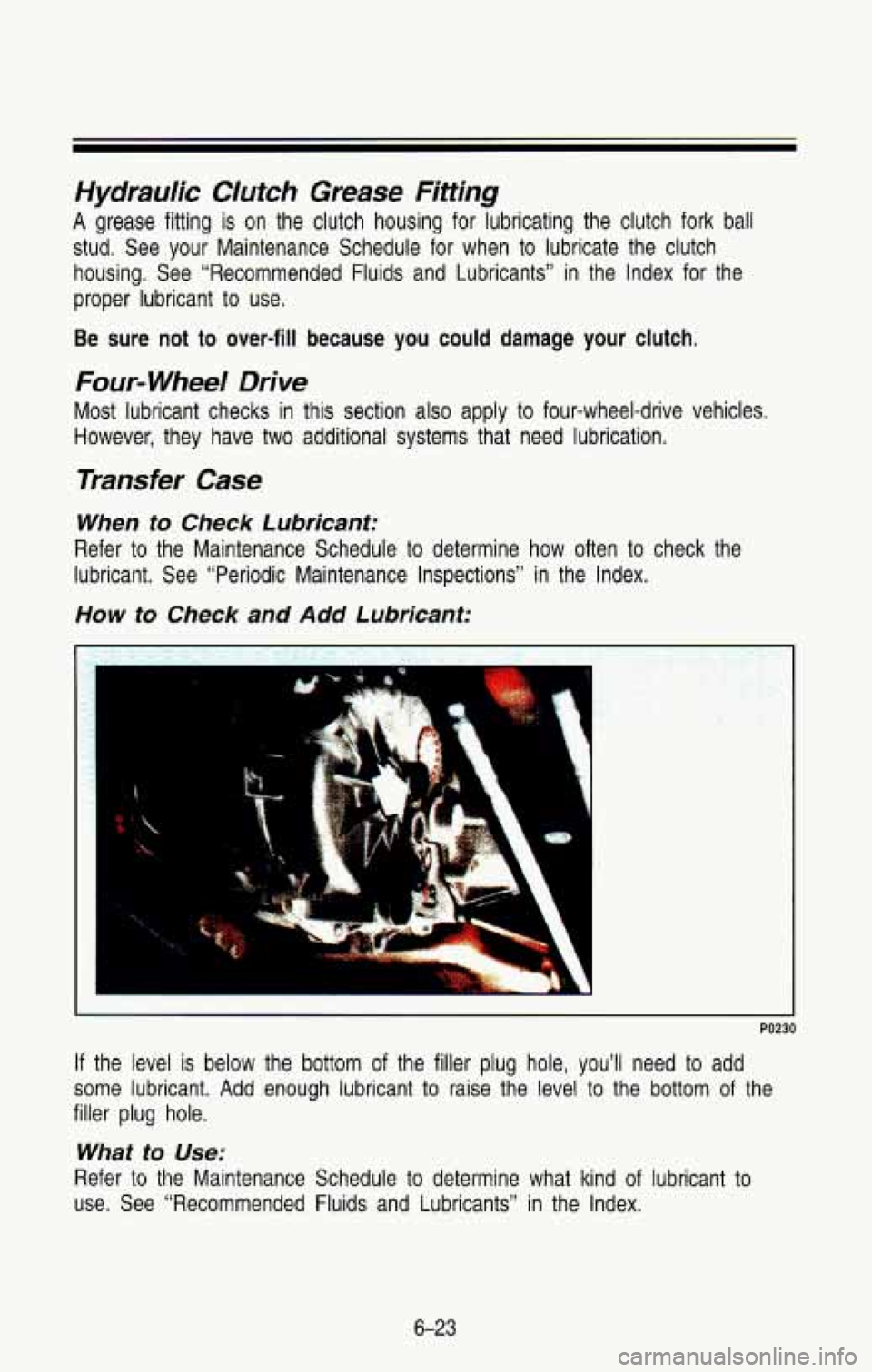
How to Check and Add Lubricant:
d Ti
I
PO230
If the level is below the bottom of the filler plug hole, you’ll need to add
some lubricant. Add enough lubricant to raise the level
to the bottom of the
filler plug hole.
What to Use:
Refer to the Maintenance Schedule to determine what kind of lubricant to
use. See “Recommended Fluids and Lubricants” in the Index.\
6-23
Page 299 of 386
Service & Appearance Care
Front Suspension and Steering Linkage
Your maintenance schedule will tell you how often to lubricate the fittings. See
“Recommended Fluids and Lubricants” in the Index for the \
proper lubricant to
use.
Front Wheel Bearings
Your vehicle has front wheel bearings that must be cleaned and repa\
cked.
Your maintenance schedule will
tell you how often this must be done.
Front Shock Absorbers
The front shock absorbers of your vehicle do many things. They help the
vehicle ride smoothly and also control the travel of the suspension system.
When the shock absorbers are serviced, any replacement shock ab\
sorbers must be the same as the original equipment shock absorbers in \
both
extended length and strength.
Wheel Nut Torque
For vehicles with dual wheels, when the vehicle, wheel or fast\
eners are new,
have the torque set at the first
100, 1,000 and 6,000 miles (160, 1600 and
9600 km). Use the torque specified in the appropriate Specification \
Chart later
in this section.
Single Belt Accessory Drive
If your new vehicle uses a serpentine belt, it is lighter, and more durable
than systems with several belts.
The belt runs over or around the pulleys on the engine.
A tensioner is used
to keep the belt tight at all times. The tensioner also makes replacing the
belt easier. If you need
to replace the belt, be sure to get the correct
replacement belt. Your dealership or parts supplier can help you with this.
The Accessory Drive Belt Routing label on your vehicle will sh\
ow you how to route the belt your vehicle uses.
6-34
Page 317 of 386
Service & Appearance Care
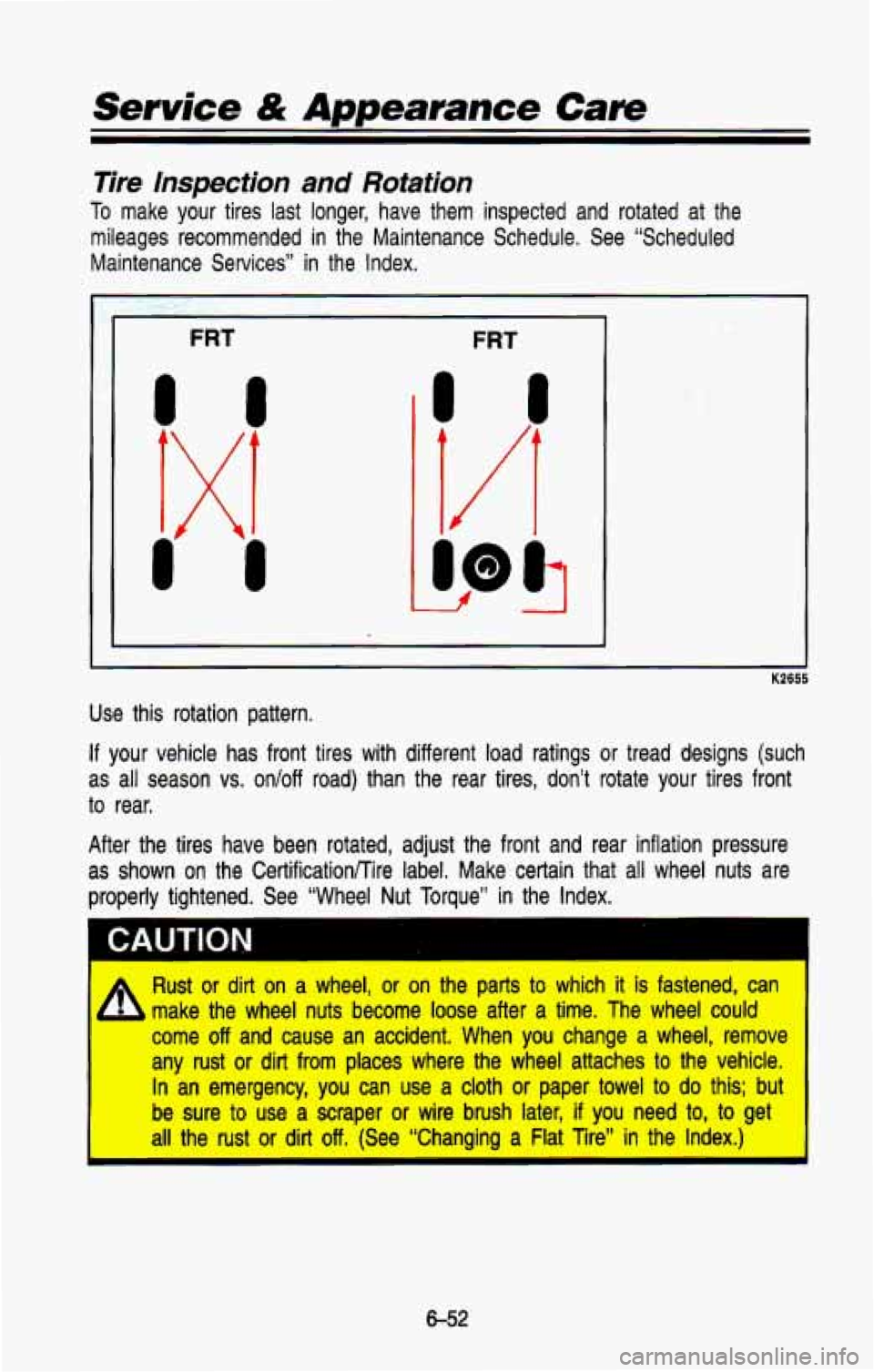
Tire lnspecfion and Rotation
To make your tires last longer, have them inspected and rotated at the
mileages recommended in the Maintenance Schedule. See “Scheduled
Maintenance Services” in the Index.
FRT FRT
L
I I
K2655
Use this rotation pattern,
If your vehicle has front tires with different load ratings or tr\
ead designs (such
as all season vs. on/off road) than the rear tires, don’t rotate \
your tires front
to rear,
After the tires have been rotated, adjust the front and rear \
inflation pressure
as shown on the CertificationRire label. Make certain that all \
wheel nuts are
properly tightened.
See “Wheel Nut Torque” in the Index.
1 CAUTION
Rust or dirt on a wheel, or on the parts to which it is fastened, can
make the wheel nuts become loose after a time. The wheel could
come
off and cause an accident. When you change a wheel, remove
any rust or dirt from places where the wheel attaches
to the vehicle.
In an emergency, you can use a cloth or paper towel to
do this; but
be sure to use a scraper or wire brush later, if you need to, to get
I
I all the rust or dirt off. (See ‘Changing a Flat Tire” in the Index.) I
&52