engine overheat CHEVROLET BLAZER 1994 2.G User Guide
[x] Cancel search | Manufacturer: CHEVROLET, Model Year: 1994, Model line: BLAZER, Model: CHEVROLET BLAZER 1994 2.GPages: 348, PDF Size: 17.88 MB
Page 259 of 348
Downloaded from www.Manualslib.com manuals search engine If the differential is cold, add enough lubricant to raise the level to 1/2 inch
(12 mm) below the filler plug hole.
What to use
Refer to the Maintenance Schedule to determine what kind of lubricant to
use.
See “Recommended Fluids and Lubricants” in the Index.
Engine Coolanr
The following explains your cooling system and how to add coolant when it
is
low. If you have a problem with engine overheating, see “Engine
Overheating” in the Index.
The proper coolant for your vehicle will:
0 Give freezing protection down to -20 “F (-29”C), or -34°F (-37°C) in
Give boiling protection up to 258°F (125°C).
Canada
and for
vehicles with the cold climate option.
0 Protect against rust and corrosion.
Help keep the proper engine temperature.
0 Let the warning lights and gages work as they should.
What to Use
Use a mixture of one-half clean water (preferably distilled) and one-half
antifreeze that meets “GM Specification 6038-M,” which won’t damage
aluminum parts.
You can use a recycled coolant conforming to “GM
Specification 6038-M,” with a complete coolant flush and refill. If you use
this mixture, you don’t need to add anything else.
6-23
Page 260 of 348
Downloaded from www.Manualslib.com manuals search engine I NOTICE:
If you use an improper coolant mix, your engine could overheat
and be badly damaged. The repair cost wouldn’t be covered by
your warranty.
Too much water in the mix can freeze and crack
the engine, radiator, heater core and other parts.
Some conditions, such as air trapped in the cooling system, can affect the
coolant level in the radiator. Check the coolant level when the engine
is cold
and follow the steps under “Adding Coolant” for
the proper way to add
coolant.
If you have to add coolant more than four times a year, have your dealer
check your cooling system.
NOTICE:
If you use the proper coolant, you don’t have to add extra
inhibitors or additives which claim to improve the system. These
can be harmful.
Adding Coolant
To Check Coolant
When your engine is cold, the coolant level should be at “ADD,” or a little
higher. When your engine
is warm, the level should be up to “FULL HOT,”
or a little higher.
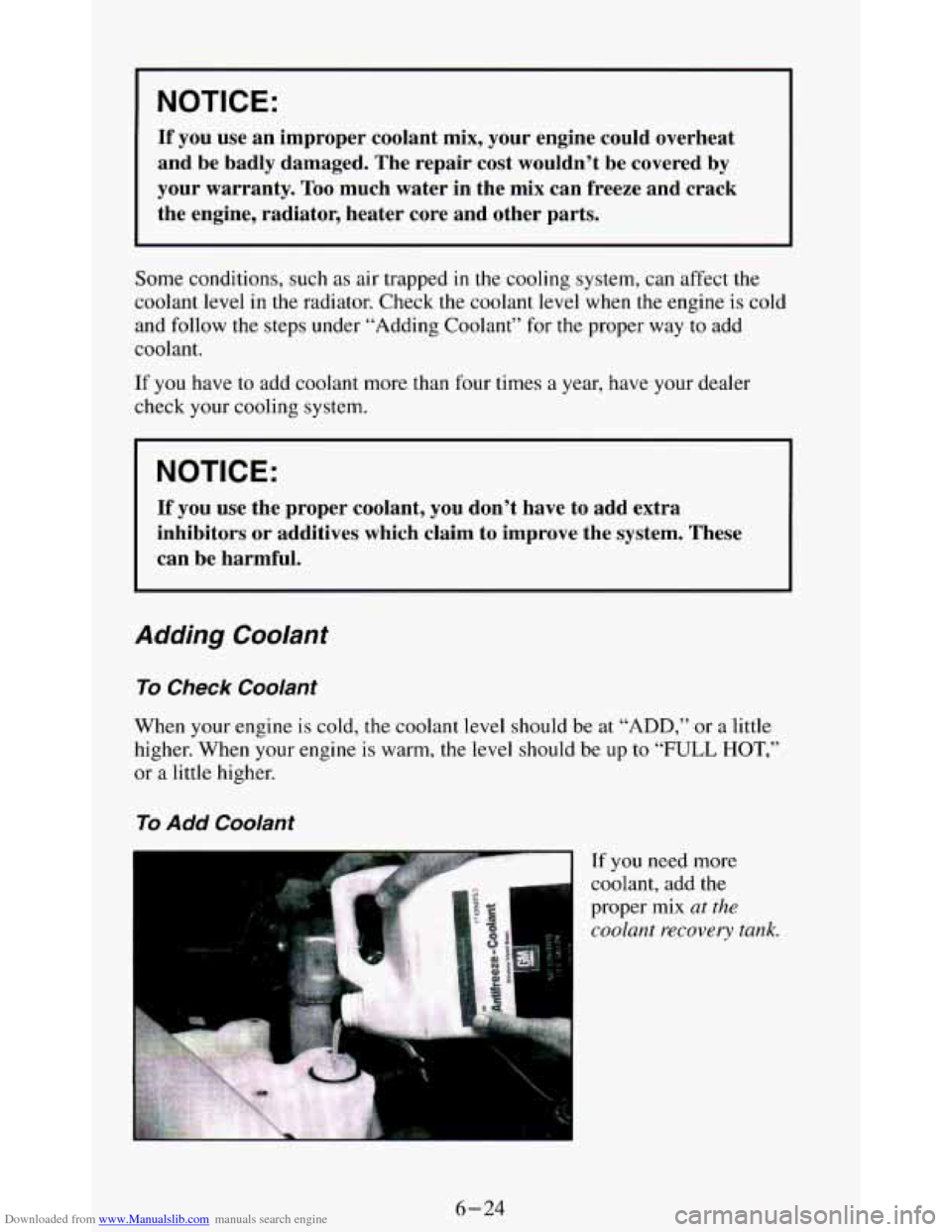
To Add Coolant
If you need more
coolant, add the
proper mix
at the
coolant recovery tank.
6-24
Page 261 of 348
Downloaded from www.Manualslib.com manuals search engine Add coolant mix at the recovery tank, but be careful not to spill it.
Radiator Pressure Cap
NOTICE:
Your radiator cap is a 15 psi (105 kPa) pressure-type cap and
must be tightly installed to prevent coolant
loss and possible
engine damage from overheating.
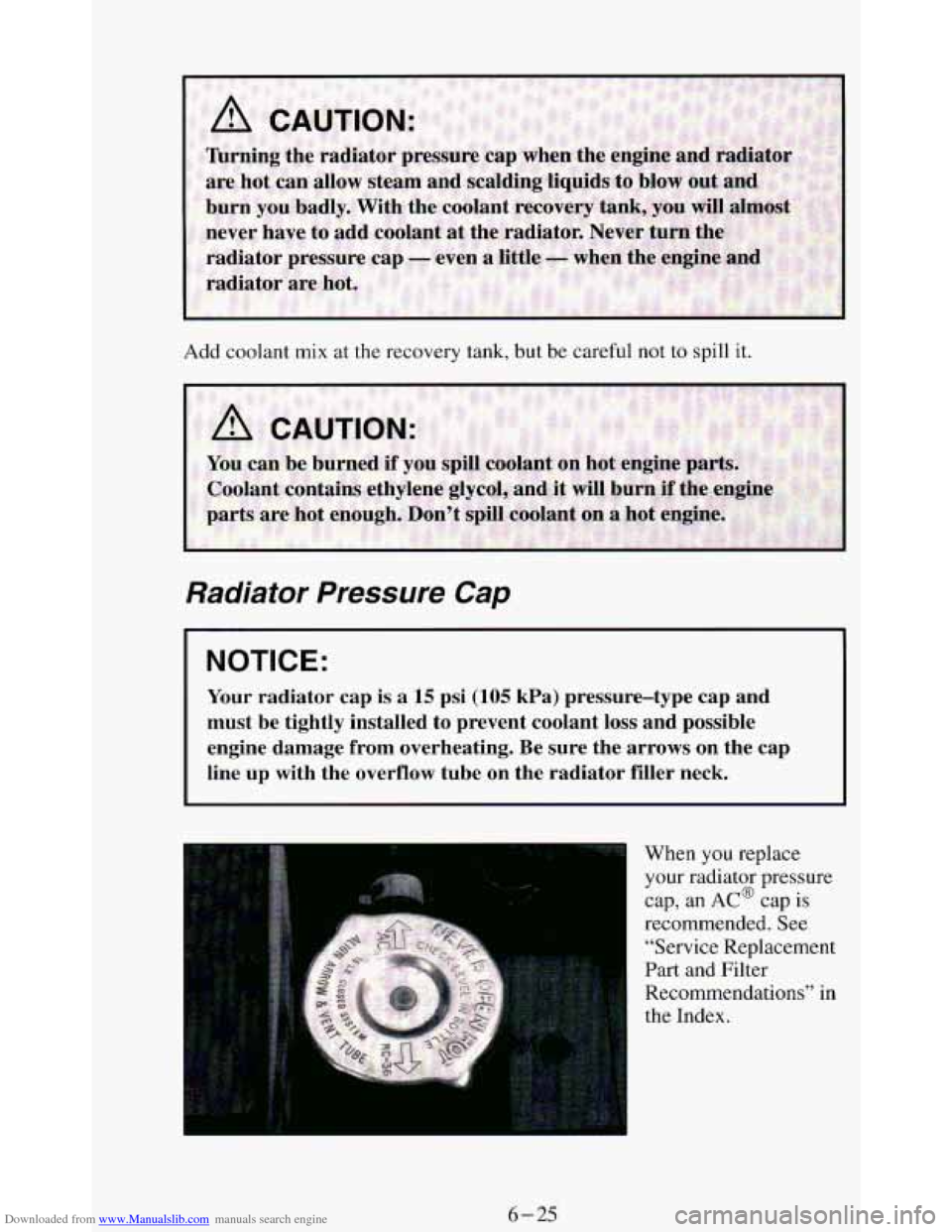
Be sure the arrows on the cap
line
up with the overflow tube on the radiator filler neck.
When you replace
your radiator pressure
cap, an
AP cap is
recommended. See
“Service Replacement
Part and Filter
Recommendations” in
the Index.
6-25
Page 297 of 348
Downloaded from www.Manualslib.com manuals search engine Headlights
The headlight wiring is protected by a circuit breaker in the light switch. An
electrical overload will cause the lights to go on and off. If this happens,
have your headlight wiring checked right away.
Windshield Wipers
The windshield wiper motor is protected by a circuit breaker and a fuse. If
the motor overheats due to heavy snow, etc., the wiper will stop until the
motor cools. If the overload is caused by some electrical problem and not
snow, etc., be sure to get it fixed.
Power Windows and Other Power Options
Circuit breakers in the fuse panel protect the power windows and other
power accessories. When the current load is too heavy, the circuit breaker
opens and closes, protecting the circuit until the problem
is fixed.
Trailer Wiring Harness
The optional seven-wire trailer wiring harness is protected by an in-line
fuse in the battery feed wire. This fuse is near the junction block. See
“Trailer Wiring Harness” in the
Features & Controls section.
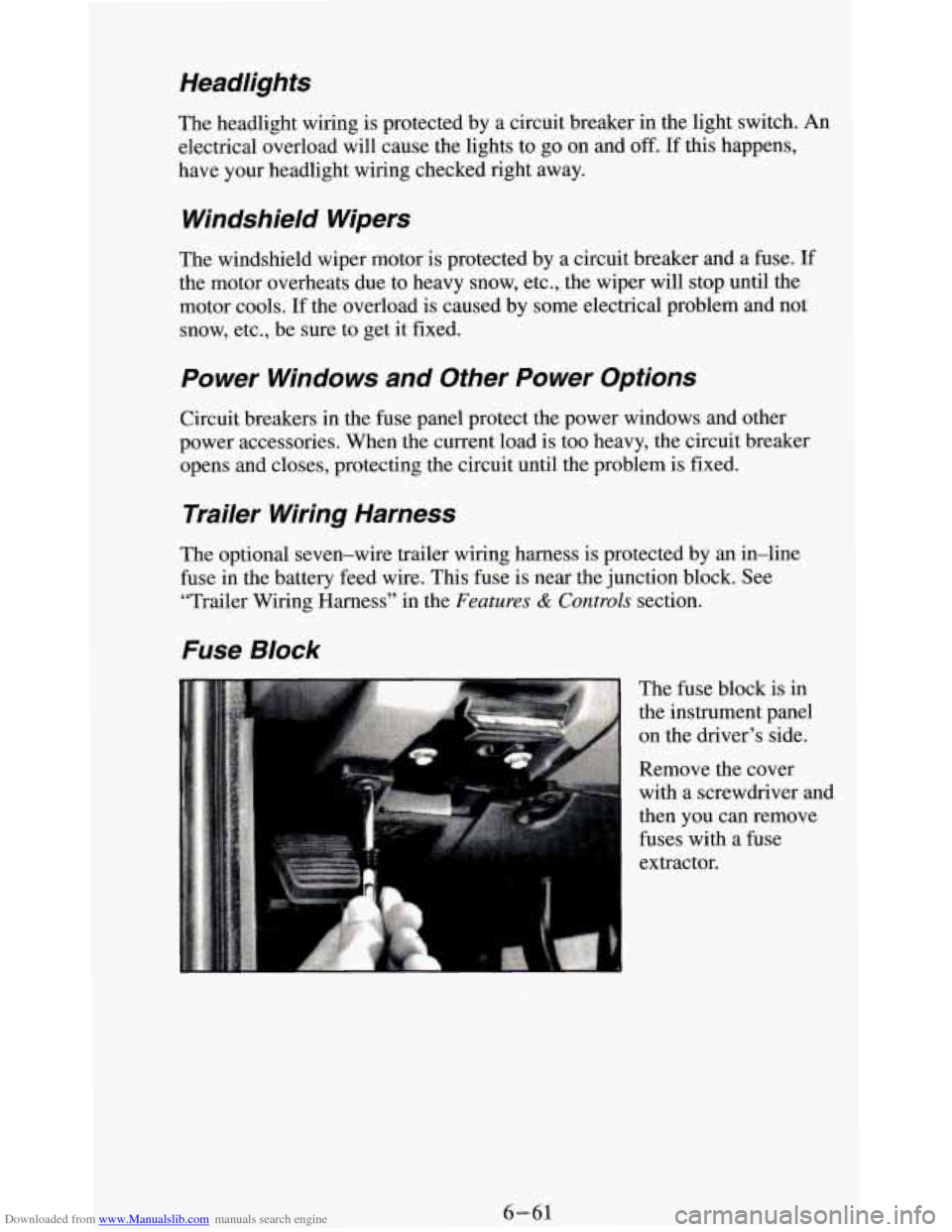
Fuse Block
The fuse block is in
the instrument panel
on the driver’s side.
Remove the cover
with a screwdriver and
then you
can remove
fuses with a fuse
extractor.
6-61
Page 339 of 348
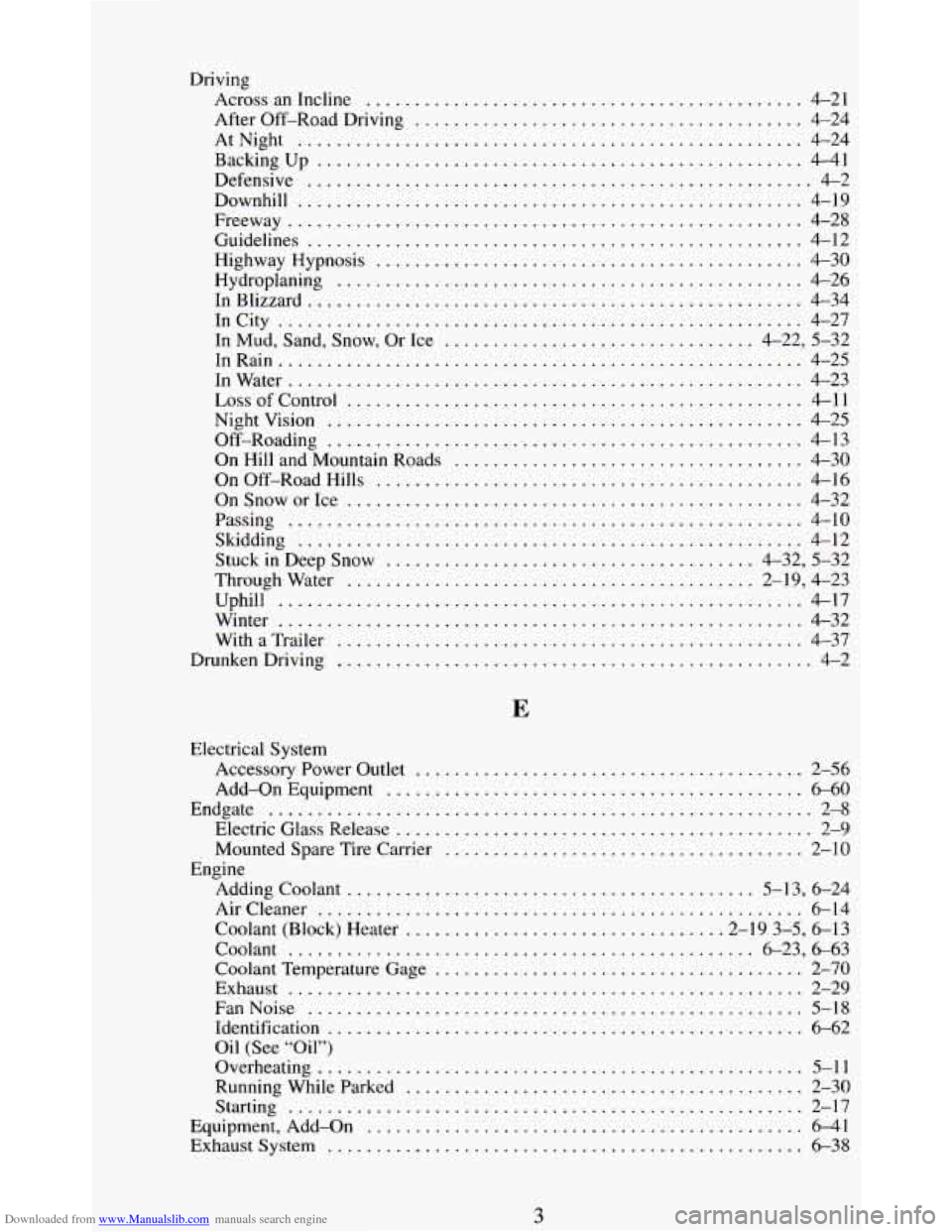
Downloaded from www.Manualslib.com manuals search engine Driving Across an Incline
............................................. 4-21
After Off-Road Driving
........................................ 4-24
AtNight
.................................................... 4-24
BackingUp
.................................................. 4-41
Defensive
.................................................... 4-2
Downhill
.................................................... 4-19
Freeway
..................................................... 4-28
Guidelines
................................................... 4-12
Highway Hypnosis
............................................ 4-30
Hydroplaning
................................................ 4-26
InBlizzard
................................................... 4-34
InCity
...................................................... 4-27
In Mud. Sand. Snow. Or Ice
................................ 4-22. 5-32
InRain
...................................................... 4-25
InWater
..................................................... 4-23
LossofControl
............................................... 4-11
Nightvision
................................................. 4-25
Off-Roading
................................................. 4-13
On Hill and Mountain Roads
.................................... 4-30
On Off-Road Hills
............................................ 4-16
OnSnoworIce
............................................... 4-32
Passing
..................................................... 4-10
Skidding
.................................................... 4-12
Stuck
in Deep Snow ...................................... 4-32. 5-32
Throughwater
.......................................... 2-19. 4-23
Uphill
...................................................... 4-17
Winter
...................................................... 4-32
With
a Trailer ................................................ 4-37
DrunkenDriving
................................................. 4-2
Electrical System Accessory Power Outlet
........................................ 2-56
Add-on Equipment
........................................... 6-60
Endgate ........................................................ 2-8
Electric Glass Release ........................................... 2-9
Mounted Spare Tire Carrier
..................................... 2-10
Adding Coolant
.......................................... 5-1 3. 6-24
Aircleaner
.................................................. 6-14
Coolant (Block) Heater
................................. 2-19 3.5, 6-13
Coolant
................................................ 6-23. 6-63
Coolant Temperature Gage
...................................... 2-70
Exhaust ..................................................... 2-29
FanNoise
................................................... 5-18
Identification
................................................. 6-62
Oil (See “Oil”)
Overheating
.................................................. 5-11
RunningWhileParked
......................................... 2-30
Starting
..................................................... 2-17
Equipment, Add-on ............................................. 6-41
Exhaustsystem ................................................. 6-38
Engine
3