key CHEVROLET BLAZER 1994 2.G Owner's Manual
[x] Cancel search | Manufacturer: CHEVROLET, Model Year: 1994, Model line: BLAZER, Model: CHEVROLET BLAZER 1994 2.GPages: 348, PDF Size: 17.88 MB
Page 156 of 348
Downloaded from www.Manualslib.com manuals search engine SCAN
Press SCAN to sample each track for approximately 10 seconds. Scanning
will continue until the
RDM, SCAN or any other motion button is pressed
again.
PREV
If you hold the PREV (4 .SEEK ) button, or press it more than once, the
disc will return
to previous tracks.
NEXT
Press NEXT (SEEK ) to hear the next track now instead of waiting until
the present track is finished. If you hold this button or press it more than
once, the disc will advance further.
ST-PL
Press ST-PL (Stop-Play) to make the disc stop and the radio play. Press
ST-PL again to restart the disc at the point where it stopped.
Press
PWR or turn the ignition key off to stop the disc player. The disc
stays
in the player and will resume playing at the point where it stopped.
Press
EJCT to eject the disc and make the radio play. The disc will start at
track
1 when you reinsert it.
Anti-Theft Feature
Delco LOC II@ is an Anti-Theft feature for the compact disc player. It can
be used or ignored. If ignored, the system plays normally. If
it is used, your
player won’t be usable
if it is ever stolen, because it won’t turn on.
The instructions below tell you how to enter a secret code into the system. If
your car loses battery power for any reason,
you must unlock the system
with the secret code before the radio will turn
on.
To Lock The System:
1.
2.
3.
4.
5.
6.
7.
Write down any 6 digit number and keep it in a safe place.
Turn the ignition
to the ACC (Accessory) or RUN position.
Press
the PWR button to turn the radio off.
Press the
1 and 4 buttons together. Hold them down until “- - -” shows
on the display.
You are now ready
to enter your secret code. Don’t wait more than
15 seconds between steps.
Press SET and 000 will appear on the display.
Press the
SEEK or 4 button to make the first number appear.
Press
SCAN to make the last two numbers agree with your code.
3-22
Page 161 of 348
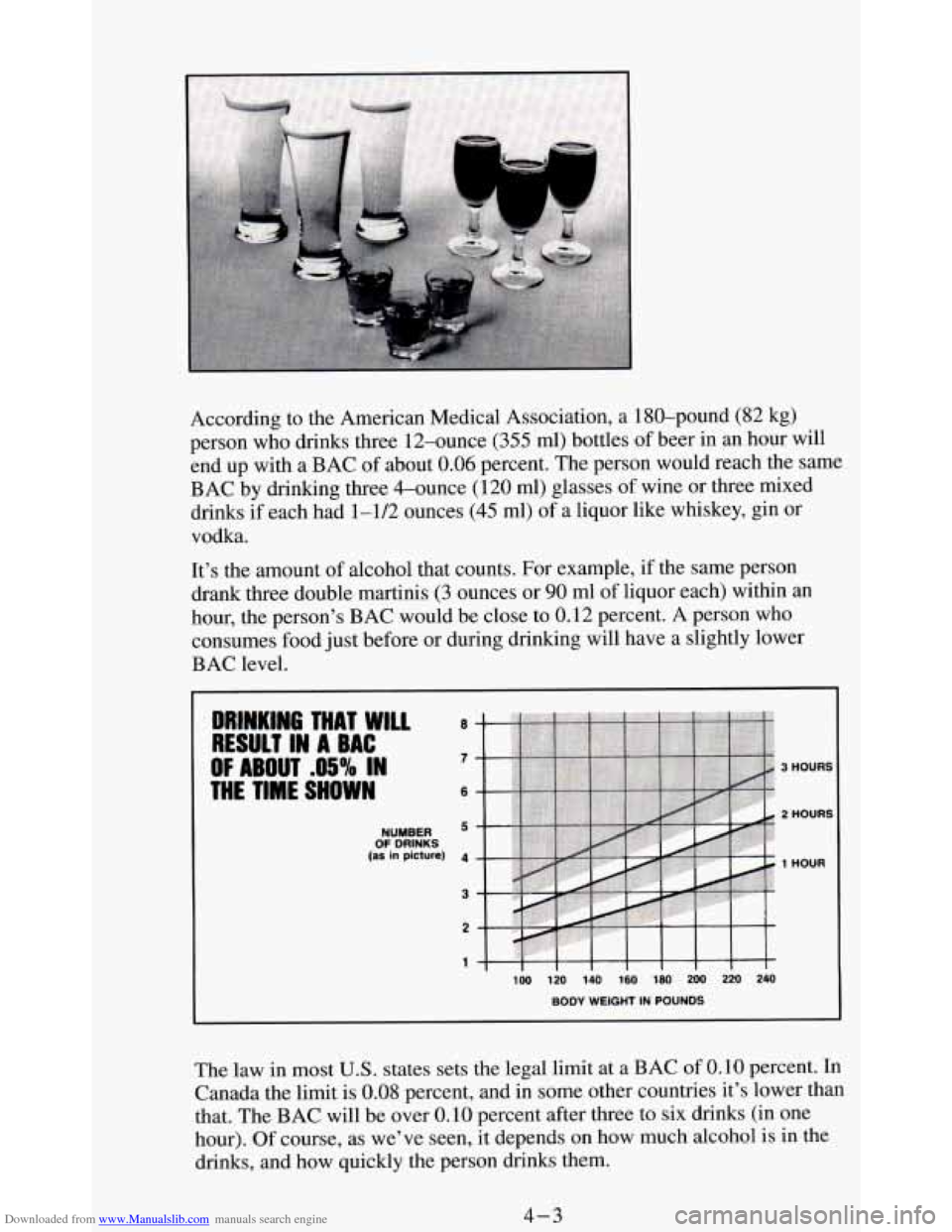
Downloaded from www.Manualslib.com manuals search engine According to the American Medical Association, a 180-pound (82 kg)
person who drinks three 12-ounce
(355 ml) bottles of beer in an hour will
end up with a BAC
of about 0.06 percent. The person would reach the same
BAC by drinking three &ounce (120
ml) glasses of wine or three mixed
drinks if each had 1-1/2 ounces
(45 ml) of a liquor like whiskey, gin or
vodka.
It’s the amount of alcohol that counts. For example, if the same person
drank three double martinis
(3 ounces or 90 ml of liquor each) within an
hour, the person’s BAC would be close to 0.12 percent. A person who
consumes food
just before or during drinking will have a slightly lower
BAC level.
OF DRINKS NUMBER
(as in picture) 1 HOUR
The law in most U.S. states sets the legal limit at a BAC of 0.10 percent. In
Canada the limit is 0.08 percent, and in some other countries it’s lower than
that. The BAC will be over
0.10 percent after three to six drinks (in one
hour).
Of course, as we’ve seen, it depends on how much alcohol is in the
drinks, and how quickly the person drinks them.
4-3
Page 173 of 348
Downloaded from www.Manualslib.com manuals search engine Controlling your vehicle is the key to successful off-road driving. One of
the best ways to control your vehicle is
to control your speed. Here are some
things to keep
in mind. At higher speeds:
you approach things faster and you have less time to scan the terrain for
obstacles.
you have less time to react.
0 you have more vehicle bounce when you drive over obstacles.
0 you’ll need more distance for braking, especially since you’re on an
unpaved surface.
Scanning the Terrain
Off-road driving can take you over many different kinds of terrain. You
need to be familiar with
the terrain and its many different features. Here are
some things
to consider.
Surface Conditions. Off-roading can take you over hard-packed dirt,
gravel, rocks, grass, sand, mud, snow or ice. Each of these surfaces affects
the steering, acceleration, and braking of your vehicle in different ways.
Depending upon the kind of surface
you are on, you may experience
slipping, sliding, wheel spinning, delayed acceleration, poor traction, and
longer braking distances.
Surface Obstacles. Unseen or hidden obstacles can be hazardous. A rock,
log, hole, rut, or bump can startle you
if you’re not prepared for them. Often
these obstacles are hidden by grass, bushes, snow or even the rise and fall
of
the terrain itself. Here are some things to consider:
Is the path ahead clear?
0 Will the surface texture change abruptly up ahead?
0 Does the travel take you uphill or downhill? (There’s more discussion
of these subjects later.)
0 Will you have to stop suddenly or change direction quickly?
When you drive over obstacles or rough terrain, keep a firm grip on the
steering wheel. Ruts, troughs, or
other surface features can jerk the wheel
out of your hands
if you’re not prepared.
4-15
Page 194 of 348
Downloaded from www.Manualslib.com manuals search engine Before towing, you should:
1. Set the parking brake firmly.
2. Place the automatic transmission in "P" (Park) or the manual
3. Firmly attach the vehicle being towed to the tow vehicle. Refer to the
transmission
in the lowest gear (1st gear).
hitch manufacturer's instructions.
4. Place the transfer case shift lever in "N" (Neutral).
NOTICE:
Removal of either propeller shaft is unnecessary.
1. Release the parking brake only after the vehicle being towed is firmly
attached to the tow vehicle.
2. Insert the ignition key into the ignition switch and turn it one notch
forward
of the LOCK position. This places the key into the OFF
position, which unlocks the steering column while preventing battery
drain. Unlocking the steering
column will allow for proper movement
of the front wheeldtires during towing.
NOTICE:
You should exercise extra care whenever towing another vehicle.
4-36
Page 204 of 348
Downloaded from www.Manualslib.com manuals search engine Hazard Warning Flashers
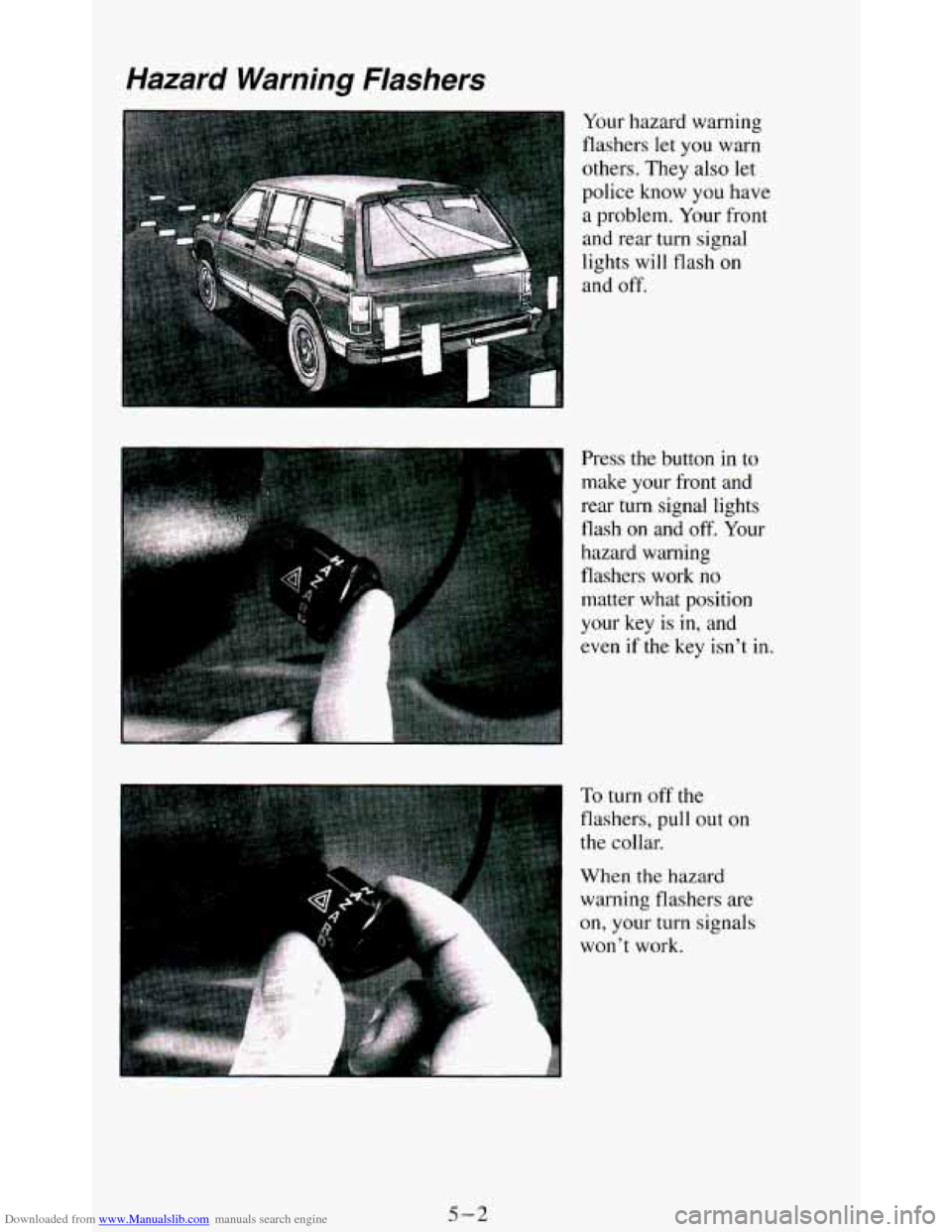
Your hazard warning
flashers let
you warn
others. They also let
~ police know you have
1 a problem. Your front
and rear turn signal
lights will flash
on
and off.
Press the button in to
make your front and
rear turn signal lights
flash on and
off. Your
hazard warning
flashers work no matter what position
your key is
in, and
even
if the key isn’t in.
To turn off the
flashers,
pull out on
the collar.
When the hazard
warning flashers are
on, your turn signals
won’t work.
5-2
Page 210 of 348
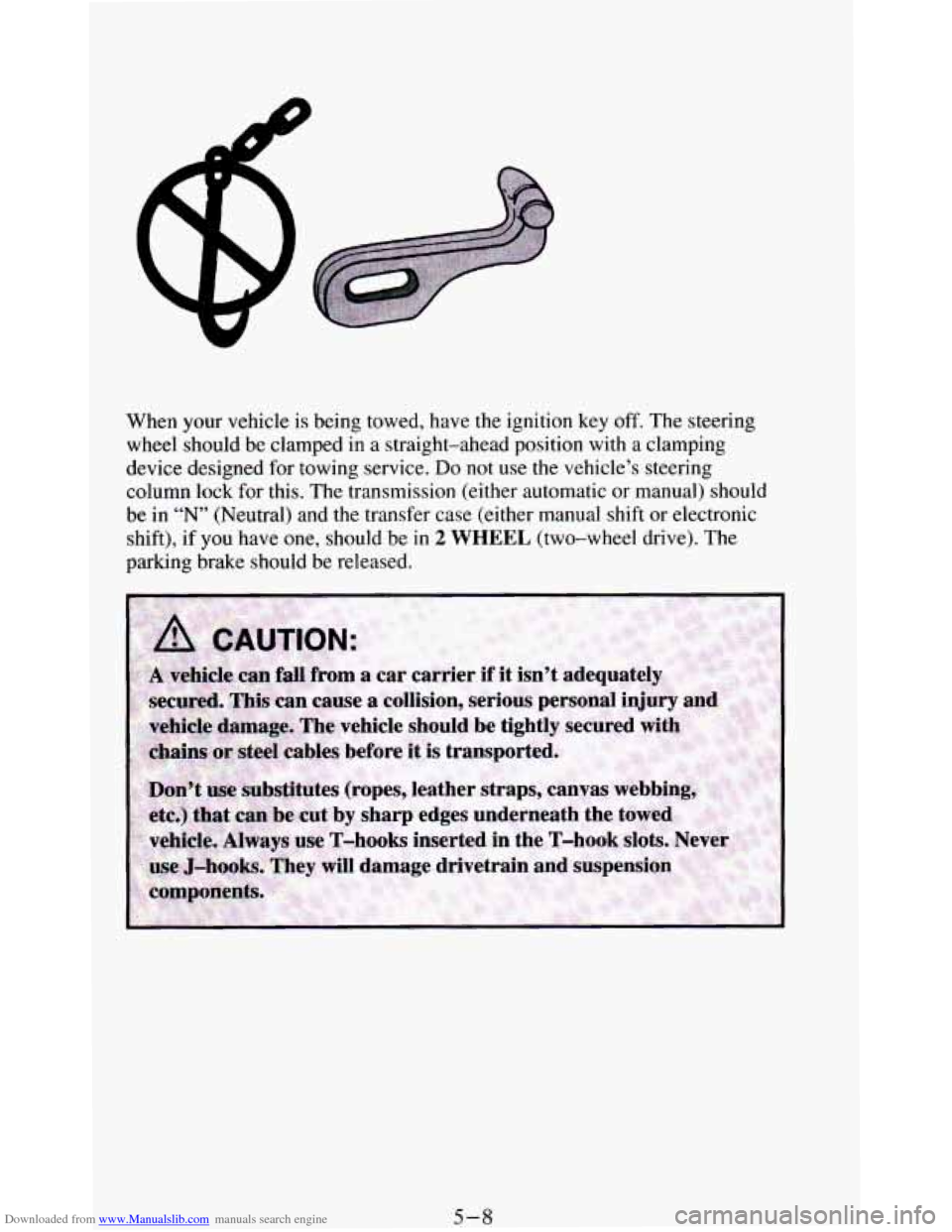
Downloaded from www.Manualslib.com manuals search engine When your vehicle is being towed, have the ignition key off. The steering
wheel should
be clamped in a straight-ahead position with a clamping
device designed for towing service.
Do not use the vehicle’s steering
column lock for this. The transmission (either automatic
or manual) should
be in
“N’ (Neutral) and the transfer case (either manual shift or electronic
shift), if
you have one, should be in 2 WHEEL (two-wheel drive). The
parking brake should be released.
5-8
Page 316 of 348
Downloaded from www.Manualslib.com manuals search engine Owner Checks and Services
Listed below are owner checks and services which would be made at the
time period specified to help ensure proper safety, emission performance,
and dependability of your vehicle.
Be sure any necessary repairs are completed at once. Whenever any fluids
or lubricants are added
to your vehicle, make sure they are the proper ones,
as shown in this section.
At Least Once a Month
Tire Inflation Pressure Check - Check the tires for proper inflation. If
they are low, inflate them to the level specified on the Certification label.
See “Inflation-Tire Pressure” in the Index.
At Least Once a Year
Key Lock Cylinder Lubrication - Lubricate key lock cylinders with one
of the lubricants recommended
in this section.
Transmission Neutral or Clutch Start Switch Operation -
1. Before you start, be sure you have enough room around the vehicle.
2. Firmly apply both the manual parking brake, and the regular brake. See
“Brakes” and “Parking Brake” in the Index.
Do not use the accelerator
pedal.
3. Be ready to turn off the engine immediately if it starts.
4. On automatic transmission vehicles, try to start the engine in each gear.
The starter should work
only in “P” (Park) or “N” (Neutral).
On manual transmission vehicles, put the shift lever in “N’ (Neutral),
push the clutch down halfway, and try to start the engine. The starter
should work only when the clutch is pushed down
all the way to the
floor.
7-10
Page 317 of 348
Downloaded from www.Manualslib.com manuals search engine Steering Column Lock Operation - While parked, try to turn the key to
LOCK in each gear shift position.
0 With an automatic transmission, the key should turn to LOCK only
0 With manual shift, the key should turn to LOCK only when you’re in
On vehicles with a key release lever, try to turn the key to
LOCK without
pressing the lever.
The key should turn to LOCK only with the key lever
depressed.
On all vehicles, the key should come out
only in LOCK.
Parking Brake and Transmission
“P’ (Park) Mechanism Operation -
when the gear shift is in “P’ (Park).
“R” (Reverse).
Park on a fairly steep hill, with the vehicle facing downhill. :eping your
foot on the regular brake, set the manual parking brake.
0 To check the parking brake: With the engine running and the
transmission in
“N’ (Neutral), slowly remove foot pressure from the
regular brake pedal.
Do this until the vehicle is held by the parking
brake only.
To check the “P” (Park) mechanism’s holding ability: Apply the regular
brake and shift to
“P” (Park). Release the manual parking brake, then
slowly release the regular brake.
Lap and Shoulder Belts Condition and Operation - Inspect belt system,
including: webbing, buckles, latch plates, retractors, guide loops and
anchors. Have a belt assembly replaced if the webbing has been cut or
otherwise damaged.
Body Lubrication Service - Lubricate all body door hinges including the
endgate, endgate handle pivot points, and endgate mounted spare tire carrier
(if equipped), lubricate the body hood,
fuel door and rear compartment
hinges, latches and locks including interior glove box and console doors,
and any moving seat hardware. Lubricate the hood safety lever pivot and
prop rod pivot. More frequent lubrication may be required when exposed
to
a corrosive environment.
7-11
Page 320 of 348
Downloaded from www.Manualslib.com manuals search engine USAGE
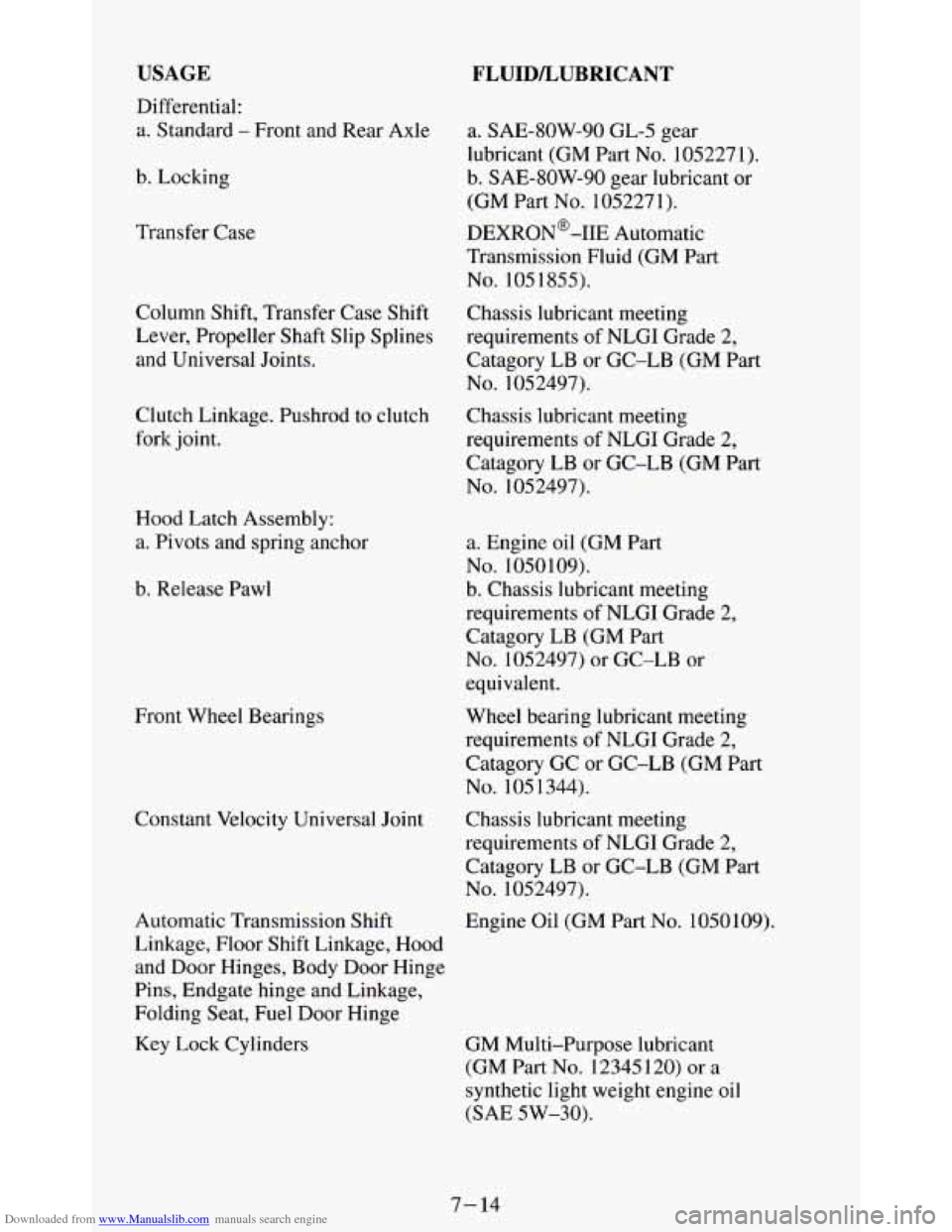
Differential:
a. Standard
- Front and Rear Axle
b. Locking
Transfer Case
Column Shift, Transfer Case Shift
Lever, Propeller Shaft Slip Splines
and Universal Joints.
Clutch Linkage. Pushrod to clutch
fork joint.
Hood Latch Assembly:
a. Pivots and spring anchor
b. Release Pawl
Front Wheel Bearings
Constant Velocity Universal Joint
Automatic Transmission Shift
Linkage, Floor Shift Linkage, Hood and Door Hinges, Body Door Hinge
Pins, Endgate hinge and Linkage,
Folding Seat, Fuel Door Hinge
Key Lock Cylinders
FLUIDLUBRICANT
a. SAE-SOW-90 GL-5 gear
lubricant (GM Part No. 1052271).
b. SAE-80W-90 gear lubricant or
(GM Part No. 1052271).
DEXRON@-IIE Automatic
Transmission Fluid (GM Part
No. 105 1855).
Chassis lubricant meeting
requirements of NLGI Grade 2,
Catagory LB or GC-LB
(GM Part
No. 1052497).
Chassis lubricant meeting
requirements of NLGI Grade 2,
Catagory LB or GC-LB (GM Part
No. 1052497).
a. Engine oil
(GM Part
No. 1050 109).
b. Chassis lubricant meeting
requirements of NLGI Grade
2,
Catagory LB (GM Part
No. 1052497)
or GC-LB or
equivalent.
Wheel bearing lubricant meeting
requirements of NLGI Grade 2,
Catagory GC or GC-LB (GM Part
No. 105 1344).
Chassis lubricant meeting
requirements of NLGI Grade 2,
Catagory
LB or GC-LB (GM Part
No. 1052497).
Engine Oil (GM Part
No. 1050109).
GM Multi-Purpose lubricant
(GM Part
No. 12345 120) or a
synthetic light weight engine oil
(S AE 5 W-30).
7-14
Page 341 of 348
Downloaded from www.Manualslib.com manuals search engine H
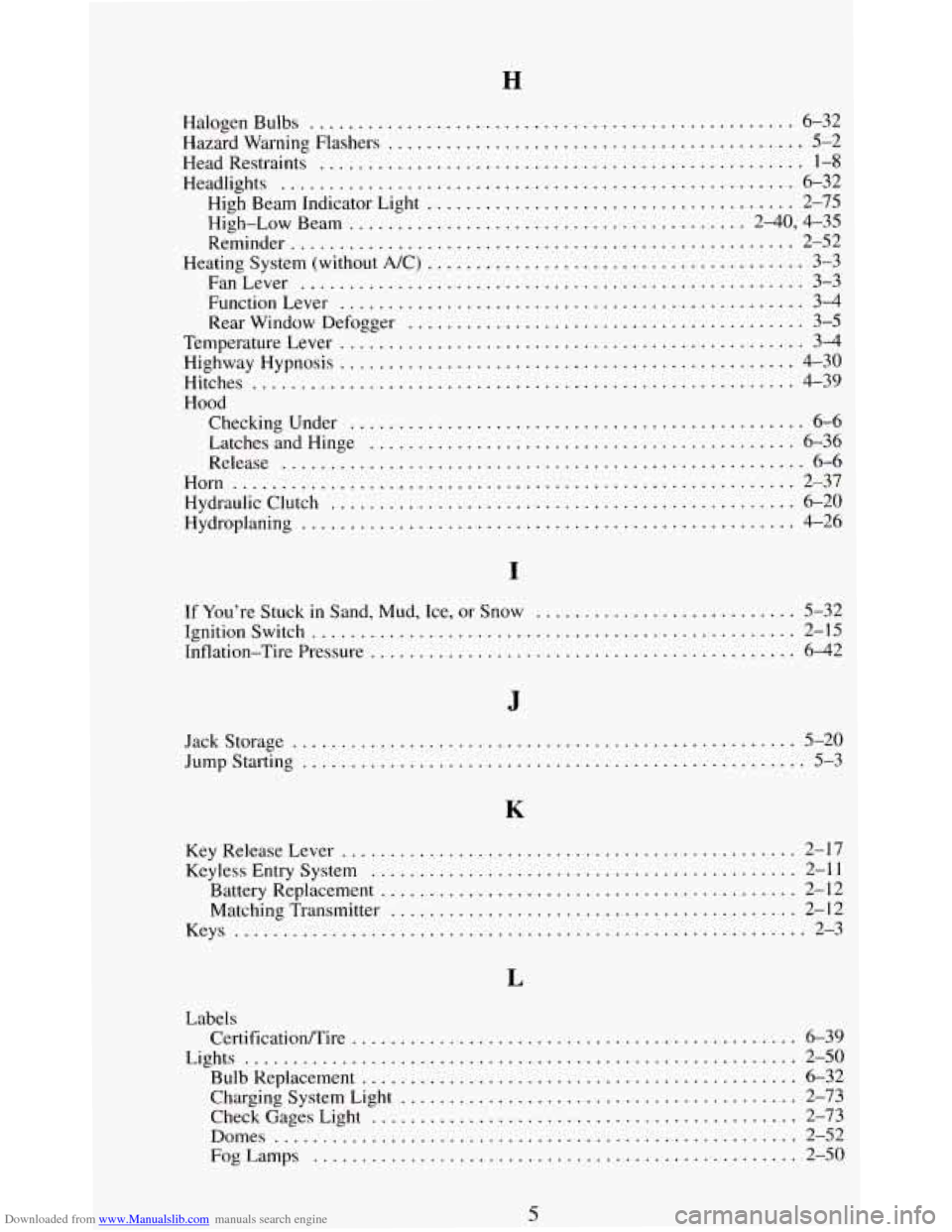
HalogenBulbs .................................................. 6-32
Headlights
..................................................... 6-32
Hazard Warning Flashers
........................................... 5-2
Head Restraints
.................................................. 1-8
High Beam indicator Light ...................................... 2-75
High-LowBeam
......................................... 2-40. 4-35
Reminder
.................................................... 2-52
Heating System (without
A/C) ....................................... 3-3
FanLever
.................................................... 3-3
FunctionLever
................................................ 3-4
Rear Window Defogger
......................................... 3-5
Temperature Lever ................................................ 3-4
Highway Hypnosis
............................................... 4-30
Hitches
.................................................... 4-39
Hood Checking Under
............................................... 6-6
LatchesandHinge
............................................ 6-36
Release
...................................................... 6-6
Horn
.......................................................... 2-37
Hydraulic Clutch
................................................ 6-20
Hydroplaning
................................................... 4-26
If You're Stuck in Sand. Mud. Ice. or Snow ........................... 5-32
Ignition Switch
.................................................. 2-15
Inflation-Tire Pressure
............................................ 6-42
Jackstorage
.................................................... 5-20
Jumpstarting
.................................................... 5-3
K
KeyReleaseLever ............................................... 2-17
Keyless Entry System
............................................ 2-11
Battery Replacement
........................................... 2-12
Matching Transmitter
.......................................... 2-12
Keys
........................................................... 2-3
Labels Certification/Tire
.............................................. 6-39
Bulb Keplacetnent
............................................. 6-32
Charging System Light
......................................... 2-73
Check Gages Light
............................................ 2-73
Domes
...................................................... 2-52
FogLamps
.................................................. 2-50
Lights
......................................................... 2-50
5