wheel CHEVROLET BLAZER 1994 2.G Manual PDF
[x] Cancel search | Manufacturer: CHEVROLET, Model Year: 1994, Model line: BLAZER, Model: CHEVROLET BLAZER 1994 2.GPages: 348, PDF Size: 17.88 MB
Page 257 of 348
Downloaded from www.Manualslib.com manuals search engine How to Check Lubricant
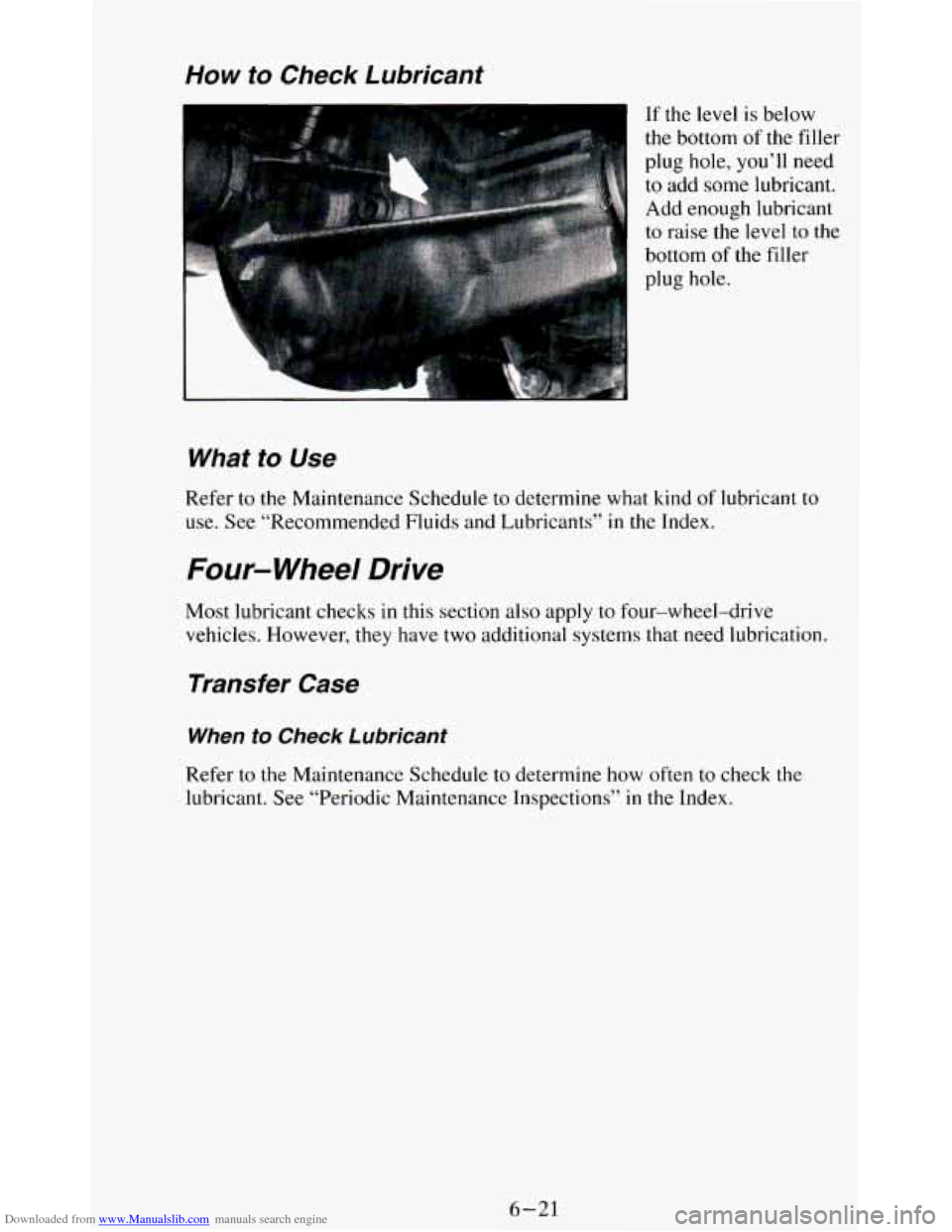
If the level is below
the bottom of the filler
plug hole,
you’ll need
to add some lubricant.
Add enough lubricant
to raise the level to the
bottom
of the filler
plug hole.
What to Use
Refer to the Maintenance Schedule to determine what kind of lubricant to
use. See “Recommended Fluids and Lubricants”
in the Index.
Four-Wheel Drive
Most lubricant checks in this section also apply to four-wheel-drive
vehicles. However, they have two additional systems that need lubrication.
TrariSfer Case
When to Check Lubricant
Refer to the Maintenance Schedule to determine how often to check the
lubricant. See “Periodic Maintenance Inspections”
in the Index.
6-21
Page 271 of 348
Downloaded from www.Manualslib.com manuals search engine Other Maintenance Items
Front Suspension and Steering Linkage
Refer to the Maintenance Schedule to determine how often to lubricate the
fittings and what type of lubricant to use.
Front Wheel Bearing (Two- Wheel Drive)
If your vehicle is two-wheel drive, it has wheel bearings that must be
cleaned and repacked.
Refer to the Maintenance Schedule to determine how often this must be
done.
Single Belt Accessory Drive
Your new vehicle uses a serpentine belt that is lighter, and more durable
than systems with several belts.
The belt runs over or around the pulleys on the engine. A tensioner is used
to keep the belt tight at all times. 'The tensioner also makes replacing the
belt easier. If you need to replace the belt, be sure to get the correct
replacement belt. Your dealership or parts supplier can help you with this.
The Accessory Drive Belt Routing label on your vehicle will show you how
to route the belt your vehicle uses.
6-35
Page 280 of 348
Downloaded from www.Manualslib.com manuals search engine Tire Inspection and Rotation
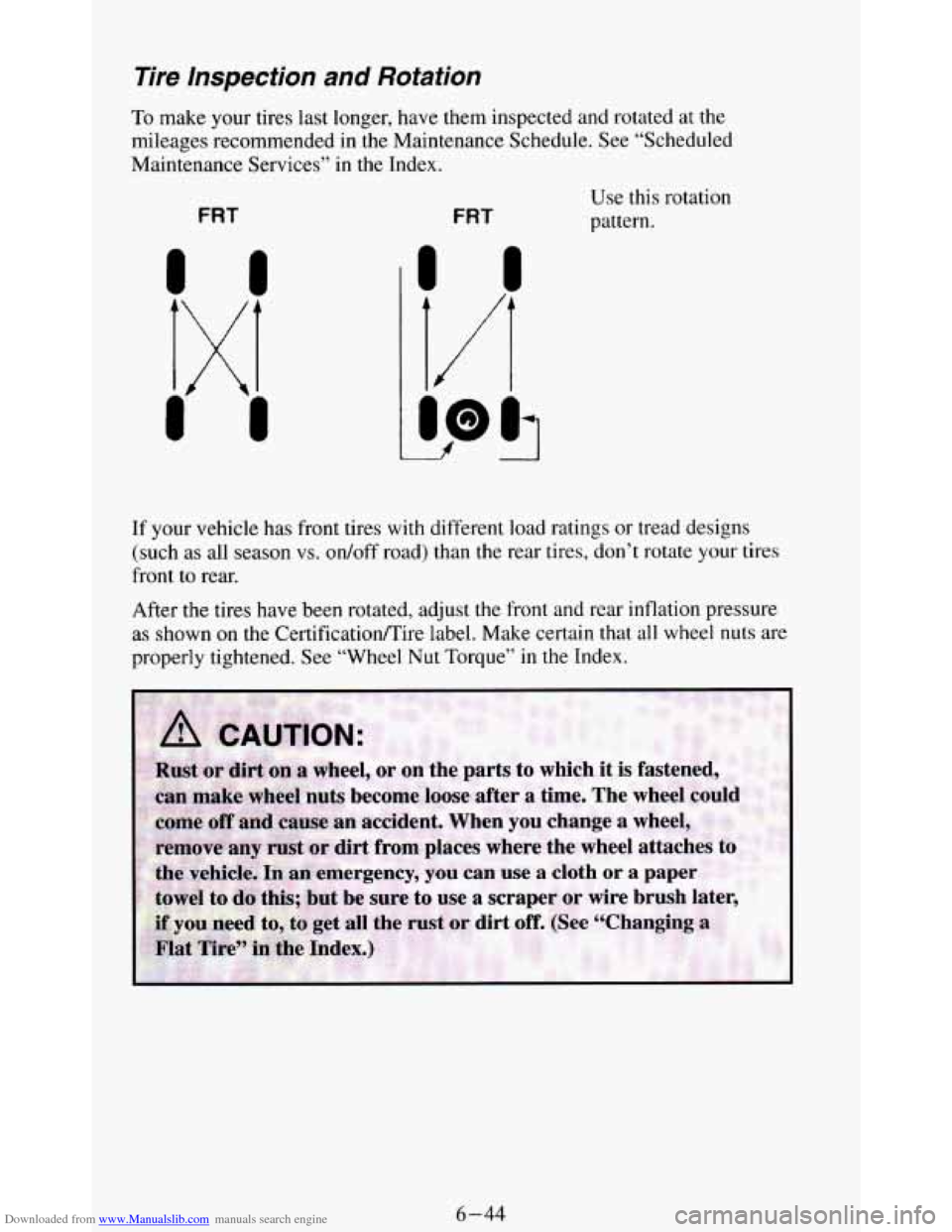
To make your tires last longer, have them inspected and rotated at the
mileages recommended in the Maintenance Schedule.
See “Scheduled
Maintenance Services’’ in the Index.
FRT FRT
Use this rotation
pattern.
U
If your vehicle has front tires with different load ratings or tread designs
(such as all season
vs. on/off road) than the rear tires, don’t rotate your tires
front to rear.
After the tires have been rotated, adjust
the front and rear inflation pressure
as shown on the CertificationEire label. Make certain that all wheel nuts are
properly tightened. See “Wheel
Nut Torque” in the Index.
6-44
Page 283 of 348
Downloaded from www.Manualslib.com manuals search engine Temperature - A, B, C
The temperature grades are A (the highest), B, and C, representing the tire’s
resistance to the generation
of heat and its ability to dissipate heat when tested
under controlled conditions on a specified indoor laboratory test wheel.
Sustained high temperature can cause
the material of the tire to degenerate
and reduce tire life, and excessive temperature can lead to sudden tire failure.
The grade
C corresponds to a level of performance which all passenger car
tires must meet under the Federal Motor Vehicle Safety Standard\
No. 109.
Grades B and A represent higher levels of performance on the laboratory test
wheel
than the minimum required by law.
Warning: The temperature grade for this tire
is established for a tire that is
properly inflated and not overloaded. Excessive speed, underinflation, or
excessive loading, either separately or
in combination, can cause heat
buildup and possible tire failure.
These grades are molded on the sidewalls
of passenger car tires.
While the tires available as standard or optional equipment on General
Motors vehicles may vary
with respect to these grades, all such tires meet
General Motors performance standards and have been approved for use on
General Motors vehicles. All passenger type
(P Metric) tires must conform
to Federal safety requirements
in addition to these grades.
Wheel Alignment and Tire Balance
The wheels on your vehicle were aligned and balanced carefully at the
factory to give you the longest tire life and best overall performance.
In most cases, you
will not need to have your wheels aligned again.
However,
if you notice unusual tire wear or your vehicle pulling one way or
the other, the alignment may need to be reset. If you notice your vehicle
vibrating when driving on
a smooth road, your wheels may need to be
rebalanced.
Wheel Replacement
Replace any wheel that is bent, cracked or badly rusted. If wheel nuts keep
coming loose, the wheel, wheel bolts, and wheel nuts should be replaced. If
the wheel leaks air, replace
it (except some aluminum wheels, which can
sometimes
be repaired). See your GM dealer if any of these conditions exist.
Your dealer will know the kind of wheel you need.
Each new wheel should have the same load carrying capacity, diameter,
width, offset, and be mounted the same way as the one
it replaces.
6-47
Page 284 of 348
Downloaded from www.Manualslib.com manuals search engine If you need to replace any of your wheels, wheel bolts, or wheel nuts,
replace them only with parts. This way, you will be sure to have the right
wheel, wheel bolts, and wheel nuts for your
GM model.
NOTICE:
The wrong wheel can also cause problems with bearing life,
bumper height, vehicle ground clearance, and tire or tire chain\
clearance to the body and chassis. brake cooling, speedometer/odometer calibration, headlight aim,
Used Replacement Wheels
6-48
Page 285 of 348
Downloaded from www.Manualslib.com manuals search engine Tire Chains
NOTICE:
If your vehicle has P235/75R15 size tires, don’t use tire chains;
they can damage your vehicle.
If you have other size tires, use tire chains only where legal and
only when you must. Use only
SAE Class “S” type chains that
are the proper size for your tires. Install them on the drive axle
tires (four-wheel-drive vehicles can use chains on both axles)
and tighten them
as tightly as possible with the ends securely
fastened. Drive slowly and follow the chain manufacturer’s
instructions.
If you can hear the chains contacting your vehicle,
stop and retighten them.
If the contact continues, slow down
until it stops. Driving too fast with chains on will damage your
vehicle.
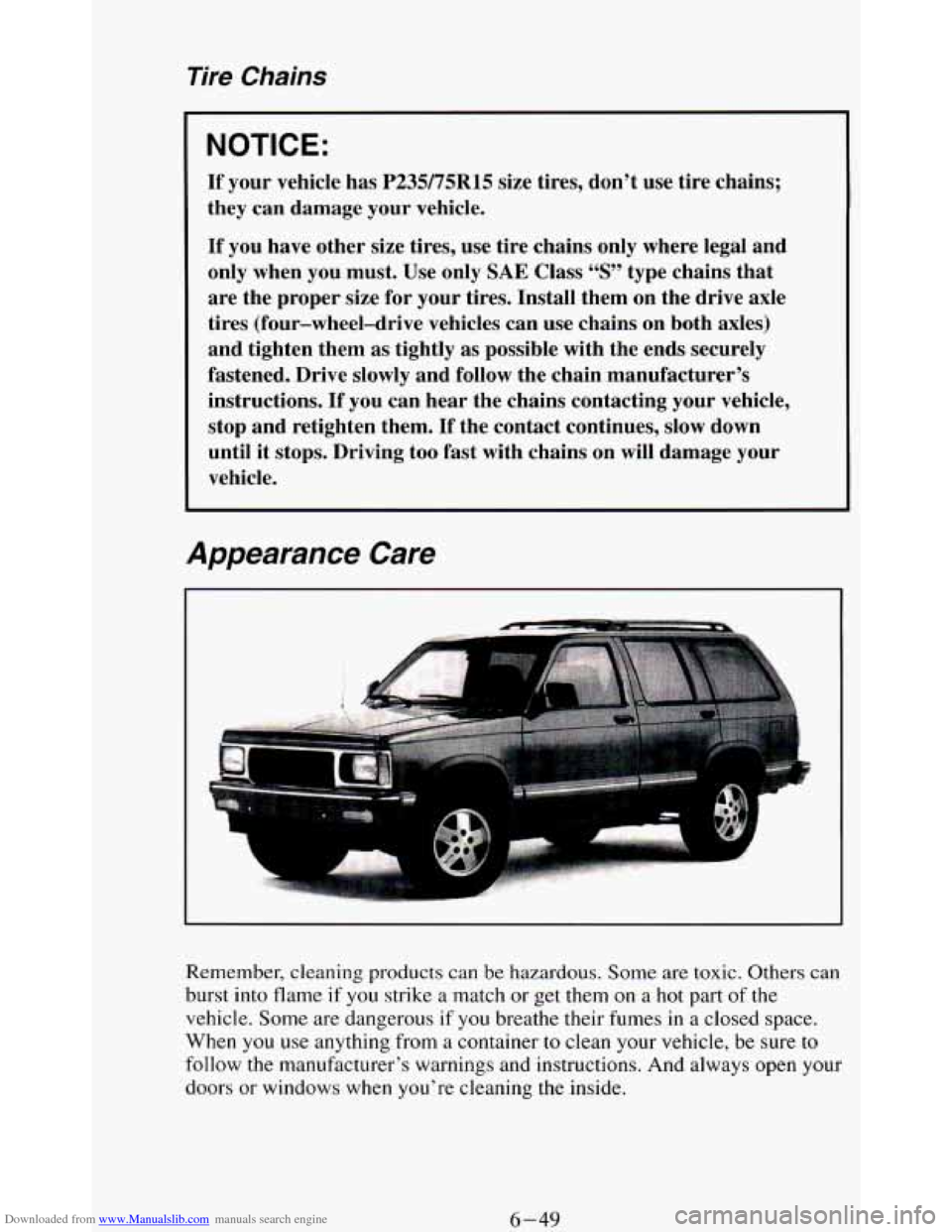
Appearance Care
1
t
Remember, cleaning products can be hazardous. Some are toxic. Others can
burst into flame if
you strike a match or get them on a hot part of the
vehicle. Some are dangerous if
you breathe their fumes in a closed space.
When you use anything from a container
to clean your vehicle, be sure to
follow the manufacturer’s warnings and instructions. And always open your
doors or windows when you’re cleaning the inside.
6-49
Page 291 of 348
Downloaded from www.Manualslib.com manuals search engine Use special care with aluminum trim. To avoid damaging protective trim,
never use auto or chrome polish, steam or caustic soap to clean aluminum.
A coating of wax, rubbed to high polish, is recommended for all bright
metal parts.
Aluminum Wheels
Aluminum wheels have a protective coating similar to the painted surface of
your vehicle. Don’t use strong soaps, chemicals, chrome polish, abrasive
cleaners or abrasive cleaning brushes on them because you could damage
this coating. After rinsing thoroughly, a wax may be applied.
I NOTICE:
If you have aluminum wheels, don’t use an automatic vehicle
wash that has hard silicon carbide cleaning brushes. These
brushes can take
off the protective coating.
White Side wa// Tires
Your GM dealer has a GM White Sidewall Tire Cleaner. You can use a stiff
brush with the cleaner.
Weatherstrips
Silicone grease on weatherstrips will make them last longer, seal better, and
not stick or squeak. Apply silicone grease with a clean cloth at least every
six months. During very cold, damp weather more frequent application may
be required. (See “Recommended Fluids
& Lubricants” in the Index.)
Sheet Metal Damage
If your vehicle is damaged and requires sheet metal repair or replacement,
make sure the body repair shop applies anti-corrosion material to the parts
repaired
or replaced to restore corrosion protection.
Foreign Material
Calcium chloride and other salts, ice melting agents, road oil and tar, tree
sap, bird droppings, chemicals from industrial chimneys, and other foreign
matter can damage your vehicle’s finish if they remain on painted surfaces.
Use cleaners that are marked safe for painted surfaces to remove foreign
matter.
4
6-55
Page 296 of 348
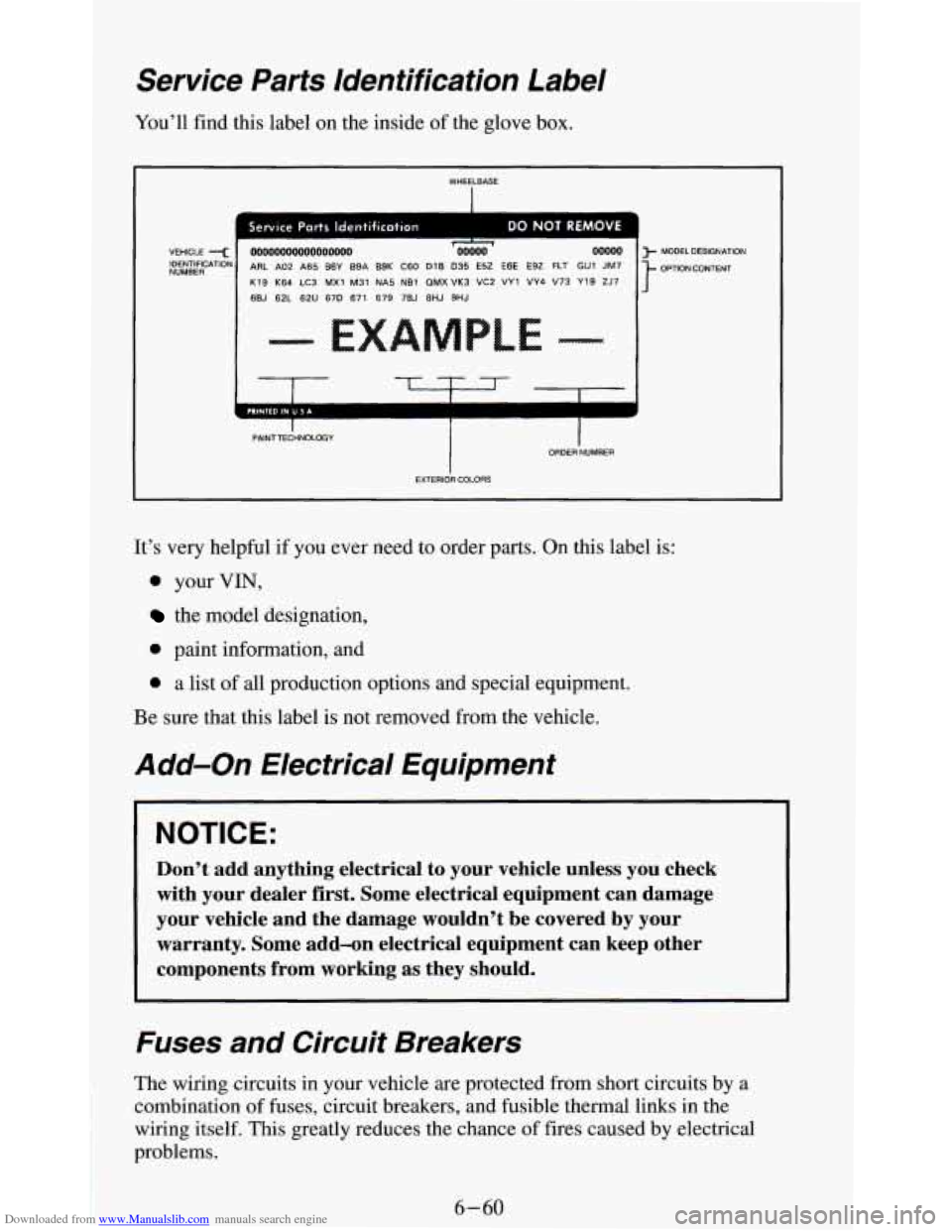
Downloaded from www.Manualslib.com manuals search engine Service Parts Identification Label
You’ll find this label on the inside of the glove box.
WHEELBASE
I
1 Service Parts Identification DO NOT REMOVE ? I VEHICLE < IDENTIFICATION
NUMBER
I I
1 PAINTTECHNOLOGY ORDER NUMBER
I i 0000000000000oO00 ’ OOOOO 00000 ARL AD2 A65 B6Y B9A B9K C60 D1B D36 E52 E6E E92 FLT GU1 JM7
K19 K64 LC3 MX1
M31 NA5 NB1 QMXVK3 VC2 VYI VY4 V73 Y19 ZJ7
6BJ 62L 62U 67D 671 679 7BJ 8HJ
9HJ
MODEL DESIGNATION
OPTlON CONTENT
EXTERIORCOLORS
It’s very helpful if you ever need to order parts. On this label is:
0 your VIN,
the model designation,
0 paint information, and
0 a list of all production options and special equipment.
Be sure that this label is
not removed from the vehicle.
Add-on Lxtrical Equipment
NOTICE:
-
Don’t add anything electrical to your vehicle unless you check
with your dealer first. ,Some electrical equipment can damage
your vehicle and the damage wouldn’t be covered by your warranty. Some add-on electrical equipment can keep other
components from working as they should.
Fuses and Circuit Breakers
The wiring circuits in your vehicle are protected from short circuits by a
combination of fuses, circuit breakers, and fusible thermal links in the
wiring itself. This greatly reduces the chance of fires caused by electrical
problems.
6-60
Page 299 of 348
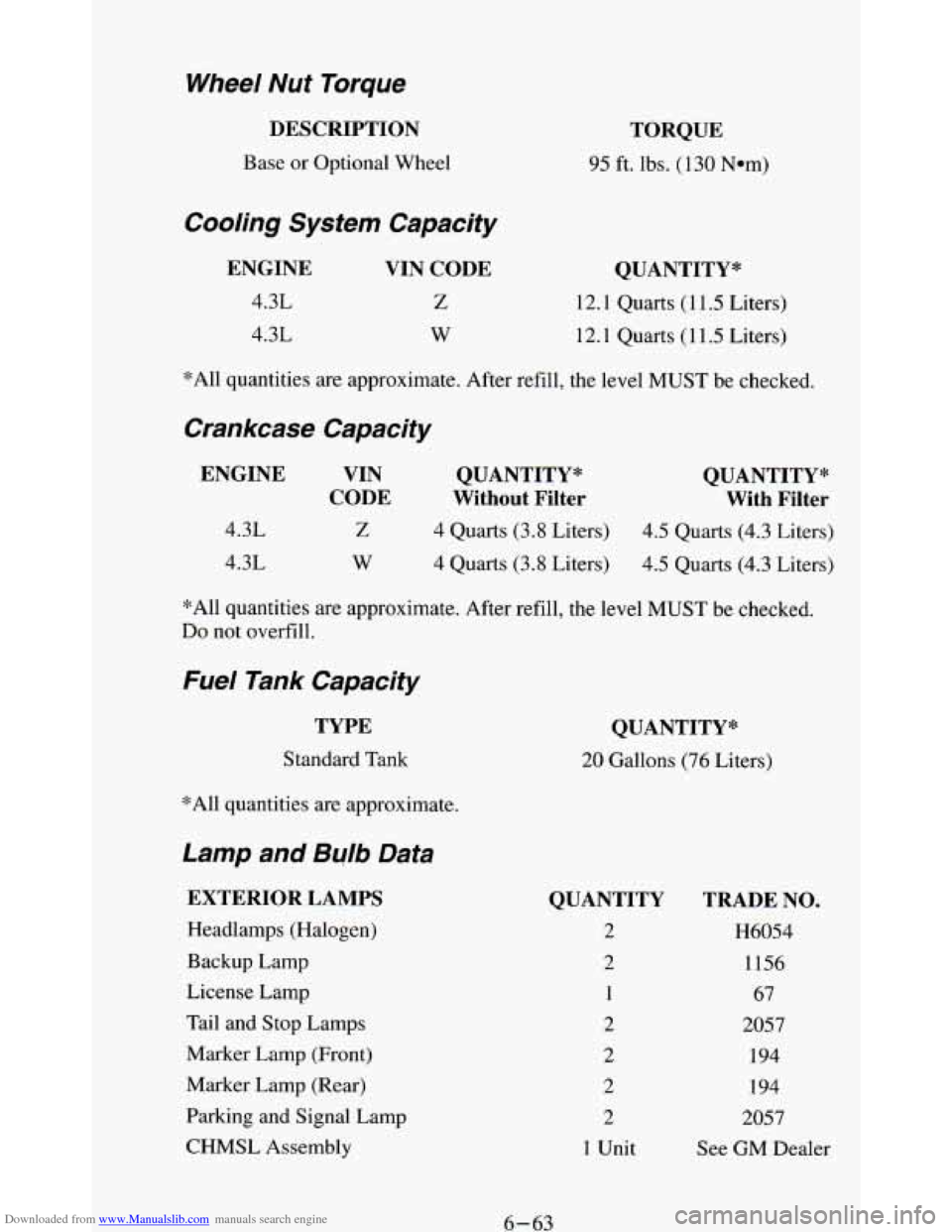
Downloaded from www.Manualslib.com manuals search engine Wheel Nut Torque
DESCRIPTION
Base or Optional Wheel
Cooling System Capacity
ENGINE
4.3L
4.3L
VIN CODE
Z
W
TORQUE
95 ft. lbs. (130 Nom)
QUANTITY*
12.1 Quarts (1 1.5 Liters)
12.1 Quarts (1 1.5 Liters)
*All quantities are approximate. After refill, the level MUST be checked.
Crankcase Capacity
ENGINE
4.3L
4.3L
VIN
CODE
Z
w
QUANTITY*
Without Filter QUANTITY*
With Filter
4 Quarts (3.8 Liters) 4.5 Quarts (4.3 Liters)
4 Quarts (3.8 Liters) 4.5 Quarts (4.3 Liters)
*All quantities are approximate. After refill, the level MUST be checked.
Do not overfill.
Fuel Tank Capacity
TYPE
Standard Tank
*All quantities are approximate.
Lamp and Bulb Data
EXTERIOR LAMPS
Headlamps (Halogen)
Backup Lamp
License Lamp
Tail and Stop Lamps
Marker Lamp (Front)
Marker Lamp (Rear)
Parking and Signal Lamp
CHMSL Assembly
QUANTITY*
20 Gallons (76 Liters)
QUANTITY
2
2
1
1 Unit
TRADE NO.
H6054
1156 67
2057
194
194
2057
See GM Dealer
6-63
Page 300 of 348
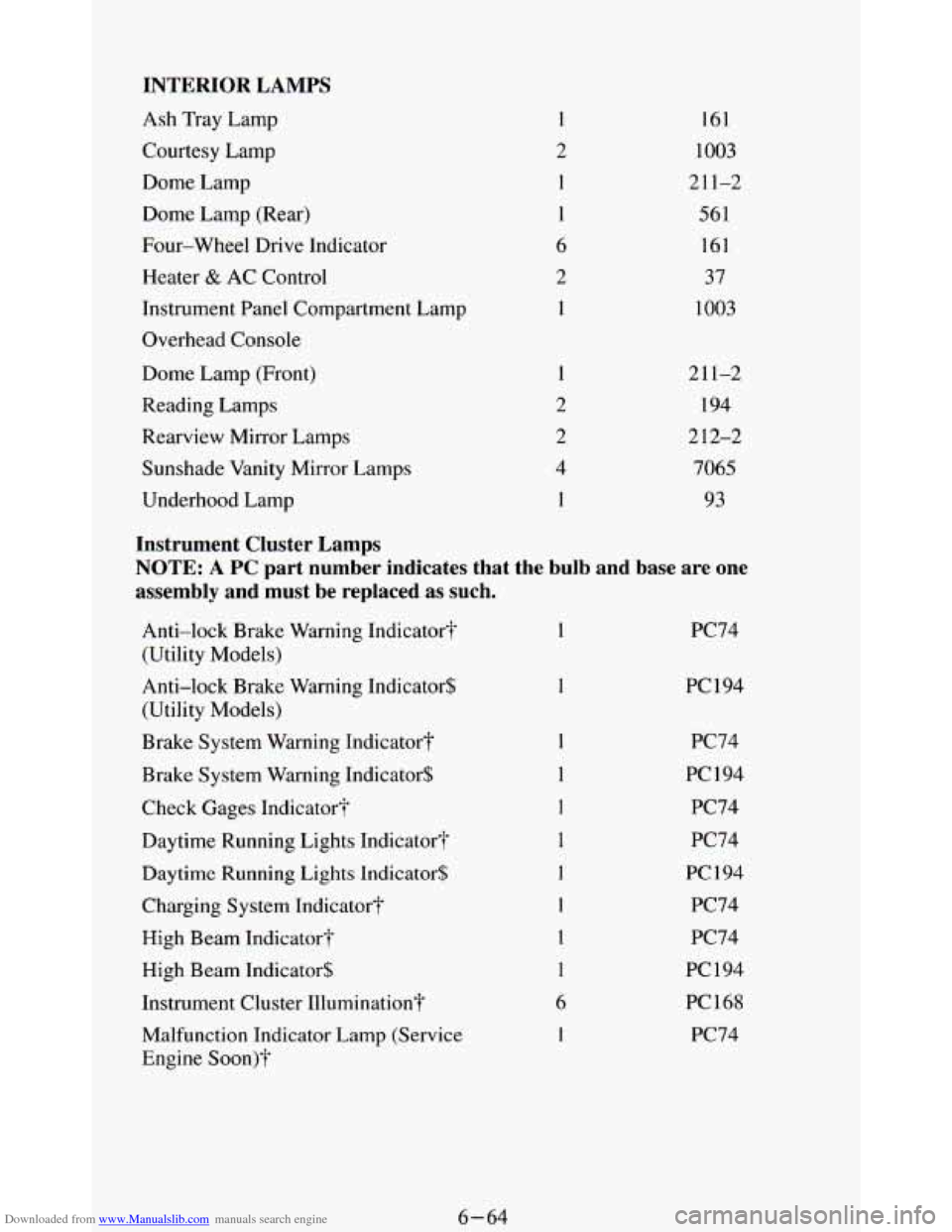
Downloaded from www.Manualslib.com manuals search engine INTERIOR LAMPS
Ash Tray Lamp
Courtesy Lamp
Dome Lamp Dome Lamp (Rear)
Four-wheel Drive Indicator
Heater
& AC Control
Instrument Panel Compartment Lamp
Overhead Console
Dome Lamp (Front)
Reading Lamps
Rearview Mirror Lamps
Sunshade Vanity Mirror Lamps
Underhood Lamp
161
1003
21 1-2
561
161
37
1003
211-2 194
2 12-2
7065 93
Instrument Cluster Lamps
NOTE:
A PC part number indicates that the bulb and base are one
assembly and must be replaced as
such.
Anti-lock Brake Warning Indicator?
(Utility Models)
Anti-lock Brake Warning Indicator$
(Utility Models)
Brake System Warning Indicator?
Brake System Warning Indicator$
Check Gages Indicator?
Daytime Running Lights Indicator’f
Daytime Running Lights Indicator$
Charging System Indicator?
High Beam Indicator?
High Beam Indicator$
Instrument Cluster Illumination?
Malfunction Indicator Lamp (Service
Engine Soon)?
1
1
1
1
1
I
1
1
1
6
1
PC74
PC 194
PC74
PC 194
PC74
PC74
PC 194
PC74
PC74
PC 194
PC168 PC74
6-64