wheel CHEVROLET BLAZER 1994 2.G Repair Manual
[x] Cancel search | Manufacturer: CHEVROLET, Model Year: 1994, Model line: BLAZER, Model: CHEVROLET BLAZER 1994 2.GPages: 348, PDF Size: 17.88 MB
Page 227 of 348
Downloaded from www.Manualslib.com manuals search engine Changing the Tire
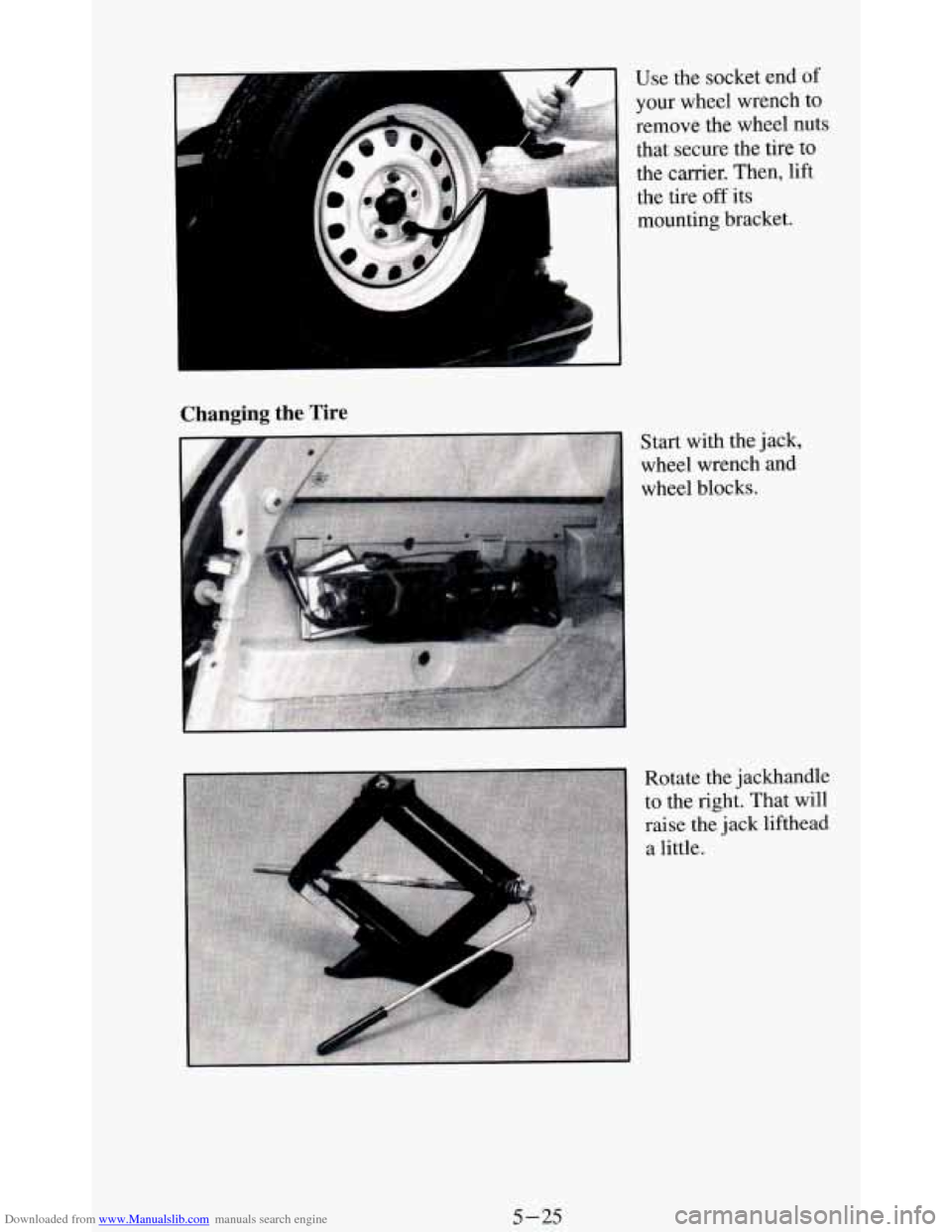
Use the socket end of
your wheel wrench to
remove the wheel nuts
that secure the
tire to
the carrier. Then, lift
the tire
off its
mounting bracket.
Start with the jack,
wheel wrench
and
wheel blocks.
Rotate the jackhandle to the right. That will
raise the jack lifthead
a little.
5-25
Page 228 of 348
Downloaded from www.Manualslib.com manuals search engine e
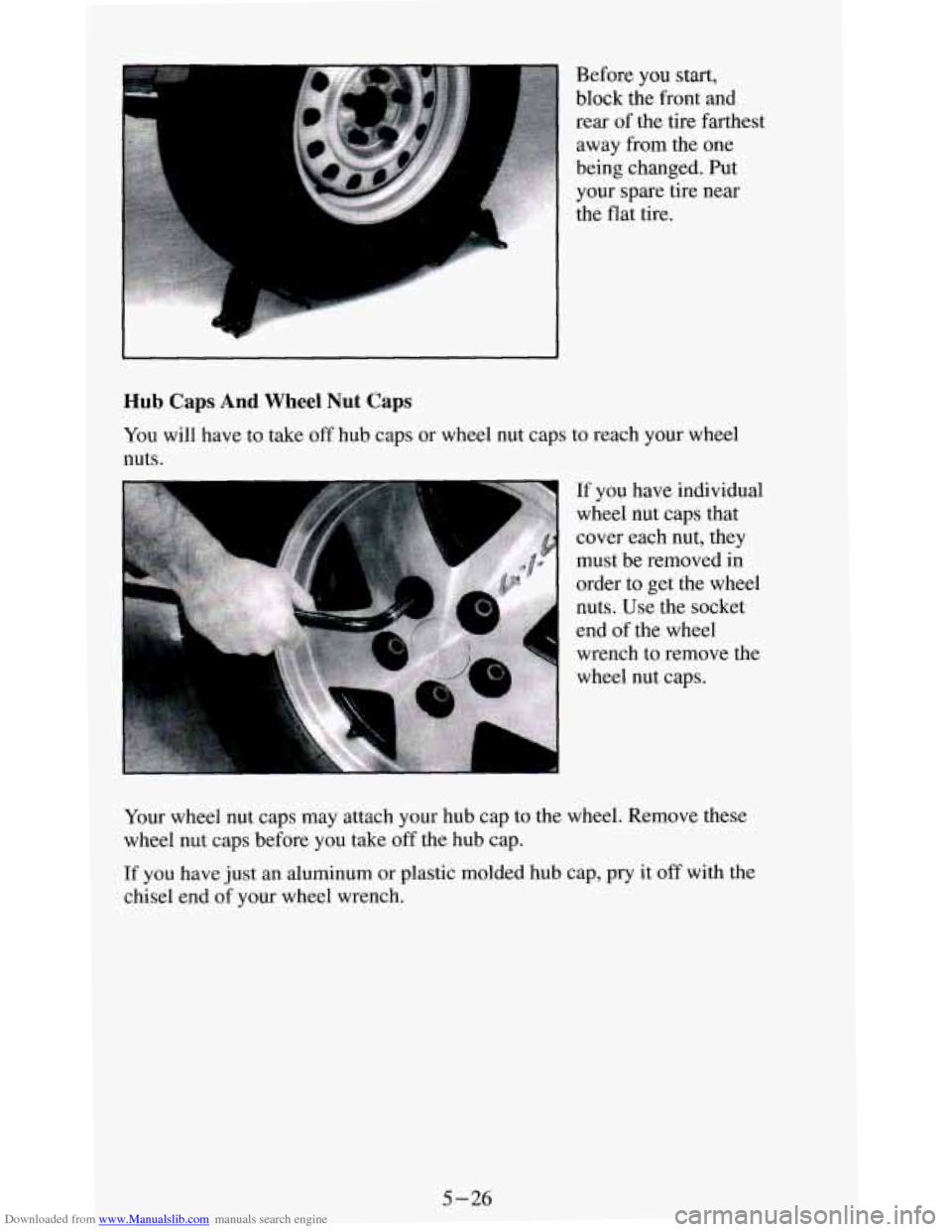
Before you start,
block the front and
rear of the tire farthest
away from the one
being changed. Put
your spare tire near
the flat tire.
Hub Caps And Wheel Nut Caps
You will have to take off hub caps or wheel nut caps to reach your wheel
nuts.
I --
If you have individual
wheel nut caps that
cover each nut, they
must be removed in
order to get the wheel
nuts. Use the socket
end
of the wheel
wrench to remove the
wheel nut caps.
Your wheel nut caps may attach your hub cap to the wheel. Remove these
wheel nut caps before you take
off the hub cap.
If you have just an aluminum or plastic molded hub cap, pry it off with the
chisel end of your wheel wrench.
5-26
Page 229 of 348
Downloaded from www.Manualslib.com manuals search engine k , ...
Some of the molded
plastic
hub caps have
imitation
wheel nuts
molded into them. The
wheel wrench won’t
fit these imitation
nuts,
so don’t try to
remove them
with the
socket end
of the
wheel wrench.
Using the wheel wrench, loosen all the wheel nuts. Don’t remove them
yet.
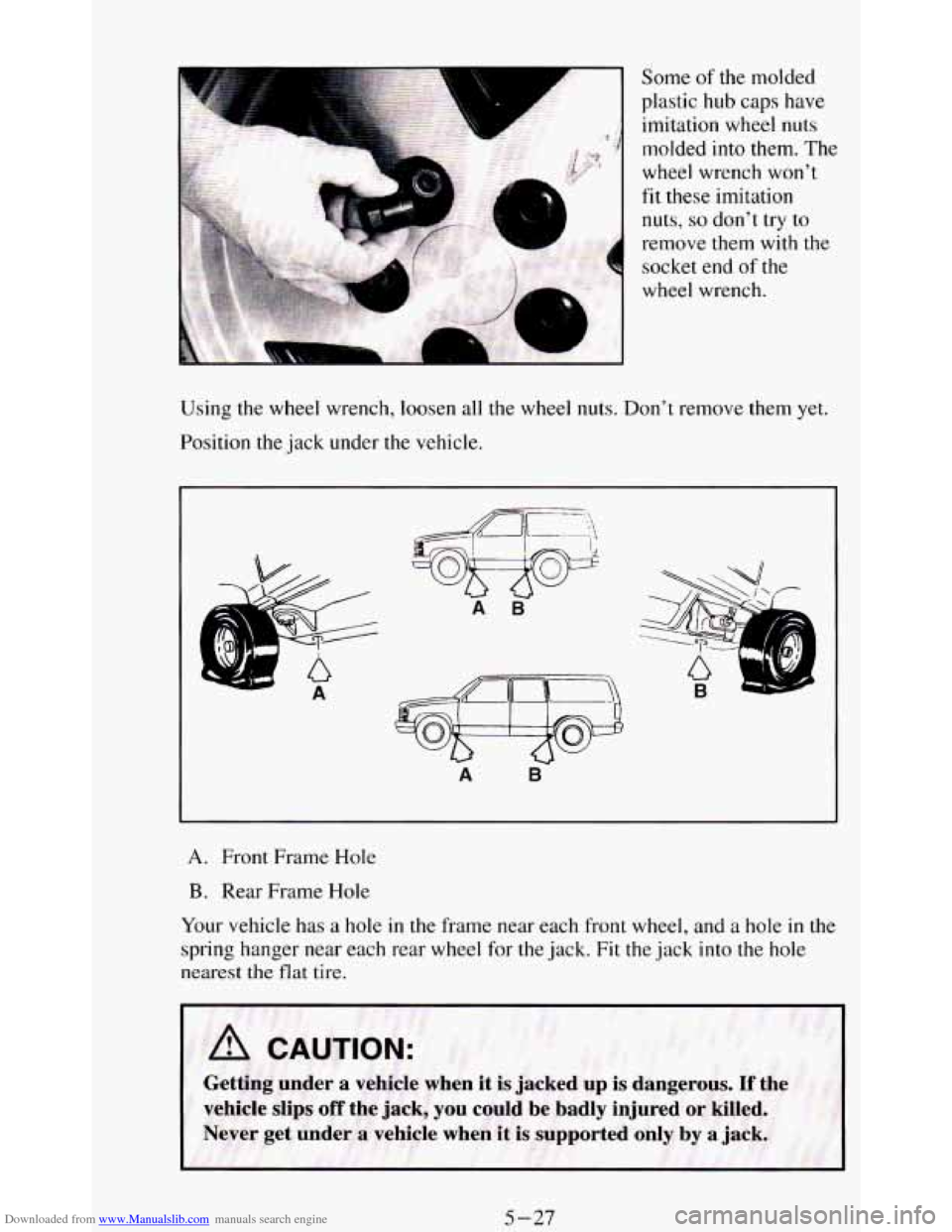
Position the jack under the vehicle.
ce,
A
A A
B-
A B
A. Front Frame Hole
B. Rear Frame
Hole
Your vehicle has
a hole in the frame near each front wheel, and a hole in the
spring hanger near each
rear wheel for the jack. Fit the jack into the hole
nearest
the flat tire.
5-27
Page 230 of 348
Downloaded from www.Manualslib.com manuals search engine NOTICE:
Raising your vehicle with the jack improperly positioned will
damage the vehicle or may allow the vehicle to fall off the jack.
Be sure to fit the jack lift head into the proper location before
raising
your vehicle.
h.
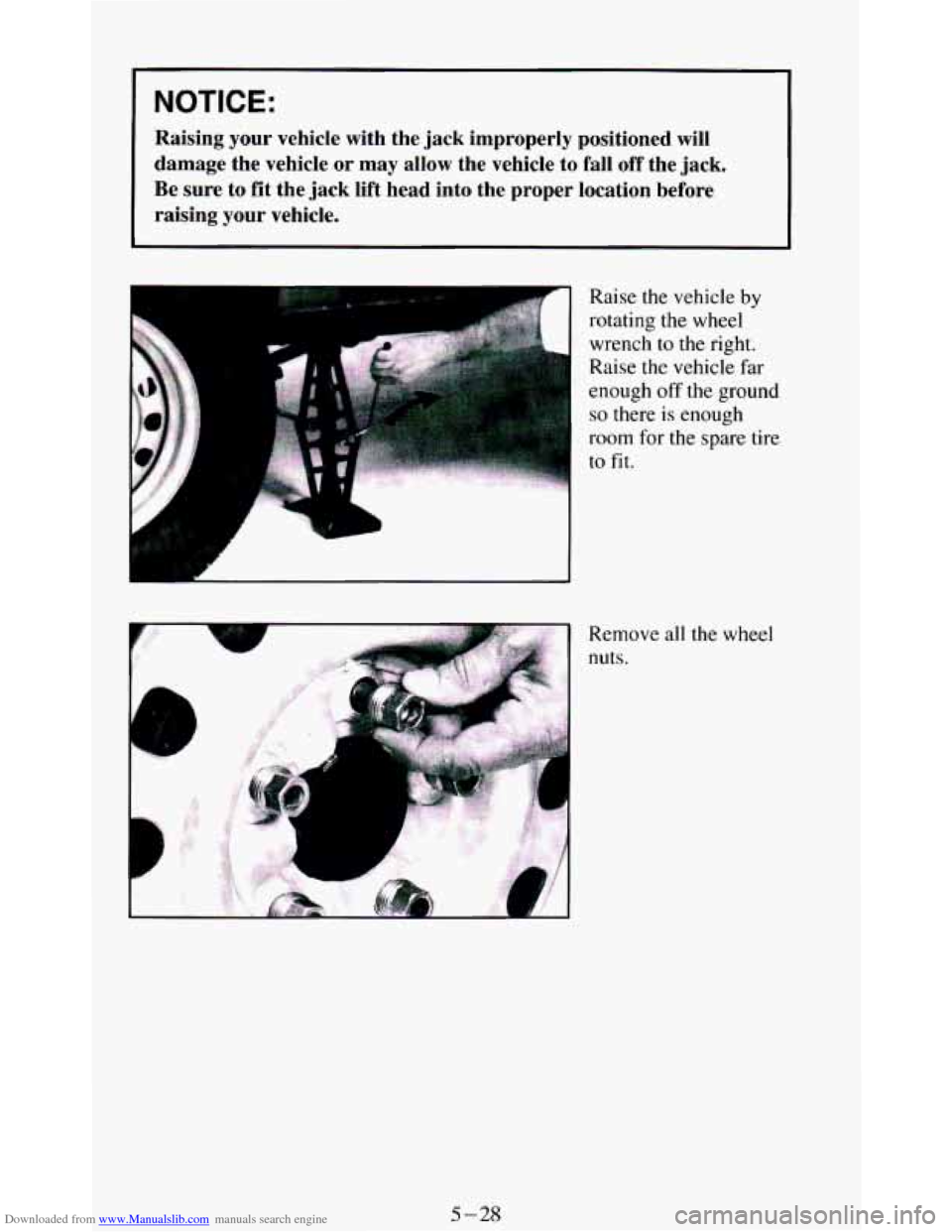
Raise the vehicle by
rotating the wheel
wrench to
the right.
~ Raise the vehicle far
enough off the ground
so there is enough
room for the spare tire
to fit.
Remove all the wheel
nuts.
5-28
Page 231 of 348
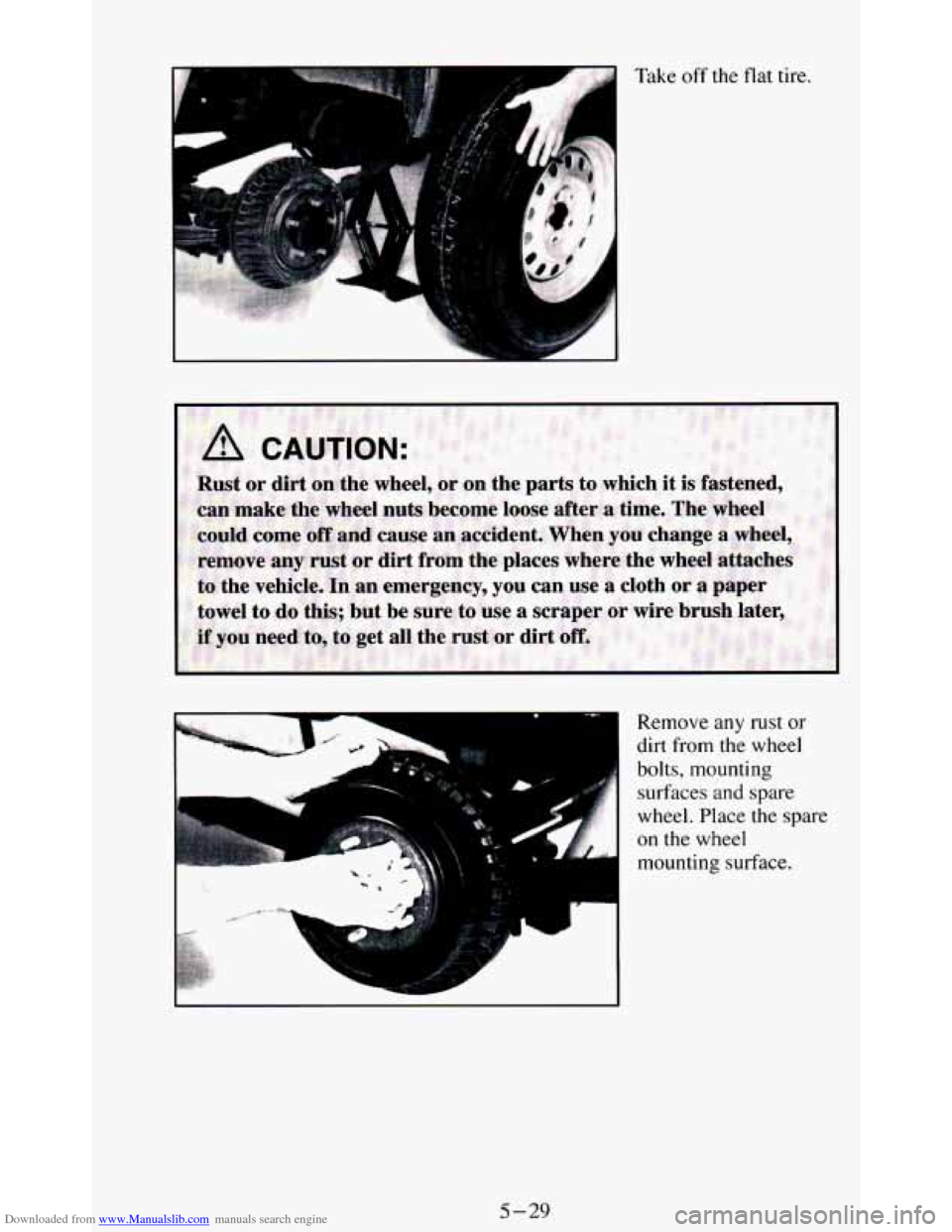
Downloaded from www.Manualslib.com manuals search engine Take off the flat tire.
L Remove any rust or
dirt from the wheel
bolts, mounting
surfaces
and spare
wheel. Place the spare
on the wheel
mounting surface.
5-29
Page 232 of 348
Downloaded from www.Manualslib.com manuals search engine Never use oil or grease on studs or nuts. If you do, the nuts
might cum@ loose. Your wheel could fall off, causing a serious
accident.
~~
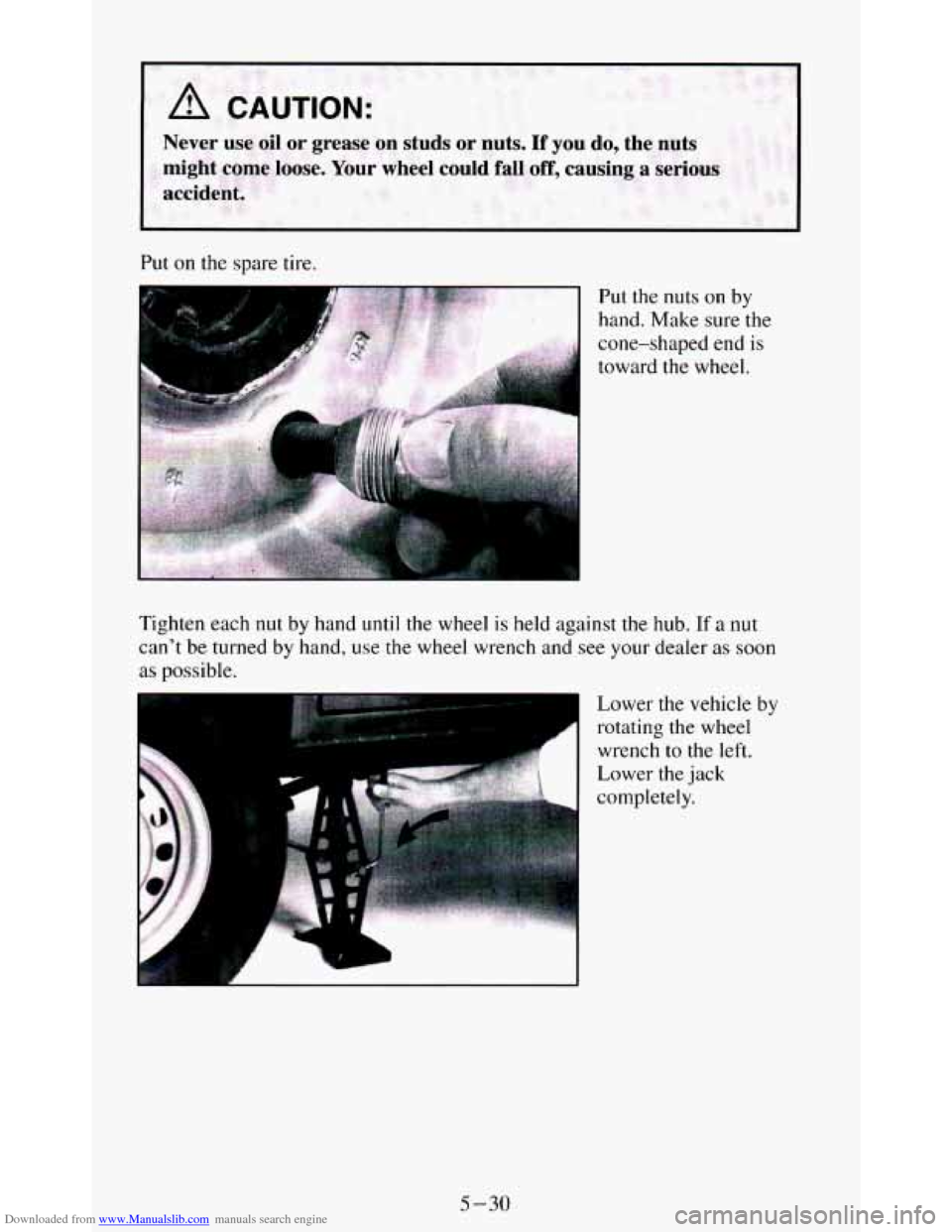
Put on the spare tire.
Put the nuts
on by
hand.
Make sure the
cone-shaped end is
toward the wheel.
Tighten each
nut by hand until the wheel is held against the hub. If a nut
can't be turned by hand, use the wheel wrench and see your dealer as soon
as possible.
Lower the vehicle by
rotating the wheel
wrench
to the left.
Lower the jack
completely.
si:..
5-30
Page 233 of 348
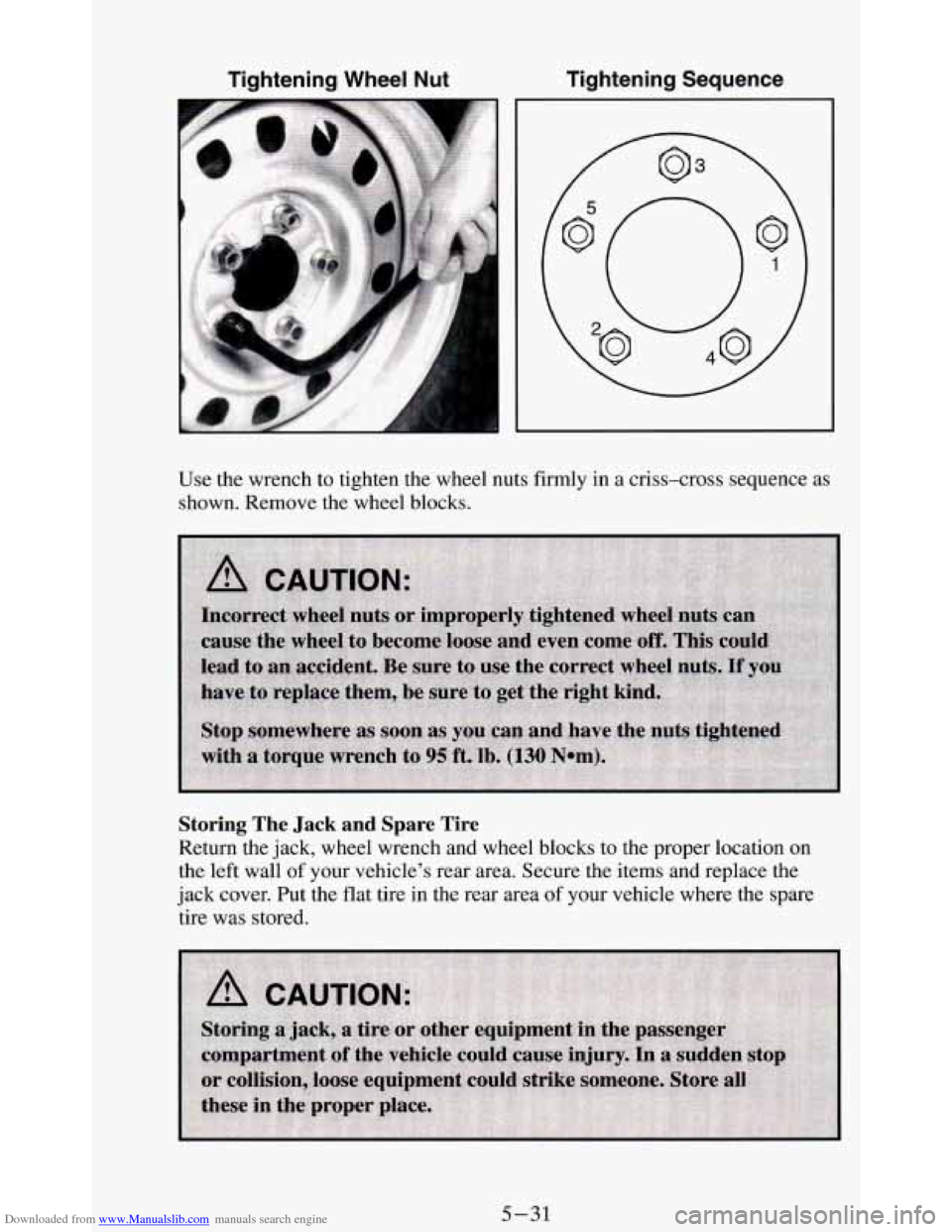
Downloaded from www.Manualslib.com manuals search engine Tightening Wheel Nut Tightening Sequence
Use
the wrench to tighten the wheel nuts firmly in a criss-cross sequence as
shown. Remove the wheel blocks.
Storing The Jack and Spare Tire
Return the jack, wheel wrench and wheel blocks to the proper location on
the left wall of your vehicle’s rear area. Secure the items and replace the
jack cover. Put the
flat tire in the rear area of your vehicle where the spare
tire was stored.
5-31
Page 234 of 348
Downloaded from www.Manualslib.com manuals search engine If you have a floor-mounted spare tire and it has an aluminum wheel, place
the hook in the floor ring before placing
it through the wheel.
If you have a endgate-mounted spare tire carrier, tighten the nuts to 22-32
ft. lb. (30-40 Nem) torque.
If You’re Stuck: In Sand, Mud, Ice or Snow
What you don’t want to do when your vehicle is stuck is to spin your
wheels. The method known as “rocking” can help you get out when you’re
stuck, but you must use caution.
I NOTICE:
Spinning your wheels can destroy parts of your vehicle as well\
as
the tires.
If you spin the wheels too fast while shifting your
transmission back and forth, you can destroy your transmission. \
5-32
Page 235 of 348
Downloaded from www.Manualslib.com manuals search engine Rocking your vehicle to get it out:
First, turn your steering wheel left and right. That will clear the area around
your front wheels. Then shift back and forth between “R” (Reverse) and
a
forward gear (or with a manual transmission, between First or Second gear
and Reverse), spinning the wheels
as little as possible. Release the
accelerator pedal while
you shift, and press lightly on the accelerator pedal
when the transmission
is in gear. If that doesn’t get you out after a few tries,
you may need to be towed out. Or,
you can use your recovery hooks, if your
vehicle has them.
If you do need to be towed out, see “Towing Your
Vehicle”
in the Index.
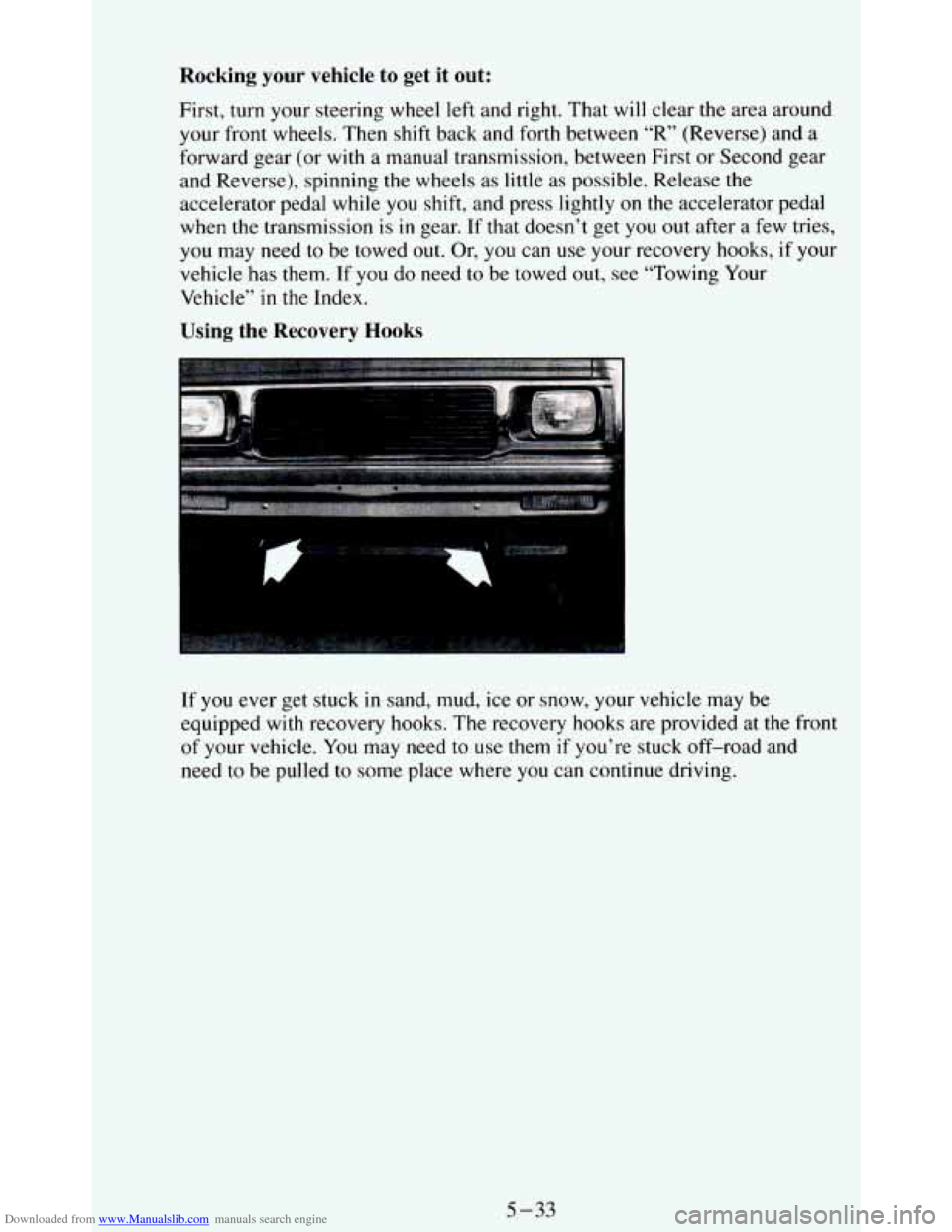
Using the Recovery Hooks
I
If you ever get stuck in sand, mud, ice or snow, your vehicle may be
equipped with recovery hooks.
The recovery hooks are provided at the front
of your vehicle. You may need to use them if you’re stuck off-road and
need to be pulled to some place where you can continue driving.
5-33
Page 249 of 348
Downloaded from www.Manualslib.com manuals search engine When to Change Engine Oil
See if any one of these is true for you:
Most trips are less than 4 miles (6 km).
It’s below freezing outside and most trips are less than 10 miles (I 6 km).
0 The engine is at low speed most of the time (as in door-to-door
delivery, or
in stop-and-go traffic).
You tow a trailer often.
0 Most trips are through dusty places.
0 The vehicle is frequently operated off-road.
If any one of these is true for your vehicle, then you need to change your oil
andfilter every 3,000 miles (5 000 km) or 3 months - whichever comes
first.
If none
of them is true, change the oil every 7,500 miles (12 500 km) or
12 months - whichever comes first. Change the filter at the first oil change
and at every other oil change after that.
Four-wheel Drive Remote Oil Filter
If your vehicle has four-wheel drive, you will have a remote oil filter
located under the hood. It is mounted to the front left inner fender, behind
the headlights.
Engine Coolant Heater (Engine Block Heater)
An engine coolant heater can be a big help if you have to park outside in
very cold weather, 0°F (-18°C) or colder. If your vehicle has this option,
see “Engine Coolant Heater
” in the Index.
What to Do with Used Oil
Did you know that used engine oil contains certain elements that may be
unhealthy for your skin and could even cause cancer? Don’t let used oil stay
on your skin for very long. Clean your skin
and nails with soap and water,
or
a good hand cleaner. Wash or properly throw away clothing or rags
containing used engine oil. (See
the manufacturer’s warnings about the use
and disposal of oil products.)
Used oil can be
a real threat to the environment. If you change your own oil,
be sure to drain all free-flowing oil from
the filter before disposal. Don’t
ever dispose of oil
by putting it in the trash, pouring it on the ground, into
sewers, or into streams or bodies of water. Instead, recycle
it by taking it to
a place that collects used oil. If you have a problem properly disposing of
your used oil, ask your dealer,
a service station or a local recycling center
for help.
6-13