wheel CHEVROLET BLAZER 1994 2.G Workshop Manual
[x] Cancel search | Manufacturer: CHEVROLET, Model Year: 1994, Model line: BLAZER, Model: CHEVROLET BLAZER 1994 2.GPages: 348, PDF Size: 17.88 MB
Page 210 of 348
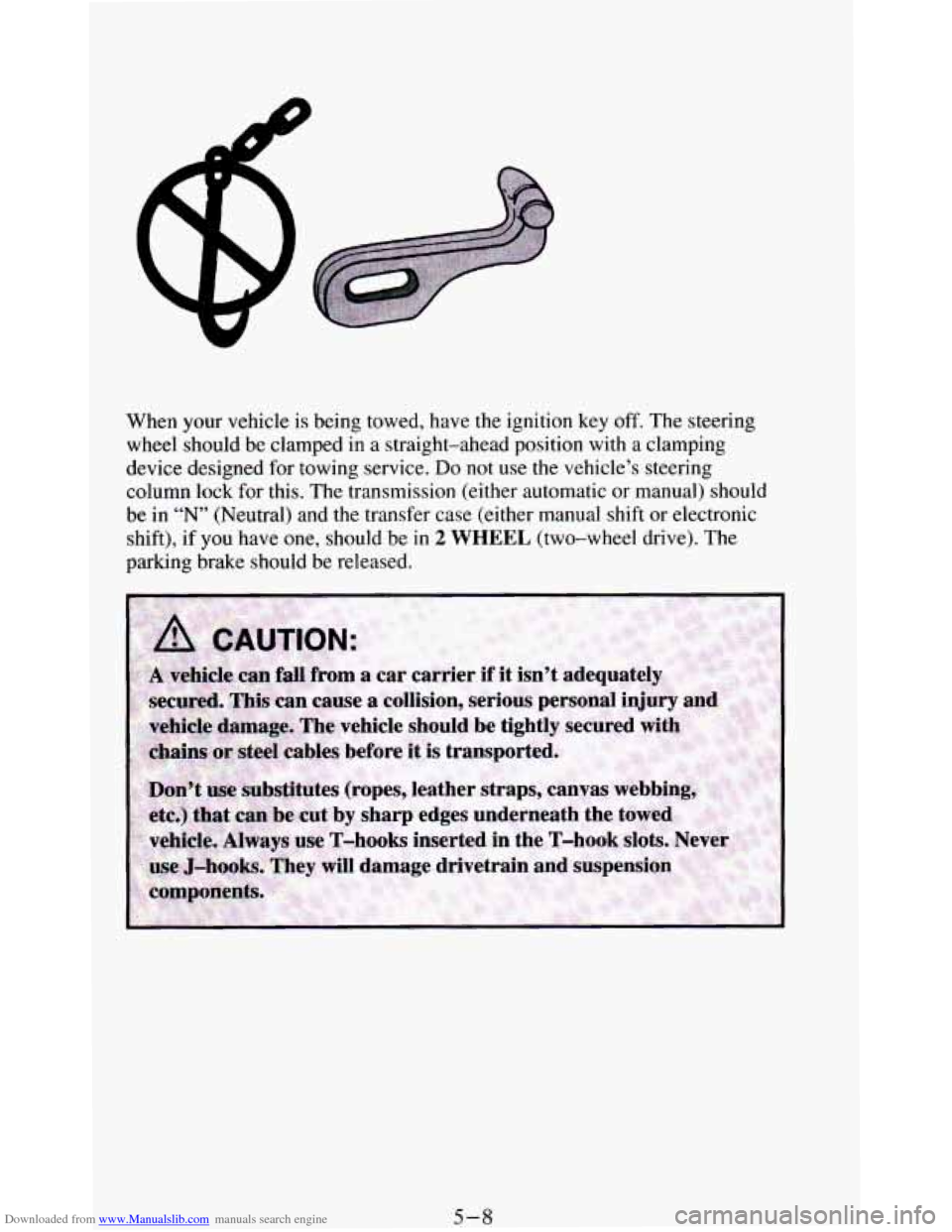
Downloaded from www.Manualslib.com manuals search engine When your vehicle is being towed, have the ignition key off. The steering
wheel should
be clamped in a straight-ahead position with a clamping
device designed for towing service.
Do not use the vehicle’s steering
column lock for this. The transmission (either automatic
or manual) should
be in
“N’ (Neutral) and the transfer case (either manual shift or electronic
shift), if
you have one, should be in 2 WHEEL (two-wheel drive). The
parking brake should be released.
5-8
Page 211 of 348
Downloaded from www.Manualslib.com manuals search engine Towing From the Front
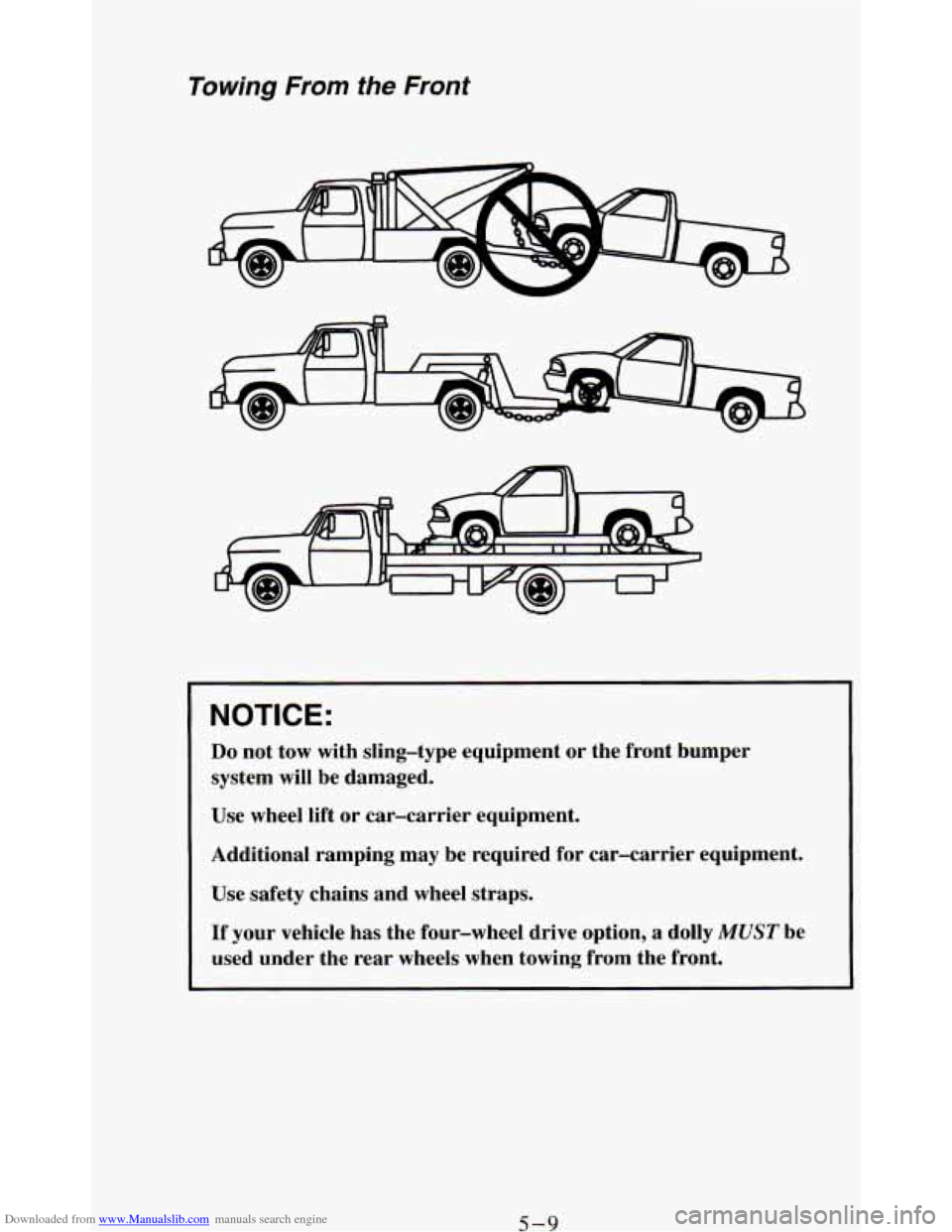
NOTICE:
Do not tow with sling-type equipment or the front bumper
system will be damaged.
Use wheel
lift or car-carrier equipment.
Additional ramping may be required for car-carrier equipment.
Use safety chains and wheel straps.
If your vehicle has the four-wheel drive option, a dolly MUST be
used under the rear wheels when towing from the front.
5-9
Page 212 of 348
Downloaded from www.Manualslib.com manuals search engine Towing From the Rear
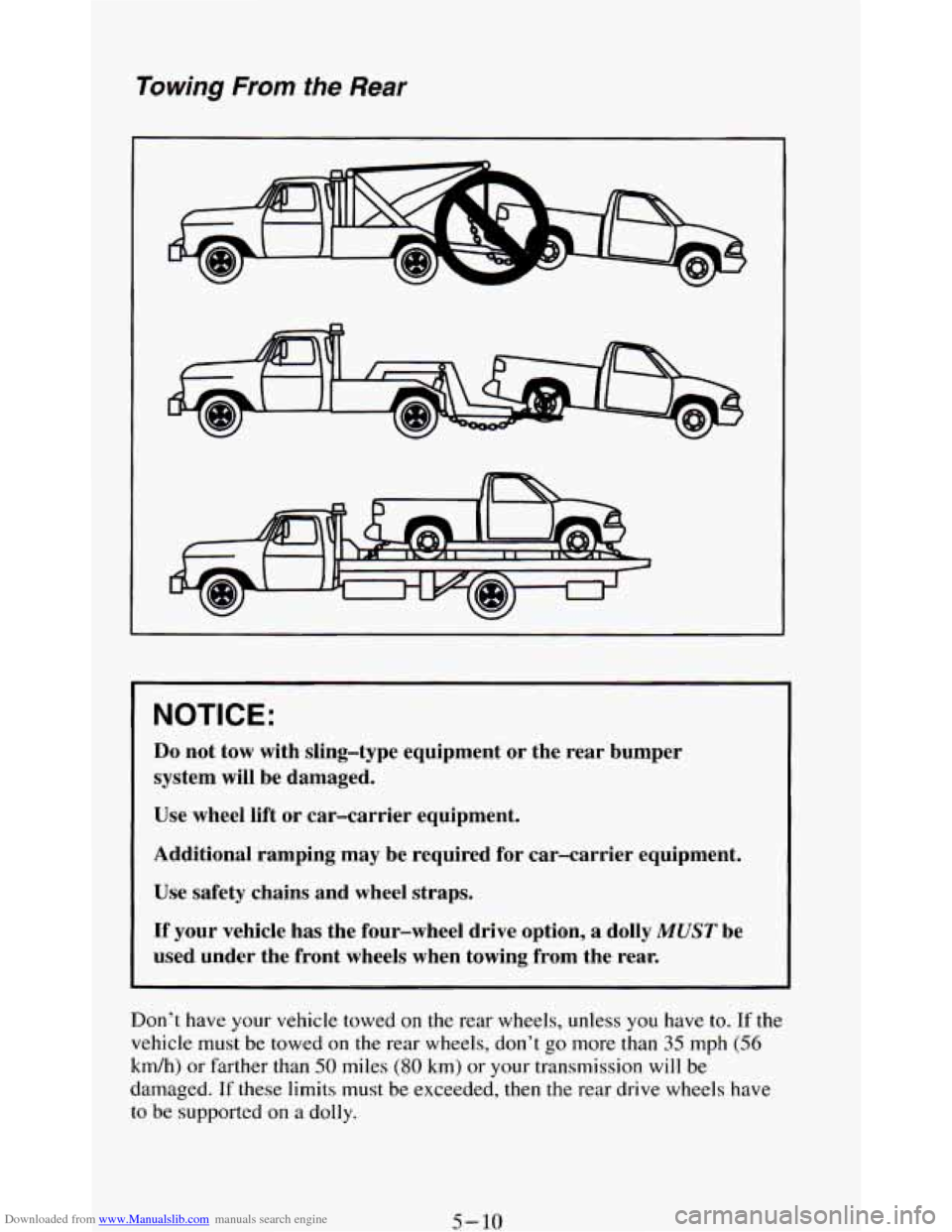
NOTICE:
Do not tow with sling-type equipment or the rear bumper
system will be damaged.
Use wheel lift or car-carrier equipment.
Additional ramping may be required for car-carrier equipment. Use safety chains and wheel straps.
If your vehicle has the four-wheel drive option, a dolly MUST be
used under the front wheels when towing from the rear.
Don’t have your vehicle towed on the rear wheels, unless
you have to. If the
vehicle must
be towed on the rear wheels, don’t go more than 35 mph (56
km/h) or farther than 50 miles (80 km) or your transmission will be
damaged.
If these limits must be exceeded, then the rear drive wheels have
to be supported on
a dolly.
5-10
Page 220 of 348
Downloaded from www.Manualslib.com manuals search engine Engine Fan Noise
This vehicle has a clutched engine cooling fan. When the clutch is engaged,
the fan spins faster to provide more air
to cool the engine. In most every day
driving conditions the clutch is
not engaged. This improves fuel economy
and reduces fan noise. Under heavy vehicle loading, trailer towing and/or
high outside temperatures, the fan speed increases when the clutch engages.
So you may hear an increase in fan noise. This is normal and should not be
mistaken as
the transmission slipping or making extra shifts. It is merely the
cooling system functioning properly. The fan will slow down when
additional cooling
is not required and the clutch disengages.
You may also hear this fan noise when you start the engine. It will go away
as the fan clutch disengages.
If a Tire Goes Flat
It’s unusual for a tire to “blow out” while you’re driving, especially if you
maintain your tires properly. If air goes out of a tire, it’s much more likely
to
leak out slowly. But if you should ever have a “blowout,” here are a few tips
about what to expect and what
to do:
If a front tire fails,
the flat tire will create a drag that pulls the vehicle
toward
that side. Take your foot off the accelerator pedal and grip the
steering wheel firmly. Steer to maintain lane position, then gently brake to a
stop well
out of the traffic lane.
A rear blowout, particularly on a curve, acts much like a skid and may
require the same correction you’d
use in a skid. In any rear blowout, remove
your foot from the accelerator pedal. Get the vehicle under control
by
steering the way you want the vehicle to go. It may be very bumpy and
noisy, but
you can still steer. Gently brake to a stop, well off the road if
possible.
If a tire goes flat, the next section shows how to use your jacking equipment
to change a flat tire safely.
5-18
Page 221 of 348
Downloaded from www.Manualslib.com manuals search engine Changing a Flat Tire
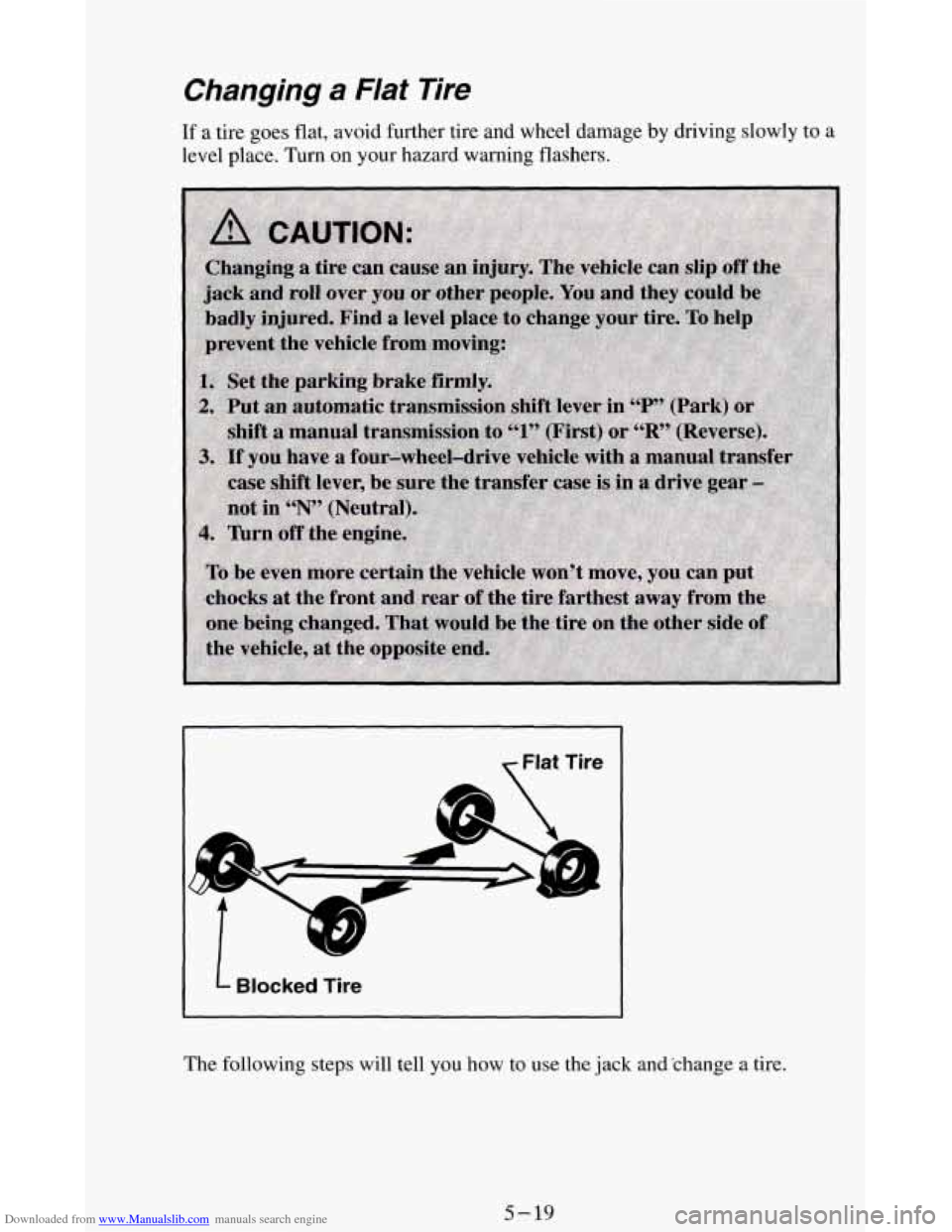
If a tire goes flat, avoid further tire and wheel damage by driving slowly to a
level place. Turn on your hazard warning flashers.
T
L Blocked Tire
The following steps will tell you how to use the jack and change a tire.
5-19
Page 222 of 348
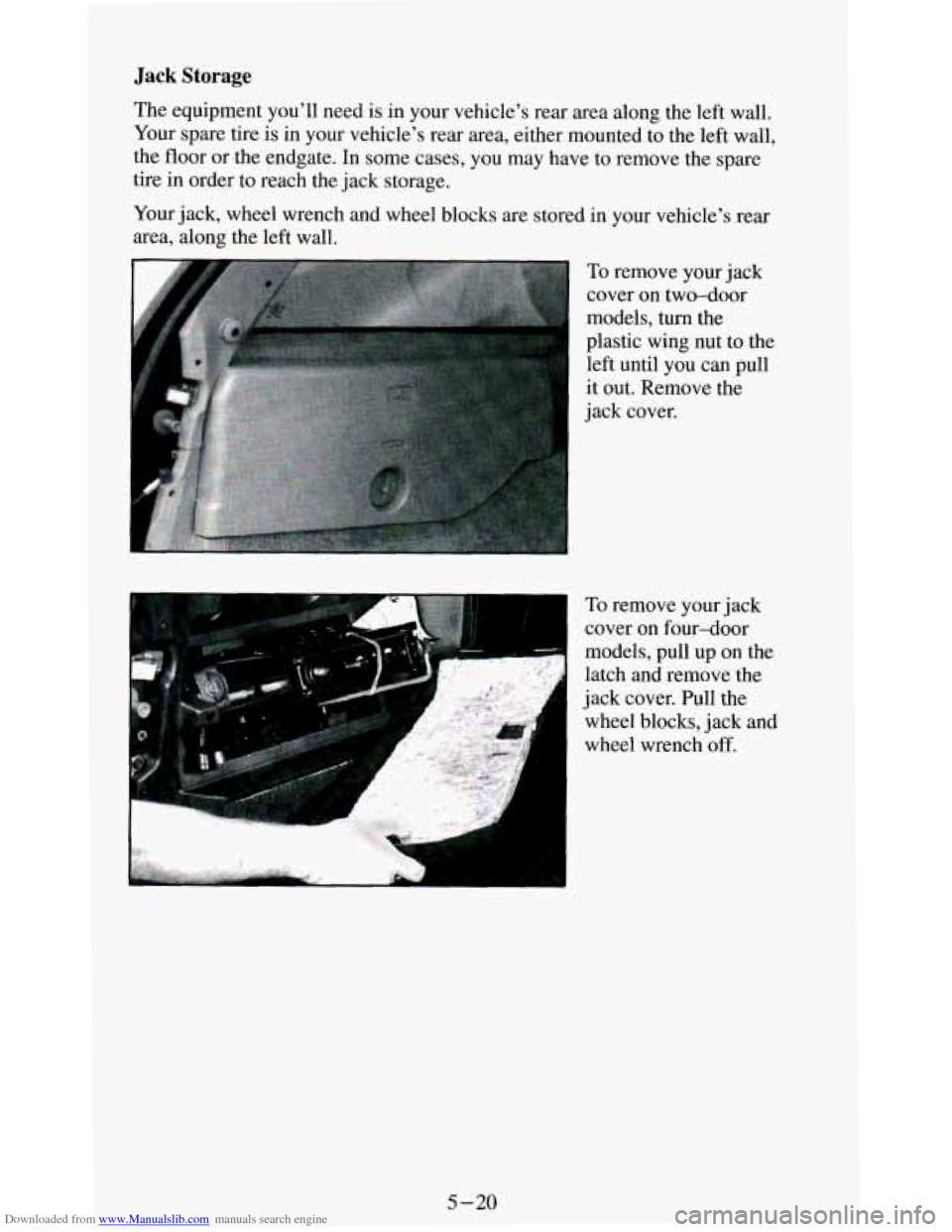
Downloaded from www.Manualslib.com manuals search engine Your jack, wheel wrench and wheel blocks are stored in your vehicle's rear
area, along the left wall.
To remove your jack
cover on two-door
models, turn the
plastic wing nut to the
left until you can pull
it out. Remove the
jack cover.
bUVC1 U11 .
models, p
To remove your jack
tlAT7-V nm four-door
lull up on the
latch and remove the
jack cover. Pull the
wheel blocks, jack and
wheel wrench
off.
c
I
5-20
Page 223 of 348
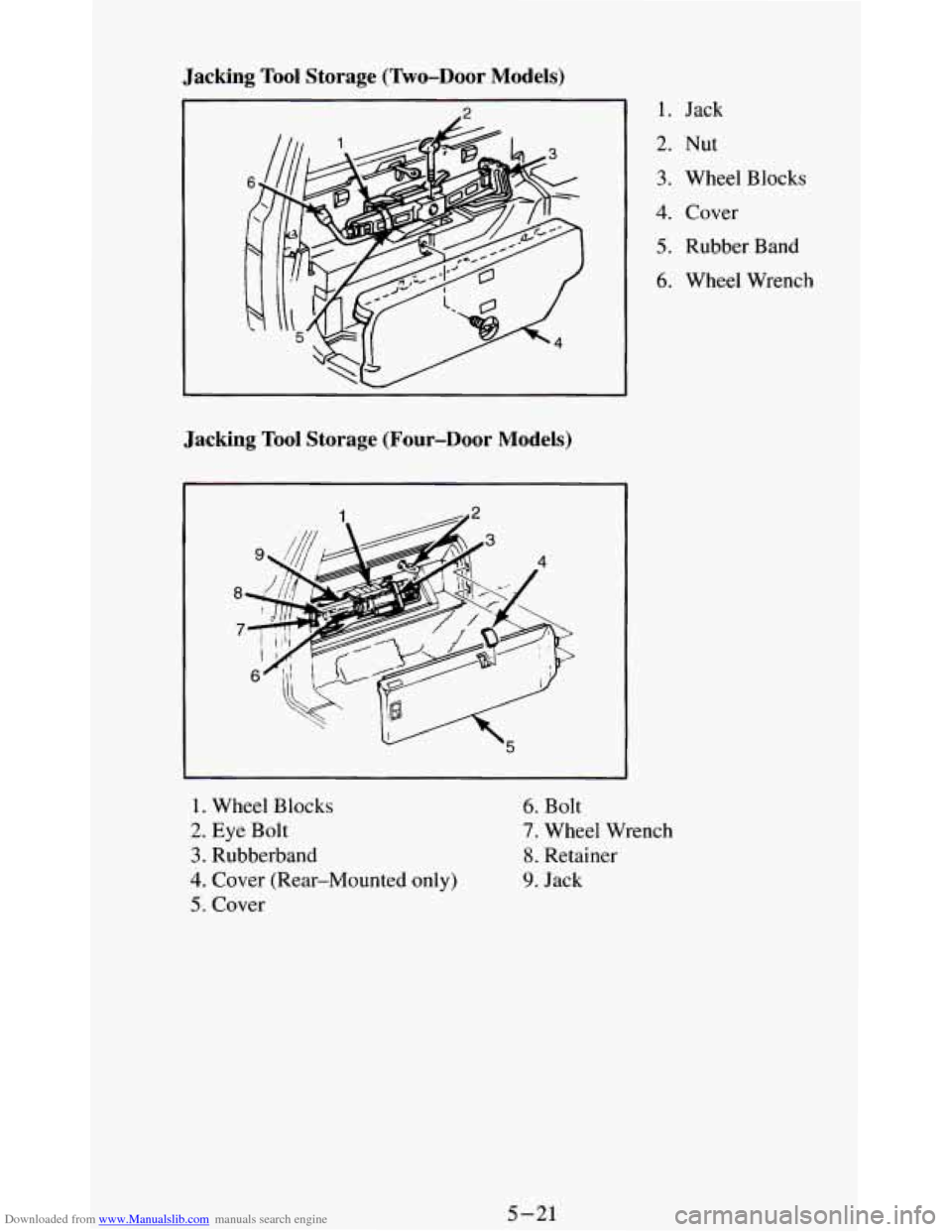
Downloaded from www.Manualslib.com manuals search engine Jacking Tool Storage (Two-Door Models)
Jacking Tool Storage (Four-Door Models)
I
1. Wheel Blocks 6. Bolt
2. Eye Bolt
3. Rubberband
4. Cover (Rear-Mounted only)
5. Cover
7. Wheel Wrench
8. Retainer
9. Jack
1. Jack
2. Nut
3. Wheel Blocks
4. Cover
5. Rubber Band
6. Wheel Wrench
5-21
Page 224 of 348
\
1
3
Rear-Mounted Spare Tire (Two-Door Models)
1. Hook
2. Va")
Downloaded from www.Manualslib.com manuals search engine Side-Mounted Spare Tire (Two-Door Models except P235/75R15 Tire)\
1
3
Rear-Mounted Spare Tire (Two-Door Models)
1. Hook
2. Valve Stem
(Pointed
Outboard)
3. Nut
4. Retainer
(2-wheel drive)
5. Retainer
(4-wheel drive)
6. Spare Tire
1. Valve Stem
(Pointed
Rearward)
2. Wheel Carrier
3. Spare Tire
4. Wheel Nut
Floor-Mounted Spare Tire (P235/75R15 Tire Two-Door Models)
Steel Wheel:
1. Nut
2. Retainer
3. Valve Stem
(Pointed
Up)
4. Hook
5. Spare Tire
5-22
Page 225 of 348
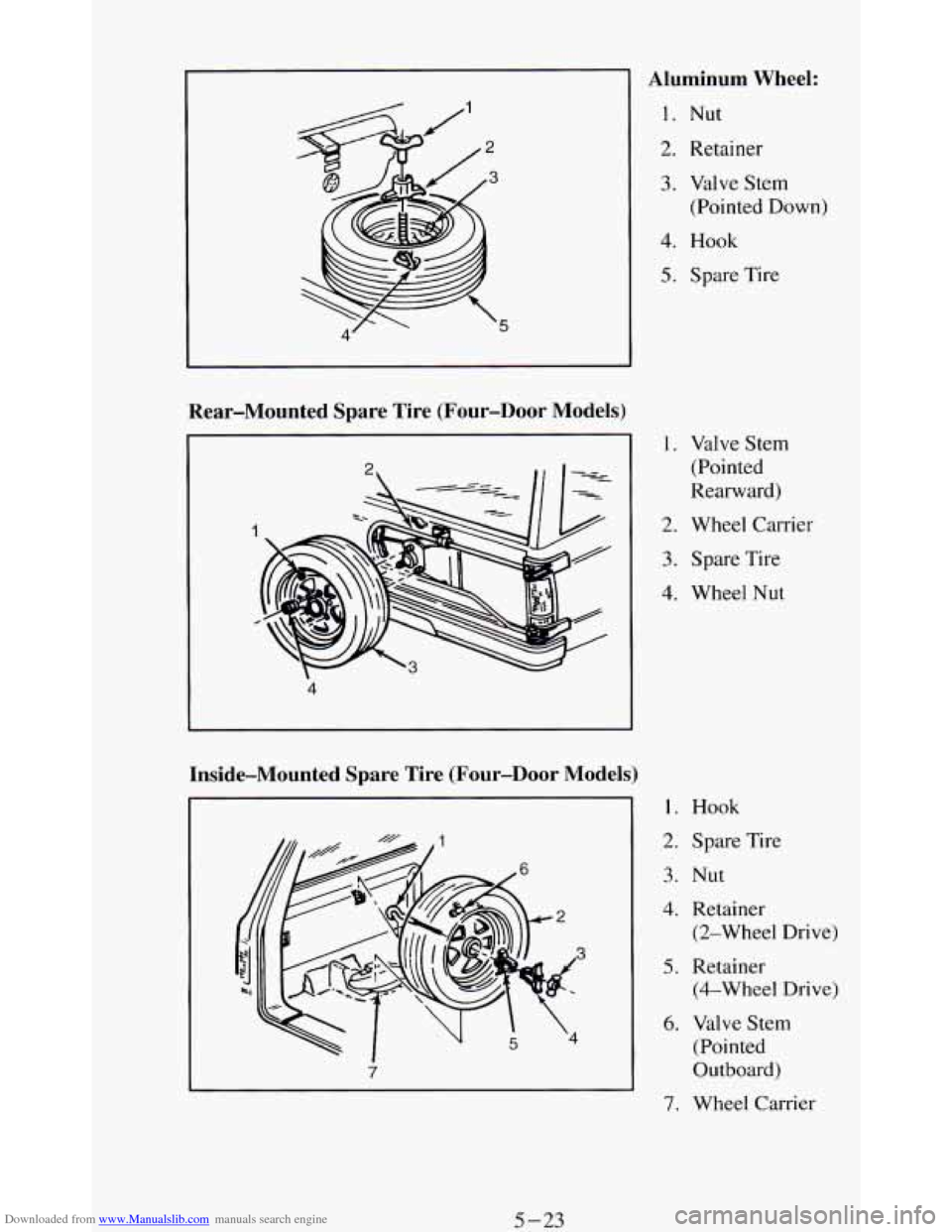
Downloaded from www.Manualslib.com manuals search engine Rear-Mounted Spare Tire (Four-Door Models)
4
Aluminum Wheel:
I. Nut
2. Retainer
3. Valve Stem
(Pointed Down)
4. Hook
5. Spare Tire
1. Valve Stem
(Pointed
Rearward)
2. Wheel Carrier
3. Spare Tire
4. Whee
Inside-Mounted Spare Tire (Four-Door Models)
1. Hook
:1 Nut
?
2. Spare Tire
3. Nut
4. Retainer
(2-Wheel Drive)
5. Retainer
(4-Wheel Drive)
6. Valve Stem
(Pointed
Outboard)
7. Wheel Carrier
5-23
Page 226 of 348
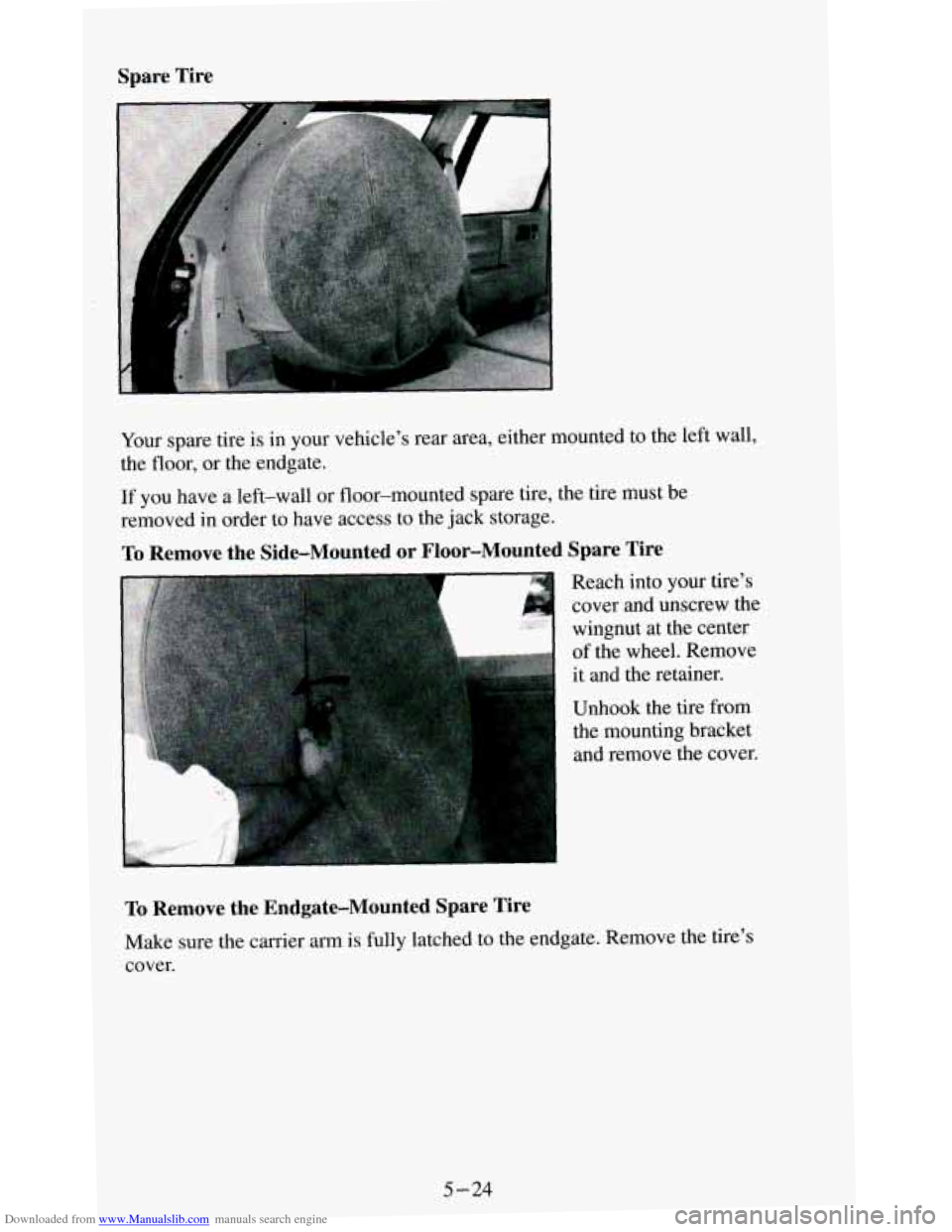
Downloaded from www.Manualslib.com manuals search engine Spare Tire
Your spare tire is in your vehicle's rear area, either mounted to the left wall,
the floor, or the endgate.
If you have a left-wall or floor-mounted spare tire, the tire must be
removed
in order to have access to the jack storage.
TO Remove the Side-Mounted or Floor-Mounted Spare Tire
Reach into your tire's
cover and unscrew the
wingnut at the center
of the wheel. Remove
it and the retainer.
Unhook the tire from
the mounting bracket
and remove the cover.
To Remove the Endgate-Mounted Spare Tire
5-24