maintenance CHEVROLET BLAZER 1995 2.G User Guide
[x] Cancel search | Manufacturer: CHEVROLET, Model Year: 1995, Model line: BLAZER, Model: CHEVROLET BLAZER 1995 2.GPages: 380, PDF Size: 20.04 MB
Page 259 of 380
Downloaded from www.Manualslib.com manuals search engine When to Checkand What to Use
P
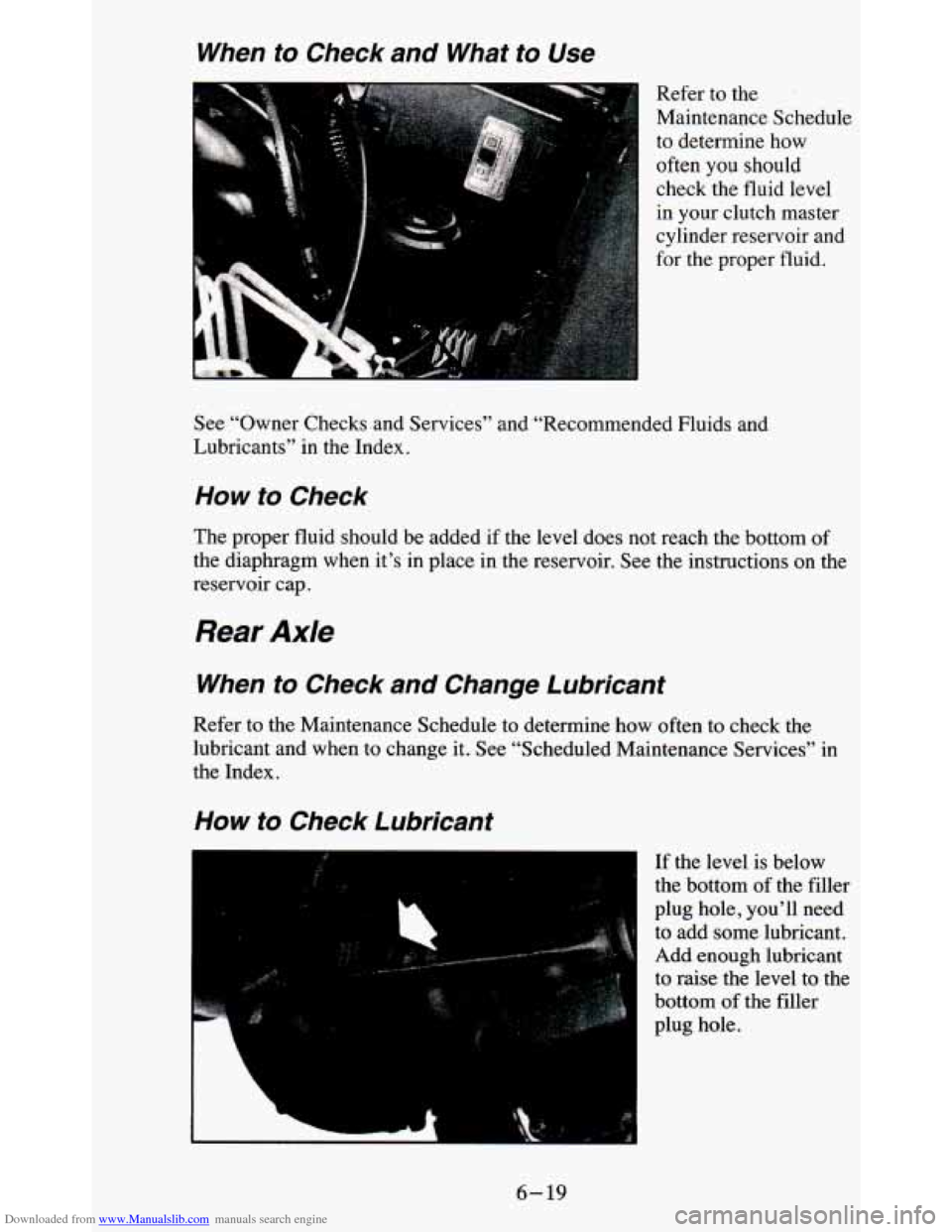
Refer to the
Maintenance Schedule
to determine how
often you should
check the fluid level
in your clutch master
cylinder reservoir and
for the proper fluid.
See “Owner Checks and Services” and “Recommended Fluids and
Lubricants” in the Index.
How to Check
The proper fluid should be added if the level does not reach the bottom of
the diaphragm when it’s in place in the reservoir. See the instructions on the
reservoir cap.
Rear Axle
When to Check and Change Lubricant
Refer to the Maintenance Schedule to determine how often to check the
lubricant and when to change it. See “Scheduled Maintenance Services” in
the Index.
How to Check Lubricant
If the level is below
the bottom of the filler
plug hole, you’ll need
to add some lubricant.
Add enough lubricant
to raise the level to the
bottom of
the filler
plug hole.
6- 19
Page 260 of 380
Downloaded from www.Manualslib.com manuals search engine What to Use
Refer to the Maintenance Schedule to determine what kind of lubricant to
use. See “Recommended Fluids and Lubricants” in the Index.
Four- Wheel and All- Wheel Drive
Most lubricant checks in this section also apply to four-wheel-drive and
all-wheel-drive vehicles. However, they have two additional syste\
ms that
need lubrication.
Transfer Case
When io Check Lubricani
Refer to the Maintenance Schedule to determine how often to check the
lubricant. See “Periodic Maintenance Inspections”
in the Index.
How to Check Lubricani
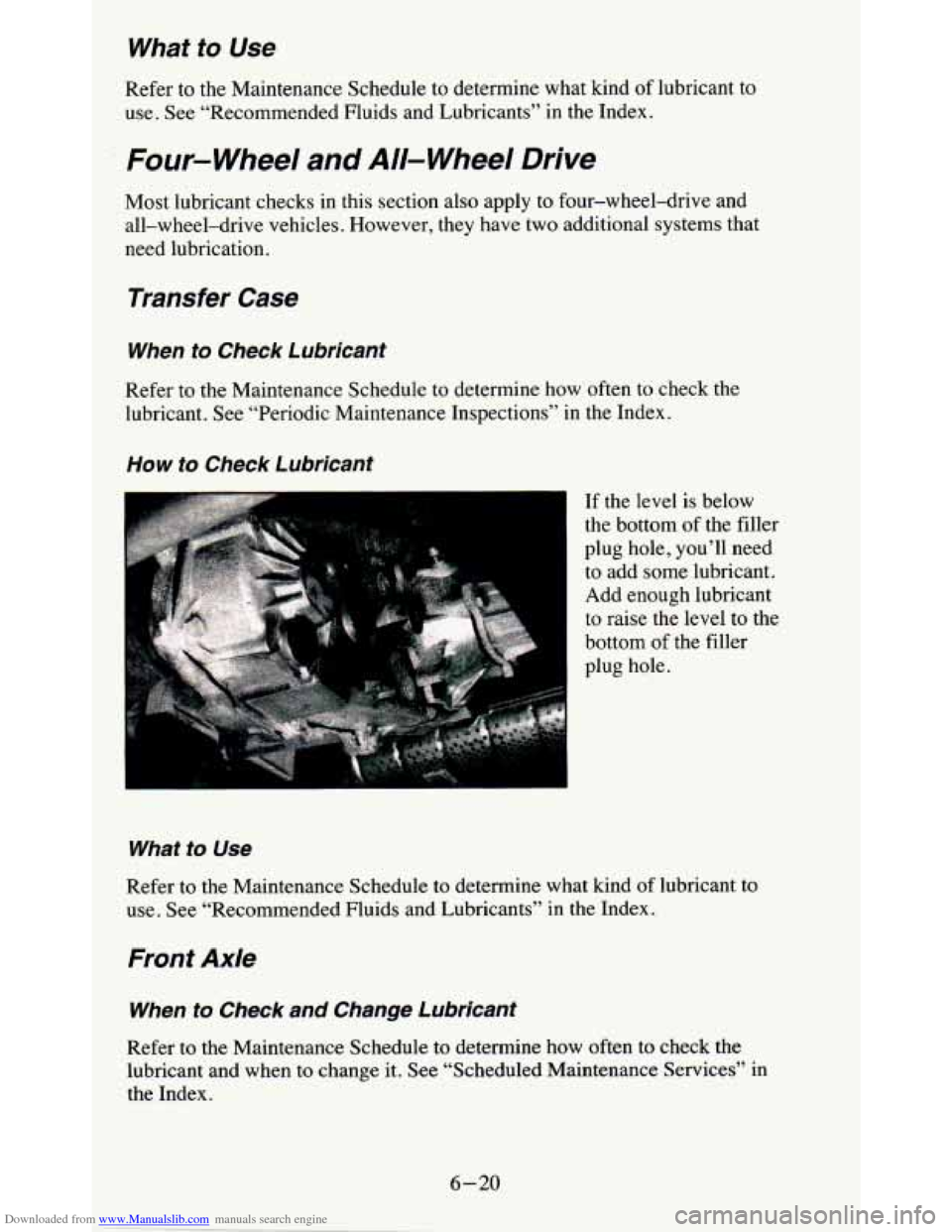
I If the level is below
the bottom
of the filler
plug hole, you’ll need to add some lubricant.
Add enough lubricant
to raise the level to the
bottom
of the filler
plug hole.
What to Use
Refer to the Maintenance Schedule to determine what kind of lubricant to
use. See “Recommended Fluids and Lubricants” in the Index.
Front Axle
When to Check and Change Lubricant
Refer to the Maintenance Schedule to determine how often to check the
lubricant and when to change it. See “Scheduled Maintenance Services” in
the Index.
6-20
Page 261 of 380
Downloaded from www.Manualslib.com manuals search engine How to Check Lubricant
,:
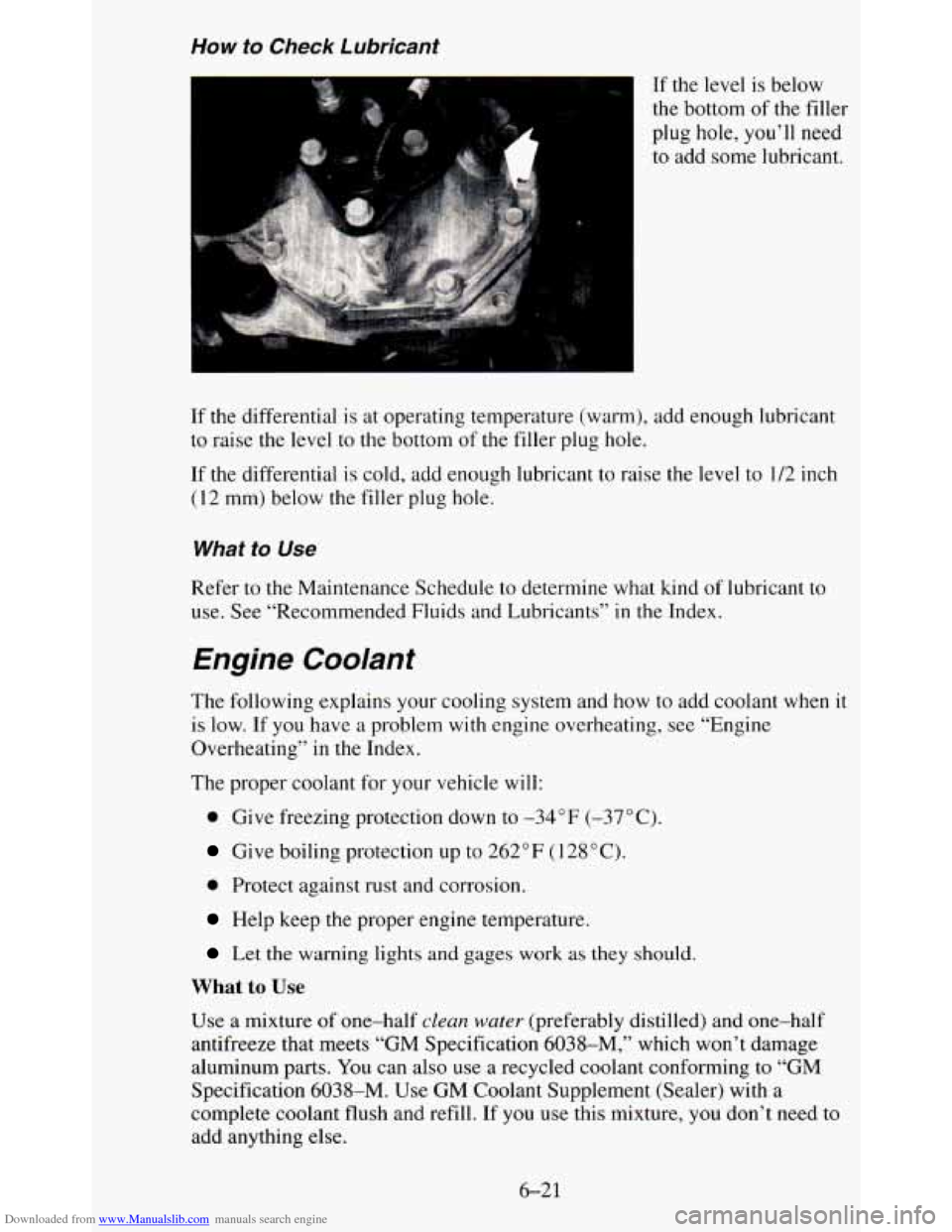
If the level is below
the bottom
of the filler
plug hole, you’ll need
to add some lubricant.
If the differential
is at operating temperature (warm), add enough lubricant
to raise the level to the bottom of the filler plug hole.
If the differential is cold, add enough lubricant to raise the le\
vel to 1/2 inch
(12 mm) below the filler plug hole.
What to Use
Refer to the Maintenance Schedule to determine what kind of lubricant to
use. See “Recommended Fluids and Lubricants”
in the Index.
Engine Coolant
The following explains your cooling system and how to add coolant \
when it
is low. If you have a problem with engine overheating, see “Engine
Overheating”
in the Index.
The proper coolant
for your vehicle will:
0 Give freezing protection down to -34°F (-37°C).
Give boiling protection up to 262°F (128°C).
0 Protect against rust and corrosion.
Help keep the proper engine temperature.
Let the warning lights and gages work as they should.
What to Use
Use a mixture of one-half clean water (preferably distilled) and one-half
antifreeze that meets “GM Specification 6038-M,” which won’t damage
aluminum parts.
You can also use a recycled coolant conforming to “GM
Specification 6038-M.
Use GM Coolant Supplement (Sealer) with a
complete coolant flush and refill. If
you use this mixture, you don’t need to
add anything else.
6-21
Page 265 of 380
Downloaded from www.Manualslib.com manuals search engine Power Steering Fluid
How To Check Power Steering Fluid
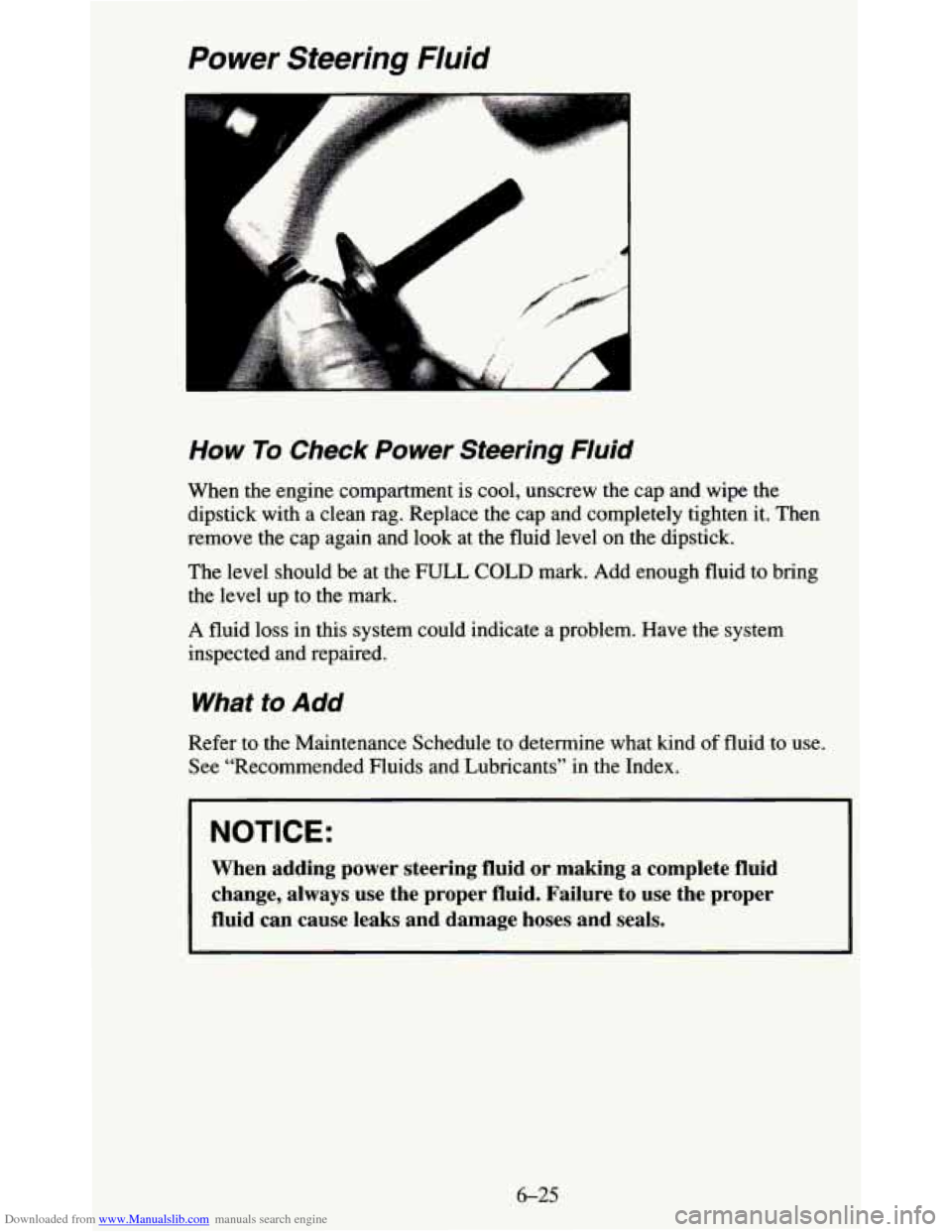
When the engine compartment is cool, unscrew the cap and wipe the
dipstick with a clean rag. Replace the cap and completely tighten it. Then
remove the cap again and look at the fluid level on the dips\
tick.
The level should be at the
FULL COLD mark. Add enough fluid to bring
the level up to the mark.
A fluid loss in this system could indicate a problem. Have the system
inspected and repaired.
What to Add
Refer to the Maintenance Schedule to determine what kind of fluid to use.
See “Recommended Fluids and Lubricants” in the Index.
NOTICE:
When adding power steering fluid or making a complete fluid
change, always use the proper fluid. Failure to use the proper\
fluid can cause leaks and damage hoses and seals.
6-25
Page 267 of 380
Downloaded from www.Manualslib.com manuals search engine Brakes
Brake Master Cylinder
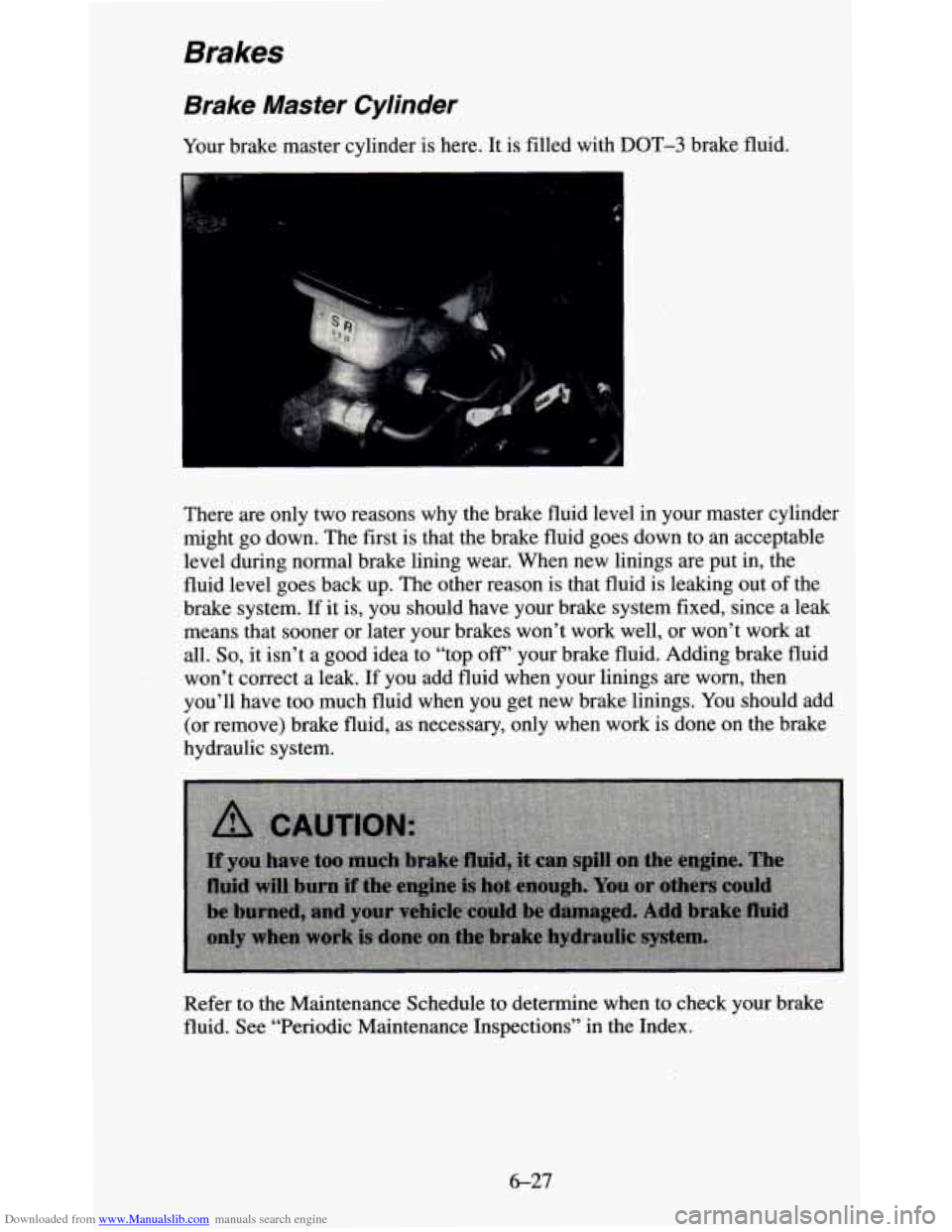
Your brake master cylinder is here. It is filled with DOT-3 brake fluid.
There are only two reasons why the brake fluid level in your master\
cylinder
might
go down. The first is that the brake fluid goes down to an acceptable
level during normal brake lining wear. When new linings are put in, the
fluid level goes back up. The other reason is that fluid is leaking out of the
brake system.
If it is, you should have your brake system fixed, since a leak
means that sooner or later your brakes won’t work well,
or won’t work at
all.
So, it isn’t a good idea to “top off’ your brake fluid. Adding brake fluid
won’t correct a leak. If you add fluid when your linings are worn, then
you’ll have too much fluid when you get new brake linings.
You should add
(or remove) brake fluid, as necessary, only when work is done on the brake
hydraulic system.
Refer to the Maintenance Schedule to determine when to check your brake
fluid. See “Periodic Maintenance Inspections”
in the Index.
6-27
Page 276 of 380
Downloaded from www.Manualslib.com manuals search engine Center High Mounted Stop Lamp (CHMSL)
A
P
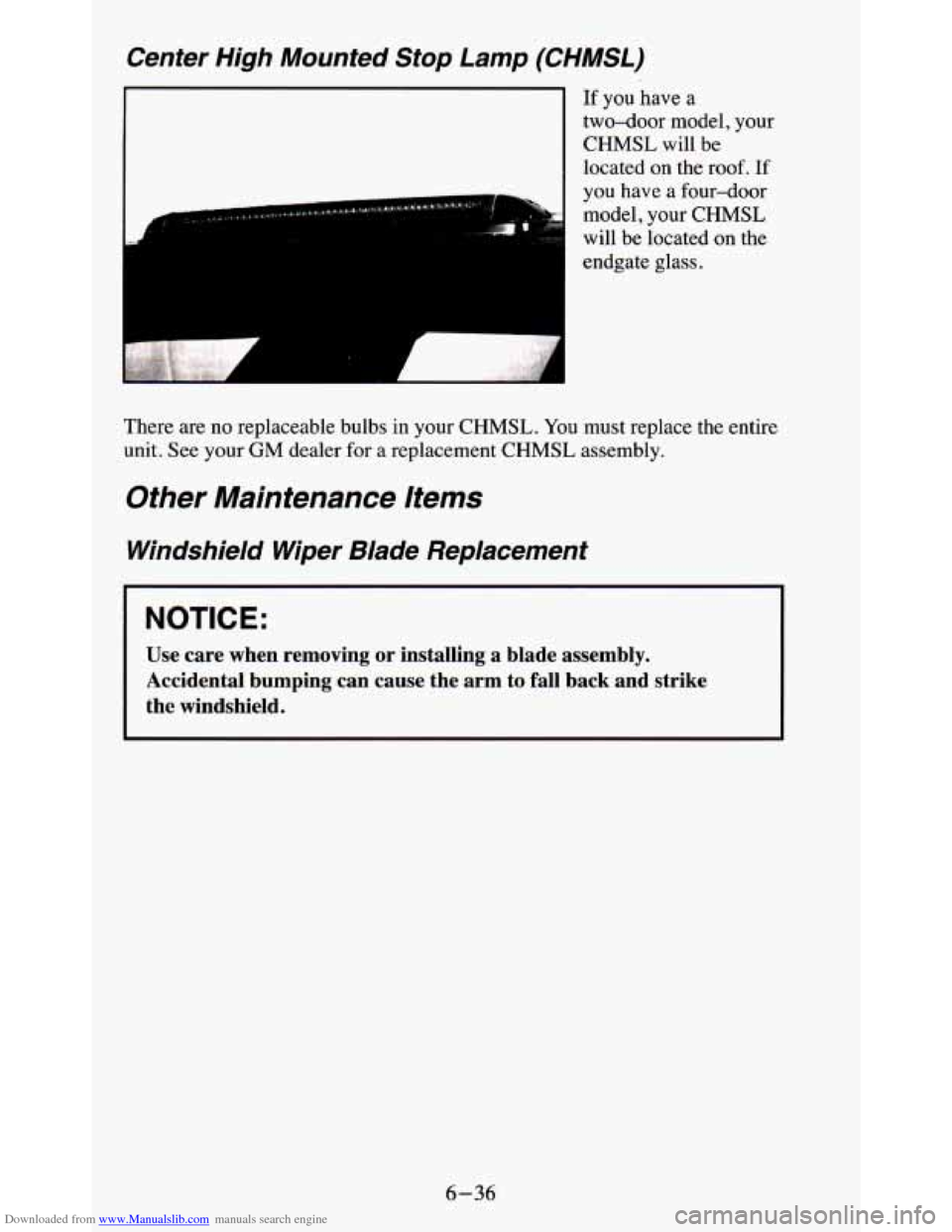
If you have a
two-door model, your
CHMSL will be
located on the roof. If
you have a four-door
model, your CHMSL
will be located on the
endgate glass.
There
are no replaceable bulbs in your CHMSL. You must replace the entire
unit. See your
GM dealer for a replacement CHMSL assembly.
Other Maintenance Items
Whdshield Wiper Blade Replacement
NOTICE:
Use care when removing or installing a blade assembly.
Accidental bumping can cause the arm to fall back and strike
the windshield.
6-36
Page 280 of 380
Downloaded from www.Manualslib.com manuals search engine Air Conditioning
Every now and then have your dealership check your air conditioning
system to be sure it has not lost any cooling ability. If you think\
the system
is not working properly, have your dealership check it out as \
soon as
possible.
The air conditioning will not work when the temperature is below
40°F
(4°C).
Lock Cylinders
To be sure your locks operate properly, they must be lubricated.
Refer to the Maintenance Schedule to determine how often to lubricate them
and what type
of lubricant to use.
You should not
use penetrating oils because they could wash out me factory
installed lubricant and cause the lock to bind. De-icers which \
contain
alcohol could also wash away the lubricant,
so be sure to lubricate the lock
after using a de-icer of this type.
Exhaust System
To help prevent damage to your exhaust system, do not continue to drive
your vehicle
if you notice:
0 Engine misfiring
0 Loss of performance
0 Exhaust system components hanging lower than normal.
0 Loud exhaust system noises.
0 Other unusual operating conditions
Have your engine and exhaust system serviced regularly.
Three-way Catalytic Converter
Your vehicle’s three-way catalytic converter is designed to reduce \
the
pollutants in your vehicle’s exhaust. Use only unleaded fuel in your vehicle.
If you use leaded fuel, you could damage your three-way catalytic converter
and other engine components.
Engine Control Module System
This system has an oxygen (02) sensor that helps keep your engine’s
air-fuel mixture at a proper level. Use only unleaded fuel
in your vehicle. If
you use leaded fuel, you could damage your oxygen (02) sensor and affect
your vehicle’s emissions.
6-40
Page 283 of 380
Downloaded from www.Manualslib.com manuals search engine lire Inspection and Rotation
Tires should be inspected every 6,000 to 8,000 miles (10 000 to 13 000 km)
for any signs of unusual wear. If unusual wear is present, rotate your tires as
soon as possible and check wheel alignment. Also check for damaged tires
or wheels. See “When It’s Time for New Tires” and “Wheel Replacement”
later in this section for more information.
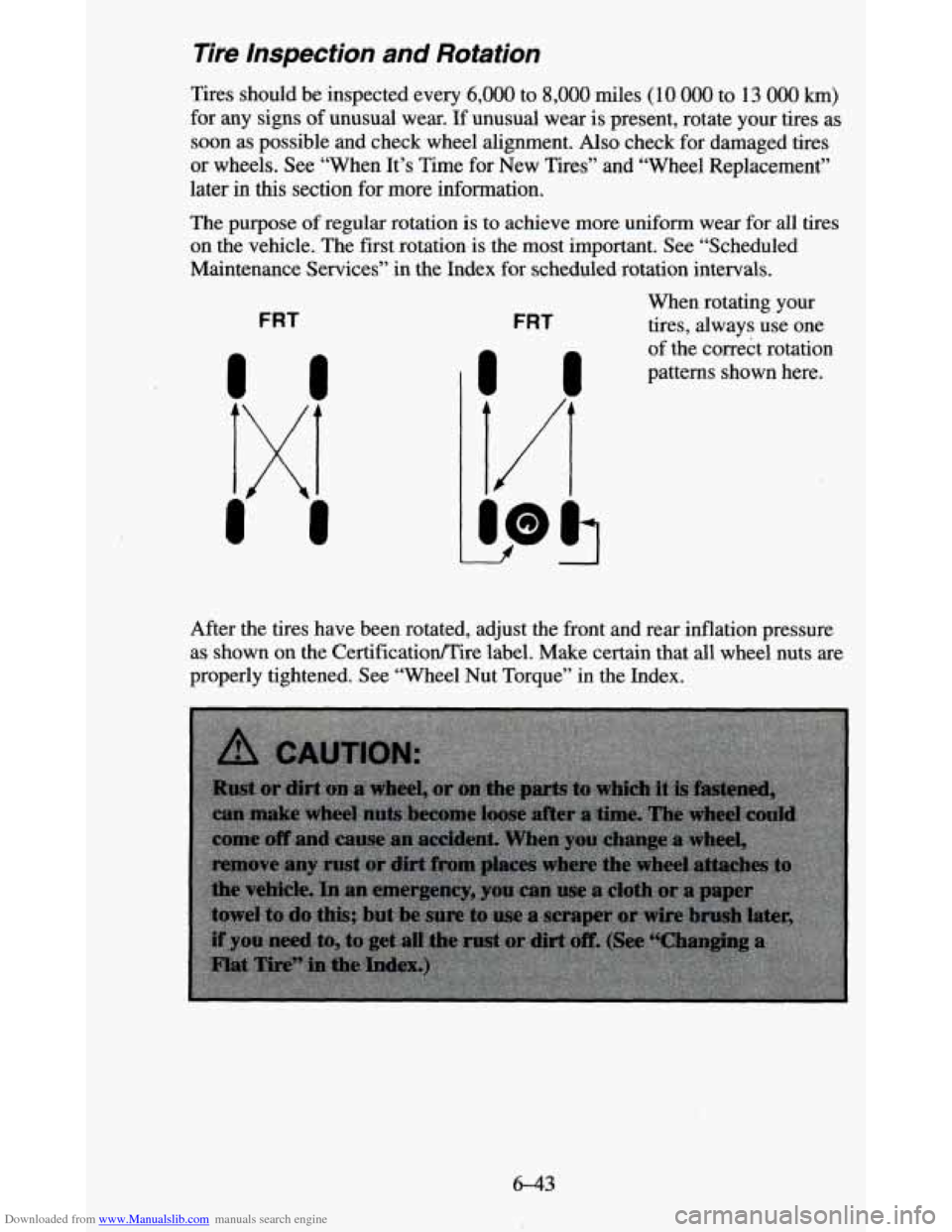
The purpose of regular rotation is to achieve more uniform wear for all tires
on the vehicle. The first rotation is the most important. See “Scheduled
Maintenance Services”
in the Index for scheduled rotation intervals.
FRT
n
FRT When
rotating your
tires, always use one of the correct rotation
patterns shown here.
After the tires have been rotated, adjust the front and rear inflation pressure
as shown on the Certificatioflire label. Make certain that
all wheel nuts are
properly tightened. See “Wheel Nut Torque” in the Index.
6-43
Page 296 of 380
Downloaded from www.Manualslib.com manuals search engine Finish Damage
Any stone chips, fractures or deep scratches in the finish should be repaired
right away. Bare metal will corrode quickly and may develop into a major
repair expense.
Minor chips and scratches can be repaired with touch-up materials available
from your dealer or other service outlets. Larger areas of finish damage can
be corrected in your dealer’s body and paint shop.
Underbody Maintenance
Chemicals used for ice and snow removal and dust control can collect on
the underbody. If these are not removed, accelerated corrosion (rust) can
occur on the underbody parts such as fuel lines, frame, floor pan, and
exhaust system even though they have corrosion protection.
At least every spring, flush these materials from the underbody with plain
water. Clean any areas where mud and other debris can collect. Dirt packed
in closed areas of the frame should be loosened before being flushed. Your
dealer or an underbody vehicle washing system can do this for you.
Chemical Paint Spotting
Some weather and atmospheric conditions can create a chemical fallout.
Airborne pollutants can fall upon and attack painted surfaces on your
vehicle. This damage can take two forms: blotchy, ringlet-shaped
discolorations, and small irregular dark spots etched into the paint surface.
Although no defect in the paint
job causes this, GM will repair, at no charge
to the owner, the surfaces of new vehicles damaged by this fallout condition
within
12 months or 12,000 miles (20 000 km) of purchase, whichever
comes first.
6-56
Page 313 of 380
Downloaded from www.Manualslib.com manuals search engine Scheduled Maintenance Services
Section
IMPORTANT:
KEEP ENGINE OIL
AT THE PROPER
LEVELAND CHANGE
AS RECOMMENDED
This section covers the maintenance required for your vehicle. Your vehicle
needs these services
to retain its safety, dependability and emission control
performance.
Protection
Plan
Have you purchased the GM Protection Plan? The Plan supplements your
new vehicle warranties. See your GM dealer for details.
Introduction
Your Vehicle and the Environment
Proper vehicle maintenance not only helps to keep your vehicle in good
working condition,
but also helps the environment. All recommended
maintenance procedures are important. Improper vehicle maintenance
or the
removal
of important components can significantly affect the quality of the
air we breathe. Improper fluid levels or even the wrong tire inflation can
increase the level of emissions from your vehicle. To help protect our
environment, and to help keep your vehicle
in good condition, please
maintain your vehicle properly.
7-1