lights CHEVROLET BLAZER 1995 2.G Owner's Manual
[x] Cancel search | Manufacturer: CHEVROLET, Model Year: 1995, Model line: BLAZER, Model: CHEVROLET BLAZER 1995 2.GPages: 380, PDF Size: 20.04 MB
Page 183 of 380
Downloaded from www.Manualslib.com manuals search engine Before Leaving on a Long Trip
Make sure you’re ready. Try to be well rested. If you must start when you’re
not fresh
- such as after a day’s work - don’t plan to make too many
miles that first part of the journey. Wear comfortable clothing and shoes
you
can easily drive in.
Is your vehicle ready for a long trip? If you keep it serviced and maintained,
it’s ready to go. If it needs service, have it done before starting out. Of
course, you’ll find experienced and able service experts in
GM dealerships
all across North America. They’ll be ready and willing to help if you need
it.
Here are some things you can check before a trip:
Windshield Washer Fluid: Is the reservoir full? Are all windows clean
inside and outside?
Wiper Blades: Are they in good shape?
0 Fuel, Engine Oil, Other Fluids: Have you checked all levels?
0 Lights: Are they all working? Are the lenses clean?
Tires: They are vitally important to a safe, trouble-free trip. Is the tread
good enough for long-distance driving? Are the tires all inflated to the
recommended pressure?
0 Weather Forecasts: What’s the weather outlook along your route?
Maps: Do you have up-to-date maps?
Should
you delay your trip a short time to avoid a major storm system?
Highway Hypnosis
Is there actually such a condition as “highway hypnosis”? Or is it just plain
falling asleep at the wheel? Call it highway hypnosis, lack of awareness, or
whatever.
There
is something about an easy stretch of road with the same scenery,
along with the hum of the tires on the road, the drone of the engine, and the
rush
of the wind against the vehicle that can make you sleepy. Don’t let it
happen
to you! If it does, your vehicle can leave the road in less than a
second,
and you could crash and be injured.
What can you
do about highway hypnosis? First, be aware that it can
happen.
4-29
Page 189 of 380

Downloaded from www.Manualslib.com manuals search engine Run your engine only as long as you must. This saves fuel. When you run
the engine, make it go a little faster than just idle. That is, push the
accelerator slightly. This uses less fuel for the heat that you get and it keeps
the battery charged. You will need a well-charged battery to restart the
vehicle, and possibly for signaling later on with your headlights. Let the
heater run for awhile.
Then, shut the engine
off and close the window almost all the way to
preserve the heat. Start the engine again and repeat this only when you feel
really uncomfortable from the cold. But do it as little as possible. Preserve
the
fuel as long as you can. To help keep warm, you can get out of the
vehicle and do some fairly vigorous exercises every half hour
or so until
help comes.
Power Winches
If you wish to use a power winch on your vehicle, only use it when your
vehicle is stationary or anchored.
NOTICE:
Operating a power winch with an automatic transmission in
PARK (P) or a manual transmission in gear may damage the
transmission. Always put the transmission in a Neutral position \
while operating a power winch.
I
Use the regular brakes, set the parking brake or block the wheels to keep
your vehicle from rolling.
If your vehicle is equipped with an airbag, see "Adding Equipment to Your
Air Bag-Equipped Vehicle" in the Index.
4-35
Page 198 of 380

Downloaded from www.Manualslib.com manuals search engine Driving with a Trailer
lowing a trailer requires a certain amount of experience. Before setting \
out
for the open road, you’ll want to get to know your rig. Acquaint yourself
with the feel of handling and braking with the added weight of the trailer. \
And always keep in mind that the vehicle you are driving is now a good
deal longer and not nearly as responsive as your vehicle is by itself.
Before you start, check the trailer hitch and platform (and attachments),
safety chains, electrical connector, lights, tires and mirror adjustment. If the
trailer has electric brakes, start your vehicle and trailer moving and then\
apply the trailer brake controller by hand to be sure the brakes are working.
This lets you check your electrical connection at the same time.
During your
trip, check occasionally to be sure that the load is secure, and
that the lights and any trailer brakes are still working.
Following Distance
Stay at least twice as far behind the vehicle ahead as you would when
driving your vehicle without
a trailer. This can help you avoid situations that
require heavy braking and sudden turns.
4-44
Page 203 of 380
Downloaded from www.Manualslib.com manuals search engine Problems on the Road
Section
Here you’ll find what to do about some problems that can occur on the road.
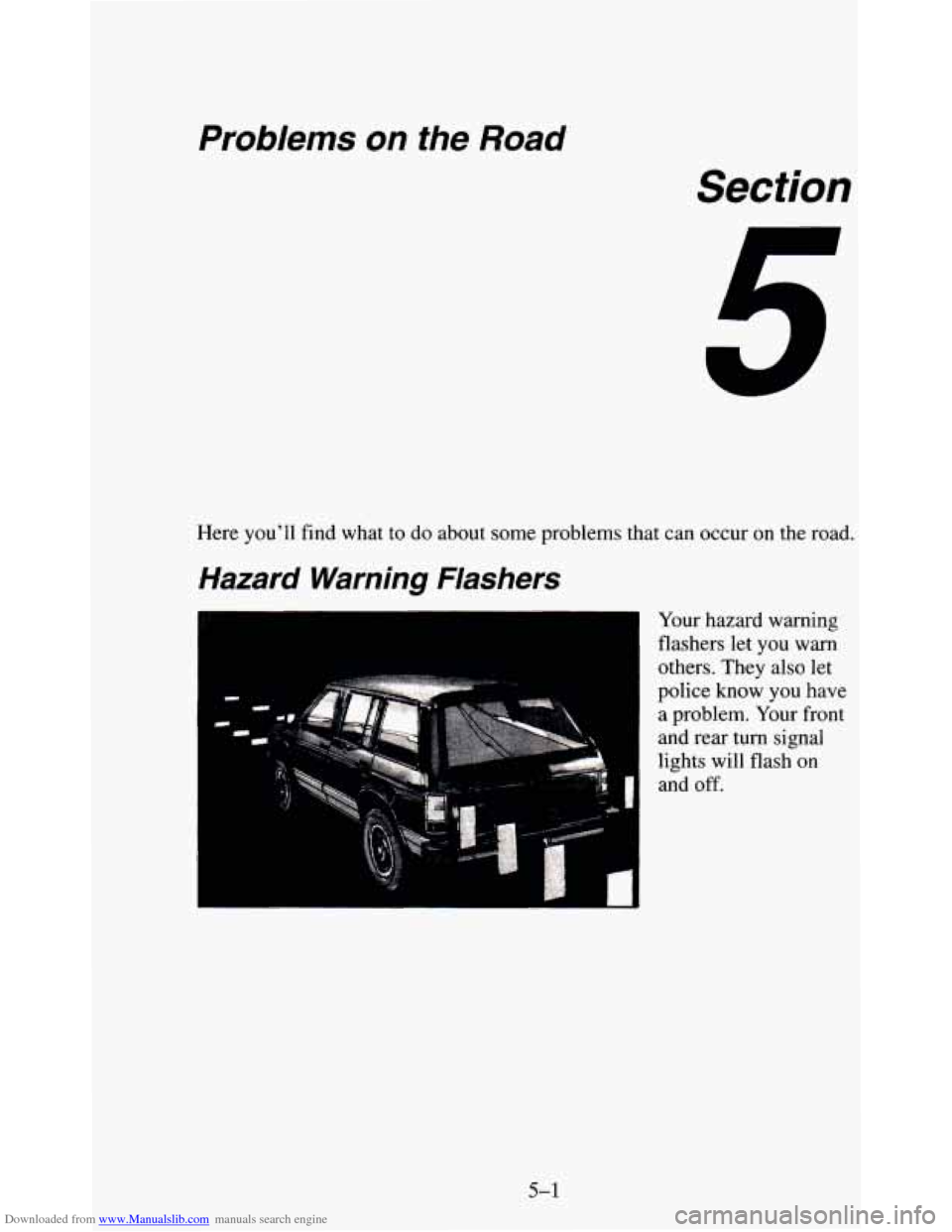
Hazard Warning Flashers
Your hazard warning
flashers let you warn
others. They also let
police know you have
a problem. Your front
and rear turn signal
lights will flash on
and
off.
5-1
Page 204 of 380
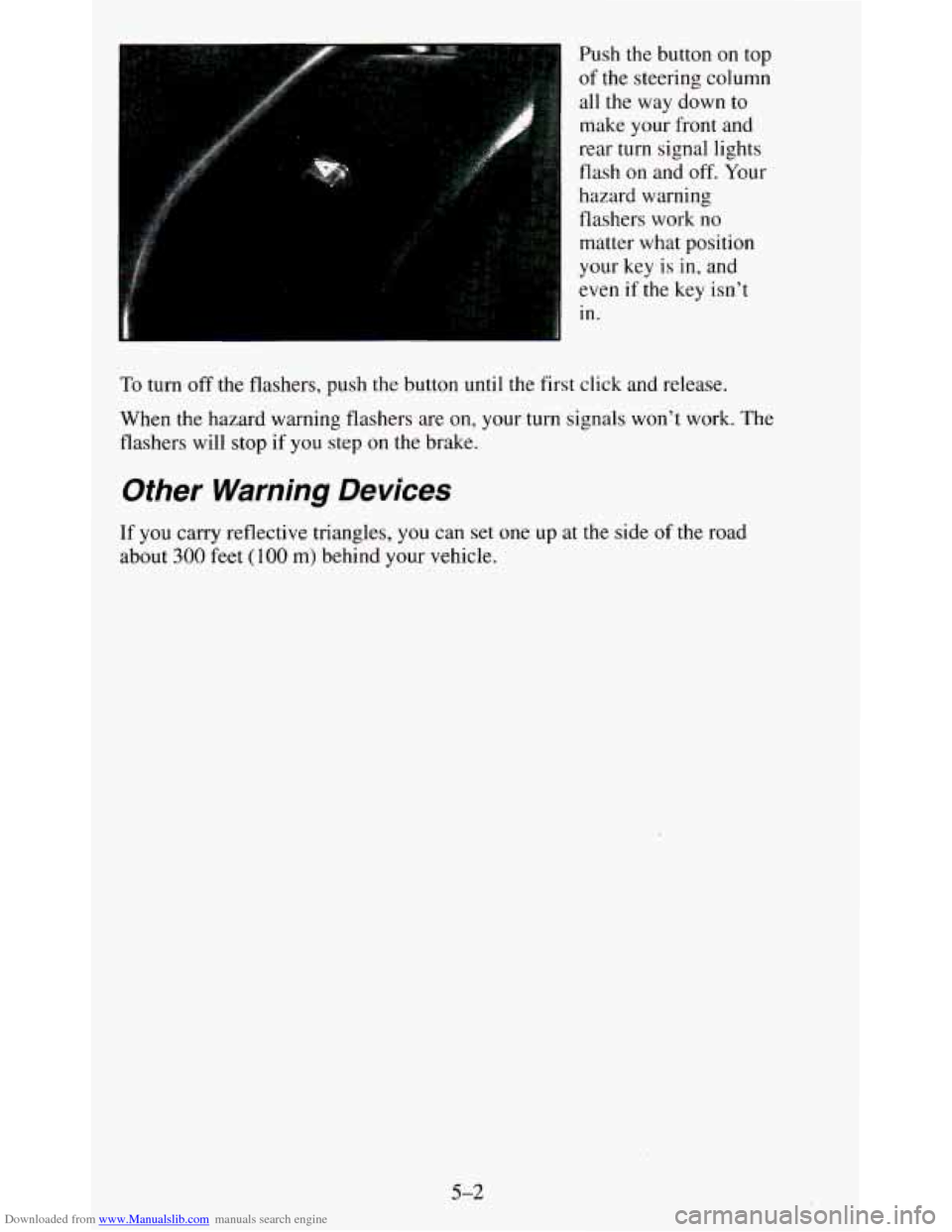
Downloaded from www.Manualslib.com manuals search engine , Push the button on top
i of the steering column
all
the way down to
make your front and
’ rear turn signal lights
flash on and off. Your
hazard warning
flashers work no matter what position
your key
is in, and
even if the key isn’t
in.
To turn off the flashers, push the button until the first click \
and release.
When the hazard warning flashers are on, your turn signals won\
’t work. The
flashers will stop if you step on the brake.
Other Warning Devices
If you carry reflective triangles, you can set one up at the side of the road
about
300 feet (100 m) behind your vehicle.
5-2
Page 206 of 380
Downloaded from www.Manualslib.com manuals search engine You could be injured if the vehicles roll. Set the parking brake firmly
on each vehicle. Put an automatic transmission in PARK (P) or a
manual transmission in NEUTRAL
(N). If you have a
four-wheel-drive vehicle with a manual transfer case shift lever, be
sure the transfer case
is not in NEUTRAL (N).
3. Turn off the ignition on both vehicles. Turn off all lights that aren’t
needed, and radios. This will avoid sparks and help save both batteries
And it could save your radio!
NOTICE:
If you leave your radio on, it could be badly damaged. The
repair wouldn’t be covered by your warranty.
~~
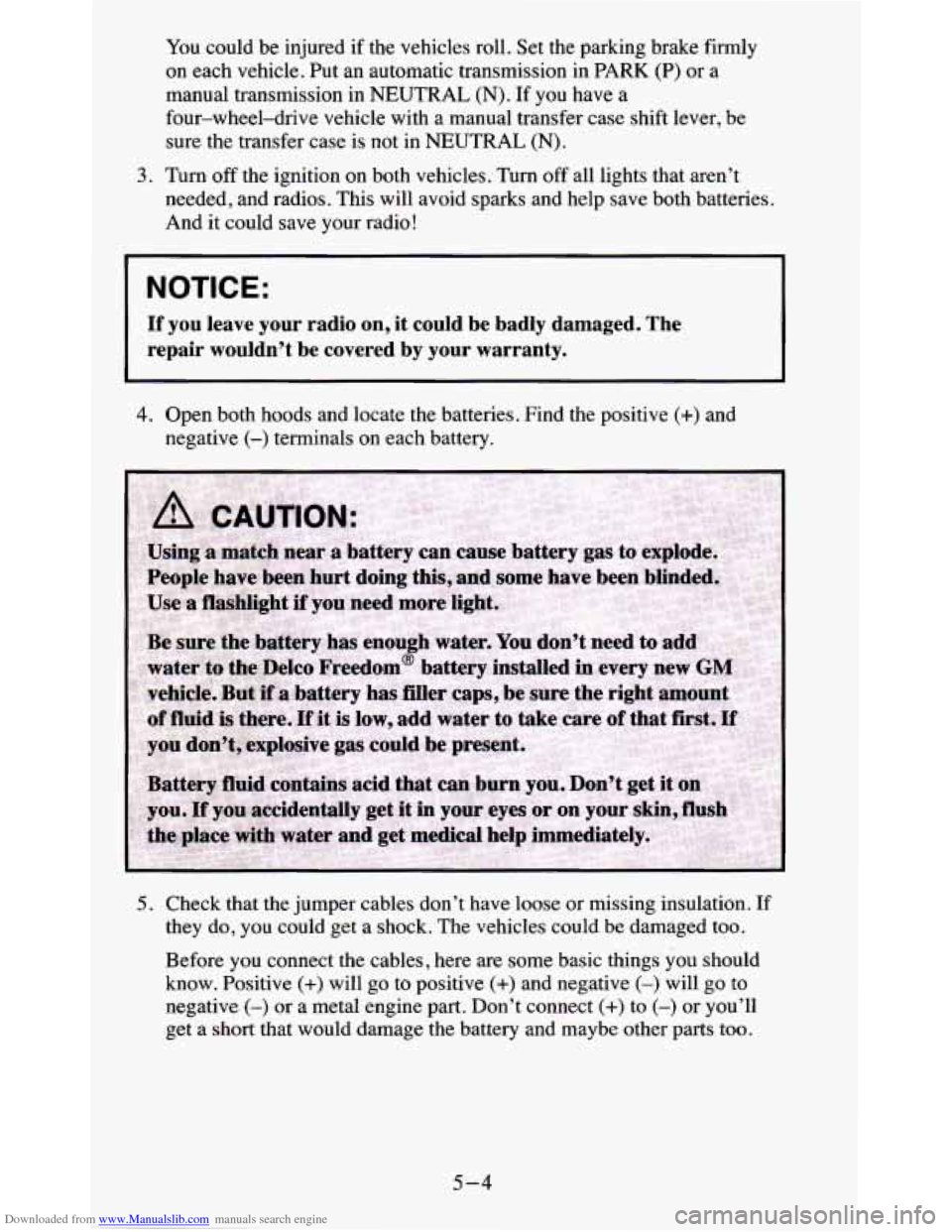
4. Open both hoods and locate the batteries. Find the positive (+) and
negative
(-) terminals on each battery.
5. Check that the jumper cables don’t have loose or missing insulation. If
they do, you could get a shock. The vehicles could be damaged too.
Before you connect the cables, here are some basic things you should
know. Positive (+) will go to positive (+) and negative (-) will go to
negative
(-) or a metal engine part. Don’t connect (+) to (-) or you’ll
get a
short that would damage the battery and maybe other parts too.
5-4
Page 261 of 380
Downloaded from www.Manualslib.com manuals search engine How to Check Lubricant
,:
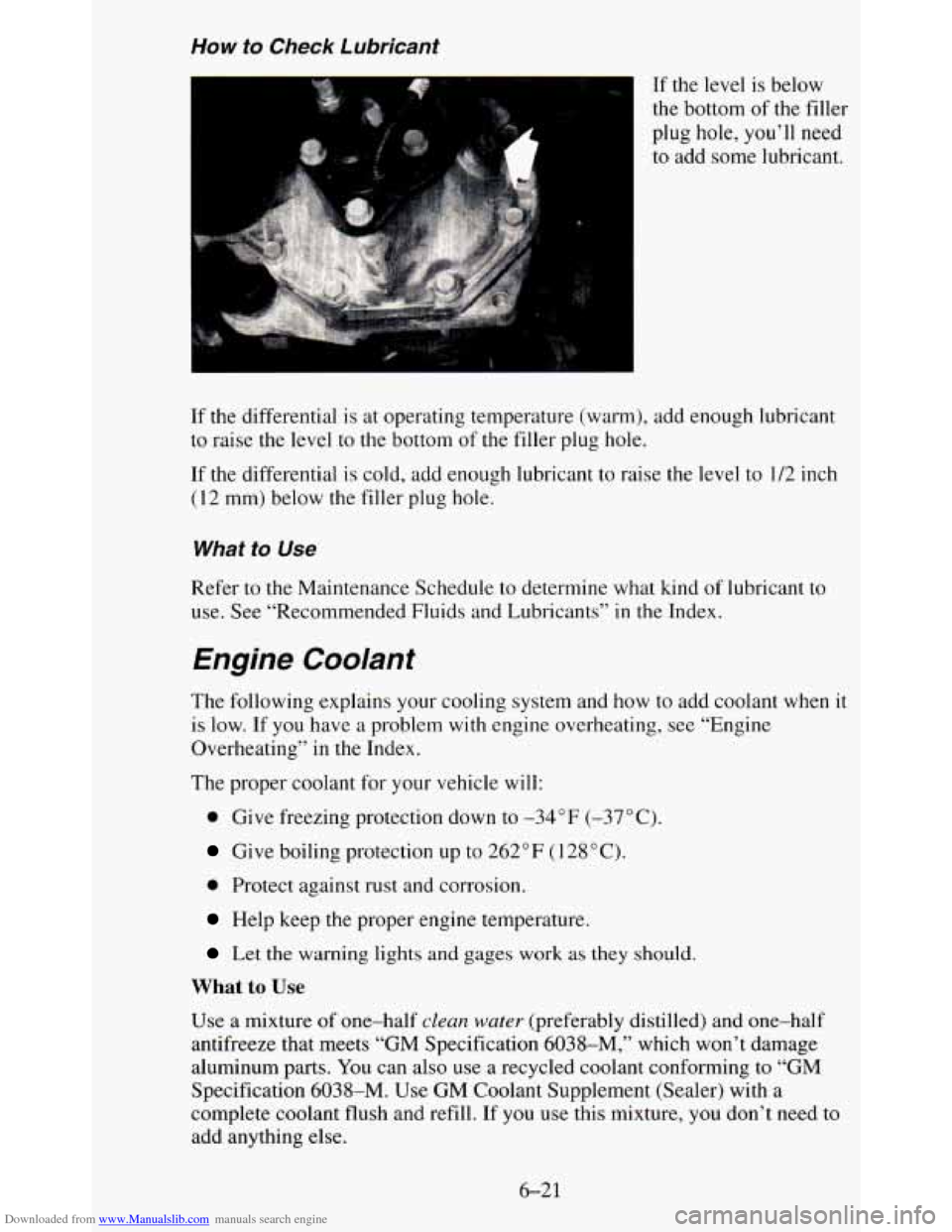
If the level is below
the bottom
of the filler
plug hole, you’ll need
to add some lubricant.
If the differential
is at operating temperature (warm), add enough lubricant
to raise the level to the bottom of the filler plug hole.
If the differential is cold, add enough lubricant to raise the le\
vel to 1/2 inch
(12 mm) below the filler plug hole.
What to Use
Refer to the Maintenance Schedule to determine what kind of lubricant to
use. See “Recommended Fluids and Lubricants”
in the Index.
Engine Coolant
The following explains your cooling system and how to add coolant \
when it
is low. If you have a problem with engine overheating, see “Engine
Overheating”
in the Index.
The proper coolant
for your vehicle will:
0 Give freezing protection down to -34°F (-37°C).
Give boiling protection up to 262°F (128°C).
0 Protect against rust and corrosion.
Help keep the proper engine temperature.
Let the warning lights and gages work as they should.
What to Use
Use a mixture of one-half clean water (preferably distilled) and one-half
antifreeze that meets “GM Specification 6038-M,” which won’t damage
aluminum parts.
You can also use a recycled coolant conforming to “GM
Specification 6038-M.
Use GM Coolant Supplement (Sealer) with a
complete coolant flush and refill. If
you use this mixture, you don’t need to
add anything else.
6-21
Page 301 of 380
Downloaded from www.Manualslib.com manuals search engine Headlamps
The headlamp wiring is protected by a circuit breaker in the light switch. An
electrical overload will cause the lights to go on and off, or in some cases to
remain
off. If this happens, have your headlamp wiring checked right away.
Windshield Wipers
The windshield wiper motor is protected by a circuit breaker and a fuse. If
the motor overheats due to heavy snow, etc., the wiper will stop until the
motor cools. If the overload is caused by some electrical problem and not
snow, etc., be sure to get it fixed.
Power Windows and Other Power Options
Circuit breakers in the fuse panel protect the power windows and other
power accessories. When the current load is too heavy, the cir\
cuit breaker
opens and closes, protecting the circuit until the problem is fixed.
Trailer Wiring Harness
The optional seven-wire trailer wiring harness is protected by an in-line
fuse in the battery feed wire. This fuse is near the junction block in the
front, driver’s side fender. See “Trailer Wiring Harness” in the
Features &
Controls section.
Fuse B/ock
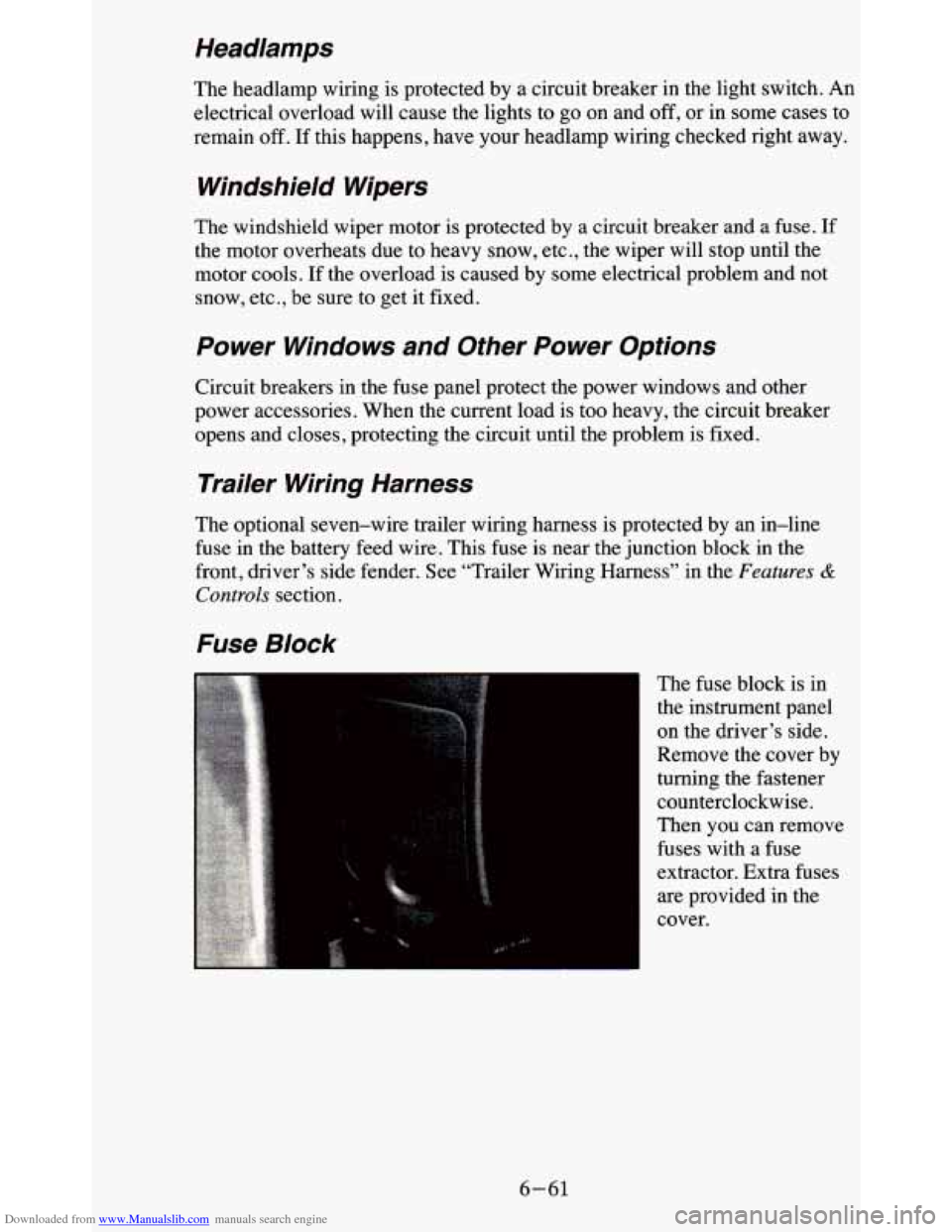
The fuse block is in
the instrument panel
on the driver’s side.
Remove the cover by
turning the fastener
counterclockwise.
Then you can remove
fuses with a fuse
extractor. Extra fuses
are provided in the
cover.
6-61
Page 369 of 380
Downloaded from www.Manualslib.com manuals search engine Index
A
Air Bag (See “Supplemental Inflatable Restraint System (SIR)”)
Readiness Light (See “Lights”)
Accessory Power Outlets
.......................................... 2-54
Aircleaner ..................................................... 6-13
Air Conditioning (See “Heater/Air Conditioning Controls”)
All-Wheel Drive (Option)
.................................... 2-29. 6-20
Antennacare ................................................... 3-19
Anti-Lock Brakes (See “Brakes”)
Appearancecare
................................................ 6-48
Materials Chart ............................................... 6-57
Arbitration Program (See “Better Business Bureau Mediation”)
Audiosystems
................................................... 3-5
AM-FM Stereo Audio Compact Disc (CD) System ................... 3-13
AM-FM Stereo Audio System .................................... 3-6
AM-FM Stereo Audio Cassette System ............................. 3-8
Care of Your Cassette Tape Player ................................ 3-18
Care of Your Compact Disc ..................................... 3-19
Delco LOC II@ Anti-Theft Feature ............................... 3-16
AM-FM Stereo Audio Cassette System with Equalizer ................ 3-10
Understanding Radio Reception .................................. 3-17
Automatic Transmission ( See “Transmission”)
Axle
Front
....................................................... 6-20
Locking ..................................................... 2-24
Rear ........................................................ 6-19
Battery ........................................................ 6-30
Belts (See “Safety Belts”)
Better Business Bureau Mediation
.................................... 8-3
Blizzard (See “Driving-If You’re Caught in a Blizzard”)
Brakes Adjustment
.................................................. 6-29
Anti-Lock .................................................... 4-6
Anti-Lock Warning Light (See “Lights”)
To Check Brake Fluid .......................................... 6-28
Master Cylinder .............................................. 6-27
Parking ..................................................... 2-24
PedalTravel ................................................. 6-29
Replacing Parts ............................................... 6-30
System Warning Light (See “Lights”)
Trailer (See “Trailer Brakes”)
Wear
....................................................... 6-29
Braking ......................................................... 4-5
InEmergencies ................................................ 4-7
Break-In. New Vehicle ............................................ 2-14
1
Page 372 of 380
Downloaded from www.Manualslib.com manuals search engine Engine (continued) FanNoise
................................................... 5-20
Identification
....................................... 6-58.6-59. 6-62
Oil (See “Oil”)
.l
RunningWhileParked ......................................... 2-28
Starting
..................................................... 2-16
Exhaust System
.................................................. 6-40
Overheating .................................................. 5-13
F .
Filter Replacement Chart (See “Service-Replacement Parts and Filter
Recommendations”)
FluidLeakCheck
................................................ 6-31
Fluids (See “Recommended Fluids and Lubricants”)
Four-wheel Drive
.......................................... 2.30. 6-20
Manual Transfer Case
.......................................... 2-30
Electronic Transfer Case
........................................ 2-32
Fuel
. FillingYourTank .............................................. 6-5
Foreign Countries .............................................. 64
Gage (See “Gages”)
Gasolines for Cleaner Air
....................................... :6-4
Tank Capacity ................................................. 6-63
Fuses and Circuit Breakers
................................... 6-60, 6-66
FuseBlock .................................................. 6-61
G
Gages Engine Coolant Temperature Gage
................................ 2-77
Oil Pressure Gage
............................................. 2-77
Trip Odometer
................................................ 247
FuelGage
................................................... 2-78
Odometer
................................................... 2-66
Speedometer
................................................. 2-66
Tachometer
.................................................. 2-67
Voltmeter
.................................................... 2-79
H
Halogen Bulbs (See “Bulb Replacement”)
Head Restraints (See “Seats”) Headlamps Hazard Wqing Flashers
........................................... 5-1
Replacement (See “Bulb Replacement”)
High Beam Indicator Light (See “Lights”)
. High-Low Beam Changer ................................. 2-39. 2-76
Reminder
.................................................... 249
Heater/Air Conditioning Controls
.................................... 3-1
Refrigerant Capacity
............................................ 6-71
Highway Hypnosis (See “Driving-Highway Hypnosis”)
Hitches (See “Towing a Trailer”)
4