steering CHEVROLET BLAZER 1995 2.G Owner's Manual
[x] Cancel search | Manufacturer: CHEVROLET, Model Year: 1995, Model line: BLAZER, Model: CHEVROLET BLAZER 1995 2.GPages: 380, PDF Size: 20.04 MB
Page 187 of 380
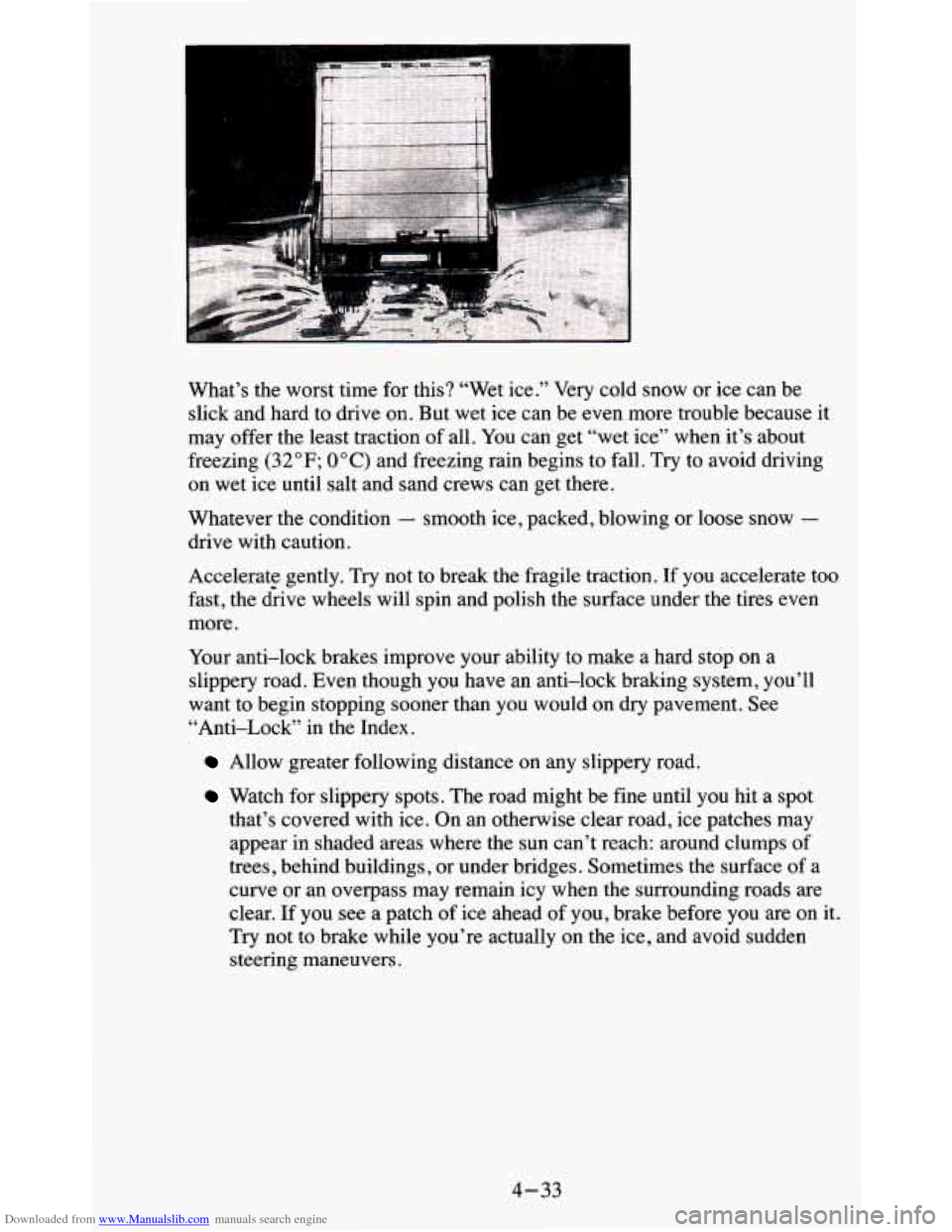
Downloaded from www.Manualslib.com manuals search engine What’s the worst time for this? “Wet ice.” Very cold snow or ice can be
slick and hard to drive on.
But wet ice can be even more trouble because it
may offer the least traction of all. You can get “wet ice” when it’s about
freezing
(32°F; 0°C) and freezing rain begins to fall. Try to avoid driving
on wet ice until salt and sand crews can get there.
Whatever the condition
- smooth ice, packed, blowing or loose snow -
drive with caution.
Accelerate gently. Try not to break the fragile traction. If you accelerate too
fast, the dkve wheels will spin and polish the surface under the tires even
more.
Your anti-lock brakes improve your ability
to make a hard stop on a
slippery road. Even though you have an anti-lock braking system, you’ll
want to begin stopping sooner than you would on dry pavement. \
See
“Anti-Lock” in the Index.
Allow greater following distance on any slippery road.
Watch for slippery spots. The road might be fine until you hit a spot
that’s covered with ice. On
an otherwise clear road, ice patches may
appear in shaded areas where the sun can’t reach: around cl\
umps of
trees, behind buildings,
or under bridges. Sometimes the surface of a
curve or an overpass may remain icy when the surrounding roads are
clear. If you see a patch of ice ahead of you, brake before you are on it.
Try not to brake while you’re actually on the ice, and avoid sudden
steering maneuvers.
4-33
Page 191 of 380
Downloaded from www.Manualslib.com manuals search engine 2. Insert the ignition key into the ignition switch and turn it one notch
forward of the
LOCK position. This places the key into the OFF
position, which unlocks the steering column while preventing battery
drain. Unlocking the steering column
will allow for proper movement
of the front wheeldtires during towing.
I NOTICE:
I You should exercise extra care whenever towing another vehicle. \
Loading Your Vehicle
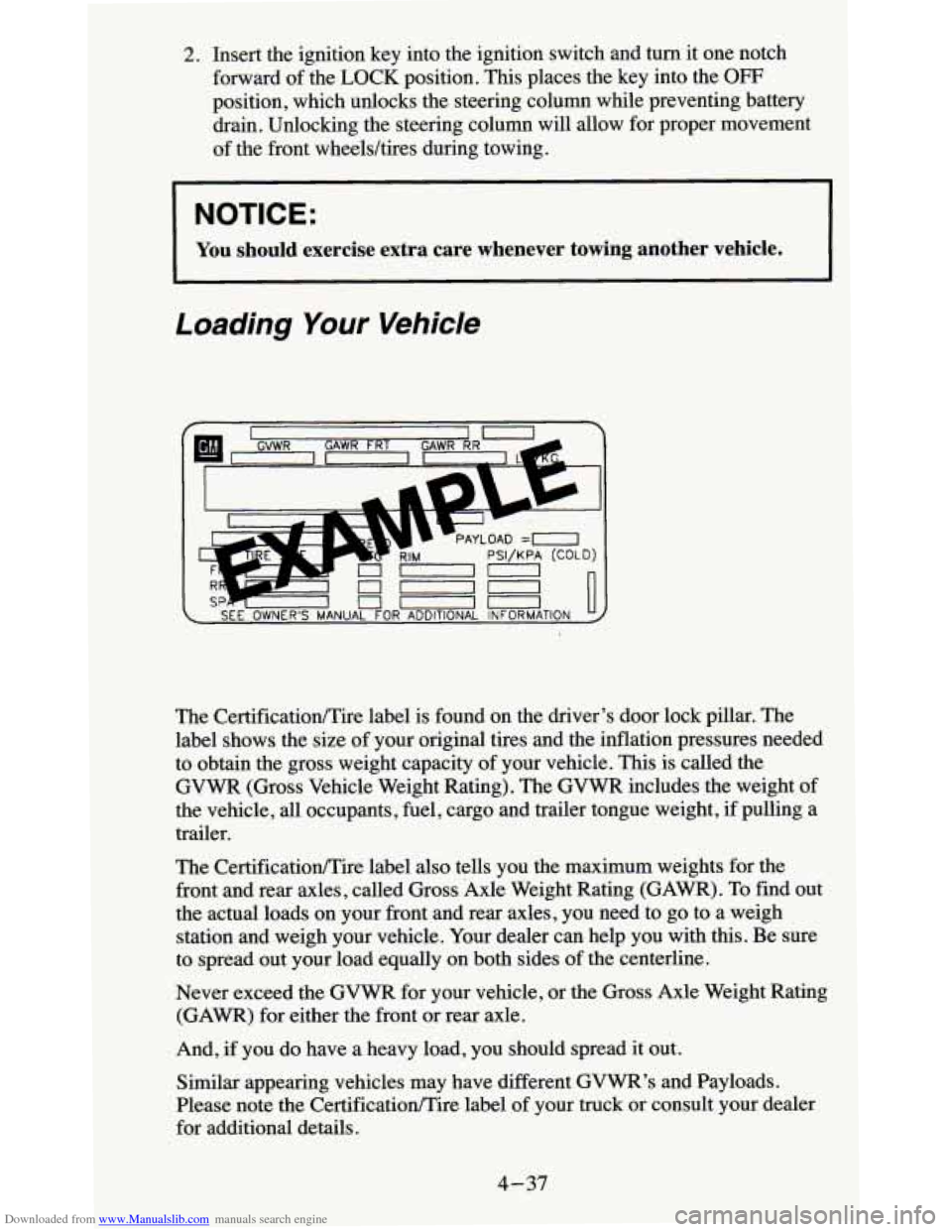
The CertificationEire label also tells you the maximum weights for the
front and rear axles, called Gross Axle Weight Rating (GAWR). To find out
the actual loads on your front and rear axles, you need to go to a weigh
station and weigh your vehicle. Your dealer can help
you with this. Be sure
to spread out your load equally on both sides
of the centerline.
Never exceed the
GVWR for your vehicle, or the Gross Axle Weight Rating
(GAWR) for either the front or rear axle.
And, if you do have
a heavy load, you should spread it out.
Similar appearing vehicles may have different
GVWR’s and Payloads.
Please note the CertificationEire label
of your truck or consult your dealer
for additional details.
4-37
Page 199 of 380
Downloaded from www.Manualslib.com manuals search engine Passing
You’ll need more passing distance up ahead when you’re towing a trailer.
And, because you’re a good deal longer, you’ll need to go much farther
beyond the passed vehicle before you can return to your lane.
Backing Up
Hold the bottom of the steering wheel with one hand. Then, to move the
trailer to the left, just move that hand to the left. To move the trailer to the
right, move your hand to the right. Always back up slowly and, if possible,
have someone guide you.
Making Turns
NOTICE:
Making very sharp turns while trailering could cause the traile\
r
to come in contact with the vehicle. Your vehicle could be
damaged. Avoid making very sharp turns while trailering.
When you’re turning with a trailer, make wider turns than normal. Do this
so your trailer won’t strike soft shoulders, curbs, road signs, trees, or other
objects. Avoid jerky or sudden maneuvers. Signal well in advance.
Turn Signals When Towing a Trailer
When you tow a trailer, your vehicle has to have extra wiring and a
heavy-duty
turn signal flasher (included in the optional trailering package).
The green arrows on your instrument panel will flash whenever you signal a
turn or lane change. Properly hooked up, the trailer lamps will also flash,
telling other drivers you’re about to turn, change lanes or stop.
When towing a trailer, the green arrows on your instrument panel will flash
for turns even if the bulbs on the trailer are burned out. Thus, you may think
drivers behind you are seeing your signal when they are not. It’s important
to check occasionally to be sure the trailer bulbs are still working.
Driving On Grades
Reduce speed and shift to a lower gear before you start down a long or steep
downgrade. If you don’t shift down, you might have to use your brakes
so
much that they would get hot and no longer work well.
On a long uphill grade, shift down and reduce your speed to around 45 mph
(70 Wh) to reduce the possibility of engine and transmission overheating.
4-45
Page 204 of 380
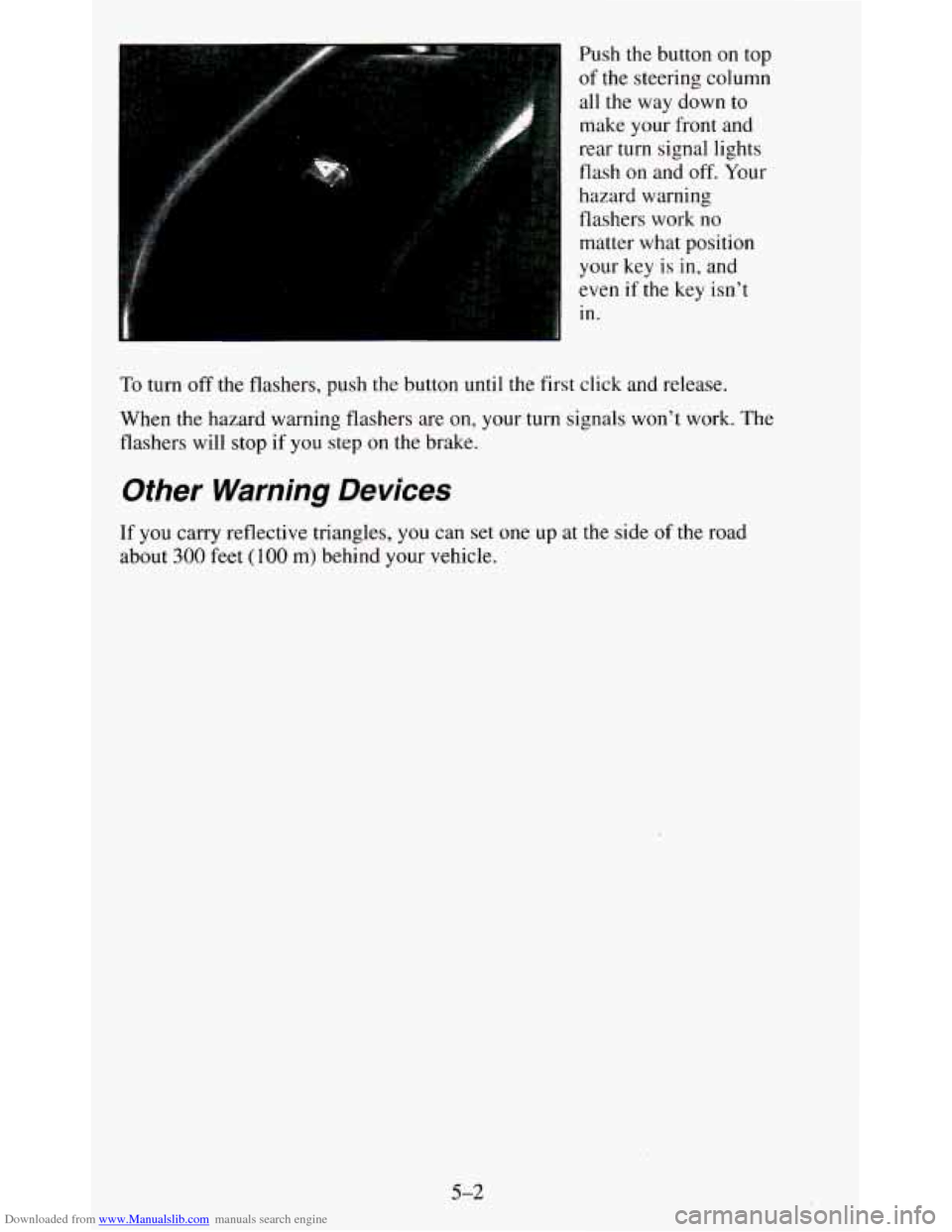
Downloaded from www.Manualslib.com manuals search engine , Push the button on top
i of the steering column
all
the way down to
make your front and
’ rear turn signal lights
flash on and off. Your
hazard warning
flashers work no matter what position
your key
is in, and
even if the key isn’t
in.
To turn off the flashers, push the button until the first click \
and release.
When the hazard warning flashers are on, your turn signals won\
’t work. The
flashers will stop if you step on the brake.
Other Warning Devices
If you carry reflective triangles, you can set one up at the side of the road
about
300 feet (100 m) behind your vehicle.
5-2
Page 210 of 380
Downloaded from www.Manualslib.com manuals search engine When your vehicle is being towed, have the ignition key off. The steering
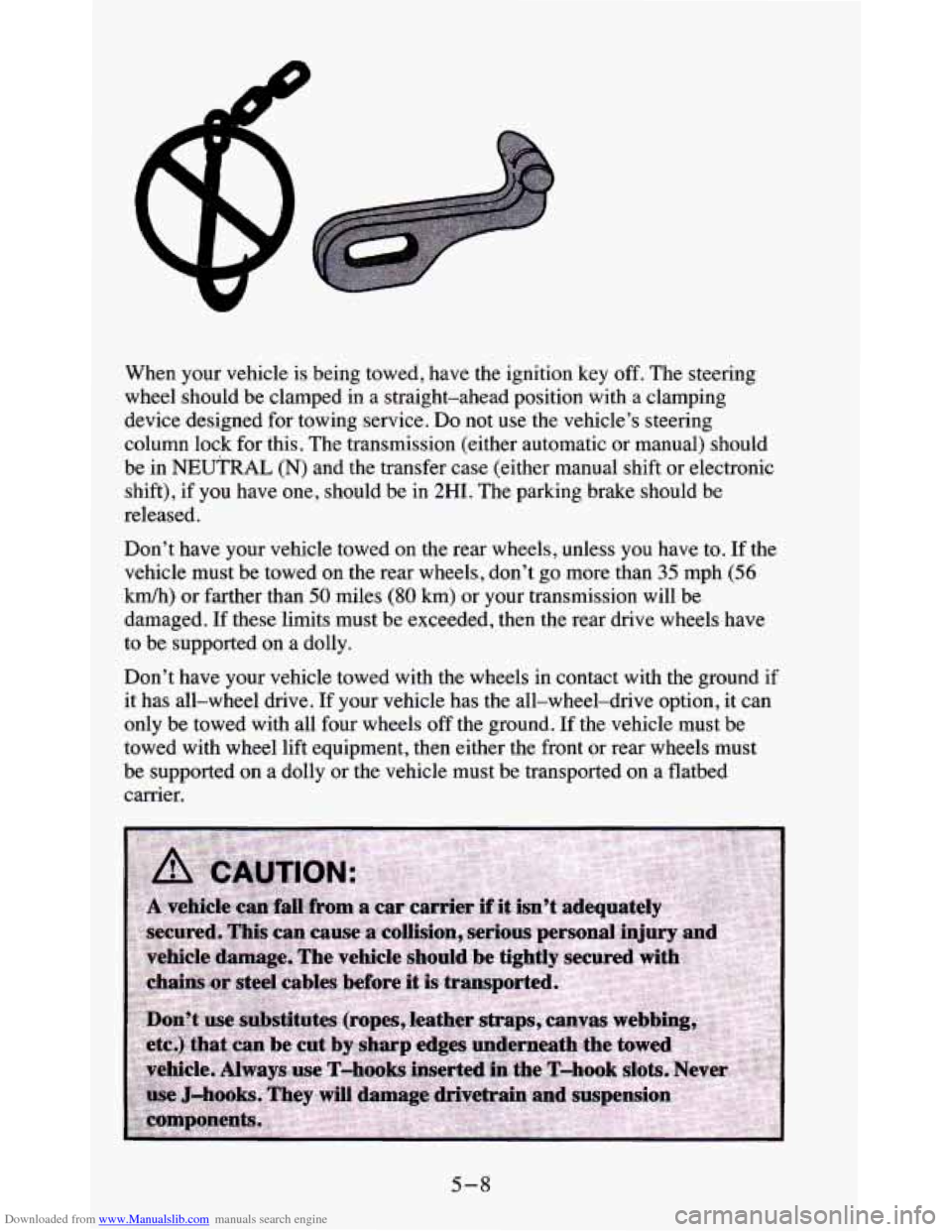
wheel should be clamped in a straight-ahead position with a clamping
device designed for towing service. Do not use the vehicle’s steering
column lock
for this. The transmission (either automatic or manual) should
be
in NEUTRAL (N) and the transfer case (either manual shift or electronic
shift), if you have one, should be in
2HI. The parking brake should be
released.
Don’t have your vehicle towed
on the rear wheels, unless you have to. If the
velucle must be towed
on the rear wheels, don’t go more than 35 mph (56
Mh) or farther than 50 miles (80 km) or your transmission will be
damaged. If these limits must be exceeded, then the rear drive wheels have
to be supported on a dolly.
Don’t have your vehicle towed with the wheels in contact with the ground if
it has all-wheel drive. If your vehicle has the all-wheel-drive option,
it can
only be towed with all four wheels off the ground. If the vehicle must be
towed with wheel lift equipment, then either the front or rear wheels must
be supported
on a dolly or the vehicle must be transported on a flatbed
carrier.
5-8
Page 223 of 380
Downloaded from www.Manualslib.com manuals search engine If a Tire Goes Flat
It’s unusual for a tire to “blow out” while you’re driving, especially if you
maintain your tires properly. If air goes out
of a tire, it’s much more likely to
leak out slowly. But
if you should ever have a “blowout,” here are a few tips
about what to expect and what
to do:
If a front tire fails, the flat tire will create a drag that pulls the vehicle
toward that side. Take your foot
off the accelerator pedal and grip the
steering wheel firmly. Steer to maintain lane position, then ge\
ntly brake to a
stop well out of the traffic lane.
A rear blowout, particularly on a curve, acts much like a skid and may
require the same correction you’d use in a skid. In any rear blowout, remove
your foot from
the accelerator pedal. Get the vehicle under control by
steering the way you want the vehicle to go. It may be very bumpy and
noisy, but you can still steer. Gently brake to a stop, well
off the road if
possible.
If a tire goes flat,
the next part shows how to use your jacking equipment to
change
a flat tire safely.
Changing a Flat Tire
If a tire goes flat, avoid further tire and wheel damage by driving slowly to a
level place.
Turn on your hazard warning flashers.
5-21
Page 238 of 380

Downloaded from www.Manualslib.com manuals search engine NOTICE:
Spinning your wheels can destroy parts of your vehicle as well\
as
the tires. If
you spin the wheels too fast while shifting your
transmission back
and forth, you can destroy your transmission.
For information about using tire chains on your vehicle, see “Tire Chains”
in the Index.
Rocking your vehicle to get it out:
First, turn your steering wheel left and right. That will clear the area around
your front wheels. Then shift back and forth between REVERSE (R) and a \
forward gear (or with
a manual transmission, between FIRST (1) or
SECOND
(2) gear and REVERSE), spinning the wheels as little as possible.
Release the accelerator pedal while you shift, and press lightly on the
accelerator pedal when the transmission is in gear. If that doesn’t get you
out after
a few tries, you may need to be towed out. Or, you can use your
recovery hooks, if your vehicle has them. If you do need to be towed out,
see “Towing Your Vehicle” in the Index.
Using the Recovery Hooks
I
Your vehicle may be equipped with recovery hooks. The recovery hooks\
are
provided at the front
of your vehicle. You may need to use them if you’re
stuck off-road and need
to be pulled to some place where you can continue
driving.
5-36
Page 253 of 380
Downloaded from www.Manualslib.com manuals search engine Four-wheel Drive Remote Oil Filter
If your vehicle has four-wheel drive, you will have a remote oil filter. There
is a special access door in the steering linkage shield assembly located under
the radiator support. Twist the screw to lock or unlock the door.
Engine Coolant Heater
An engine coolant heater can be a big help if you have to park outside in
very cold weather,
0°F (-18 “C) or colder. If your vehicle has this option,
see “Engine Coolant Heater” in
the Index.
What to Do with Used Oil
Did you know that used engine oil contains certain elements that may be
unhealthy for your skin and could even cause cancer? Don’t let used oil stay
on your skin for very long. Clean your skin and nails with soap and water,
or a good hand cleaner. Wash or properly throw away clothing or rags
containing used engine oil. (See the manufacturer’s warnings about the use
and disposal of oil products.)
Used oil can be a real threat to the environment. If you change your own oil,
be sure to drain all free-flowing oil from the filter before disposal. Don’t
ever dispose of oil by putting it in the trash, pouring
it on the ground, into
sewers, or into streams or bodies of water. Instead, recycle it by taking
it to
a place that collects used oil. If you have a problem properly disposing of
your used oil, ask your dealer, a service station or a local recycling center
for help.
Air Cleaner
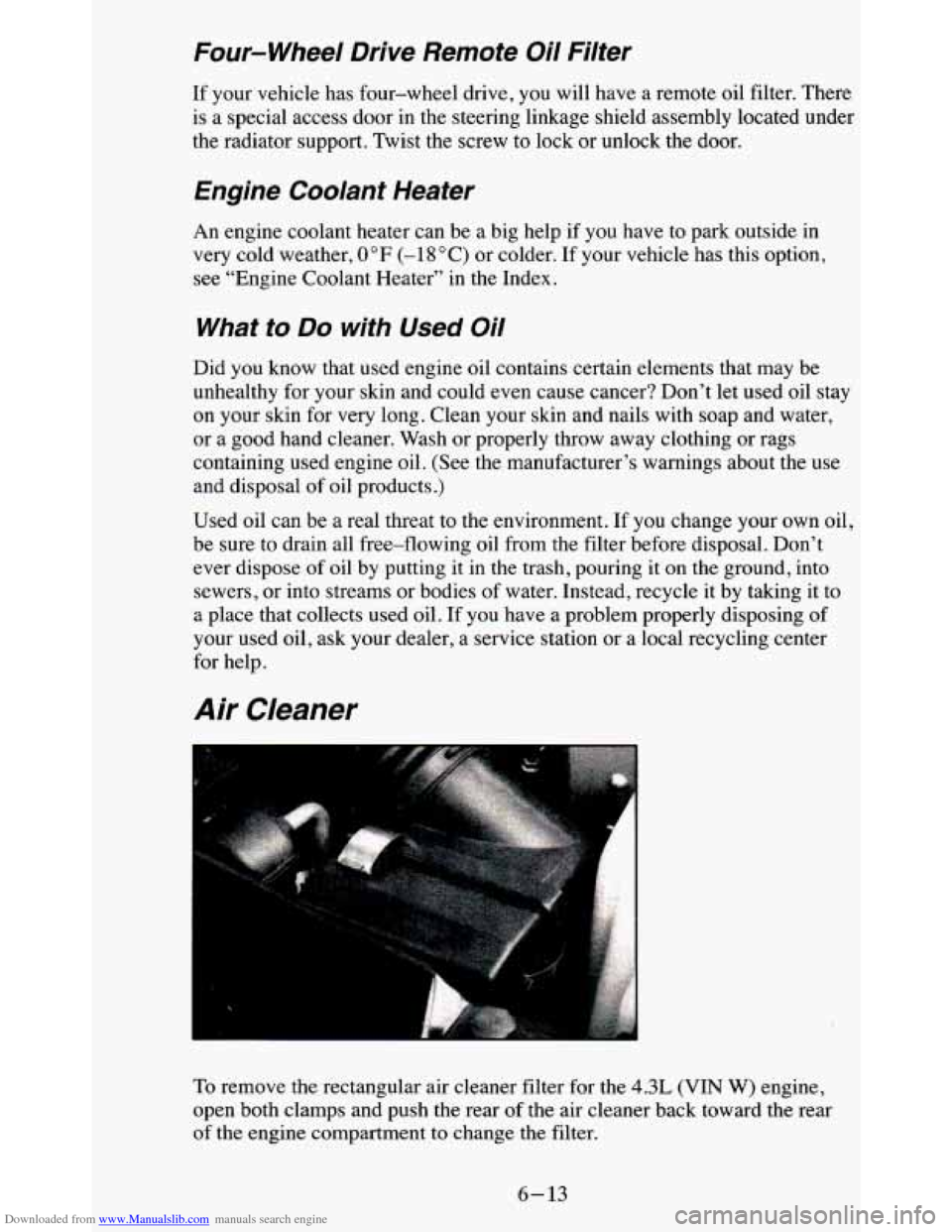
To remove the rectangular air cleaner filter for the 4.3L (VIN W) engine,
open both clamps and push the rear
of the air cleaner back toward the rear
of the engine compartment to change the filter.
6-13
Page 265 of 380
Downloaded from www.Manualslib.com manuals search engine Power Steering Fluid
How To Check Power Steering Fluid
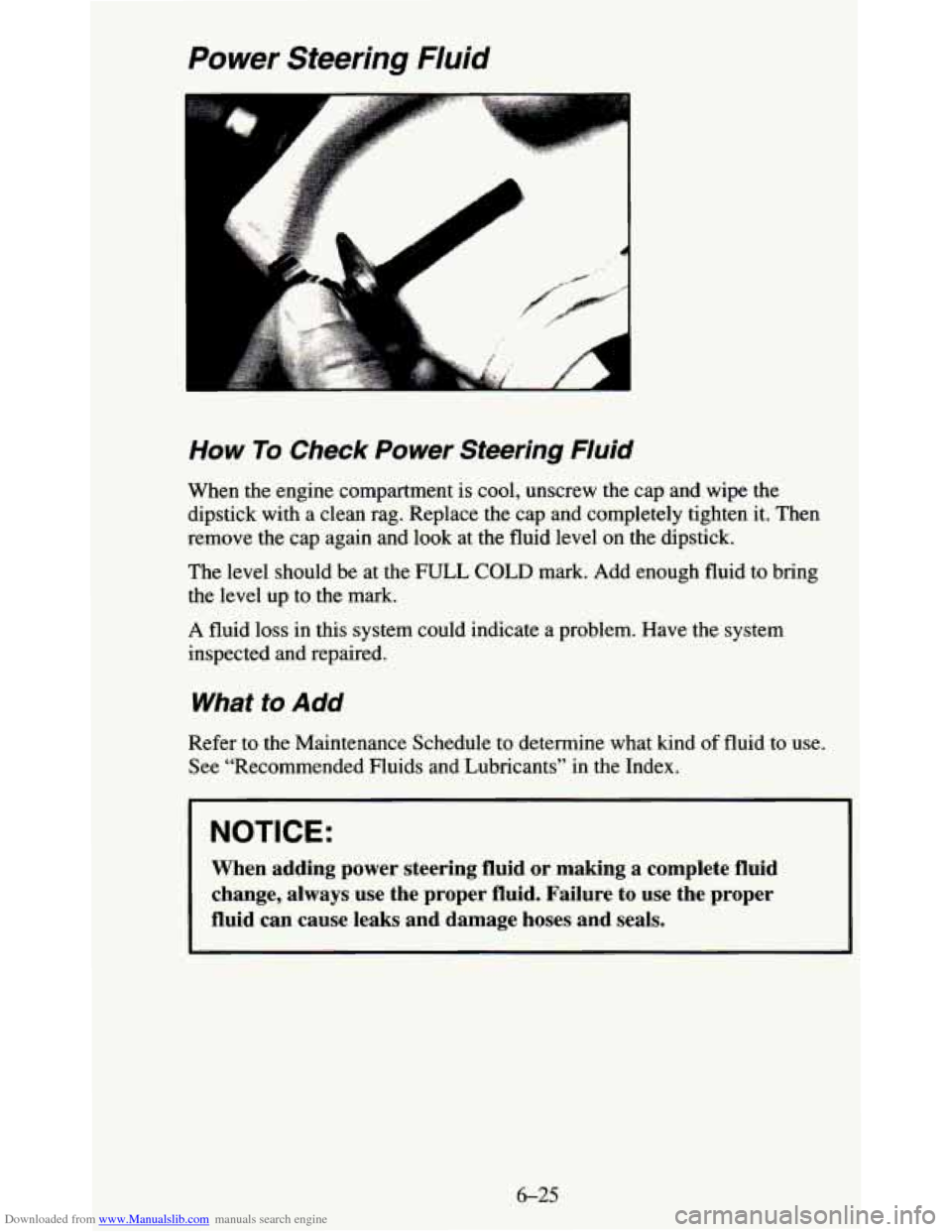
When the engine compartment is cool, unscrew the cap and wipe the
dipstick with a clean rag. Replace the cap and completely tighten it. Then
remove the cap again and look at the fluid level on the dips\
tick.
The level should be at the
FULL COLD mark. Add enough fluid to bring
the level up to the mark.
A fluid loss in this system could indicate a problem. Have the system
inspected and repaired.
What to Add
Refer to the Maintenance Schedule to determine what kind of fluid to use.
See “Recommended Fluids and Lubricants” in the Index.
NOTICE:
When adding power steering fluid or making a complete fluid
change, always use the proper fluid. Failure to use the proper\
fluid can cause leaks and damage hoses and seals.
6-25
Page 318 of 380
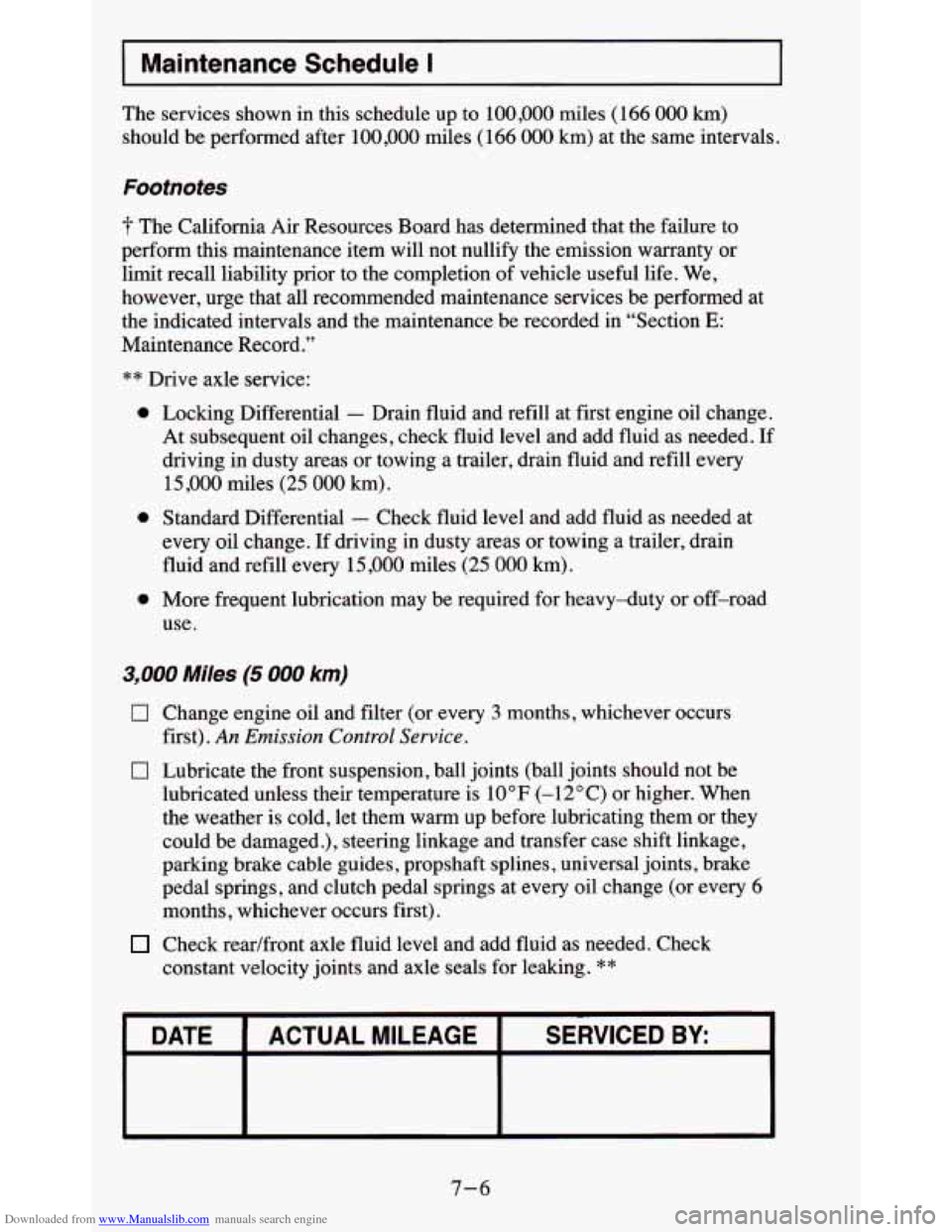
Downloaded from www.Manualslib.com manuals search engine I Maintenance Schedule I
The services shown in this schedule up to 100,000 miles (166 000 km)
should be performed after 100,000 miles (166 000 km) at the same intervals.
Footnotes
? The California Air Resources Board has determined that the failure to
perform this maintenance item will not nullify the emission warranty or
limit recall liability prior to the completion of vehicle useful life. We,
however, urge that all recommended maintenance services be performed at
the indicated intervals and the maintenance be recorded in “\
Section
E:
Maintenance Record.”
** Drive axle service:
0
0
0
Locking Differential - Drain fluid and refill at first engine oil change.
At subsequent oil changes, check fluid level and add fluid as needed.
If
driving in dusty areas or towing a trailer, drain fluid and refill every
15,000 miles (25
000 km).
Standard Differential
- Check fluid level and add fluid as needed at
every oil change. If driving in dusty areas or towing
a trailer, drain
fluid and refill
every 15,000 miles (25 000 km) .
More frequent lubrication may be required for heavy-duty or off-road
use.
3,000 Miles (5 000 km)
0
0
Change engine oil and filter (or every 3 months, whichever occurs
first).
An Emission Control Service.
Lubricate the front suspension, ball joints (ball joints should not be
lubricated unless their temperature is 10°F (-1 2°C) or higher. When
the weather is cold, let them warm up before lubricating them
or they
could be damaged.), steering linkage and transfer case shift linkage,
parking brake cable guides, propshaft splines, universal joints, brake
pedal springs, and clutch pedal springs at every
oil change (or every 6
months
, whichever occurs first).
Check readfront axle fluid level and add fluid as needed. Check
constant velocity joints and axle seals for leaking.
**
I DATE I ACTUALMILEAGE I SERVICED BY:
7-6