automatic transmission CHEVROLET BLAZER 1996 2.G User Guide
[x] Cancel search | Manufacturer: CHEVROLET, Model Year: 1996, Model line: BLAZER, Model: CHEVROLET BLAZER 1996 2.GPages: 392, PDF Size: 20.35 MB
Page 84 of 392
Downloaded from www.Manualslib.com manuals search engine Shifting from 4LO to 4HI
To shift from 4LO to 4H1, your vehicle must be
stopped or moving
less than 3 mph (4.8 km/h) with the
transmission
in NEUTRAL (N) or the clutch pedal
engaged. The preferred method for shifting out
of
4LO is to have your vehicle moving 1 to 2 mph
(1.6 to 3.2 km/h). Press and release the 4HI switch.
You must wait for
the 4HI indicator light to stop
flashing and remain illuminated before shifting your
transmission into gear or releasing the clutch pedal.
If the 4HI switch is pressed when your vehicle is in
gear and/or moving, the 4HI indicator light will flash
for
30 seconds but not complete the shift unless the
vehicle is moving slower than
3 mph (4.8 km/h) and
the transmission is in NEUTRAL
(N) or the clutch
pedal engaged. On automatic transmission equipped vehicles,
if your
transfer case does not shift into 4H1, your transmission
indicator switch may require adjustment. With your
transmission in NEUTRAL
(N), press and release the
4HI switch. While the 4HI indicator light is flashing,
shift your transmission into PARK
(P). Wait until the
4HI indicator light remains illuminated before shifting
your transmission into gear. This will get you into 4H1,
but you should take your vehicle
in for service to restore
normal operation.
Parking Brake
To set the parking brake, hold the regular brake pedal
down with your right foot. Push down the parking brake
pedal with your left foot. If
the ignition is on, the brake
system warning light will come on.
To release
the parking brake hold the regular brake
pedal down.
2-26
Page 85 of 392
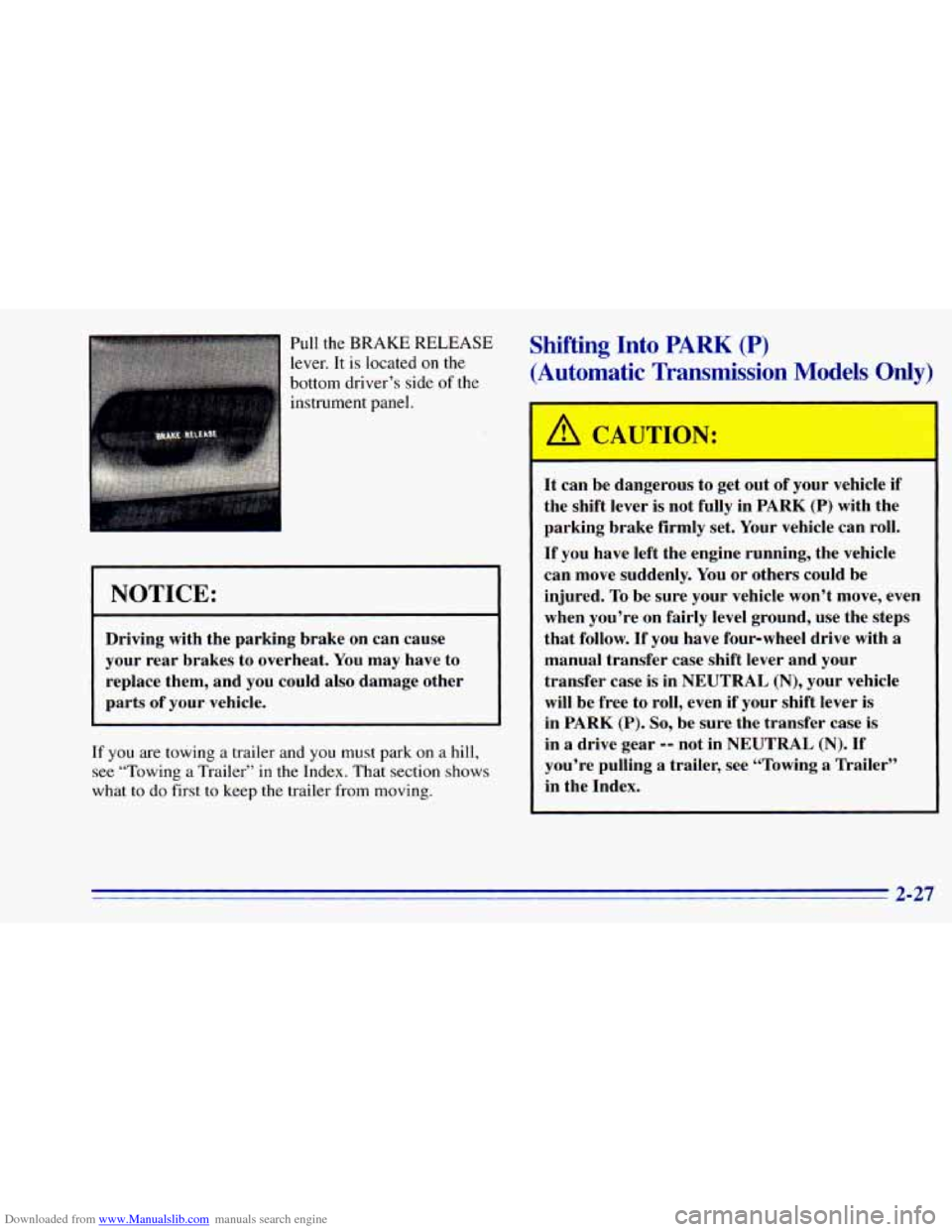
Downloaded from www.Manualslib.com manuals search engine Pull the BRAKE RELEASE
lever. It is located
on the
bottom driver’s side
of the
instrument panel.
Shifting Into PARK (P)
(Automatic Transmission Models Only)
NOTICE:
Driving with the parking brake on can cause
your rear brakes to overheat. You may have to
replace them, and you could also damage other
parts of your. vehicle.
If
you are towing a trailer and you must park on a hill,
see “Towing a Trailer’’ in the Index. That section shows
what
to do first to keep the trailer from moving.
A CAUTION:
It can be dangerous to get obL df your vehicle if
the shift lever is not fully in
PARK (P) with the
parking brake firmly set. Your vehicle can roll.
If you have left the engine running, the vehicle
can move suddenly. You or others could be
injured. To be sure your vehicle won’t move, even
when you’re on fairly level ground, use the steps
that follow. If you have four-wheel drive with
a
manual transfer case shift lever and your
transfer case is in
NEUTRAL (N), your vehicle
will be free to roll, even if your shift lever is
in
PARK (P). So, be sure the transfer case is
in a drive gear -- not in NEUTRAL (N). If
you’re pulling a trailer, see “Towing
a Trailer”
in the Index.
2-27
Page 87 of 392
Downloaded from www.Manualslib.com manuals search engine Console Shift Lever
1. Hold the brake pedal down with your right foot and
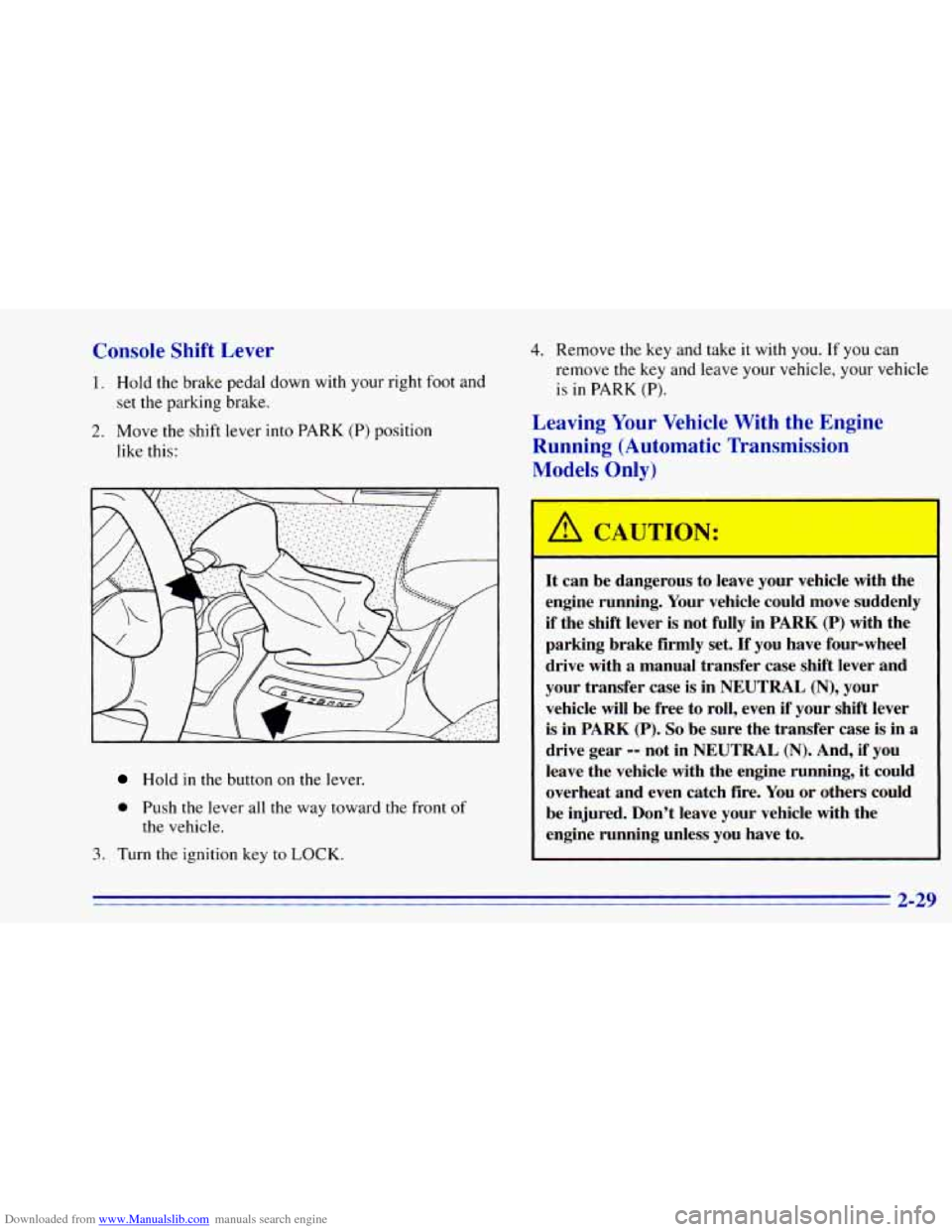
2. Move the shift lever into PARK (P) position
set the
parking brake.
like this:
4. Remove the key and take it with you. If you can
remove the key and leave your vehicle, your vehicle
is in PARK
(P).
Leaving Your Vehicle With the Engine
Running (Automatic Transmission
Models Only)
Hold in the button on the lever.
0 Push the lever all the way toward the front of
the vehicle.
1. Turn the ignition key to LOCK.
It can be dangerous to leave your vehicle with the
engine running. Your vehicle could move suddenly
if the shift lever is not fully in PARK (P) with the
parking brake firmly set.
If you have four-wheel
drive with
a manual transfer case shift lever and
your transfer case is in
NEUTRAL (N), your
vehicle will be free to roll, even if your shift lever
is in PARK
(P). So be sure the transfer case is in a
drive gear -- not in NEUTRAL (N). And, if you
leave the vehicle with the engine running, it could
overheat and even catch fire. You or others could
be injured. Don’t leave your vehicle with the
engine running unless you have to.
Page 88 of 392
Downloaded from www.Manualslib.com manuals search engine If you have to leave your vehicle with the engine
running, be sure your vehicle is in PARK (P) and your
parking brake is firmly set before
you leave it. After
you’ve moved the shift lever into the PARK (P)
position, hold the regular brake pedal down. Then, see
if you can move
the shift lever away from PARK (P)
without first pulling it toward
you or pressing the button
on a console shift lever. If you can, it means that the
shift lever wasn’t fully locked into PARK
(P).
Torque Lock (Automatic Transmission)
If you are parking on a hill and you don’t shift your
transmission into PARK (P) properly, the weight of
the
vehicle may put too much force on the parking pawl in
the transmission. You
may find it difficult to pull the
shift lever out
of PARK (P). This is called “torque lock.”
To prevent torque lock, set the parking brake and then
shift into PARK (P) properly before you leave the
driver’s seat. To find
out how, see “Shifting Into
PARK (P)” in the Index.
When you are ready to drive, move the shift lever
out of
PARK (P) before you release the parking brake.
If torque lock does occur, you may need to have another
vehicle push yours a little uphill to take some
of the
pressure from the transmission,
so you can pull the shift
lever out of PARK
(P).
Shifting Out of PARK (P)
(Automatic Transmission)
Your vehicle has a brake-transmission shift interlock.
You have to fully apply your regular brake before you
can shift from PARK (P) when the ignition is in the
RUN position. See “Automatic Transmission Operation”
in the Index.
If
you cannot shift out of PARK (P), ease pressure on
the shift lever -- push the shift lever all the way into
PARK (P) as
you maintain brake application. Then
move the shift lever into the gear you want (you must
press the shift lever button if you have the console
shift lever).
If
you ever hold the brake pedal down but still can’t
shift out
of PARK (P), try this:
1. Turn
the key to OFF.
2. Apply and hold the brake until the end of Step 4.
3. Shift to NEUTRAL (N).
4. Start the vehicle and then shift to the drive gear
5. Have the vehicle fixed as soon as you can.
you want.
2-30
Page 90 of 392
Downloaded from www.Manualslib.com manuals search engine Engine Exhaust
A CAUTION:
Engine exhaust can kill. It ‘contains the gas
carbon monoxide
(CO), which you can’t see or
smell. It can cause unconsciousness and death.
You might have exhaust coming in if:
Your exhaust system sounds strange
Your vehicle gets rusty underneath.
Your vehicle was damaged in a collision.
0 Your vehicle was damaged when driving over
high points on the road or over road debris.
Repairs weren’t done correctly.
Your vehicle or exhaust system had been
If you ever suspect exhaust
is coming into
your vehicle:
Drive it only with all the windows down to
Have your vehicle fixed immediately.
or
different.
modified improperly.
blow out any
CO; and
Running Your Engine While You’re
Parked (Automatic Transmission)
It’s better not to park with the engine running. But if you
ever have to, here are some things to know.
Idling the engine with the air system control
off could allow dangerous exhaust into
your vehicle (see the earlier Caution under
“Engine Exhaust”).
Also, idling in
a closed-in place can let deadly
carbon monoxide
(CO) into your vehicle even
if the fan switch is
at the highest setting. One
place this can happen is
a garage. Exhaust -- with
CO
-- can come in easily. NEVER park in a
garage with the engine running.
Another closed-in place can be
a blizzard. (See
“Blizzard” in the Index.)
2-32
Page 98 of 392
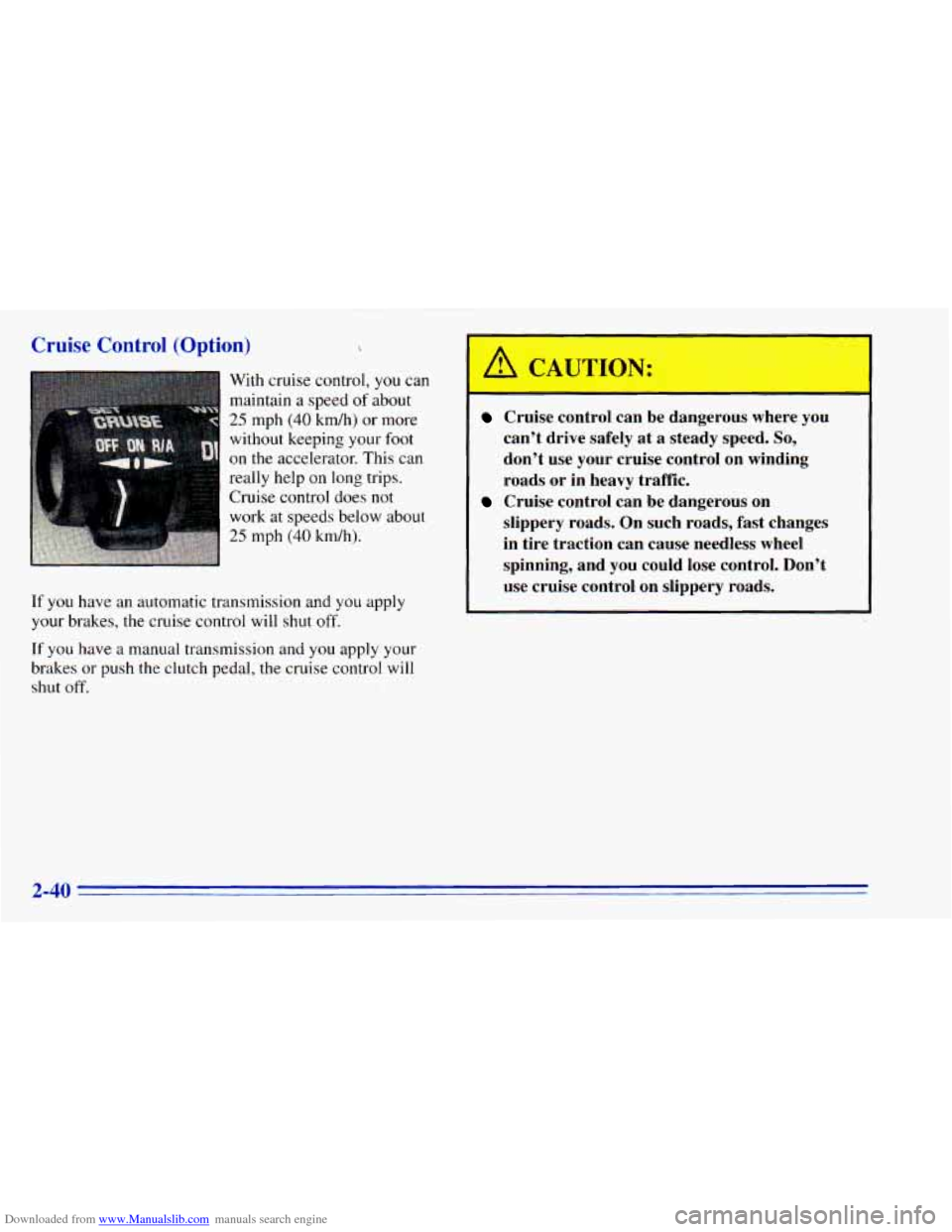
Downloaded from www.Manualslib.com manuals search engine Cruise Control (Option)
With cruise control, you can
maintain a speed
of about
25 mph (40 km/h) or more
without keeping your foot
on the accelerator. This can
really help on long trips.
Cruise control does
not
work at speeds below about
25 mph (40 kdh).
If
you have an automatic transmission and you apply
your brakes, the cruise control will
shut off.
If you have a manual transmission and you apply your
brakes or push the clutch pedal, the cruise control
will
shut off.
A CAUTIOh: '
Cruise contrt I be dangerous where you
can't drive safely at
a steady speed. So,
don't use your cruise control on winding
roads or in heavy traffic.
slippery roads. On such roads, fast changes in tire traction can cause needless wheel
spinning, and you could lose control. Don't
use cruise control on slippery roads.
-
Cruise control can be dangerous on
2-40
Page 122 of 392
Downloaded from www.Manualslib.com manuals search engine Speedometer ar Odometer
Your speedometer lets you see your speed in both miles
per hour (mph) and kilometers per hour (km/h).
Your odometer shows how far your vehicle has been
driven, in either miles (used in the United States)
or
kilometers (used in Canada).
Your odometer
is tamper resistant. It will show silver lines
between the numbers if someone tries to turn it back.
You may wonder what happens if your vehicle needs a
new odometer installed.
If the new one can be set to the
mileage total
of the old odometer, then it must be. But if
it can’t, then it’s set at zero, and a label must be put on
the driver’s door to show the old mileage reading when
the new odometer was installed.
Trip Odometer
The trip odometer can tell you how far your vehicle has
been driven since you last set the trip odometer to zero.
To set
the trip odometer to zero, press the button near
the readout.
Tachometer (Option)
The tachometer displays the engine speed in revolutions
per minute
(rpm).
Each tachometer has a different limit depending on the
powertrain
in your vehicle. The tachometer has three
areas: normal operating range, red warning range and
red danger range.
Normal operating range shows your engine speed during
normal driving conditions. For example, when the
needle points to
2, it means the engine is running at
2,000 revolutions per minute (rpm). The tachometer
needle will vary all
the time that the engine is running.
The red warning range tells you that your engine speed
is reaching its upper limits. Don’t drive very long with
the tachometer in
the red warning range. If you have a
manual transmission, shift to a higher gear as soon as
possible. If
you have an automatic transmission, lift
your
foot off of the accelerator pedal.
The red danger range
tells you that your engine speed is
at its upper limits. You should immediately shift to a
higher gear, or lift your
foot off of the accelerator pedal.
L
NOTICE:
Do not operate the engine with the tachometer in
the red range, or engine damage will occur.
2-64
Page 197 of 392
Downloaded from www.Manualslib.com manuals search engine Run your engine only as long as you must. This saves
fuel. When
you run the engine, make it go a little faster
than just idle. That
is, push the accelerator slightly. This
uses less fuel for the heat that
you get and it keeps the
battery charged. You will need a well-charged battery
to
restart the vehicle, and possibly for signaling later on
with your headlamps. Let the heater run for awhile.
Then, shut the engine off and close the window almost
all
the way to preserve the heat. Start the engine again
and repeat this
only when you feel really uncomfortable
from the cold. But
do it as little as possible. Preserve the
fuel as long as you can. To help keep warm, you can get
out
of the vehicle and do some fairly vigorous exercises
every half hour or
so until help comes.
Recreational Vehicle Towing
(Four-wheel Drive Only)
1. Set the parking brake firmly.
2. Place an automatic transmission in PARK (P) or a
manual transmission
in FIRST (1).
3. Firmly attach the vehicle being towed to the tow
vehicle.
Do not tow the vehicle by the rear bumper
bar. Refer to the hitch manufacturer’s instructions.
4. Place the transfer case shift lever in NEUTRAL (N).
Recreational vehicle towing is not recommended for
vehicles with
the optional electronic shift transfer
case or all-wheel drive because the transfer cases
have
no neutral position.
Shifting the transfer case into NEUTRAL (N) can
cause your vehicle to roll even if the transmission
is in PARK (P), for an automatic transmission,
or if your vehicle is in gear, for a manual
transmission. This is because the transfer case
overrides the transmission.
5. Release the parking brake only after the vehicle
being towed is firmly attached to the tow vehicle.
6. Insert the ignition key into the ignition switch and
turn it
one notch forward of the LOCK position. This
places the key
in the OFF position, which unlocks
the steering column while preventing battery drain.
Unlocking the steering column will allow for proper
movement
of the front wheelshires during towing.
4-43
Page 202 of 392
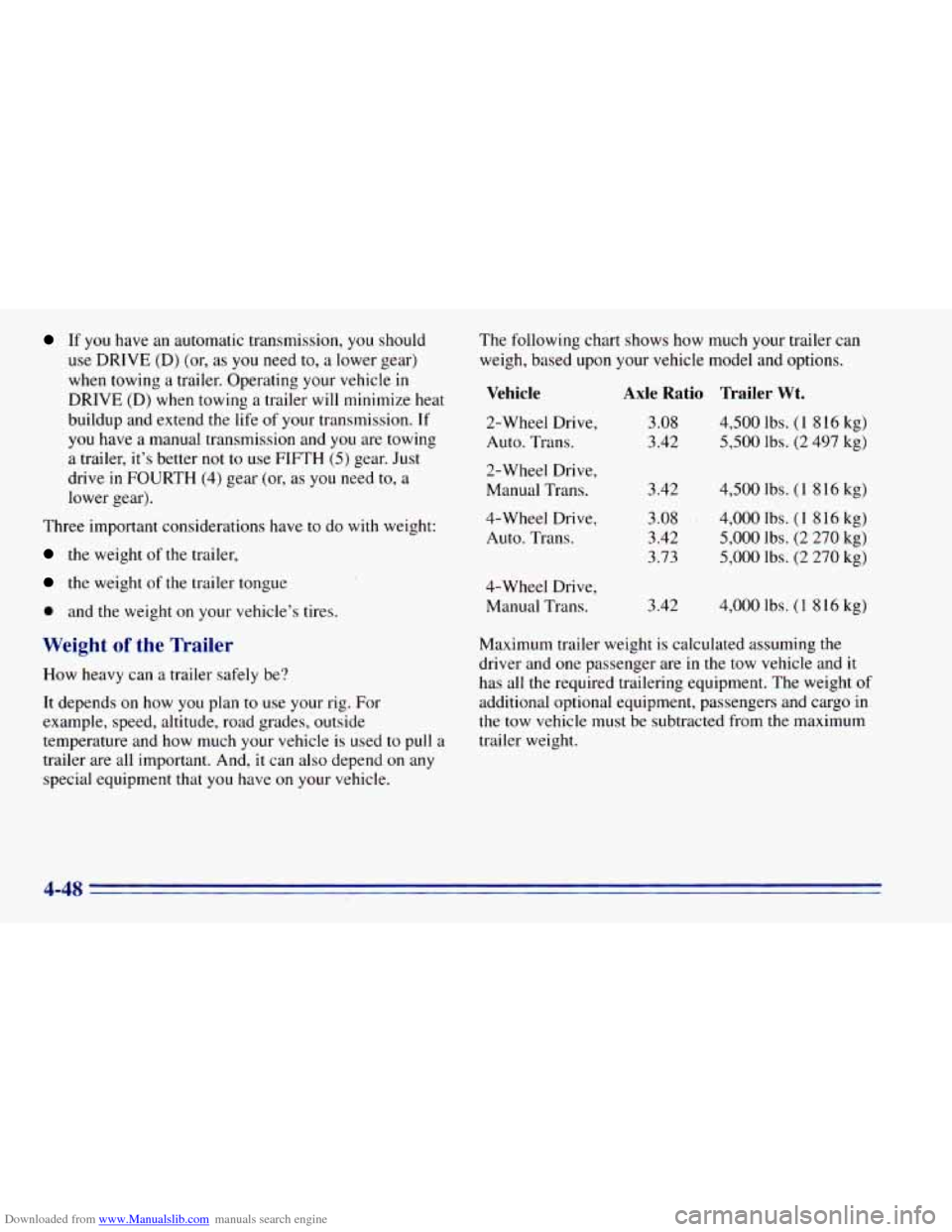
Downloaded from www.Manualslib.com manuals search engine If you have an automatic transmission, you should
use DRIVE
(D) (or, as you need to, a lower gear)
when towing a trailer. Operating your vehicle
in
DRIVE (D) when towing a trailer will minimize heat
buildup and extend the life of your transmission. If
you have a manual transmission and you are towing
a trailer, it’s better not to use FIFTH (5) gear. Just
drive in FOURTH
(4) gear (or, as you need to, a
lower gear).
Three important considerations have to do with weight:
the weight of the trailer,
the weight of the trailer tongue
0 and the weight on your vehicle’s tires.
Weight of the Trailer
How heavy can a trailer safely be?
It depends on how you plan
to use your rig. For
example, speed, altitude, road grades, outside
temperature and how much your vehicle is used
to pull a
trailer are all important. And, it can also depend on any
special equipment that you have
on your vehicle. The
following chart shows how much your trailer can
weigh, based upon your vehicle model and options.
Vehicle
2-Wheel Drive, Auto. Trans.
2-Wheel Drive,
Manual Trans.
4-Wheel Drive, Auto. Trans.
4-Wheel Drive, Manual Trans.
Axle Ratio Trailer Wt.
3.08
3.42
3.42 4,500
lbs. (1 816 kg)
5,500 lbs. (2 497 kg)
4,500 Ibs. (1 8 16 kg)
3.08
. 4,000 Ibs. (1 8 16 kg)
3.42
5,000 lbs. (2 270 kg)
3.73
5,000 lbs. (2 270 kg)
3.42
4,000 lbs. (1 8 16 kg)
Maximum trailer weight
is calculated assuming the
driver and one passenger are in the tow vehicle and it
has all the required trailering equipment. The weight
of
additional optional equipment, passengers and cargo in
the tow vehicle must be subtracted from the maximum
trailer weight.
4-48
Page 208 of 392
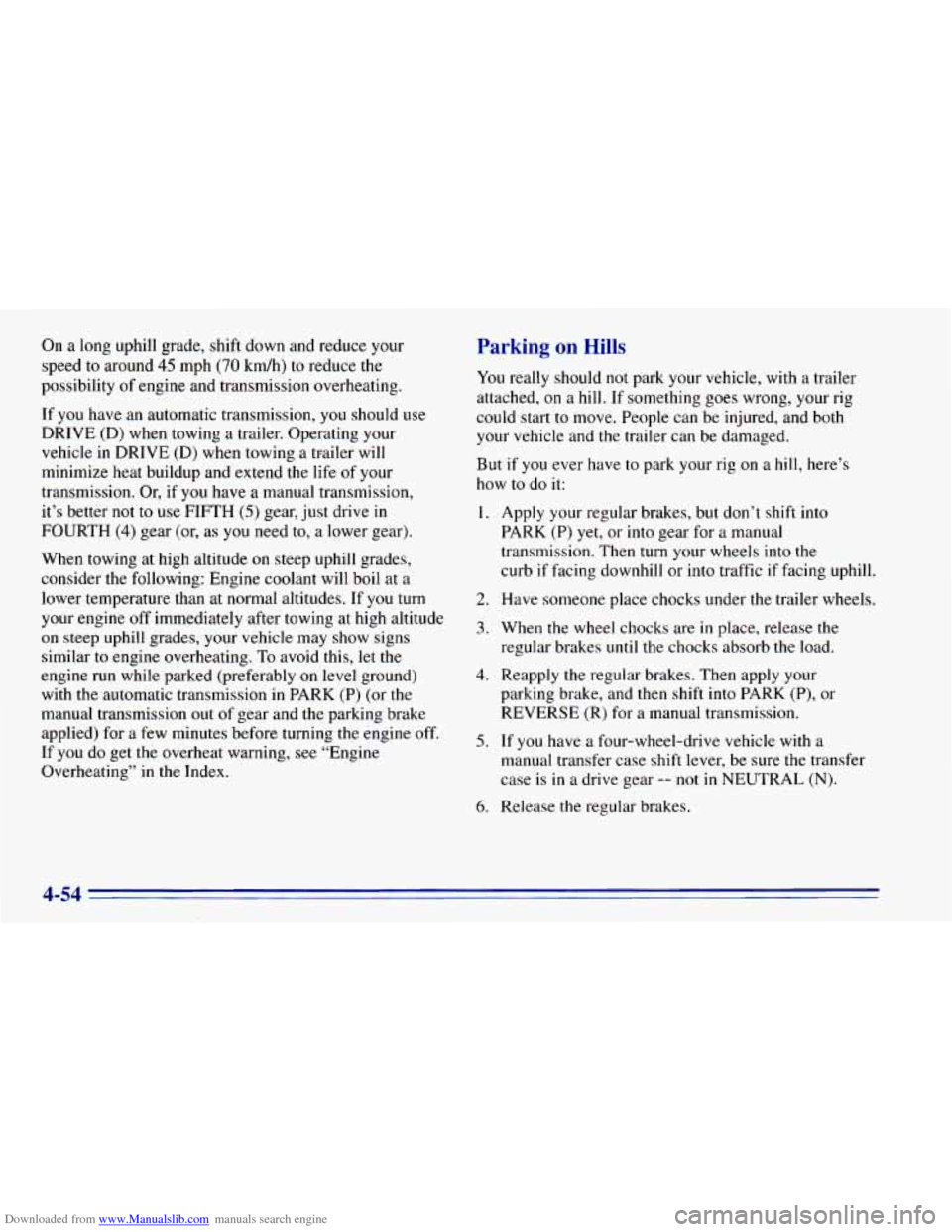
Downloaded from www.Manualslib.com manuals search engine On a long uphill grade, shift down and reduce your
speed to around
45 mph (70 kmh) to reduce the
possibility of engine and transmission overheating.
If you have
an automatic transmission, you should use
DRIVE (D) when towing
a trailer. Operating your
vehicle in DRIVE
(D) when towing a.trailer will
minimize heat buildup and extend the life of your
transmission. Or, if
you have a manual transmission,
it’s better not to use FIFTH
(5) gear, just drive in
FOURTH (4) gear (or, as you need to, a lower gear).
When towing at high altitude
on steep uphill grades,
consider the following: Engine coolant will boil at a
lower temperature than at normal altitudes. If you turn
your engine off immediately after towing at high altitude
on steep uphill grades, your vehicle may show signs
similar to engine overheating.
To avoid this, let the
engine run while parked (preferably on level ground)
with the automatic transmission in PARK
(P) (or the
manual transmission
out of gear and the parking brake
applied) for a few minutes before turning the engine off.
If
you do get the overheat warning, see “Engine
Overheating” in the Index.
Parking on Hills
You really should not park your vehicle, with a trailer
attached,
on a hill. If something goes wrong, your rig
could start to move. People can be injured, and both
your vehicle and the trailer can be damaged.
But
if you ever have to park your rig on a hill, here’s
how to
do it:
1.
2.
3.
4.
5.
6.
Apply your regular brakes, but don’t shift into
PARK
(P) yet, or into gear for a manual
transmission. Then turn your wheels into the
curb
if facing downhill or into traffic if facing uphill.
Have someone place chocks under the trailer wheels.
When the wheel chocks are
in place, release the
regular brakes
until the chocks absorb the load.
Reapply the regular brakes.
Then apply your
parking brake, and then shift into PARK (P), or
REVERSE
(R) for a manual transmission.
If
you have a four-wheel-drive vehicle with a
manual transfer case shift lever, be sure the transfer
case is
in a drive gear -- not in NEUTRAL (N).
Release the regular brakes.
4-54