Neutral CHEVROLET BLAZER 1997 2.G User Guide
[x] Cancel search | Manufacturer: CHEVROLET, Model Year: 1997, Model line: BLAZER, Model: CHEVROLET BLAZER 1997 2.GPages: 402, PDF Size: 21.93 MB
Page 84 of 402
Downloaded from www.Manualslib.com manuals search engine 4LO: This setting also engages your front axle to give
you extra traction. You may never need
4LO. It sends
the maximum power
to all four wheels. You might
choose
4LO if you were driving off-road in sand, mud
or deep snow and climbing or descending steep hills.
Indicator lights
in the switches show you which setting
you are
in. The indicator lights will come on briefly when
you
turn on the ignition and one will stay on. If the lights
do not come on, you should take your vehicle in for
service. An indicator light
will flash while shifting. It will
remain illuminated when the shift is completed.
Shifting from 2HI to 4HI
Press and release the 4HI switch. This can be done at
any speed, and the front axle will lock automatically.
Shifting from 4HI to 2HI
Press and release the 2HI switch. This can be done at
any speed.
and the front axle will unlock automatically.
Shifting from 2HI or JHI to 4LO
To shift tiom ZHI or -!HI to 4L0, the vehicle must be
stopped or mo\fing less than 3 mph (4.8 kmk) with the
transmission
in NEUTRAL (N) in vehicles equipped with
an automatic transmission or the clutch pedal engaged in
vehicles equipped with a manual transmission.
The
preferred method for shifting into 4LO is to have your
vehicle moving
1 to 2 mph (1.6 to 3.2 km/h). Press
and release the
4LO switch. You must wait for the
4LO indicator light to stop flashing and remain
illuminated before shifting your transmission into
gear or releasing the clutch pedal.
If
the 4LO switch is pressed when your vehicle is in
gear and/or moving, the
4LO indicator light will flash
for
30 seconds and not complete the shift unless your
vehicle is moving slower than 3 mph (4.8
kmk) and
the transmission is in
NEUTRAL (N) or the clutch
pedal engaged.
On automatic transmission equipped vehicles,
if your
transfer case does not shift into 4L0, your transmission
indicator switch may require adjustment. With your
transmission in
NEUTRAL (N), press and release the
4LO switch. While the
4LO indicator light is flashing,
shift
your transmission into PARK (P). Wait until the
4LO indicator light remains illuminated before shifting
your transmission into gear. This will get you into 4L0,
but you should take your vehicle in for service to restore
normal operation.
2-27
Page 85 of 402
Downloaded from www.Manualslib.com manuals search engine Shifting from 4LO to 4HI or 2HI
To shift from 4LO to 4HI or 2H1, your vehicle must be
stopped or moving less than 3 mph (4.8 kmh) with the
transmission in NEUTRAL (N) or the clutch pedal
engaged. The preferred method for shifting out
of
4LO is to have your vehicle moving 1 to 2 mph (1.6 to
3.2 km/h). Press and release the 4HI switch. You must
wait for the
4HI indicator light to stop flashing and
remain illuminated before shifting your transmission
into gear or releasing
the clutch pedal.
If the 4HI switch is pressed when your vehicle is in gear
and/or moving, the
4HI indicator light will flash for
30 seconds but not complete the shift unless the
vehicle is moving slower than
3 mph (4.8 km/h) and
the transmission
is in NEUTRAL (N) or the clutch
pedal engaged.
On automatic transmission equipped vehicles, if your
transfer case does not shift into
4H1, your transmission
indicator switch may require adjustment. With your
transmission in NEUTRAL
(N), press and release the
4HI switch. While the 4HI indicator light is flashing,
shift your transmission into PARK
(P). Wait until the
4HI indicator light remains illuminated before shifting
your transmission into gear. This will get
you into 4HI.
but you should
take your vehicle in for service to restore
normal operation.
2-2s
Page 87 of 402
Downloaded from www.Manualslib.com manuals search engine Shifting Into PARK (P) (Automatic
Transmission
Models Only)
A CAUTION:
~~
It can be dangerous to get out of your vehicle .. ,. if I
the shift lever is not fully in PARK (P) with the
parking brake firmly set. Your vehicle can roll.
If you have left the engine running, the vehicle can
move suddenly. You
or others could be injured.
To be sure your vehicle won’t move, even when
you’re
on fairly level ground, use the steps that
follow.
If you have fourwheel drive with a manual
transfer case shift lever
and your transfer case is
in NEUTRAL (N), your vehicle will be free to roll,
even
if your shift lever is in PARK (P). So, be sure
the transfer case is in
a drive gear -- not in
NEUTRAL (N). If you’re pulling a trailer, see
“Towing a ’Iltailer” in the Index.
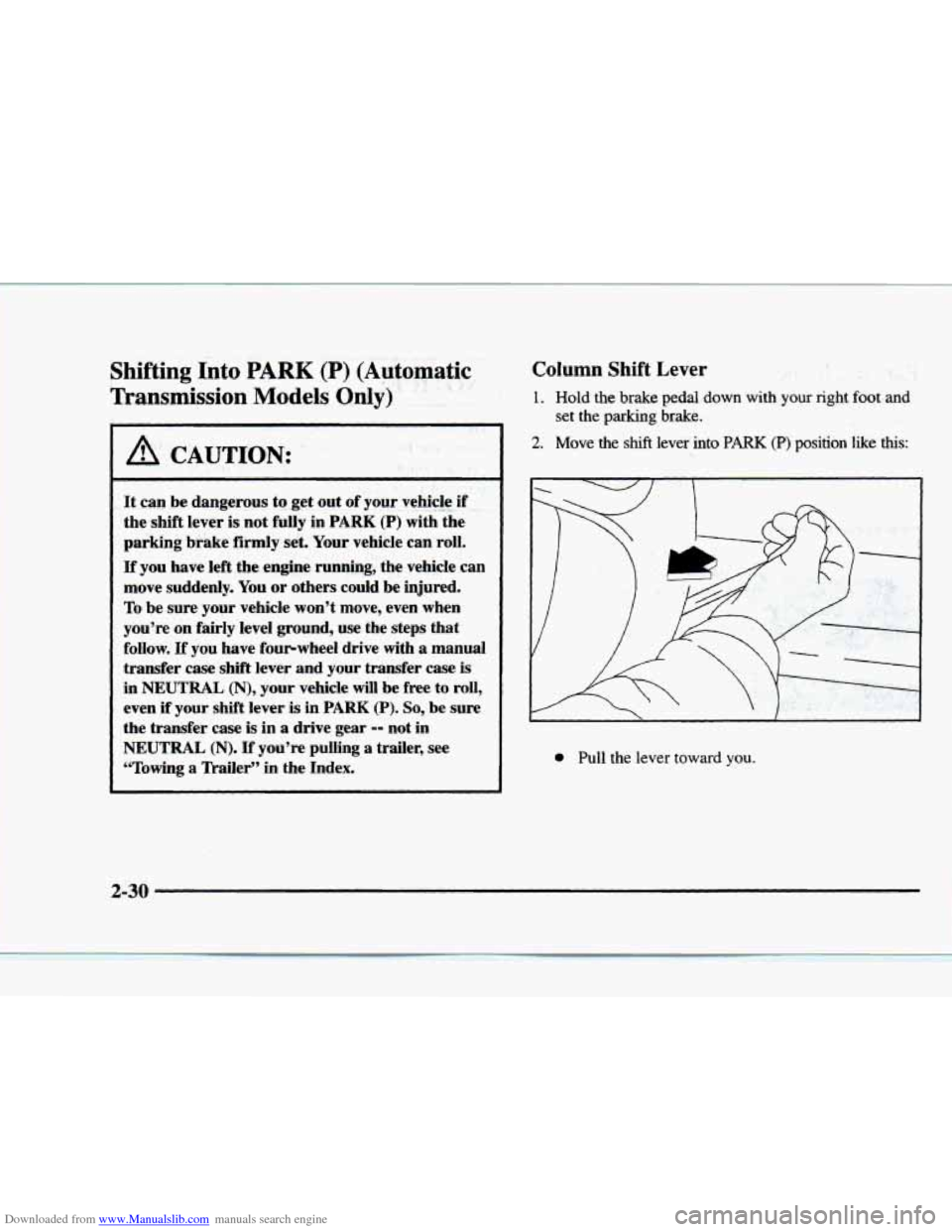
Column Shift Lever
1. Hold the brake pedal down with your right foot and
2. Move the shift lever into PARK (P) position ‘like this:
set the parking brake.
0 Pull the lever toward you.
2-30
Page 88 of 402
Downloaded from www.Manualslib.com manuals search engine F
3.
4.
5.
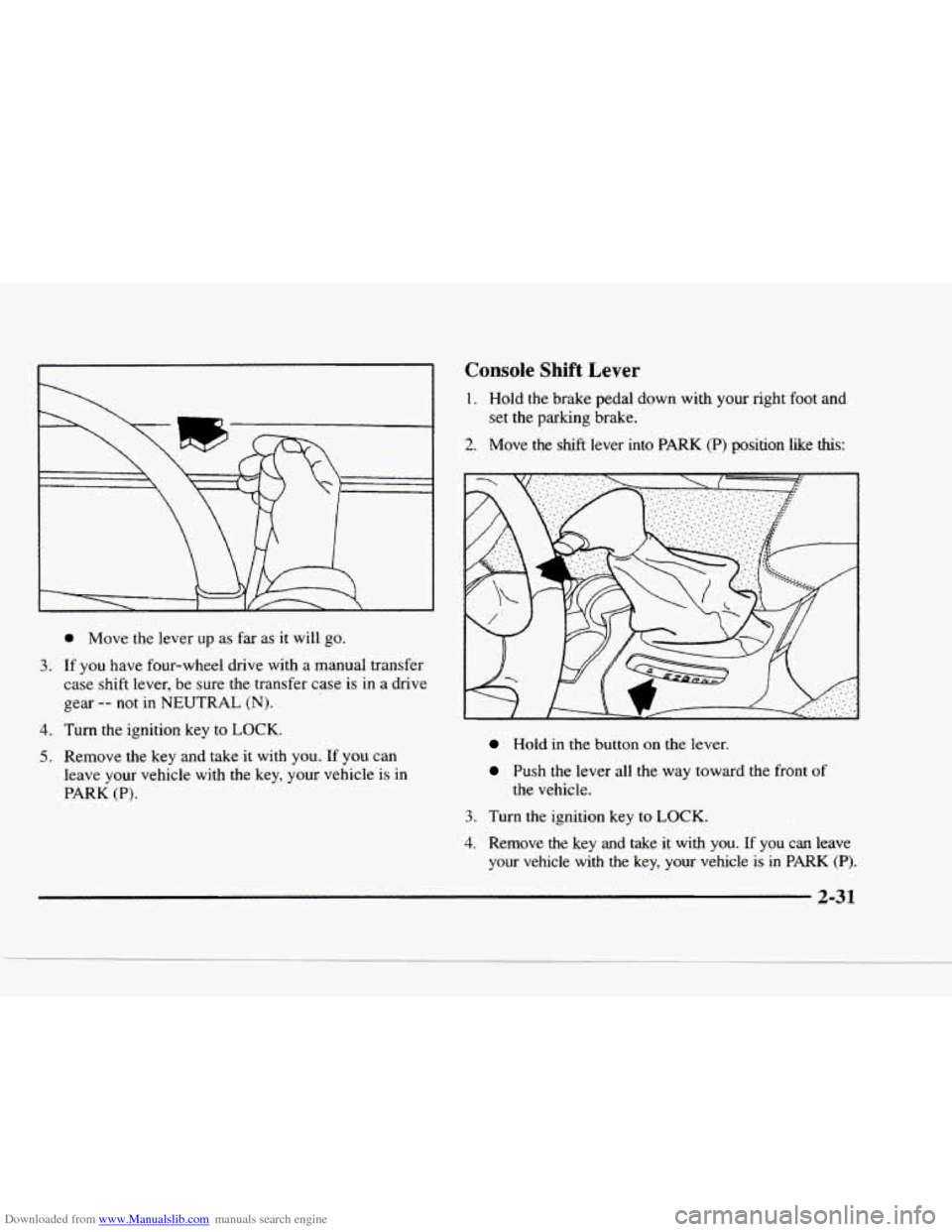
0 Move the lever up as far as it will go.
If you have four-wheel drive with a manual transfer
case shift lever, be sure the transfer case
is in a drive
gear
-- not in NEUTRAL (N).
Console Shift Lever
1. Hold the brake pedal down with your right foot and
set
the parking brake.
2. Move the shtft lever into PARK (P) position like this:
Turn the ignition key to LOCK.
Remove the key and take it with you. If you can
leave your vehicle with
the key, your vehicle is in
PARK (P).
Hold in the button on the lever.
Push the lever all the way toward the front of
the vehicle.
3. Turn the ignition key to LOCK.
4. Remove the key and take it with you. If you can leave
your vehcle with the key, your vehicle
is in PARK (P).
Page 89 of 402
Downloaded from www.Manualslib.com manuals search engine Leaving Your Vehicle With the Engine
Running (Automatic Transmission
Models Only)
I A CAUTION:
It can be dangerous to leave your vehicle with the
engine running. Your vehicle could move suddenly
if the shift lever is not fully in PARK (P) with the
parking brake firmly
set. If you have four-wheel
drive with
a manual transfer case shift lever and
your transfer case is in NEUTRAL (N), your
vehicle will
be free to roll, even if your shift lever
is in PARK (P). So be sure the transfer case is in a
drive gear -- not in NEUTRAL (N). And, if you
leave the vehicle with the engine running, it could
overheat and even catch fire. You or others could
be injured. Don't leave your vehicle with the
engine running unless you have to.
If you have to leave your vehicle with the engine
running, be sure your vehicle is
in PARK (P) and your parking brake
is firmly set before
you leave it. After
you've moved the shift lever into the
PARK (P)
position, hold the regular brake pedal down. Then, see
if you can move the shift lever away from PARK (P)
without first pulling it toward you (or pressing the
button
on a console shift lever). If you can, it means that
the shift lever wasn't
fully locked into PARK (P).
Torque Lock (Automatic Transmission)
If you are parking on a hill and you don't shift your
transmission
into PARK (PI properly, the weight of the
vehicle may
put too much force on the parlung pawl in the
tr'msmission.
You may find it difficult to pull the shift
Icver out of PARK (P). This is called "torque lock." To
prevent torque lock, set the parking brake and then shift
into
PARK (P) properly before you leave the driver's seat.
To find out how, see "Shifting Into PARK (P)" in
the Index.
When you are ready to drive, move the shift lever out
of
PARK (P) before you release the parking brake.
If torque lock does occur. you may need to have another
vehicle push yours a little uphill
to take some of the
pressure from the parking pawl
in the transmission, so
you can pull the shift lever out of PARK (P).
2-32
Page 90 of 402
Downloaded from www.Manualslib.com manuals search engine Shifting Out of PARK (P)
(Automatic Transmission)
Your vehicle has a brake-transmission shift interlock.
You have
to fully apply your regular brake before you
can shift from PARK (P) when the ignition is in the
RUN position. See “Automatic Transmission Operation”
in the Index.
If
you cannot shift out of PARK (P), ease pressure on
the shift lever
-- push the shift lever all the way into
PARK (P) as you maintain brake application. Then
move the shift lever into the gear
you want (you must
press the shift lever button if
you have the console
shift lever).
If you ever hold the brake pedal down but still can’t
shift out
of PARK (P), try this:
1. Turn the key to OFF.
2. Apply and hold the brake until the end of Step 4.
3. Shift to NEUTRAL (N).
4. Start the vehicle and then shift to the drive gear
you want.
5. Have the vehicle fixed as soon as you can.
Parking Your Vehicle (Manual
Transmission Models Only)
Before you get out of your vehicle, turn off your engine,
put your manual transmission in
REVERSE (R) and
firmly apply the parking brake.
If you have four-wheel drive with a manual transfer case
shift lever,
be sure your transfer case is in a drive gear.
Your vehicle could roll
if it isn’t.
If
you are parking on a hill, or if your vehicle is pulling
a trailer, see “Towing
a Trailer” in the Index.
2-33
Page 92 of 402
Downloaded from www.Manualslib.com manuals search engine Running Your Engine While You’re
Parked (Automatic Transmission)
It’s better not to park with the engine running. But if
ever have
to, here are some things to know.
A CAUTION:
Idling the engine with the air system control
off could allow dangerous exhaust into
your vehicle (see the earlier Caution under
“Engine Exhaust”).
Also, idling in
a closed-in place can let deadly
carbon monoxide
(CO) into your vehicle even if
the fan switch is at the highest setting. One place
this can happen is
a garage. Exhaust 9- with
CO -- can come in easily. NEVER park in a
garage
with the engine running.
Another closed-in place can be a blizzard.
(See “Blizzard” in the Index.)
I A CAUTION:
It can be dangerous to get out of your vehicle if
the shift lever
is not fully in PARK (P) with the
parking brake firmly set. Your vehicle can roll.
Don’t leave your vehicle when the engine
is
running unless you have to. If you’ve left the
engine running, the vehicle can move suddenly.
You or others could be injured.
To be sure your
vehicle won’t move, even when you’re on fairly
level ground, always set your parking brake and
move the shift lever to PARK
(P).
If you have four-wheel drive with a manual transfer case
shift lever and your transfer case
is in NEUTRAL (N),
your vehicle will be free to roll, even if your shift lever
is
in PARK (P). So, be sure the transfer case is in a drive
gear
-- not in NEUTRAL (N). Always set your parking
brake. Follow the proper steps
to be sure your vehicle
won’t move. See “Shifting Into PARK
(P)” in the Index.
If you’re pulling a trailer, see ”Towing a Trailer”
in
the Index.
2-35
Page 160 of 402
Downloaded from www.Manualslib.com manuals search engine You may also choose a non-scrubbing action, wet-type
cleaner which uses
a cassette with a fabric belt to clean
the tape head. This type
of cleaning cassette will not
eject and,
it may not clean as thoroughly as the
scrubbing type cleaner.
Cassettes
are subject to wear and the sound quality
may degrade over
time. Always make sure the cassette
tape is
in good condition before you have your tape
player serviced.
Care of Your Compact Discs
Handle discs carefully. Store them in their original cases
or other protective cases and away from direct sunlight
and dust.
If the surface of a disc is soiled, dampen a
clean, soft cloth in a mild, neutral detergent solution and
clean it, wiping from the center
to the edge.
Be sure never to touch the signal surface when handling
discs. Pick
up discs by grasping the outer edges or the
edge
of the hole and the outer edge.
Fixed Mast Antenna
The fixed mast antenna can withstand most car washes
without being damaged. If
the mast should ever become
slightly bent, you can straighten
it out by hand. If the
mast is badly bent, as
it might be by vandals, you should
replace it.
Check
every once in a while to be sure the mast is still
tightened
to the fender.
3-2 1
Page 182 of 402
Downloaded from www.Manualslib.com manuals search engine @ What should I do if my vehicle stalls, or is about
A: If this happens, there are some things you should
to stall, and I can’t make it up the hill?
do. and there are some things you must not do.
First, here’s what
you should do:
0 Push the brake pedal to stop the vehicle and keep it
from rolling backwards. Also, apply the parking brake.
0 If your engine is still running, shift the transmission
to REVERSE
(R), release the parking brake, and
slowly back down the hill
in REVERSE (R).
0 If your engine has stopped running, you’ll need to
restart it. With the brake pedal depressed and the
parking brake still applied, shift
the transmission to
PARK (P) (or, shift to NEUTRAL (N) if your
vehicle has a manual transmission) and restart
the
engine. Then, shift to REVERSE (R), release the
parking brake, and slowly back down the
hill as
straight as possible in REVERSE (R).
As you are backing down the hill, put your left hand
on the steering wheel at the 12 o’clock position. This
way, you’ll be able
to tell if your wheels are straight
and maneuver
as you back down. It’s best that you
back down the hill with your wheels straight rather
than
in the left or right direction. Turning the wheel
too far to the left or right will increase the possibility
of
a rollover.
Here are some things
you must not do if you stall, or are
about
to stall, when going up a hill.
0 Never attempt to prevent a stall by shifting into
NEUTRAL
(N) (or depressing the clutch, if you
have
a manual transmission) to “rev-up” the engine
and regain forward momentum. This
won’t work.
Your vehicle will roll backwards very quickly and
you could go out of control.
Instead, apply the regular brake
to stop the
vehicle. Then apply
the parking brake. Shift to
REVERSE
(R), release the parking brake, and
slowly back straight down.
0 Never attempt to turn around if you are about to stall
when going up
a hill. If the hill is steep enough to
stall your vehicle, it’s steep enough to cause you to
roll over if you turn around. If you can’t make it up
the hill, you must back straight down the hill.
4-21
Page 183 of 402
Downloaded from www.Manualslib.com manuals search engine Suppose, after stalling, I try to back down the
hill and decide
I just can’t do it. What should
I do?
A: Set the parking brake, put your transmission in
PARK (P) (or the manual transmission in
FIRST ( I )) and turn off the engine. Leave the
vehicle
and go get some help. Exit on the uphill
side and
stay clear of the path the vehicle would
take
if it rolled downhill. Do not shift the transfer
case
to NEUTRAL (N) when you leave the vehicle.
Leave
it in some gear-.
~ A CAUTION:
I
If you have a manual transfer case shift lever,
shifting the transfer case to NEUTRAL
(Nj can
cause
your vehicle to roll even if the transmission
is in
PARK (P) (or, if you have the manual
transmission, even
if you’re in gear). This is
because the NEUTRAL
(N) position on the
transfer case overrides the transmission.
If you
are going
to leave your vehicle, set the parking
brake and shift the transmission to
PARK (P) (or,
put your manual transmission in
FIRST (I)).
But do not shift the transfer case to the
NEUTRAL (N) position. Leave the transfer case
in the 2HI,4HI or 4LO position.
4-22