Neutral CHEVROLET BLAZER 1997 2.G Owners Manual
[x] Cancel search | Manufacturer: CHEVROLET, Model Year: 1997, Model line: BLAZER, Model: CHEVROLET BLAZER 1997 2.GPages: 402, PDF Size: 21.93 MB
Page 64 of 402
Downloaded from www.Manualslib.com manuals search engine Operation
When you press UNLOCK, the driver’s door and endgate will unlock automatically.
If you press
UNLOCK again within five seconds, all doors will
unlock. Press
LOCK to lock all the doors.
Battery Replacement
Under normal use, the battery in your remote keyless
entry transmitter should
last about two years.
Press the REAR button twice within
3 1/2 seconds to
unlock and unlatch
the rear glass. If your vehicle has
an automatic transmission, the transmission must be
in PARK (P) or NEUTRAL (N).
If your vehicle has
a manual transmission, you must engage the
parking brake.
Matching Transmitter(s) To Your Vehicle
Each remote keyless entry transmitter is coded to
prevent another transmitter from unlocking your vehicle.
If a transmitter is lost or stolen, a replacement can be
purchased through your dealer. Remember to bring any
remaining transmitters
with you when you go to your
dealer. When
the dealer matches the replacement
transmitter to your vehicle, any remaining transmitters
must also be matched. Once your dealer has coded the
new transmitter, the lost transmitter will not unlock your
vehicle. Each vehicle can have only two transmitters
matched
to it.
You can tell the battery is weak if the transmitter won’t
work at the normal range in any location.
If you have to
get close to your vehicle before the transmitter works,
it’s probably time to change the battery.
NOTICE:
When replacing the battery, use care not to touch
any of the circuitry. Static from your body
transferred to these surfaces may damage
the transmitter.
2-7
Page 68 of 402
Downloaded from www.Manualslib.com manuals search engine Remote Rear Glass Release
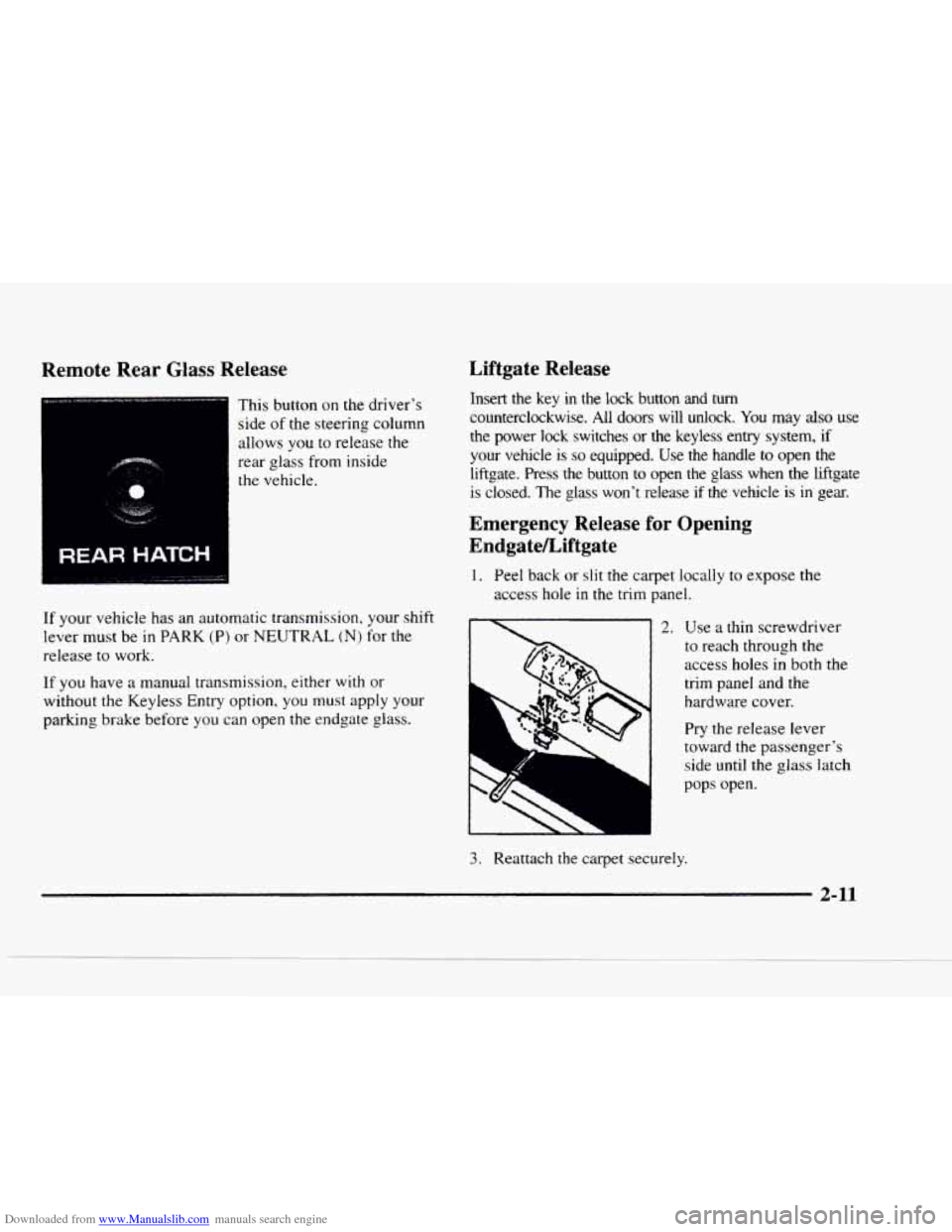
REAR HATCH I
This button on the driver's
side
of the steering column
allows
you to release the
rear glass from inside
the vehicle.
If your vehicle has an automatic transmission, your shift
lever must be
in PARK (P) or NEUTRAL (,N) for the
release to work.
If you have
a manual transmission, either with or
without the Keyless Entry option, you must apply your
parking brake before you can open
the endgate glass.
Liftgate Release
Insert the key in the lock button and turn
counterclockwise. All doors will unlock. You may also use
the power lock switches or the keyless entry system, if
your vehicle
is so equipped. Use the handle to open the
liftgate. Press the button
to open the glass when the liftgate
is closed. The glass won't release if the vehicle
is in gear.
Emergency Release for Opening
EndgateLiftgate
1. Peel back or slit the carpet locally to expose the
access hole
in the trim panel.
ii 2. Use a thin screwdriver
1
~ 2'''
to reach through the
access holes in both the
trim panel and the
hardware cover.
Pry the release lever
toward the passenger's
side until
the glass latch
pops open.
3. Reattach the carpet securely.
- 44
Page 72 of 402
Downloaded from www.Manualslib.com manuals search engine Key Release Button
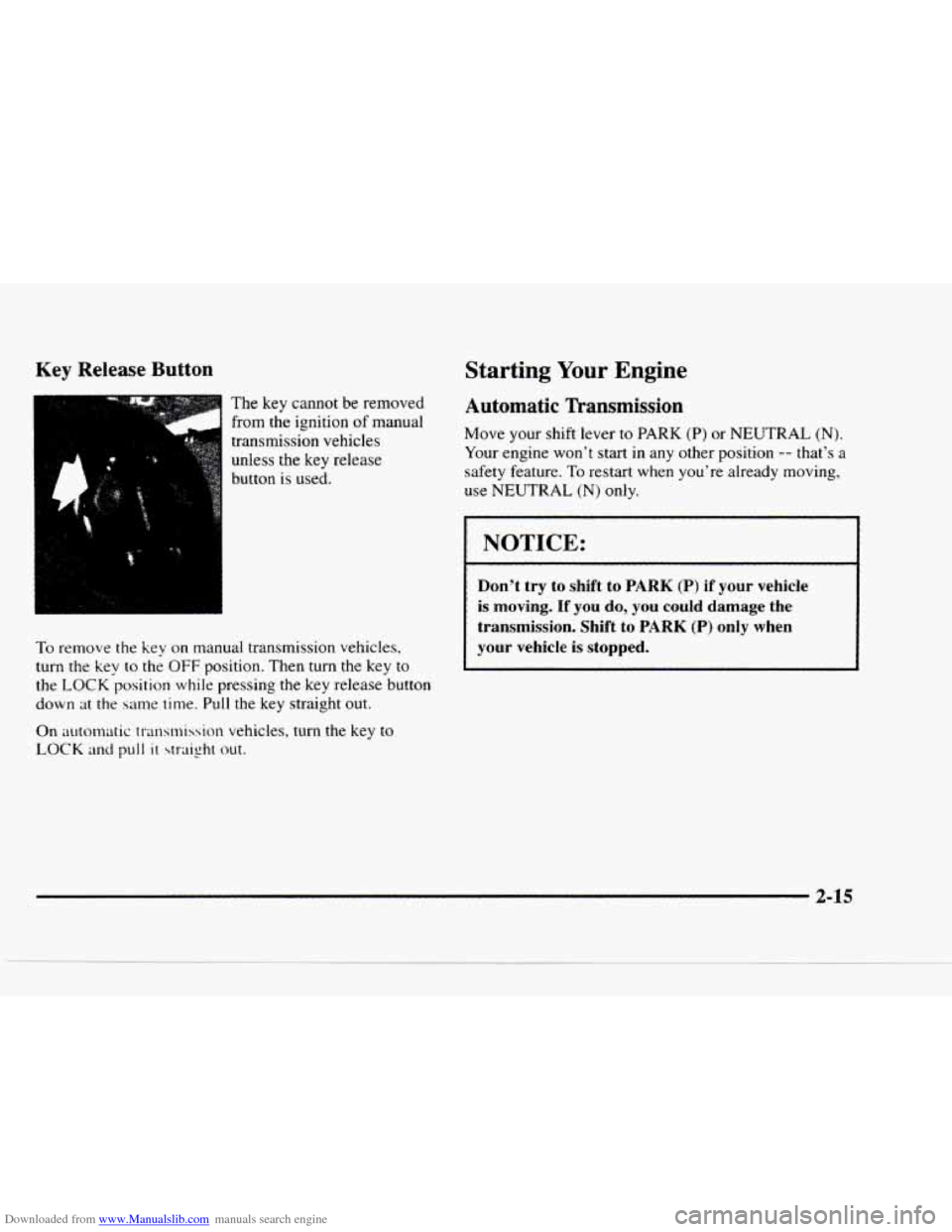
ca The key cannot be removed
9.-
from the ignition of manual
transmission vehicles
unless the key release
button
is used.
To remove the key on manual transmission vehicles,
turn
the key to the OFF position. Then turn the key to
the
LOCK position while pressing the key release button
down
at the same time. Pull the key straight out.
On automatic
transmission vehicles, turn the key to
LOCK and pull it straight out.
Starting Your Engine
Automatic Transmission
Move your shift lever to PARK (P) or NEUTRAL (N).
Your engine won't start in any other position -- that's a
safety feature. To restart when you're already moving,
use
NEUTRAL (N) only.
I NOTICE:
Don't try to shift to PARK (P) if your vehicle
is moving. If you do, you couId damage the
transmission. Shift
to PARK (P) only when
your vehicle is stopped.
2-15
Page 73 of 402
Downloaded from www.Manualslib.com manuals search engine Manual Transmission
The gear selector should be in NEUTRAL (N). Hold the
clutch pedal to the
floor and start the engine. Your
vehicle won’t start
if the clutch pedal is not all the way
down
-- that’s a safety feature.
1. Without pushing the accelerator pedal, turn your
ignition key to START. When the engine starts, let
go of the key. The idle speed will go down as your
engine gets warm.
NOTICE:
Holding your key in START for longer than
15 seconds at a time will cause your battery to be
drained much sooner.
And the excessive heat can
damage your starter motor.
2. If it doesn’t start right away, hold your key in
START. If it doesn‘t start in 10 seconds, push the
accelerator pedal
all the way down for five more
seconds. or
until it starts.
3. If your engine still won’t start (or starts but then
stops), wait
15 seconds and start over.
When the engine starts,
let go of the key and the
accelerator pedal.
NOTICE:
Your engine is designed to work with the
electronics in
your vehicle. If you add electrical
parts
or accessories, you could change the way
the engine operates. Before adding electrical
equipment, check with your dealer.
If you don’t.
your engine might not perform properly.
If you ever have to have your vehicle towed, see
the part
of this manual that tells how to do it
without damaging your vehicle. See “Towing
Your Vehicle” in the Index.
2-16
Page 75 of 402
Downloaded from www.Manualslib.com manuals search engine Automatic Transmission Operation
Your automatic transmission may have a shift lever
located
on the console between the seats or on the
steering column.
There are several different positions
for your shift lever.
If your vehicle is equipped with a coiunm shift lever, it
features an electronic shift position indicator within the
instrument cluster. This display must be powered
anytime the shift lever is capable of being moved out of
the
PARK (P) position. This means that if your key is in
the
OFF position, but not locked, there will be a small
current drain
on your battery which could discharge
your battery over
a period of time. If you need to leave
your key
in the ignition in the OFF position for an
extended period, it is recommended that you disconnect
the battery cable from the battery to prevent discharging
your battery.
PARK (P): This locks your rear wheels. It’s the best
position to use when you start your engine because your
vehicle can‘t move easily.
A CAUTION:
It is dangerous to get out of your vehicle if the
shift lever
is not fully in PARK (P) with the
parking brake firmly set. Your vehicle can roll.
Don’t leave your vehicle when the engine
is
running unless you have to. If you have left the
engine running, the vehicle can move suddenly.
You or others
could be injured. To be sure your
vehicie won’t move, even when you’re on fairly
level ground, always set your parking brake and
move the shift lever to
PARK (P).
If you have four-wheel drive, your vehicle will
be free to
roll -- even if your shift lever is
in PARK (P) -- if your transfer case is in
NEUTRAL (N). So, be sure the transfer case is in
a drive gear, two-wheel high (2HI) or four-wheel
high (4HI) or four-wheel low (4LO) -- not in
NEUTRAL (Nj. See “Shifting Into PARK (P)” in
the Index.
If you’re pulling a trailer, see “Towing
a Trailer” in the Index.
2-18
Page 76 of 402

Downloaded from www.Manualslib.com manuals search engine Ensure the shift lever is fully in PARK (P) range before
starting
the engine. Your vehicle has a brake-transmission
shift interlock.
You have to fully apply your regular brakes
before you can shift from
PARK (P) when the ignition
key is
in the RUN position. If you cannot shift out of
PARK (P), ease pressure on the shift lever -- push the shift
lever all
the way into PARK (P) (press the button in on the
console shift lever)
as you maintain brake application.
Then move the shift lever into
the gear you wish. See
“Shifting Out
of PARK (P)” in the Index.
REVERSE
(R): Use this gear to back up.
NOTICE:
Shifting to REVERSE (R) while your vehicle
is moving forward could damage your
transmission. Shift to REVERSE (R) only
after your vehicle is stopped.
To rock your vehicle back and forth to get out of snow,
ice or sand without damaging your transmission, see
“Stuck: In Sand, Mud, Ice or
Snow” in the Index. NEUTRAL
(N): In this position, your engine doesn’t
connect with the wheels.
To restart when you’re already
moving, use
NEUTRAL (N) only.
I A CAUTION:
Shifting out of PARK (P) or NEUTRAL (N) while
your engine is “racing” (running at high speed)
is
dangerous. Unless your foot is firmly on the
brake pedal, your vehicle could move very
rapidly.
You could lose control and hit people or
objects. Don’t shift
out of PARK (P) or
NEUTRAL
(N) while your engine is racing.
I NOTICE:
Damage to your transmission caused by shifting
out of
PARK (P) or NEUTRAL (N) with the
engine racing isn’t covered by your warranty.
2-19
Page 78 of 402
Downloaded from www.Manualslib.com manuals search engine Manual Transmission Operation
5-Speed
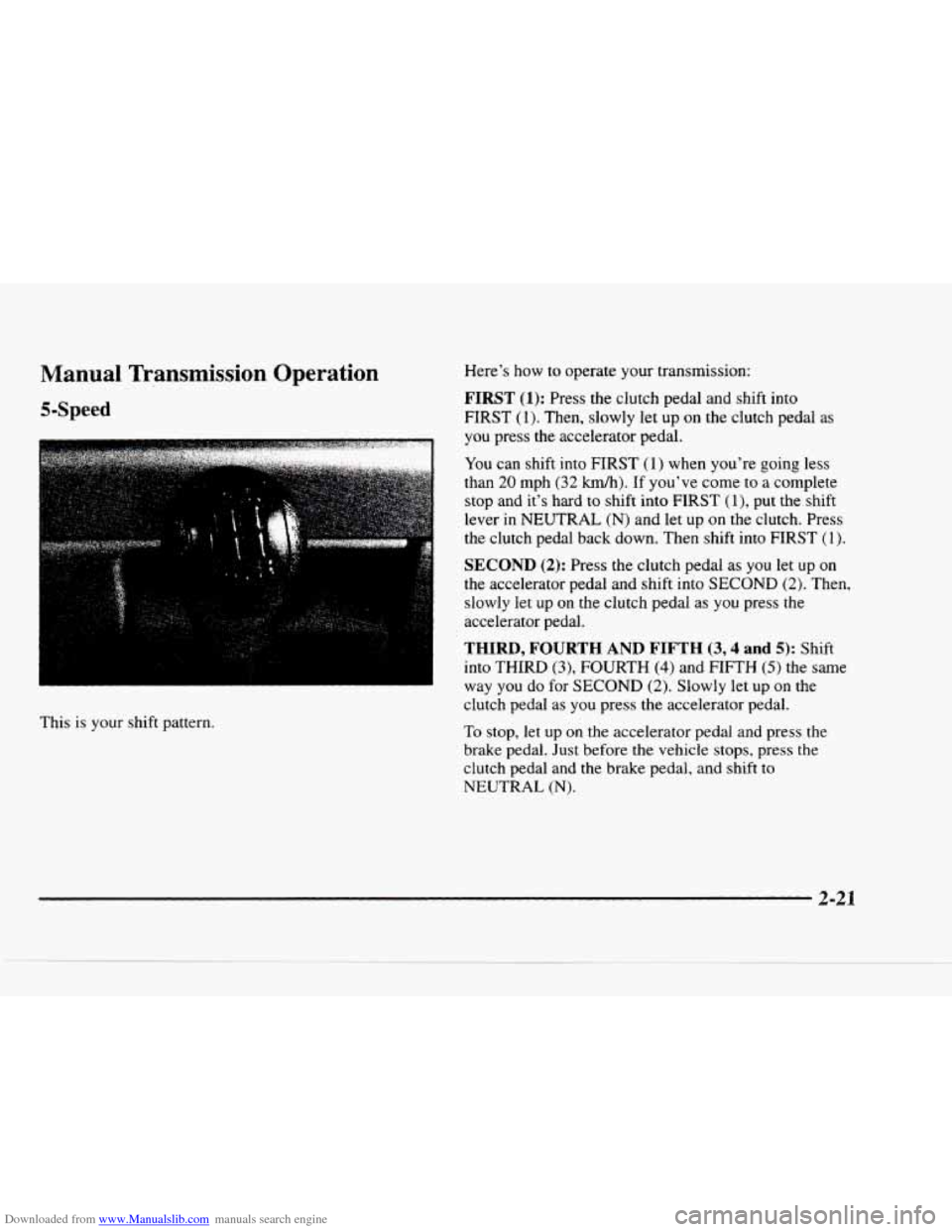
This is your shift pattern. Here’s
how to operate your transmission:
FIRST (1): Press the clutch pedal and shift into
FIRST
(1). Then, slowly let up on the clutch pedal as
you press the accelerator pedal.
You can shift into FIRST
(1) when you’re going less
than
20 mph (32 km/h). If you’ve come to a complete
stop and it’s hard to shift into FIRST
(1), put the shift
lever in NEUTRAL
(N) and let up on the clutch. Press
the clutch pedal back down. Then shift into
FIRST (1).
SECOND (2): Press the clutch pedal as you let up on
the accelerator pedal and shift into SECOND (2). Then,
slowly let up on the clutch pedal as you press the
accelerator pedal.
THIRD, FOURTH AND FIFTH (3,4 and 5): Shift
into THIRD
(3), FOURTH (4) and FIFTH (5) the same
way you do for SECOND (2). Slowly let up on the
clutch pedal as you press the accelerator pedal.
To stop, let up on the accelerator pedal and press the
brake pedal. Just before the vehicle stops, press
the
clutch pedal and the brake pedal, and shift to
NEUTRAL (N).
2-21
Page 79 of 402
Downloaded from www.Manualslib.com manuals search engine NEUTRAL (N): Use this position when you start or
idle your engine.
REVERSE (R): To back up, press the clutch pedal, wait
about six seconds, then shift into
REVERSE (R). Then
let up
on the clutch pedal slowly while pressing the
accelerator pedal.
NOTICE:
Shift to REVERSE (R) only after your vehicle
is stopped. Shifting to REVERSE (R) while
your vehicle is moving could damage
your transmission.
Use REVERSE (R), along with the parking brake, for
parking your vehicle.
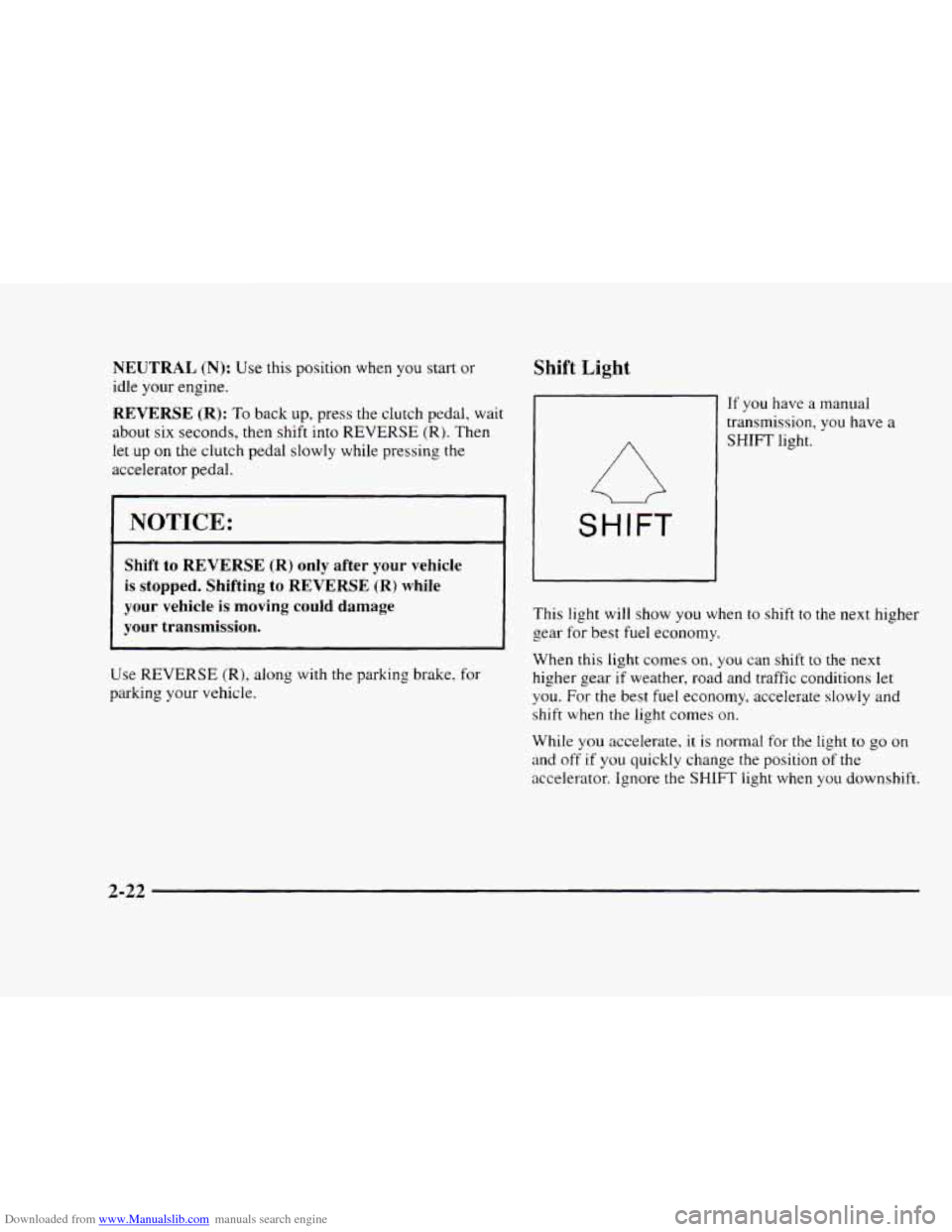
Shift Light
SHIFT
If you have a manual
transmission, you have
a
SHIFT light.
This light will show you when
to shift to the next higher
gear for best fuel economy.
When this light comes
on, you can shift to the next
higher gear if weather, road and traffic conditions let
you. For the best fuel economy, accelerate slowly and
shift when the light comes
on.
While you accelerate. it is normal for the light to go on
and off if you quickly change the position of the
accelerator. Ignore the SHIFT light when you downshift.
2-22
Page 82 of 402
Downloaded from www.Manualslib.com manuals search engine The front axle portion of the diagram on the indicator
will light up when you shift
into four-wheel drive. A
slight delay between shifting and the pattern’s lighting is
normal. If the pattern does not light up, or if the front
axle lights do not go out after you shift out of
four-wheel drive, have your dealer check your system.
Turn the INT LIGHTS switch located to the right of
your headlamp switch
to dim your transfer case
indicator light when your headlamps or parking lamps
are on. This will also cause your instrument panel lights
to dim.
2HI: This setting is for driving in most street and
highway situations. Your front axle is
not engaged in
two-wheel drive.
4HI: This setting engages your front axle to help
drive
your vehicle. Use 4HI when you need extra
traction, such as on snowy
or icy roads, or in most
off-road situations.
N SET PARK BRAKE: Shift to this neutral setting
only when your vehicle needs to be towed.
4LO: This setting also engages your front axle to give
you extra traction and provides extra gear reduction.
You may never need 4LO. It sends the maximum power
to all four wheels. You might choose 4LO if you were
driving off-road in sand, mud or deep snow and
climbing or descending steep hills.
You can shift from 2HI to 4HI or from 4HI to 2HI while
the vehicle is moving. Do not press the transfer case
shift lever button when shifting from 2HI
to 4HI or
from 4HI to 2HI.
To shift your transfer case into N SET PARK BRAKE:
1. Stop the vehicle and shift your transmission into
NEUTRAL
(N).
2. Set the parking brake. Your vehicle can roll unless
the brakes are applied.
3. Pull the transfer case shift lever into N SET
PARK BRAISE.
2-25
Page 83 of 402
Downloaded from www.Manualslib.com manuals search engine To shift into or out of 4LO:
1. The vehicle must be moving less than 3 mph
(4.8
kmh) with the transmission in NEUTRAL (N)
for an automatic transmission. For a manual
transmission, the clutch pedal must be engaged.
The preferred method for shifting into
or out of 4LO
is to have your vehicle moving 1 to 2 mph (1.6 to
3.2 km/h).
2. Press the transfer case shift button and shift in one
continuous motion.
Don't pause in
N SET PARK BRAKE as you shift into
or out
of 4L0, or your gears could clash.
Remember that driving
in 4HI or 4LO may reduce fuel
economy. Also. driving in four-wheel drive on dry
pavement could cause
your tires to wear faster and
make your transfer case harder to shift and reduce
powertrain longevity.
Electronic Transfer Case (U' Equipped)
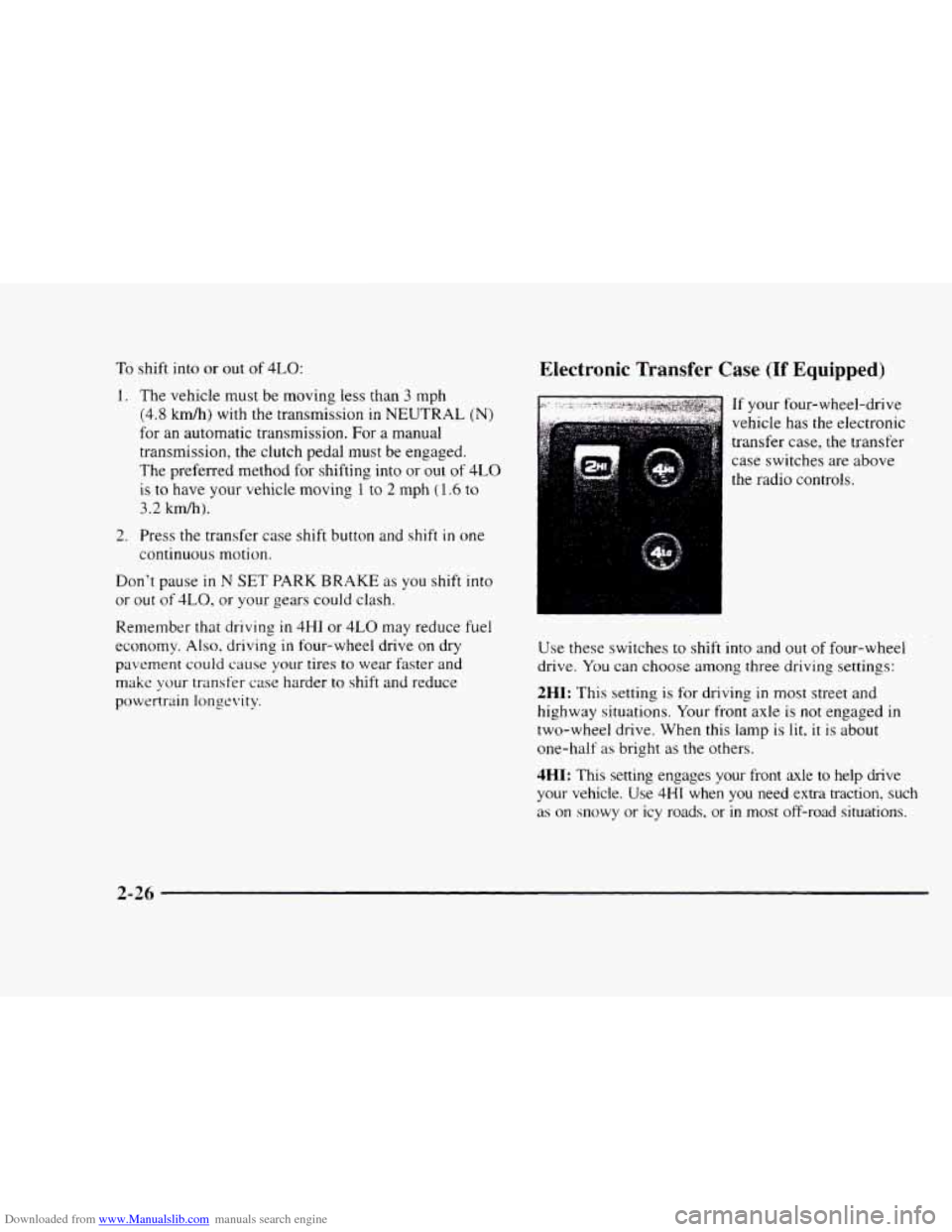
. . ... If your four-wheel-drive
vehicle has the electronic
transfer case,
the transfer
case switches are above
Use these switches
to shift into and out of four-wheel
drive.
You can choose among three driving settings:
2HI: This setting is for driving in most street and
highway situations. Your front axle is not engaged in
two-wheel drive. When this lamp
is lit, it is about
one-half
as bright as the others.
4HI: This setting engages your front axle to help drive
your vehicle. Use
4HI when you need extra traction, such
as on snowy or icy roads, or in most off-road situations.
2-26