ECU CHEVROLET BLAZER 1997 2.G Owner's Manual
[x] Cancel search | Manufacturer: CHEVROLET, Model Year: 1997, Model line: BLAZER, Model: CHEVROLET BLAZER 1997 2.GPages: 402, PDF Size: 21.93 MB
Page 177 of 402
Downloaded from www.Manualslib.com manuals search engine A CAUTION:
0
0
0
Cargo on the load floor piled higher than
the seatbacks can be thrown forward
during a sudden
stop. You or your
passengers could
be injured. Keep cargo
be
below
the top of the seatbacks.
Unsecured cargo on the load floor can
tossed about when driving over rough terrain. You or your passengers can be
struck by flying objects. Secure the
cargo properly.
Heavy loads on the roof raise the vehicle's
center
of gravity, making it more likely to
roll over. You can be seriously or fatally
in.jured
if the vehicle rolls over. Put heavy
loads inside the cargo area, not on the roof.
Keep cargo
in the cargo area as far forward
and low as possible.
You'll find other important information in this manual.
See "Vehicle Loading."
"Luggage Carrier" and "Tires"
in the Index.
Environmental Concerns
Off-road driving can provide whoIesome and satisfying
recreation. However.
it also raises environmental
concerns.
GM recognizes these concerns and urges
every off-roader
to follow these basic rules for
protectins the environment:
Always use established trails, roads and areas that
have been specially set aside
for public off-road
recreational drivihg; obey all posted regulations.
0 Avoid any driving practice that could damage the
environment
-- shrubs. flowers. trees, grasses -- or
disturb wildlife
(this includes wheel-spinning,
breaking down trees
or unnecessary driving through
streams or over
soft ground).
0 Always carry a litter bag . . . make sure all refuse is
removed from any campsite before leaving.
Take extreme care with open fires (where permitted).
camp stoves and lanterns.
0 Never park your vehicle over dry grass or other
cotnbustible materials that could catch fire
f1-0~11 the
heat
of the vehicle's exhaust system.
4-16
Page 196 of 402
Downloaded from www.Manualslib.com manuals search engine Highway Hypnosis
Is there actually such a condition as “highway hypnosis”?
Or is it just plain falling asleep at the wheel? Call it
highway hypnosis, lack
of awareness, or whatever.
There is something about
an easy stretch of road with
the same scenery, along with the hum of the tires on the
road, the drone
of the engine, and the rush of the wind
against the vehicle that can make
you sleepy. Don’t let it
happen
to you! If it does, your vehicle can leave the
road in less than a secund, and you could crash and
be injured.
What can
you do about highway hypnosis? First, be
aware that
it can happen.
Then here are
some tips:
0
0
0
Make sure your vehicle is well ventilated, with a
comfortably cool interior.
Keep your eyes moving. Scan the road ahead and
to the sides. Check your mirrors and your
instruments frequently.
If you Sct dwpy. pull off the road into a rest, service
or
parking xe;L and take a nap, get some exercise, or
both. For safety. treat drowsiness on the highway as
an
emergency.
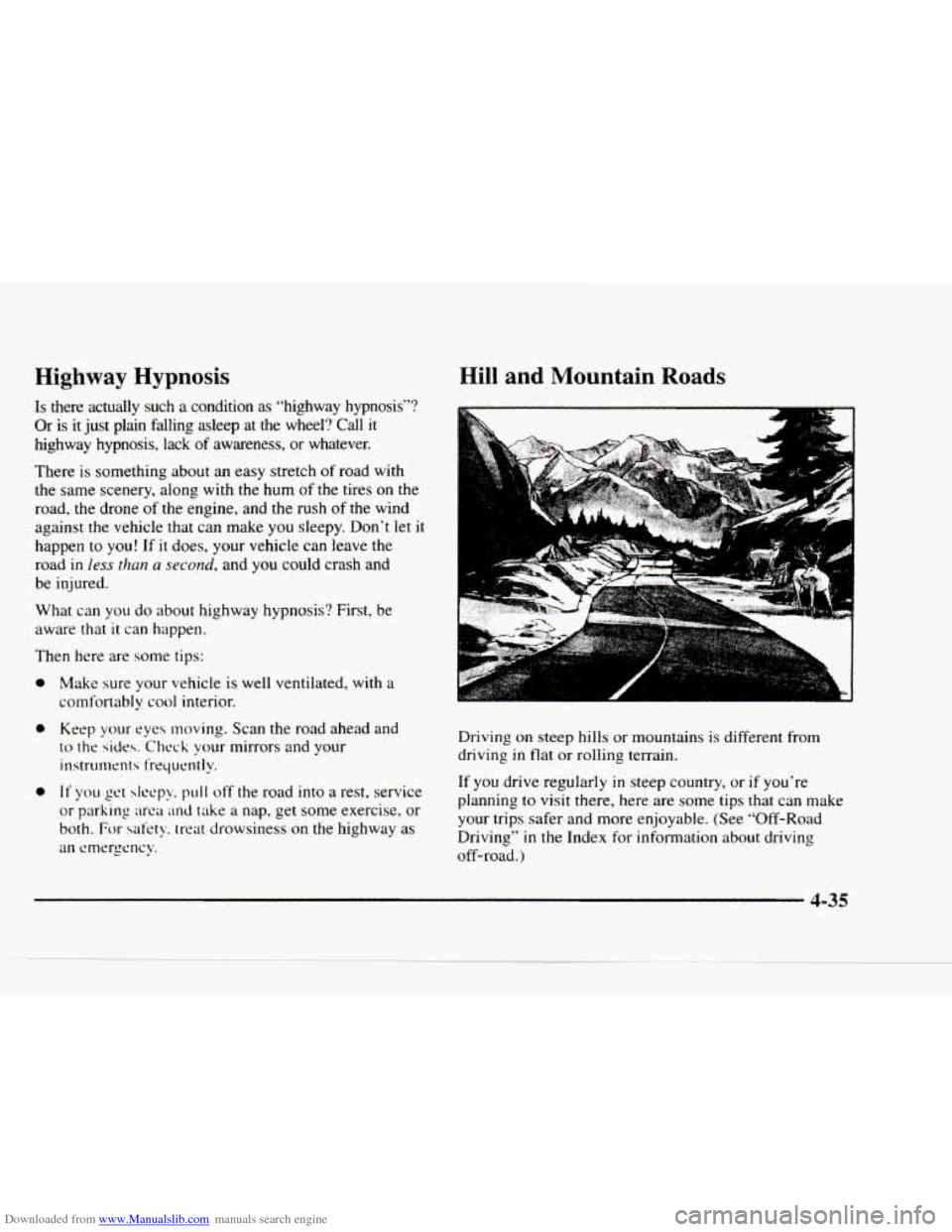
Hill and Mountain Roads
L
Driving on steep hills or mountains is different from
driving
in flat or rolling terrain.
If you drive regularly in steep country, or if you’re
planning
to visit there, here are some tips that can make
your trips safer and more enjoyable. (See “Off-Road
Driving’’ in the Index for information about driving
off-road.)
4-35
Page 198 of 402
Downloaded from www.Manualslib.com manuals search engine Winter Driving
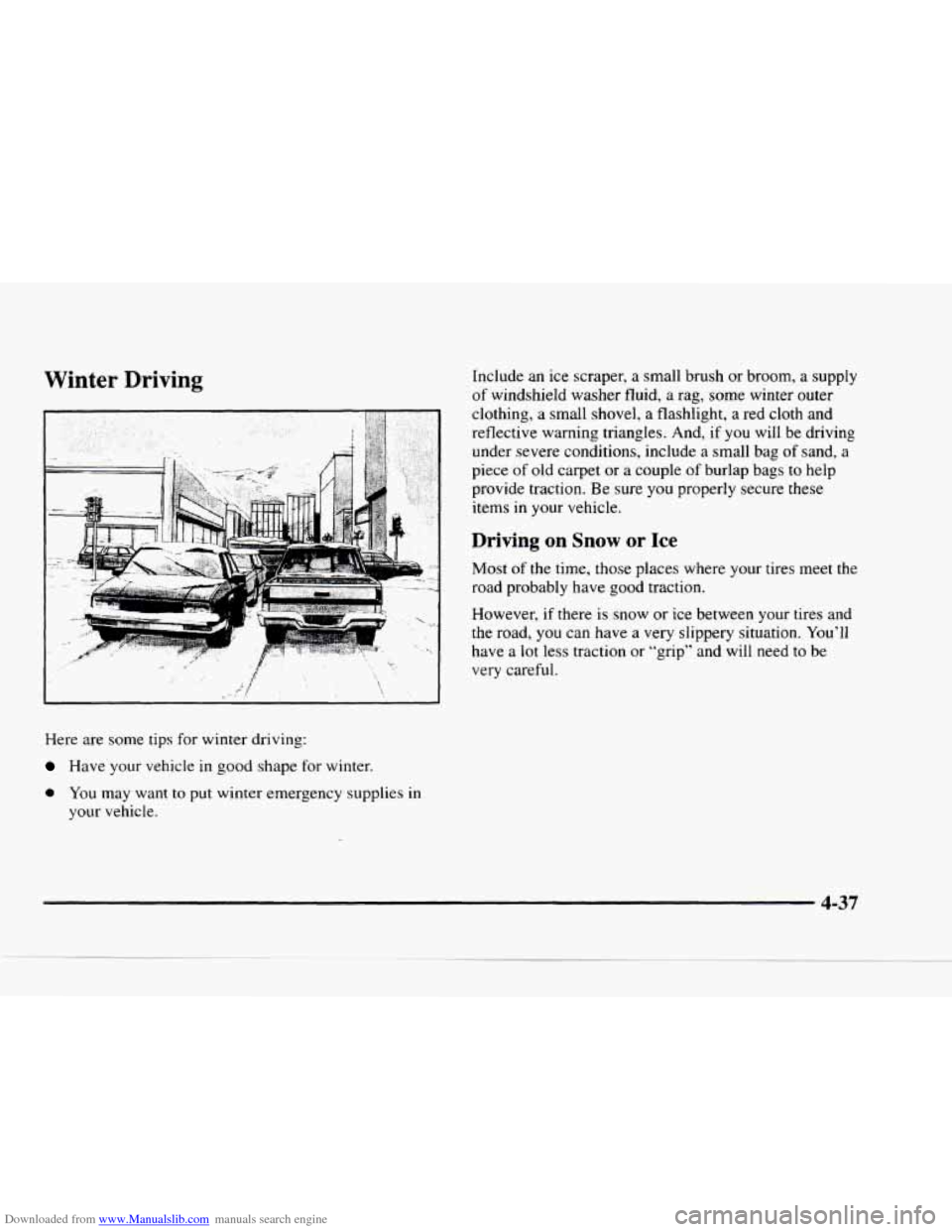
Here are some tips for winter driving:
Have your vehicle in good shape for winter.
0 You may want to put winter emergency supplies in
your vehicle. Include an ice scraper,
a small
brush or broom, a supply
of windshield washer fluid, a rag, some winter outer
clothing, a small shovel,
a flashlight, a red cloth and
reflective warning triangles. And, if you will be driving
under severe conditions, include a
small bag of sand, a
piece of old carpet or a couple of burlap bags to help
provide traction. Be
sure you properly secure these
items in your vehicle.
Driving on Snow or Ice
Most of the time, those places where your tires meet the
road probably have good traction.
However, if there is snow or ice between your tires and
the road, you can have a very slippery situation.
You’ll
have a lot less traction or “grip” and will need to be
very careful.
4-37
Page 205 of 402
Downloaded from www.Manualslib.com manuals search engine ~ A CAUTION: ~
~
Things you put inside your vehicle can strike and
~ injure people in a sudden stop or turn, or in
1 a crash.
~ Try to spread the weight evenly.
~ 0 Never stack heavier things, like suitcases,
0 Put things in the cargo area of your vehicle.
inside the vehicle
so that some of them are
above the tops of the seats.
0 Don't leave an unsecured child restraint in
When you carry something inside the
vehicle, secure it whenever
you can.
0 Don't leave a seat folded down unless you
need to.
~ your vehicle.
There's also important loading information
lor off-road
driving
in this manual. See "Loading Your Vehicle for
Off-Road Driving" in the Index.
Payload
The payload capacity is shown on the Certificationflire
label.
This is the maximum load capacity that your
vehicle
can carry. Be sure to include the weight of the
occupants as part
of your load. If you added any
accessories or equipment after your vehicle
left the
factory, remember
to subtract the weight of these things
from
the payload. Your dealer can help you with this.
Add-on Equipment
When you carry removable items, you may need to put a
limit on how many people you carry inside your vehicle.
Be sure to weigh your vehicle before ~OLI buy and install
the new equipment.
NOTICE:
Your warranty doesn't cover parts or
components that fail because of overloading.
L
4-44
Page 211 of 402
Downloaded from www.Manualslib.com manuals search engine Driving with a Trailer
If you have a rear-most window open and you
pull a trailer with your vehicle, carbon monoxide
(CO) could come into your vehicle. You can’t see
or smell
CO. It can cause unconsciousness or
death. (See “Engine Exhaust” in the Index.)
To
maximize your safety when towing a trailer:
Have your exhaust system inspected for
leaks, and make necessary repairs before
starting on your trip.
0 Keep the rear-most windows closed.
If exhaust does come into your vehicle
through
a window in the rear or another
opening, drive with your front, main heating or cooling system on and
with the
fan on
any speed. This will bring fresh,
outside
air into your vehicle. Do not use
MAX A/C because it only recirculates the
air inside your vehicle. (See b‘ Comfort
Controls”
in the Index.) Towing
a trailer requires a certain
amount of experience.
Before setting out for the open road. you‘ll want
to get
to know your rig. Acquaint yourself with the feel of
handling and braking with the added weight of the
trailer. And always keep in mind that the vehicle you are
driving
is now a good deal longer and not nearly as
responsive as your vehicle is by itself.
Before
you start, check the trailer hitch and platform
(and attachments). safety chains. electrical connector,
lamps, tires and mirror adjustment. If the trailer has
electric brakes. start your vehicle and trailer moving and
then apply the trailer brake controller by hand to be sure
the brakes are working. This lets
you check your
electrical connection at the same time.
During your trip. check occasionally to be sure that the
load is secure. and that the lamps and any trailer brakes
are still working.
4-50
Page 216 of 402
Downloaded from www.Manualslib.com manuals search engine Trailer Wiring Harness
The light duty trailer wiring is a six-wire harness
assembly. The optional heavy-duty trailer wiring is an
eight-wire harness assembly. The harnesses are stored
under the vehicle, along the passenger-side frame
crossmember on two-door vehicles or on the driver’s
side corner frame crossmember on four-door vehicles.
The heavy-duty trailer wiring has
a 30-amp feed wire
with an inline
fuse located by the junction block. See
“Fuses and Circuit Breakers”
in the Index. Both
harnesses have no connector and should be wired by a
qualified electrical technician. The technician can
use
the following color code chart when connecting the
wiring harness
to your trailer.
Dark Blue: Use for electric trailer brakes or
auxiliary wiring.
0 Red: Use for battery charging; it connects to the
starter solenoid (eight-wire harness only).
0 Light Green: Back-up lamps (eight-wire
harness only).
Brown: Taillamps and parking lamps.
0 Yellow: Left stoplamp and turn signal.
0 Dark Green: Right stoplamp and turn signal.
0 White (Heavy Gage): Ground wire.
0 White (Light Gage): Auxiliary stoplamp.
Securely attach the harness
to the trailer, then tape or
strap
it to your vehicle’s frame rail. Be sure you leave it
loose enough so the wiring doesn‘t bend or break, but
not so loose that it drags on the ground. Store the
harness in its original place. Wrap the harness together
and tie
it neatly so it won’t be damaged.
4-55
Page 225 of 402
Downloaded from www.Manualslib.com manuals search engine A CAUTION:
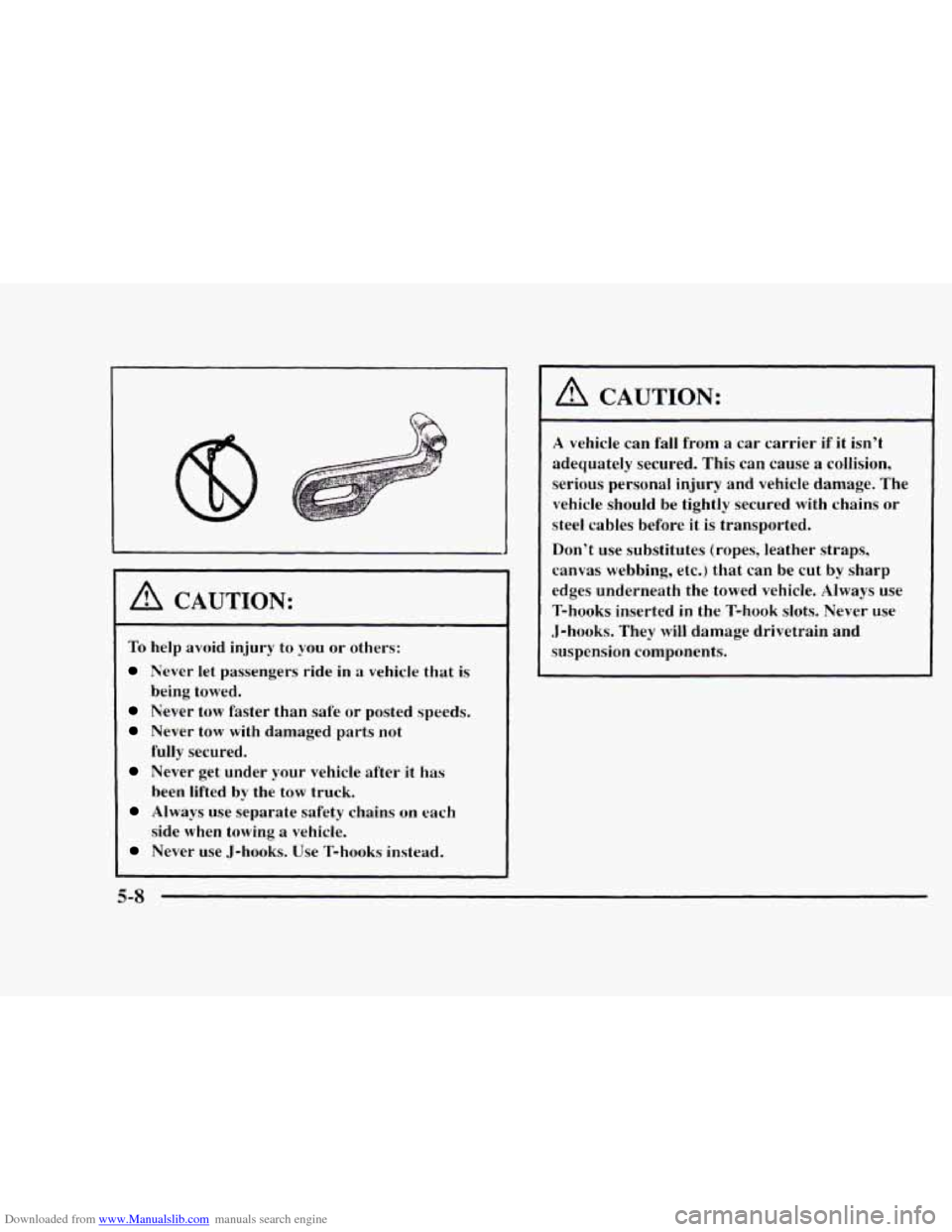
To help avoid injury to you or others:
Never let passengers ride in a vehicle that is
Never tow faster than safe or posted speeds.
Never tow with damaged parts not
Never get under your vehicle after it has
Always use separate safety chains on each
Never use J-hooks. Use T-hooks instead.
being
towed.
fully secured.
been lifted by the tow truck.
side when towing a vehicle.
A CAUTION:
A vehicle can fall from a car carrier if it isn’t
adequately secured. This can cause a collision,
serious personal injury and vehicle damage. The
vehicle should be tightly secured with chains or
steel cables before it is transported.
Don’t use substitutes (ropes, leather straps,
canvas webbing, etc.) that can be cut
by sharp
edges underneath the towed vehicle. Always use
T-hooks inserted
in the T-hook slots. Never use
,J-hooks. They will damage drivetrain and
suspension components.
5-8
Page 250 of 402

Downloaded from www.Manualslib.com manuals search engine Follow this diagram to store the underbody-mounted spare.
Y; BJ
A. Retainer
B. Valve Stem
(Pointed Down)
C. Spare or Flat Tire
D. Spring
E. Wheel Wrench
E Lower
G. Raise
H. Hoist Arm
1. Put the tire on the ground at the rear of the vehicle,
with the valve stem pointed down and to the rear.
2. Pull the retainer through the wheel.
3. Put the chisel end of the wheel wrench, on an angle,
through the hole
in the rear bumper and into the hoist
shaft. Turn the wheel wrench clockwise
until the tire
is raised against the underside of the vehicle.
You
will hear two “clicks“ when the tire is secure,
but pull on the tire to make sure.
5-33
Page 251 of 402
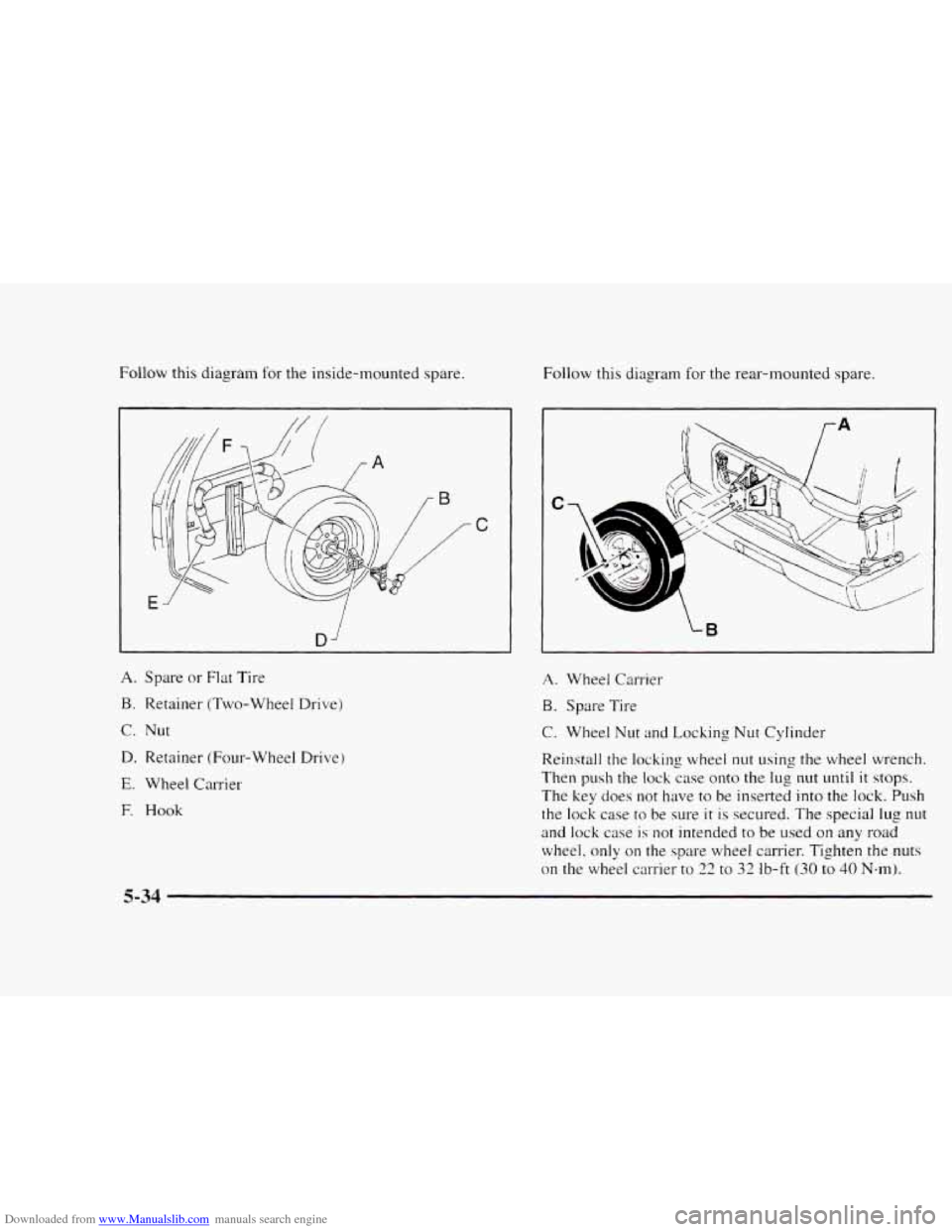
Downloaded from www.Manualslib.com manuals search engine Follow this diagram for the inside-mounted spare. Follow this diagram for the rear-mounted spare.
C
D i
C7
- i,
A. Spare or Flat Tire
B. Retainer (Two-Wheel Drive)
C. Nut
D. Retainer (Four-wheel Drive)
E. Wheel Carrier
E Hook
A. Wheel Carrier
B. Spare Tire
C. Wheel Nut and Locking Nut Cylinder
Reinstall the locking wheel
nut using the wheel wrench.
Then push the lock case onto
the lug nut until it stops.
The key does not have to be inserted into the lock. Push
the lock case to be sure
it is secured. The special lug nut
and lock case is not intended to be used on any road
wheel.
only on the spare wheel carrier. Tighten the nuts
on the wheel carrier to 22 to 32 Ib-ft (30 to 40 N-m).
Page 252 of 402
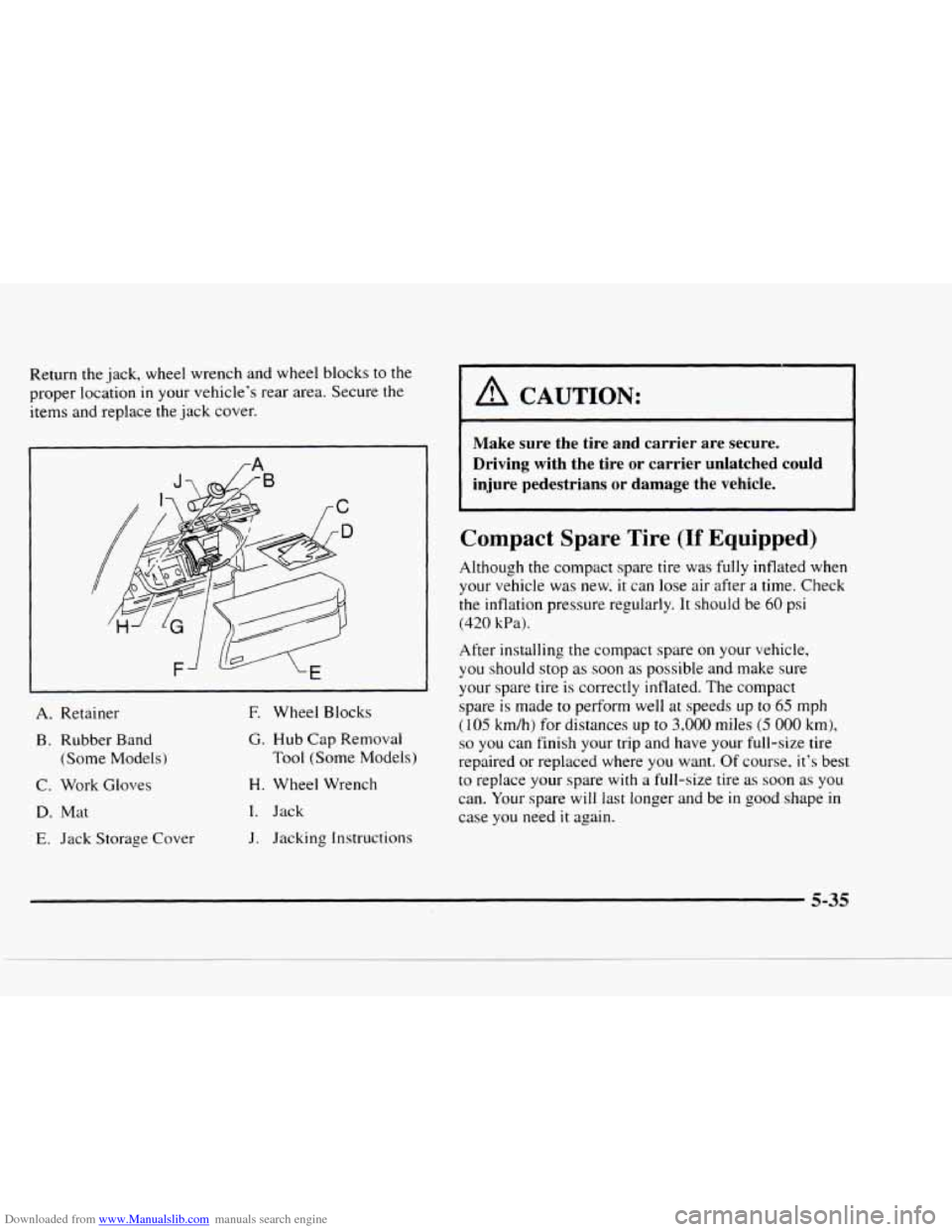
Downloaded from www.Manualslib.com manuals search engine Return the jack, wheel wrench and wheel blocks to the
proper location
in your vehicle’s rear area. Secure the
items and replace
the jack cover.
I
-
A. Retainer E Wheel Blocks
B. Rubber Band
(Some Models
j
C. Work Gloves
D. Mat
E. Jack Storage Cover
G. Hub Cap Removal
Tool (‘Some Models)
H. Wheel Wrench
I. Jack
J. Jacking Instructions
I A CAUTION:
I
Make sure the tire and carrier are secure.
Driving with the tire or carrier unlatched could
injure pedestrians
or damage the vehicle.
Compact Spare Tire (If Equipped)
Although the compact spare tire was fully inflated when
your vehicle was new,
it can lose air after a time. Check
the inflation pressure regularly. It should be 60 psi
(420 kPa).
After installing the compact spare on your vehicle,
you should stop as
soon as possible and make sure
your spare tire
is correctly inflated. The compact
spare
is made to perform well at speeds up to 65 mph
(105 km/h) for distances up to 3,000 miles (5 000 km),
so you can finish your trip and have your full-size tire
repaired or replaced where
you want. Of course, it’s best
to replace your spare with a full-size tire as soon as you
can. Your spare will last longer and be in good shape in
case you need
it again.
5-35